
Agentic AI is software that perceives information, plans a sequence of steps, uses tools, makes decisions, and takes actions toward a defined objective. A 2026 academic analysis mapped 43 agent benchmarks containing 72,342 tasks against all 1,016 U.S. occupations, a sign that these systems are being evaluated against real work, not only single-answer outputs.
For CEOs, CMOs, and CROs at growth-stage B2B companies, the decision is whether an agent belongs anywhere near the pipeline this year, and what controls must be in place before it can act. Our argument is that the limiting factor isn't the model alone. It's the control plane around it: permissions, validation, monitoring, and approval gates that keep a plausible mistake from becoming a customer-facing or costly action.
Table of Contents
- What Is Agentic AI and Why the Definition Matters
- How Agentic AI Differs from Assisted and Autonomous AI
- The Architecture Behind an Agentic System
- Where Agentic AI Already Works in Marketing and Sales
- How to Choose Between Building, Buying and Advisory Support
- Where Agentic AI Fails and Why Autonomy Is Not the Goal
- A Sequenced Path from Pilot to Production
What Is Agentic AI and Why the Definition Matters
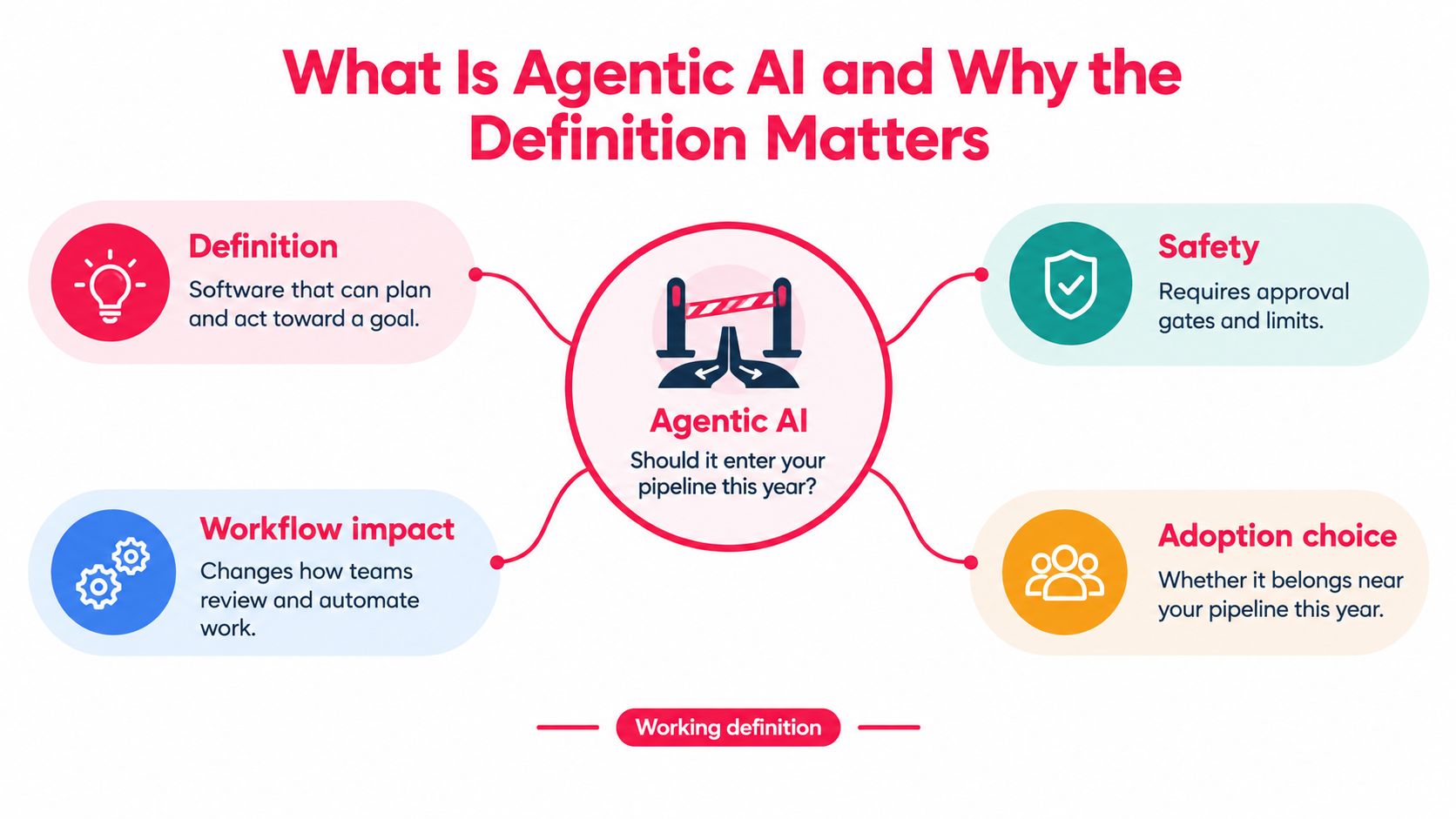
Agentic AI is a software system that works toward a defined goal through a sequence of decisions and actions. Unlike a chatbot that returns a response to a prompt, an agent can gather information, plan steps, use connected tools, inspect results, and adapt its next action.
The benchmark-to-occupation analysis gives leaders a practical reason to care about this distinction. Its scope, 43 agent benchmarks, 72,342 tasks, and 1,016 U.S. occupations, indicates that agentic systems are increasingly assessed against work tasks rather than a single expected answer. The academic analysis of agent benchmarks and occupations also places the current field in a longer history: Carl Hewitt developed the actor model in 1973, and formal agent frameworks became prominent in the 1980s and 1990s.
In 1995, Russell and Norvig characterized agents as systems that operate autonomously, perceive their environment, persist over time, adapt to change, and pursue goals. Modern large language models expanded that idea by adding general-purpose language and reasoning, making it possible for agents to interact with software, data, websites, and people rather than relying only on narrowly programmed rules.
Why the distinction changes governance
A generated answer can be reviewed before anyone acts on it. An agent can turn that answer into an action by updating a CRM record, creating a task, or sending a message. That transition from output to action changes the risk: leaders must govern not only what the system says, but also what it can access, what it can change, and when it needs approval.
Practical rule: If a mistake could alter a customer record, spend, price, or external communication, define the approval gate before connecting the agent to the workflow.
For a growth-stage team, agentic AI belongs near the pipeline only when the workflow has a clear objective, limited permissions, a way to verify intermediate results, and an accountable person who can stop or correct execution. A convincing demo doesn't prove that the same system will handle incomplete data or an unusual account safely.
How Agentic AI Differs from Assisted and Autonomous AI
Buyers often hear “assistant,” “automation,” and “agent” used for the same product. The useful distinction is operational: who starts the work, who approves the result, and what the system can do when its first approach fails.
Assisted AI waits for a person to provide a prompt or request. It returns a draft, summary, or recommendation for a human to review. Autonomous AI can execute a defined task without a fresh prompt, but usually follows a narrow, pre-programmed path. Agentic AI receives an objective, breaks it into steps, selects tools or sub-agents, observes results, and continues until it reaches a stopping condition or needs approval.
A U.S. Federal Register description frames agent systems as including at least one generative AI model and scaffolding software that enables discretionary actions. The system may also coordinate multiple agents, with little or no continuous human oversight. The Federal Register description of agentic systems is useful for assessing whether a product is doing more than generating text with a tool call attached.
| Model | Who initiates | Who approves | Scope of action | Failure mode | Typical revenue use |
|---|---|---|---|---|---|
| Assisted AI | A person prompts it | A person reviews the output | Drafting or analysis | Incorrect advice reaches a human reviewer | Drafting a campaign brief |
| Autonomous AI | A trigger starts a predefined task | Rules or an assigned owner govern execution | A fixed workflow | An exception falls outside the programmed path | Routing a lead by set criteria |
| Agentic AI | A person or system sets an objective | A human or policy gate approves sensitive actions | Multi-step planning and tool use | A planning or tool error carries through to later actions | Researching accounts and staging CRM tasks |
To evaluate a vendor's claim, ask whether the system can choose and sequence actions, inspect what happens after each action, and adjust its plan. Then ask what permissions it receives and what stops it from continuing when data is missing. If the product only drafts a reply or runs a fixed rule, call it what it is. That precision matters when you compare implementation risk, not just feature lists.
The Architecture Behind an Agentic System
An agent is a software architecture, not just a larger language model. The model can interpret instructions and generate decisions, but other components connect it to business systems, track its state, and govern the actions it takes.
A typical system has five working layers:
- Model: Interprets the objective and produces plans, decisions, or language.
- Orchestration: Breaks work into steps, routes tasks to tools or sub-agents, and decides when to retry or stop.
- Tools and data: Connects to systems such as a CRM, email platform, ad platform, or data warehouse.
- Memory and state: Carries relevant information and records what has happened during the workflow.
- Control plane: Enforces permissions, tool schemas, validation checks, audit logs, retries, and escalation rules.
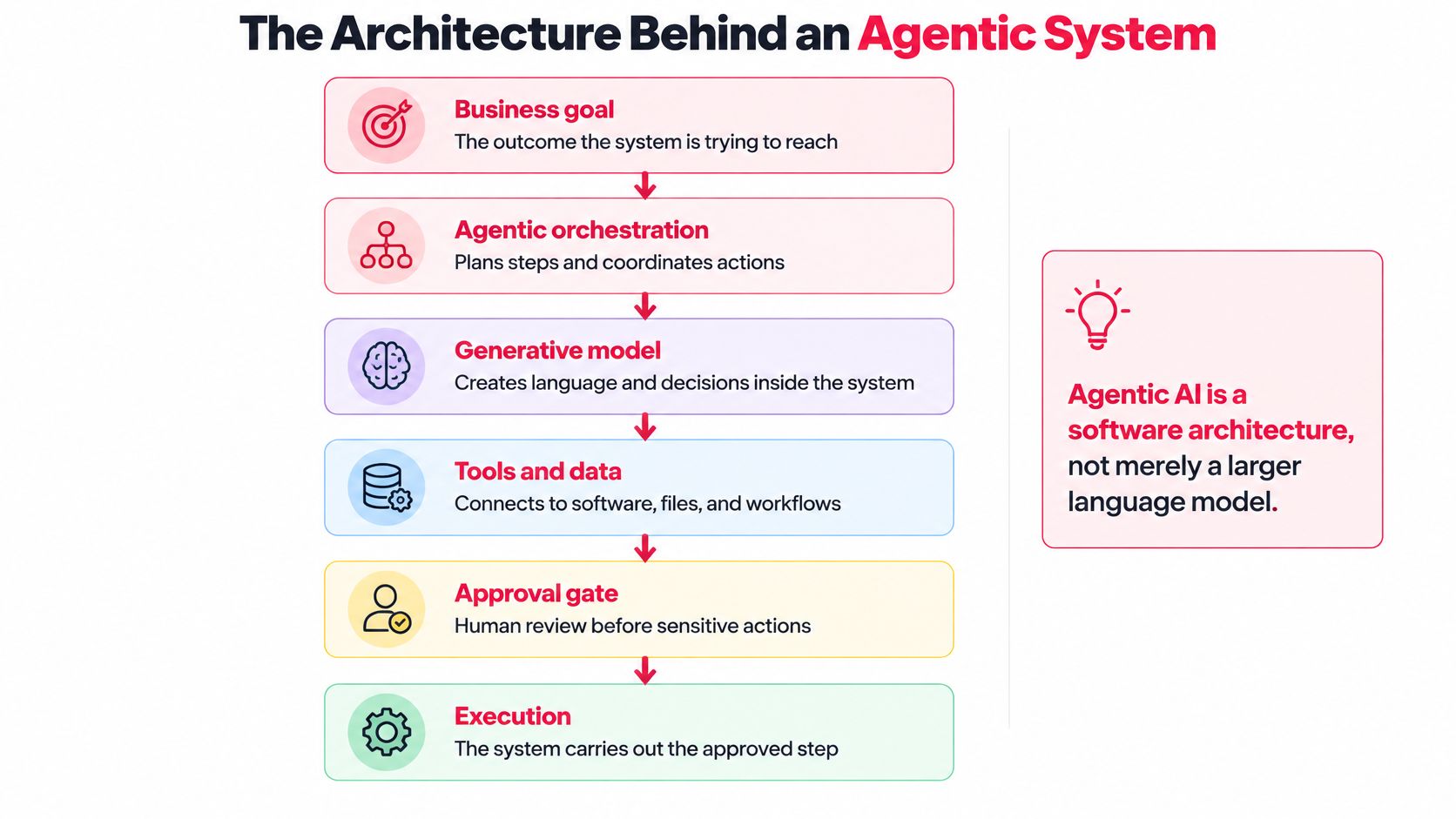
The system receives an objective, interprets its context, breaks the work into steps, selects tools, observes results, and repeats until it meets a stopping condition or requests human approval. That loop makes an agent flexible, but each added action also creates another chance for incorrect state, stale information, or an authorization mistake.
For a growth team, that means the model's quality is only one part of reliability. A strong model can still make a wrong CRM change if the tool allows broad write access and the system doesn't check the proposed update. A useful overview of AI agents for operational efficiency can help teams think through workflow design alongside the controls needed to govern it.
Production should begin with bounded workflows and read-only access where possible. Require deterministic approval gates before external communications or irreversible changes, then evaluate task completion, factuality, tool-call accuracy, latency, and cost. Each metric should connect to a workflow decision: whether to expand access, add review, or stop the pilot.
Where Agentic AI Already Works in Marketing and Sales
The best initial sales and marketing applications prepare work for a human rather than acting as an unreviewed replacement for one. That lets a team use automation to reduce manual research or data entry while retaining control over decisions that could affect prospects and customers.

Three bounded workflows to test
Account research and signal triage: An agent can collect funding announcements, job changes, and technographic signals, then use a fit-scoring rubric to stage an account shortlist. A sales operations lead can connect sources to a CRM such as Salesforce, with an SDR approving the shortlist before outreach. Judge it by whether accepted accounts meet the team's qualification criteria and become useful inputs to pipeline activity, not by how many records the agent touches.
Conversion testing: An agent can turn campaign or landing-page observations into test hypotheses, prepare variants, and route them to a growth lead for review before they enter an experimentation platform. The owner should compare testing velocity with the quality of the experiments and the resulting conversion evidence. More variants don't help if the team can't run and interpret them properly.
Pipeline hygiene: An agent can read call transcripts, suggest CRM field updates, and draft follow-up sequences for a rep to approve. Salesforce can hold the record, while a transcript source and an email platform provide context and draft execution. Keep the initial integration read-only where practical, and measure whether the proposed changes are accurate enough to save review time without degrading pipeline records.
We distinguish between an established workflow and an implementation hypothesis. The examples above describe practical designs, not a claim that Stimulead has deployed each one for clients. Where a client engagement provides evidence, we identify that plainly; where we lack a measured result, we don't convert a plausible use case into a case study. Teams assessing their stack can also use this guide to match sales technology to outbound bottlenecks.
A walkthrough can make these workflows easier to visualize, but a video demo can't establish your own permissions, data quality, or approval requirements.
How to Choose Between Building, Buying and Advisory Support
The right path depends on your data readiness, internal skills, and tolerance for implementation work. A platform can shorten the distance to a working workflow, but it doesn't remove the need to define permissions, test performance, and assign an owner.
| Path | Best fit | Trade-off |
|---|---|---|
| Build in-house | The team has engineering capacity and needs control over the orchestration and control plane | Greater control, with more responsibility for integrations, evaluation, and maintenance |
| Buy a platform | A supported workflow fits the product and the team can manage governance | Faster setup, while permission design and quality checks remain the buyer's job |
| Advisory-led implementation | Leaders need help prioritizing, sequencing, and governing the work | Adds outside direction, while internal owners still need to make decisions and operate the system |
For many companies with 10 to 200 staff, engineering capacity is already committed to product and data priorities. Building a custom agent can still make sense, but it competes for that capacity and leaves the company responsible for the control plane. Buying a tool may get a pilot running sooner, yet pilots often stall when no one owns access design, evaluation, or exception handling.
Stimulead works through three engagement models: executive advisory for an AI roadmap, vendor evaluation, implementation oversight, and board-ready strategy; hands-on team training in CRO, prospecting, and AI-powered content workflows; and an AI Growth Partnership that starts with an audit and prioritized roadmap with KPIs, then continues through fractional Chief AI Officer execution. The working group usually needs a business owner, a marketing or sales operator, a systems or data owner, and someone accountable for risk and approvals.
Price depends on scope and delivery model, so we don't assign a range without a defined engagement. Compare the options by total internal time, integration requirements, and who owns the work after launch. For more detail on that choice, see Stimulead's guide to build versus buy for AI tools.
Where Agentic AI Fails and Why Autonomy Is Not the Goal
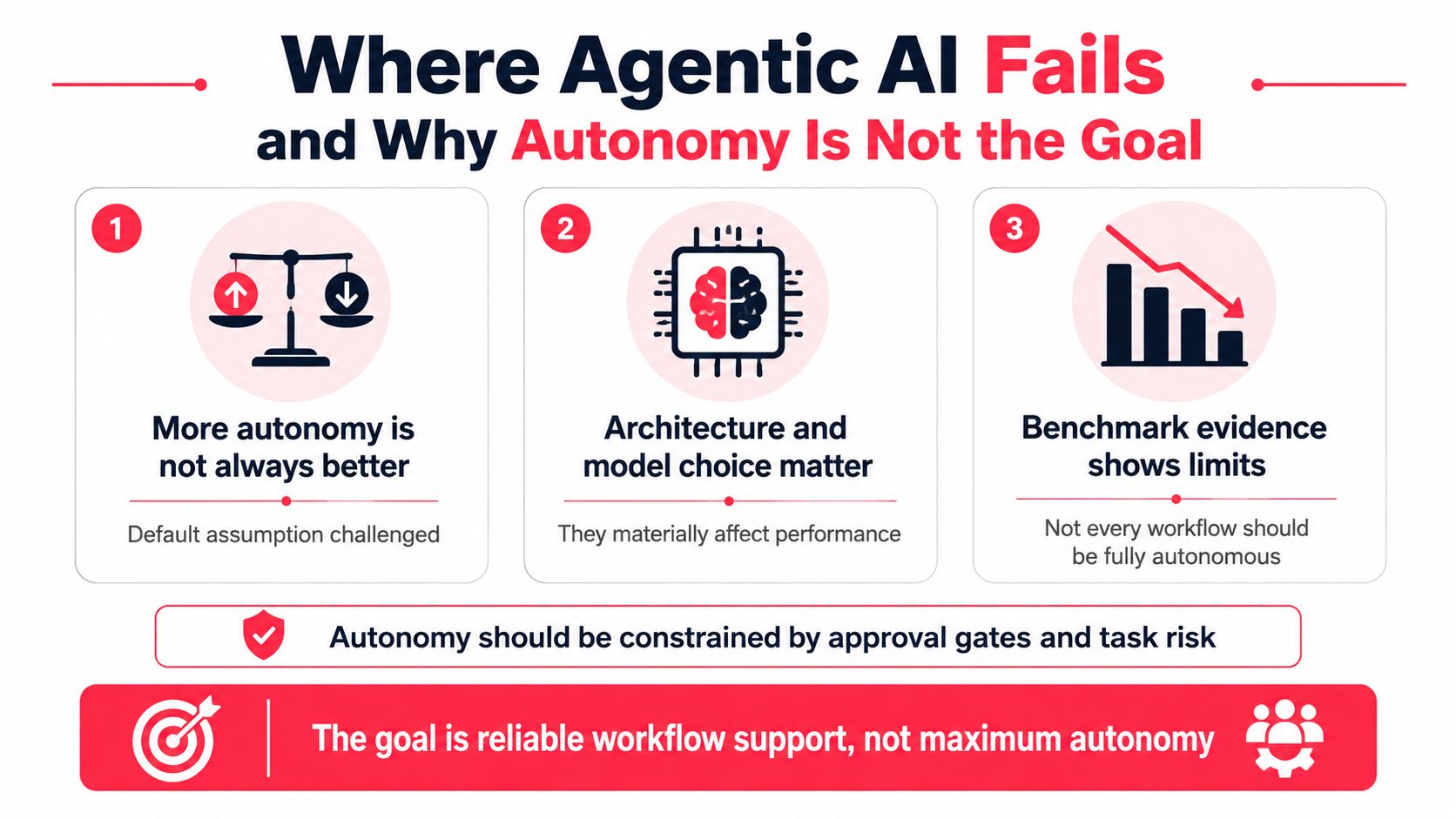
The most important correction to agent marketing is that more autonomy doesn't automatically mean better performance. The question is whether the system can complete the task reliably under the conditions your team faces, with a level of risk the business accepts.
AgentArch evaluated 18 enterprise-agent configurations across orchestration strategy, ReAct versus function-calling style, memory architecture, and thinking-tool integration. It found model-specific architectural preferences rather than one design that works best for every system. Reported success reached 70.8% on a simpler enterprise task and 35.3% on a more complex task, according to the AgentArch evaluation.
Those results show how errors can compound: the system may plan incorrectly, choose the wrong tool, rely on stale state, or accept an intermediate answer without checking it. Task duration matters as well. Stanford's 2025 AI Index reported that leading AI systems scored four times higher than human experts on two-hour RE-Bench tasks, but human experts outperformed AI systems by a 2-to-1 margin when tasks lasted 32 hours. Stanford's account of the 2025 AI Index results makes a task's time horizon a necessary part of the evaluation.
The risks revenue teams can't ignore
Trust is another constraint in customer-facing workflows. In Forrester's March 2025 survey, only 24% of U.S. online adults trusted AI agents to make routine purchases on their behalf, according to Forrester's report on trust in agentic commerce. That makes it premature to assume buyers will accept autonomous purchasing or that brands can delegate customer interactions without oversight.
Security risks go beyond a bad recommendation. Malicious instructions in webpages, documents, emails, or tool outputs can hijack an agent's reasoning. Excessive permissions can give an attacker or faulty agent a path to unauthorized access, data exfiltration, or destructive changes. The NIST-related industry submission on agent security risks describes why scoped credentials, validation, runtime monitoring, containment procedures, and complete action logs matter.
Bounded autonomy is often the safer design: let the agent research, recommend, draft, and stage actions, while a person approves irreversible or customer-facing decisions.
For an operating guide to review controls, see Stimulead's article on AI quality control. The practical test is risk-adjusted impact: successful outcomes minus the costs of remediation, compliance, and lost trust. If broader autonomy increases those costs, the system shouldn't receive broader authority.
Related reading: the agentic AI definition focuses on permissions and stopping rules, agentic AI meaning covers how to tell a working agent from a chatbot, and what is an agentic workflow shows where these systems earn revenue.
A Sequenced Path from Pilot to Production
Adoption is real, but most organizations are still expanding through selected workflows. McKinsey's 2025 survey of 1,993 participants found that 23% of respondents said their organizations were scaling an agentic AI system in at least one function, while 39% had begun experimenting. Most organizations scaling agents were doing so in only one or two functions, according to McKinsey's 2025 State of AI survey.
IBM's survey of 2,900 executives found that respondents expected AI-enabled workflows to increase from 3% at the time of the survey to 25% by the end of 2025. Respondents also identified data concerns, trust issues, and skills shortages as barriers at 49%, 46%, and 42% of organizations, respectively, in IBM's study of business views on AI agents.
Use a staged test rather than granting broad access:
- Select one bounded workflow with clean data and a measurable business outcome.
- Define task duration, stopping conditions, and cases that require escalation.
- Give the agent the minimum permissions needed, read-only access where possible.
- Test representative, adversarial, ambiguous, and missing-data cases.
- Compare human-review checkpoints with fully autonomous execution before expanding scope.
Track task completion, tool-call accuracy, human override rate, cost per completed task, and risk-adjusted business impact. Stop or redesign the pilot if the agent can't reliably explain its actions in the audit trail, if reviewers repeatedly correct the same failure, or if its savings don't outweigh remediation and trust costs. Stimulead's AI roadmap guidance can help leadership sequence that work around accountable owners and measurable outcomes.
This quarter, choose one workflow to put in front of an agent, then name the person who owns its approval gate.
