
Before approving another AI pilot, ask whether the workflow needs software that chooses its own actions or whether predictable automation already solves the problem. The popular advice to pursue more autonomy skips the operating decision: an agent should earn authority through measurable value and controlled execution, rather than receive it because the demo looks capable.
Table of Contents
- The Enterprise Decision Behind Agentic AI
- An Agentic AI Definition Built Around Action
- Compare Agents with Fixed Automation
- Judge Agentic AI by Its Operating Characteristics
- Where Marketing and Sales Agents Create Value
- Where Agentic AI Does Not Work
- Govern Authority Before Expanding Autonomy
- Start With One Controlled Business Decision
The Enterprise Decision Behind Agentic AI
Your executive team is deciding who controls a business process. When developers prescribe every step, they retain control over the sequence. When a model decides what happens next, you're delegating part of that control to software.
That delegation needs a business case. A persuasive account-research demo doesn't establish that the system can improve qualified pipeline without creating unacceptable review work. A campaign generator doesn't establish that marketing can run more validated experiments with the same team.
Start with the counterfactual
At our fractional Chief AI Officer decision reviews, we recommend comparing the proposed agent with the simplest credible alternative. Ask the team to demonstrate what breaks when a fixed workflow handles the same task.
Use these approval questions:
- Business movement should mean a defined change in conversion, qualified pipeline, or time per validated experiment.
- Integration effort must include data access, exception handling, and maintenance ownership.
- Failure cost should account for customer impact and the work required to correct an incorrect action.
- Incremental value must survive comparison with existing automation and human-assisted execution.
For sales measurement design, Fetchin sales analytics insights offers a related resource to review alongside your own pipeline definitions. Set those definitions before evaluating whether the agent helps.
Authorize a decision, not a category
The useful question is whether variable execution creates enough value to justify delegating process control. If the valid route is already known, calling the implementation agentic adds little to the investment decision.
Approve autonomy only where the team can explain which execution decisions require it.
A successful pilot earns further evaluation. Production approval requires evidence about behavior under realistic operating conditions, including the cases the demo avoided.
An Agentic AI Definition Built Around Action
A useful agentic AI definition describes a system that interprets context, plans actions, uses tools, and adjusts its next action based on results while pursuing a specified goal. Its agency remains bounded by human-defined authority.
A NIST-related definition of AI agents and autonomy describes an agent as a system that perceives inputs, makes decisions, and acts toward specified goals. It treats autonomy as the degree to which the system operates without human intervention.
The diagram places that action cycle inside explicit limits.
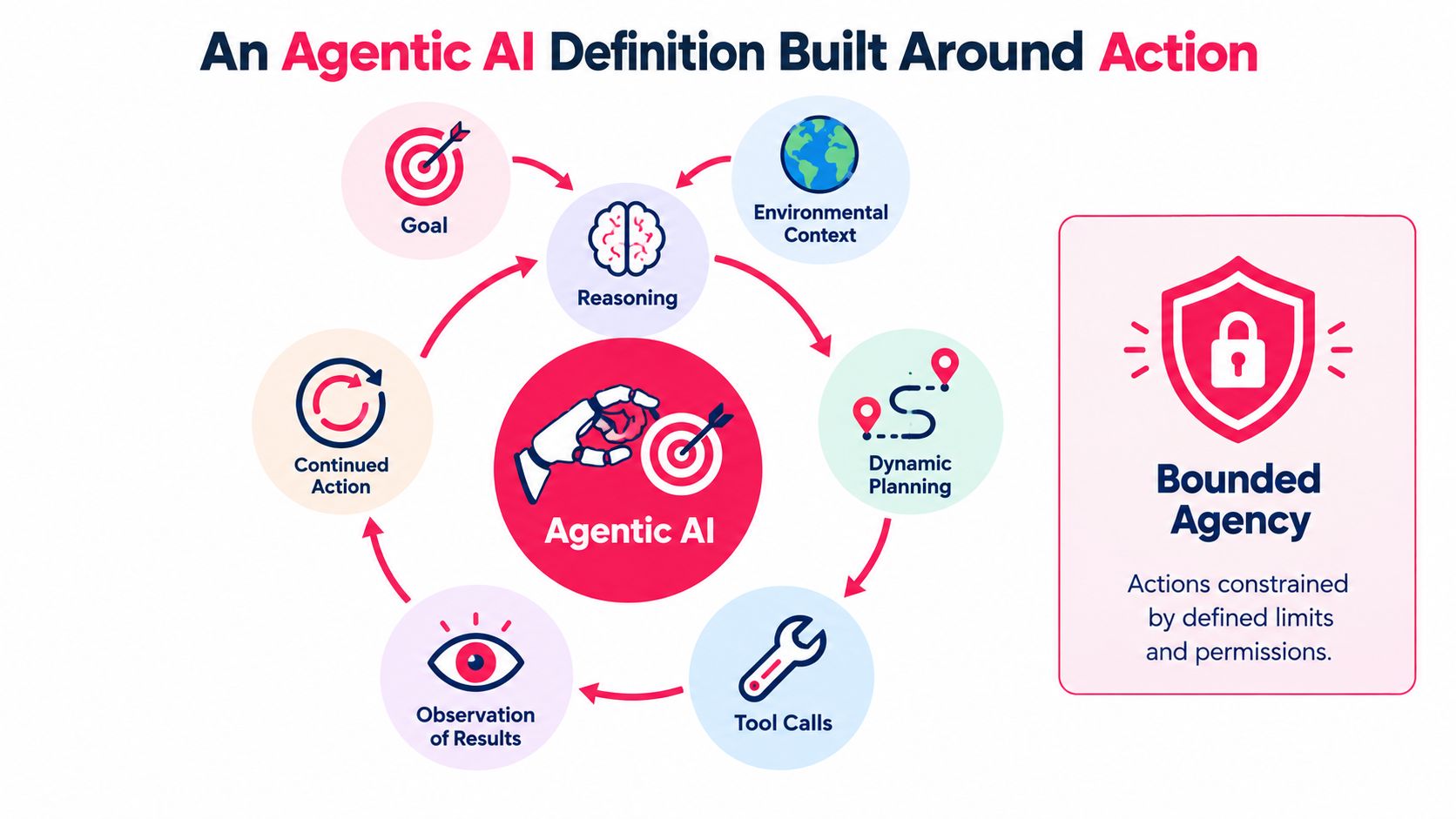
Follow the action cycle
To inspect a proposed system, trace its execution rather than its conversational output.
- Assign a clear objective, such as drafting an evidence-backed account brief.
- Define the environmental context it can inspect, including approved account records and documents.
- Examine how it reasons about missing information and selects a plan.
- Observe which tools it calls and what those calls accomplish.
- Check how returned results shape its next action.
- Confirm when it finishes, stops unsuccessfully, or escalates.
Generating a plausible brief doesn't prove the system completed the underlying work. You need to see whether it checked the right account, retrieved usable evidence, and recognized when information was missing.
Treat agency like a mandate
A capable employee still works within an assigned mandate. The employee may decide how to investigate an account while lacking authority to approve a contract exception.
Apply that distinction to software. Reasoning capability doesn't grant permission to contact customers or change commercial terms.
When considering custom AI agent development from AY Automate or another implementation provider, make the action cycle part of the specification. Require the provider to identify the decisions the model controls and the decisions your company reserves.
Bounded autonomy can still be useful autonomy. An agent that investigates independently and hands a complete recommendation to an accountable manager may be a better operating design than one permitted to execute the final commitment.
Compare Agents with Fixed Automation
The clearest technical distinction concerns control flow. Anthropic's guidance on workflows and agents distinguishes predefined code paths from agents that dynamically direct their process and tool usage.
That distinction should shape procurement language. A sequence of prompts connected by developer-written rules is a fixed AI workflow, even when its outputs appear refined.
Choosing the right automation model
| Approach | Process control | Best fit | Main constraint |
|---|---|---|---|
| Deterministic automation | Developers define rules and sequence | Stable routing, validation, scheduled synchronization | Unexpected inputs need a defined exception route |
| Fixed LLM workflow | Code determines stages; the model handles assigned interpretation or generation | Document extraction followed by prescribed checks | Flexibility remains limited to specified stages |
| Ordinary chatbot | User requests guide the interaction | Questions, explanations, draft assistance | An answer doesn't establish completed execution |
| Agent | Model chooses subsequent steps and available tools | Investigation with genuinely variable paths | More possible execution paths require broader evaluation |
For predictable work, start with a script or an established automation platform. If a lead-routing rule depends on known fields, dynamic planning adds another possible source of error without an obvious operating benefit.
A fixed LLM workflow can handle ambiguity inside an otherwise stable process. For example, a model might classify an inbound request before code applies the routing policy.
Match evaluation to the architecture
Evaluate deterministic automation against expected rule outcomes. Evaluate a fixed LLM workflow at each model-dependent stage and at its final output.
For an agent, also examine tool selection and execution paths. Similar inputs may produce different sequences, so checking only the final prose leaves important behavior untested.
The AI automation implementation discussion is a useful companion when deciding how much flexibility a workflow needs. Keep that decision separate from vendor terminology.
We recommend fixed execution whenever the company already knows the acceptable path. Choose an agent when changing conditions require execution-time judgment and the evaluation demonstrates that this flexibility pays for its additional complexity.
Judge Agentic AI by Its Operating Characteristics
A production candidate needs an observable relationship between action and outcome. The feedback-loop description of production agents centers on a goal, tools, environmental feedback, and stopping conditions.
That gives executives something concrete to inspect. Ask the implementation lead to show a completed execution record, including an unsuccessful run.
Use the operating characteristics below to distinguish actual capability from a fluent interface.
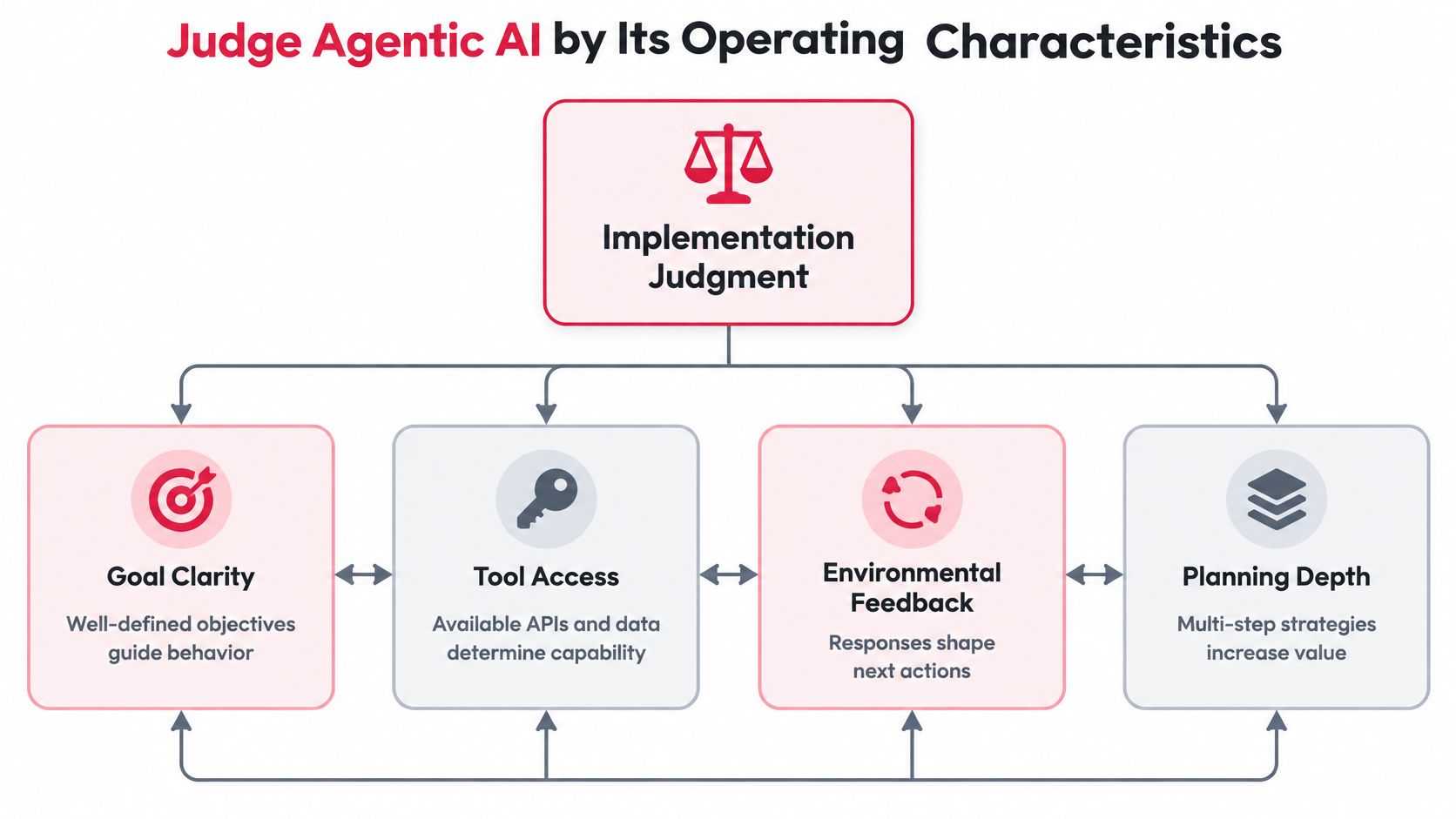
Inspect the completion signal
An agent's assertion that it updated a record isn't sufficient evidence. Require the returned record identifier and confirmation of the persisted change.
For marketing, completion might mean an approved draft entered the review queue. For sales, it might mean the system attached verified qualification evidence to the correct account.
Tool descriptions deserve the same attention as prompts. Specify accepted inputs, returned fields, failure responses, and whether a tool reads information or changes it.
Test the limits of continued work
Define the conditions that should terminate execution before running the evaluation.
- Missing evidence should trigger an explicit unresolved state rather than an invented answer.
- Resource limits should stop further calls when the approved execution budget is exhausted.
- Repeated failure should route the task to an owner instead of restarting the same approach.
- Human handoff should preserve enough context for the owner to continue without repeating the investigation.
Memory also needs a business purpose. Persist only the context necessary for the workflow, with an owner responsible for correcting stale information.
A completion message is an output. A verified change in the operating system is evidence.
Planning depth should earn its place through task performance. A longer plan can create more opportunities for failure, so don't reward elaborate execution when a shorter route produces the same validated result.
Where Marketing and Sales Agents Create Value
Consider these proposed workflow designs rather than claimed client results. Each gives the agent a variable investigation task while preserving commercial accountability with a named owner.
The practical opportunity is to reduce avoidable coordination between research and review. Measure whether employees receive better-prepared work, rather than counting how many drafts the agent produces.
The diagram illustrates research and engagement activities that can sit inside a controlled workflow.
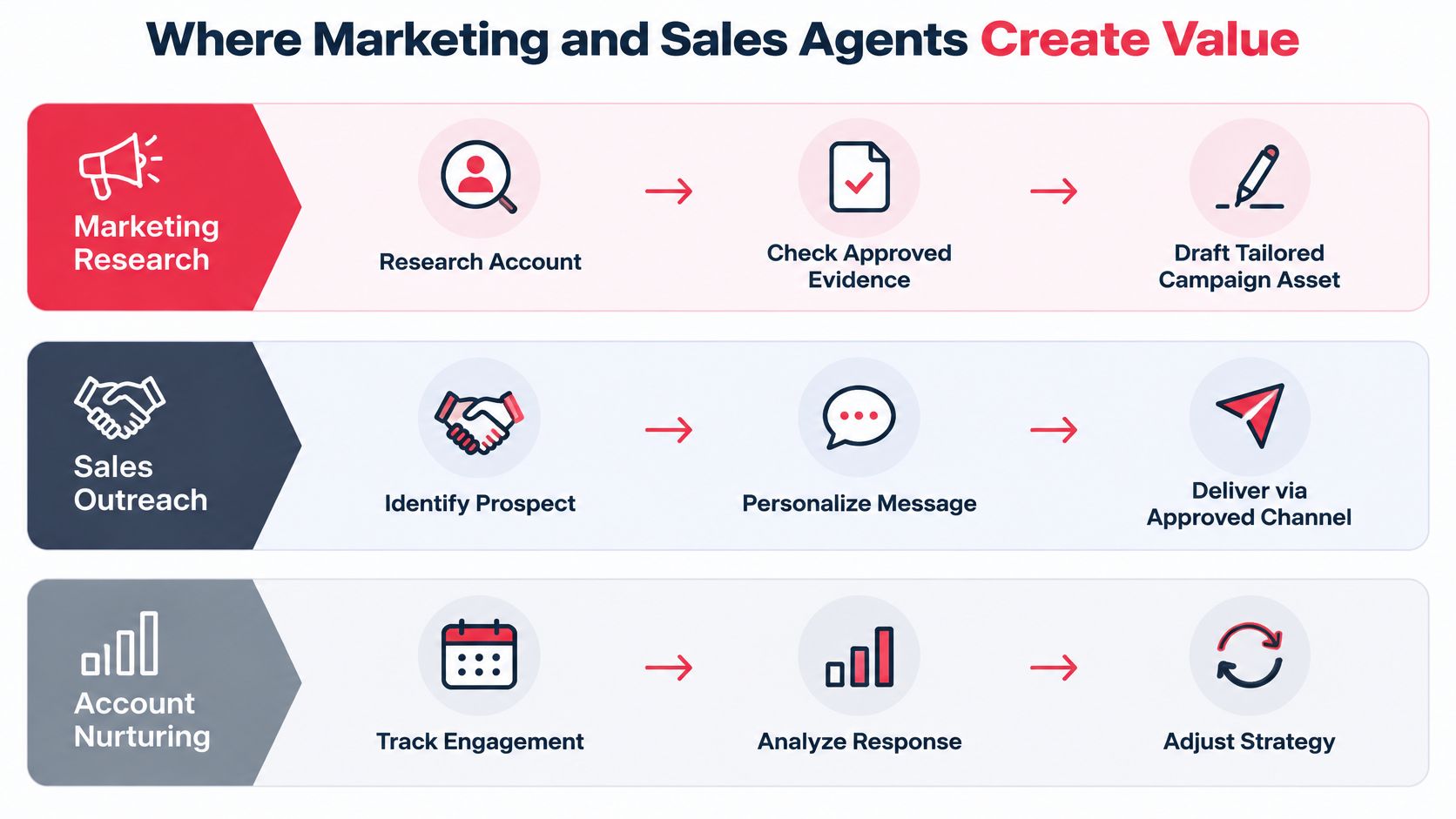
Marketing and sales execution
For marketing, assign an agent to investigate an account, locate approved evidence, and prepare a campaign asset. Let it choose additional research steps when evidence is incomplete, then route the draft to the campaign owner.
After an approved test runs, it can inspect the response and recommend a follow-up hypothesis. The CMO should judge the workflow by time per validated experiment and conversion quality, rather than asset volume.
For sales, have the agent prepare account research and identify gaps in qualification evidence. Permit updates only to designated CRM fields, with supporting records attached for review.
Compare that design with a fixed extraction workflow. If every account requires the same documents and checks, a prescribed sequence may be sufficient; variable research is where dynamic planning deserves evaluation.
Agent-commerce with a controlled commitment
For agent-commerce, let the system retrieve catalog information, compare available options against buyer requirements, and prepare a cart. Keep checkout authorization and pricing exceptions with the designated commercial owner.
A fixed product filter may already handle standard requirements. Consider agentic execution when the buyer's constraints require investigation across changing information, and test whether the recommendations are accurate enough for customer-facing use.
For additional context on multi-step execution, review this video alongside your proposed approval boundaries.
Microsoft Research's Magentic-UI report describes graduated human involvement through mechanisms including co-planning, co-tasking, multitasking, action guards, and long-term memory. The useful design choice is where people intervene, rather than whether they supervise every action.
Keep brand and legal decisions with accountable owners. Grant independence over preparation only when evaluation shows that reviewers receive usable work with less correction.
Where Agentic AI Does Not Work
Don't authorize an agent when nobody can identify the business result that would justify its operating cost. Activity counts won't resolve that problem.
Forrester's assessment of agentic AI in 2026 reported that three-quarters of enterprise leaders were adopting agentic AI, while only a small minority had meaningful production deployments beyond agentish chatbots. Adoption language therefore deserves scrutiny when a vendor presents it as evidence of production readiness.
Reject unnecessary autonomy
| Situation | Better starting point | Reason to reconsider later |
|---|---|---|
| Every valid case follows known rules | Deterministic automation | Exceptions become material and require contextual judgment |
| The task is answering questions from approved documents | Retrieval with answer evaluation | Users need authorized actions after retrieval |
| Interpretation is needed at a known stage | Fixed LLM workflow | Subsequent steps depend on unpredictable findings |
| Errors create expensive customer commitments | Human-approved execution | Evidence supports a narrowly scoped delegation |
| Reviewers must reconstruct every result | Improve evidence and workflow design | Review effort falls without weaker quality control |
The economics need a complete denominator. Include integration work, model calls, monitoring, and human review when calculating cost per accepted result.
For conversion work, hold the eligible population and measurement method consistent across alternatives. If the agent produces more variants but reviewers validate fewer experiments, the team hasn't demonstrated better testing velocity.
Make rejection reversible
Record why the candidate failed the approval test. Distinguish poor task suitability from a fixable problem such as missing source data.
Track exception rate, rollback time, and review burden alongside the primary KPI. An apparent pipeline improvement deserves little confidence if sales has to repair inaccurate qualification records.
Keep the simpler process until autonomous execution demonstrates a worthwhile incremental result at an acceptable total cost.
Revisit the decision when the workflow changes or new evaluation evidence addresses the original failure. A vendor's new agent label isn't sufficient reason to reopen procurement.
Govern Authority Before Expanding Autonomy
Give security and business owners the same action inventory before granting production access. Marketing needs to know what the system can publish; sales operations needs to know what it can overwrite.
A 2026 Deloitte survey of 3,235 leaders across 24 countries found that 21% had mature agentic-AI governance, while roughly 80% lacked capabilities such as explicit decision boundaries, real-time behavior monitoring, and complete action audit trails. Those findings establish a governance gap among respondents, not a benchmark for accepting your own company's risk.
Use the checklist as an access-review structure.

Assign authority explicitly
- Inventory reachable tools, APIs, data stores, and external channels. Name the business owner for each.
- Classify permitted actions by consequence and reversibility. Treat preparing a draft differently from sending it.
- Enforce scoped permissions and spending limits outside the prompt. Define denied actions as carefully as permitted ones.
- Require approval for external or irreversible actions until evaluation supports a narrower exception.
- Preserve action logs and test credential revocation. Confirm that operators can interrupt execution.
Microsoft's agentic risk guidance identifies indirect prompt injection, unintended actions, data exfiltration, agent hijacking, and supply-chain compromise among the risks associated with connected agents. Review each connection rather than treating application login as the full security boundary.
Make revocation operational
Separate trusted instructions from retrieved content. A document encountered during research mustn't acquire authority to change the agent's permissions.
The security owner should control access revocation, while the business owner controls workflow suspension. Legal and data owners should approve relevant handling rules before customer information enters the process.
Use the AI governance best-practices guidance to organize that cross-functional review. Reversibility must include a tested correction procedure, not merely a promise that someone can fix the record later.
For more on the same topic, what is agentic AI covers architecture and governance limits in revenue work, and agentic AI meaning explains how to evaluate agentic systems against real KPIs.
Start With One Controlled Business Decision
Choose a workflow whose current performance the team can explain. Avoid company-wide deployment proposals that hide different tasks behind a shared agent interface.
The AI proof-of-concept approach provides a suitable evaluation frame: establish whether a bounded implementation deserves additional investment before committing to broader deployment.
Build an authorization record
Run the decision through a controlled sequence.
- Document the baseline and select a simpler control alternative.
- Specify the execution decisions that require model-directed control.
- Approve tool permissions and stopping rules before connecting production systems.
- Run shadow mode, then supervised execution, with realistic exception cases.
- Compare business results and total operating effort before expanding authority.
Keep the evaluation record usable by the CEO, CMO, or CRO who must approve the next stage.
| Record | Required evidence |
|---|---|
| Business outcome | KPI movement and measurement method |
| Reliability | Error severity and exception rate |
| Execution speed | Testing velocity and time per accepted result |
| Total effort | Integration cost and human review burden |
| Recovery | Reversibility and tested correction procedure |
| Accountability | Named owner and approval decision |
Stimulead offers fractional Chief AI Officer advisory and implementation oversight; internal technical leadership or an implementation provider can also own this evaluation. Whichever option you choose, retain approval authority with the executive responsible for the business outcome.
Schedule a 60-minute decision review this week with the workflow owner and technical lead. Bring one candidate workflow, its baseline, and a simpler alternative, then require the team to justify model-directed control before procurement or deployment.
