
What is agentic workflow? It is a goal-oriented loop where an AI system interprets a goal, reasons about the next step, calls a tool, observes the result, and revises until it reaches the objective. For growth-stage B2B companies, the decision is which workflow deserves that loop and which one should stay human-gated.
The category stopped being theoretical when the ReAct paper formalized interleaving reasoning and acting, with 71% average success on ALFWorld versus 37% for the BUTLER baseline, and 27.4% exact match on HotpotQA, rising to 35.1% with chain-of-thought self-consistency (ReAct paper summary). That is the operating shift we care about, because it turns a model from a text generator into a system that can adapt its next move from tool feedback.
If you want the commerce side of the same trend, the companion framing in what is agentic commerce is useful because buying agents and seller agents are heading toward the same machine-readable layer. This article stays on the operator side, where CEOs, CMOs and CROs have to decide what to wire, what to gate, and what to leave alone.
Table of Contents
- The Decision Worth Making Before The Term Saturates
- The Four Parts of an Agentic Workflow
- Where Agentic Workflows Beat Automation And Where They Lose
- Three Revenue Use Cases Worth Building This Year
- How To Sequence Your First Agentic Workflow
- A Sample Workflow Pattern With The Failure Path Included
- Where Agentic Workflows Quietly Fail
- The Next Decision for Your Operating Committee
The Decision Worth Making Before The Term Saturates
The first useful benchmark is still ReAct. Submitted to arXiv in October 2022, it formalized the pattern that made modern tool-using agents practical, and its strongest gains showed up in interactive environments rather than static text tasks (ReAct paper summary). That matters because the executive question is not whether agentic workflow exists, it's whether you can afford the control loop around it.
An agentic workflow is a goal-oriented execution loop. The system decomposes the objective, selects a tool, observes the result, then revises the plan until the outcome is acceptable or safely stopped. A chatbot answers. A scripted workflow executes. An agentic workflow decides what to do next based on what just happened.
For growth-stage B2B companies, that distinction matters because you're not buying “AI”. You're deciding which process can tolerate adaptive execution and which process will bleed money if the model gets one step wrong. If the workflow touches CRM records, outbound mail, bids, pricing, or customer commitments, the burden of proof is on autonomy, not on enthusiasm.
Practical rule: Start with the workflow's reversibility. If you can't undo the action cleanly, it needs a human gate.
The useful boundary is simple. We cover the architecture, the control layer, and the commercial use cases because those are the decisions CEOs, CMOs and CROs have to make inside a business between $1M and $50M in revenue. Anything else turns into a demo culture, and demo culture is expensive.
The Four Parts of an Agentic Workflow
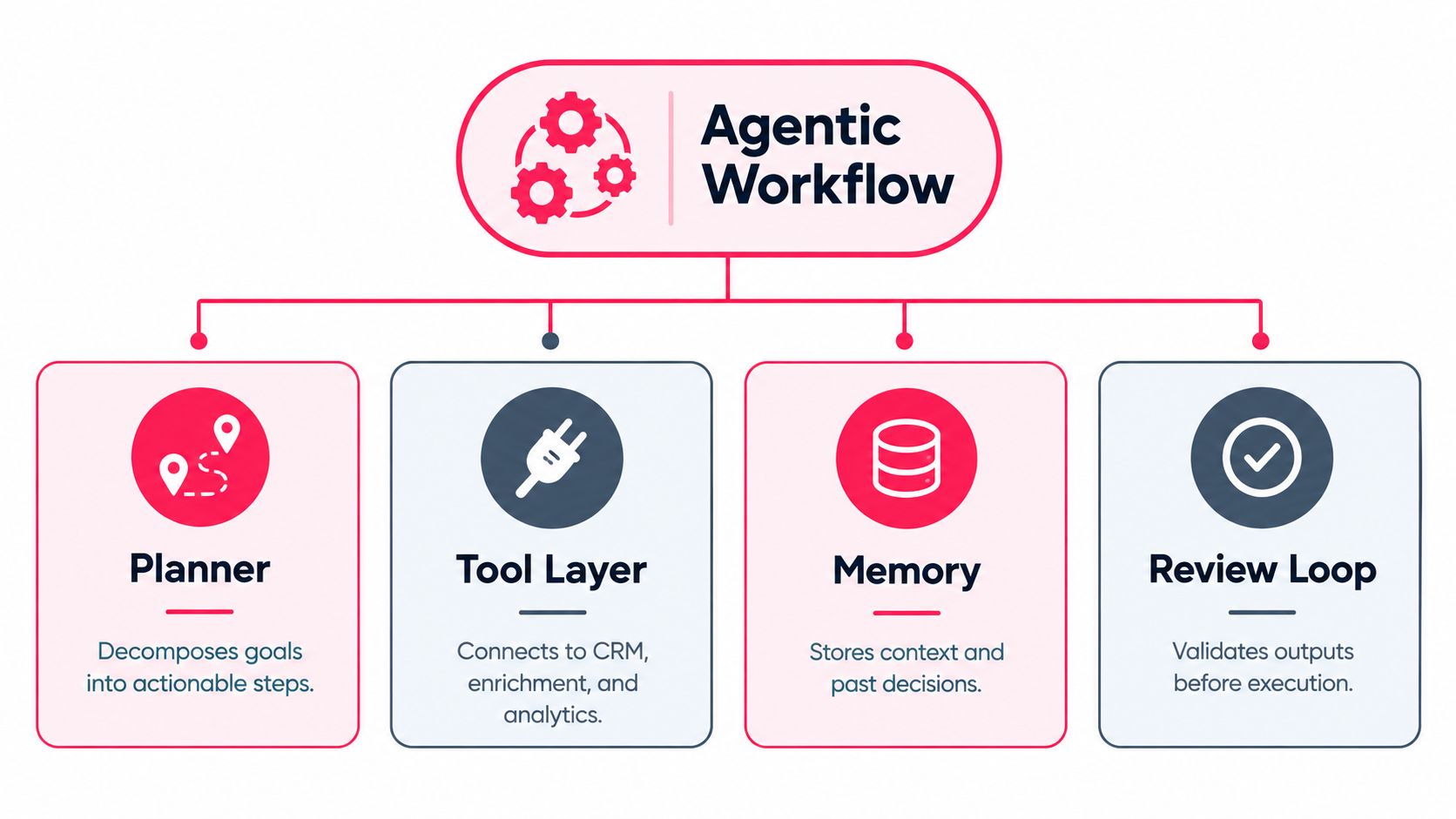
A real agentic workflow has four layers. If one is weak, the whole loop becomes theater. The planner, the tool layer, memory, and review layer each carry a different failure mode, and leaders should know which one they are paying for.
Planner and tool layer
The planner decomposes the goal into steps. The tool layer touches the systems that matter, usually CRM, enrichment, analytics, content, or checkout. That pairing is where most vendors stop talking in detail, because the hard part is not the prompt, it's the contract between the plan and the action.
FlowBench, which evaluates 51 scenarios across six domains, says current LLM agents still need substantial improvement for workflow-guided planning, which is why production systems need explicit inputs, outputs, preconditions, postconditions, permissions and retry rules rather than an unconstrained conversational loop (FlowBench). In plain terms, a planner that invents tool arguments is a liability. A tool layer with loose permissions is worse.
Memory and review loop
Memory is the state tracker. It records what was tried, what succeeded, what was verified, and what still needs approval. Without it, the agent repeats work, loses context between runs, and creates duplicated actions in sales and marketing systems.
The review loop is where governance lives. It decides who approves, when to escalate, and whether the workflow can be paused mid-execution. That is where the common failure shows up, over-broad autonomy. An agent that can write to CRM, send external mail, and trigger another system without a clear stop condition is not a growth asset, it's a control problem.
A useful way to think about the stack is this.
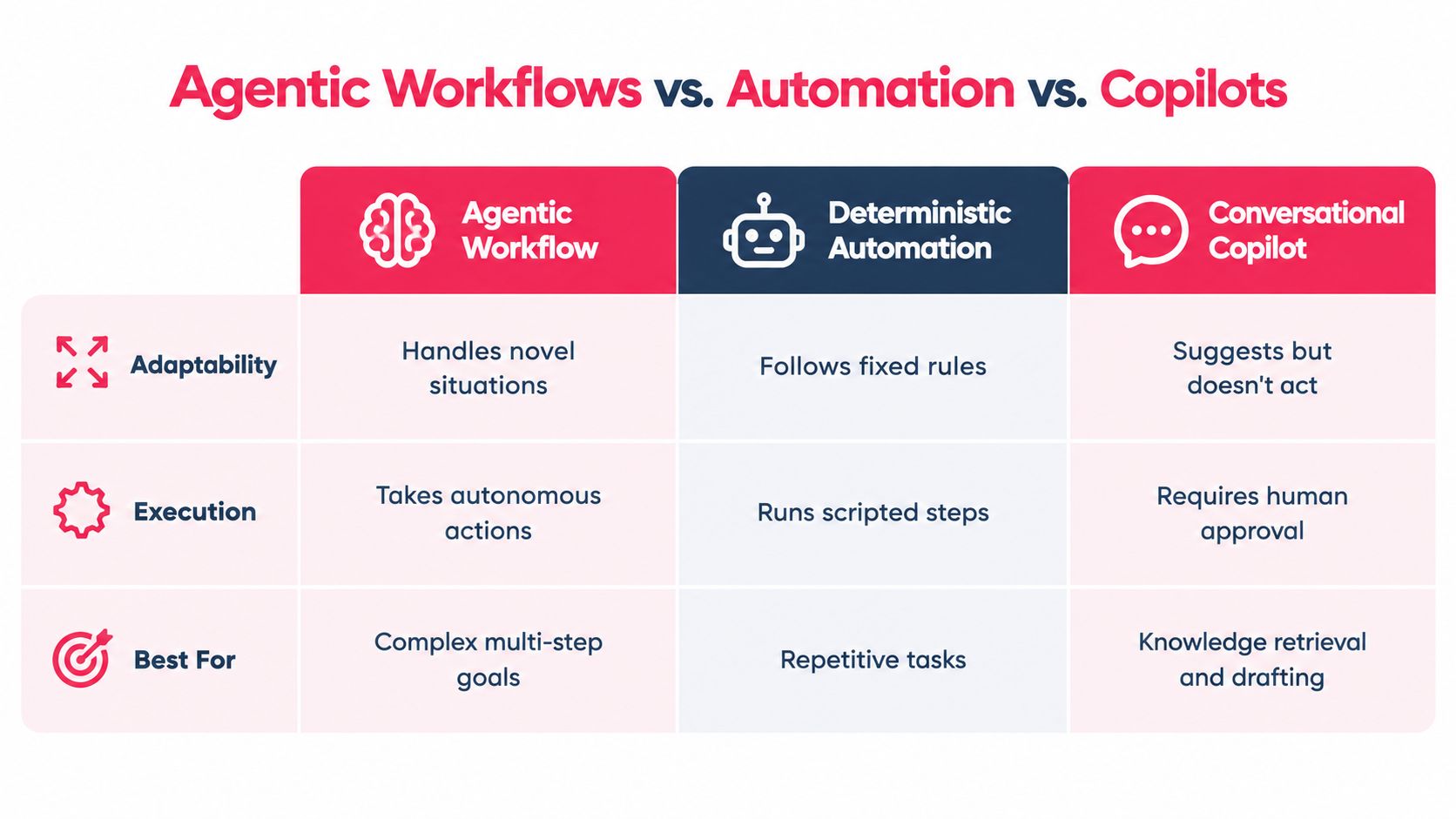
| Dimension | Deterministic automation | Agentic workflow | Conversational copilot |
|---|---|---|---|
| Inputs | Known, stable | Partial, changing, messy | Mostly user-provided |
| Decisioning | Fixed rules | Runtime planning with tools | Suggestion only |
| Best fit | Repeatable steps | Research, routing, bounded decisions | Drafting and retrieval |
| Risk surface | Low if rules are right | Higher, because action is possible | Lower, because action is usually absent |
| Control need | Rule testing | Tool permissions, state, approvals | Output review |
If you're trying to buy your way out of ambiguity, the wrong system is deterministic automation. If you're trying to execute a known sequence faster, the wrong system is an agent. The best operators use both, then let humans own anything irreversible.
For an adjacent view of orchestration inside go-to-market systems, our own signal-based selling guidance is the cleaner fit than generic AI tooling advice.
A dynamic-intervention experiment across 5,000 synthetic enterprise tasks reached 98.2% task success with intervention on only 14.5% of decision steps, and 89% lower latency than a static human-in-the-loop approach, versus 84.3% for a fully autonomous baseline (dynamic intervention study). That's the lesson. Selective intervention beats blind autonomy.
Where Agentic Workflows Beat Automation And Where They Lose
The best use of autonomy is where the workflow has variance, interpretation, or recovery cost. If the path is predictable, stay with scripts, RPA, Zapier, n8n, or whatever deterministic stack already works. If the job is to interpret a prospect record, check conflicting signals, and choose the next action, then agentic workflow earns its keep.
| Dimension | Deterministic automation | Agentic workflow | Conversational copilot |
|---|---|---|---|
| Reversibility | Usually high | Depends on the step | High, because it rarely acts |
| Error cost | Low when rules are stable | Can be high when action is external | Mostly confined to bad advice |
| Cost per execution | Usually predictable | Can vary with retries and tool calls | Lower, but limited to assistance |
| Good use | Repetitive processing | Multi-step research, routing, enrichment | Drafting, summarizing, answering |
| Bad use | Novel situations | Irreversible commitments without approval | Tasks that require execution |
Cost per execution matters because the model cost is never the whole bill. Tool calls, retries, latency, review time, and rollback all belong in the math. A workflow that looks cheap in token spend can still be a budget sink if it creates rework in CRM or forces humans to clean up bad actions.
Rule of thumb: Use agentic workflow where the next step depends on feedback. Use automation where the next step is already known.
The operating principle is graduated autonomy. Deterministic systems handle repeatable low-variance steps. Agentic systems handle research, routing, enrichment, and bounded decisions. Humans approve anything irreversible, externally committed, or financially sensitive.
A 2025 experiment on 5,000 synthetic enterprise tasks showed that selective intervention can beat both fully autonomous execution and static human review on throughput and latency (dynamic intervention study). That's the standard we should hold against every proposal. If the workflow can't justify its review cost, it doesn't belong in production.
Three Revenue Use Cases Worth Building This Year

We've built these patterns inside growth-stage companies because they connect directly to metrics leaders already track. They are not abstract “AI use cases”. They either move pipeline math or they don't.
CRO experimentation
The strongest CRO pattern is a closed loop where the agent drafts a variant, sends it through validation, observes the result, and queues the next iteration for human approval. That works when the business already has a clean testing discipline and a clear owner for conversion rate optimization. It earns value by increasing testing velocity without letting unreviewed copy touch the live funnel.
IBM's 2025 Institute for Business Value research reported that 76% of executives were developing, executing or scaling proofs of concept for autonomous intelligent workflows, and 75% expected agents to execute transactional workflows autonomously within two years (IBM Institute for Business Value). That tells you where the market is headed, but the practical win is narrower. Use agents to move the testing queue, not to replace strategic judgment about offer, positioning, or pricing.
Prospecting and account research
Agentic workflow usually earns money first in this context. The loop collects firmographic and intent signals, enriches them against the CRM, checks a verified claim, drafts outreach, and routes only high-confidence records to the SDR queue. The metric is simple: better qualified meetings from better records, with less time wasted on bad targets.
For a concrete operating model, our AI agents guidance covers the planning, retrieval, and approval pattern we use when the agent has to touch prospect data. The point is not volume. It's cleaner handoffs and fewer junk records getting into outbound motion.
AEO and agent-commerce readiness
This use case is less flashy and more strategic. An agent audits product data, checks schema and machine-readable facts, and prepares structured feeds so answer engines and buyer agents can cite the category correctly. The metric here is answer-engine citation share and clean retrieval, which matter because buyers now meet your brand in machine-mediated contexts before they meet your site.
You don't need to turn every page into a machine feed overnight. You do need a workflow that can identify missing fields, broken schema, weak product claims, and inconsistent terminology, then route fixes to the right owner. That's the boring work that decides whether an answer engine understands you.
The commercial filter is easy. If a workflow improves funnel conversion, SDR qualified-meeting rate, or answer-engine citation share, it belongs on the shortlist. If it only produces nicer-looking drafts, it stays out of the budget review.
How To Sequence Your First Agentic Workflow
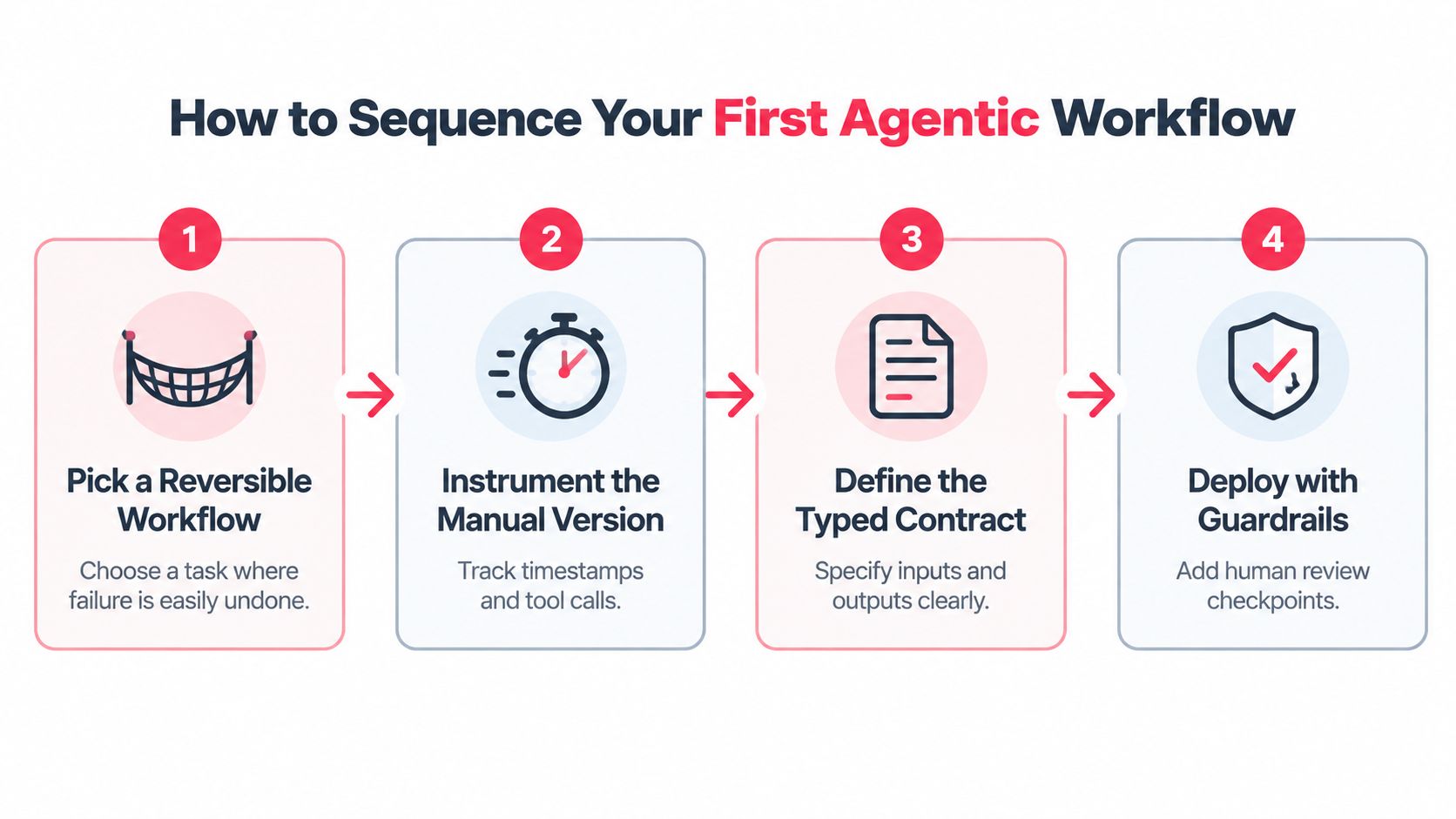
The sequence matters more than the model. If you get the order wrong, you end up with a clever system that no one trusts. If you get it right, you get a workflow that can expand without turning into a liability.
Start with reversibility
Pick a workflow whose failure is reversible. Then instrument the manual version with timestamps, tool calls, and the decisions humans already make. That gives you a baseline, and it exposes where the bottleneck really is.
A good first candidate is usually one of three things, account research, enrichment, or a review-heavy content workflow. All three have room for automation, and none should be allowed to act without traceability. If the workflow can't be rolled back, it doesn't deserve autonomy.
Define the contract before you build the planner
Least-privilege credentials per workflow are essential. So are typed tool contracts, explicit preconditions, postconditions, and an audit log that captures the goal, plan version, tool arguments, approver, timestamp, and outcome. Berkeley's Center for Long-Term Cybersecurity names human control, accountability, intervention points, escalation paths, shutdown mechanisms, system-level assessment of tool and environment access, continuous monitoring, defense-in-depth containment, and transparency about system boundaries as core elements of an agentic AI risk profile (Berkeley CLTC).
Our own AI proof of concept process follows the same order, because governance comes before scale. If you skip that step, you'll spend more time cleaning up exceptions than shipping work.
Audit trails aren't admin overhead. They're the only reason a leader can widen autonomy with a straight face.
Expand autonomy one step at a time
Start with research only. Then allow draft generation. Then add routing. Save the last step, external action, for after the workflow has proven that it can survive exceptions, duplicates, unavailable APIs, and rollback. That sequencing keeps the review burden tied to risk instead of to hype.
The better the test harness, the faster you can widen the loop without wrecking data quality. In practice, that means you measure complete workflow performance, not isolated prompt quality, because a model that looks smart in a sandbox can still fail on the actual chain of actions.
A Sample Workflow Pattern With The Failure Path Included
A sane outbound workflow looks like this. Goal, research account X, verify one recent claim, draft a personalized email, then send for approval. The agent is allowed to gather data and draft text, but it doesn't get to commit anything externally until a human has seen the evidence.
- Research step. The planner asks for firmographic data, recent company news, and a likely pain point.
- Validation step. The workflow checks whether the claim is supported by a source the team trusts.
- Draft step. The agent writes the email using only verified facts and approved positioning.
- Approval step. A human reviews the output, edits if needed, and decides whether the message goes out.
If the API is unavailable, the workflow should stop and log the failure instead of inventing a fallback. If two enriched records conflict, the record stays in review until a human resolves it. If the model hallucinates a customer logo or a case study, the validation rule should reject the draft and flag the source problem, because one bad detail can poison trust in the whole queue.
That's the difference between an operator's playbook and a vendor brochure. The failure path is where the system either earns credibility or corrupts pipeline data.
The reason this matters is plain from evaluation research. The WebArena benchmark found that one of the strongest GPT-4-based web agents completed only 14.41% of tasks successfully, compared with 78.24% for humans, which is why full business scenarios matter more than isolated prompts (NIST AI 600-1 PDF). If the workflow can't survive the ugly cases, it isn't ready.
Where Agentic Workflows Quietly Fail
The hidden bottleneck is operational control, not model intelligence. Recent readiness data says only 6% of surveyed companies fully trust AI agents to run core processes, only 20% say their infrastructure is fully ready, and only 12% say governance controls are fully in place (HBR-cited survey summary). That gap should make every executive pause before adding more autonomy.
A separate 2025 SailPoint report found that 82% of organizations use AI agents, only 44% have policies to secure them, and 23% said an agent had been tricked into revealing access credentials (SailPoint AI agent adoption report). That is the agent-sprawl problem. More agents can increase risk faster than they increase capability.
What actually breaks
- Permission drift: A workflow that starts narrow picks up too many permissions over time.
- State loss: The agent forgets what it already checked and repeats work.
- Bad escalation design: Humans get alerts after the action, which is too late.
- Weak logging: The team can't reconstruct why a decision was made.
- Adversarial failure: The agent accepts bad input or reveals secrets.
- Ownerless remediation: No one is accountable when the workflow misfires.
A meaningful control model needs least-privilege tool access, separate credentials per workflow, approval gates for high-impact actions, structured logs of inputs and decisions, test cases for adversarial behavior, and one named owner responsible for remediation. That is the minimum viable operating model for a mid-sized company, whether the workflow lives in sales, marketing, or customer operations.
If you want a useful external reference for the kinds of marketing actions that can be automated safely, the guide to AI-powered marketing tactics is a better starting point than vague AI hype. The central question, though, is still the same: what evidence must exist before you widen the mandate of the workflow?
For background on the building blocks, what is agentic AI covers the wider category and its control requirements, and what is an AI agent explains how to define an agent’s operating boundary before you buy one.
The Next Decision for Your Operating Committee
The next decision is simple. Pick one workflow, not five, whose failure is reversible and whose success moves a metric already on the Monday dashboard. Then run it as a graduated-autonomy pilot with named owners, audited tool calls, and a clear escalation threshold.
If you need an outside operator to help sequence that work, treat the choice as a sequencing question, not a procurement question. The gating work in 2026 is governance, data readiness, and measurement, not model selection. A fractional Chief AI Officer is useful when the company needs someone to set the operating rules, not when it needs another tool demo.
The diagnostic question to answer before approving budget is this. Which existing process has the highest reversibility-to-error-cost ratio and the cleanest tool surface?
Answer that, and the first agentic workflow becomes a disciplined pilot. Miss that answer, and you will buy autonomy before you have earned control.
