
Companies have burned through $37 billion on generative AI in 2025, while only 24% of use cases were still being built in-house after the market flipped to 76% purchased rather than built, up from a 47% built / 53% purchased split the year before (Menlo Ventures enterprise AI spending study). That's the starting point for build vs buy AI tools. The market has already voted for speed, vendor capability, and deployment over custom code.
For CEOs, CMOs, and CROs, the mistake is treating this as a one-time procurement call. It isn't. The first decision is usually a 90-day choice. The second decision comes after teams have real usage data, real integration pain, and a clear view of whether the workflow is strategic or just convenient.
The teams that get this right buy the commodity layer, build the control layer, and re-decide after the first quarter. The teams that get it wrong either buy software they barely use or build something they can't maintain.
| Decision lens | Buy | Build | Hybrid |
|---|---|---|---|
| Speed to deploy | Higher | Lower | Medium |
| Workflow fit | Medium | Higher | Higher |
| Data control | Lower | Higher | Higher |
| Maintenance burden | Lower | Higher | Medium |
| Vendor dependency | Higher | Lower | Medium |
| Re-decision flexibility | Medium | Higher | Higher |
Table of Contents
- The Build vs Buy Decision Has Inverted
- A Six-Dimension Scorecard for AI Tools
- Modeling the Real Cost Across Three Years
- Three Paths, Five Scenarios
- Where Most Comparisons Go Soft
- How AI-Assisted Development Changes the Equation
- Your 90-Day Build vs Buy Protocol
The Build vs Buy Decision Has Inverted
The old assumption was simple. Buy if you want speed, build if you want control. Enterprise AI has already moved past that shortcut. In 2024, 47% of solutions were built internally and 53% were purchased, then by 2025 the mix flipped to 76% purchased. That shift matters because it shows how often teams now start with tools and only later decide whether the workflow deserves custom ownership.
Why the first purchase is rarely the final answer
I've watched teams buy AI tools as a fast path, then replace them later when internal confidence grew and the workflow became clearer. I've also watched teams overbuild in year one, then spend year three paying the maintenance tax nobody budgeted for. The mistake is treating the first decision as permanent.
A better model is simple. Make the first call in 90 days, then re-score the workflow in 12 months after adoption, governance, and revenue impact are visible. That keeps you from locking in a weak vendor or inheriting a brittle internal build that looked cheaper on day one than it really was.
Practical rule: buy first when the workflow is generic, then revisit the build case only after you've seen real usage, real failure modes, and real integration friction.
For founders and operators who need a sharper way to frame ownership, Refact's framework for founders on the build vs buy ownership question is a useful companion to this decision.
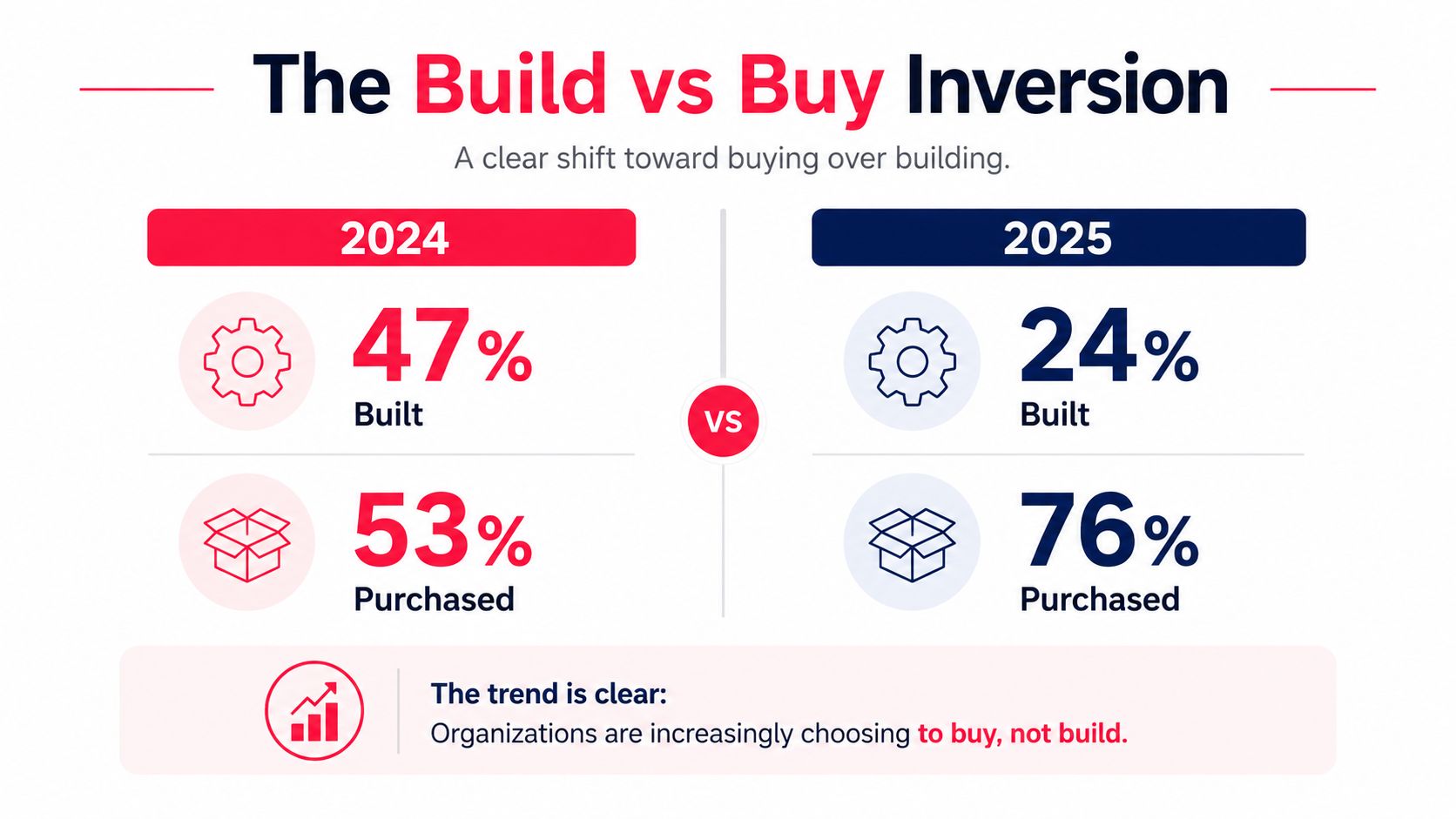
The key takeaway for CEOs and CROs is direct. A purchased tool is not finished when procurement signs it. A custom build is not finished when engineering ships the first version. In both cases, the test is whether the system still earns its keep after it meets production, user adoption, governance review, and the first round of replacement pressure.
Teams miss the second-stage effect. They buy fast, learn where the process breaks, then either add custom layers on top or rip the tool out entirely. That is why the build versus buy question is no longer a one-time choice, it is a lifecycle decision that changes once the team sees actual usage, control gaps, and maintenance costs.
A Six-Dimension Scorecard for AI Tools
The fastest way to make this decision defensible is to score both paths on the same six dimensions, each on a 1 to 5 scale. I use this with growth-stage teams because it forces the conversation out of opinion territory and into workflow reality. It also fits on one page, which matters when the CEO, CMO, and CRO all need to sign off.
The six dimensions that actually matter
Use these six lenses: capability fit, data control, integration complexity, total cost of ownership, vendor risk, and time to value. Score the build option and the buy option separately. If the gap is wide in only one or two categories, that usually tells you the answer is hybrid.
| Dimension | What to score | Why it matters |
|---|---|---|
| Capability fit | Does it solve the exact workflow? | A generic tool may miss the conversion path. |
| Data control | Who owns the data model and outputs? | This decides how much trust and tuning you keep. |
| Integration complexity | How hard is CRM, MAP, or analytics wiring? | Deep integration is expensive to retrofit later. |
| Total cost of ownership | What happens over three years? | Sticker price hides real operating cost. |
| Vendor risk | Can the vendor change pricing, roadmap, or access? | Dependency is a strategic cost. |
| Time to value | How fast does it change revenue behavior? | A slow win is often a weak win. |
A good worked example is AI search and AEO monitoring. If the tool only surfaces rankings and mentions, buying is usually fine. If you need your own taxonomy, your own source weighting, and custom ties to pipeline, the case tilts toward a custom layer on top of a foundation model. That's because integration depth and data ownership are hard to bolt on later.
My rule: score the parts you can't cheaply reverse later more heavily, especially data model ownership, workflow integration, and evaluation criteria.
Growth teams using Stimulead's advisory work often run this exact scorecard during vendor evaluation, because it makes the tradeoffs visible before anyone gets attached to a demo.
Modeling the Real Cost Across Three Years
Sticker price is where bad decisions begin. The published decision framework I trust most puts custom build at $220K–$850K in year 1, $150K–$400K in year 2, and $150K–$400K in year 3, for a 3-year total of $520K–$1.65M. It puts commercial buy at $135K–$610K in year 1, $95K–$455K in year 2, and $100K–$475K in year 3, for a 3-year total of $330K–$1.54M (A rdura build-vs-buy AI decision framework).
Why the cheaper option changes as usage rises
Buy usually looks cleaner at the start because it shifts more work into subscription or usage fees. Build looks heavier because the cost shows up upfront in engineering and infrastructure. But the picture is usage. Per-seat, per-call, and per-feature pricing compounds, while build shifts more of the pain into maintenance and staffing.
That's why I use a 10x volume test before any serious commit. Model the workflow at ten times current usage, even if that sounds aggressive. If the tool is still cheaper and still cleanly governed at that scale, buy is probably the right move.
For ROI framing, MyMentions' 2026 AI ROI framework is a useful companion because it pushes teams to think about outcomes instead of just license fees.
A CRO example that changes the answer
Take a CRO team buying an AI testing assistant versus a GTM engineering team building the same capability inside the stack. At low volume, the subscription can look easier and cheaper. At higher usage, the cost of seats, API calls, integrations, and admin work starts to erase that advantage. If the built version sits inside your actual testing and reporting workflow, the control can justify the engineering spend.
For leaders trying to run this with shared services, Stimulead's fractional Chief AI Officer cost guide is a practical reference point for understanding advisory spend alongside product spend.
The honest read is this. Buy tends to win for early-stage convenience and moderate scale. Build tends to win when the workflow becomes central, the usage pattern becomes predictable, and the integration layer starts to matter more than the feature list.
Three Paths, Five Scenarios
The right answer changes by workflow, not by ideology. I'd default to buy for commodity systems, build for proprietary revenue loops, and hybrid when you need control over the workflow but don't want to recreate the whole stack.
The workflow should drive the choice
For AI search and AEO monitoring, I'd start with buy, then add a custom layer if you need source weighting, content mapping, or internal taxonomy. For hyper-personalized outbound in GTM engineering, I'd favor hybrid, because the message logic and enrichment rules are often proprietary even if the base model is standard.
For conversion rate optimization testing velocity, the answer usually becomes hybrid as soon as the team wants its own experiment logic, routing, or reporting tied to revenue. For predictive lead scoring, buy is fine when the inputs are ordinary, but build starts making sense when the score must reflect your own conversion path and sales behavior. For customer support deflection, buy is the default unless your support flow is tightly coupled to a proprietary product or a regulated queue.
Heuristic: buy the layer that solves the common problem, then build only the part that changes revenue, control, or learning speed.
The same applies to agent commerce readiness. If you need buyers' agents to trust your data, your provenance, and your structured outputs, the control layer matters more than the chat layer. That's where a hybrid model usually earns its keep.
A few clean calls:
- Buy for AI search monitoring: the workflow is often standard, and speed matters.
- Hybrid for GTM engineering: the playbook may be unique even if the model isn't.
- Build for CRO instrumentation: your data and conversion logic are usually the moat.
- Buy for support deflection: mature vendors already solved most edge cases.
- Hybrid for lead scoring: the model can be standard, the calibration usually can't.
This is the part most leaders miss. The best path is often the one that preserves your ability to change the workflow later without ripping out the whole system.
Where Most Comparisons Go Soft
Most build vs buy writeups get lazy right where the decision gets real. They talk about features, timeline, and cost, then bury governance in a footnote. That's backwards. In AI for marketing and sales, the tool that looks functional in a demo can still be unsafe in production.
Governance is the real dividing line
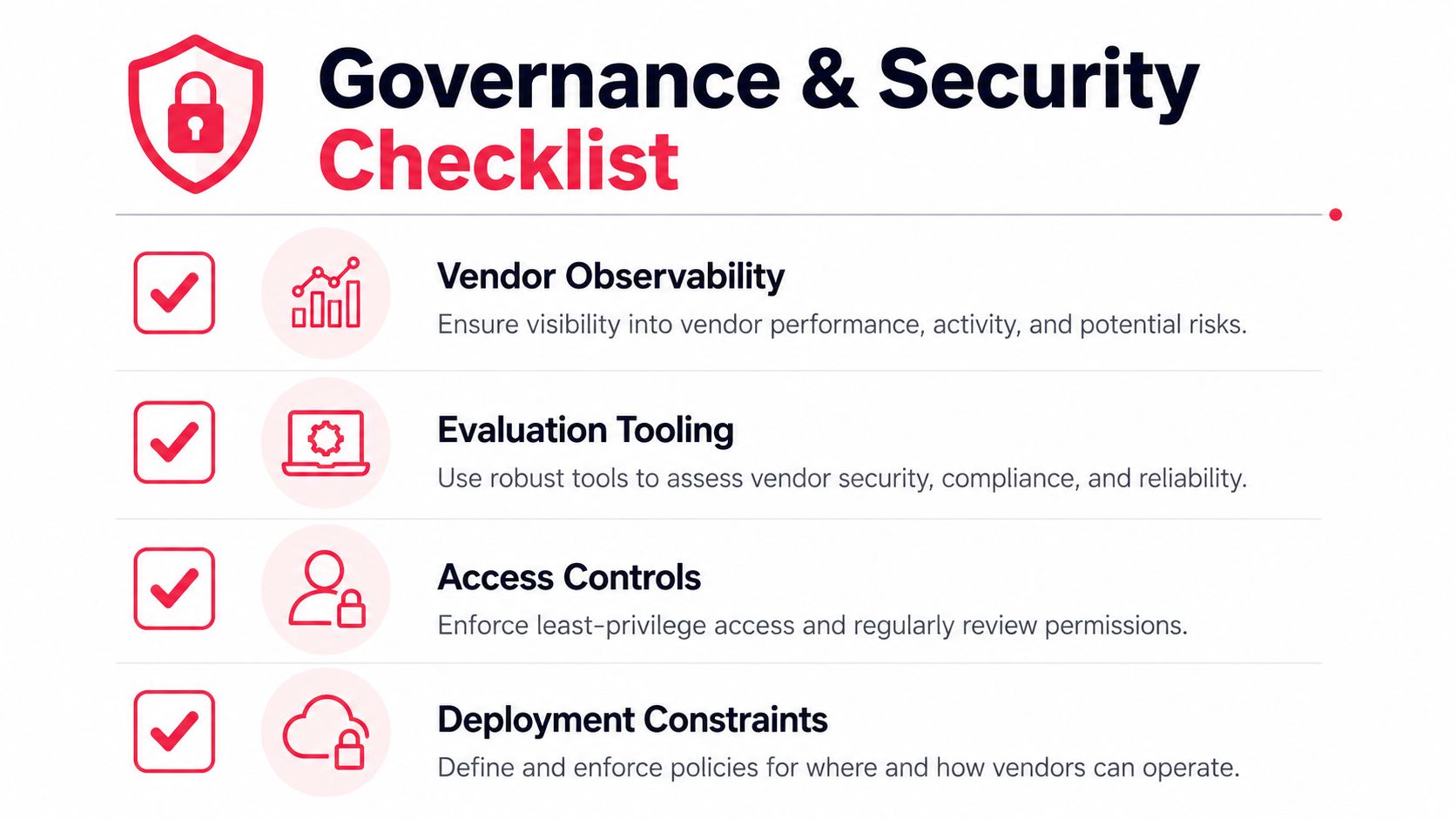
Recent enterprise guidance says the decision should hinge on whether the vendor can provide the observability, evals, controls, and deployment constraints needed for high-stakes or regulated use cases. I agree. If you can't inspect outputs, test failure modes, and restrict where the system runs, you don't really own the workflow. You're renting a black box.
That matters in AI search and AEO because a hallucinated recommendation can damage brand authority fast. It also matters for agent commerce, where buyer-side agents will prefer vendors with verifiable provenance and clean data trails. A great pitch deck doesn't help if the system can't prove what it's doing.
The questions every vendor call should answer
Use these on every evaluation call:
- Vendor observability: Can we inspect outputs, logs, and failure patterns?
- Evaluation tooling: Can we test quality against our own KPIs?
- Access controls: Can permissions map to our team structure?
- Deployment constraints: Can the tool stay inside our data and policy boundaries?
If a vendor can't answer those clearly, the tool is probably too shallow for pipeline-critical work. For sensitive GTM systems, that usually pushes the decision toward a custom layer or a stronger hybrid setup.
The practical rule is simple. If the workflow touches revenue, brand authority, or buyer trust, the vendor has to prove control, not just capability. If they can't, move on.
How AI-Assisted Development Changes the Equation
AI-assisted coding has lowered the friction of building. That matters. It doesn't erase maintenance, but it does make the first version cheaper and faster to explore. The market is already responding to that shift.

Retool surveyed 817 builders and customers and found that 35% had already replaced at least one SaaS tool with a custom build, while 78% expected to build more internal tools in 2026. The same report said 60% had built software outside IT oversight in the prior year, and 25% did so frequently (Retool AI build vs buy report). That's a clear second-wave pattern. Teams buy first, then start replacing specific SaaS functions once they know the workflow well enough.
Where the break-even point is moving
Most content stays static, and it's wrong. AI-enabled development, including faster prototyping and vibe coding, makes custom work cheaper to test and easier to start. That shifts the break-even point for some teams, especially when the workflow is central and the maintenance burden is acceptable.
I still wouldn't build just because it's faster to start. Build when the workflow is central, the team can maintain it, and the commitment is long enough to absorb the ongoing work. Otherwise, the prototype turns into shadow software, and nobody wants to own it.
If your team is considering agents and internal automation, Stimulead's agents and AI page is relevant because it sits in that space between workflow design and operational control.
Short version: AI makes building easier to start, not easier to ignore. If you can't support the system after week 12, the cheap prototype becomes expensive drift.
The new judgment call is timing. Buy to move. Build to replace. Re-score after the first 90 days when the actual maintenance load is visible.
Your 90-Day Build vs Buy Protocol
Week 1, list every AI use case tied directly to revenue, pipeline, or conversion. Week 2, score each one on the six-dimension model. Week 3, run the 3-year TCO math at 10x current volume. Week 4, either shortlist vendors or build the smallest prototype that proves the workflow.
Weeks 5 through 8 are for the pilot. Don't widen scope. Don't polish the UI. Just test the workflow, the data boundary, and the failure mode. By week 12, re-score the use case and decide what to keep, what to replace, and what to extend.
If you want a structured starting point, book a Stimulead AI Growth Partnership audit through the AI implementation roadmap. It begins with a prioritized roadmap and KPIs tied to revenue, which is the only way this decision should be run.