
AI quality control breaks when the output volume outruns human review. In revenue teams, that's usually the primary failure; a sequence can ship cleanly in the model and still flood RevOps, Sales Ops, and Compliance with more claims than they can check.
We've seen the pattern firsthand. A CRO approves an AI-driven outbound sequence, the first week looks productive, then complaints start coming in about fabricated case studies, inflated ROI, and prospect-specific claims that were never in the CRM.
Table of Contents
- The Volume Gap That Breaks AI Quality Control
- Six Components of AI Quality Control for Revenue Operations
- Start with input quality, because broken inputs create confident nonsense
- Model validation has to test edge cases, not just average cases
- Monitoring has to move from reporting to alerting
- Feedback loops keep the system from drifting into repeat mistakes
- Bias and fairness checks protect pipeline coverage
- Security has to cover prompt injection and data leakage
- Setting KPIs and SLAs That Actually Hold
- Implementation Roadmap and Where Teams Fail
- Tooling and Vendor Decisions for Growth-Stage Companies
- Concrete Examples Across Marketing Sales AEO and CRO
- Your First Release Gate and Governance Decision
The Volume Gap That Breaks AI Quality Control
The hard problem isn't whether the model can write decent copy. The hard problem is whether your team can review enough of it before it reaches the market.
Why output speed beats human review capacity
AI quality control is usually discussed like a model problem, but production failure looks like an operating-model problem. AI systems can create hundreds or thousands of outbound variants, while a RevOps team can only review a fraction before launch. That mismatch creates a volume gap, and once the gap opens, review turns into sampling under pressure instead of governance.
Practical rule: if the team cannot review the output before send, the model is already in production without a gate.
That's why a good sequence can still fail. We've seen AI-generated campaigns create pipeline interest in week one, then trigger complaints in week two because the sequence cited nonexistent customer outcomes and copied claims from competitors. The model didn't “break” in isolation, the release process did.
The formal frame for this comes from quality management, where ISO 9000 defines quality assurance as “part of quality management focused on providing confidence that quality requirements will be fulfilled” (arXiv summary of AI quality control research). In other words, the task is sustained confidence, not a one-time check before launch.
What the volume gap looks like in revenue operations
| Use Case | Daily AI Output | Human Review Capacity | Volume Gap Ratio |
|---|---|---|---|
| AI-driven outbound sequence | high-volume batch production | limited manual review | wide and growing |
| AI-assisted ad variants | rapid multichannel generation | small approval queue | wide and growing |
| AI-generated call summaries | continuous post-call output | selective spot-checking | moderate |
| AI lead scoring explanations | ongoing score narratives | periodic audit review | moderate |
The exact ratio depends on the workflow, but the pattern is the same. Output scales faster than trust, and teams that ignore that fact end up discovering quality issues from customers, not from dashboards.
A recent bibliometric study covering 2013 to 2024 found a significant rise in publications on AI-driven QA, with defect detection, predictive maintenance, and automated quality control becoming dominant themes (arXiv research summary). That shift matters because it shows AI quality control has moved into mainstream operations, including revenue workflows where bad output now touches pipeline, brand, and conversion.
Six Components of AI Quality Control for Revenue Operations
Revenue teams need six checks working together. A draft can pass review while the live sequence fails, because AI output expands faster than people can inspect it.
Start with input quality, because broken inputs create confident nonsense
Lead enrichment errors, stale CRM fields, and mismatched account data often seed hallucinations. When the CRM has a stale job title and the model auto-fills it as “Decision Maker” in every outreach, the error spreads across thousands of sends. A wrong industry tag or empty buying stage creates the same problem, with plausible text masking defective source data.
Fraunhofer IPA describes AI-driven QA in industrial inspection as a way to automate manual inspection and make hard-to-define rules objective by combining training data with expert knowledge (Fraunhofer IPA reference in the provided research brief). Revenue operations follows the same principle. Generation is only as dependable as the records, definitions, and approved evidence supplied to the system.
Model validation has to test edge cases, not just average cases
A useful approval set includes odd ICP segments, fringe geographies, competitor mentions, and tone variations that slip through routine review. If the model writes a case study about an unknown client or presents a competitor as a customer, validation has failed even when the average score looks healthy.
Hallucination testing for LLMs is increasingly benchmark-driven. HaluEval introduced a human-annotated benchmark for hallucination type, trigger, and persistence, while HALOGEN adds 10,923 prompts across nine domains and atomic-unit verifiers for generated claims (HaluEval and HALOGEN benchmark paper). For revenue teams, test each claim against an approved source, not only the fluency of the finished copy.
Monitoring has to move from reporting to alerting
Dashboards arrive too late when AI output moves through outbound, content, and SDR workflows each day. Monitor reply rate for commercial impact, correction rate for factual workload, and rep overrides for trust breakdown. A reply-rate drift under 2% can trigger a prompt rewrite, while a correction rate above 15% should pause the rollout for investigation. Precision shows whether flagged outputs require intervention, recall shows how many harmful outputs the gate catches, and F1 helps balance those two when review capacity is limited.
AI-based QA frameworks also track accuracy, precision, recall, F1 score, resilience against adversarial attacks, and continuous monitoring after deployment (industry-oriented QA study). Each measure needs an owner and a response. A benchmark score without an operational threshold does not protect a live sequence.
A model that looks fine on a benchmark can still be unusable in a live sequence if the outputs are hard to verify quickly.
Feedback loops keep the system from drifting into repeat mistakes
Sales rep edits, customer replies, and campaign rejects should return to the prompt, ruleset, or evaluation set. If the same hallucination is corrected ten times without changing the system, the team is funding the same failure repeatedly. Tag each correction by cause, such as stale data, unsupported claim, tone, or targeting, so the next release addresses the underlying defect.
Bias and fairness checks protect pipeline coverage
AI can favor segments resembling historic winners and deprioritize markets missing from past patterns. Compare lead prioritization and outreach treatment across target segments, then require a review when one group receives less coverage without a documented business reason. This protects pipeline creation from historical bias embedded in training data or CRM activity.
Security has to cover prompt injection and data leakage
If a model can reveal internal notes, customer data, or draft claims from another account, quality control becomes a security control. Customer-facing output should block prompt injection attempts, isolate account context, and stop release when retrieved evidence crosses permission boundaries.
Stimulead's AI testing framework provides a practical reference for combining component checks, attack testing, drift monitoring, and runtime monitoring in one testing discipline.
Setting KPIs and SLAs That Actually Hold
A common mistake is setting a vague quality target and calling it governance. Revenue teams need thresholds that map to action, owner, and review path.
Separate thresholds by function
Marketing, sales, and AI-enabled ops have different tolerance for error. A blog draft can survive a correction, a customer-facing email sequence usually can't.
| Function | KPI | Threshold | Review SLA | Release Gate Type |
|---|---|---|---|---|
| Marketing | hallucination rate | under 2% | 4 hours | pre-launch approval |
| Marketing | brand voice consistency | above 85% | 4 hours | pre-launch approval |
| Sales outreach | personalization accuracy | above 90% | 2 hours | hard stop before send |
| Sales outreach | fabricated claims | zero tolerance | 2 hours | hard stop before send |
| AEO | data enrichment accuracy | above 95% | same day | post-launch audit for low risk, pre-launch for customer-facing assets |
| AEO | lead scoring drift | under 5% month over month | 30 minutes | alert and review |
| AEO | alert response | within 30 minutes | 30 minutes | escalation trigger |
These are operating thresholds, not vanity metrics. If an outbound sequence fails the zero fabricated claims rule, it doesn't matter if the click rate is strong, because the brand cost can outrun the early conversion gain.
For a practical way to think about measurement discipline in adjacent workflows, Tagada's discussion of KPIs for ecommerce account growth is useful because it reinforces the same idea, metrics only matter when they drive ownership and action.
Use release gates, not blanket approval theater
Low-risk internal tools can use sampling. Customer-facing sequences need full review or strict gating until trust is earned. If you're shipping a high-volume outbound batch, sample review only works when the output is low trust and the downside of one miss is contained.
For example:
- Full review for first-time outbound templates, new markets, or regulated claims.
- Sampling review for internal enrichment or rep-assist suggestions.
- Automatic release only after sustained performance and clean audit history.
The core issue is review capacity. If your team can only inspect 100 items a day, but the system produces 1,000, then the SLA has to reflect that ceiling or you'll end up pretending the gate exists.
Implementation Roadmap and Where Teams Fail
The common mistake is starting with model evaluation. That's backwards. If the team doesn't know how much it can review, the evaluation design is already detached from reality.
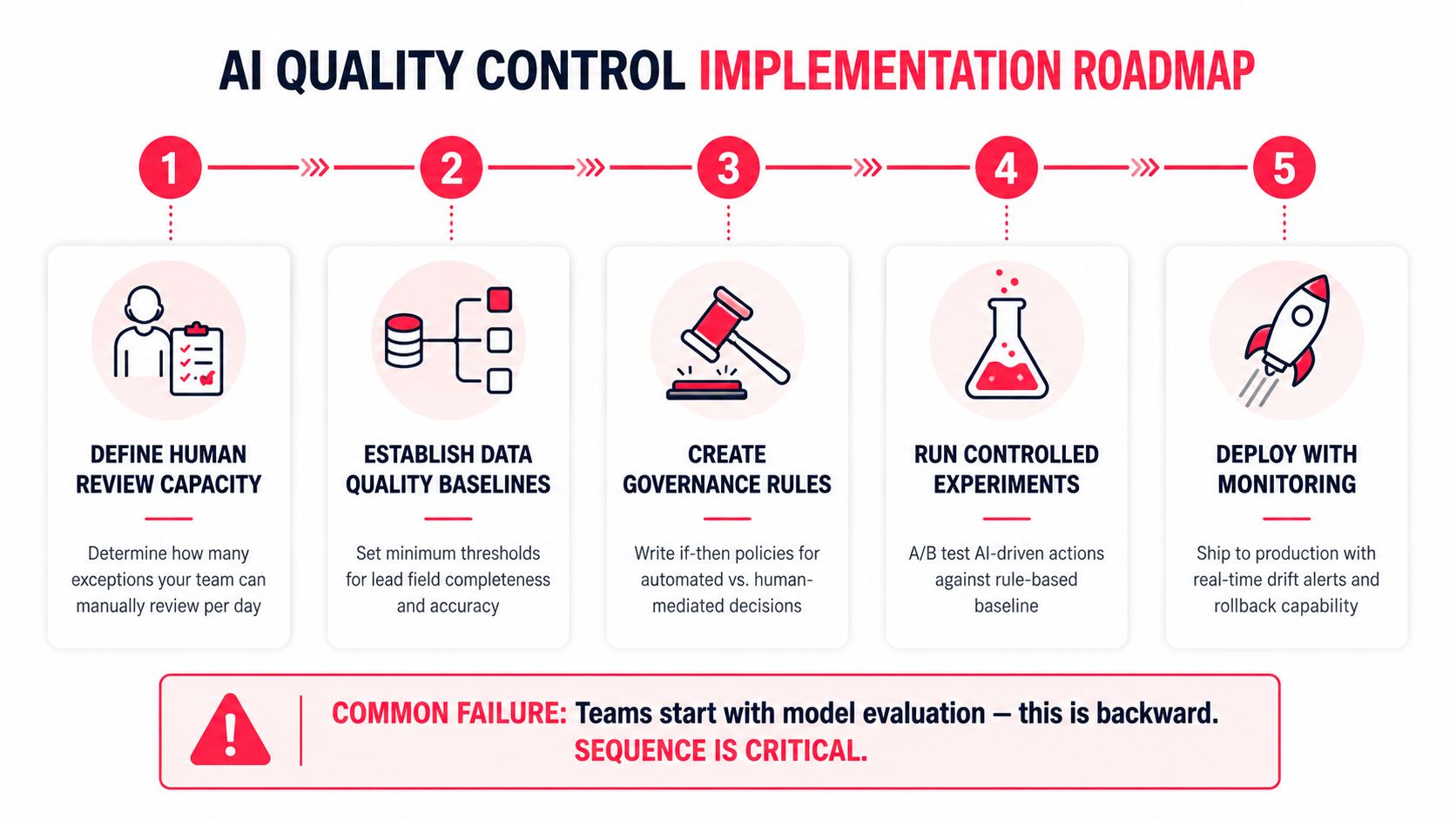
Phase 1 to 2, map capacity before you touch the model
Weeks 1 to 2 should produce a review inventory. That means the team documents who reviews what, how long each review takes, and which outputs require human approval. It also means identifying the bottleneck, because a 3x increase in review demand usually means the current process can't absorb the launch.
Teams fail here when they assume the existing QA queue can stretch. It usually can't.
Phase 3, write gates and rollback rules
Weeks 3 to 4 should produce written release rules. Define what blocks launch, what triggers post-launch review, and what causes rollback. A clean setup includes the escalation owner, the notification path, and the exact SLA breach that pauses sends.
For data pipeline discipline, the truelabel pipeline guide is a solid reference because it reinforces how data checks and quality thresholds belong in the pipeline, not after the fact.
Practical rule: if rollback criteria are vague, the first bad campaign will stay live too long.
Phase 4 to 5, run shadow deployment before full release
Weeks 5 to 8 should use parallel human review. The AI writes, humans score, and nothing reaches the customer unless the gate passes. Teams discover whether the model is misattributing competitors, inventing customer claims, or drifting in tone.
Weeks 9 to 12 should only begin after the shadow period proves the workflow can sustain the output. At that point, automated escalation paths matter more than more model tuning, because production failures are usually governance failures first.
Stimulead's AI implementation roadmap is worth reviewing alongside your own rollout plan if you need a cleaner sequencing model for release gates and review ownership.
Tooling and Vendor Decisions for Growth-Stage Companies
Growth-stage teams don't need the same stack as regulated enterprises. They need tools that fit the amount of output they create and the number of humans available to check it.
Three tiers, three trade-offs
| Tier | Examples | Monthly Cost | Best For | Key Limitation |
|---|---|---|---|---|
| Native platform controls | HubSpot, Salesforce Einstein, Outreach | bundled or low incremental cost | basic validation and approvals | limited cross-channel governance |
| AI observability platforms | Arthur, Patronus, LangSmith | $2,000 to $15,000 monthly | model monitoring, drift detection, evaluation pipelines | needs engineering setup |
| Governance suites | Credo AI, Holistic AI | $50,000+ annually | regulated environments and formal oversight | usually too heavy for growth-stage revenue teams |
The right choice depends on where the pain sits. If the problem is isolated to outbound claims, platform controls plus a written gate may be enough. If multiple teams are shipping AI output across content, sales, and ops, observability starts to matter.
What to value more than feature lists
Time-to-value matters because QA debt compounds fast. Integration depth matters because a disconnected tool won't see the actual CRM state or outbound queue. Human-in-the-loop support matters because revenue teams need a place to approve, reject, and learn.
We've implemented setups where a simple approval workflow beat a fancy monitoring suite because the team could use it every day. We've also seen the reverse, where observability tools found drift that the native platform never surfaced.
Stimulead is one option in this category for teams that want advisory plus implementation oversight, but the deciding factor should still be workflow fit, not brand.
Concrete Examples Across Marketing Sales AEO and CRO
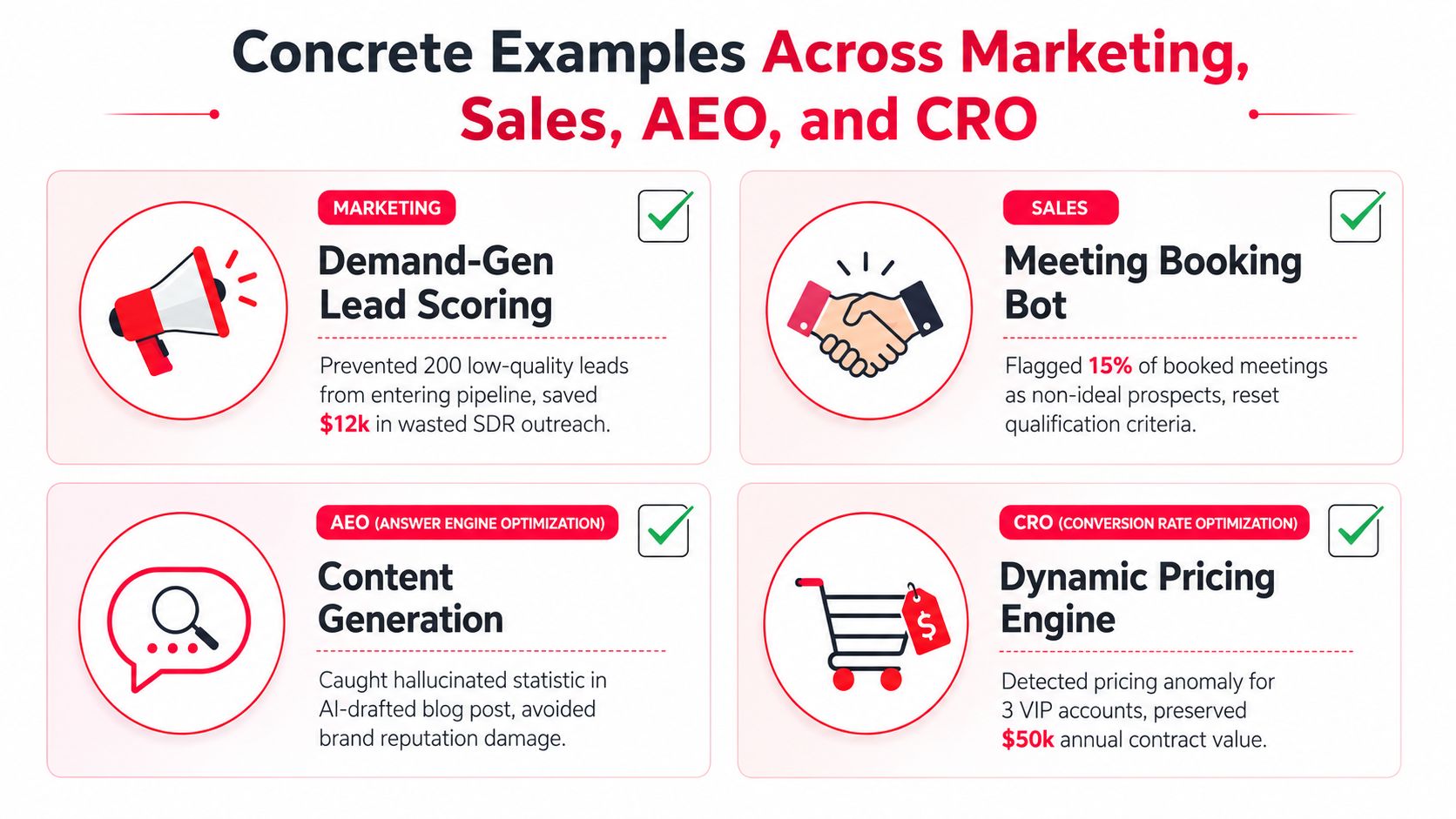
The cleanest way to judge a quality-control design is to look at where it catches real mistakes before customers do.
Marketing and sales
A demand-gen team running AI-personalized email at scale can route a slice of output to human review when confidence drops below the team's threshold. In practice, that gate catches hallucinated product claims before they hit prospects, and it keeps the sequence from damaging sender trust.
An SDR team using AI-generated call summaries can watch for repeated misattribution of competitor mentions. If the model keeps attaching the wrong competitor to the wrong objection, the feedback loop has to trigger a prompt change or fine-tune step before reps start relying on bad notes.
AEO and CRO
For AI-assisted blog publishing, a factual-accuracy SLA tied to verified claims is the right control. Automated citation checking before publication prevents invented statistics from going live under the company name.
For lead scoring, drift monitoring should trigger retraining when the score's correlation with conversion starts to degrade. That protects routing quality, which matters more than the elegance of the score itself.
A short video example can help teams visualize the operating pattern.
The best teams don't ask whether AI can write faster. They ask whether the review path can keep up with the volume and the risk.
Your First Release Gate and Governance Decision
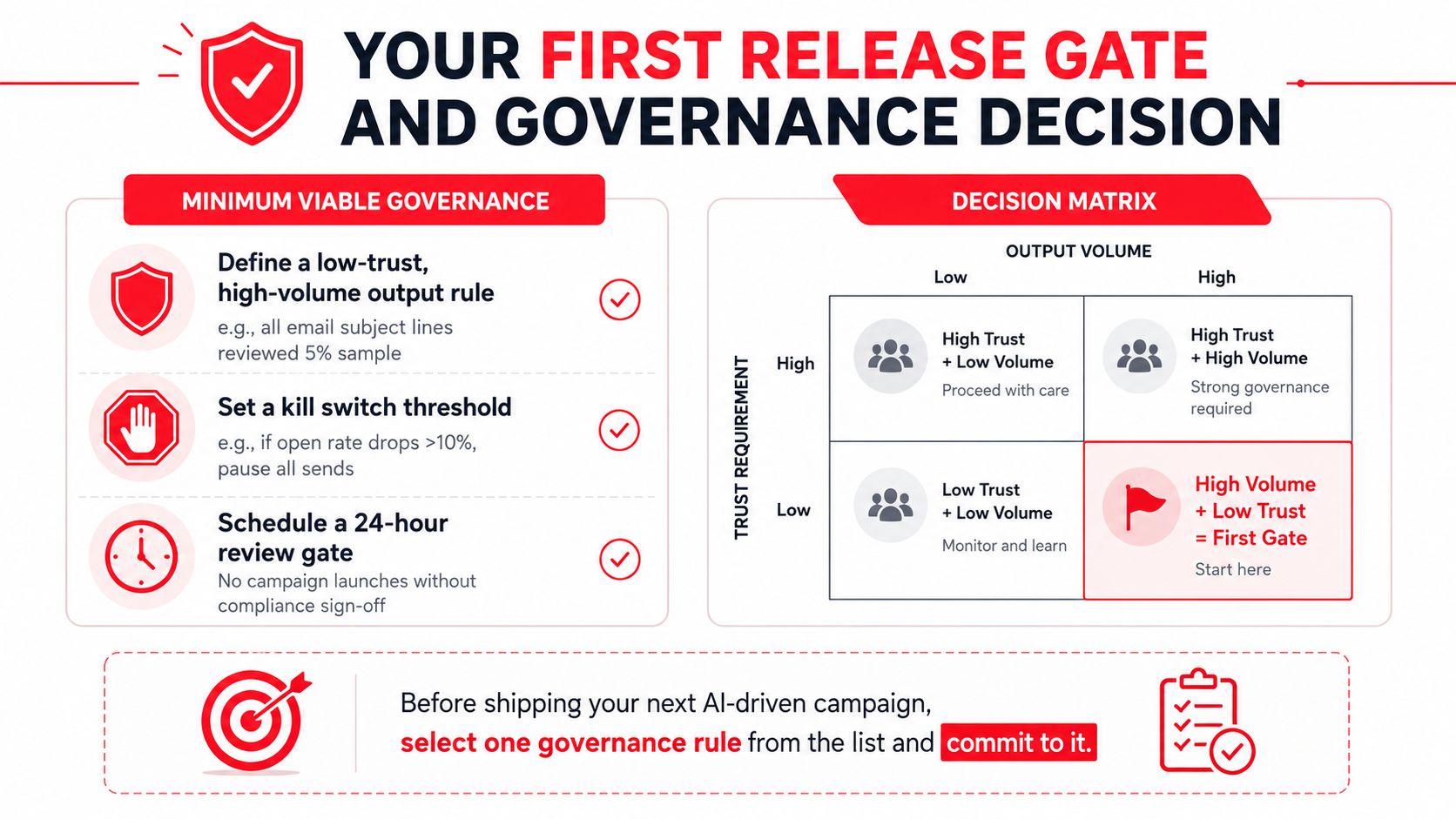
Pick the lowest-trust, highest-volume output first. For most revenue teams, that means automated outbound email or ad copy variants, because those are the fastest ways to create customer-facing risk at scale.
The owner should be RevOps, not the person who built the model. The gate needs a named reviewer, a review sample size, and a rollback trigger tied to a specific SLA breach. If the output is customer-facing and the trust level is still low, the default should be human approval before send.
Stimulead's AI governance best practices is a useful reference if you want a cleaner decision structure for ownership, escalation, and kill switches.
Before shipping your next AI-driven campaign, fill in one page with five items, output type, volume threshold, reviewer role, SLA metric, and kill switch criteria. Then commit to that gate for the first release, because if you don't decide now, the first customer complaint will decide for you.