
McKinsey's 2025 research found that 88% of organizations use AI in at least one business function, yet nearly two-thirds haven't started scaling it across the enterprise, and only about one-third have begun scaling AI programs (McKinsey research referenced in the OECD's AI progress report). That gap changes the decision facing CEOs, CMOs, and CROs: the priority isn't another strategy document or vendor shortlist. It's building an AI roadmap that gets selected use cases through data preparation, governance, integration, adoption, and measurable production outcomes.
For growth-stage B2B companies with 10 to 200 staff, pilots often stall because nobody owns the path between a promising demo and a workflow that sales, marketing, or operations can run every week. We've seen teams choose capable models, approve ambitious use cases, and still fail at the handoffs that determine whether an AI system ships.
Table of Contents
- Why Most AI Roadmaps Never Reach Production
- Core Components of a Production-Ready AI Roadmap
- Prioritizing Use Cases by Revenue Impact and Readiness
- Realistic Timelines and Milestone Gates
- Where AI Roadmaps Fail and Why
- The Fractional CAIO as Execution Bridge
- Your Next Decision on AI Roadmap Execution
Why Most AI Roadmaps Never Reach Production
The common assumption is that AI adoption creates a straightforward path to scale. The evidence points elsewhere. McKinsey reported that organizational AI use rose from 78% to 88% in its 2025 research, while nearly two-thirds of respondents said they hadn't begun scaling AI across the company (OECD summary of AI implementation progress).
That means many companies have already crossed the experimentation threshold. Their teams are using ChatGPT, Claude, Microsoft Copilot, Salesforce Einstein, HubSpot AI, or custom applications in isolated workflows. The harder question is whether those workflows can operate reliably inside the company's systems, approval processes, data policies, and customer commitments.
Deloitte reports that only 25% of respondents had moved 40% or more of their AI pilots into production (Deloitte's 2026 State of AI report). In the same body of research, companies felt more prepared on strategy than on infrastructure, data, risk, and talent. That pattern matches what we see in client engagements. Leadership approves the direction, but the people responsible for CRM hygiene, analytics, security, legal review, and workflow ownership aren't brought into the design early enough.
The production gap is operational
A roadmap that lists vendors, model choices, and pilot ideas can look complete while leaving the actual delivery system undefined. Who validates the source data? Who reviews model outputs? Which system receives the result? What happens when the model is wrong? Which executive decides whether the workflow is safe to release?
A production-ready AI roadmap answers those questions before a team spends months refining a prototype.
Practical rule: Treat every pilot as a conditional production candidate. Define the data, owner, integration path, approval process, and business KPI before development begins.
The NIST AI Risk Management Framework offers a useful governance reference because it was introduced on January 24, 2023 as a voluntary resource for organizations that design, develop, deploy, or use AI systems (Deloitte's discussion of enterprise AI adoption and governance). Its role matters because an AI roadmap now has to address accountability, risk identification, measurement, and deployment controls alongside model selection.
Core Components of a Production-Ready AI Roadmap
A useful roadmap connects business intent to the conditions required for a dependable release. We use the following hierarchy when reviewing growth-stage B2B companies.
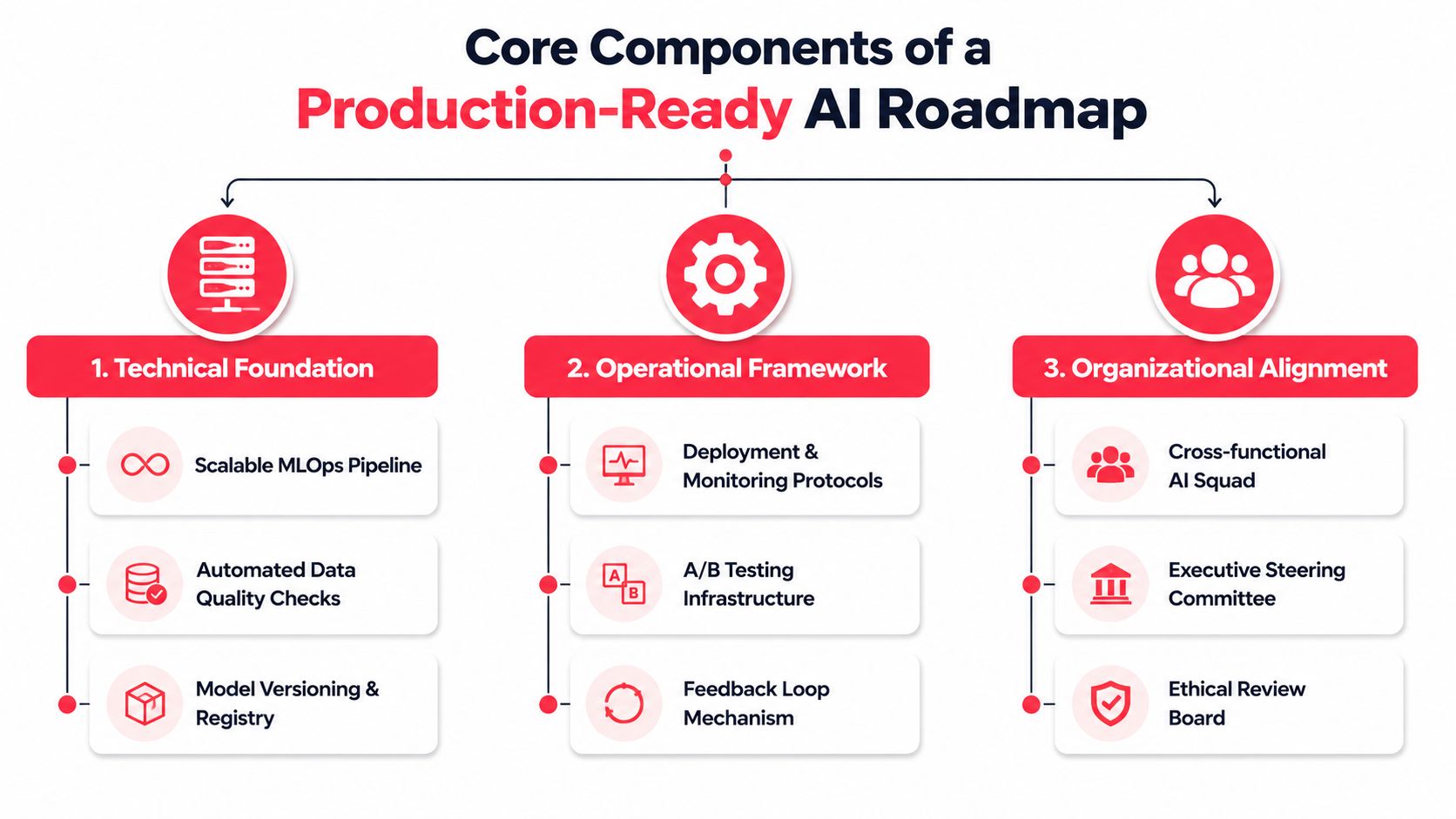
Start with a measurable business constraint
The top layer is the business outcome. A CRO may want faster lead routing, better opportunity qualification, or more consistent account research. A CMO may need more testing capacity for landing pages, messaging, or audience segmentation. A CEO may care about reducing service workload or improving forecast confidence.
Write the outcome in operational terms. “Use AI in sales” can't guide sequencing. “Reduce manual account research in the qualification workflow while maintaining review standards” gives the team a defined process to inspect.
Build the technical foundation beneath it
Data access determines which use cases can leave the backlog. Audit the source systems, field completeness, permissions, freshness, taxonomy, and ownership. A model can't repair inconsistent account records or disconnected campaign data without a separate data-quality effort.
The technology stack should fit the company's existing architecture. That may mean connecting Salesforce, HubSpot, Segment, Snowflake, BigQuery, OpenAI, Anthropic, or a retrieval layer rather than building a new platform. Choose the smallest stack that supports testing, logging, security review, version control, and rollback.
For teams comparing internal capability with external support, an independent valutazione tool AI aziendali can help structure vendor and tool decisions before procurement starts.
Assign operating ownership
A production workflow needs a named business owner, technical owner, risk reviewer, and adoption owner. The executive sponsor removes barriers, while the delivery team handles implementation and measurement. These roles can sit with existing employees, agencies, or contractors, but responsibility can't remain collective and undefined.
Governance should cover acceptable use, sensitive data, human review, vendor terms, incident handling, monitoring, and retirement. NIST's voluntary framework is a neutral starting point for internal policy and vendor review because it addresses trustworthiness across the design, development, use, and evaluation of AI systems (NIST AI Risk Management Framework).
The roadmap should also record regulatory triggers. The EU AI Act was signed on 13 June 2024, published on 12 July 2024, and entered into force on 1 August 2024, with obligations introduced in stages (EU AI Act implementation timeline). Legal review belongs at intake, not after a team has built a workflow around restricted data or high-risk decisions.
Prioritizing Use Cases by Revenue Impact and Readiness
A backlog full of interesting ideas creates political pressure rather than progress. We rank each use case on two axes: its potential effect on a business KPI and the organization's ability to supply the data, integrations, skills, and approvals required to operate it.
Start by writing the current process and baseline. For a CRO, that might include time to research an account, lead response quality, opportunity progression, or testing throughput. For a CMO, it may include experiment setup time, content review workload, or the consistency of audience research. The AI system should change a measurable process, even when the expected benefit is operational rather than financial.
Use the matrix as a starting point, then validate each score with the people who own the workflow.
| Use Case Category | Revenue Impact | Data Readiness | Integration Complexity | Typical Timeline to Production |
|---|---|---|---|---|
| CRO testing support | High | Medium to high | Medium | Short to medium |
| GTM research and personalized outreach | Medium to high | Medium | Medium | Short to medium |
| AI search optimization and answer monitoring | Medium | Medium | Low to medium | Short |
| Lead scoring and routing | High | Variable | High | Medium to long |
| Forecasting and pipeline analysis | High | Variable | High | Medium to long |
| Customer-facing autonomous workflows | Potentially high | Variable | High | Long |
The table isn't a promise of delivery time. Integration complexity, review requirements, and data cleanup can move a project into a different category. A high-impact use case with weak data readiness shouldn't automatically win. It may consume the team's capacity before the company has learned how to monitor or govern a simpler workflow.
A practical sequence often begins with a use case that has clear ownership and usable data, even if its impact is moderate. The team learns how to instrument the workflow, collect feedback, handle exceptions, and measure adoption. It can then apply those capabilities to a more ambitious sales or marketing system.
Decision test: If the team can't name the source data, workflow owner, receiving system, human reviewer, and first KPI, the use case isn't ready for the roadmap's delivery queue.
Before committing resources, use an AI readiness assessment to expose gaps that a prioritization workshop may overlook. Readiness should change the sequence, not merely add a risk paragraph to the strategy document.
Realistic Timelines and Milestone Gates
An enterprise AI roadmap commonly takes 18 to 36 months from strategy through full optimization. A practical delivery pattern includes 3 to 6 months for strategy and assessment, 6 to 12 weeks for data and infrastructure work, and an 8 to 16 week pilot before phased scaling (enterprise AI implementation roadmap timeline).
The exact calendar depends on the use case and the company's starting point. The sequence matters more than the dates because each stage exposes a different failure mode.
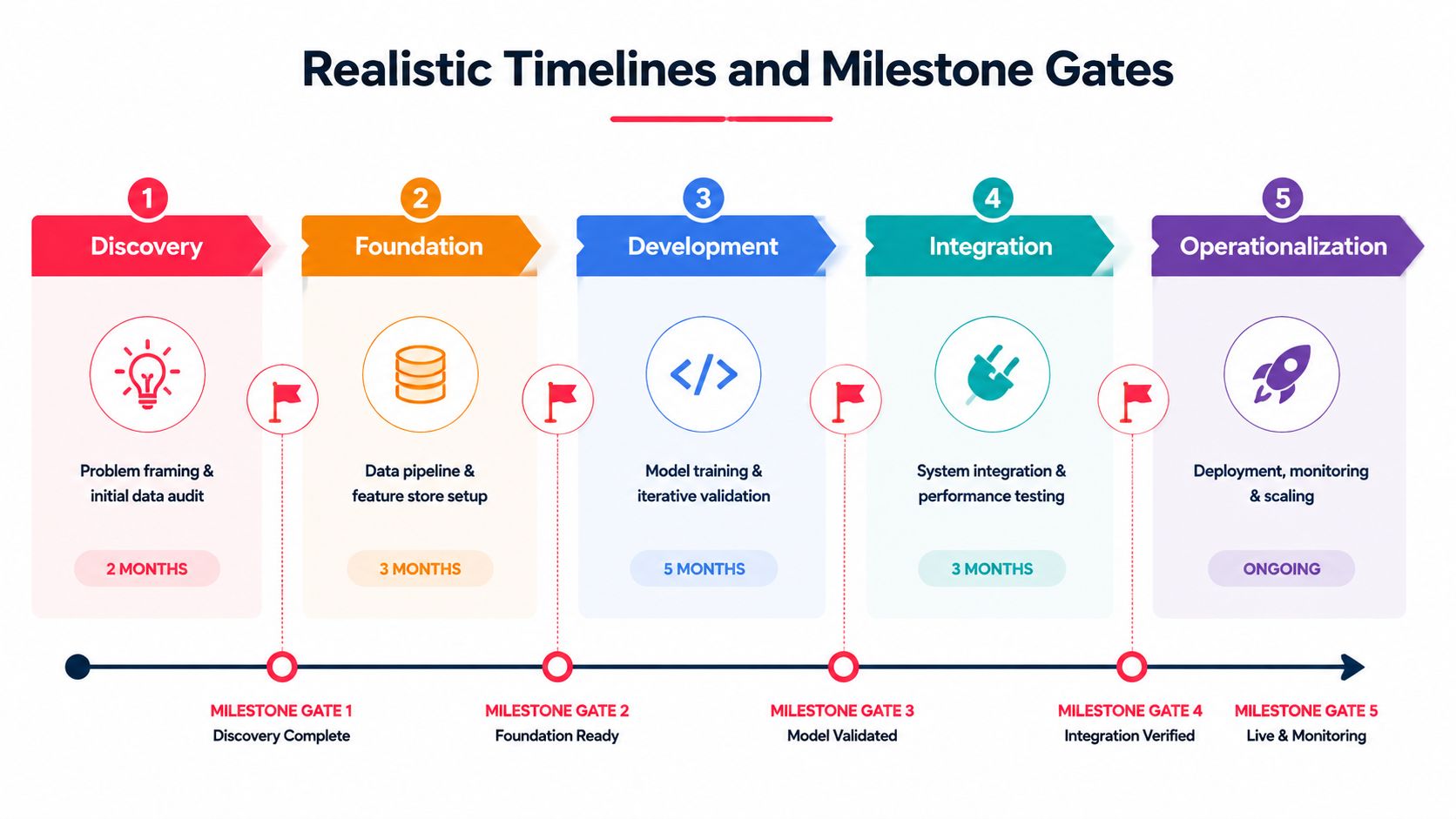
Gate one is problem and data confirmation
During discovery, the team should confirm the business problem, process owner, baseline, data sources, privacy constraints, and release conditions. A workshop that produces only a list of use cases hasn't finished discovery. The output should include a delivery brief that engineering, marketing, sales, and legal can interpret the same way.
Foundation work then prepares the source data and system connections. Companies often discover that customer records use conflicting definitions, campaign data sits in separate tools, or permissions prevent the proposed workflow from operating. Moving ahead because the prototype produced plausible answers creates debt that appears during integration.
Development should test the workflow rather than chase impressive examples. Validation needs representative inputs, failure cases, human review rules, logging, and a clear way to compare the AI-assisted process with the existing one.
Gates should block premature scaling
A pilot can pass a technical test and still fail its production gate. We recommend checking:
- Data gate: Required data is accessible, documented, permitted, and monitored.
- Integration gate: The output reaches the system where the team works, with error handling and rollback.
- Governance gate: Reviewers have approved data use, vendor terms, controls, and escalation paths.
- Workflow gate: The responsible team has trained, tested, and accepted the process.
- Business gate: The KPI, baseline, measurement method, and decision threshold are agreed.
The pilot should be designed to generate evidence for these gates. Our AI proof of concept guidance focuses on testing whether a proposed system can work inside the actual operating environment, rather than treating a polished demo as validation.
The following video provides another way to think about moving from an idea toward an executable AI initiative.
Where AI Roadmaps Fail and Why
The first failure appears during data inspection. A company chooses an attractive use case, then finds that key records are incomplete, access is restricted, or the system of record doesn't expose the fields needed for reliable decisions. Independent 2026 research reports that only 5% of businesses were AI-ready on data, with limited data access cited by 50%, privacy or compliance risk by 44%, data quality by 40%, and system integration by 38% (Beri's report on the AI data readiness gap).
The fix is uncomfortable but simple. Move the data audit ahead of vendor selection, then downgrade or redesign use cases that depend on unavailable inputs. A smaller workflow with clean data will teach the team more than a high-profile pilot that can't run against production records.
Governance arrives after the build
Legal, security, or compliance teams often enter once a prototype is ready for customer or employee use. They then raise valid questions about retention, consent, confidentiality, model training, auditability, and human review. The project pauses because nobody created an approval path at intake.
Create a risk classification and review checklist for every use case. Record which data enters the tool, where outputs are stored, who can see them, how users correct errors, and what happens when the system fails. The EU AI Act timeline makes staged obligations a planning issue for companies serving European markets, even when the initial application sits inside marketing or sales.
Skills and measurement get separated from delivery
A company may have excellent marketers, sellers, developers, and analysts, but production AI work crosses their boundaries. Without a delivery owner who can coordinate those functions, the model team optimizes output quality while the business team struggles with adoption, integration, or workflow design.
Measurement fails when the team tracks model accuracy or demo quality without tying those measures to a business process. Establish pre-production baselines and monitor adoption, exception rates, review time, conversion movement, pipeline velocity, or cost reduction as appropriate to the use case. For more examples of how teams can frame measurable AI results in 2026, compare the KPI structure with the actual workflow rather than copying headline outcomes.
We've also seen roadmaps fail because leaders fund a pilot without funding the operating work after launch. Monitoring, retraining, documentation, user support, and periodic risk review need owners and capacity. If the company can't support those responsibilities, it should delay the use case.
The Fractional CAIO as Execution Bridge
Growth-stage companies rarely lack ideas. They lack a single executive owner with enough authority to coordinate marketing, sales, data, engineering, security, and finance around one delivery sequence. A fractional CAIO fills that coordination gap without requiring a full-time executive hire before the company knows the long-term shape of its AI function.
The role should produce tangible operating artifacts:
- Roadmap governance: A ranked portfolio, decision rights, milestone gates, risk register, and executive reporting cadence.
- Delivery oversight: Vendor evaluation, technical review, workflow design, pilot management, integration decisions, and release criteria.
- Capability building: Team training, operating procedures, prompt and evaluation standards, documentation, and ownership transfer.
Stimulead offers three engagement models that fit different conditions. Executive advisory supports leaders who need an AI roadmap, vendor evaluation, implementation oversight, and board-ready strategy. Hands-on team training equips marketing and sales teams with workflows for CRO, prospecting, and AI-powered content. An AI Growth Partnership starts with an audit and prioritized roadmap with KPIs, then continues through fractional CAIO execution support.
The right model depends on the bottleneck. If the leadership team has delivery capacity but lacks direction, advisory may be enough. If teams understand the strategy but can't apply tools reliably, training is the better first move. If several functions need coordinated execution, ongoing fractional leadership provides the operating structure.
For a broader comparison of fractional CAIO and full-time Chief AI Officer roles, focus on decision rights, delivery accountability, and the point at which a permanent internal role becomes justified.
A useful adjacent reference is RevOps automation with MarTech Do, particularly for companies connecting AI work to marketing operations, sales processes, and system ownership.
Your Next Decision on AI Roadmap Execution
Before commissioning a roadmap, score the company's readiness through direct questions:
- Problem clarity: Can the executive sponsor name a specific process and KPI?
- Data readiness: Can the team access, prepare, and govern the required data?
- System integration: Is there a clear destination for the AI output?
- Team capacity: Is a cross-functional owner available for delivery and adoption?
- Executive sponsorship: Can one leader remove barriers across functions?
- Measurement: Is the baseline defined before the pilot starts?
- Governance: Can legal, security, and operational reviewers approve the workflow?
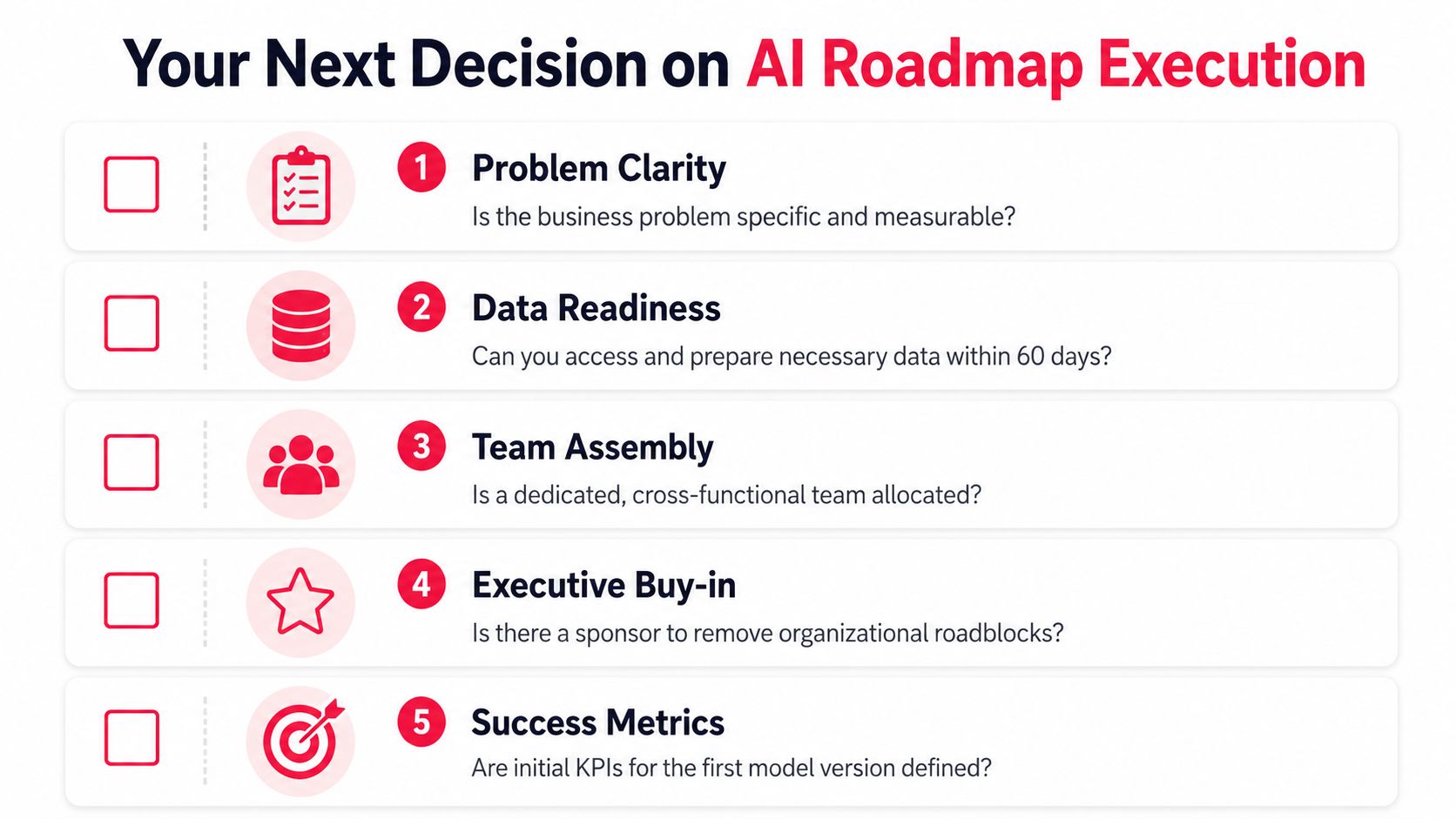
If most answers are clear, begin roadmap development with internal owners and a tightly bounded first use case. If the company has executive intent but weak data, integration, or governance, bring in fractional leadership to sequence the readiness work before approving larger pilots. If the team lacks practical AI capability, start with hands-on training and use the first workflow to establish evaluation and review habits.
For companies that need an audit, prioritized roadmap, KPI design, and continuing execution support, review Stimulead's AI Growth Partnership. Bring your current pilots, system map, data constraints, and stalled decisions to the first working session, then decide whether the next investment belongs in a new use case or in the foundation required to ship the one already on your list.
