
AI Overviews changed the math. Across 68,879 tracked Google queries, users clicked a traditional result in 8% of visits when an AI summary appeared, versus 15% without one. That means what is AEO is now a forecasting question for CEOs, CMOs, and CROs, because the old model assumes rankings create clicks, clicks create pipeline, and that chain is breaking.
AEO is the discipline of getting a brand cited inside AI-generated answers rather than merely ranked in blue links, and we treat it as a revenue-attribution problem before we treat it as a content problem. If your weekly reporting still stops at traffic and rank, you're reading the wrong dashboard.
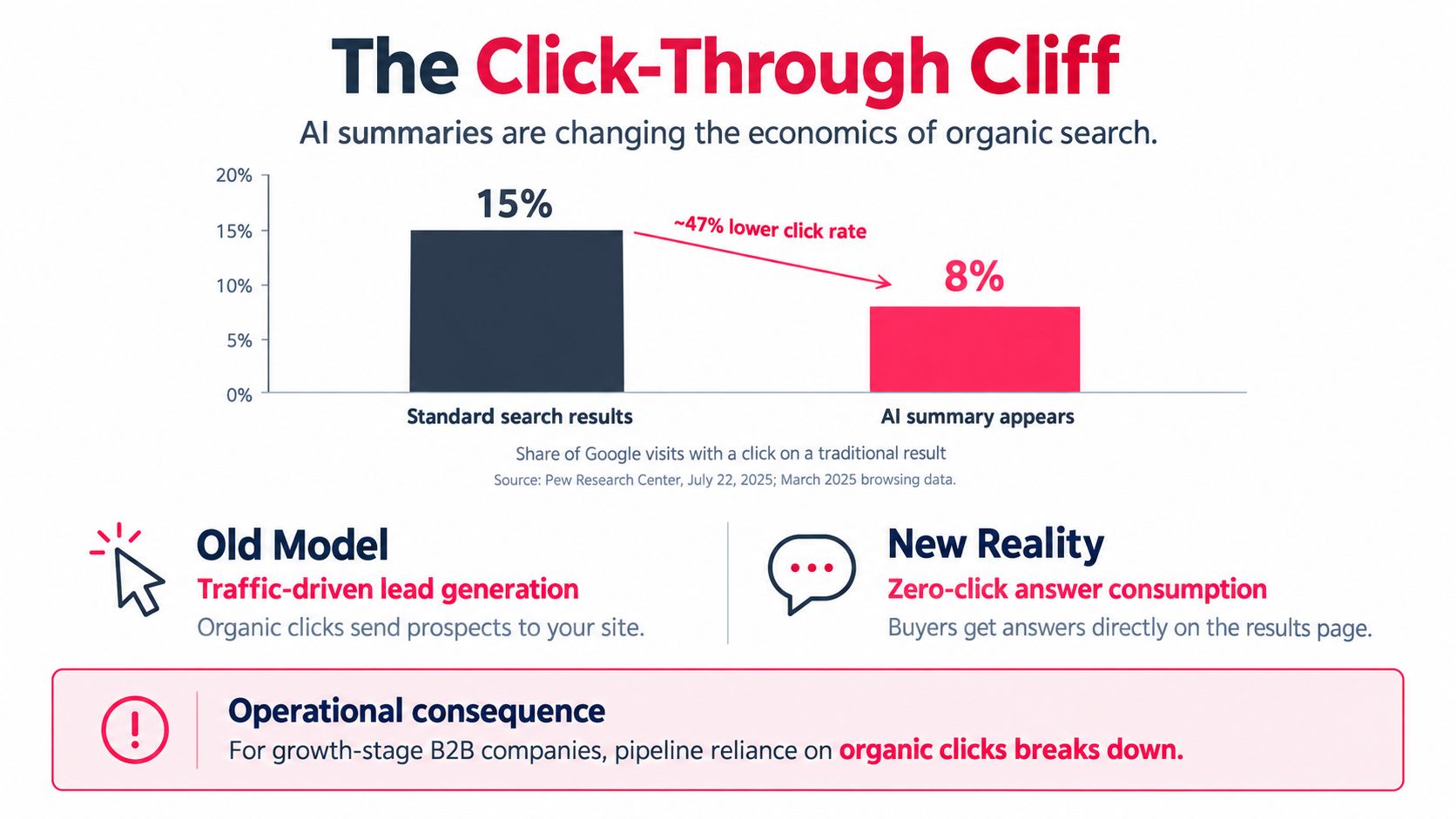
Table of Contents
- The Decision a CEO Faces When AI Answers Replace Clicks
- What AEO Actually Is and How It Differs from Traditional SEO
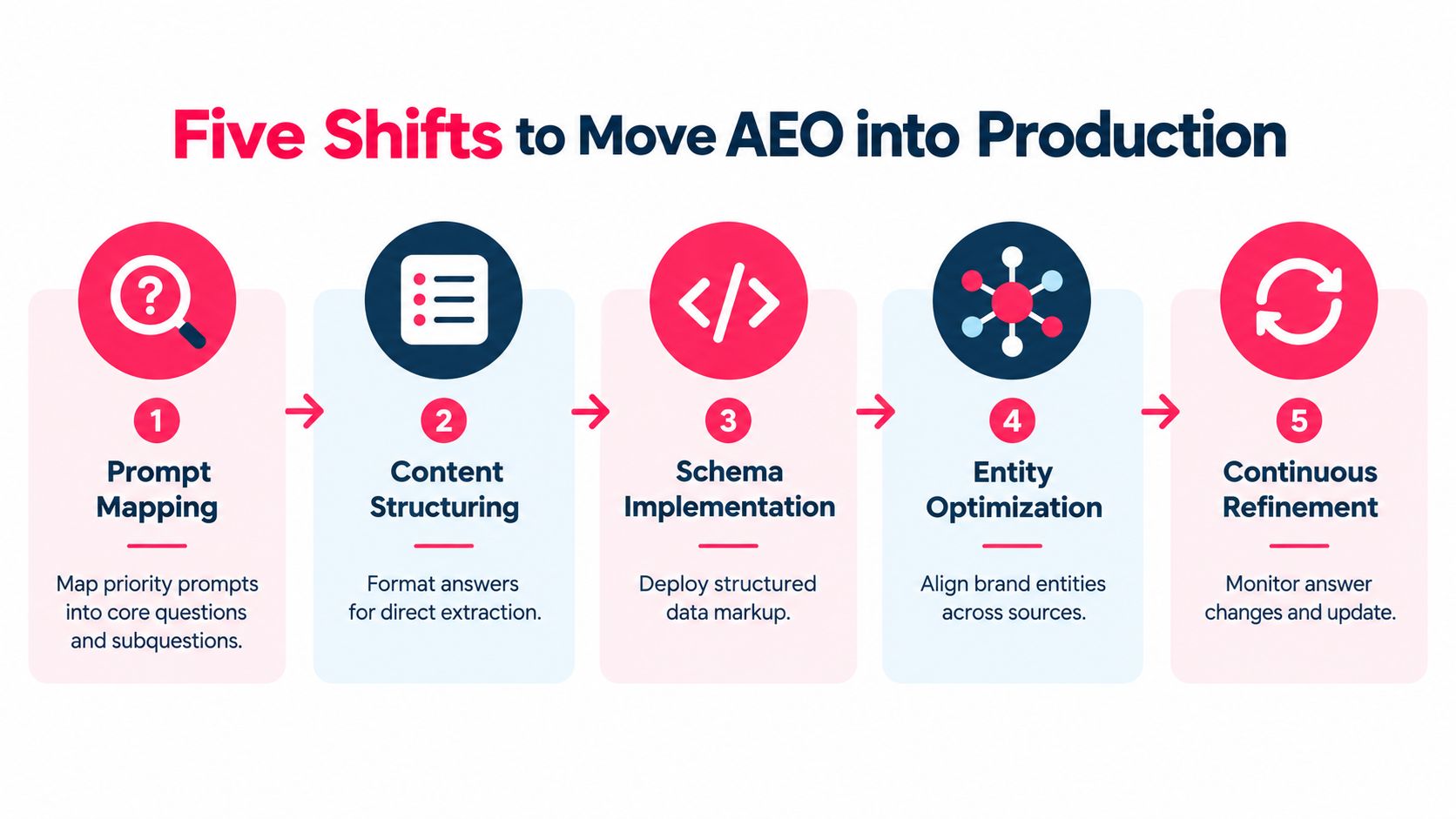
- The Five Operational Shifts That Move AEO From Theory to Production
- What Does Not Work and Where AEO Fails
- Measuring AEO When Buyers Stop Clicking the Pipeline Math
- Three Use Cases That Show AEO Inside Existing Revenue Motions
- The 90-Day AEO Decision and Where a Fractional CAIO Fits
The Decision a CEO Faces When AI Answers Replace Clicks
The decision is simple, even if the implications aren't. Do you keep treating search as a traffic channel, or do you start treating AI citations as a first-class input to forecasting, pipeline coverage, and sales efficiency?
Pew's numbers force that choice into the open. When an AI summary appears, users click a traditional result in 8% of visits, versus 15% without one, which means the familiar ranking-to-visit-to-pipeline chain loses reliability at the exact moment buyers are getting answers faster. For a growth-stage B2B company, that's not a content nuance, it changes how a CMO explains next quarter and how a CRO sets expectations with the board. Pew's reported findings make the point bluntly.
Practical rule: if your team can't tell you where AI answers mention you, your pipeline forecast is missing a channel.
We think the right response is to move AEO out of the SEO bucket and into executive reporting. That doesn't mean abandoning rankings. It means accepting that a page can win visibility inside an answer, shape a shortlist, and still produce no click at all. The leadership question becomes whether your brand is being represented accurately when buyers ask comparative or recommendation-oriented prompts.
What AEO Actually Is and How It Differs from Traditional SEO
AEO is the discipline of structuring and strengthening a company's information so AI-mediated search systems can retrieve it, assess it as credible evidence, and use it in generated answers. Traditional SEO still matters, but it's aimed at getting a page to rank and earn a click. AEO is aimed at getting your brand named, cited, and described correctly inside the answer itself.
Google's own guidance is clear enough for operators, because it says AI Overviews and AI Mode may use query fan-out across multiple subtopics and sources, and that there's no special schema.org markup required for eligibility. In practice, that means the control layer is clean, crawlable text, good page structure, descriptive titles, accessible links, and accurate structured data where it already applies. Google's AI features documentation matters more here than old-school schema superstition.
| Dimension | Traditional SEO | Answer Engine Optimization |
|---|---|---|
| Objective | Rank a page and earn a click | Get cited inside an answer |
| Signal set | Keywords, backlinks, technical health | Entity clarity, claim structure, evidence density, third-party corroboration |
| Output | Rank, impressions, organic sessions | Mention rate, citation share, factual accuracy |
| Leadership use | Traffic planning | Revenue attribution and recommendation quality |
| Failure mode | Low rankings | Being absent, misquoted, or recommended inaccurately |
For a CEO, that table changes the conversation. For a CMO, it changes content priorities. For a CRO, it changes which motions deserve budget, because an answer engine can now influence buying intent before a visit ever appears in analytics.
If you want the blunt SEO-versus-AEO distinction in one place, we've laid it out in our internal AEO vs SEO breakdown.
The Five Operational Shifts That Move AEO From Theory to Production
AEO starts working when teams stop chasing single keywords and start mapping the questions buyers ask. That means turning one topic into a coverage graph, core question, subquestions, entities, comparisons, evidence, and use cases. A prompt about "best security review software" is several prompts about compliance, integrations, shortlist criteria, pricing model, and implementation risk.
1. Build prompt maps, not keyword lists
A growth-stage B2B team should map priority prompts by funnel stage and market. A demand gen lead owns the research set, the product marketer owns the claims, and the CRO cares whether the answer positions the brand inside comparison prompts. We've seen that work move faster when the content lead and sales lead agree on the same prompt set.
2. Rewrite pages for extractable claims
Each section needs one answerable claim, stated plainly, with dates, units, geography, and supporting sources where relevant. That makes retrieval easier for answer systems and review easier for humans. The editorial habit here is boring on purpose, because ambiguity is what gets your claim skipped or distorted.
3. Test the same prompt set repeatedly
Generated answers vary, so you need repeated runs across the same prompt set. A fixed benchmark helps you see whether a change improved mention rate, citation rate, and accuracy, or just produced noise. Teams using multi-agent workflows often need orchestration discipline, and a useful reference is multi agent systems coordination explained, because content, product, and revenue teams will otherwise pull in different directions.
4. Measure answer quality, not just appearance
Track mention rate, citation rate, citation share, factual accuracy, competitor displacement, answer sentiment, and downstream assisted conversions. AEO without those metrics is theater. The point isn't to celebrate being present, it's to know whether the answer is accurate and commercially useful.
5. Separate visibility from traffic
AEO can improve visibility without creating a visit, so reporting has to split those two outcomes. That means one line for answer inclusion and another for downstream behavior. Teams that collapse them into a single referral metric end up undercounting influence and overrewarding clicky answers that don't move deals.
The cleanest implementation pattern we see is simple, prompt mapping in one sheet, content fixes in one backlog, and answer tracking in one dashboard.
For operators who want a testable visibility lift, an arXiv analysis of GEO methods reported that targeted optimization could increase visibility in generative-engine responses by up to 40%. That's a hypothesis worth testing, not a promise worth selling. The study summary supports the direction, but the execution still has to prove itself in your own category.
What Does Not Work and Where AEO Fails
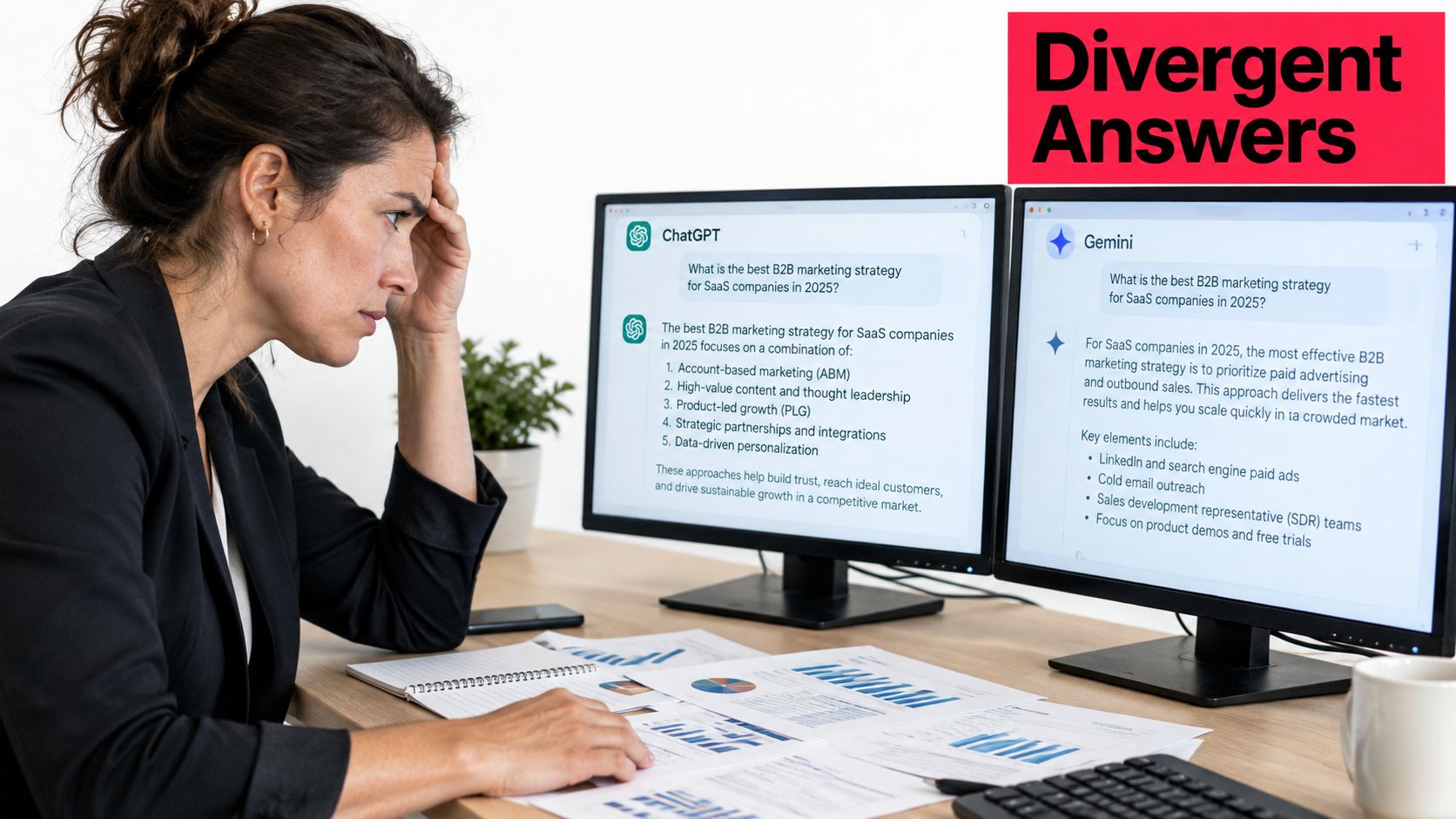
The biggest mistake is assuming one answer engine behaves like the next. An arXiv study of more than 24,000 conversations across OpenAI, Perplexity, and Google found citation patterns diverged by provider and clustered around a relatively small set of news outlets. That means a page can look strong in one assistant and weak in another, even when the topic is the same. The study summary is a warning, not a comfort blanket.
Regional and language variation creates another trap. The same prompt can return different recommendations in different markets, which makes global consistency a governance problem, not a content style issue. If your product attributes drift by region, answer engines will amplify the inconsistency.
Citation decay is quieter and more damaging. One outdated stat on a third-party page can keep reappearing in generated answers long after your own page was corrected. Recurring audits and correction workflows matter here. If you do not own the correction path, you do not own the recommendation.
AEO also fails when the answer is technically visible but commercially misleading. A brand can be cited in a negative comparison with the wrong product attributes attached, and that error can spread faster than the fix. Legal, product marketing, and sales leadership need to review that risk together.
Similarweb's June 2025 estimate put AI-platform referral visits at 1.13 billion versus 191 billion Google referrals, with AI referrals up 357% year over year. That is momentum, but it is still a smaller channel than traditional search. Treat AEO as a revenue-attribution problem for zero-click buying, not a traffic contest. Measure claim accuracy, regional consistency, and whether answer presence helps deals close, because authority traffic alone creates a paradox. The brands most often cited are not always the ones getting the most visits, so budget decisions need to follow influence, not vanity visibility.
Measuring AEO When Buyers Stop Clicking the Pipeline Math
The measurement mistake teams make is treating referral traffic as the whole story. It isn't. AEO needs four separate lenses, discoverability, inclusion, citation quality, and revenue influence.
What the dashboard should show
- Discoverability: whether your priority prompt set surfaces the brand category at all.
- Inclusion: whether the brand appears in the answer.
- Attribution: whether the inclusion turns into assisted conversions or influenced opportunities.
- Revenue impact: whether answer presence helps pipeline move faster or close more cleanly.
That four-part split matters because AI search often behaves like a one-stop answer. In a study of 1,526 practical search tasks, ChatGPT users found correct solutions faster and relied significantly less on primary web sources than Google users. That tells us direct attribution will understate influence, because the buyer may get what they need without ever visiting the site. The task study supports the shift to assisted-conversion logic.
For a CRO board pack, we'd rather see this KPI set than a raw traffic chart:
- Prompt-set mention rate
- Citation share versus named competitors
- Accuracy audit pass rate
- Branded-search lift after answer visibility changes
- Direct-traffic movement on priority pages
- Self-reported attribution from sales calls
- CRM opportunity influence
If you need an operating reference for broader marketing measurement, we've put our framework in how to measure marketing effectiveness.
Board-level rule: if the answer engine names you correctly and the pipeline doesn't move, your offer or follow-up is the problem, not only the content.
Three Use Cases That Show AEO Inside Existing Revenue Motions
A CRO team can tie AEO to experiment velocity by mapping prompt sets to the test backlog. When buyers ask for comparison or best-of guidance, the brand should appear in the answer set alongside the pages already supporting conversion tests. In our client work, that's the cleanest way to turn answer inclusion into a signal the experimentation team can use.
A GTM engineering team can use entity clarity and consistent product attributes across the site and reputable third-party pages so shortlist prompts recommend the brand accurately across stakeholders. That matters in B2B buying committees, where the first answer often gets forwarded inside the account. The evidence here is thinner than the measurement section, but the operating logic is strong.
A personalized outbound motion can use answer-engine output as a research input. SDRs should confirm what the answer systems already say about a prospect before outreach, instead of opening from scratch. That usually gives the account team a cleaner angle and fewer blind spots.
We think the operating split is obvious. AEO is a horizontal capability that feeds CRO, GTM, and content, not a vertical team that sits apart from revenue work.
For a plain-language explanation of the term, see what AEO means for revenue teams. Our AEO definition for 2026 sets out the KPIs we use, and what AI visibility is covers how to measure your presence across AI answers.
The 90-Day AEO Decision and Where a Fractional CAIO Fits
The first 90 days should be sequenced, not sprayed across every page. Weeks one to two are for a prompt audit across priority categories and competitors, then a baseline report on mention and accuracy. Weeks three to six are for the highest-impact content and entity fixes on pages already tied to revenue. Weeks seven to ten are for measurement cadence and correction workflows. Weeks eleven to twelve are for leadership alignment on what belongs in forecasting.
If you want outside support, a fractional CAIO function matters here. Stimulead's fractional CAIO vs full-time chief AI officer comparison is a useful starting point for choosing scope, and how a fractional AI dept works is a good lens for understanding why the model stays useful after the initial audit. Stimulead's AI Growth Partnership starts with the audit and roadmap, then continues as ongoing execution support so the work doesn't stall after the novelty wears off.
The next move is straightforward, commission the audit, put AI citation metrics next to pipeline, and decide which categories deserve correction first.
If you want us to pressure-test your prompt set, your citation quality, and your revenue reporting, book a working session with Stimulead and we'll turn your current AEO posture into a 90-day action plan your CMO and CRO can run.
