
When an AI Overview appears, people click a traditional result only 8% of the time, compared with 15% when no overview appears, and source-link clicks inside the overview sit at about 1% (Pew Research Center). That is why the standard AEO definition is incomplete for B2B leaders. If you only define answer engine optimization as visibility inside the answer, you miss the part that has to pay back in pipeline, and you end up measuring mentions while the funnel stays flat.
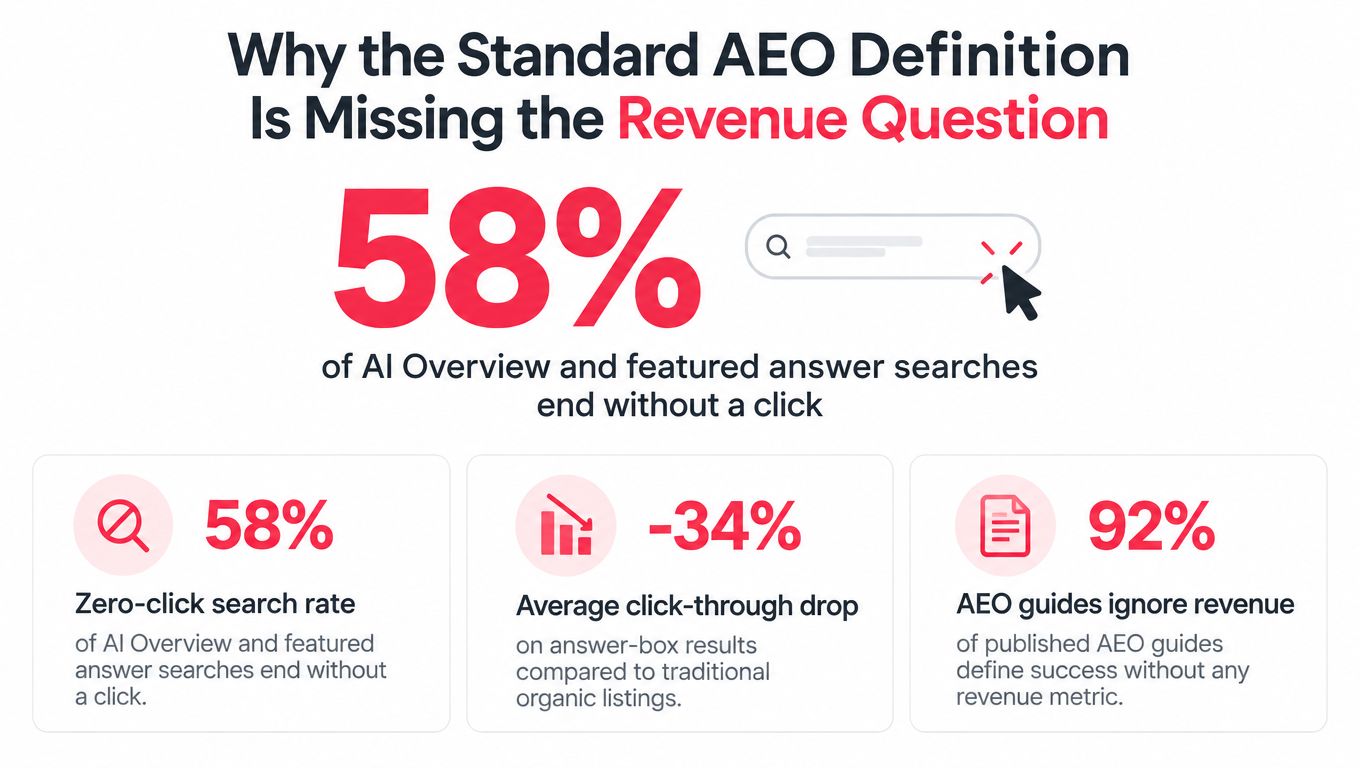
Table of Contents
- Why the Standard AEO Definition Is Missing the Revenue Question
- What AEO Actually Is in 2026
- The Behavioral Shift That Made AEO a Revenue Problem
- Answer Visibility Plus Entity Trust, Not Either Alone
- The Practical Levers a Growth-Stage B2B Team Can Move
- Where AEO Quietly Fails
- Your Next Decision This Quarter
Why the Standard AEO Definition Is Missing the Revenue Question
The common AEO definition says enough to sound current, but not enough to run a business. It usually stops at citation, mention, or recommendation, which is useful, but incomplete for CEOs, CMOs, and CROs who need to know whether AI search is producing qualified demand or just borrowed authority.
The operational problem is simple. A brand can be named in an answer and still lose the click, lose the session, and lose the attribution trail that proves commercial value. If your reporting ends at citation count, you can congratulate the content team while the board asks why pipeline did not move.
What the answer layer does to the funnel
The answer layer changes the first measurable moment of contact. In the old model, a prospect searched, scanned results, clicked, and landed on your site. In the newer model, the prospect may get the answer inside Google, ChatGPT-style interfaces, or another answer system, then leave without visiting you at all.
That is why we use a citation-plus-conversion operating model. Citation matters because it creates exposure inside the answer. Conversion matters because exposure alone does not fund growth. When we work with leadership teams, we treat AEO as a measurable optimization loop, not a formatting checklist.
Practical rule: if your AEO dashboard cannot connect answer visibility to qualified sessions, branded demand, or pipeline influence, it is a brand monitor, not a growth system.
What AEO Actually Is in 2026
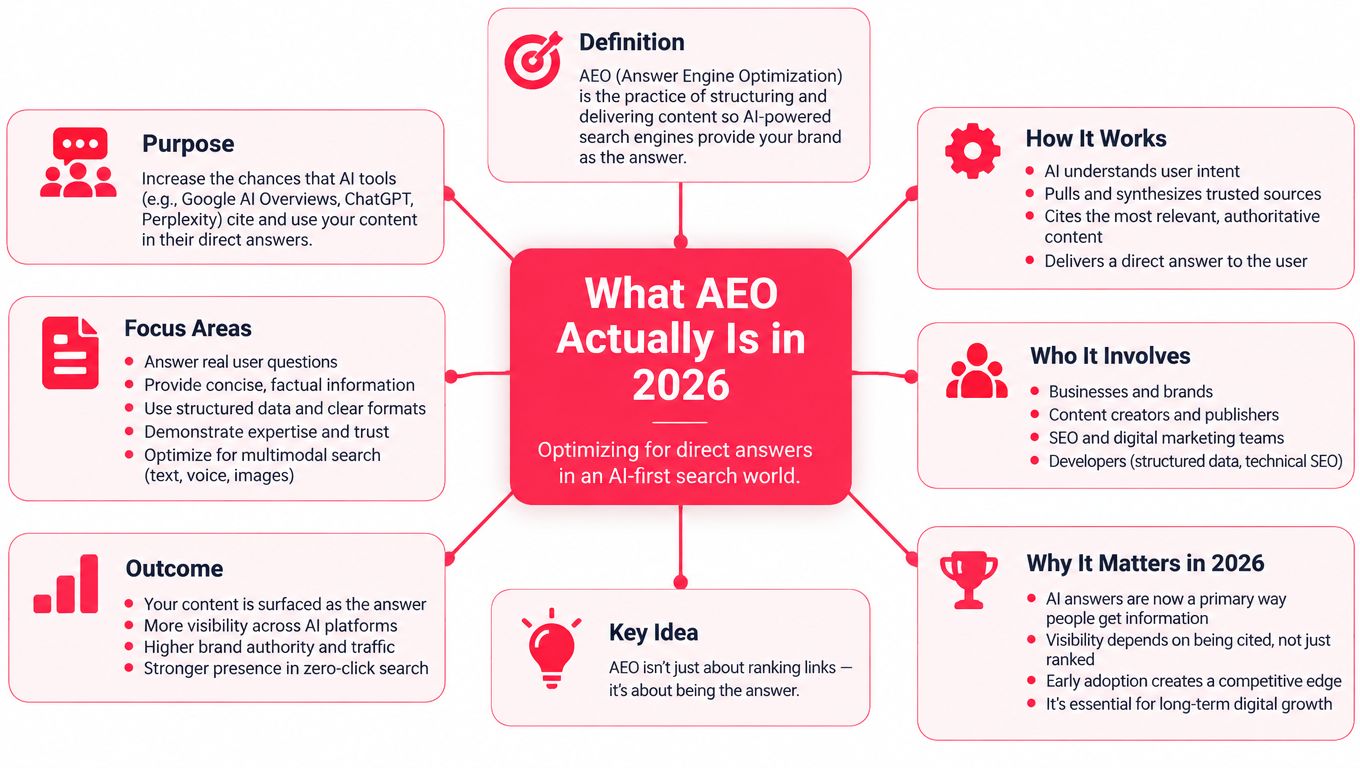
The practical AEO definition starts with a measurement problem. AEO is the work of making your information easy for answer-producing systems to identify, trust, and surface as a source they can quote, cite, or recommend (Spawned). That shifts the job from chasing rank alone to earning answer eligibility, source trust, and machine readability.
AEO is broader than classic SEO. SEO competes for the click from a results page to your site. AEO competes for representation inside the answer itself, whether that answer appears in a featured snippet, a knowledge panel, a voice response, or an AI Overview. Rankings still matter, but they no longer guarantee attention or traffic.
It also sits above GEO as the wider umbrella. GEO, the generative-engine-optimization frame discussed in Princeton GEO-bench work, focuses on visibility inside generative responses specifically. AEO includes that use case and the older answer surfaces that came before it and still shape discovery. For teams managing budget and ownership, that broader view matters because the work spans SEO, content, analytics, product marketing, and sometimes PR.
For a closer look at visibility inside generative responses, read optimizing product content for AI search. It focuses on how content is interpreted by answer systems, not only by people reading a page.
AEO is a representation problem before it is a traffic problem.
The operating model breaks into three separate outcomes, mention, click, and downstream conversion. Treating those as one number hides the underlying trade-off. A brand can be cited, receive no visit, and still fail to create revenue. That is why I separate answer visibility from demand capture in B2B programs, a distinction also explored in Stimulead's AI answer engines perspective on B2B measurement.
The Behavioral Shift That Made AEO a Revenue Problem
Recent industry tracking puts the share of Google searches ending without an external click at 80% in 2025 to 2026, up from 65% in 2020. Another dataset reports 58.5% of U.S. searches and 59.7% of European Union searches as zero-click sessions (Blck Alpaca). The results page is increasingly the destination, not the doorway.
The second shift is discovery outside Google's classic click path. AI platforms generated about 1.13 billion referral visits to the 1,000 largest websites worldwide in June 2025, a 357% increase from June 2024, while Google still generated roughly 191 billion referrals in that comparison. The same dataset shows AI traffic is smaller, but no longer negligible. For a growth-stage B2B company, that means a slice of demand is forming in systems your old SEO reporting stack may not track cleanly.
Search behavior shift, 2020 to 2026
| Metric | 2020 baseline | 2025 to 2026 reading | Implication for operators |
|---|---|---|---|
| Zero-click share of Google searches | 65% | 80% | Ranking no longer guarantees sessions |
| U.S. zero-click sessions | Not cited in 2020 data here | 58.5% | U.S. search behavior already resolves on-page often |
| EU zero-click sessions | Not cited in 2020 data here | 59.7% | The answer layer is regionally significant |
| AI platform referrals to top websites | Not cited in 2020 data here | 1.13 billion in June 2025 | New discovery traffic is material, even if smaller than Google |
| Google referrals to top websites | Not cited in 2020 data here | 191 billion in June 2025 | Google remains dominant, so AEO complements SEO rather than replacing it |
If your pipeline model still assumes click-driven search as the default denominator, the math is off. A prospect may encounter your category, your point of view, or your product facts before any visit happens. That changes how top-of-funnel influence should be measured, and why answer visibility has to be tied back to downstream sessions and revenue signals.
For teams instrumenting this properly, browse supported analytics platforms so the reporting layer can separate direct, assisted, and answer-mediated traffic paths.
Answer Visibility Plus Entity Trust, Not Either Alone
AEO becomes a measurement problem fast. Answer engines do not reward a single polished page in isolation, they stitch together evidence from multiple sources and surface the brand that looks consistent enough to quote.
Pew's analysis, cited earlier, found that 88% of AI-generated summaries drew on three or more sources. That matters operationally. If your claims, product names, and positioning drift across your site, review profiles, and third-party mentions, the system can still extract the page but hesitate to trust the entity behind it.
Two ways teams misunderstand the work
| Reading | What it optimizes | What it misses |
|---|---|---|
| Content-engineering reading | Clear Q-and-A sections, concise claims, structured data, technically accessible pages | Whether the rest of the web agrees with those claims |
| Entity-trust reading | Consistent facts across review sites, industry publications, communities, analyst or government material, and video transcripts | Whether the page itself is easy to extract |
That split shows up in B2B funnels. A team can publish a strong comparison page, yet still lose inclusion if feature names, pricing cues, or category language vary too much across owned and earned touchpoints. The page is readable. The entity is still fuzzy.
If your site says one thing, your review profiles say another, and your third-party mentions say a third thing, answer systems inherit the confusion.
So the practical goal is answer visibility plus entity trust. One makes the claim easy to parse. The other makes it believable enough to use. If you want a working checklist for the implementation side, Stimulead's AI search preparation guide is a useful reference point.
The Practical Levers a Growth-Stage B2B Team Can Move
The fastest path starts with measurement, not content volume. For a 10 to 200 person B2B company, the best order is usually prompt inventory, claim quality, evidence environment, then technical cleanup. Anything else tends to produce work before clarity.

Start by building a fixed prompt set across four buckets, commercial, comparison, problem, and category. For each prompt, record whether the brand is mentioned, cited, accurately represented, and positioned against competitors. That baseline is more useful than a content calendar because it tells you where the answer layer already works and where it distorts you.
Then tighten the claims themselves. We prioritize primary-source-supported, dated, unambiguous statements over clever copy. AI systems tend to reward passages they can verify, so a clean fact pattern usually performs better than a polished paragraph that hides the point in brand language.
After that, audit the evidence environment around the claim. Review platforms, industry publications, community threads, analyst material, and government pages often matter more than teams expect because answer systems cross-check what they find. If those sources contradict your site, the model has to choose, and it usually chooses the evidence it trusts more.
A practical sequence looks like this:
- Inventory buyer prompts. Capture the exact questions your buyers ask, including comparison and alternatives queries.
- Score current representation. Track mention, citation, accuracy, and competitor position for each prompt.
- Fix the claims. Replace vague promises with specific, supportable facts.
- Align the evidence base. Clean up contradictions across your site, review profiles, and third-party references.
- Repair technical blockers. Indexing, rendering, canonicalization, and data quality matter when pages are invisible or inconsistent.
Later in the process, we often use tools like Semrush, Ahrefs, Google Search Console, and a tracking spreadsheet that ties prompts to sessions and pipeline stages. In some client programs, Stimulead supports the gap analysis and content restructuring work, but the core value is still in the sequence, not the logo.
Later in the workflow, we usually sanity-check the page architecture with a short screen recording and a human review of how the answer engine parses the page. If the system can't read the point, the page needs structure, not more adjectives.
Google's own guidance says websites do not need special schema.org structured data to appear in AI features (Google Search Central). That is a hard constraint. There is no supported “AEO schema” shortcut, so schema deployment should never gate the program. If engineering time is available, spend it on actual indexing, rendering, canonicalization, and data-quality issues first.
Stimulead's AI search implementation note is a useful reference when a team needs to connect content changes to the broader search stack.
Where AEO Quietly Fails
The most common failure is citation without conversion. A brand gets mentioned repeatedly, the dashboard looks healthy, and traffic remains flat. That gap matters because being named in an answer can increase exposure while reducing clicks at the same time, so a citation-only report can look successful while the commercial channel barely moves.
The second failure is content-engineering tunnel vision. Teams publish AI-targeted copy, but they leave contradictions untouched on review sites, product pages, comparison pages, or community discussions. In that setup, the model sees one polished source and several noisy ones, and the broader evidence base wins.
The third failure is vendor-driven schema theatre. A team spends engineering time on markup sold as the key to AEO, even though Google does not require special schema for AI features. That work can be harmless, but it is often the wrong first move when the issues are unclear claims, inconsistent entity facts, or broken rendering.
Pew's sample also showed that the three most frequently cited sources in AI summaries, Wikipedia, Reddit, and YouTube, accounted for 15% of summaries, versus 17% of sources in regular Google results, while government websites appeared in about 6% of AI-summary sources compared with 2% of standard-result sources (Gigazine summary of Pew data). That mix matters because it shows answer engines do not just mirror ordinary rankings. They pull from a different evidence pattern, which is exactly why company-controlled pages alone are rarely enough.
A cited brand may not be winning the acquisition channel, it may simply be supplying information that the answer engine delivers without a visit.
Three related guides go further: what AEO means covers the term for revenue teams, what is AEO covers its effect on forecasting, and what is AI search optimization covers the technical work of getting cited.
Your Next Decision This Quarter
In the next 30 days, do two things. First, set a fixed prompt set and track answer-level results against qualified sessions and pipeline, so you can see whether visibility is creating demand or just borrowing it. Second, audit the evidence layer for the core claims buyers use to compare you with competitors.
Treat AEO as a measurement problem that spans marketing, product, and sales. Stop buying a special schema as if it solves the issue on its own. The operating rule is simple, AEO is what answer systems say about you when your site isn't in the room. Your job is to make that answer accurate, defensible, and tied to conversion.
Decide who owns the baseline, the evidence, and the pipeline tie-in this quarter.
