
Most advice on how to measure marketing effectiveness is wrong in one predictable way. It treats tracking as the job. It isn't. Tracking is plumbing. The job is deciding where to put budget, which messages move pipeline, which channels deserve more headcount, and whether marketing is creating future demand or just harvesting existing demand.
A lot of teams already have dashboards for Google Analytics, HubSpot, Salesforce, LinkedIn, Meta, and revenue reporting. They still can't answer simple operating questions. Which campaigns created qualified pipeline? Which content changed win rates? Which brand efforts gave sales more pricing room? Which AI search surfaces are starting to influence demand before a click ever happens?
If you're leading a growth-stage company, you don't need another beginner guide about pageviews and click-through rates. You need a measurement system that ties marketing activity to revenue, pipeline, retention, and real go-to-market decisions. That's the standard now.
Table of Contents
- Stop Drowning in Data and Start Measuring What Matters
- Redefine Your North Star from Vanity to Value
- Build Your Three-Layer Measurement Stack
- Choose an Attribution Model for the Real World
- Design Your High-Velocity Experimentation Program
- Measure What Is Next AI Search and Agent Commerce
- Your First 90 Days to Better Measurement
Stop Drowning in Data and Start Measuring What Matters
More dashboards don't fix weak measurement. They usually make it worse.
Most leadership teams are overloaded with channel data and starved for operating clarity. Marketing reports show traffic, impressions, clicks, MQLs, and engagement trends. The CEO wants to know what created revenue. The CRO wants to know what improved close rates. The CMO wants to know where to cut spend without slowing pipeline. Those are different questions, but they all require the same thing. A measurement model built around business decisions.
That's why I push teams toward data-driven marketing measurement that starts with decision-making, not with tools. If you want a useful outside reference on that shift, Trackingplan has a solid piece on data-driven marketing measurement that complements this view.
The old model also breaks in AI-mediated buying. Prospects now discover vendors through AI summaries, recommendation engines, answer surfaces, and private community mentions that never appear as a neat last-click trail. If you're still treating web sessions as the center of truth, you're measuring a shrinking slice of buyer behavior.
Start with the revenue question
Ask your team these four questions:
- Budget question: Which channels should get more spend next quarter?
- Pipeline question: Which campaigns influenced qualified opportunities, not just form fills?
- Sales question: Which assets helped reps move deals forward?
- Strategy question: Which marketing activity improved retention, pricing, or category position?
If your reporting can't answer those, your measurement system is decorative.
Practical rule: Every metric in your stack should support a budget decision, a pipeline decision, or a GTM decision.
A lot of companies also miss buyer understanding in the process. They instrument events but don't connect them to buyer intent, sales objections, or deal progression. That's where better customer insight work matters. Stimulead's piece on how B2B marketers use data for understanding buyers is worth reading if your team has plenty of data and weak message-market fit.
Redefine Your North Star from Vanity to Value
If your definition of marketing effectiveness stops at leads or ROAS, you're managing too low in the stack.
Marketing affects revenue in direct and indirect ways. Some activity creates immediate pipeline. Some lowers CAC over time. Some gives sales air cover in competitive deals. Some changes whether buyers search for your brand by name. Some increases willingness to pay. Those outcomes belong in the measurement model, or leadership will keep underfunding the work that creates future demand.
A strong advisory view from TrinityP3 makes this point well. Chasing short-term attribution often misses the delayed effect of brand activity, and the better question is what shifted demand, pricing power, or retention over time, not only what converted this week. Their piece on the effectiveness gap in marketing performance is one of the better references on this problem.
Start with business outcomes
I usually separate metrics into two buckets.
| Type | What it tells you | Typical use |
|---|---|---|
| Tactical efficiency | Whether a campaign executed efficiently | Bid changes, creative swaps, landing page fixes |
| Strategic value | Whether marketing changed business position | Budget allocation, category strategy, pricing confidence |
Tactical efficiency metrics include channel and campaign signals your team needs to operate. Strategic value metrics are the numbers leadership needs to judge whether marketing is building a stronger company.
Your North Star set should be small. Keep it to 3–5 core metrics, consistent with the workflow described by Siteimprove in its guidance on measuring marketing campaign effectiveness. More than that and your exec team will drift back into dashboard tourism.
Run one leadership workshop
Get the CEO, CMO, CRO, finance lead, and whoever owns RevOps in one room. Lock the door for ninety minutes. Decide these five things:
Primary business outcome
Is this year about new logo pipeline, expansion revenue, retention, category share, or margin quality? Pick one primary outcome.Secondary strategic outcome
Pricing power, win-rate support, or brand consideration usually feature in this outcome.Buying path reality
Name how buyers discover and evaluate you. Include AI search, communities, partners, dark social, SDR outreach, and sales-led touchpoints.Proof threshold
Decide what evidence is enough to move budget. Dashboard movement alone usually isn't enough.Metric owner
Every core metric needs a human owner. No shared ownership. Shared ownership becomes no ownership.
If a metric has no owner and no decision attached to it, delete it.
For teams working on AI search and answer-engine visibility, add one more layer. Track whether your brand appears in AI-mediated recommendations and whether that visibility shows up later as branded search, direct traffic quality, or sales mentions. If you need a useful external reference point, Algomizer published a practical guide to AI visibility metrics that can help your team think beyond classic SEO reporting.
Build Your Three-Layer Measurement Stack
A metric pile isn't a measurement system. Structure matters.
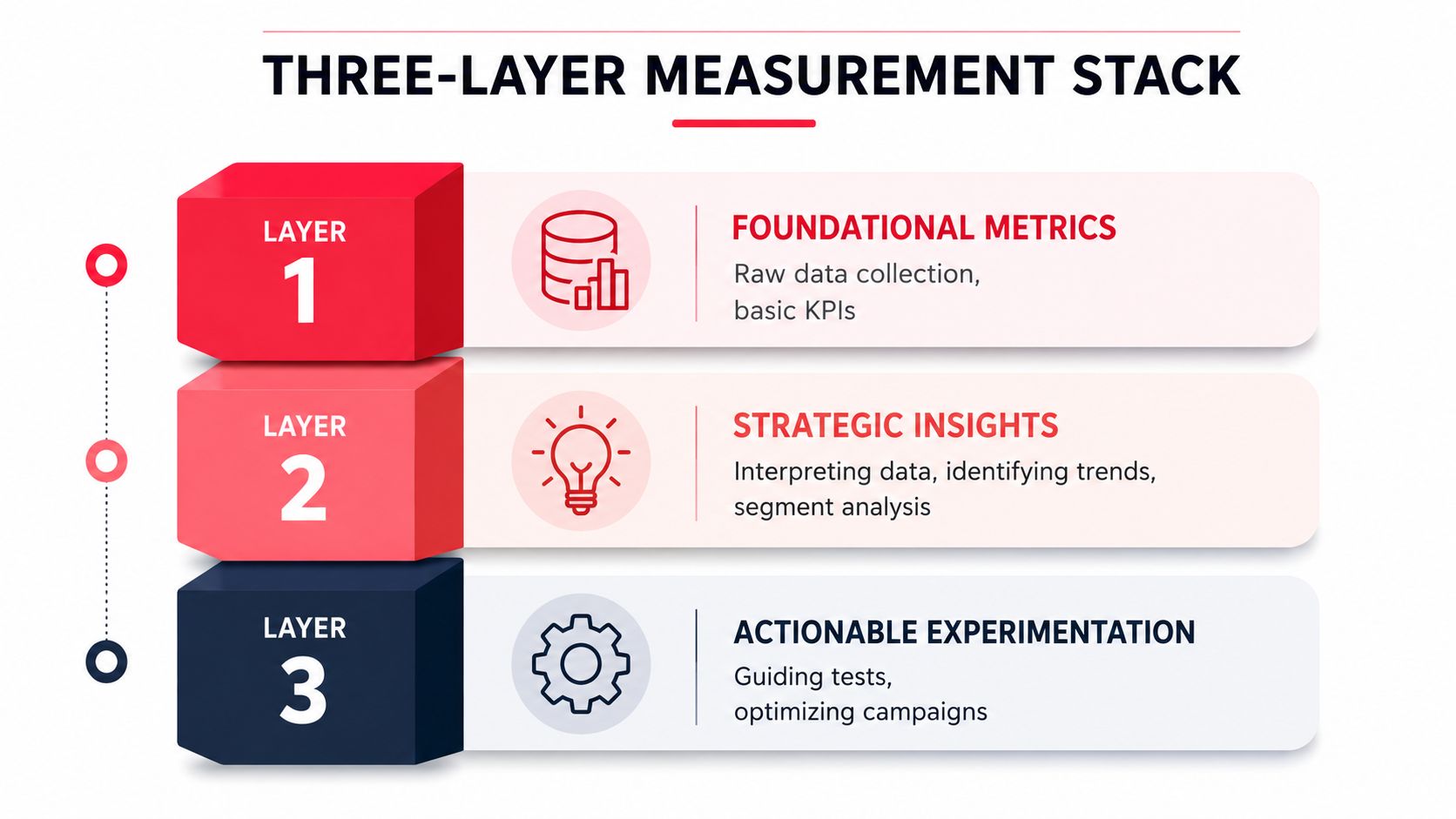
According to Harvard Business School, organizations that run a digital marketing audit before setting KPIs report 40% higher accuracy in defining measurable objectives, and the strongest setups use a three-layer pyramid of executive revenue metrics, operational campaign data, and tactical platform indicators, as described in HBS's guide to how to measure marketing effectiveness.
Audit first, then choose metrics
Many organizations approach this backward. They open dashboards, pick numbers they can already see, and call them KPIs. That's lazy measurement.
Start with an audit:
- Inventory every dashboard: GA4, ad platforms, CRM, MAP, sales reporting, product analytics.
- Mark each metric by decision use: budget, pipeline, sales enablement, retention, pricing, or none.
- Delete vanity metrics from executive reports: if a metric doesn't support a leadership decision, keep it at the operator level or remove it.
- Check data trust: broken UTMs, duplicate conversions, mismatched CRM stages, missing offline outcomes, bad campaign naming.
You can't build credibility on dirty data.
What belongs in each layer
Here's the model I recommend for growth-stage teams.
| Layer | Audience | What belongs here | Cadence |
|---|---|---|---|
| Top layer | CEO, CMO, CRO, finance | Revenue impact, CAC, ROI, pipeline contribution, CLV direction | Weekly and monthly |
| Middle layer | Marketing leaders, RevOps, sales leaders | Channel performance, campaign influence, funnel progression, assisted conversions | Weekly |
| Bottom layer | Channel owners, demand gen, paid media, CRO | Ad, email, landing page, creative, audience, keyword, and on-site execution data | Daily |
A few implementation rules keep this sane:
Keep the top layer small
Use 3–5 core metrics. That's enough to guide decisions without creating noise. If your exec dashboard needs fifteen tiles to explain marketing, the operating model is broken.
Let the middle layer explain movement
When pipeline influence falls, the middle layer should tell you whether the issue came from channel mix, audience quality, offer conversion, or sales follow-up. This is the diagnostic layer.
Push platform noise to the bottom
Practitioners need tactical data. Executives don't need to see every audience segment, CPC swing, or email open trend. The bottom layer exists so teams can optimize without polluting leadership reporting.
Good measurement creates line of sight. A drop in revenue impact should trace back to a channel, a campaign, an audience, or a conversion point.
If you run GTM engineering or CRO with AI support, this stack becomes even more important. AI can increase output fast. It can generate more copy variants, more landing page tests, more outbound sequences, more search surfaces. Without a hierarchy, you get metric sprawl at machine speed.
Choose an Attribution Model for the Real World
Attribution isn't about philosophical purity. It's about making fewer bad budget decisions.
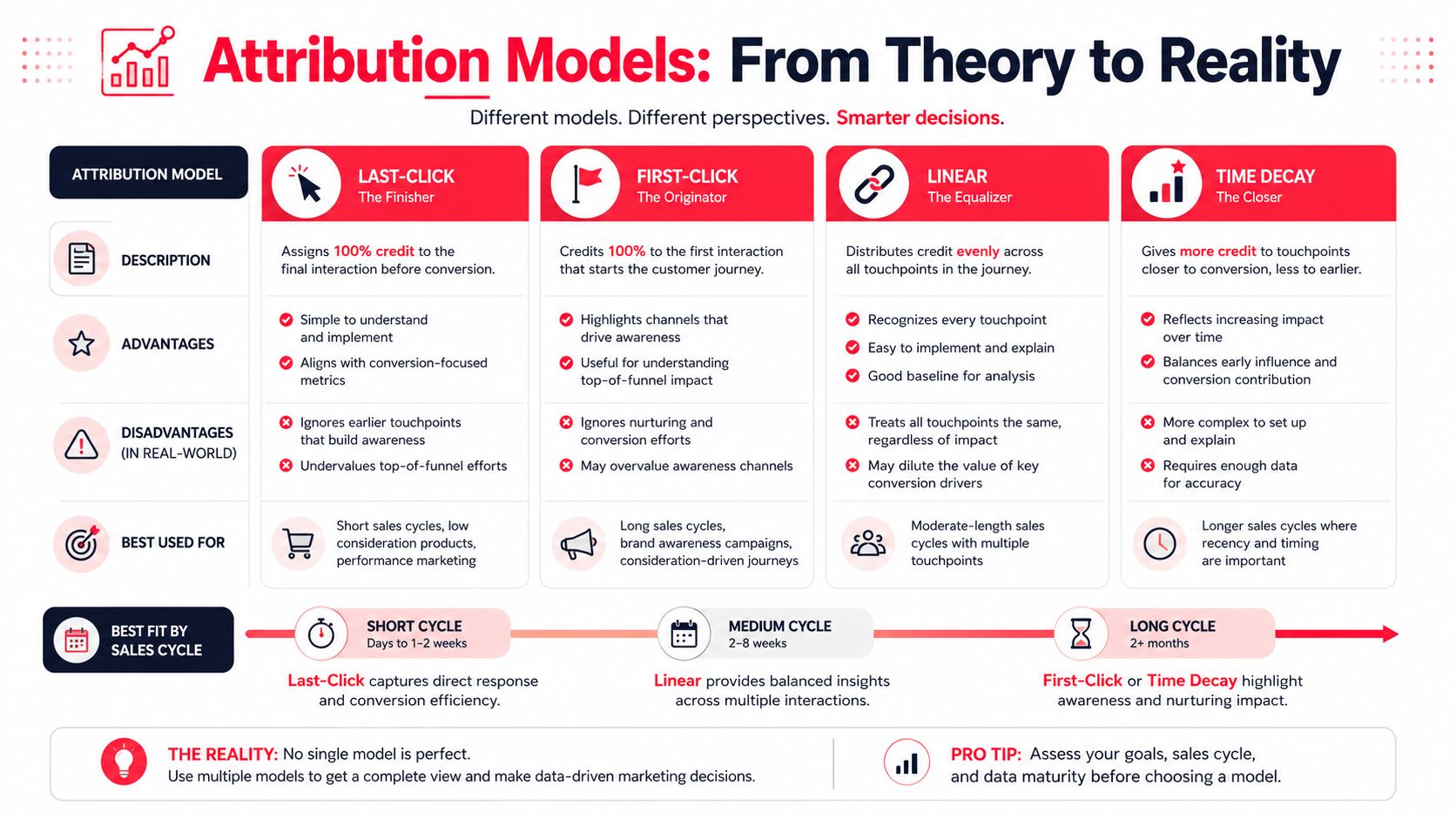
The wrong move is choosing a model because the analytics tool defaults to it. Last-click is easy to explain and dangerously incomplete for any company with a sales cycle, multiple channels, or repeat exposure before conversion.
Pick the model that matches your sales motion
Use this simple decision guide.
| Situation | Starting model | Why |
|---|---|---|
| Short sales cycle, few channels | Last-click or first-click | Fast read on demand capture or demand creation |
| Mid-length cycle, multiple touches | Linear | Better visibility into channel cooperation |
| Long cycle, buyer education matters | Time-based or data-driven | Gives later-stage and repeat touches more realistic credit |
| Sales-led with offline influence | Hybrid model with CRM validation | Web analytics alone will miss too much |
A practical example helps. Say a buyer first sees a LinkedIn ad, later downloads a whitepaper, joins a webinar, speaks with an SDR, then converts after a branded search. Last-click gives almost all the credit to search. That's operationally convenient and strategically dumb. Search closed demand that other touchpoints built.
The better workflow is straightforward. Establish quantifiable KPIs first. Instrument conversion tracking in your analytics and CRM. Then map real customer journeys and choose the attribution model that reflects how buyers move across the funnel. That's the methodology I recommend, and it matches the HBS guidance already cited earlier.
Validate attribution with revenue teams
Model choice isn't enough. You need human validation.
Sales sees influence that tools miss. Reps hear, "I saw you mentioned in ChatGPT," or "Your webinar clarified the category," or "I kept seeing your content before I replied." None of that shows up cleanly in default attribution reports.
Use a monthly review with marketing, sales, and RevOps:
- Inspect closed-won and closed-lost deals for recurring touchpoints
- Compare platform attribution with CRM evidence
- Review self-reported attribution fields from forms, demos, and sales calls
- Adjust weighting rules when the model clearly misrepresents influence
If your team wants a practical external walkthrough, Otter A/B has a useful attribution modeling guide that explains the tradeoffs in plain language.
Attribution should help you place the next dollar. If it only explains the past, it isn't doing enough.
Design Your High-Velocity Experimentation Program
Measurement without testing is expensive reporting.
The point of knowing what happened is to change what happens next. That means building a testing program with enough speed to produce real learning, not a random A/B test every few months.

Build a testing rhythm your team can sustain
Testing tends to be too low in the funnel and too small in scope. Button color tests are easy. They rarely move a board-level number.
Test bigger variables:
- Message-market fit: headline, angle, promise, objection handling
- Offer structure: demo, trial, audit, consultation, proof asset
- Landing flow: short form versus qualification step, social proof placement, objection sequencing
- Sales handoff: routing, speed-to-lead, follow-up sequence, booking experience
- Audience match: segmented pages by industry, role, use case, or buying stage
I like a weekly operating rhythm:
Monday review
Check active tests, pipeline influence, and any broken instrumentation.Tuesday hypothesis triage
Rank ideas by expected business impact and implementation effort.Midweek launch
Ship the next round. Use clear naming in GA4, your experimentation platform, CRM, and project tracker.Friday learning review
Document what changed, what didn't, and what to do next.
That rhythm works especially well when AI helps generate and deploy variants for CRO, ad creative, and sales messaging. You still need human judgment. You just remove the content bottleneck.
Use incrementality when channel reports lie
Platform attribution will overclaim. It always does.
If you're making serious budget decisions, run holdout tests, geo tests, audience exclusions, or time-based suppression tests where possible. Those methods answer the only question that matters: what happened because you ran the campaign, versus what would've happened anyway?
A short explainer is useful here before your team starts building test plans:
Document each experiment with five fields:
| Field | What to write |
|---|---|
| Hypothesis | What you believe will change |
| Primary metric | The business metric that decides success |
| Secondary metric | The diagnostic signal |
| Decision rule | What action you'll take if the result is positive, neutral, or negative |
| Owner | One person responsible for setup and readout |
Without this discipline, teams confuse activity with experimentation.
Measure What Is Next AI Search and Agent Commerce
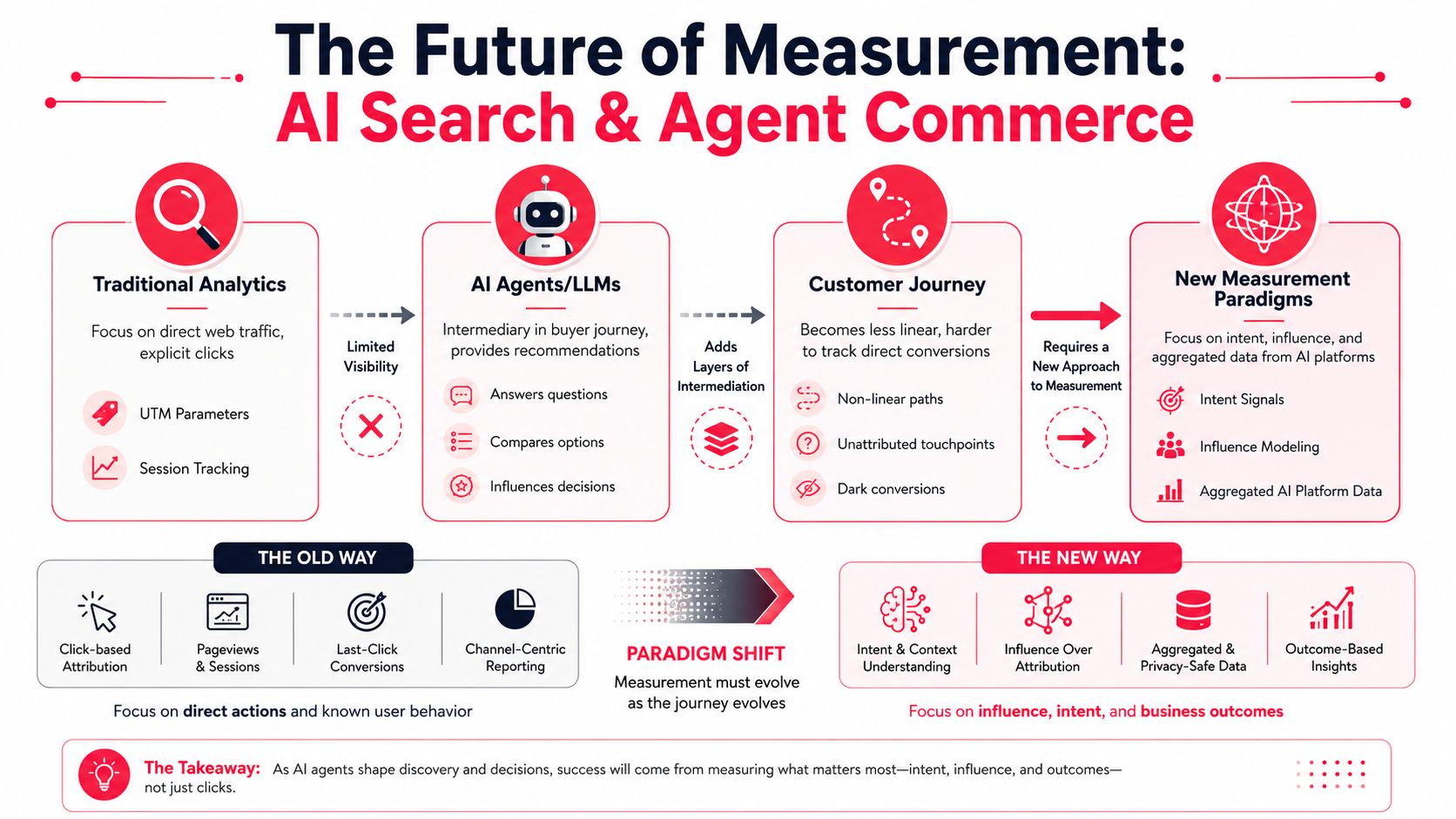
Your current analytics stack is blind in an area that already matters. AI-mediated discovery.
A prospect asks an LLM for vendor recommendations. The system synthesizes sources, names a shortlist, and the buyer may visit you later through branded search, direct traffic, a forwarded note, or an offline sales conversation. Your UTM structure doesn't capture the original influence. Neither does classic last-click attribution.
A 2025 BCG study found that 75% of leaders factor long-term brand outcomes into their evaluation of marketing effectiveness, while only 50% include both brand and performance metrics in their KPI frameworks. The same BCG coverage also points to the need to measure across AI search, AEO, and conversational interfaces, with emerging metrics such as share of AI-recommended visibility, branded search lift, assisted conversions, and incrementality tests in place of pure click-based reporting, as discussed in BCG's article on more effective marketing measurement.
Your analytics stack misses AI-mediated discovery
Many revenue teams are behind on this point. They still treat the website as the origin point of demand. It isn't.
Discovery now happens across:
- AI answer engines
- LLM recommendation flows
- Agentic product research
- Conversation interfaces inside apps and search
- Private communities and dark social paths that later convert elsewhere
If you're investing in answer engine optimization, start tracking it intentionally. Stimulead's guide to AI Search Optimization is a useful primer if your team is still treating this as a variation of old-school SEO.
What to measure instead
You need a blended framework. I recommend four classes of signals.
Visibility signals
Track whether your brand, products, category pages, and supporting content appear in AI-generated recommendation sets for your priority commercial prompts.
Demand signals
Watch for branded search lift, direct traffic quality, inbound mentions, demo request language, and sales-call references that suggest upstream AI influence.
Conversion signals
Measure assisted conversions, CRM source enrichment, self-reported attribution, and downstream opportunity creation after AI-sourced visibility improves.
Causal signals
Run incrementality tests when AI visibility initiatives go live. If branded demand, qualified traffic quality, or influenced pipeline moves after launch, you have better evidence than any click report can provide.
The question has changed. It isn't only which click converted. It's which presence changed buyer preference before the click existed.
This is also where marketing and sales measurement start to merge. Agent commerce won't care about your siloed dashboards. If software agents compare vendors, summarize value, and guide purchasing, your measurement model has to capture recommendation presence, structured data quality, sales enablement readiness, and conversion paths that begin outside your owned properties.
Your First 90 Days to Better Measurement
Don't turn this into a strategy deck. Put it on the operating calendar.
The gap between what leaders say they value and what they track is still wide. As noted earlier, 75% of leaders now factor long-term brand outcomes into evaluation, but only 50% include both brand and performance metrics in KPI frameworks. That gap is exactly what your first quarter of work should fix.
Days 1 through 30
Audit everything.
- List every dashboard and recurring report
- Map each metric to a business decision
- Cut anything that has no decision owner
- Check CRM and analytics field hygiene
- Document missing data from offline, sales-led, and AI-influenced paths
By day 30, your team should know which numbers matter and which ones are wasting attention.
Days 31 through 60
Define the measurement model.
- Run the leadership workshop
- Choose your 3–5 core metrics
- Build the three-layer stack
- Assign one owner to each top-layer metric
- Set reporting cadences for executives, operators, and revenue teams
This is also a good time to benchmark AI readiness across marketing and sales workflows. If your team needs a structured starting point, use Stimulead's AI readiness assessment to find the operational gaps before you automate bad processes.
Days 61 through 90
Instrument and test.
- Choose a baseline attribution model
- Validate it against CRM reality and sales feedback
- Launch your first incrementality tests
- Add AI visibility and assisted-conversion signals to reporting
- Create a weekly experimentation review with marketing, sales, and RevOps
By the end of the quarter, you don't need perfection. You need a measurement system leadership trusts enough to use in budget, hiring, and GTM decisions.
If you want help implementing this with your team, Stimulead can support the process through fractional CAIO advisory, team training, or an AI Growth Partnership that starts with an audit and KPI roadmap, then moves into execution across CRO, GTM engineering, AI search, and agent commerce readiness.