
According to June 2026 data from SparkToro, summarized earlier in this article, only 32% of Google searches end in a click to a website. The other 68% end on the results page or inside an AI-generated answer. If your revenue plan still treats search as a traffic channel first, you are underinvesting in how buyers now discover, compare, and short-list vendors.
Leadership teams should stop framing AEO vs SEO as a channel choice. Search now runs on two outcomes: visits and citations. You still need pages that rank and convert. You also need content, structure, and proof points that large language models can extract, trust, and repeat without sending a visitor to your site.
That shift changes budget decisions faster than it changes language. The operating question is not whether SEO still matters. It does. The question is how much of your search investment should keep chasing clicks, and how much should build answer visibility that influences pipeline before a session ever shows up in analytics.
My default recommendation for the next 18 months is simple: keep 70% of search resources in SEO and move 30% into AEO. That split is practical for teams that still need organic traffic, but can no longer ignore zero-click discovery. It gives marketing a clear build plan, gives sales better air cover in buyer research, and gives RevOps a reason to expand measurement beyond sessions and form fills.
CEOs do not need another definitions article. You need a resource model tied to revenue, ownership, and reporting. That means deciding what stays in the SEO backlog, what moves into answer-first content and schema work, how to track citation influence, and what your team should ship in the next 90 days.
Table of Contents
- SEO Is Not Dead It Is Just Half the Story
- The Core Difference Clicks vs Citations
- Actionable Tactics for Your Marketing and Sales Teams
- The Investment Framework How to Allocate Your Budget
- Measuring What Matters A New Go-To-Market Dashboard
- Your First 90 Days An Integrated AEO and SEO Roadmap
SEO Is Not Dead It Is Just Half the Story
Organic traffic no longer captures the full value of search. A large share of searches now ends on the results page or inside an AI-generated answer, which means your buyer can engage with your brand before your analytics platform records a visit.

The problem CEOs should care about
This changes how you plan revenue.
First, search influence is now larger than your click reports suggest. A prospect can see your company cited in an answer, remember the brand, and return later through direct traffic, branded search, partner traffic, or a rep's follow-up. Marketing created demand, but the old attribution model misses it.
Second, a content team can hit SEO goals and still lose market share. If your pages rank but answer engines do not quote them, you are paying for discoverability without getting distribution inside the interface buyers increasingly use.
That is why SEO should stay funded, but not funded alone.
Treat SEO as the system that builds authority, crawlability, and topic coverage. Treat AEO as the system that turns that authority into quoted answers, citations, and zero-click influence. If you manage both with one budget line and one reporting model, you will underinvest in the second system until competitors take the answer layer.
What this means in practice
Do not cut technical SEO. Keep the foundation strong. Site architecture, internal linking, page quality, and indexation still determine whether your brand earns trust in search systems. Zemith's semantic search guide is useful on this point because it explains why retrieval now depends more on meaning, entity relationships, and context than on old keyword matching alone.
But stop asking SEO to carry a job it was not designed to do by itself.
Your team also needs answer-ready assets: concise response blocks, clear entity definitions, structured data, comparison pages, FAQ formats, and supporting evidence that can be cited cleanly by AI systems. This is not a content side project. It is a go-to-market capability that affects branded demand, sales efficiency, and category authority.
My recommendation is simple. Keep SEO as 70 percent of the search budget if the foundation still needs work. Put the other 30 percent into AEO production, schema, citation testing, and measurement. That split gives you enough coverage to protect traffic while building visibility where buyers now make decisions.
If the board sees flat organic sessions but stronger branded demand or better close rates, do not assume search is weakening. Assume your measurement model is lagging buyer behavior.
The Core Difference Clicks vs Citations
AI search changes the economics of search because visibility no longer depends only on winning the click. It now depends on being selected as the answer.
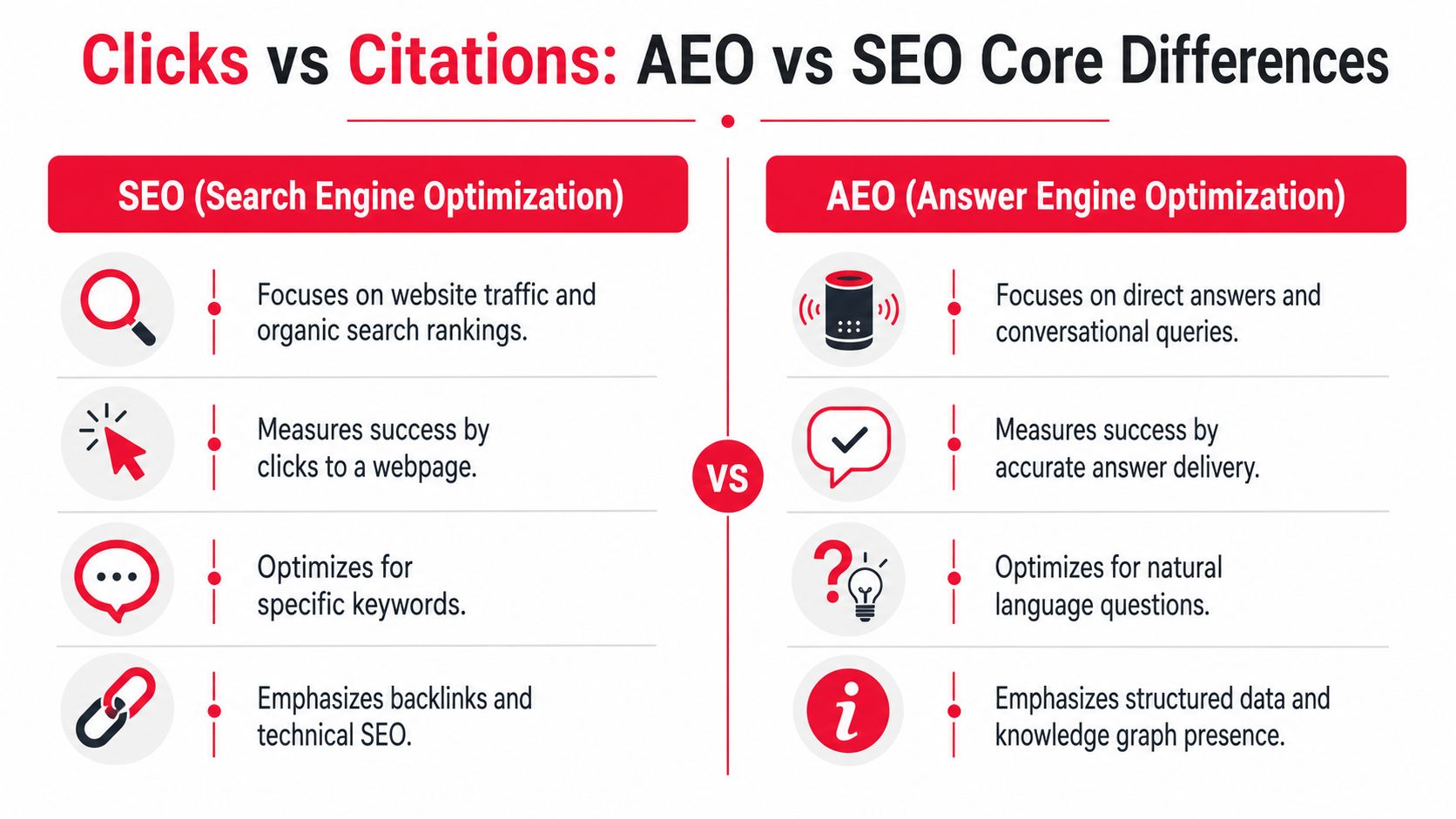
AEO vs SEO for leadership teams
Leadership teams should stop treating AEO and SEO as channel variations. They produce different business outcomes, require different workflows, and deserve different reporting lines.
SEO is built to earn visits you can convert on your site. AEO is built to earn citations and answer presence before a buyer ever clicks. One drives session volume. The other shapes consideration, shortlists, and trust inside AI interfaces. If you manage both with one KPI set, you will misallocate budget.
| Criterion | Traditional SEO | Answer Engine Optimization (AEO) |
|---|---|---|
| Primary outcome | Website visits from search | Citation and presence in AI-generated answers |
| Success metrics | Rankings, organic sessions, conversions from search | Citation presence, answer visibility, zero-click CTA engagement |
| Content structure | Pages built to rank and earn clicks | Answer blocks built to be retrieved and quoted |
| Optimization focus | Keywords, backlinks, technical SEO | Entity clarity, structured data, machine-readable answers |
| Best-fit queries | Research, navigation, comparison that still lead to clicks | Direct questions, conversational prompts, fast-answer intent |
| Team implication | SEO manager, content, developer, analytics | Content, SEO, RevOps, product marketing, developer |
That table should change how you fund search over the next 18 months.
A clicks model rewards depth, internal linking, and conversion paths. A citations model rewards clarity, consistency, source attribution, and structured formatting. If your writers still get briefs that say "cover the topic fully" but do not require a direct answer, named entities, and clean supporting evidence, you are paying for traffic assets while competitors build answer assets.
For teams refining their AI search optimization strategy, the practical question is simple. Which pages deserve investment because they can drive both visits and answer inclusion, and which pages should be rebuilt primarily to earn citations on commercial queries?
For teams that need a better mental model of how retrieval shifted from exact-match keywords toward meaning and entity relationships, Zemith's semantic search guide is a useful reference.
Why this changes operating plans
The operating model changes first.
SEO can sit inside a traffic team. AEO cannot. It touches product marketing, content, RevOps, web, and often sales enablement because the source material has to be factually consistent across pages, schemas, decks, and proof points. If those inputs conflict, citation rates drop and sales hears a different story than the website tells.
Editorial standards also need to get stricter. Revenue pages should answer the commercial question early. Claims need attributable proof. Author pages need to represent real operators. Machines need a clear signal about who made the claim, what the claim means, and why the source deserves trust.
Citation is a trust outcome. Ranking is a discovery outcome. Strong go-to-market teams budget for both.
This is why the 70/30 split matters. Keep most investment in SEO when the technical and content foundation still needs work, but carve out a defined AEO budget with its own owner, production process, and scorecard. If nobody owns answer visibility, it will fall between the CMO, the SEO lead, and the revenue team, and you will lose high-intent demand without seeing the loss in click reports.
Actionable Tactics for Your Marketing and Sales Teams
AEO work wins or loses in execution. If your team treats it as a side research project, it will produce slide decks instead of pipeline. Put the effort on pages that already influence revenue. Service pages, product pages, competitor comparisons, implementation pages, pricing-adjacent pages, and high-intent FAQs come first. Leave the blog archive for later.
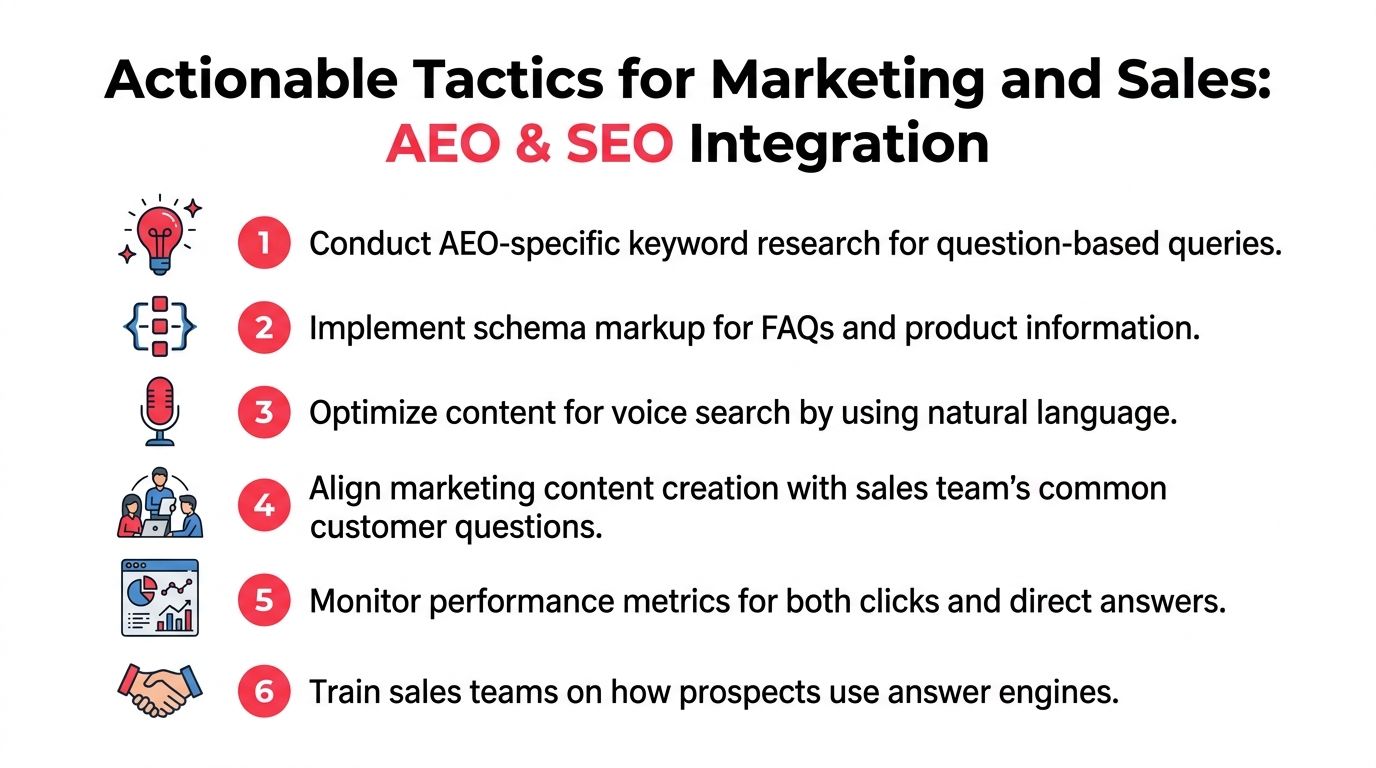
What marketing should ship first
Use this as a working sprint list tied to commercial pages, not a content wish list.
Add answer-first blocks to revenue pages: Open key pages with a direct response to the buyer question. Keep it concise, specific, and easy for both humans and machines to parse. Long introductions waste high-intent traffic and reduce citation potential.
Implement schema that matches the page: Use FAQPage, HowTo, and other relevant structured data only where the visible content supports it. Misaligned markup weakens trust and creates cleanup work later.
Put real experts on the page: Add named operators, clear titles, and point-of-view quotes to important sections. Anonymous brand copy is weaker than attributed expertise, especially on implementation, pricing logic, and category claims.
Use proof where proof exists: Add customer evidence, sourced statistics, certifications, case examples, and product specifics only when your team can stand behind them. If the evidence is thin, write plainly and avoid fake precision.
Standardize entity language: Your company description, category terms, product names, leadership bios, and service definitions should match across the site, sales collateral, and profiles. Inconsistent language confuses answer engines and buyers at the same time.
Rewrite slow introductions: Cut the SEO-era throat clearing. Lead with the answer, then expand with detail, proof, and next steps.
Build this inside a disciplined AI search optimization program, with an owner, a publishing workflow, and a review process tied to pipeline impact.
Support content matters too. If your team also owns service and post-demo follow-up, the same answer design rules apply in conversational channels. Teams that manage WhatsApp AI support well usually do three things right: they keep answers consistent, they structure replies around real buyer questions, and they update flows when objections change.
Before your team starts implementation, give them a quick visual walkthrough:
What sales should add to the process
Sales should not sit downstream from this work. Sales is one of the inputs.
Marketing needs the actual questions buyers ask in discovery, security review, procurement, and implementation scoping. Pull them from call recordings, CRM notes, lost-deal reviews, and objection handling docs. Then turn that language into briefs for pages, FAQ modules, comparison sections, and support content.
Give sales a defined role:
Collect repeated buyer questions: Focus on pricing logic, rollout timelines, migration risk, integrations, compliance, and fit. If the same question appears every week, it deserves a published answer.
Feed competitor framing back to marketing: Buyers ask blunt questions. Why you versus X. What breaks in onboarding. Who should not buy. Publish the answers your reps already give.
Ask what prospects saw in AI search: Reps should document whether prospects mention ChatGPT Search, Google AI Overviews, Perplexity, or AI summaries in the buying process. That tells you where your brand story is missing, distorted, or owned by a competitor.
Close the loop with RevOps: Track which questions appear before qualified pipeline, before demo conversion, and before late-stage stalls. Prioritize content that removes friction in deals, not content that only adds impressions.
One rule matters here. If sales hears a recurring commercial question and marketing has not published a clear answer, you are choosing to leave that demand open for competitors.
The operating model should be simple. Marketing owns the page. Sales owns the buyer language. RevOps owns tracking. A single GTM owner should decide priorities, approve updates, and push resources toward the pages that influence revenue first.
The Investment Framework How to Allocate Your Budget
Budget is where strategy gets exposed. If AEO matters but no one funds it, you do not have a strategy. You have a talking point.
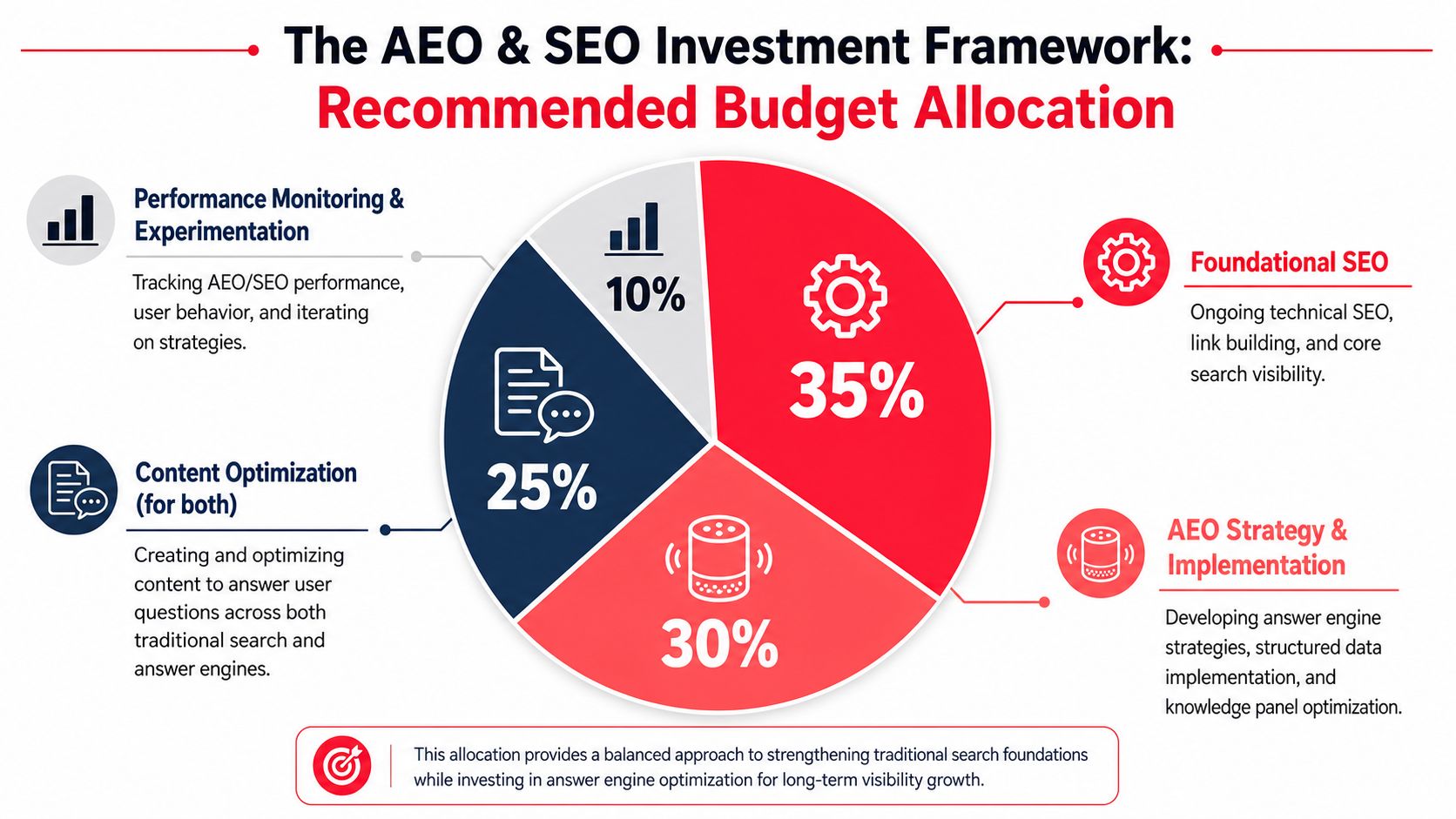
My default budget split
Use a 70/30 split. Put 70% into SEO and 30% into AEO.
That is the right model for growth-stage companies that already have a live site, a sales team that needs pipeline, and no appetite for building a second content machine. SEO still funds discoverability, authority, and conversion paths on your owned site. AEO earns placement inside AI answers, summaries, and agent-mediated research flows. One drives durable demand capture. The other shapes demand before the click happens.
I do not recommend a 50/50 split for the next 18 months. That overstates AEO maturity and starves the systems that still produce revenue today. I also do not recommend treating AEO as a side project. That leaves your brand absent from the answer layer buyers increasingly see first.
Here is how to allocate the money:
- 70% to SEO foundation and revenue pages: technical fixes, internal linking, commercial page quality, comparison pages, category or solution pages, and authority-building content that supports rankings and conversion.
- 30% to AEO execution: answer-first page modules, schema, entity consistency, FAQ coverage, citation testing across AI surfaces, and content updates built around real buying questions.
- A small portion of that 30% should stay flexible: use it to test prompt patterns, monitor answer visibility, and update pages that start getting cited or misrepresented.
The point is simple. SEO remains the asset base. AEO is the distribution layer sitting on top of it.
How to make the split real inside a team
Budget lines do not ship work. Owners, cadence, and instrumentation do.
A workable model looks like this:
| Workstream | Where it usually sits | What to fund |
|---|---|---|
| Technical SEO | SEO lead and developer | Crawlability, performance, indexation, site structure |
| Revenue page content | Content lead and subject matter experts | Core pages, comparison pages, use-case pages, proof-heavy bottom-funnel content |
| AEO implementation | Content, SEO, developer | Answer modules, schema markup, entity cleanup, citation checks, AI prompt testing |
| Measurement and attribution | RevOps and analytics | Branded search lift, assisted pipeline signals, AI answer monitoring, prompt-level visibility checks |
Keep one GTM owner accountable for the full 70/30 plan. Do not create a separate AEO team. That adds meetings, slows decisions, and splits accountability across channels buyers do not experience separately.
If your reporting model still treats visits as the main signal, fix that before you expand spend. Use a shared framework for measuring marketing effectiveness across influence and pipeline so the AEO budget is judged on revenue impact, not just traffic deltas.
If your team lacks a way to assess whether your workflows are ready for AI-assisted execution, review this Agentops AI workflow assessment. It's useful for leaders trying to connect content visibility with operational readiness.
The board-level message should be clear. The 70% protects and compounds your existing search revenue engine. The 30% prepares your company for an answers-based buying journey that will influence pipeline before analytics records a session.
Measuring What Matters A New Go-To-Market Dashboard
If your dashboard still treats traffic as the center of truth, you're going to misread the next 18 months.
The search journey now includes answers that shape demand before the visit. So the reporting stack has to cover influence, branded recall, and readiness for agent-mediated action.
The dashboard I want a CMO and CRO to review together
I want one monthly dashboard with two layers.
First layer: classic SEO measures that still matter. Rankings on commercial terms. Organic sessions to bottom-funnel pages. Conversion rate from organic traffic. Pipeline sourced from search-led entry points.
Second layer: AEO and answer-surface measures. Citation presence on priority prompts. Brand mention quality in AI responses. Presence for comparison queries. Sales call evidence that buyers already encountered your positioning before speaking to a rep.
For teams still relying on GA4 as the default answer for everything, that's too narrow. You need a broader measurement approach. I'd start with a shared framework for attribution and influence like the one outlined in Stimulead's guide on how to measure marketing effectiveness, then add AI-search-specific checks on top.
Here's the KPI stack I usually push into the reporting rhythm:
- Citation presence: Are you present in AI answers for your highest-value prompts?
- Share of AI voice: When buyers ask comparison or category questions, how often does your brand appear?
- Branded term presence: Do answer engines associate your brand with the category and problem you solve?
- Zero-click CTA engagement: Are answer surfaces pushing users toward branded search, demo intent, or direct navigation?
- Sales-confirmed AI influence: What are reps hearing in discovery about buyer research behavior?
Agent commerce readiness belongs on the same dashboard
Many teams are late at this point.
According to Pepper's write-up on AEO versus SEO measurement, the gap in measurement is significant because AEO must now optimize for LLMs.txt and API exposure to enable AI agents to execute tasks directly, not just retrieve text. AEO is not just about becoming cited but about becoming the executable engine for agent-commerce.
That means your dashboard should also cover operational readiness:
- Can an AI system find your canonical product or service data?
- Do your systems expose usable information for booking, pricing, availability, or qualification?
- Can your team tell whether AI agents can act, or only read?
The next reporting mistake will be treating AI search as a branding channel only. It also affects transaction design.
If you sell SaaS, professional services, or products with a clear next step, your answer-engine work should eventually connect to GTM engineering and agent commerce readiness. Visibility without execution leaves money on the table.
Your First 90 Days An Integrated AEO and SEO Roadmap
You don't need a six-month strategy deck to start. You need one owner, a scoped pilot, and a shipping calendar.
The first 90 days should focus on pages that already touch revenue. Don't start with your whole site. Start with the assets most likely to influence pipeline now.
Days 1 to 30 fix the foundation
Audit before you write anything new.
Review your top commercial pages, your comparison pages, your solution pages, and your highest-intent FAQs. Check whether each one has a direct answer near the top, clear authorship, accurate page structure, and usable schema. Pull sales transcripts and list the repeated buyer questions that should already have a published answer.
At the same time, define the query set you'll monitor manually across major answer surfaces. Focus on commercial prompts, objection-handling prompts, and category-definition prompts.
Use this month to assign ownership:
- Marketing: page updates, content briefs, publishing cadence
- SEO or web lead: schema, indexing, internal linking, page structure
- Sales leadership: objection list, call-note extraction, rep feedback loop
- RevOps: dashboard design and reporting cadence
If your team needs a practical framework for sequencing execution, this AI implementation roadmap is the kind of structure I'd use to keep the work grounded in operators, owners, and measurable outputs.
Days 31 to 60 publish answer-first assets
Now ship.
Start by updating existing pages before creating net-new content. Add answer blocks to the top of key pages. Insert FAQ sections based on real sales questions. Add named expert commentary from internal leaders with actual domain credibility. Tighten page titles and subheads so they mirror the way buyers ask the question.
A few priorities matter more than others:
- Service and solution pages first: These shape qualified demand.
- Comparison and alternative pages next: These affect in-market buyers.
- Implementation and pricing-adjacent FAQs after that: These reduce friction late in the cycle.
Keep copy direct. Keep structure clean. If a paragraph doesn't help a buyer or an AI system retrieve the answer, cut it.
Days 61 to 90 measure and tighten execution
By this point, don't flood the site with more content. Review what's happening.
Look at answer-surface presence for the query set you defined in month one. Ask sales what buyers are repeating. Watch branded search behavior and direct traffic patterns qualitatively. Review whether AI surfaces are citing your pages, paraphrasing your points, or skipping you.
Then make the next round of edits:
- tighten weak answer blocks
- improve entity consistency
- add missing schema
- replace vague copy with sourced, attributable statements
- expand pages that address high-value objections
The main goal in the first 90 days isn't perfection. It's proof. You want evidence that integrated AEO and SEO can improve how your company gets discovered, referenced, and chosen.
If you want help building this into an operating system instead of a one-off content project, Stimulead's AI Growth Partnership is built for exactly that. We help CEOs, CMOs, and CROs turn AI into measurable GTM execution across CRO with AI, GTM engineering, AI search optimization, and agent commerce readiness. The practical next step is a focused audit of your current search visibility, answer-surface presence, and team workflow gaps, then a roadmap your existing team can actually execute.