
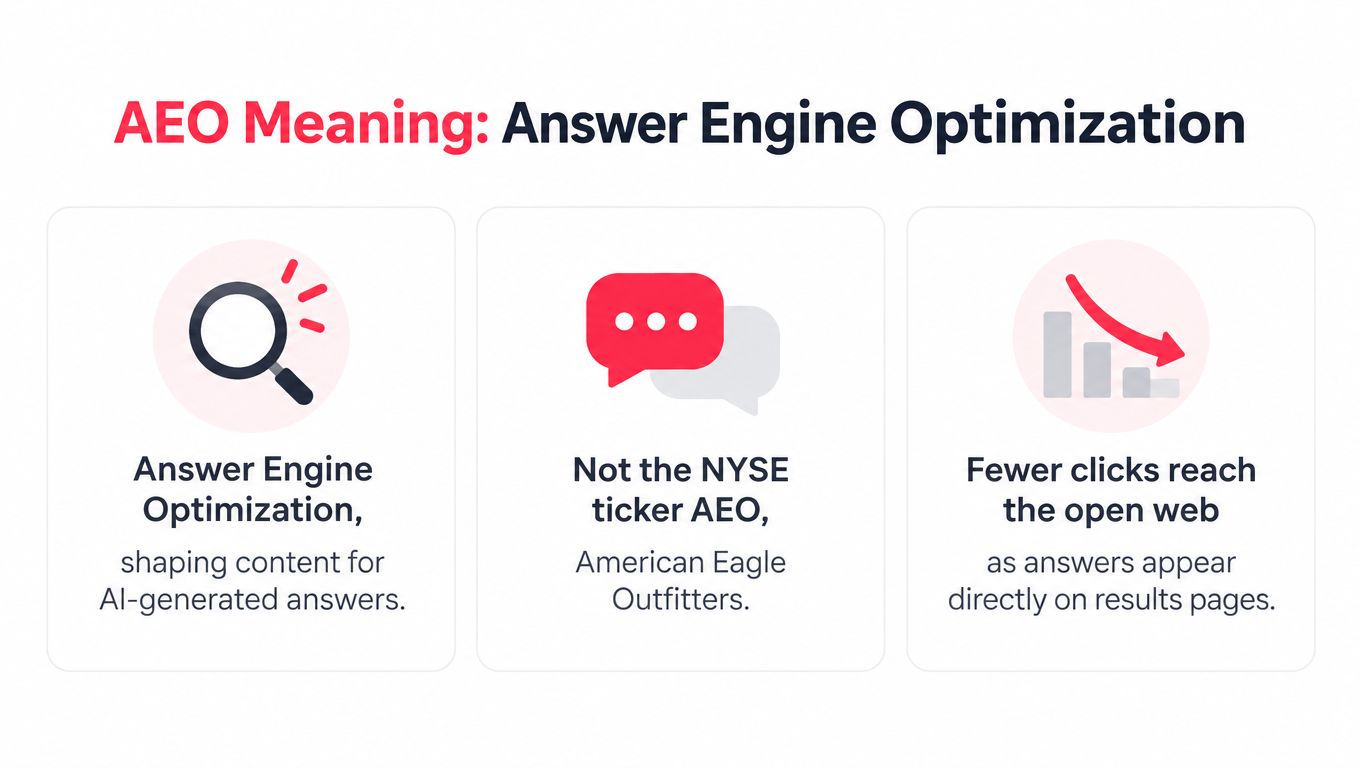
The phrase AEO meaning matters because the buying journey is changing faster than most dashboards can measure it. In practical terms, Answer Engine Optimization is the work of shaping content so AI answer systems can understand it, choose it, and cite it, while the stock ticker AEO still means American Eagle Outfitters on the NYSE.
That distinction matters because clicks are thinning out. Industry reporting citing Similarweb-based analysis says 49% of U.S. searches ended without a click in 2019, rising to 60.45% in 2024 and 68.01% during the first four months of 2026, and that when an AI summary appears, only 8% of users click a traditional result, compared with 15% when no summary is present (source context). If your team still reads AEO as a ranking project, you're measuring the wrong thing.
For growth-stage B2B teams, the question isn't whether answer engines matter. It's whether your company shows up in the answer, shows up accurately, and gets credited with the right claim. If your site is still built only to win blue links, you need a different operating model. A useful place to start is to find end-to-end marketing examples that show how content, measurement, and revenue work together instead of living in separate silos.
Table of Contents
- AEO Meaning and the Click Math That Just Changed
- What an Answer Engine Actually Does to Your Content
- AEO vs SEO vs GEO
- The Content Signals That Move the Needle
- A Measurement Framework the Board Will Accept
- What AEO Programs Get Wrong
- A 30-Day Sequencing Decision
AEO Meaning and the Click Math That Just Changed
AEO means Answer Engine Optimization in marketing and AI strategy. It's the discipline of structuring content so systems like ChatGPT, Google AI features, Perplexity, and Gemini can pull from it, cite it, and use it in synthesized responses. It does not mean the NYSE ticker for American Eagle Outfitters, which is a different context entirely and only creates confusion if someone drops the acronym into a board deck without explanation.
The commercial issue is simple. Discovery is moving from pages of links to answers that resolve the question without a visit. When that happens, a good ranking can still produce a weak outcome if the answer engine cites a competitor, a secondary source, or nothing from your site at all.
AEO is the response to that shift. The useful mental model is this, the buyer asks a question, the engine assembles an answer, and your job is to make your claim easy to extract and hard to misstate. That means clear entity naming, factual formatting, and enough credibility for the engine to trust your passage over a generic rewrite.
Practical rule: if your page can't be quoted cleanly in one sentence, it isn't ready for answer engines.
For CEOs, CMOs, and CROs, the implication is operational. Your organic dashboard can look stable while your answer-engine presence erodes. That's why teams need a separate view of mention quality, citation quality, and downstream conversion.
If you want a related strategic lens, the guide maker approach is useful here because it forces content into repeatable, testable steps instead of vague brand language. That's the right mindset for AEO too, since the work is about making evidence legible to machines, not decorating copy for style.
What an Answer Engine Actually Does to Your Content
Answer engines don't read your site the way a person skims a homepage. They break a query into related subqueries, retrieve passages, compare source quality, and then compose a response with supporting links. Google says its AI Overviews and AI Mode can use query fan-out, which means a page can be cited even when it isn't the top result for the buyer's original query (Google developer documentation).
That changes content strategy in a very concrete way. A 2,000-word pillar page with one buried statistic can lose to a 120-word passage that answers the exact sub-question cleanly. The engine wants a claim it can lift, not a long essay it has to interpret.
A simple example
A buyer asks, “Which attribution model should a mid-market SaaS company use for paid and organic reporting?” Three pages exist.
- One page is a polished thought-leadership article with broad advice and no explicit recommendation.
- One page gives a direct answer, names the use case, defines the model, and cites a source.
- One page is a generic FAQ with loose wording and no proof.
The second page is the one most likely to be selected, because it reduces interpretation work. The engine doesn't need to infer the claim, and it doesn't need to guess the scope.
That's why answer-engine content has to be extractable. Use direct claims, explicit entity references, and compact answer blocks near the top of the section. Then make the supporting evidence visible in the same passage or immediately adjacent.
For teams building internal process around this, our AEO and AI answer engine notes are useful as a reference point for the structure, not as a magic formula. The principle is the same across systems, make the claim easy to pull and easy to verify.
A page that answers the exact question clearly usually beats a larger page that only sounds authoritative.
What the engine is really ranking
It's ranking passages for usefulness inside an answer, then weighting them by trust. That means your job is to reduce ambiguity. If a page discusses pricing, geography, product tiers, or audience fit, say so directly. If it's a comparison page, name the comparison criteria instead of hiding them in prose.
The team that understands this will stop asking, “How do we make the page longer?” and start asking, “Which sentence should the engine quote?”
AEO vs SEO vs GEO
These terms get blurred because vendors keep renaming the same work and selling a fresh audit. They are related, but they are not the same. SEO still handles discovery in search results. GEO gives you the research frame for generative visibility. AEO is the operating system for being selected, cited, and described correctly inside answer engines.
Here's the clean version.
| Dimension | Traditional SEO | GEO (research framing) | AEO (operating practice) |
|---|---|---|---|
| Objective | Rank in search results | Measure visibility in generated answers | Be selected, cited, and described correctly |
| Primary metric | Position and clicks | Position-adjusted visibility | Presence, accuracy, recommendation, assisted pipeline |
| Target surface | SERP | Generative response | Multi-engine answer surfaces |
| Workflow change | Optimize pages for ranking | Test how passages appear in answers | Build extractable claims and monitor citations |
| Success signal | Ranking and traffic | Visibility in generated responses | Mention quality, citation quality, downstream conversion |
| Content style | Broad relevance | Answer-friendly passages | Extractable claims with proof |
| Risk if done badly | Weak rankings | Low experimental visibility | Misattribution, missing citations, bad answer coverage |
The distinction matters because the work changes. SEO teams optimize for crawlability, relevance, and link equity. AEO teams have to care about whether the engine can cite the page, whether it describes the brand correctly, and whether the source is authoritative enough to survive the answer composition step.
The Princeton GEO study is the best known research anchor here, and it formalized visibility measurement inside generative responses rather than conventional rank. That is why we treat GEO as the measurement and research layer, and AEO as the business program that sits on top of it.
For a deeper comparison of how generative visibility differs from traditional ranking, see our GEO vs SEO breakdown. If you want a short explainer on where the terms diverge, generative engine optimization basics is a useful external reference point. Internally, the rule is simple, SEO is the base, GEO is the measurement frame, and AEO is the execution layer.
Buying an “AEO audit” and getting a blue-link report with a fresh label is the wrong move. If the vendor cannot tell you where you were cited, how accurately you were described, and whether the citation came from an authoritative source, they are selling SEO language with AI paint on top.
The core point is simple. SEO gets you found. AEO gets you used.
The Content Signals That Move the Needle
Here, teams waste time. They rewrite pages for conversational tone, but the defect is that the page never makes a quotable claim. If the engine can't lift a specific statement, your content is just more text to ignore.
The strongest research signal we have points in a clearer direction. The Princeton GEO work reported that adding statistics increased visibility in generated answers by 41%, adding quotations from credible sources increased visibility by 28%, and adding citations from reliable sources could improve visibility by as much as twofold for pages with lower conventional search rankings (study summary). That's not a creative-writing lesson, it's a claim-formatting lesson.

What to change first
Start with the prompt set, not the content library. Pick the buyer questions by stage, then score which prompts already trigger your brand and which ones don't. After that, rewrite the top answer-passages for extractability, and don't touch the rest until you have a control group.
Then add proof where it matters. Use independently verifiable numbers, named sources, attributable expert quotations, and clear authorship or methodology metadata. If you sell software, identify the product scope and the use case. If you serve specific geographies, say which ones. Engines do better when the page removes guesswork.
A practical workflow looks like this.
- Map the prompt set. Group questions by awareness, evaluation, and vendor-shortlist intent.
- Audit current citations. Note whether you're mentioned, cited, or ignored.
- Rewrite answer passages. Make the first 100 to 150 words of each target page quote-ready.
- Add proof. Put numbers, sources, and named evidence directly into the answer block.
- Disambiguate entities. Use structured data and consistent naming so the engine doesn't confuse product, company, and person.
- Retest weekly. Keep a treated set and a control set.
Structured data helps here, but only as a disambiguation layer. It tells the engine what something is. It doesn't rescue weak claims, vague positioning, or pages that never answer the buyer's question.
Practical rule: don't add more FAQ blocks until you've fixed the one passage the engine should quote.
We've seen teams get better results from a single precise page rewrite than from a site-wide content refresh. That's usually because the rewrite changed the retrieval shape, while the refresh only changed the tone. If your content still hides the answer, the engine won't care how polished it reads.
A Measurement Framework the Board Will Accept
Board-level reporting needs more than “we got mentioned.” That's a vanity metric unless it connects to accuracy, authority, and pipeline. A real AEO program needs five linked measurements, and each one answers a different business question.
The five measures
- Citation presence. Are we mentioned at all?
- Citation accuracy. Does the answer describe us correctly?
- Recommendation position. Are we one of the top options, or buried in the answer?
- Source authority. Is the cited source ours, current, and credible?
- Downstream conversion. Do AI-referred visitors convert or create qualified pipeline?
Use a recurring prompt panel of 50 to 200 prompts across ChatGPT, Perplexity, Gemini, and Google AI Mode, scored weekly by hand or with a thin internal tool. That panel should reflect buying-stage questions, not random curiosity prompts. Then connect the output to CRM where possible so you can see whether AI-referred sessions turn into opportunities.
The reason this matters is that citation selection and conventional rankings don't fully overlap. An independent audit of Google AI Overviews reported 55,393 searches and 61,212 citations, and found that only 38% of cited pages also appeared in the conventional top 10 for the same query, while cited domains had higher average credibility scores than the traditional first-page results shown for the same searches (Washington University report). That means your rank tracker is necessary, but it's not sufficient.
| Measure | What it tells leadership | Common data source |
|---|---|---|
| Citation presence | Are we in the answer at all | Prompt panel, manual review |
| Citation accuracy | Are we described correctly | Prompt panel, QA review |
| Recommendation position | How prominent is the mention | Prompt scoring |
| Source authority | Are we trusted enough to be cited | Content audit, page review |
| Downstream conversion | Does it matter commercially | Analytics, CRM, pipeline attribution |
If you need a broader KPI framework for marketing measurement discipline, our marketing effectiveness measurement guide is a good companion, because AEO should sit inside a broader performance system, not outside it.
The board doesn't need a story about AI novelty. It needs a clean answer to three questions, are we seen, are we right, and does it move revenue-adjacent behavior. If your dashboard can't answer those, it's not a dashboard for AEO.
What AEO Programs Get Wrong
The first mistake is treating AEO as a rewrite project. That's lazy, and it misses the underlying problem, retrieval. If the engine can't reach the page, can't parse it, or can't tell which entity it describes, the writing quality won't save you.
The second mistake is buying a tool that counts brand mentions and calling it a strategy. Mention counts are useful only if they also show whether the model described you accurately and whether the citation came from a page you control. Without that, you can report progress while the answer engine is misrepresenting your product, pricing, or geography.
The third mistake is FAQ bloat. Teams dump hundreds of low-quality Q&A blocks onto a site and hope scale fixes visibility. It doesn't. In our client work, that usually dilutes authority signals and creates pages nobody wants to cite.
The fourth mistake is handing AEO to the SEO agency without giving them a revenue metric. They'll send rank reports, traffic charts, and mention dashboards, then stop there. That's useful for search hygiene, but it doesn't tell you whether answer engines are helping or hurting demand capture.
The fifth mistake is assuming one engine is enough. A query that produces a ChatGPT citation may produce nothing useful in Perplexity or Gemini, so the measurement panel has to be multi-engine from day one. Treat each system as its own surface, because the citation behavior isn't identical.
A related implementation trap is ignoring the tension between ranking and citation optimization. A report tied to the Princeton study says adding citations produced a 115.1% visibility increase for pages ranked fifth in conventional search, while visibility for the top-ranked page fell 30.3% under that test condition (Search Engine Land report). That's proof that the same page can be pulled in different directions by the two systems.
Don't optimize for mentions that can't be traced back to a current, authoritative source.
The strongest AEO teams are the ones that accept trade-offs. They don't try to make every page do everything. They pick the pages that matter, instrument them properly, and remove the clutter that confuses both buyers and answer engines.
For more on this topic, what is AEO looks at how answer engines change revenue forecasting, the AEO definition covers the KPIs that prove it works, and what is LLMO explains the closely related practice of optimizing for large language models.
A 30-Day Sequencing Decision
If AEO is on your roadmap, start with measurement, not content volume. In the first two weeks, stand up the prompt panel, score citation presence and accuracy for your top buying-stage prompts, and connect AI-referred sessions to pipeline where the analytics stack allows. That gives you a baseline you can defend.
In week three, choose one page that gets misattributed or ignored and reformat it for extractability. Use the signals that matter, direct claims, proof, authorship, scope, and clean entity labeling, then hold the rest of the site as a control. Don't spread the work across ten pages before you've learned what changed.
In week four, assign ownership. Decide who runs the prompt panel, how often it runs, and what trigger causes a content update. If nobody owns the recurring review, the program decays into a one-time audit with a fresh label.
Adobe's reported holiday-season data found AI-driven referral visits had 14% higher engagement than non-AI sources (Indian Express coverage). That's the signal growth leaders should care about, a smaller stream can still carry better engagement quality.
AEO is the wrong next hire if your organic traffic is still growing on a stable conversion base, if your category still isn't cited by answer engines at all, or if nobody owns weekly measurement. In those cases, fix the underlying search and analytics basics first.
This week, pick the top 50 prompts your buyers ask, score them manually across two answer engines, and identify the one page most worth rewriting for citation quality.
