
You're probably in this spot right now.
Your marketing team has a few AI pilots running. Sales wants AI for outbound research and call prep. Someone is testing AI search visibility. Someone else is talking about agent commerce and what happens when buyers start delegating more of the purchase journey to software. None of it is fully coordinated. Nobody owns the roadmap. Nobody owns the risk. Nobody owns the revenue case end to end.
That's when the leadership question stops being theoretical. You need an executive owner for AI. The primary decision is whether that person should be fractional or full-time.
I've sat in this exact discussion with CEOs, CMOs, and CROs. My advice is blunt. If your goal is to turn AI into pipeline, conversion lift, and faster GTM execution in the next year, a fractional CAIO is usually the better first move. A full-time Chief AI Officer makes sense later, when AI has enough operational weight that part-time oversight starts slowing the business down.
Table of Contents
- The CAIO is No Longer an Optional Hire
- Defining the Models by Impact not Title
- A Practical Cost and ROI Analysis for CEOs
- Comparing Core Responsibilities and KPIs
- When a Fractional CAIO is the Smart Choice
- The Tipping Point for a Full-Time Hire
- Your Decision Framework and Next Step
The CAIO is No Longer an Optional Hire
Most growth companies don't have an AI problem. They have an ownership problem.
The pilots exist. The tools exist. The demand from marketing and sales exists. What's missing is one executive who can decide where AI should drive revenue first, which experiments deserve production investment, and which risks need policy before rollout.

That's why I don't frame this as a future-facing org chart exercise. It's a near-term operating decision. According to Justin McKelvey's 2026 CAIO market analysis, 76% of organizations now report having a Chief AI Officer in some form, up from 26% in the prior year.
That shift matters because it tells you how serious companies are treating AI governance and execution. They aren't leaving it as a side project under IT, marketing ops, or innovation. They're putting executive ownership around it.
What CEOs usually get wrong
A lot of CEOs wait too long because they think the role only makes sense once AI is embedded everywhere.
Wrong. The CAIO role usually earns its keep before that point. It exists to stop random acts of AI, force prioritization, and move the company from scattered experiments to a managed portfolio tied to business outcomes.
If you're running CRO with AI, GTM engineering, AI search optimization, or preparing for agent commerce, the cost of weak ownership shows up fast:
- Testing drift: experiments pile up, but nobody decides what moves into production
- Tool sprawl: teams buy overlapping vendors with no shared architecture
- Revenue ambiguity: wins get reported as anecdotes instead of measured commercial impact
- Compliance exposure: legal and data concerns surface after deployment instead of before it
Practical rule: If AI already touches pipeline generation, conversion optimization, or customer acquisition, it deserves executive ownership.
The decision has changed
The old question was, “Do we need a Chief AI Officer?”
The current question is, “What version of AI leadership fits the business right now?”
For most companies in the growth stage, that means evaluating fractional CAIO vs full-time chief AI officer based on execution load, speed to revenue, and governance needs. Title matters less than who can drive the work.
For what the seat should own once you fill it, see when a fractional AI officer pays off and what it owns.
Defining the Models by Impact not Title
I don't care much about titles. I care about the problem you need solved.
A fractional CAIO is there to create momentum and impose discipline. A full-time Chief AI Officer is there to build an operating system around AI across the company. Both can be right. They are not substitutes in every context.
Fractional CAIO
A fractional CAIO is the right hire when you need senior judgment quickly and you need it pointed at specific business outcomes.
In practice, that means things like:
- setting the AI roadmap for marketing, sales, and customer acquisition
- evaluating vendors for GTM workflows, content systems, research automation, and analytics
- putting governance in place before teams ship AI-driven experiences
- choosing a small set of use cases that can produce visible commercial results
- forcing weekly accountability around experiments, adoption, and rollout
This model is built for companies that need executive-level direction without carrying a permanent senior hire too early. The value is speed and focus. You're buying experience, pattern recognition, and operating judgment.
A good fractional CAIO doesn't act like a consultant who drops a slide deck and disappears. They own outcomes, decisions, and tradeoffs.
Full-time Chief AI Officer
A full-time Chief AI Officer is different. This role exists when AI stops being a focused strategic initiative and starts becoming part of how the company runs.
That usually means the CAIO is doing more than prioritizing use cases. They're building internal capability. They're managing specialists. They're setting company-wide standards around model usage, data handling, vendor choices, and execution quality across multiple departments.
The time horizon is also different. A full-time CAIO isn't only there to ship near-term wins in sales and marketing. They're there to turn AI into a durable internal capability.
How I explain the split to CEOs
Here's a clear explanation:
| Model | Primary job | Best fit | Time horizon |
|---|---|---|---|
| Fractional CAIO | Drive strategy, governance, and initial execution in priority areas | Growth companies with urgent revenue use cases and limited internal AI leadership | Months |
| Full-time Chief AI Officer | Build embedded AI capability across teams and manage expanding complexity | Companies with sustained AI dependency across multiple active workstreams | Years |
If you need a strategic accelerator, hire fractional.
If you need an organizational integrator, hire full-time.
That distinction matters more than any debate about seniority, prestige, or how many meetings the executive can attend.
A Practical Cost and ROI Analysis for CEOs
Most CEOs start with cost. That's reasonable. It's also incomplete.
The core decision is capital efficiency. You're not buying an AI title. You're buying time to validated business impact.

For a hard baseline, The AI Hat's 2026 decision framework states that for a $20 million mid-market company, a full-time Chief AI Officer represents 2% to 4% of total annual revenue before delivering a single validated use case, while a fractional engagement costs $60,000 to $180,000 annually, compared with a $511,000 to $701,000 minimum required for a full-time hire.
That should get your attention.
Where the ROI actually comes from
A fractional model usually wins the first-year math because it shortens the path to a working use case. That matters if your biggest opportunities sit in demand generation, conversion, sales efficiency, and AI search visibility.
A full-time hire often spends early cycles on hiring plans, internal alignment, infrastructure decisions, and long-range operating design. Those things matter. They just don't usually produce first revenue fastest.
If I'm advising a CEO, I care about:
- Time to first validated use case: how quickly you can move from pilot to something the business can trust
- Decision quality: whether someone senior is killing bad projects early
- Execution focus: whether AI is tied to revenue teams or wandering across low-value experiments
- Downside control: whether governance and vendor choices reduce expensive mistakes
A good framework for this is understanding AI project ROI, especially if your leadership team keeps arguing about “potential” instead of business value.
Why the cheaper option isn't always cheap
Plenty of companies overspend on AI by hiring too much leadership too early. Others overspend by staying under-led and letting internal teams drift.
The question isn't whether fractional is cheaper on paper. It is. The question is whether it gets you to a measurable result with less wasted spend.
That's why I usually tell CEOs to start with a focused operating plan. If you need one, an AI implementation roadmap is the useful artifact, because it forces prioritization across revenue use cases, data readiness, team ownership, and compliance.
Here's the video version of the cost discussion if you want a quick briefing for your leadership team.
Comparing Core Responsibilities and KPIs
The worst way to hire a CAIO is to make the role advisory-only.
If the person doesn't own metrics, they won't drive behavior. You'll get meetings, recommendations, and polite momentum. You won't get execution pressure.
Early comparison table
The fractional model already has a clear performance profile. According to the Umbrex fractional Chief AI Officer playbook, key performance metrics include experiment-to-production velocity, inference cost per user, EU AI Act compliance readiness, P95 latency, hallucination rate, and adoption penetration over control groups. Typical engagements run 6–24 months at $15,000–$40,000 per month for 3–5 days per month.
That's useful because it tells you the role should own measurable operating outputs, not broad advice.
| Dimension | Fractional CAIO | Full-Time CAIO |
|---|---|---|
| Core mandate | Prioritize revenue-relevant AI initiatives and get them into production | Build long-term AI capability across the company |
| Time commitment | Part-time executive attention with defined operating cadence | Daily executive ownership |
| KPI ownership | Experiment-to-production velocity, inference cost per user, compliance readiness, P95 latency, hallucination rate, adoption penetration | All of the fractional KPIs plus internal team performance, cross-functional execution, budget allocation, and enterprise governance |
| Revenue focus | Often concentrated in marketing, sales, CRO, GTM engineering, AEO, and agent commerce readiness | Broader portfolio that can span revenue, product, operations, and internal systems |
| Governance role | Sets policies, chairs governance, makes go or no-go decisions | Owns governance as a permanent executive function |
| Best use case | Build the operating model and prove value | Run an expanding AI estate that needs daily oversight |
What ownership should look like
If your AI leader is serving the revenue team, I want to see accountability tied to how work moves through the funnel.
For example:
- CRO with AI: faster experiment cycles, cleaner hypothesis selection, stronger handoff from test to production
- GTM engineering: better research workflows, stronger outreach inputs, cleaner CRM enrichment, tighter sales process automation
- AI search optimization: whether your brand is present and accurate in AI-driven recommendation environments
- Agent commerce readiness: whether your product data, offer structure, and purchase flow are readable and usable by automated buying agents
When teams build retrieval-heavy systems, product recommendation assistants, or sales research copilots, the quality of the underlying data pipeline matters more than the model brand name. If your team is sorting that out, the guide on RAG pipeline web data is worth reading because it gets practical about what these systems need.
If you can't name the KPI your CAIO owns, you're hiring theater.
A fractional CAIO should still sign off on decisions, push work into production, and force measurement. Part-time doesn't mean passive.
When a Fractional CAIO is the Smart Choice
Most growth companies should start here.
That's my opinion after watching companies try to jump straight to a permanent senior AI executive before they've even agreed on what AI is supposed to do for revenue.
Signals I look for
You should choose a fractional CAIO when the company needs direction more than headcount.
A few clear signals:
- You need a board-ready strategy fast. The leadership team wants an AI plan, policy framework, vendor view, and rollout order before making a permanent executive bet.
- Your biggest opportunities sit in marketing and sales. That includes CRO with AI, GTM engineering, AI search optimization, and agent commerce preparation.
- Your internal team is capable but under-led. You may already have strong operators in RevOps, demand gen, product marketing, analytics, or engineering. They just don't have a senior AI owner calling priorities.
- You need a bridge from experiments to production. There's usually a pile of pilots and demos. There's very little operational discipline around which ones matter.
What this looks like in revenue teams
A fractional CAIO works well when the first mandate is commercial.
That means deciding where AI can shorten sales cycles, tighten qualification, increase testing throughput, improve content relevance, or clean up the path from traffic to booked call to closed revenue. For many teams, this starts with a focused audit and advisory structure rather than a full executive build-out. If you want a plain-English explanation of that model, what AI consulting is gives a practical frame.
This is also where I'll name one real option. Stimulead operates in this lane as a fractional CAIO advisory focused on revenue functions, including CRO with AI, GTM engineering, AEO, and agent commerce readiness. That kind of scope makes sense when your problem is commercial execution, not foundational model research.
Hire fractional when you need senior AI judgment to make your current team faster and sharper.
If the company still needs to prove where AI drives dollars, a fractional model is usually the disciplined move.
The Tipping Point for a Full-Time Hire
A lot of hiring advice on this topic is lazy. It says you need a full-time CAIO when you get bigger.
Company size is a weak signal. What matters is concurrency.
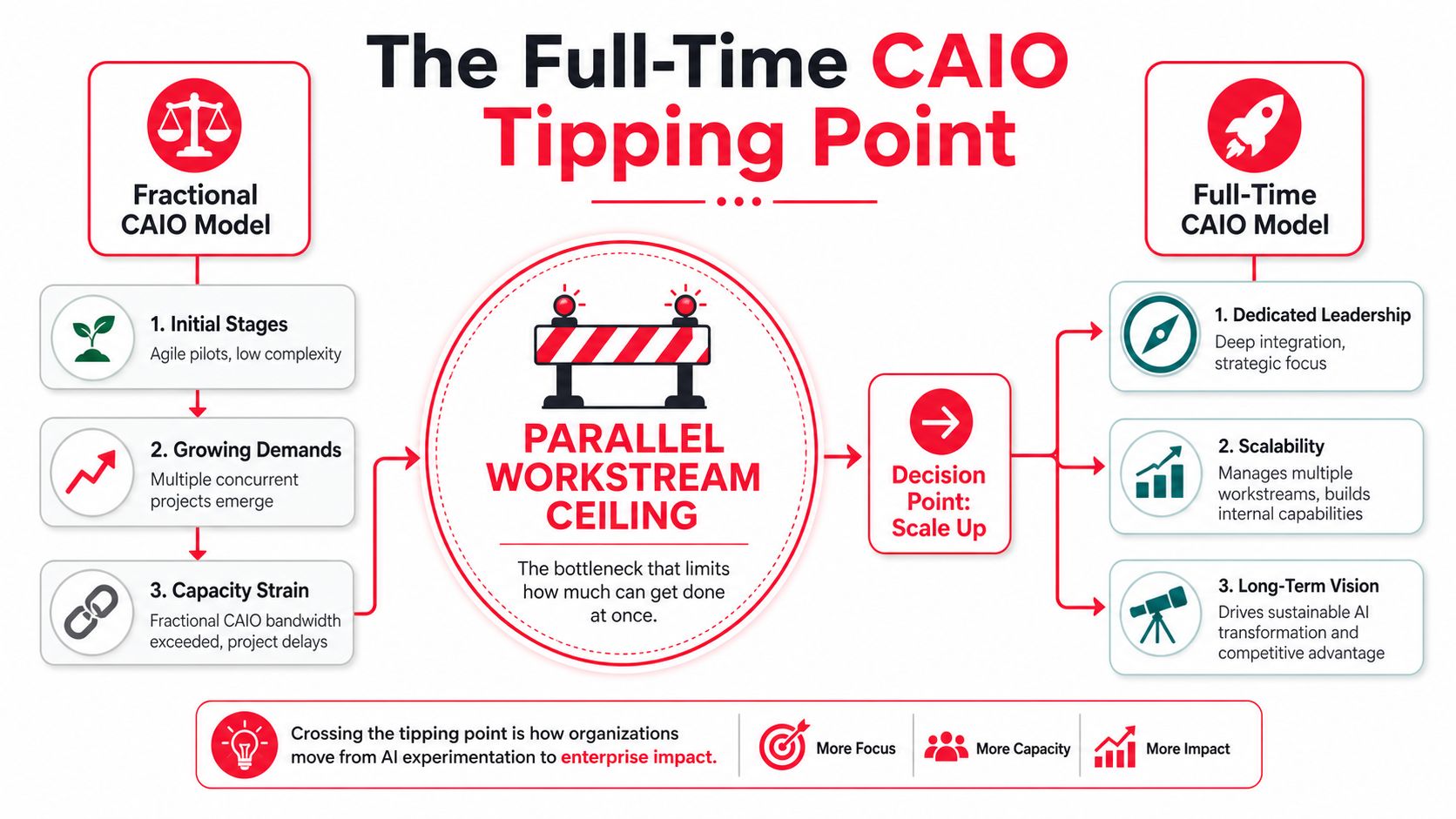
The parallel-workstream ceiling
The most useful decision trigger I've seen is the parallel-workstream ceiling. According to Iternal's analysis of the transition point, the shift from fractional to full-time happens when 5%+ of revenue depends on AI or 3+ AI projects are live in production simultaneously, requiring daily executive attention that a 2–3 day/week fractional model cannot cover.
That's the metric CEOs should use.
Not employee count. Not a vague feeling that AI is “important.” Not whether a competitor just posted a flashy AI job listing.
If three or more AI systems are live and matter operationally, things change. You've got cross-functional coordination. You've got production risk. You've got change management. You've got governance decisions that can't wait for the next weekly check-in.
What changes after the ceiling
Once you cross that threshold, the role stops being mainly about prioritization and starts becoming about continuous management.
A full-time CAIO becomes the better hire when the business needs someone to:
- Run daily executive coordination: product, engineering, marketing, sales, legal, and data teams all need faster decisions
- Manage interdependent workstreams: one live AI system often affects another through shared data, prompts, workflows, or vendor contracts
- Own persistent governance: policy needs to live in the business, not in a periodic advisory cycle
- Build internal capability: specialists need hiring, coaching, review, and operating standards
Here's the direct version. A fractional CAIO is a strong bridge. It becomes a bottleneck when AI revenue dependence or production concurrency demands daily executive attention.
That's your tipping point.
Your Decision Framework and Next Step
This decision should take one leadership meeting, not six months of drift.

The leadership checklist
Use these questions with your CEO, CMO, CRO, and whoever currently owns data or product execution.
How many AI workstreams are live in production today?
If the answer is one or two, fractional is usually enough. If you're at three or more, look hard at full-time.What's the actual goal for the next year?
If you need validated wins in marketing and sales, choose the model that gives immediate senior direction. If you're building an internal AI function across departments, choose the model built for permanence.Where should AI move revenue first?
Be specific. Pipeline creation. Win rate support. Conversion rate. Search visibility inside AI interfaces. Buying readiness for agent-led commerce. If nobody can answer this cleanly, you're not ready for a full-time CAIO.Do we have capable operators who need direction, or do we need to build a dedicated function from scratch?
Existing operators plus executive guidance points to fractional. A widening internal AI organization points to full-time.Can we justify a large fixed executive commitment before the first validated use case is clear?
If that answer is no, don't force the full-time hire.
My recommendation
For most companies in the growth stage, start with a fractional CAIO. Use that leader to set the roadmap, install governance, prioritize revenue use cases, and prove where AI changes commercial performance.
Then reassess when execution load changes. If AI becomes closely tied to revenue and multiple production systems need daily executive attention, upgrade to full-time.
If you want a clean starting point, run an AI readiness assessment and force the business to answer three things: what AI should own, where it should hit revenue first, and whether your current operating model can support it.
Your next step is simple. Book a 30-minute AI roadmap audit with someone who will challenge your assumptions, count the actual workstreams, and tell you whether you need a fractional CAIO or a full-time Chief AI Officer right now.