
U.S. traffic from generative AI services grew more than tenfold between July 2024 and February 2025, and retail traffic from those services grew 12-fold in the same period (Adobe). Executives should treat that as an operating signal. Buyers now form opinions before they ever visit your site.
Measure AI visibility inside your existing GTM system. It is a retrieval-and-recommendation measurement problem, not a side project for SEO alone. Track whether AI systems mention you, cite you, recommend you, and describe you accurately. Then connect those outputs to non-click signals, conversion paths, pipeline influence, and governance checkpoints, so your team can find the exact failure and fix it fast.
Table of Contents
- Understanding Core Concept of AI Visibility
- Why AI Visibility Matters for Marketing Sales and Revenue
- How to Measure and Audit AI Visibility
- Practical Examples of Signals and Metrics to Monitor
- Steps to Improve AI Visibility in GTM Workflows
- Common Pitfalls and Governance Considerations
- Next Actions for Measuring AI Visibility
Understanding Core Concept of AI Visibility
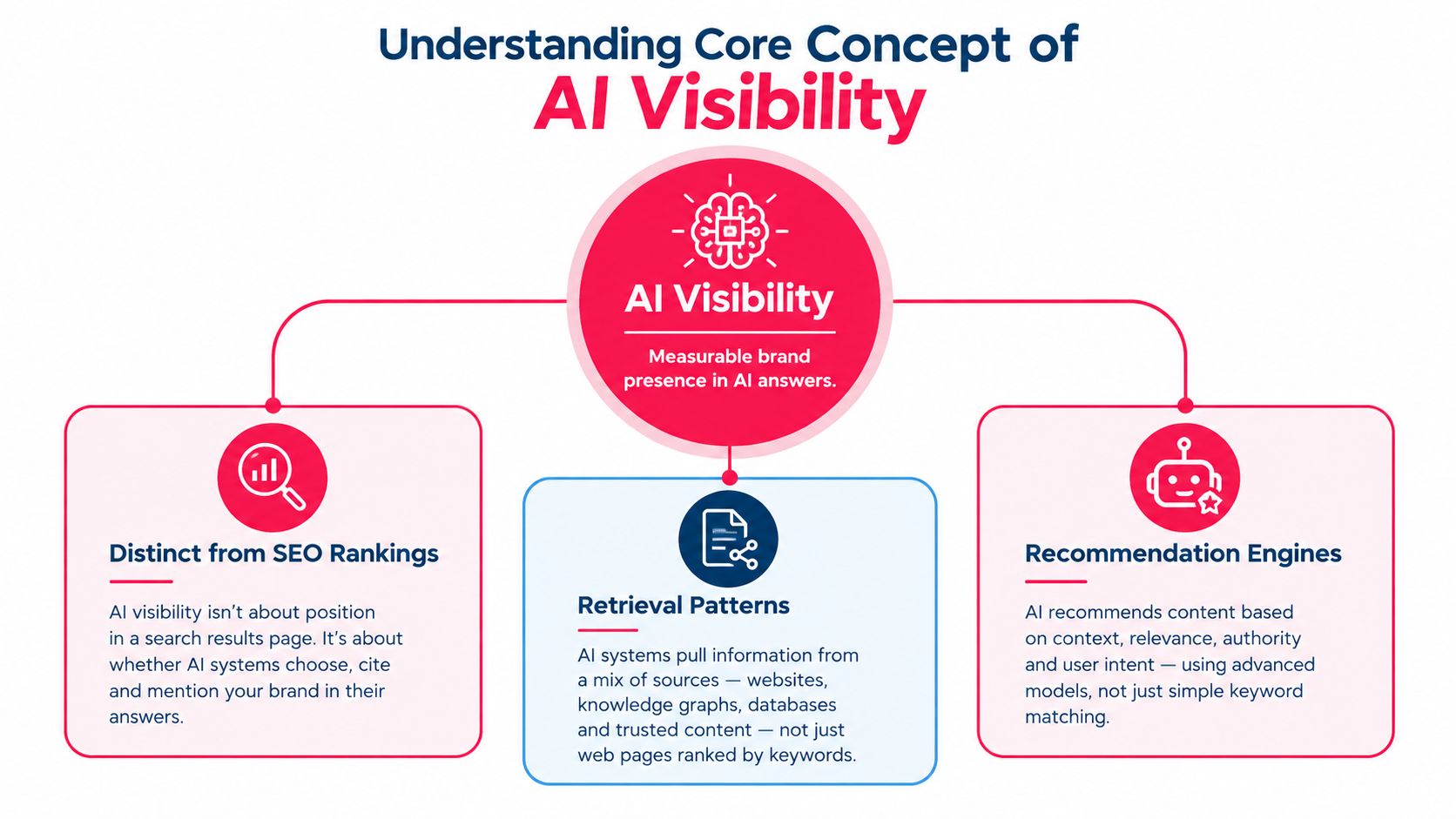
AI visibility measures whether a brand, product, or website appears in answers generated by ChatGPT, Google AI Overviews, Perplexity, Microsoft Copilot, and similar systems. Traditional search visibility tends to focus on rankings, impressions, and clicks. AI visibility asks different questions: Was the company mentioned? Was it recommended? Was it described accurately? Was its website cited? Did it appear ahead of competitors?
The distinction matters because an AI answer can shape consideration without sending a session. A buyer may accept a summary, remember a recommendation, or search for the brand later through another channel. Google launched AI Overviews in the United States in May 2024 after testing Search Generative Experience in 2023, then expanded the feature internationally by October 2024 (AI Overviews history).
The pipeline behind an AI answer
An AI system generally interprets the prompt, retrieves or activates relevant evidence, ranks candidate entities and documents, and synthesizes a response. Citations and recommendations emerge at the final stage, but failure can occur earlier.
A company may be absent because:
- Retrieval failed: the system didn't find an accessible, relevant page or external reference.
- Entity selection failed: the system found the company but chose a competitor for the answer.
- Evidence failed: the page didn't support a specific claim strongly enough.
- Attribution failed: the answer included a claim that couldn't be safely connected to the cited source.
That's why a single brand-mention score is inadequate. We recommend tracking mention rate, average mention position, citation presence, recommendation share, sentiment, source domain, and factual accuracy. The AI answer engine guide provides useful context for how these systems differ from conventional search.
AI visibility extends SEO beyond ranking pages. The practical objective is to become a reliable, relevant, and favorably represented source across the buyer questions that influence demand, evaluation, and purchase.
Why AI Visibility Matters for Marketing Sales and Revenue
AI referrals matter, but clicks are the lagging indicator. The bigger commercial shift is that AI systems now shape vendor discovery, comparison, and shortlist creation before a visit ever appears in analytics. As noted earlier, generative AI referral traffic is rising fast. The harder problem for revenue teams is that a meaningful share of influence now happens without a click, which breaks any measurement model built only on sessions and last-touch attribution.
That gap shows up first in B2B buying. A prospect can ask for category options, implementation guidance, or competitor alternatives, then see your brand cited, compared, or excluded inside the answer. If your company is recommended, you may enter the deal before paid search, outbound, or direct traffic gets credit. If a competitor owns those answers, demand shifts away from you upstream and your conversion team never gets a fair shot.
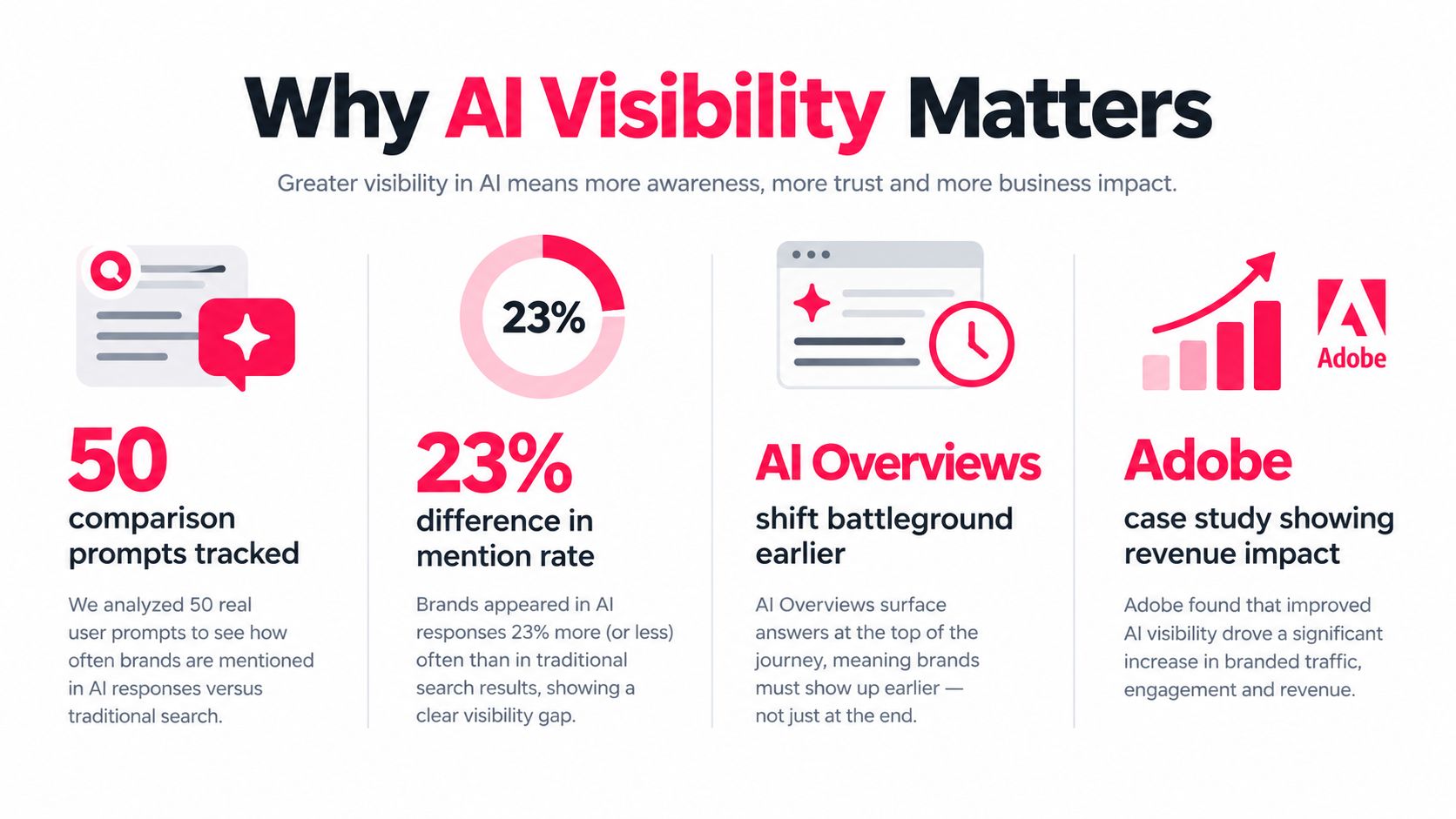
Treat AI visibility as a retrieval-and-recommendation measurement problem, not a traffic report. Marketing, sales, and revenue leaders need to track whether the brand is retrieved for the right prompts, whether it is recommended in a favorable position, whether citations support the claims, and whether those exposures line up with later demand signals. That means combining classic GTM metrics with non-click signals your current dashboard probably ignores.
Put visibility beside pipeline metrics
Use a three-layer model that connects AI exposure to commercial outcomes without pretending every mention produces an immediate visit.
| Layer | What to measure | Where it belongs |
|---|---|---|
| Exposure | Mention rate, recommendation position, citation rate | SEO and brand reporting |
| Engagement | AI referral visits, branded searches, direct sessions | Analytics and attribution |
| Commercial outcome | Qualified leads, assisted opportunities, pipeline, revenue | CRM and finance |
This structure prevents a common mistake. Teams often celebrate a gain in AI mentions or dismiss AI entirely because referral sessions look small. Both reactions miss the point. A higher mention rate shows that retrieval and recommendation improved. Revenue impact comes later, through branded search, direct visits, partner traffic, sales conversations, and assisted conversions that reflect changed buyer consideration.
Executive rule: Don't judge an AI recommendation by last-click traffic alone. A cited answer can influence a buyer who later arrives through direct, branded, partner, or sales-assisted channels.
Your CFO does not need a speculative AI revenue story. Your GTM team needs governance and traceability. Define the buyer questions that matter, monitor which engines answer them, record which competitors appear, and check whether changes in visibility correlate with qualified demand. That is how AI visibility becomes a revenue measurement system instead of another awareness metric.
How to Measure and Audit AI Visibility
Start with a prompt panel, not a vendor demo. Build prompts around the questions your sales team hears and your buyers ask during evaluation.
- Category discovery: Which platforms solve this business problem?
- Comparison: What are the best options for a company with this use case?
- Alternatives: What should buyers consider instead of a named competitor?
- Implementation: What does adoption require, and which vendors support it?
- Purchase: Which providers should a buyer shortlist?
Run the same panel across ChatGPT, Google AI Overviews, Perplexity, Gemini, and Microsoft Copilot where access and tooling allow. Repeat the tests because model updates, location, personalization, retrieval changes, and sampling variation can alter the answer.
A large-scale study covering more than 100,000 responses, 102 brands, five AI engines, and 149,912 citations found first-run visibility averaging approximately 73% for global household brands, 44% for established mid-market or regional brands, and 11% for niche or small brands (Alphaxiv study). The same study found that sentiment changed approximately 6.7 times more often than whether a brand appeared, so visibility and sentiment need separate reporting.
Choose metrics by decision
| Metric | Definition | Recommended tool |
|---|---|---|
| Mention rate | Share of monitored prompts that name the company | Commercial AI-visibility platform or structured manual testing |
| Average mention position | Where the company appears among recommendations | Prompt export with spreadsheet or Python |
| Citation rate | Share of answers citing the company's domain or material | AI-visibility platform, URL parser |
| Recommendation share | Portion of prompts where the company is actively recommended | Prompt panel and competitor tagging |
| Sentiment and accuracy | Whether the description is favorable and factually correct | Human review with rules-based QA |
| Source domains | Websites used to support the answer | Citation extraction and CRM-style source log |
For a lean team, a custom Python script can support an initial collection workflow with an implementation budget around $1,000, while commercial AI-visibility platforms may cost approximately $3,000 to $7,000 per month. Those ranges are planning figures, not universal market prices. Confirm current pricing, engine coverage, data retention, and export rights before procurement.
A tool such as the Bluesky endpoint by Captapi can help teams collect social-source data when public discussion is part of the citation or reputation audit. It shouldn't replace answer testing, source verification, or human review.
For an operating process, assign ownership clearly:
- SEO lead: owns prompt taxonomy, technical discoverability, and content changes.
- Data engineer: owns collection, deduplication, storage, and reporting.
- Sales operations: connects visibility shifts with opportunity and source data.
- Fractional CAIO: sets test priorities, resolves trade-offs, and reports risk to executives.
A structured AI visibility audit should produce an issue list, not a vanity score.
Practical Examples of Signals and Metrics to Monitor
The useful dashboard isn't a leaderboard of brands. It's a panel that shows where your company appears, how it is described, which evidence supports the answer, and whether the pattern changes by engine, intent, or market.
A B2B SaaS company might monitor comparison prompts across ChatGPT, Gemini, and Perplexity. If mention rates differ by engine, the team should inspect retrieval sources and answer framing rather than average the engines into one number. A strong result on one engine can conceal weak category coverage elsewhere.
Read the signal before changing the page
A company can be mentioned but described inaccurately. It can be cited as a source without being recommended. It can be recommended in one country and omitted in another. Each condition points to a different intervention.
Recent analysis of 6.8 million citations across ChatGPT, Gemini, and Perplexity found that citation patterns changed by query type. First-party websites and local pages generated nearly 60% of citations for unbranded objective queries, while branded or subjective queries relied more heavily on listings and reviews. The analysis also found that 86% of citations came from brand-managed sources, including websites, listings, and reviews or social profiles (Yext citation analysis).
That changes the operating question from “How visible are we?” to:
- Which buyer questions produce a mention?
- Which markets and locations show a gap?
- Are product claims accurate?
- Which source domains support the answer?
- Does the system recommend us or merely cite us?
- Which competitor appears in the position we want?
Use the dashboard in weekly GTM reviews
Put prompt-level results beside SEO landing-page performance and sales objections. If buyers ask about implementation risk and AI answers lack evidence on your site, update the implementation page and equip sales with the same proof points. If third-party reviews misstate your product, route the issue to marketing, customer success, and legal rather than publishing another generic blog post.
Your dashboard should preserve the raw answer, cited URLs, engine, location, prompt category, date, and reviewer decision. Without that audit trail, the team can't distinguish a genuine improvement from answer volatility.
Steps to Improve AI Visibility in GTM Workflows
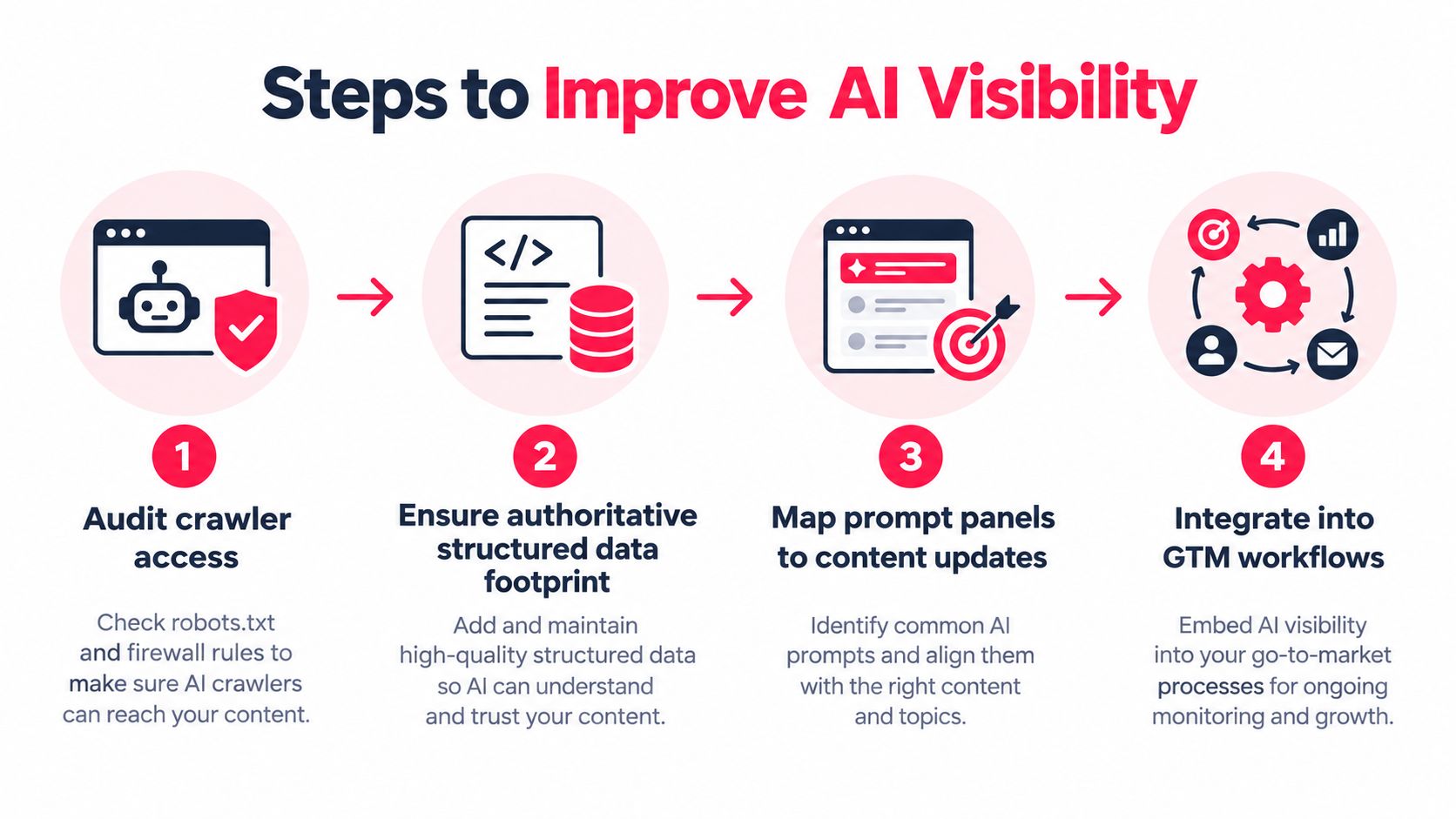
Improvement starts with access and evidence. Publishing more pages before checking whether AI crawlers can reach the right pages wastes time.
1. Audit crawler access
Review robots.txt, CDN rules, firewall policies, authentication layers, and deployment settings. OpenAI identifies OAI-SearchBot as the crawler used to surface websites in ChatGPT search features. A site that disallows OAI-SearchBot won't appear as a source in ChatGPT search answers, although it may still appear as a navigational link (OpenAI bot documentation).
The SEO lead and a web engineer should document which paths are available, which are blocked, and whether staging rules accidentally reached production.
2. Build an authoritative entity footprint
Make the company, products, use cases, customer types, integrations, and proof points easy to connect. Use consistent naming, structured data where appropriate, clear author and company information, comparison pages, implementation documentation, and independently verifiable references.
A page needs differentiated evidence. Keyword repetition won't compensate for vague positioning or claims that a retrieval system can't safely attribute.
3. Map prompts to content updates
Treat each visibility gap as a content or evidence hypothesis. If the company is omitted from “alternatives to” prompts, review category positioning and comparison content. If it appears with incorrect pricing or capabilities, create a clear source of truth and correct conflicting public listings.
Search teams already run content refreshes. Add prompt outcomes to the same backlog, with an owner, hypothesis, target engine, and review date.
4. Add AI checks to GTM testing
Include AI visibility in SEO reviews, CRO experiments, product launches, sales enablement, and major website migrations. Track whether a page update changes citations or answer accuracy, then retain the original answer so the team can compare outcomes.
Teams evaluating techninis SEO can use that work as a technical input, but technical SEO alone won't decide whether an AI system recommends the company. Retrieval access, entity clarity, evidence quality, and category relevance all need attention.
Common Pitfalls and Governance Considerations
The first failure is treating every mention as a win. A company can appear below competitors, receive an inaccurate description, or be cited from a weak source. Report appearance, prominence, description, citation, and recommendation separately.
The second failure is treating referral clicks as the complete scorecard. A 2026 study of Google search-result behavior found that only about 1% of visits involving an AI Overview resulted in a click to one of the cited sources, while users clicked traditional results on roughly 8% of visits when an AI Overview appeared (Google search behavior study). Those findings make last-click reporting especially unreliable for AI influence.
Governance checkpoints
- Crawler policy: Separate OAI-SearchBot, which supports ChatGPT search visibility, from GPTBot, which relates to training access. Decide which paths each crawler may access.
- Sensitive content: Exclude customer areas, internal documentation, staging resources, and confidential material from public retrieval.
- Citation QA: Check whether the cited page supports the generated claim, especially for regulated or technical categories.
- Change control: Record robots.txt, firewall, CMS, schema, and major content changes beside visibility results.
- Legal review: Define who approves claims about security, compliance, performance, and customer outcomes.
For internal policy design, Stimulead's AI governance best practices can serve as a related planning resource.
A single successful answer is evidence that one test passed. It isn't evidence of durable market coverage.
BrightEdge reported that ChatGPT, Google AI Overviews, and Google AI Mode disagreed on brand recommendations for 62% of tracked queries. Its analysis also found that Google AI Overviews mentioned 2.5 times more brands than ChatGPT, and that AI Overview mentions had 16.7% greater volatility than AI Mode (BrightEdge AI search analysis). Repeat testing is a governance requirement, not an analytics preference.
For adjacent topics, what is LLMO covers how language models select and cite companies, and what is agentic search explains how AI systems that plan and act on a buyer’s behalf change discovery.
Next Actions for Measuring AI Visibility
Choose the operating model that matches your maturity and desired testing velocity.
- Fractional CAIO advisory: Use this when executives need a roadmap, governance decisions, vendor evaluation, and cross-functional ownership.
- Dedicated monitoring software: Consider a platform priced around $2,000 to $5,000 per month when the team needs automated recurring tests, competitor comparisons, and reporting.
- Internal capability: Train SEO, revenue operations, and data teams when the company can maintain prompt panels, scripts, source QA, and CRM connections.
Start with a fixed prompt panel and a crawler-access review. Then assign one owner to connect mention and citation changes with branded demand, qualified opportunities, and sales-source feedback. If your team can't run that loop consistently, bring in an advisory partner before purchasing another dashboard.
Request a Stimulead AI visibility assessment at stimulead.com and bring your highest-value buyer questions, competitor list, analytics access, and current crawler policy. We'll help you decide whether the next investment belongs in technical access, evidence and content, measurement infrastructure, or governance.
