
Most advice says to buy an AI agent when you want a system to work autonomously. That's a poor buying rule: autonomy alone doesn't tell you whether a product can finish a sales task, recover when data changes, or avoid sending an unapproved offer.
We define an agent by what it can do, what controls its actions, and what happens if it gets the decision wrong. For CEOs, CMOs, and CROs at growth-stage B2B companies, those distinctions determine whether to pilot an agent, keep a workflow, or leave the decision with a person.
Table of Contents
- Why the Standard AI Agent Definition Breaks in the Boardroom
- From 1995 Research to the Modern Agent Stack
- Agent vs Workflow vs Chatbot vs RPA
- What an Agent Looks Like in Marketing, Sales, and Commerce
- The Autonomy Boundary: When to Trust an Agent to Act
- KPIs, Ownership, and Pilot Sequencing for a 50-Person Company
- The Next Decision: Pilot, Defer, or Buy a Workflow Instead
Why the Standard AI Agent Definition Breaks in the Boardroom
Vendors often call any software with a language model an agent. That label makes budget and governance discussions imprecise: a scripted process, a chatbot that retrieves answers, and a system that decides which tools to use across a task are different products with different risks.
The classic definition is more demanding. IBM's history of AI agents traces the modern framing to 1995, when Stuart Russell and Peter Norvig described an agent as operating autonomously, perceiving its environment, persisting over time, adapting to change, and pursuing goals. The same year, Michael Wooldridge and Nicholas Jennings identified autonomy, social ability, reactivity, and proactiveness as properties of intelligent agents.
That history is useful, but a boardroom needs an operating test, not a vocabulary quiz. We define an AI agent as a system that can maintain a task's context, plan across steps, use tools, observe what happened, and revise its actions toward a stated goal. Autonomy matters only when those capabilities produce a dependable outcome inside approved boundaries.
Our buying rule: Don't pay an “agent” premium for a product label. Ask the vendor to demonstrate the work the system can complete, the decisions it makes, and the controls that limit those decisions.
The same standard helps buyers distinguish a voice interface from a sales system that can take action. For a focused look at the category, see this Voicedial.ai guide to AI sales agents. Then ask the vendor to show, rather than assert, how its product handles tool access, task context, handoffs, and exceptions.
From 1995 Research to the Modern Agent Stack
Buy the control loop; the model demo is evidence of only one layer. In production, the language model interprets a goal and proposes a next move. The surrounding software decides what that move may touch, what it must log, and when it has to stop.
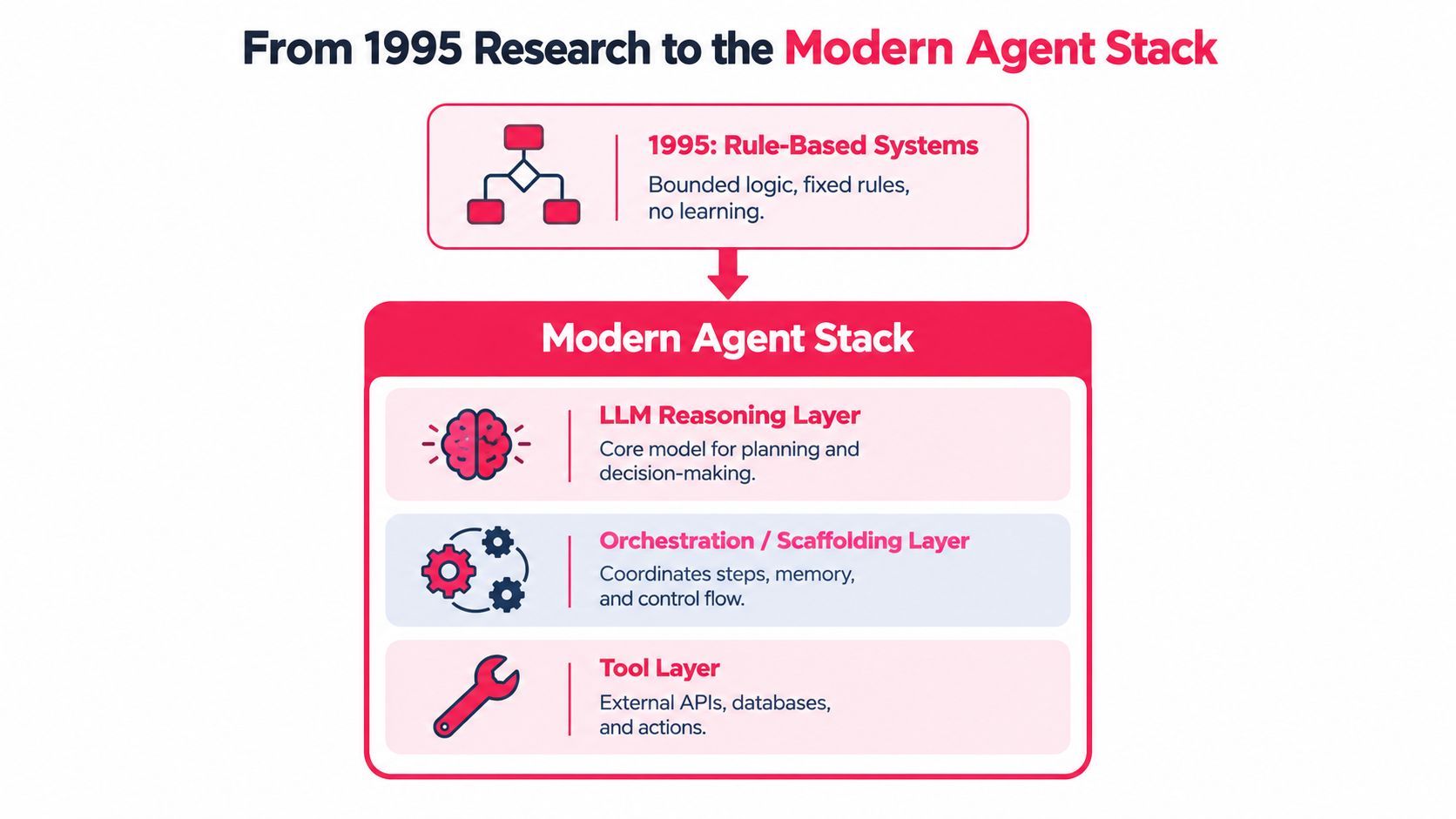
A useful stack review separates five surfaces: the reasoning layer that drafts plans; the orchestration layer that runs the loop, state, retries, and approvals; the tool and API surface where CRM, data, or order systems are exposed; memory that keeps context and prevents repeated work; and execution that applies the change and records the result. Capability comes from the model. Safety comes from the control surface. Consequence comes from what execution can alter.
Model quality alone is a weak buying signal. In the 2024 TravelPlanner benchmark, GPT-4 completed only 0.6% of complex multi-step planning tasks across 1,225 curated intents, according to the benchmark paper. Fluent narration can mask bad planning.
Ask each vendor to map ownership per layer: who sets permissions, who can revoke tool access, where state is stored, and which exceptions route to a person. For deployment choices around permissions, logging, and human approval, use this AI agent deployment with safety guardrails guide while you scope the pilot.
Agent vs Workflow vs Chatbot vs RPA
The most useful distinction is who controls the action sequence. Anthropic describes a workflow as a system that follows predefined code paths, while an agent directs its own process and tool use in a feedback loop. That difference affects what you should buy, how you test it, and what you allow it to change.
| System type | Who controls the action sequence | Best-fit growth use case |
|---|---|---|
| Workflow | Code follows a predefined path | Enrich every inbound lead, score it, then update a CRM field in a fixed order |
| RPA | Rules imitate a person's actions in a user interface | Copy a value between systems that lack a practical integration |
| Chatbot | A user asks questions; the system responds | Answer self-serve support questions from an approved knowledge base |
| Agent | The system selects tools and can revise the plan based on results | Research a prospect, check available signals, and prepare a context-aware next action |
A workflow can include a language model and still be a workflow. If every task follows the same path, that may be the right design. Fixed sequences are easier to audit and test against known inputs. RPA can help when a process is trapped behind an interface, but it can break when that interface changes.
An agent fits a less predictable task. It may decide that one lead needs firmographic research while another needs a CRM check, then use the result to choose what to do next. That flexibility brings more exception paths, so evaluation must cover tool selection, recovery, and stopping behavior, not only the final text.
Don't let a demo collapse these distinctions. Ask the vendor to show whether the system preserves task context, uses tools, verifies outcomes, and handles exceptions. If your team is comparing automation approaches in finance operations, this guide to finance automation for auditors offers a useful adjacent example of why process design matters.
What an Agent Looks Like in Marketing, Sales, and Commerce
A real agent is easier to assess through its operating boundaries than through a feature list. The following are implementation patterns, not claims about client results. Each defines the goal, the tools, a stopping condition, an approval point, and a KPI before the system goes live.
Outbound research. A prospecting agent checks a funding announcement and approved company data, then writes its findings to HubSpot. It can draft a first-touch message, but it stops before sending unless the relevant intent signal and approval rules are satisfied. The team measures research completeness, correction volume, and whether qualified meetings result, rather than counting drafts.
Commerce operations. An agent checks inventory and product data, then proposes a repricing action within a margin band set by the business. It stops and asks for a person's approval when the proposed change falls outside that band or the source data conflicts. The operating KPI is margin-safe completion, with escalations and corrections tracked alongside it.
Customer success. A system reviews product-usage data, records a risk assessment, and opens a customer-success ticket when the evidence meets defined criteria. It escalates uncertain or sensitive cases to the CSM instead of sending a customer-facing message on its own. The team tracks whether reviews reach the right owner and whether the resulting action supports retention.
Anthropic describes agents as LLMs that dynamically direct their process and tool use in a feedback loop, and recommends making planning visible and tool documentation explicit in its engineering guidance on effective agents. That's practical advice: hidden decisions are difficult to inspect when a task goes wrong.
For a deeper look at where this model can fit in a marketing operation, see Stimulead's AI agents for marketing. The operating question for a growth-stage company isn't whether it can connect tools. It's whether a named owner can define a successful outcome, a safe stop, and a useful measurement before deployment.
The Autonomy Boundary: When to Trust an Agent to Act
The best agent isn't the one with the fewest approval prompts. It's the one whose permission level matches the reversibility and business impact of each action. Set those limits before connecting the agent to systems of record or external communication.
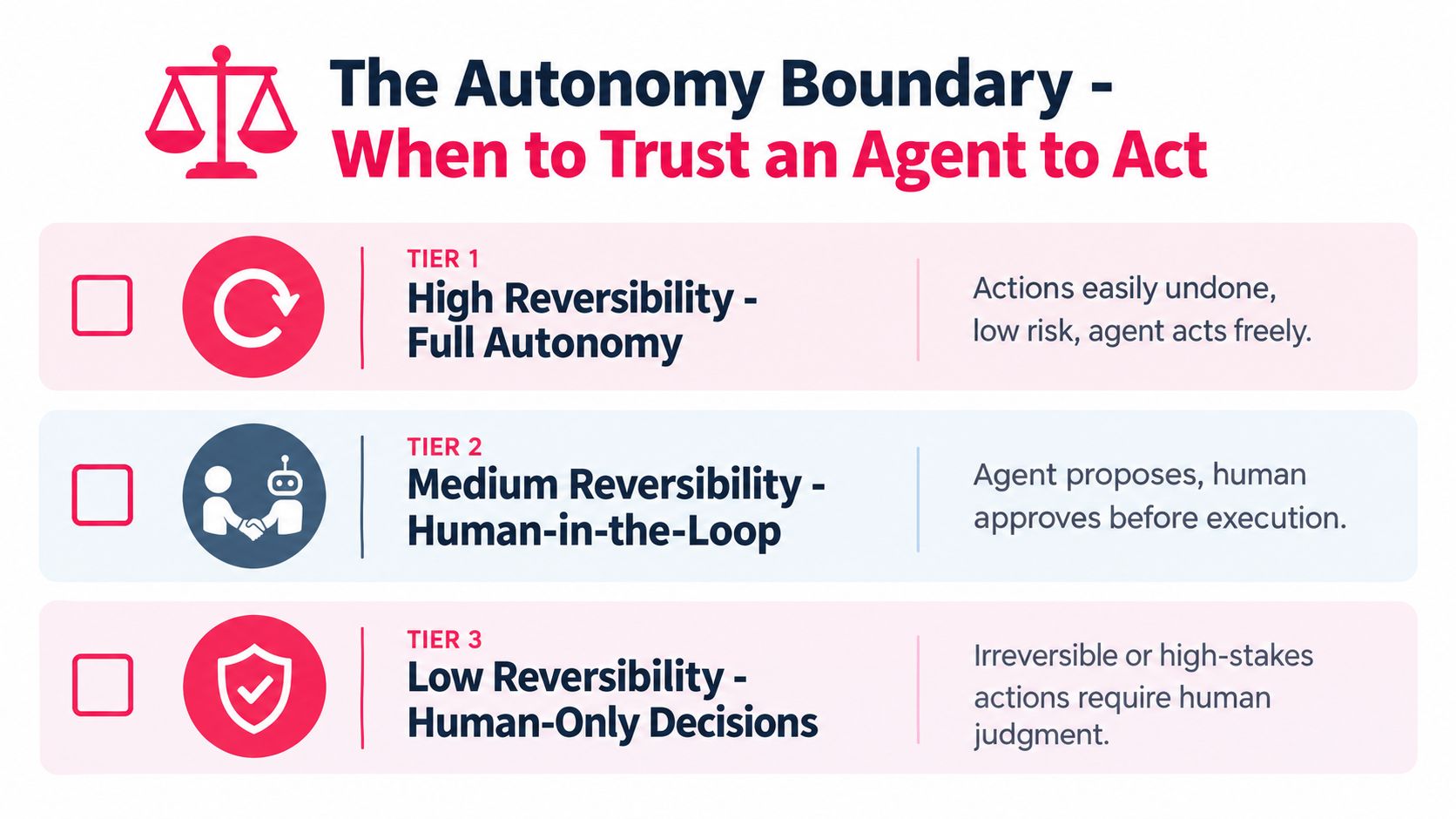
- High reversibility, low impact: Let the agent draft a report, summarize account research, or enrich a lead record when changes are easy to review and undo. Log the actions and sample outputs for quality checks.
- Moderate reversibility or material impact: Let the agent propose campaign changes or personalized outreach, but require approval before execution. Keep an audit log, define an approval threshold, and make rollback available.
- Low reversibility or high stakes: Keep pricing changes, contractual commitments, financial transactions, and customer-data deletion under human authority. The agent may gather evidence or prepare a recommendation, but a person makes and approves the decision.
Research prepared for the European Parliament flags prompt sensitivity, inconsistent outputs, and concept drift as failure modes that call for continuous validation and expert oversight. Those risks make broad permissions a poor default, especially when an agent can act on unvetted inputs or affect customer relationships.
The European Commission's guidance on high-risk AI systems describes obligations for specified high-risk uses, including areas such as employment, education, critical infrastructure, biometrics, migration, and border control. A marketing or sales agent isn't automatically high-risk because it uses AI; classification depends on its use and the applicable legal framework. Still, the operating principle applies widely: document the system's purpose, owner, access boundaries, monitoring, and escalation path.
For a structured review of the risks before a system reaches production, Stimulead's AI due diligence service can help teams assess proposed uses and controls. The accountable owner should be able to explain, in plain language, what the agent may do without approval and what always requires a person.
KPIs, Ownership, and Pilot Sequencing for a 50-Person Company
A pilot produces activity. An operating system produces a measurable change in how work gets completed. Before launch, name one workflow owner who can set the success criteria, coordinate marketing, sales, and RevOps, and decide when the system needs review or a change in scope.
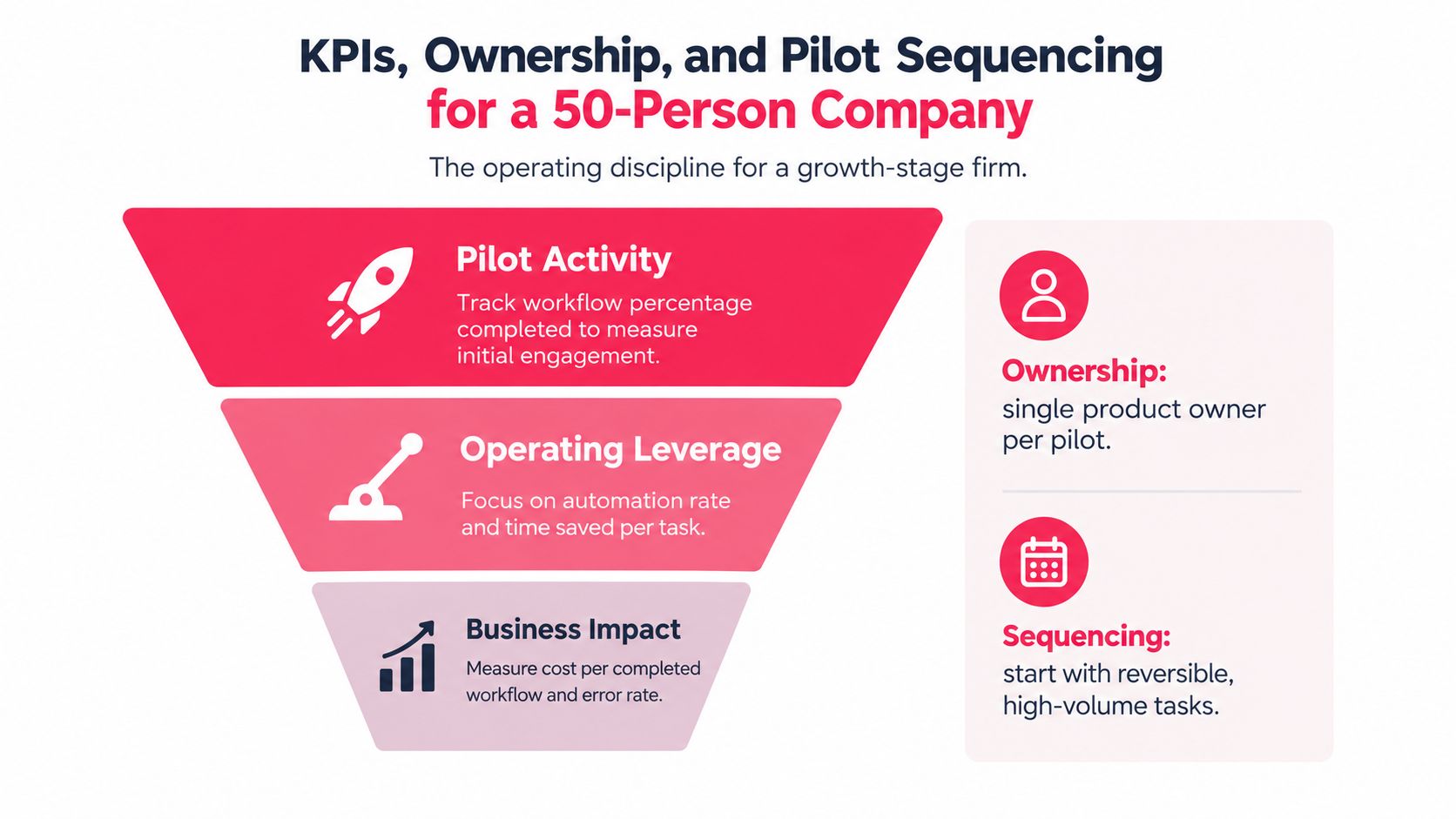
Use a scorecard that connects agent behavior to business outcomes:
- Completion without intervention: What share of eligible tasks reaches the defined end state without a person taking over?
- Tool-call success and exception rate: Do connected systems return the expected result, and how often does the agent need to stop?
- Human-intervention rate and cycle time: How much review does the process still require, and does the task finish sooner?
- Cost per completed task: Include model usage, software, implementation, review, and correction effort.
- Pipeline and conversion impact: Check whether the workflow changes qualified progression or conversion, not merely the volume of activity.
Microsoft's 2025 Work Trend Index reported that 46% of leaders said their organizations fully automated workflows with AI agents, while 40% of employees said they were familiar with AI agents (Microsoft's report). Those figures describe reported automation and familiarity, not independently measured commercial results. Treat adoption as a reason to examine the work, not as evidence that your own process is ready.
Start with a reversible, high-volume task where the team can check results and learn from exceptions. For signal triage inside an SDR motion, Stimulead's signal-based selling approach provides a related starting point for defining what the system should recognize and what happens next. Don't expand scope until the owner can explain the error rate, review burden, cycle time, and downstream pipeline effect.
For more on this, what is an AI agent covers architecture choices and permissions, AI agent meaning looks at what an agent actually runs in a revenue stack, and the agentic AI definition covers stopping rules and verification.
The Next Decision: Pilot, Defer, or Buy a Workflow Instead
A pilot is the right choice when the task varies across cases, the feedback loop is short, and the consequences of a mistake are bounded. Defer when reliable data isn't available or the cost of an error outweighs the plausible conversion upside. Buy a deterministic workflow when inputs and steps are repeatable and auditability matters more than flexibility.
McKinsey's 2025 AI survey reported that 39% of organizations were experimenting with AI agents, while 23% were scaling an agentic system in at least one business function (McKinsey's survey). The gap is a reminder to judge a proposal by completed work and operating evidence, not by a pilot announcement.
What to demand in a vendor evaluation
Don't accept a polished demo as proof of production readiness. Ask the vendor to demonstrate:
- Multi-step completion: Can it reach a verified end state, not just produce a plausible response?
- Auditability: Can your team inspect the plan, tool calls, inputs, results, and approvals?
- Recovery: What happens when a tool fails, information changes, or the agent reaches a stopping condition?
- Permissions: Are tools denied by default until an owner explicitly grants access?
- Evaluation: Can the vendor run your cases and show how it scores correct outcomes, exceptions, and unsafe actions?
Then put the governance record in writing: the purpose, accountable owner, permitted scope, monitoring plan, human escalation rules, and exit plan. Name the systems the agent can access and identify which actions it can take without approval. If the vendor can't explain these controls clearly, keep the system out of consequential workflows.
For a deeper application to buying and selling through AI-mediated channels, Stimulead's agentic commerce guide is a relevant next read. Before committing budget, choose one workflow and decide which outcome would justify expansion, which failure would stop the pilot, and who owns that call. If you can't answer those questions, defer the agent. If you can, scope a bounded pilot or buy the simpler workflow.
Stimulead works with growth leaders on AI roadmaps, vendor evaluation, and implementation oversight. If your team is weighing a pilot, define the workflow owner, action boundary, and outcome scorecard before the next vendor demo.
