
90.3% of surveyed marketing and martech leaders used AI agents somewhere in their stack, yet only 23.3% had them in full production, while 80.6% kept them in assist-only mode, according to Neil Patel's 2026 AI agent adoption summary. That gap defines the decision facing CEOs, CMOs, and CROs at growth-stage B2B companies: choose one revenue surface where an agent can act under control, or keep funding impressive demos that never influence pipeline.
We've deployed marketing agents in production, and the pattern is consistent. Content generation is easy to approve and hard to connect to revenue. Lead routing, landing-page experimentation, personalized outreach, and GTM data work offer clearer economic tests, but they also expose weak data, unclear ownership, and missing safeguards quickly.
Table of Contents
- The Operator Decision Behind Marketing Agents
- What AI Agents for Marketing Actually Are
- Where Marketing Agents Move Revenue
- The Velocity and ROI Math That Justifies the Build
- A 90-Day Implementation Roadmap with KPIs
- Where Agent Programs Fail Before They Reach Production
- Vendor Evaluation and Fractional CAIO Engagement Models
The Operator Decision Behind Marketing Agents
Before comparing vendors, decide what the agent is allowed to touch. A system that drafts an email inside a CMS carries a different risk from one that enriches a form submission, changes lead priority in Salesforce, launches outreach in Outreach, or selects a landing-page offer for a live visitor.
We see three practical scope postures:
Assist-only content generation. The agent drafts subject lines, briefs, landing-page copy, or sales messages. A marketer approves every output, so the main benefit is production capacity and testing volume. The main limitation is that the team may never learn whether autonomous execution would have performed better.
Contained experimentation. The agent operates on one funnel surface, such as form enrichment, a landing-page variant, or inbound lead routing. The team defines a control, limits traffic or permissions, and evaluates a conversion event. This is usually the most useful starting point for a company with clean enough instrumentation but limited appetite for operational risk.
Full revenue-loop deployment. The agent reads signals, chooses an action, executes it across connected systems, and receives downstream feedback from CRM and pipeline reporting. This posture can affect acquisition and sales outcomes, but it demands data lineage, approval rules, auditability, and a clear rollback path.
The AI agents market was estimated at $5.1 billion in 2024 and projected to reach $47.1 billion by 2033, according to DataGrid's marketing statistics analysis. The category's size doesn't answer whether your company is ready for autonomy. Your operating model does.
Operator rule: Start with the narrowest agent that can influence a conversion event, then earn permission to touch the next system.
A fractional CAIO can help separate a strategic wedge from a tool-shopping exercise. Our guide to when to hire a Chief AI Officer covers the leadership conditions that usually justify that support. The immediate question remains scope: what may the agent change without waiting for a person?
What AI Agents for Marketing Actually Are
A marketing agent follows a closed operating loop:
- Perceive: inspect defined inputs such as form data, CRM records, campaign metrics, web behavior, or approved account signals.
- Reason: compare those inputs with a goal, context, and constraints.
- Act: update a connected system, generate a message, route a lead, alter an experience, or create a work item.
- Learn: measure the result and use the outcome to inform later decisions.
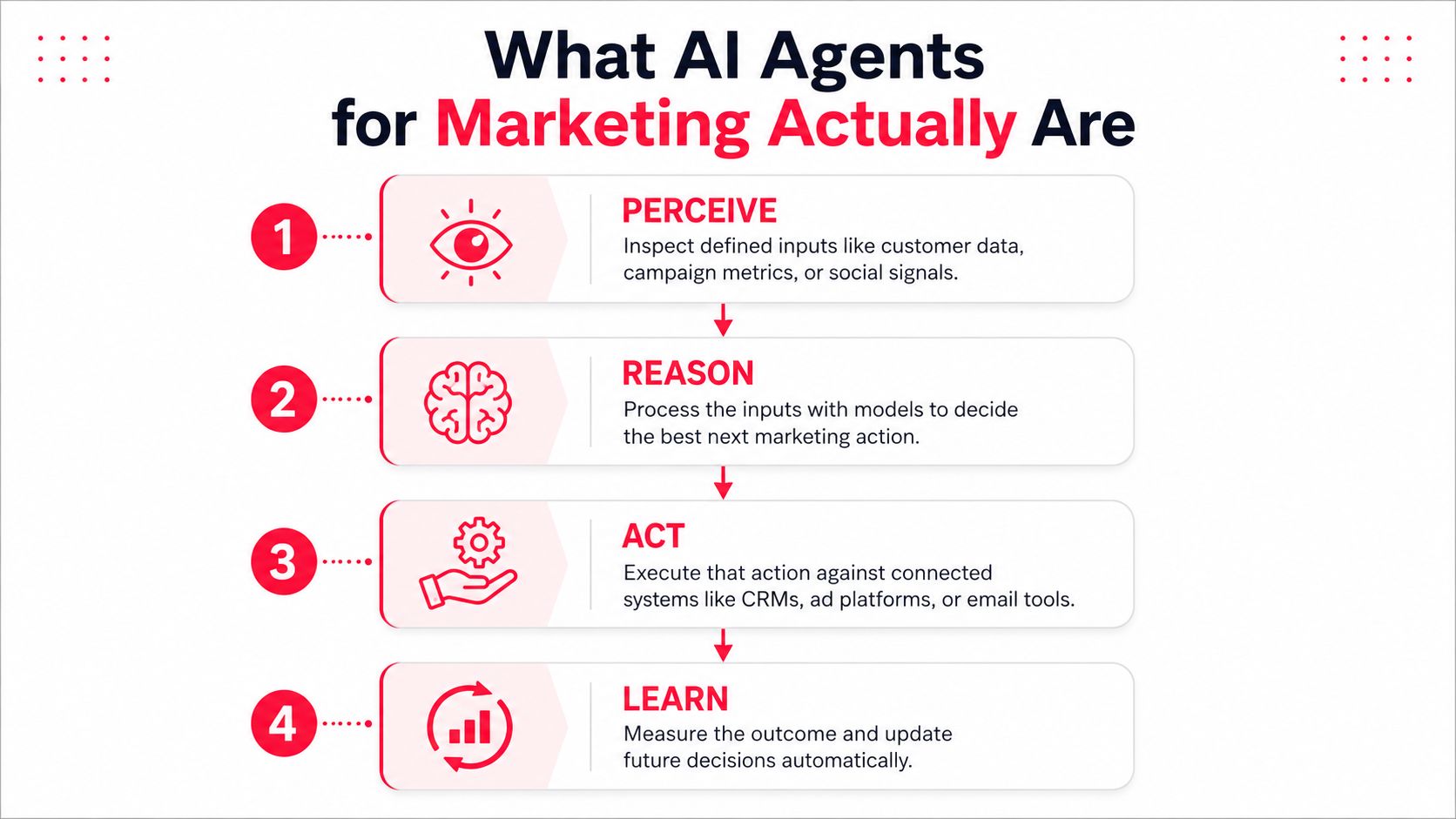
That loop separates agents from two systems often sold under the same label. A copilot suggests an action and waits for confirmation. Traditional automation follows deterministic rules, such as sending Email B after a contact opens Email A. An agent can choose among several permitted actions based on context, then evaluate what happened.
The distinction matters because autonomy creates a different measurement burden. If the agent only writes copy, approval rate and editorial time may be relevant. If it routes leads or changes offers, the evaluation must reach form conversion, sales acceptance, opportunity creation, or another agreed business event.
Three capability tiers
Tier 1, single-task agents, operate inside one tool. Examples include a subject-line generator in an email platform, a CTA rewriter in a CMS, or a landing-page QA assistant. These agents can increase creative throughput, but their performance ceiling is tied to the local task.
Tier 2, multi-step workflow agents, sit between systems. A lead may arrive through HubSpot, receive enrichment from an approved data provider, move through routing logic, and enter a sales engagement sequence. The agent needs API access, field definitions, exception handling, and permissions across each step.
Tier 3, revenue-loop agents, connect activity with downstream results. They may read CRM stage movement, web analytics, campaign performance, and closed-won feedback before adjusting a recommendation or workflow. GTM-Bench's framework makes the evaluation standard explicit: its agents complete 72 realistic prospecting tasks and are scored on offer summaries, ICP definitions, ranked prospect lists, and evidence in a controlled tool environment, as described in the GTM-Bench research paper.
That evidence requirement is the practical dividing line. A fluent answer isn't enough. A production agent must show which data it used, why the action met the goal, and what happened afterward.
Where Marketing Agents Move Revenue
Revenue impact appears when an agent owns a measurable bottleneck and operates on a system that records the result. We usually begin with the conversion event, then work backward to the data inputs and the permitted action.
| Use Case | Primary Metric | System of Record | Key Failure Signal |
|---|---|---|---|
| CRO velocity | Form-fill conversion or demo-book rate | Web analytics and experimentation platform | Variants ship without a controlled holdout, or wins don't persist after traffic changes |
| Personalized outreach | Pipeline attributed to targeted sequences | Sales engagement platform and CRM | Reply activity rises while qualified meetings and opportunities stay flat |
| AEO and AI search visibility | Share of answer across priority queries | Search monitoring and content system | Content volume increases while cited or recommended presence doesn't |
| GTM engineering | Routing accuracy and sales acceptance | CRM and enrichment system | Duplicate, incomplete, or misrouted records increase |
CRO velocity
An agent can inspect page behavior, identify friction, generate bounded headline or offer variants, and send approved variants into an experimentation platform. The metric should be a defined conversion event, such as form completion or demo booking, with a static control preserved.
The agent depends on clean event tracking, consistent page templates, offer rules, and a decision about which changes require human approval. A failure signal appears when the team celebrates more variants without a reliable comparison or when the agent optimizes a proxy such as click-through rate while qualified conversion remains unchanged.
Personalized outreach
An outreach agent can combine approved first-party account activity, CRM context, persona information, and sales-approved messaging rules. It can draft account-specific messages, select a sequence branch, and write the resulting activity back to the CRM or engagement platform.
The primary metric should reach pipeline attribution, not message volume. A lead-generation agent playbook from DialNexa Labs Private Limited is useful for mapping the operational steps, but your own CRM must decide whether the workflow creates qualified progression.
AEO and AI search visibility
AEO agents can create structured, evidence-grounded content, identify topic gaps, monitor mentions in answer engines, and feed findings into the editorial calendar. Their inputs include approved product facts, customer language, existing content, and query sets tied to buying decisions.
The meaningful measure is share of answer against priority queries. A large publishing queue isn't proof of progress. If the agent produces pages that don't earn citations, recommendations, or qualified visits, the workflow needs a better source set or a narrower query strategy.
GTM engineering
GTM agents often deliver value through operational accuracy. They can normalize job titles, identify missing account fields, detect ICP drift, and route records according to current definitions.
Their failure signal is silent data degradation. If sales receives more records but trusts the CRM less, the agent has increased activity without improving the commercial system.
The Velocity and ROI Math That Justifies the Build
We don't approve an agent because it can perform a task. We approve it when the task creates a measurable change in conversion economics or frees a constrained team to run more valid tests.
Three measures usually decide the case:
- Testing throughput: experiments shipped per week per channel, with a defined control and decision process.
- Personalization lift: reply and meeting rates for signal-driven variants against a comparable generic sequence.
- Time to first touch: elapsed time between an inbound conversion and an accountable sales action.
A multi-agent email marketing study reported average open-rate increases of 16.7%, click-through-rate increases of 5% to 20%, and conversion likelihood above 100% for some personas when comparing AI-personalized campaigns with non-personalized emails. The Brunel University study also describes the mechanism: persona-specific generation combined with evaluation loops.
We treat those results as directional evidence, not a forecast for every account. Your baseline, sample quality, offer, sender reputation, and sales follow-up determine whether personalization creates pipeline or merely more engagement.
| Use Case | Monthly Cost | Primary Lift | Pipeline Impact (Quarter) | ROI Multiple |
|---|---|---|---|---|
| Personalized outreach | $8K to $15K | Reply and meeting conversion | Recovered or incremental pipeline must be measured in the CRM | 4x to 6x threshold |
| CRO agent program | $8K to $15K | Experiment throughput and qualified conversion | Incremental pipeline tied to winning variants | 4x to 6x threshold |
| Inbound routing agent | $8K to $15K | Time to first touch and sales acceptance | Pipeline associated with correctly routed leads | 4x to 6x threshold |
The table uses the $8K to $15K monthly agent cost and 4x to 6x ROI threshold we use with finance for a go-build decision. We don't claim a pipeline result before the baseline exists. Teams can use Eludic's SDR ROI calculator to pressure-test assumptions, then replace estimates with CRM outcomes.
Testing velocity deserves the same discipline. A program that increases the number of variants without improving the quality and speed of decisions is a content factory, not a conversion program. Our AI proof-of-concept approach starts with a bounded workflow, an event definition, and a decision on what evidence would justify production.
A 90-Day Implementation Roadmap with KPIs
A production agent should pass through staged risk, not a software launch checklist. Each phase has a commercial KPI and three gates: data lineage, brand safety, and model evaluation.
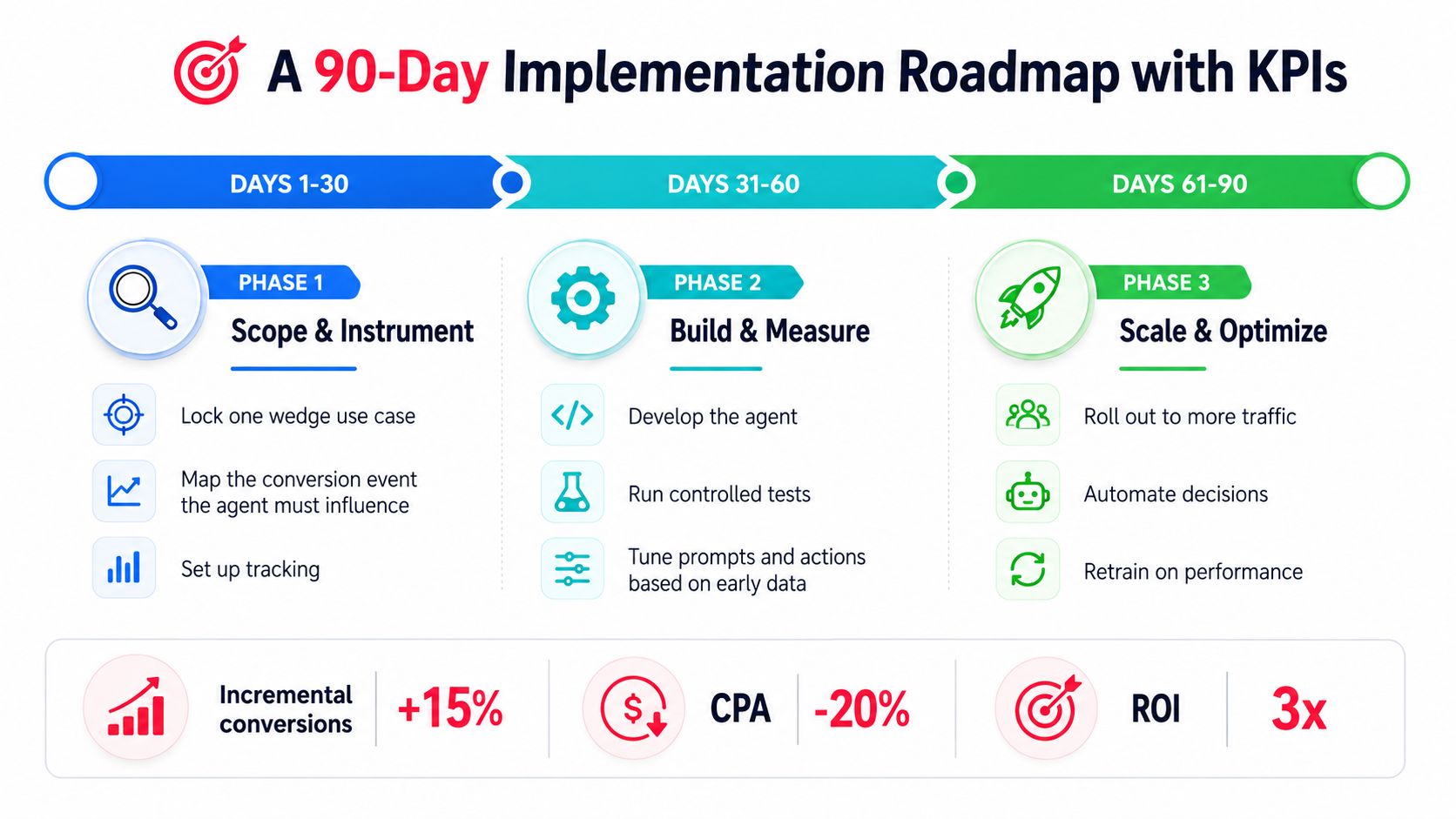
Days 1 to 30, scope and instrument
Choose one wedge use case. Map the exact conversion event, systems involved, approved inputs, prohibited actions, consent requirements, and owner for exceptions.
The team should connect event-level analytics before asking the agent to optimize. It should also document PII handling, model disclosure where relevant, human review requirements, and a kill-switch procedure.
Track:
- Time to instrumentation: how long it takes to record the event reliably.
- Data-readiness score: whether the required fields are complete, current, permissioned, and traceable.
- Lineage gate: every input has a named source and permitted use.
- Brand-safety gate: claims, tone, prohibited language, and escalation rules are documented.
- Evaluation gate: historical or test examples exist for judging output quality.
Days 31 to 60, ship in shadow mode
The agent generates outputs or recommendations, but a human reviews them before publication, routing, or sending. Shadow mode should preserve the agent's proposed action, the human decision, the reason for any override, and the downstream result where available.
Track output approval rate, override rate, and engagement against a static control. An override isn't automatically a failure. Repeated overrides on the same type of decision usually indicate poor instructions, missing context, or an action that shouldn't be automated.
Days 61 to 90, enter constrained production
Release the agent to a defined traffic segment or account group. Set permission boundaries, daily spend ceilings where applicable, frequency limits, and rollback steps. Review accuracy and exceptions weekly, while monitoring conversion metrics daily enough to catch material errors quickly.
Production KPIs can include reply-rate lift, experiment win rate, MQL-to-SQL movement, and pipeline per dollar of agent spend. The governance model should also record intervention rate, unintended actions per 1,000 tasks, rollback or undo rates, and time to resolution after an error, following the AI marketing governance measurement framework from AXY Digital.
A production decision should be reversible. If the team can't pause the agent, reconstruct its decisions, or identify who approved a high-impact action, the workflow hasn't passed the operational gate.
Where Agent Programs Fail Before They Reach Production
The most common failure isn't model quality. It's a program that never gives the model a measurable job.
Assist-only deployment keeps every decision with a person and records none of the actions the agent would have taken. The team can report drafting time, but it can't determine whether autonomy would improve conversion or merely create more review work.
Weak signal governance creates a different class of problem. Scraped third-party intent, unauthorized first-party data, and unclear consent may pass an early demo and fail during procurement or legal review. Marketing governance needs approved metric definitions, budget ceilings, attribution-model version control, and customer PII masking rules, as outlined in Improvado's marketing agent governance guidance.
Measurement gaps bury useful programs. Teams report clicks, open rates, or time on page while MQL, SQL, opportunity, or closed-won movement remains flat. Those proxy metrics can help diagnose behavior, but they can't carry a production budget by themselves.
Workflow mismatch appears when an agent is attached to a stack without the required API permissions, event streams, or stable field structure. The output may look plausible while updates fail or arrive too late for sales action.
Scope sprawl prevents learning. Five use cases launched together produce shallow tests, fragmented ownership, and too few iteration cycles for any one workflow to earn trust.
Use one diagnostic question for each failure: What would we observe if the agent worked, and where is that observation recorded? If the answer is a draft, dashboard click, or anecdotal approval, the team hasn't connected the agent to a business outcome.
Security teams should issue API tokens just in time, keep credential lifetimes short, separate read, write, and spend permissions, and log every tool call with prompt context, target system, and human approver. NHIMG's security guidance for marketing agents provides a concrete permission model for that design.
Vendor Evaluation and Fractional CAIO Engagement Models
Vendor selection changes the economics of the program. A polished demo doesn't tell you how quickly the agent will reach production, whether it can work with your systems, or whether your team can reconstruct an action after something goes wrong.
Score each vendor on:
- Time to first production agent: use your data and one real workflow, not a prepared demo.
- Integration depth: confirm read and write access, event timing, field mapping, and error handling for HubSpot, Salesforce, GA4, Marketo, Outreach, or your actual stack.
- Model flexibility: ask whether you can change models, prompts, retrieval sources, and evaluation rules without rebuilding the workflow.
- Observability: require action logs, input visibility, approval records, and rollback support.
- Commercial clarity: price usage, seats, data volume, connectors, and implementation separately.
Four red flags predict stalled deployments: black-box decisions, brittle connectors, vague pricing, and no governance layer. A low license fee can become expensive if the team must build missing controls or manually repair failed actions.
| Model | Typical Cost | Time to Production | Best Fit |
|---|---|---|---|
| In-house build with fractional CAIO | $8K to $15K monthly for 10 to 15 hours | Depends on stack and wedge scope | Series A to mid-market teams needing senior strategy and vendor oversight |
| Embedded vendor team | Vendor-specific | Often faster for the vendor's own platform | Teams with a clear use case and limited internal implementation capacity |
| Full outsourced stack | Vendor-specific | Can be fast, with less internal control | Companies willing to delegate architecture, operations, and workflow ownership |
A fractional CAIO model works well when the company has capable marketing, sales, and operations owners but lacks a senior person to connect AI strategy with pipeline measurement. The role should include use-case selection, vendor evaluation, governance design, implementation oversight, and finance-ready reporting. It shouldn't become a permanent substitute for process ownership inside marketing or revenue operations.
We recommend a one-week pilot structure:
- Day one: select one workflow and define the conversion event.
- Days two and three: connect approved data and run historical or test cases.
- Days four and five: compare agent output with human work, identify failure modes, and document permissions.
- End of week: decide whether to instrument a controlled production test, revise the wedge, or stop.
Our comparison of a fractional CAIO and a full-time Chief AI Officer explains where that leadership model fits. Stimulead can support strategy, vendor evaluation, and production oversight, while tools such as Salesforce Agentforce, HubSpot workflows, Mutiny, Optimizely, Outreach, and custom retrieval systems may serve as implementation components. We mention Stimulead once here because the engagement model matters more than the logo on the platform.
The next decision is specific: choose the one agent that can reach a controlled production surface first, name the conversion event it must influence, and schedule the one-week pilot before approving a wider purchase.