
In 2025, 29% of organizations were already using agentic AI, and 44% planned implementation within the following year according to one summary of the Blue Prism Global Enterprise AI Survey. That forces a practical decision: how much autonomy should you grant, to which workflow, and under what controls?
A CMO can buy a platform labeled “agentic” and still end up with a chatbot plus tool calls. The question is whether the system can act across steps, retain context, and make bounded decisions without a human wiring every move. For teams asking that question, our AI search optimization guide sits next to this topic because the same buyer often evaluates both.
Table of Contents
- Why the Definition Matters Now
- The Working Operator Definition
- AI Agent vs LLM vs Chatbot vs Automation Script
- A Worked Example in a B2B Revenue Workflow
- When an Agent Is the Wrong Answer
- Governing Agents by Risk Tier
- Cost, KPIs, and the Next Move
Why the Definition Matters Now
The label matters because budget owners don't buy abstractions, they buy operating behavior. A revenue leader who thinks they're approving an agent may be approving a prettier interface for prompt-and-response work, and that gap creates bad expectations on speed, oversight, and risk.
Practical rule: if you can't describe the action boundaries, approval points, and rollback path, you don't have an agent decision, you have a naming problem.
That's why we treat ai agent meaning as a working definition plus a business rubric. The definition tells you what the system is. The rubric tells you whether it deserves autonomy in a live workflow.
A typical failure looks like this. A CMO green-lights “agentic outbound,” then discovers the product drafts messages well but can't research accounts, push records into CRM, or ask for approval before sending. The tool may still be useful, but it's closer to assisted content generation than an autonomous operator.
A better frame is simple: determine whether the workflow is goal-directed, multi-step, tool-using, memory-aware, and feedback-driven. Then decide whether those traits create enough business value to justify the controls. That's the split between marketing language and production reality.
The Working Operator Definition
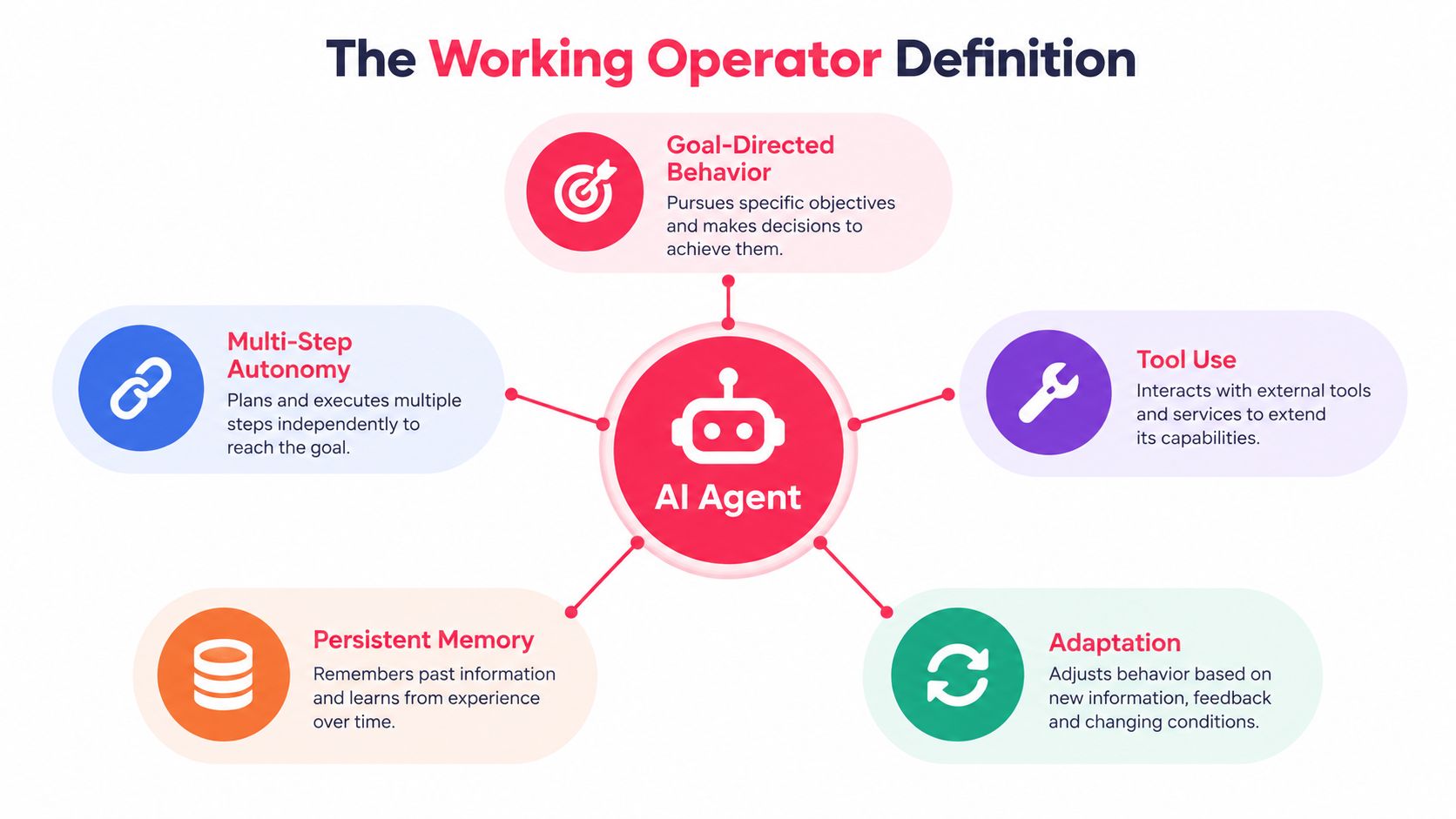
The classical idea comes first. In artificial intelligence, an agent is a computational entity that perceives its environment and acts on it to achieve objectives. That idea predates generative AI entirely. Alan Turing's 1950 paper introduced the imitation game, and the Dartmouth Summer Research Project on Artificial Intelligence in 1956 formally named and organized the field as summarized here.
The five traits we audit
Modern usage keeps that older spine and adds operating detail. Research surveys usually converge on five characteristics, and growth teams can test each one in a live workflow.
- Goal-directed behavior. The system is pointed at an outcome, such as finding qualified accounts or updating a CRM field.
- Multi-step autonomy. It chooses among steps instead of waiting for a human to trigger each one.
- Tool use. It reaches into APIs, browsers, databases, or business apps.
- Persistent or semi-persistent memory. It keeps relevant context across turns or runs.
- Adaptation from feedback. It changes behavior when results or corrections come back.
For a prospecting team, goal-directed behavior means the system is trying to fill a target account list with useful evidence, not just produce a nice paragraph. Multi-step autonomy appears when it decides whether to enrich, summarize, or escalate before drafting. Tool use shows up when it queries enrichment data or writes into a sequencing platform. Memory matters when it remembers that a target account was already contacted last quarter. Feedback matters when it stops repeating weak subject lines after review.
The operating model underneath
A useful technical scaffold is brain, perception, action. The brain interprets the instruction and current state. Perception retrieves relevant data from the environment. Action calls tools and records the result.
That model helps because modern agentic systems extend the classical definition rather than replace it. They combine language-model reasoning with tools, external data, memory, and planning. LegesGPT's picks for legal AI are a good example of how the same concept appears in a regulated workflow, where action boundaries matter as much as output quality.
AI Agent vs LLM vs Chatbot vs Automation Script
The labeling mess clears up fast when you place the tools on a spectrum. At one end sits deterministic automation. At the other sits a system that can pursue a goal across multiple steps with tool use and feedback.
| Dimension | Automation script | LLM or chatbot | AI agent |
|---|---|---|---|
| Decision-making | Fixed sequence | Responds to prompts | Chooses next steps toward a goal |
| Tool access | Prewired actions | Usually none or limited | Calls APIs, CRM, browsers, databases |
| Memory | None or basic state | Session-level at most | Persistent or semi-persistent context |
| Reversibility | Usually high if simple | Depends on usage | Ranges from read-only to irreversible writes |
| Best fit in stack | Data sync, routing, scheduled tasks | Drafting, Q&A, summarization | Research, enrichment, bounded workflows |
An AI content generator drafts one email. An outbound agent researches an account, selects evidence, personalizes the message, writes to a sequencing platform, records provenance in CRM, and requests approval before sending. The first is a text system. The second is an operator.
For CX and EX teams, the distinction is explained well in Yellow.ai's guide for CX and EX leaders, especially if the team is trying to decide whether the tool should answer, route, or act.
The practical test
If a human still has to wire every step, it's not yet an agent. If the product only produces a response and stops, it's still a chatbot or LLM interface, even when the vendor adds tool-call language to the brochure.
Practical rule: autonomy is a workflow property, not a branding claim.
That matters because a buyer can own the same model through different product designs and get very different outcomes. The model might draft fine in one tool and behave like a brittle automation layer in another.
A Worked Example in a B2B Revenue Workflow
A useful test case is a research-and-draft prospecting flow. The operator starts with a target account list, calls enrichment APIs, pulls first-party intent signals, writes an account summary, then drafts a personalized email for human review.
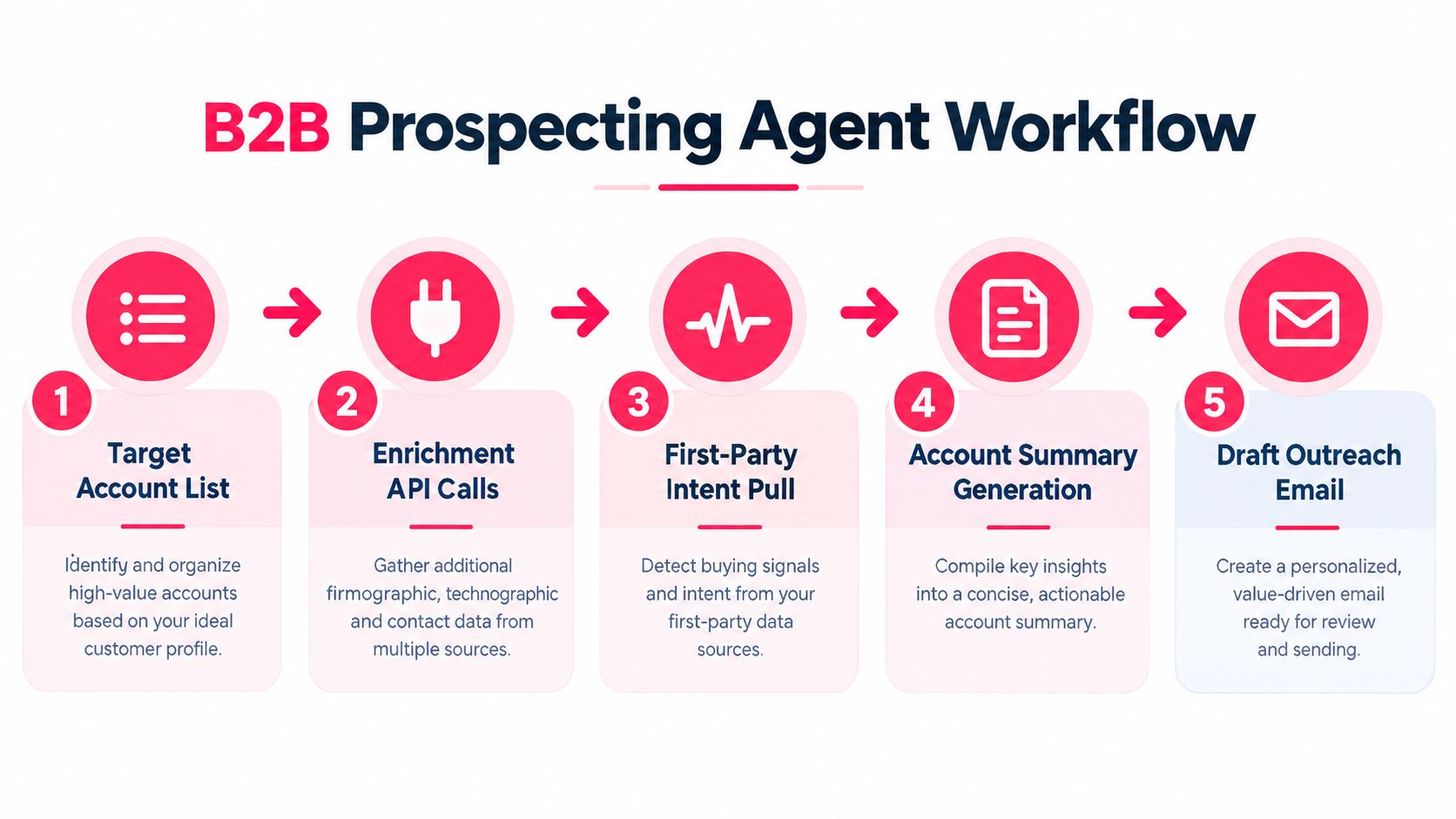
A practical stack often includes HubSpot or Salesforce for CRM, Outreach or Salesloft for sequencing, an enrichment provider, and a model interface with function calling. The agent isn't just stitching them together. It needs idempotency keys so it doesn't write duplicate records, retry limits so failed calls don't loop forever, approval gates before sending, and observability on prompts, retrieved data, tool calls, and final output.
What the loop adds
Each pass through the loop improves capability. The system can gather evidence, make the message more specific, and preserve provenance for review. That's the difference between a draft generator and a workflow operator.
The same loop also increases failure surface. Bad planning can send it down the wrong path. Stale memory can make it reuse an outdated fact. Malformed tool arguments can break the CRM write. Duplicate actions can create messes that human operators then have to clean up.
The working definition in our agentic workflow guide applies here because the right question isn't whether the model can write. It's whether the full workflow can complete safely, with the right checks around each action.
The best prospecting agents are narrow. They research, summarize, draft, and stop. The moment they start sending without review, the cost of a bad assumption goes up fast.
What the human still owns
The rep or manager still owns high-stakes judgment. The agent can gather evidence and prepare the draft, but it shouldn't invent reasons to contact an account, override policy, or decide that a message is ready when the data is thin. In our client work, the systems that stick are the ones that make review easier, not the ones that try to remove judgment from the process.
When an Agent Is the Wrong Answer
The budget signal is real. In PwC's May 2025 survey of 308 US business executives, 88% said their team or function planned to increase AI-related budgets because of agentic AI, yet respondents ranked connecting agents across applications and workflows, organizational change, and employee adoption among the leading challenges PwC, 2025.
That's the part vendors rarely lead with. The model is the easy part. The wiring, the change management, and the operating discipline around it are where deployments stall.
Deterministic beats clever when the task is stable
If a deterministic workflow can achieve the same outcome more cheaply and reliably, agentic behavior reduces business value. A routing rule, a templated enrichment job, or a scheduled sync often wins when the task is narrow and the inputs are clean.
Autonomy adds overhead fast. Each extra decision point creates another place to monitor, review, and correct. At some point, the team ends up paying for judgment it did not need.
Readiness signals to respect
Data and governance readiness deserve the same scrutiny. In Salesforce's 2025 survey, 48% of IT security leaders worried their data foundation was inadequate, 55% lacked full confidence in guardrails, and only 47% were fully confident they could deploy agents in compliance with regulations and standards. Those figures do not argue against adoption. They show where the friction sits.
When ambition outruns readiness, companies often make a predictable mistake. If the data foundation is weak, the workflow should stay in read-only mode until the inputs are clean and the approval model is clear.
Governing Agents by Risk Tier
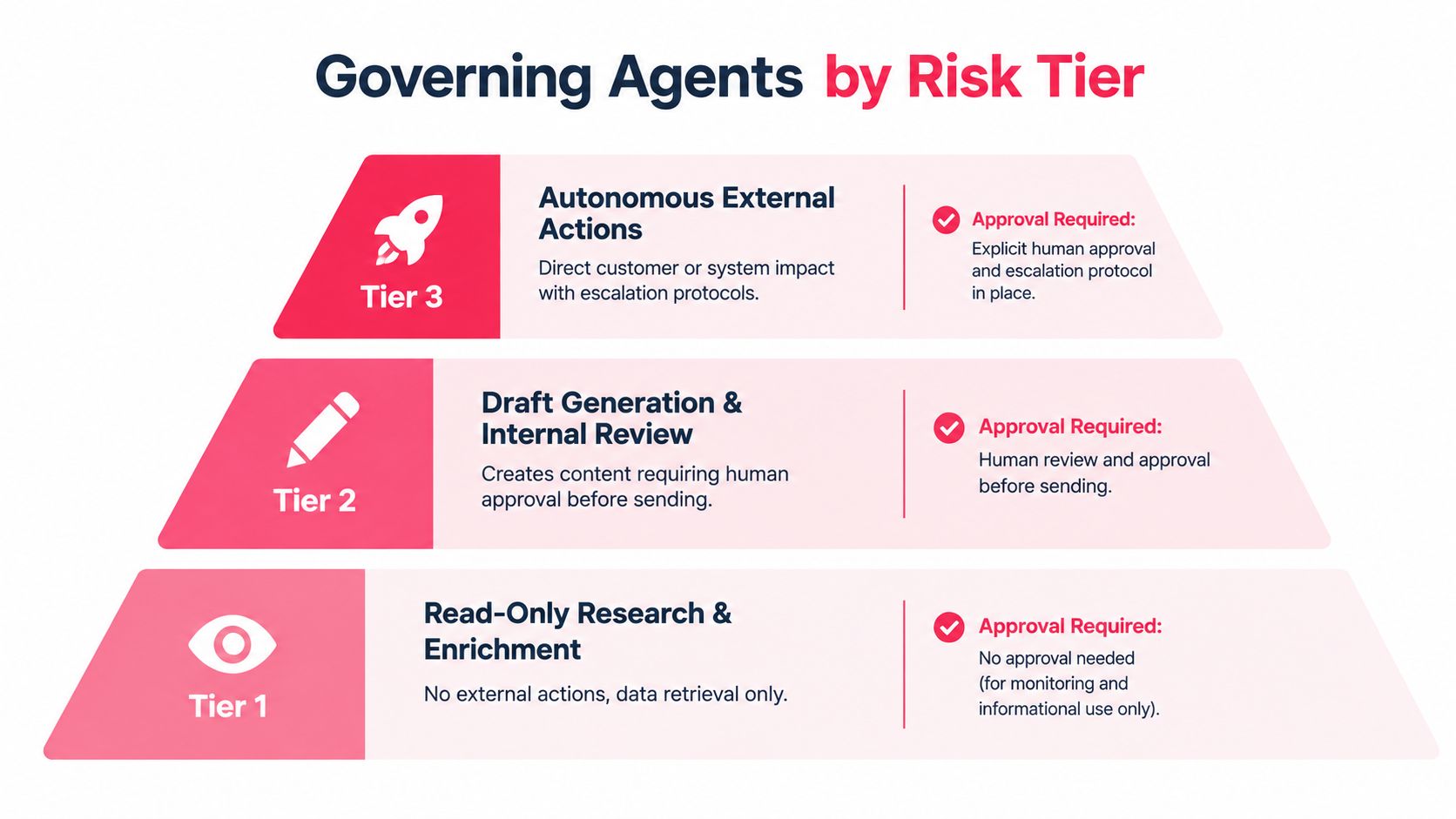
NIST's tool-use work is a useful lens because it classifies tools by access to external resources, write permissions, harm severity, and whether actions are stateful or reversible NIST, 2025. We translate that into a tiered approval model that executives can apply this week.
Tier 1 and Tier 2 first
- Tier 1, read-only research and enrichment. The agent can query sources, summarize findings, and build drafts. No external action, no write access, no side effects. This is the safest place to start.
- Tier 2, draft generation and internal review. The agent can prepare content, recommendations, and next-step suggestions, but a human must approve before anything leaves the system.
- Tier 3, bounded writes to CRM, sequence, or campaign systems. The agent can update structured fields or stage actions, but rollback and traceability are mandatory.
- Tier 4, pricing changes, budget commitments, and high-stakes outbound. These actions need explicit human reauthorization and tighter controls than most growth teams are ready to run on day one.
A procurement, marketing, or revenue team should treat Tier 3 and Tier 4 as earned privileges. The agent gets there only after the lower tiers prove clean on precision, policy adherence, and duplicate-action control.
Identity and access are non-negotiable
Agent security depends on identity, not shared human credentials. Agents should have their own service identity, scoped least-privilege tokens, rotation and revocation procedures, and an audit trail that shows the request, tool call, approval, and action.
Our AI due diligence checklist is useful for teams deciding which vendor claims map to real controls and which ones are just UI copy. In practice, the strongest deployments keep tool permissions narrow and reversible wherever possible.
Practical rule: a prospecting agent should never inherit a salesperson's full CRM, email, billing, and file access just because it needs to research accounts.
For other angles on the same question, what is an AI agent focuses on the operating contract to define before choosing a model, and our AI agent definition sets out tests for vendor claims and action risk. What is agentic search applies the same autonomy question to research and retrieval.
Cost, KPIs, and the Next Move
The money question sits under every agent discussion. McKinsey's 2025 global survey found that one in five respondents said their organization was limiting AI use because of operating costs. That is a warning to check unit economics before anyone asks for scale.
A company that skips the cost model usually underestimates three buckets: inference and tool-call cost, integration and monitoring load, and human review time. A fourth bucket, failure recovery, rarely appears in vendor pitches, but it lands on the ops team when a write goes wrong.

The KPI set to demand
For each agent workflow, require a small scorecard:
- Task completion rate
- Factuality score
- Latency
- Cost per successful task
- Escalation rate
- Rollback frequency
- One business metric, such as reply rate, qualified meetings, conversion rate, or pipeline generated
That set keeps the discussion honest. If completion is high but factuality is poor, the workflow is not ready. If cost per successful task rises while human review stays high, the business case weakens. If rollback frequency keeps climbing, the write path needs a redesign.
What to do in the next 30 days
Pick one bounded workflow with low blast radius. Run it in Tier 1 mode first, instrument the four metrics that map most directly to revenue or pipeline, and set clear go or no-go criteria before any write action is enabled.
If your stack is centered on Snowflake data work, Faberwork LLC's Snowflake data platform services are one place teams go when they need data plumbing and analytics support around these workflows. The pattern still holds whether you use Snowflake, a warehouse, or a simpler reporting layer.
Capgemini, 2025 reported that 14% of organizations have implemented AI agents at partial or full scale, while another 23% are running pilots, and nearly 45% of organizations already scaling agents are piloting or scaling multi-agent systems. That puts most companies in controlled experimentation, which is where most growth-stage B2B teams should be too.
The next move is simple. Choose one workflow, one owner, one approval path, and one scorecard. If the agent proves value in Tier 1, it earns a controlled path to writes. If it does not, you have saved the company from buying autonomy it does not need.
