
Juniper Research puts a hard number on the shift, $3.5 trillion in agentic commerce transaction value in 2026. That makes this a revenue story, not a novelty story. If software can research, compare, and complete purchases on behalf of a buyer, then the commercial battle moves upstream into discovery, data quality, identity, and checkout control.
What is agentic commerce? It's commerce where AI agents execute the purchase lifecycle on behalf of a person or business buyer. In practice, that means the agent can browse catalogs, compare options, manage carts, authenticate, and complete checkout with limited human input, which is the operational split from standard ecommerce where every step starts with a person clicking and typing. IBM and Bloomreach both frame the model as delegating the buying steps the human shopper used to do, and Mastercard describes it as AI that closes the loop by searching, comparing, and purchasing.
For CEOs, CMOs, and CROs, the useful lens is simple. Agentic commerce changes which brand, SKU, or merchant gets selected before a human reaches checkout. That means the first revenue fight is often won in the machine-readable layer, long before the final payment screen.
A practical primer for teams that want a broader implementation view is this agentic AI for ecommerce guide, and Stimulead's work on agent commerce readiness sits in the same operating zone, where data, checkout, and revenue systems meet.
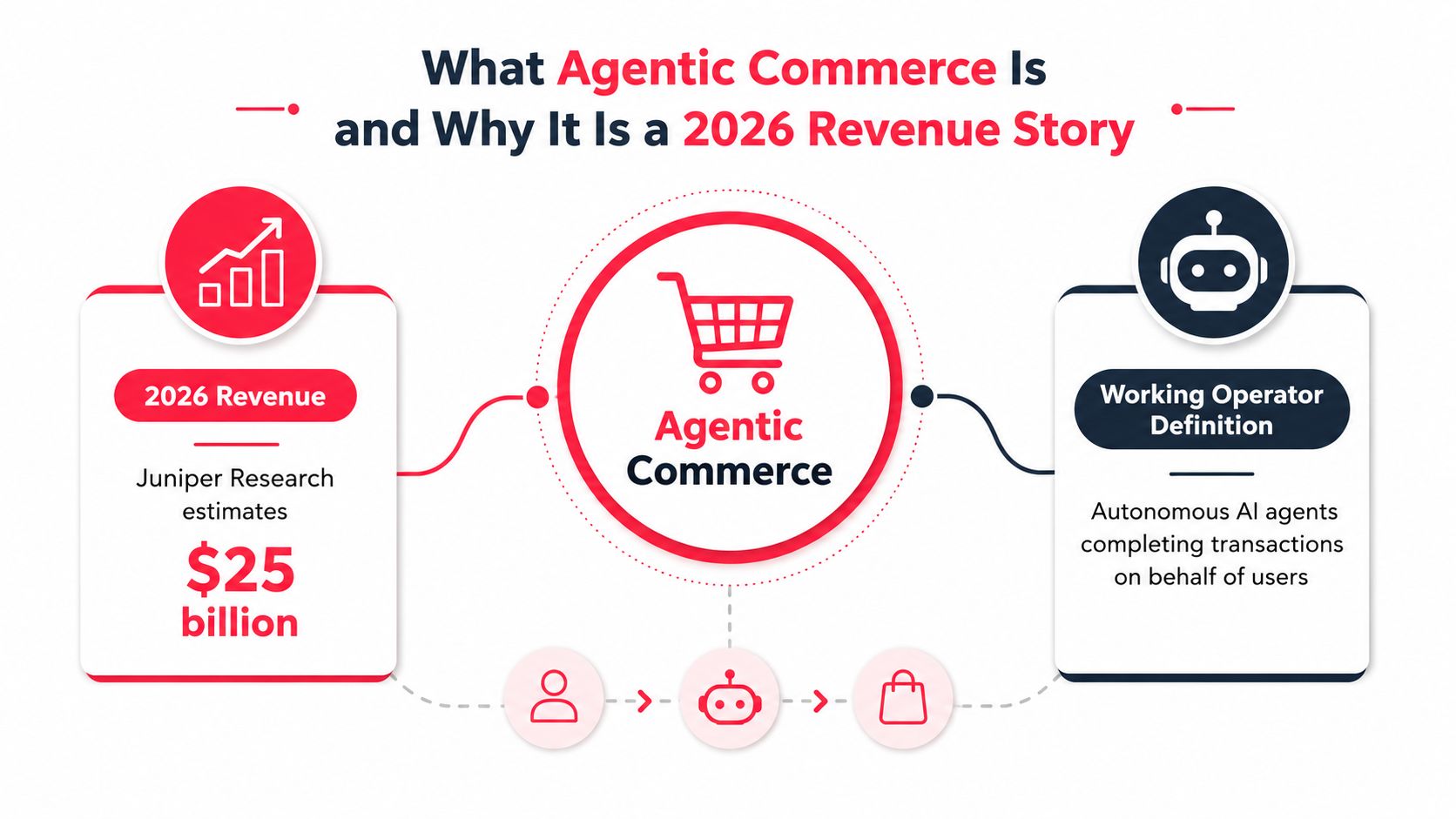
Table of Contents
- What Agentic Commerce Is and Why It Is a 2026 Revenue Story
- The Seven-Layer Agentic Commerce Stack
- How Agents Actually Buy Protocols, Identity, and Checkout
- Adoption Is Already Here and the Conversion Math
- The B2B Procurement Angle Most Explainers Skip
- Risks, Trust, and a Merchant Readiness Checklist
- A 90-Day Agentic Commerce Plan for Growth-Stage Companies
What Agentic Commerce Is and Why It Is a 2026 Revenue Story
Juniper Research's $3.5 trillion 2026 estimate is the right place to start because it changes the frame. This is a transaction layer with scale, not a side feature inside a chatbot. When a category has a trillion-dollar benchmark this early, executives should treat it like infrastructure work, because that's what merchants are buying into, whether they planned for it or not.
The working operator definition
Agentic commerce means an AI agent can move through the full buying path on behalf of a user. It can identify a need, search inventory, compare offers, place items in a cart, authenticate, and complete the purchase.
That's different from standard ecommerce. In standard flows, the customer drives each action. In agentic flows, the system performs those actions with delegated authority and a narrower set of machine-readable rules.
Practical rule: if your commerce stack only works when a human is manually browsing your site, it's not agent-ready yet.
The business implication is straightforward. The value starts before checkout, at the point where an agent decides which merchant is worth surfacing. That makes catalog quality, pricing freshness, and identity controls part of the revenue engine, not just backend hygiene.
Why CEOs should care before the channel looks mature
A channel doesn't need to be dominant to matter. It only needs to influence choice. Agentic commerce is already moving there, because the buying decision can be made inside a system that never sees your brand's homepage. For growth-stage operators, that means the central question is whether your products are readable and purchasable by agents when intent is forming.
There's a useful mental model for this in Stimulead's agent commerce readiness work. The focus is on getting product data, identity, and checkout logic into a state where software can transact without guesswork. That's the difference between a storefront that talks to people and a commerce surface that machines can use.
The right takeaway is not that human ecommerce disappears. It's that the front door to revenue is expanding. If your team only optimizes the visible site experience, you're leaving part of the buying journey outside your control.
The Seven-Layer Agentic Commerce Stack
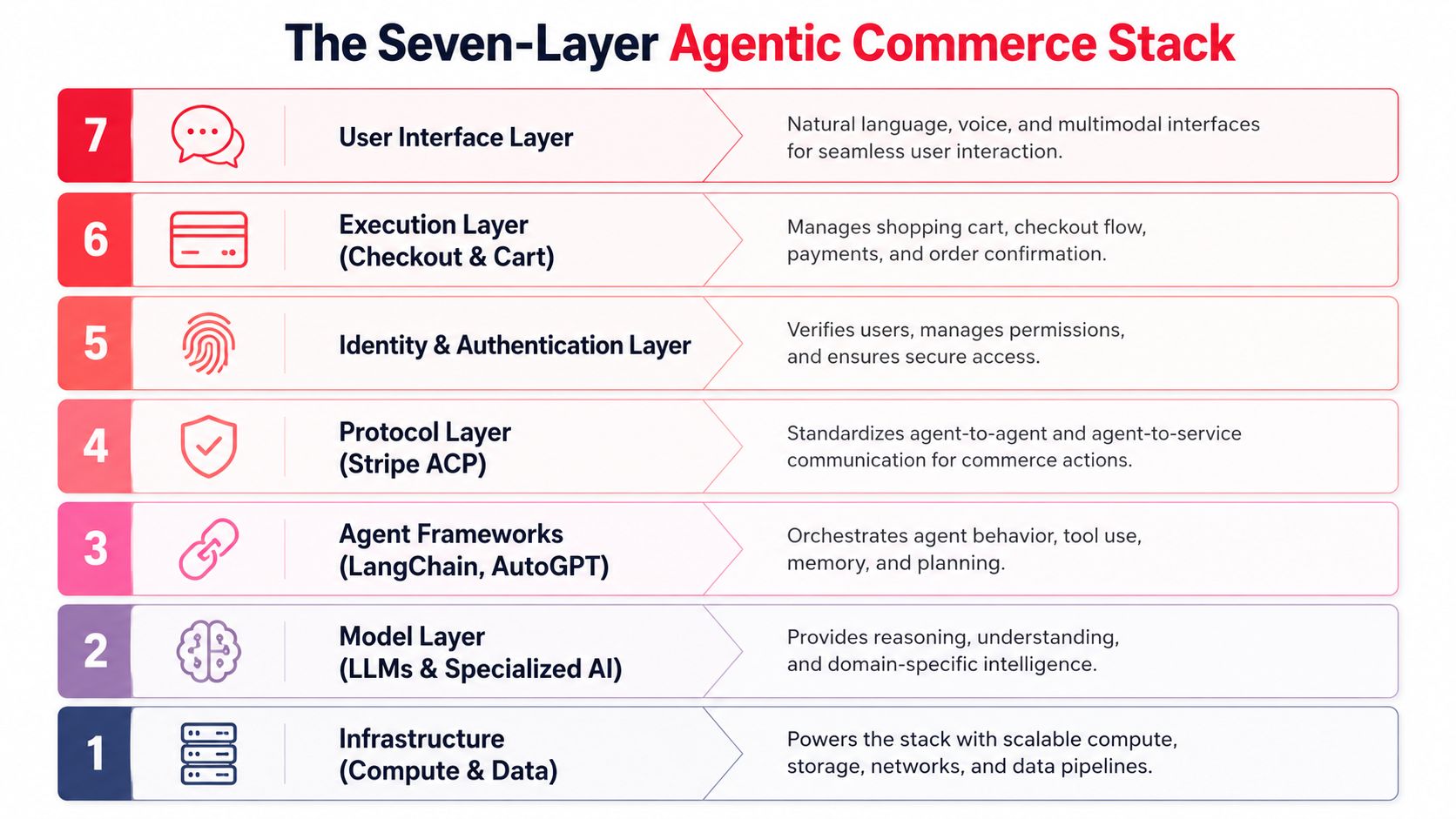
A lot of explainers flatten agentic commerce into one category. That's a mistake. The space works more like a stack, and the stack view is what helps a CEO or CRO decide where money and engineering time should go first.
Where value sits in the stack
Independent mapping splits the market into seven layers, AI surfaces, protocols, payments and identity, card issuance, checkout execution, merchant enablement and discovery, and trust and security. Payments has attracted the most startup activity, while the weakest areas are universal merchant coverage and the link between product data and checkout execution. A company can have a polished AI surface and still fail to convert if the lower layers are fragile.
That's why the best vendor is rarely the one with the flashiest assistant. It's the one that can make data, execution, and trust work across a merchant base at scale. The stack tells you where the product creates value.
The chatbot is the visible layer. The margin lives in the plumbing.
A practical mapping for operators looks like this:
- AI surfaces: the discovery layer where agents or assistants first interact with the buyer.
- Protocols: the rules that let software systems understand each other.
- Payments and identity: delegated authorization, fraud control, and payment rails.
- Card issuance: tools that let agents spend through controlled instruments.
- Checkout execution: the part that turns intent into an order.
- Merchant enablement and discovery: catalog visibility and product exposure.
- Trust and security: verification, policy enforcement, and abuse prevention.
The point of that structure is internal clarity. Your storefront team touches one layer, your payments partner touches another, and your analytics stack often sees only the last step. If you don't know which layer is broken, you'll buy the wrong software.
Why this matters for vendor evaluation
The stack view also exposes a common trap. Some vendors pitch agentic commerce as a conversation layer. Others pitch it as payment orchestration. Both can be useful, but neither is enough alone. If product data isn't standardized and the merchant can't be discovered cleanly, the agent never gets far enough to buy.
That's why evaluation should start with a simple question. Which layer does this product improve, and which layer does it leave untouched? If the answer is only the front-end experience, the commercial impact may be thin.
How Agents Actually Buy Protocols, Identity, and Checkout
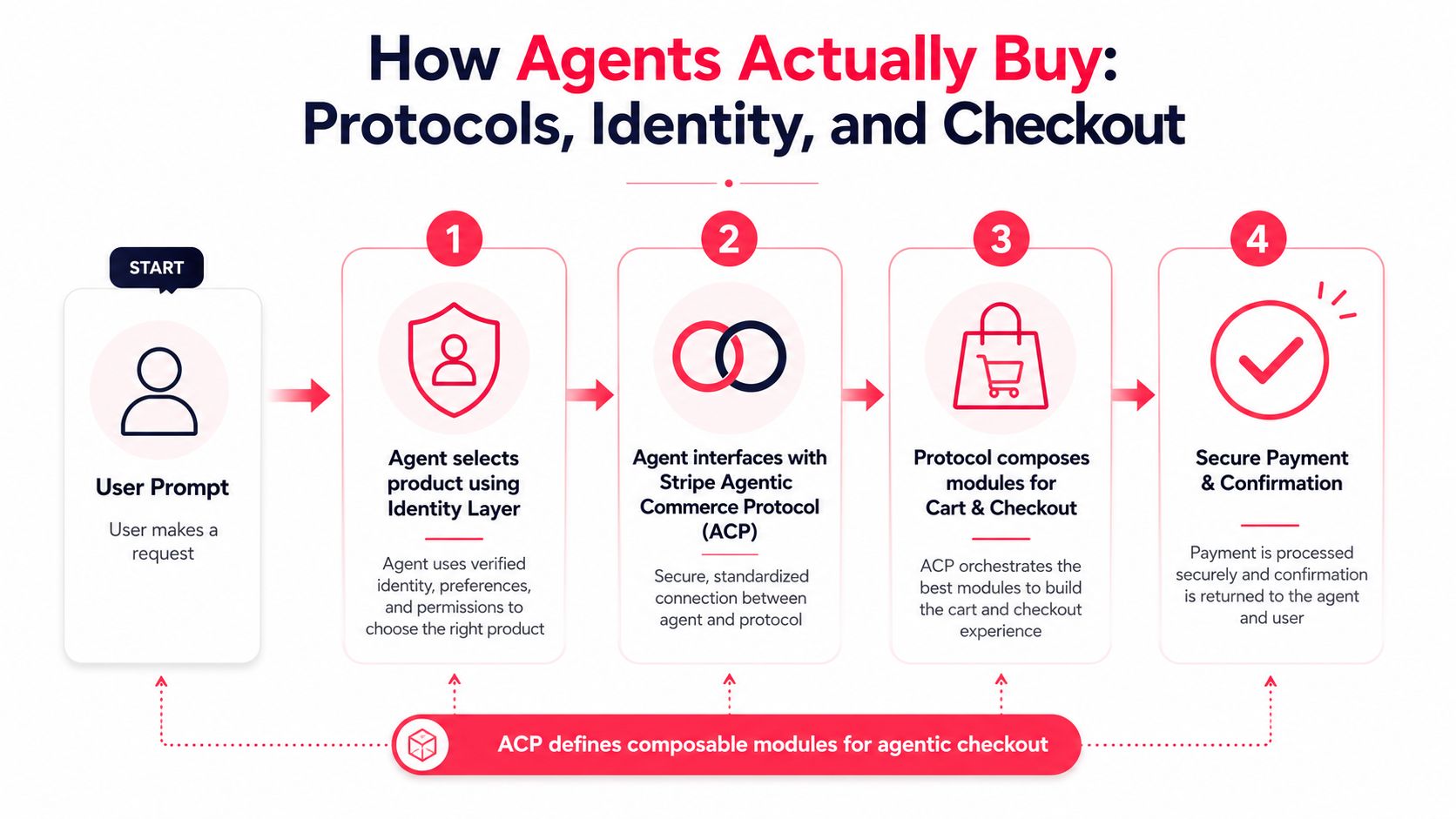
The mechanics matter more than the buzzwords. Stripe's Agentic Commerce Protocol, ACP, created with OpenAI and Meta, lays out how agents can complete commerce actions with structured modules for checkout, cart and feed access, delegated payment, delegated authentication via OAuth 2.0, and order lifecycle webhooks. That moves the system away from brittle browser automation and toward explicit request and response contracts.
What has to be exposed
The merchant side has to expose structured commerce objects, not just a nicer chatbot. That means schema.org JSON-LD, stable SKU, GTIN, and MPN identifiers, fast APIs, and inventory and pricing sync across surfaces. Guidance for agentic readiness also points to API response times under 200 ms as a practical benchmark, because agents need deterministic responses to trust a merchant enough to complete a transaction.
Passflow's compare Passflow vs Clerk is useful context for teams evaluating identity and access patterns, because the authorization problem is central here. If the agent can't be authenticated cleanly, delegated buying becomes risky fast.
The operating logic is simple. A human shopper can tolerate a messy page. An agent cannot. If the catalog data is inconsistent or the inventory status lags, the agent either fails the transaction or routes around your store.
What changes for your stack
GTM engineering stops being a slogan and becomes revenue infrastructure. The system needs machine-readable product facts, a checkout object the agent can invoke, and a delegated identity model that records what the agent is allowed to do. Clean APIs matter because they let the merchant keep existing fulfillment and payment systems while exposing commerce in a form software can use.
A practical implementation pattern looks like this:
- Publish structured product data on every relevant SKU.
- Keep inventory and pricing synchronized across channels.
- Expose checkout and cart endpoints that agents can call deterministically.
- Use delegated identity so the buyer's intent can be verified.
- Log order lifecycle events so support, finance, and ops can audit what happened.
That is the core architecture. If the stack can't support those steps, it may look agent-ready in a demo and fail in production.
Adoption Is Already Here and the Conversion Math
Agentic commerce looks abstract until you watch the traffic shift. Salesforce reports that 39% of consumers and more than half of Gen Z already use AI for product discovery, and Adobe reported a 4,700% year-over-year surge in generative-AI shopping traffic to U.S. retail sites in July 2025. Industry researchers also cited an 805% year-over-year increase in AI traffic to U.S. retail sites on Black Friday 2025. The pattern is clear. AI is already influencing how buyers find products, not just how they browse them.
The money sits in discovery
The first commercial win happens before checkout. If AI-mediated discovery decides which product gets surfaced, the agent can route a buyer toward one merchant instead of another. That makes structured product data the first place to focus, because it affects both AEO and whether your brand is visible in AI search and LLM recommendations.
For growth-stage teams, the revenue math is straightforward to model. If AI-mediated discovery influences even 10% of a $20M ecommerce book, that is $2M of revenue exposed to whichever merchant has cleaner data and a better machine-readable offer. The point is not perfect precision. The point is that the first impression may now be algorithmic, and merchants with weak product data will feel that immediately.
| Signal | Value | Period | Source |
|---|---|---|---|
| Consumers using AI for product discovery | 39% | Current consumer behavior | Salesforce commerce AI and agentic commerce data |
| Gen Z using AI for product discovery | More than half | Current consumer behavior | Salesforce commerce AI and agentic commerce data |
| Generative-AI shopping traffic surge to U.S. retail sites | 4,700% year-over-year | July 2025 | Adobe commerce agentic commerce standards post |
| AI traffic surge to U.S. retail sites on Black Friday | 805% year-over-year | Black Friday 2025 | Salesforce commerce AI and agentic commerce data |
If you want the practical view, treat AI discovery the way you would a paid channel test. Track product visibility, click-through, and downstream conversion by source. Then compare what happens when structured data is clean versus when it is not.
Why AEO and agent readiness now overlap
The same catalog discipline that helps agents buy also helps LLMs recommend your products. Product schema, question-answer content, and consistent attributes now sit inside both search visibility and transaction readiness. Stimulead's 10 AI agent use cases is useful for teams mapping where AI starts to affect acquisition and pipeline, because discovery is becoming a shared layer across search and commerce.
The B2B Procurement Angle Most Explainers Skip
Consumer shopping gets the headlines, but procurement may be the larger near-term opportunity. A recent industry piece called out the “boring, unglamorous, enormous world of B2B procurement” as largely unexamined, and that framing tracks with how these systems work in practice. Procurement is full of repeatable workflows, approvals, negotiated pricing, and account-specific inventory, which are exactly the kinds of rules software agents handle well.
Why procurement fits the agent model
A consumer can improvise. A procurement team usually can't. They work inside policy, budget, and vendor rules, and those constraints are a feature, because they make the buying logic more predictable. That means delegated purchase flows, vendor onboarding, and invoice handling can be designed around fewer moving parts than many consumer checkout journeys.
A broader market map also matters here. One independent view projects agentic commerce to grow from $135 billion in 2025 to $1.7 trillion by 2030, with more than 50 companies building across the stack. That kind of growth will not be won by consumer demos alone, especially where merchant coverage and checkout execution still have gaps.
For CEOs and CROs, the key question is operational. How does an agent handle a purchase when the buyer is a procurement team, not an individual shopper? The answer has to include approval routing, contract logic, onboarding, and invoice flow. If your systems can't express those rules cleanly, B2B demand will stay manual.
Where GTM teams should focus
This is a GTM engineering problem as much as a commerce problem. The vendor that wins in B2B agentic commerce will probably be the one that can read account context, respect policy, and transact inside a controlled buying environment. That makes merchant readiness, identity, and structured account data more important than a slick interface.
Stimulead's GTM engineering focus fits here because the work sits between revenue systems and execution. The teams that move first will be the ones that can align catalog data, account rules, and agent actions without adding friction for finance or ops.
Risks, Trust, and a Merchant Readiness Checklist
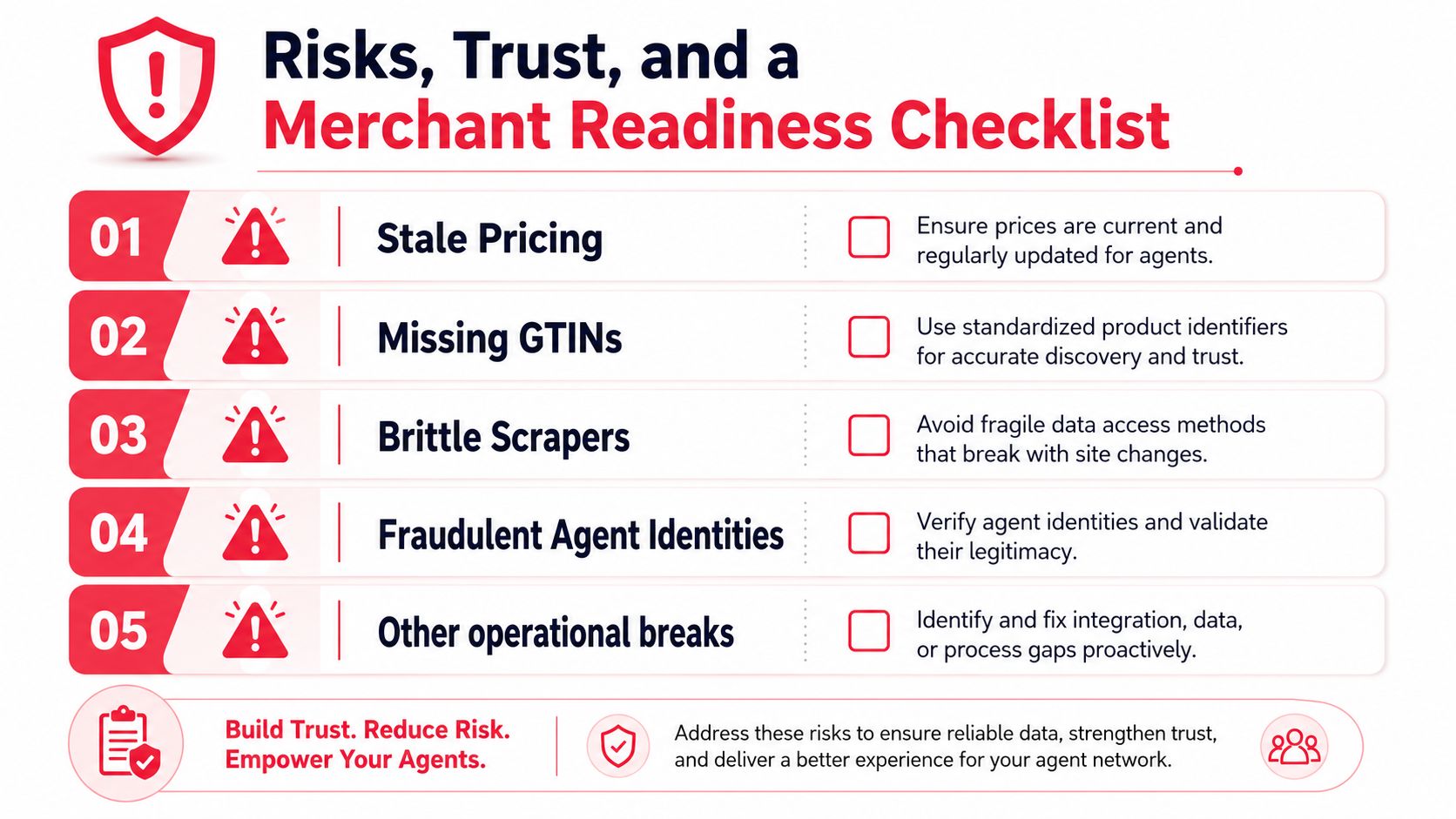
The first things to break are usually dull. Stale pricing, missing GTINs, brittle scrapers, fraudulent agent identities, and policy violations show up fast once software starts transacting on behalf of people. Gartner's projection that 20% of digital commerce transactions will be executed through AI platforms by 2030 means those issues won't stay as edge cases for long.
The checklist I'd use before pilot launch
If a team asked me where to start, I'd push this sequence:
- Clean product schema: put schema.org JSON-LD on every relevant product.
- Stable identifiers: make sure SKU, GTIN, and MPN are consistent.
- Fresh pricing and inventory: sync both across every surface an agent can see.
- Fast APIs: keep response times under the published readiness benchmark of 200 ms.
- Delegated identity and payment scopes: use OAuth2-based agent identity and narrow permissions.
- Unified control plane: connect ERP, CRM, and warehouse context so decisions reflect current reality.
Each item solves a failure mode. Missing identifiers cause mismatches. Slow APIs cause timeout and fallback. Weak identity controls create fraud risk. If one of those breaks, the agent may route the sale somewhere else.
What trust looks like in practice
Trust in agentic commerce is operational, not rhetorical. The buyer needs confidence that the agent was authorized, the merchant had current data, and the order can be audited later. That means logs, webhooks, and policy controls matter as much as the customer-facing experience.
For teams building the stack, a useful companion reference is AI for ecommerce, because the same catalog and data discipline that supports AI-assisted selling also supports agentic checkout. The people who win here are the ones who treat data freshness as a sales issue.
If pricing or inventory can't be trusted by software, the agent will trust a different merchant.
That's the board-level issue. Once AI platforms carry a meaningful share of transactions, governance can't sit only with developers. Finance, legal, commerce, and RevOps all need a say in how delegated buying is approved and logged.
A 90-Day Agentic Commerce Plan for Growth-Stage Companies
The smartest way to approach this is in three blocks. First, spend days 1 to 30 auditing catalog quality, schema coverage, and API latency, then shortlist vendors that support ACP-style integration. Next, use days 31 to 60 to pilot one product line, one B2B procurement flow, or one high-AOV DTC SKU and measure agent-influenced conversion against a control. Then use days 61 to 90 to scale the pilot or kill it and document the blockers.
McKinsey's estimate that agentic commerce could create up to $1 trillion in orchestrated revenue in the U.S. B2C retail market alone by 2030, with global projections of $3 trillion to $5 trillion, gives you a defensible budget anchor. That's the right lens for a growth-stage team. You're not funding a side experiment. You're deciding whether your commerce stack can participate in where intent is moving.
The first call I'd make is a readiness audit across product data, identity, and checkout. If you want a practical next step, book a 30-minute agent commerce readiness audit with Stimulead and bring your catalog, API, and checkout owners into the same room.