
An AI agent executes a goal across tools rather than merely answering a prompt; fluent conversation alone doesn't make a chatbot an agent. With 79% of surveyed executives reporting agent adoption in their companies, the buying decision should focus on execution boundaries and evidence of completed work, not the quality of a demonstration.
The popular advice to choose a capable model, connect your applications, and improve the prompt skips the expensive decisions. We recommend defining the operating contract before selecting the model: what the agent must accomplish, what authority it receives, and what happens when it gets stuck.
Table of Contents
- The Definition That Keeps Tripping Growth Teams Up
- How an Agent Actually Works Without the Hype
- Agents Versus Workflows, and Why That Choice Matters
- Where Agent Deployments Actually Break
- Governing Autonomy as a Risk System
- The Evaluation Harness That Decides Whether an Agent Stays
- The Next Decision a Growth Leader Should Make
The Definition That Keeps Tripping Growth Teams Up
Your first decision is whether you're buying assistance for an employee or delegating part of an operating process. Those choices require different acceptance criteria. A convincing answer can satisfy the former while concealing serious defects in the latter.
A useful working definition is a goal-directed software system that interprets information, plans actions, uses tools, and adjusts its behavior based on results. The NIST agent glossary provides the relevant conceptual distinction: an agent acts within an environment toward an externally specified goal. For a buyer, the important question is what that authority permits in practice.
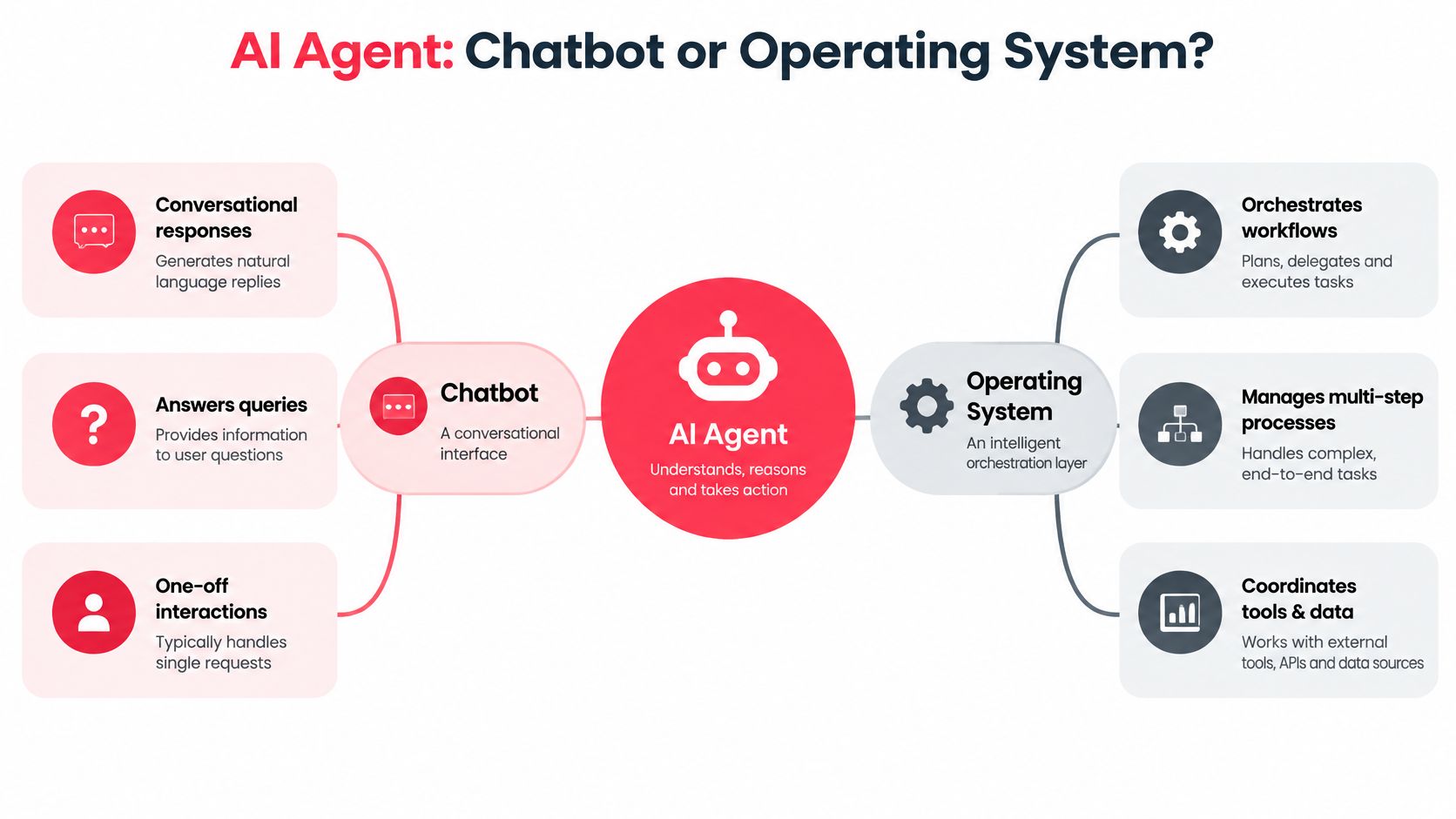
The architectural distinction is easier to see when conversation and workflow execution sit side by side.
Buy a defined responsibility
The operating-system analogy helps explain coordination, but don't take it as a strict rule. An agent still needs infrastructure, permissions, and business rules supplied by people.
We'd reject a specification that says the agent will improve prospecting. We'd accept one that defines eligible accounts, approved research sources, required evidence, and the exact point where a salesperson takes responsibility.
Ask the vendor to demonstrate an exception, not another successful answer.
The commercial interest is real. In PwC's survey of 308 US business executives, 79% reported adoption, but only 17% said agents were fully adopted across almost all workflows and functions. Those figures describe very different operating commitments.
For a useful adjacent comparison, consider the operational questions raised by SellerAI's take on AI store operations. Evaluate store operations with the same test you'd apply to B2B prospecting: which decisions can software execute, and which consequences still require an accountable person?
The answer to “what is an AI agent?” becomes useful only when it changes the specification you approve.
How an Agent Actually Works Without the Hype
Consider a proposed SDR research agent. Its assignment is to prepare an evidence-backed account brief, propose a CRM update, and draft an outreach message for approval. This is an illustrative architecture, not a client case study.
The control loop shows where decisions and external actions separate.
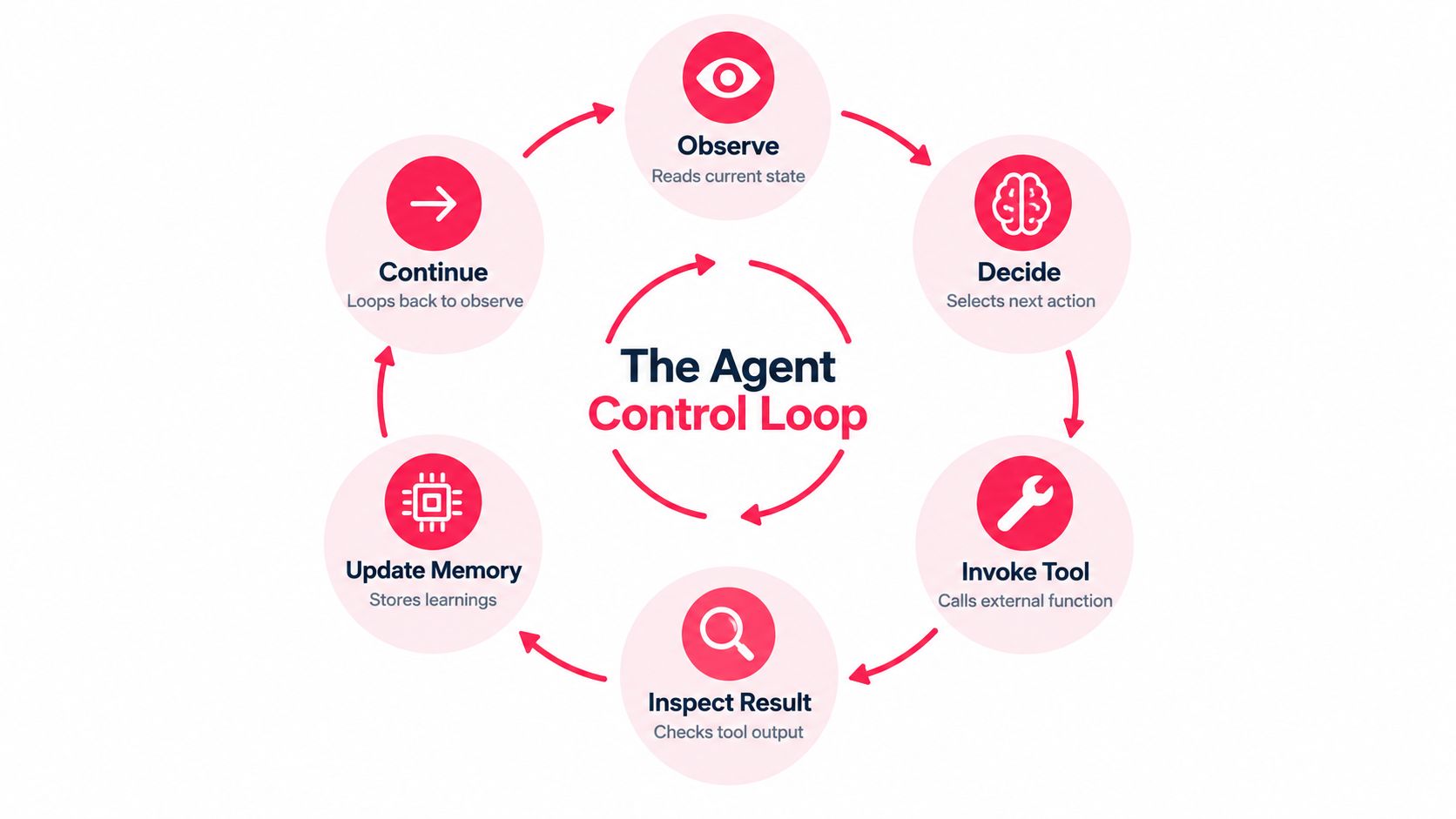
- Read the account's current state, including existing research and contact restrictions.
- Select the next permitted action. Missing company information might justify retrieval; a suppression flag should stop outreach preparation.
- Invoke a tool through its defined interface, such as a browser retrieval function or CRM lookup.
- Inspect the response. An empty result must remain distinguishable from a verified absence.
- Update working memory with evidence and unresolved questions.
- Continue, stop, or request approval according to explicit completion criteria.
Pay for the surrounding system
The model supplies decision logic. The orchestration layer controls execution, while integrations determine what actions are possible. Memory design determines which information persists between actions.
The evaluation harness is another deliverable, not an optional reporting feature. In procurement, we want separate scope for orchestration, integration maintenance, memory behavior, and regression testing. A single model-access fee tells you little about the operating cost of the complete system.
Anthropic's guidance on writing tools for agents treats documentation, interfaces, and evaluation as engineering work. Apply that discipline to CRM actions: distinguish reading an account, proposing a change, and committing that change. Don't expose a broad administrative function when the task needs a narrow update.
The accompanying video offers another format for considering agent execution.
For an agent that prepares outbound messages, delivery requires its own implementation review. The documentation on email deliverability for AI Agents is relevant reading when assessing that boundary, but permission to draft must remain separate from permission to send.
Don't accept “connected to your CRM” as a complete integration specification. Ask which operations are exposed, how failures are returned, and whether repeated execution can create duplicate changes.
Agents Versus Workflows, and Why That Choice Matters
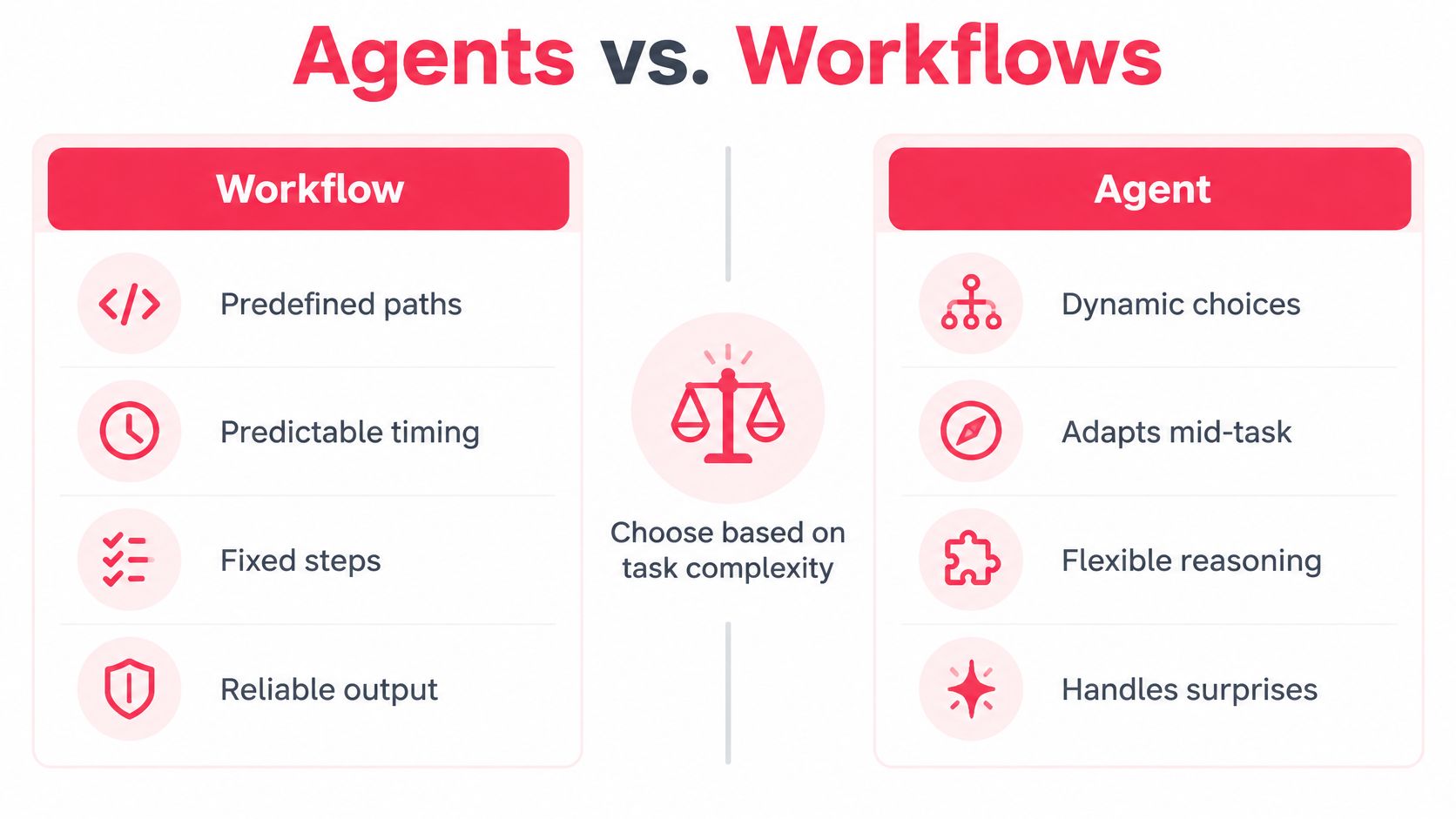
Use a scripted workflow when you already know the acceptable execution path. Give an agent discretion when the next useful action depends on information discovered during the task.
That distinction follows Anthropic's guidance on building effective agents, which separates predefined workflows from systems that dynamically direct their own processes and tool use. Our recommendation is to start with the simpler pattern and make the case for each additional decision the model controls.
The comparison below shows the architectural choice, rather than a maturity ladder.
Workflows vs Agents, Decision Criteria
| Criterion | Scripted Workflow | AI Agent |
|---|---|---|
| Execution path | Defined in advance | Selected during execution |
| Best-fit task | Stable rules and known branches | Ambiguous work requiring investigation |
| Exception handling | Explicitly programmed routes | Model-directed choices within limits |
| Testing emphasis | Branch coverage and rule correctness | Full trajectories and recovery behavior |
| Cost control | Bound the predefined operations | Also constrain exploration and retries |
| Suitable sales example | Route an approved lead | Investigate conflicting account evidence |
A fixed lead-routing policy doesn't need an agent to reconsider territory rules for every record. Conversely, researching whether an account meets a nuanced qualification criterion may require choosing sources, checking contradictions, and deciding when evidence is sufficient.
Neither approach guarantees correctness. A scripted workflow can faithfully execute a bad rule, and an agent can confidently choose an inappropriate action.
Use mixed architectures deliberately
We often recommend a deterministic outer workflow with a bounded agent inside it. The workflow handles eligibility and approvals; the agent investigates the uncertain part of the task.
Our related explanation of agentic AI workflows is useful when deciding where those boundaries belong. Treat the agent's output as a proposal that downstream rules can validate before execution.
Don't give the model discretion over a decision your company has already settled in policy.
Choosing incorrectly creates different costs. Excessive branching can make a scripted research process expensive to maintain, while unnecessary autonomy can introduce avoidable compliance exposure. More agents won't fix a process that should have remained a clear rule.
Where Agent Deployments Actually Break
Consider a hypothetical deployment that passes its initial demonstrations. The agent researches accounts, prepares useful briefs, and proposes accurate CRM updates. Then its memory summary drops a contact restriction, a tool interface changes, and failed updates enter a retry path nobody owns.
A better prompt doesn't repair the missing restriction or restore the interface contract. The team needs to identify which component failed and prevent the same failure from reaching another account.
The production incident is an engineering problem before it becomes a prompt-writing exercise.

Diagnose the architecture before changing the wording
The AgentArch benchmark evaluates 18 configurations across four architectural dimensions: orchestration strategy, agent style, memory architecture, and thinking-tool integration. Its comparison of ReAct and function-calling styles also makes clear why “same model” doesn't mean “same system.”
| Failure in the illustrative deployment | Design question |
|---|---|
| Contact restriction disappears | Which facts must persist outside summarized memory? |
| CRM call no longer validates | Who versions tool definitions and tests compatibility? |
| Retries continue without resolution | Where does orchestration enforce termination? |
| Delegated work returns conflicting conclusions | Who resolves state and evidence disagreements? |
Memory compression deserves particular skepticism. Keep policy-critical facts in explicit structured state rather than trusting a conversational summary to preserve them. Summaries can support context, but they shouldn't become the authoritative record of permissions.
Start with a single agent unless task decomposition provides a demonstrated benefit. Multiple agents introduce coordination work and additional state to inspect, as the architecture research discusses.
Activity isn't evidence of value
A busy trace can contain successful tool calls and still fail the business task. Researching an ineligible account accurately doesn't make that research useful.
Our operational test is whether a reviewer can reconstruct why the agent acted and whether the completed output met its acceptance criteria. If the team can't explain a failed run, expanding autonomous access is premature.
The evidence supports architecture-sensitive evaluation, not a universal claim that one agent style wins every task. Treat benchmark results as reasons to test your workload, rather than a substitute for doing so.
Governing Autonomy as a Risk System
An agent that reads account information creates a different exposure from one that changes pricing or contacts prospects. Approve those capabilities separately. A broad “AI approved” decision is too coarse for systems that can affect external records and customers.
A NIST AI Risk Management Framework-aligned governance approach organizes the work around Govern, Map, Measure, and Manage. We translate those functions into operating responsibilities rather than leaving them in a policy document.
Assign decisions to accountable people
| Function | Required operating decision | Recommended accountable role |
|---|---|---|
| Govern | Define ownership and escalation authority | Business process owner |
| Map | Document data scope and permitted actions | RevOps with security review |
| Measure | Monitor failures and accepted outcomes | Evaluation owner |
| Manage | Approve recovery and disablement procedures | Technical owner with business oversight |
These are recommended roles, not a requirement for new hires. In a smaller company, an existing leader can hold multiple responsibilities, provided each responsibility has an explicit owner and someone can act when that person is unavailable.
Our AI governance guidance provides related reading for translating oversight into deployment decisions. Keep the resulting controls close to the workflow, where operators can inspect and enforce them.
Grant permissions by consequence
Reading CRM records should require access controls and logging. Writing records should also require field-level restrictions, validation, and a recovery mechanism appropriate to the change.
Contacting prospects adds an external consequence. Pricing changes deserve a separate authorization policy rather than inheriting the permissions used for research.
Autonomy is an operating privilege. Expand it only when the evidence supports the additional consequence.
The implementation barriers are substantial. Deloitte reports that 72% of surveyed companies lacked unified, accessible data, while 70% lacked sufficient trust or governance for agents. Those constraints belong in the deployment plan, not in a list of concerns to revisit after launch.
Require approval gates for consequential actions, capped retries, and a tested shutdown procedure. Record who can disable the agent and who reconciles unfinished work afterward. A kill switch without a recovery owner leaves the company with an interrupted process and an unresolved queue.
The Evaluation Harness That Decides Whether an Agent Stays
The agent should earn continued deployment against the existing process. Comparing it with an imagined perfect employee makes the exercise useless; comparing it only with an impressive demonstration makes it dangerous.
We recommend an evaluation harness that captures the execution trace alongside the accepted outcome. It should show what the system attempted, which tools it used, and where people had to intervene.
Run the acceptance sequence
- Select a bounded workflow with a clear definition of completion. For account research, define the evidence required before a brief counts as usable.
- Establish the current baseline. Measure completion time, review effort, and rejected outputs using the process people follow.
- Instrument each action and its result. Capture tool selection, validation failures, retries, and approval decisions without exposing unnecessary sensitive data.
- Test representative tasks with production-like permissions. Include conflicting evidence and unavailable tools, rather than testing only clean records.
- Score completed work against acceptance criteria. Assess task completion and tool-selection accuracy separately so a good final answer doesn't hide unsafe execution.
- Decide whether to release, constrain, or roll back. Preserve the test set so later changes can reveal regressions.
The AI model evaluation guide provides related guidance, but agent acceptance must extend beyond response quality. Your test subject is the operating trajectory.
Put the denominator in the dashboard
Cost per completed task should include review and rework, not merely model usage. Human-intervention rate needs a consistent definition, otherwise teams can make performance appear better by relabeling assistance.
For prospecting, track accepted account briefs and qualification quality before claiming downstream improvement. Qualified meetings depend on targeting, messaging, and sales execution as well as research, so attribution needs a controlled comparison.
A practical scorecard can stay compact:
| Measure | Decision it supports |
|---|---|
| Accepted completions | Does the agent finish useful work? |
| Invalid tool calls | Are interfaces or action choices failing? |
| Review effort | Has work shifted rather than disappeared? |
| Latency and total task cost | Is the operating trade-off acceptable? |
| Qualified-meeting conversion | Does downstream quality hold? |
Don't set release criteria after seeing the results. Agree on acceptable failures before the pilot, then give the process owner authority to reject deployment.
Related reading: AI agent meaning for growth operators covers cost and when plain automation wins, the AI agent definition gives tests for vendor claims, and what is agentic AI covers the wider category and its control plane.
The Next Decision a Growth Leader Should Make
Choose the workflow before approving the platform. Prefer a visible bottleneck with accessible data and an owner who can judge the result. Avoid starting with the most politically attractive demonstration or the broadest promise of autonomous selling.
Your budget should cover the complete operating responsibility. Separate initial implementation from ongoing integration maintenance, evaluation, and incident response so nobody mistakes a successful pilot for a finished capability.
Make the vendor show the operating evidence
Ask for a failed execution trace and the corresponding recovery path. Request the tool-permission specification, then compare it with the capabilities shown in the demo.
Useful procurement questions include:
- Acceptance evidence should show which representative tasks passed and which failed.
- Change control should explain how model or tool updates trigger regression tests.
- Operating ownership should identify who handles incidents after implementation.
An internal engineering team can own this work, or a specialist implementation partner can supply defined components. Stimulead's executive advisory and AI Growth Partnership are another option for leaders who need roadmap decisions and implementation oversight alongside their existing teams and agencies.
Once execution is controlled, related reading on AI search optimisation can inform how agent-mediated discovery affects your acquisition strategy. Keep that decision separate from permission to act inside your own systems.
Publication details
Bring your process owner and technical lead to the next budget discussion with a candidate workflow, its current performance baseline, and its prohibited actions. If you need fractional CAIO support, request an executive advisory discussion focused on that workflow and its acceptance criteria before authorizing the build.
