
88% of AI proof of concept projects do not make it to widescale production. That's the number that should frame every conversation about an AI proof of concept in a growth-stage company, because the usual failure point isn't the demo. It's the handoff from a contained test to a system that has governance, integrations, owners, and a business result tied to it. IDC's finding, cited in CIO's coverage, is a clean reminder that a pilot can look good and still die before it touches revenue workflows IDC figure on AI POC production failure.
For CEOs, CMOs, and CROs, that means the POC is a revenue decision gate. If you treat it like a science project, you'll get one of those impressive demos that never ships. If you treat it like a controlled business test, you can kill bad ideas fast and back the few that deserve production time.
Table of Contents
- Why Most AI POCs Never Reach Production
- Define the Business Question and Pre-Register Success Criteria
- Scope, Data Readiness, and the Time-Box
- Build the Evaluation Harness Before the Model
- Choosing Build, Buy, or Fractional CAIO
- Five POC Killers and How to Spot Them Early
- The Go-or-No-Go Decision and the 90-Day Scale Plan
Why Most AI POCs Never Reach Production
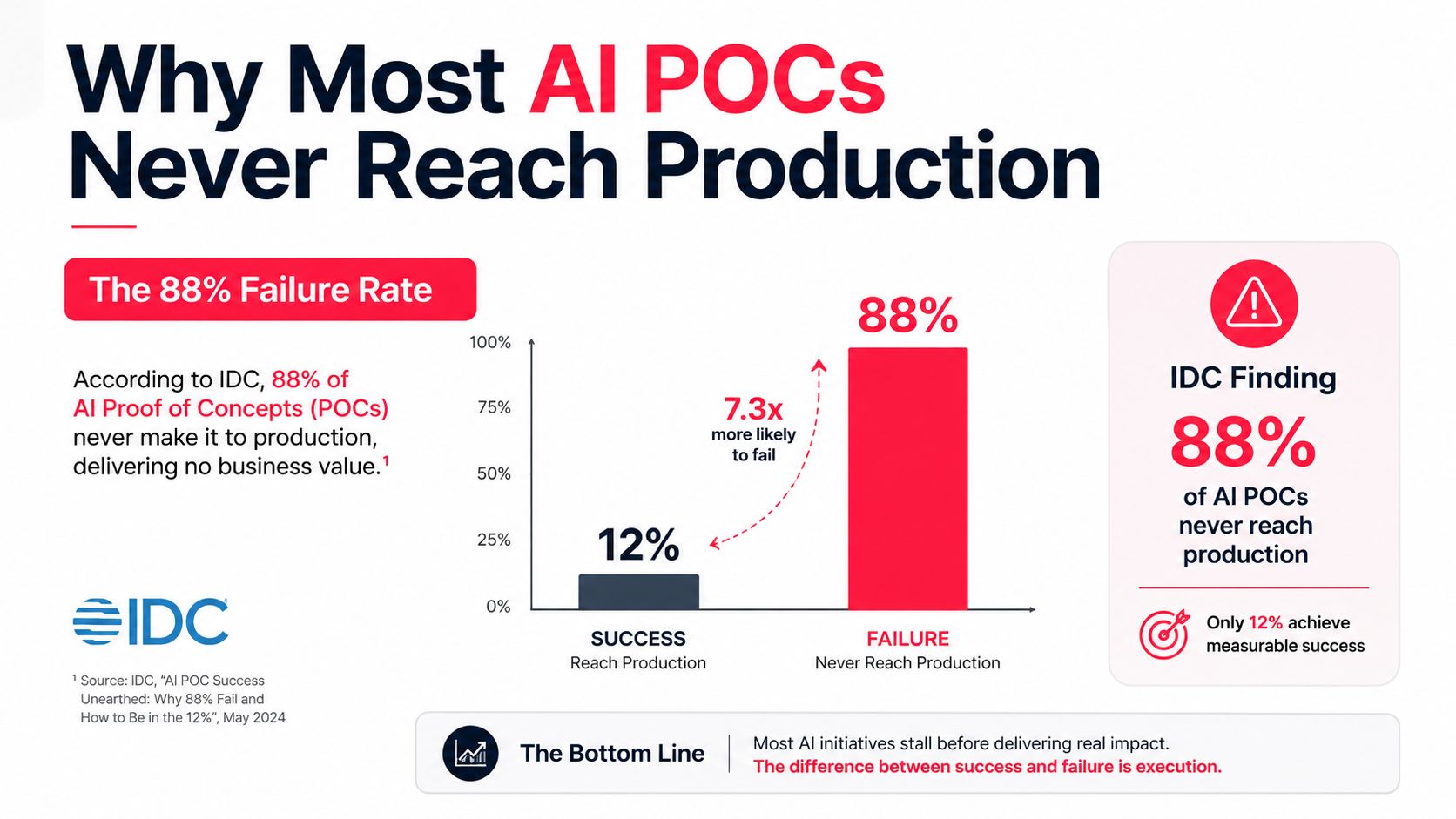
The failure rate is high because teams often start in the wrong place. They ask whether the model can work before they ask whether the business should care. That leads to pilots that impress in a sandbox and collapse in production, where the work involves data plumbing, workflow adoption, security review, and ownership.
A clean way to think about it is this. A POC should prove one revenue-linked behavior against one measured baseline. If the team can't say what KPI should move, what data will be used, and who owns the result after the demo, the project is already drifting toward the graveyard. For a useful primer on the common implementation traps, the guide to tackle common AI challenges is worth reading before anyone green-lights a build.
The three reasons POCs die
First, the team never defined a business KPI before model work began. They may have said they wanted “better lead scoring” or “smarter routing,” but those are directions, not decision criteria. Without a named metric, success becomes a vibe instead of a measurable change.
Second, they used toy data or a handpicked sample that doesn't resemble real traffic. That hides the ugly edge cases, the mislabeled records, and the routing exceptions that show up the second the pilot touches production. When the first serious test produces messy output, confidence drops fast.
Third, nobody owns the production system. The demo team finishes, engineering was never in the room, and the business owner assumes someone else will operationalize the result. That gap kills more good ideas than model quality ever will.
Practical rule: if the executive sponsor can't state the KPI, the baseline, and the owner in one breath, the POC is too vague to fund.
The upside is that the same failure pattern makes the fix obvious. Strong AI programs start with a decision gate, then move through a short validation cycle, then stop or scale. The rest of this playbook is built to move the team into that rarer 12% that ships.
Define the Business Question and Pre-Register Success Criteria
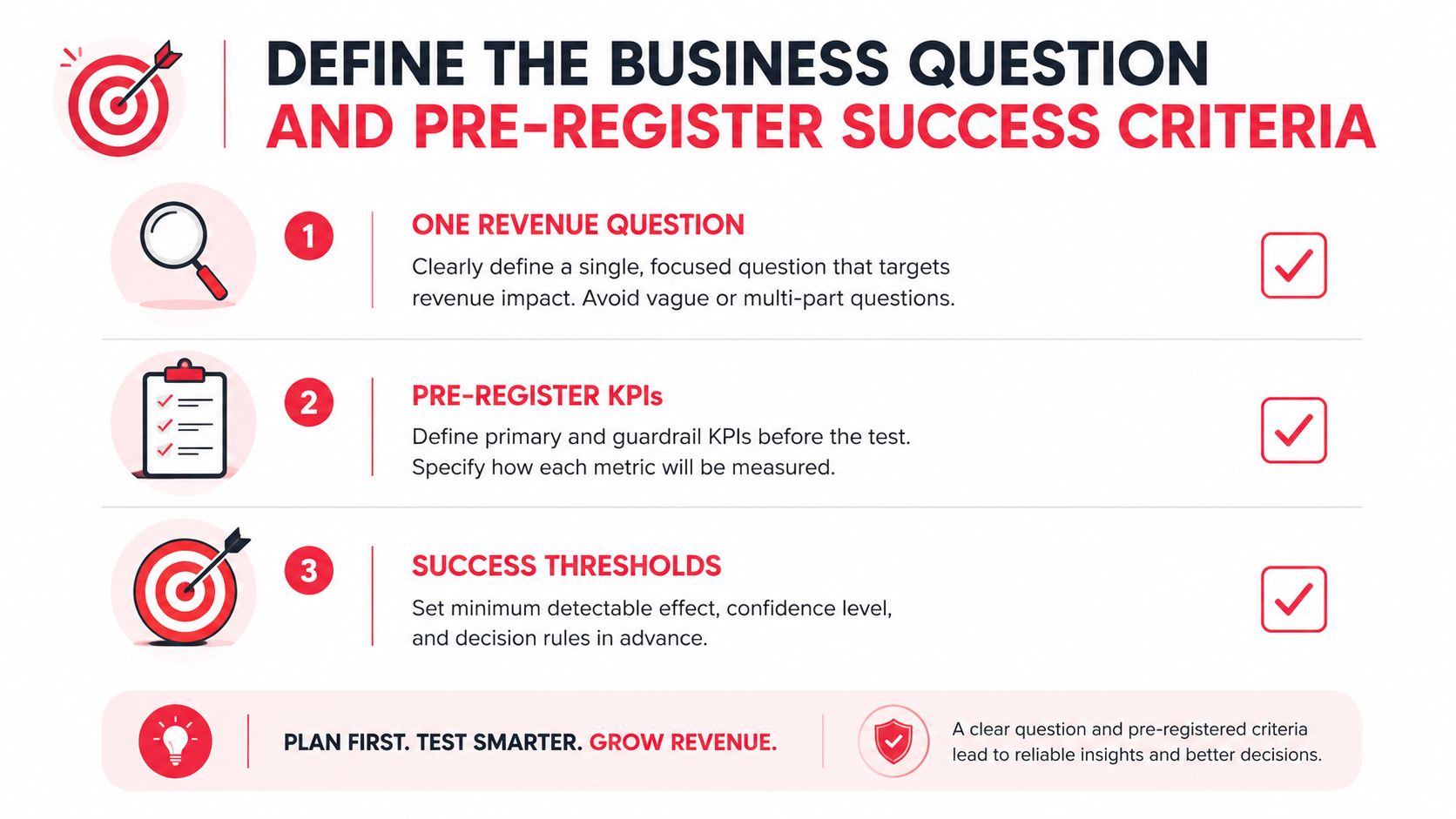
A revenue-grade POC starts with one business question, not a list of wishes. In practice, that means choosing a single problem like qualified pipeline lift, triage time reduction, or checkout conversion improvement, then writing it down before anyone trains a model. The brief should be short enough that a CRO, CMO, and engineering lead can all sign it without debate.
The strongest briefs I've seen name the KPI, define the baseline, and state the threshold for a pass. That matters because baseline measurement beats model accuracy as the decision anchor. A model can look elegant and still fail the business test if the KPI doesn't move enough to justify rollout.
Write the brief before the build
A useful one-page brief usually includes the problem, the owner, the KPI, the data source, the evaluation window, and the decision rule. It should also state what success looks like in plain language. For a CRO use case, a valid threshold might be cutting sales triage time by at least 30% while holding error rate under a defined threshold, using the test evidence to decide whether the system deserves a rollout threshold example.
That kind of pre-registration matters because teams love moving the goalposts after they see a prototype. If the model gets a nice demo and leadership then asks what it was “good at,” the POC has already slipped away from the business question. The brief protects the team from that drift.
What belongs in the kickoff packet
- One Revenue Question: Name the exact outcome, such as lead response quality, routing speed, or checkout friction.
- Pre-Registered KPI: Record the metric, the baseline, and the measurement source before development starts.
- Success Thresholds: State the pass or fail bar in business terms, then tie it to the POC window.
A strong brief also forces a useful conversation about scope. If the team cannot describe the result in one sentence, the problem is too broad for a POC. That is where many AI efforts go sideways, because broad goals invite endless interpretation and weak ownership.
For teams who want a structured starting point, Stimulead's AI readiness assessment is a practical way to pressure-test the use case, the KPI, and the data before any implementation work starts. The result should be a decision, not a mood.
Scope, Data Readiness, and the Time-Box
The POC window has to be short enough to force clarity. Industry guidance commonly frames an AI POC as a 4- to 8-week effort, with generative AI POCs often taking 3 to 5 weeks and traditional machine-learning POCs taking 6 to 10 weeks depending on complexity POC timing guidance. That time-box matters because it changes the kind of claim the team can make. A short POC can prove feasibility, data quality, and KPI movement. It cannot prove a full enterprise rollout.
The fastest way to waste the window is to start with data discovery that never ends. A proper scoping pass should name the exact systems in play, the fields needed for the KPI, and the data that stays out of scope. I also freeze the training-data snapshot early. If the team keeps changing the dataset midstream, the baseline stops meaning anything.
Match scope to the question
A revenue POC should be narrow enough that one team can run it and one owner can sign off on it. If the question is lead triage, keep the first test focused on a single routing decision. If the question is AEO content selection, keep the first test focused on one content class and one target query pattern. Broad scope invites hidden dependencies.
Budgets should be set before enthusiasm gets ahead of the finance conversation. Industry guidance puts many POCs around $10,000 to $20,000, while another common range is £25,000 to £50,000 for more integrated work budget guidance. I use those ranges to frame expectations, not to promise outcomes. A cheap POC that answers the wrong question is expensive in the only way that matters.
Budget rule: spend enough to test the real workflow, but never so much that the pilot becomes too expensive to kill.
A clean six-week cadence
Week 1 should lock the question, the KPI, and the data sources. Week 2 should confirm the baseline and clean the snapshot. Weeks 3 and 4 should build the smallest viable prototype. Weeks 5 and 6 should measure results, inspect failures, and write the go/no-go memo.
That cadence works because it keeps the work tied to a decision, not a wandering build. If week two still feels like exploration, the team is already behind. The POC should feel narrow, testable, and a little uncomfortable, because comfort usually means the scope is too soft.
Build the Evaluation Harness Before the Model
The evaluation harness is where disciplined teams separate signal from theater. The right sequence is simple. Freeze the test set, define the scoring method, run the model against real data, inspect the failures, then judge production viability. If the test harness comes after the prototype, the team will keep adjusting the rules to favor the model.
Real data matters here. A POC that uses production-shaped traffic tells you far more than a polished sample ever will. It surfaces the weird edge cases, the ambiguous records, the false positives, and the odd routing patterns that usually matter most in revenue workflows. That is why the test set should come from your own systems, not from a toy dataset.
What the harness should prove
The harness should answer six questions. Did the model perform against the pre-registered KPI? What did it get right on a per-example basis? Where did it fail? How confident were the outputs? Which edge cases broke the pattern? Is the system viable in production?
Here's a practical structure.
| Component | What it proves | Owner |
|---|---|---|
| Held-out test set | The model was evaluated on real examples it did not train on | Data owner |
| Per-example results | Which records succeeded or failed | Analyst or ML lead |
| Error analysis | Why the model missed on specific cases | AI lead |
| Confidence scores | How much trust to place in each output | Engineering |
| Edge-case probes | Whether the model handles real revenue exceptions | Business owner |
| Production-viability assessment | Whether the result is worth hardening | Executive sponsor |
The point is to make the evidence legible. If a sales leader can't understand the failure modes in plain English, the POC is not ready for a go/no-go decision. Accuracy alone won't help if the output breaks on the exact customer situations that matter most.
Translate lift into business impact
The test set should be connected back to the baseline KPI. If the prototype improves a workflow in the lab, the team should be able to estimate what that means for the process in production. That translation is where many POCs either become credible or collapse. A tidy metric without a business readout is just a technical score.
The best teams document the result as a production question, not a research summary. They ask whether the model outcome justifies integration, monitoring, and ownership. That's the standard a revenue leader should use every time.
Choosing Build, Buy, or Fractional CAIO
The first decision is usually between control and speed. In-house build gives the team the most control over the workflow and data path. A SaaS tool can get to a visible result faster when the use case is generic. A fractional CAIO fits when the company needs senior judgment to run the POC, build the harness, and hand back something the internal team can operate.
The right choice depends on the use case, the data, and the ownership model after the demo. If the workflow is proprietary and the KPI sits at the center of the business, build is often the right answer. If the use case is standard and the vendor already has the integration, buy can save time. If the team needs someone who knows how to turn a business question into a working revenue test, fractional leadership is the cleanest path.
Compare the trade-offs honestly
| Path | Speed to first result | Integration risk | Ownership after POC |
|---|---|---|---|
| Build in-house | Slower at the start, stronger control later | Lower if the team knows the stack | Highest internal ownership |
| Buy SaaS | Fastest when the fit is close | Depends on the vendor's footprint | Often shared or vendor-led |
| Fractional CAIO | Fast when scope and data are clear | Lower when the harness is set well | Strong handoff if the work is documented |
For a practical read on the operating model behind that kind of engagement, Yalc's fractional engineer role is a useful comparison point. It maps closely to reality of a lean GTM AI build where one senior operator needs to coordinate data, workflow, and delivery without creating a full-time headcount.
The vendor or operator review should ask for four things. Real-data benchmarks, security review readiness, integration footprint, and a written production runbook. If a vendor can't show how the system behaves on real records, or can't explain handoff after the pilot, the product is still a pitch.
Stimulead's fractional CAIO vs full-time chief AI officer comparison is useful if the company is deciding whether the POC needs a part-time executive operator or a permanent hire. The answer usually depends on how quickly the team needs the first decision, not on how ambitious the roadmap is.
Choose the model that gets you to a defensible decision with the least organizational drag.
Five POC Killers and How to Spot Them Early
The first killer is success criteria written after the demo. The warning sign is leadership asking what the model did well instead of asking whether the KPI moved. Once that happens, the conversation has shifted from a business test to a show-and-tell. The fix is to freeze the brief before build and force the team back to the pre-registered threshold.
The executive conversation is direct. If the sponsor wants to celebrate early, remind them that celebration comes after the business metric moves. If they want to change the metric midstream, they need to accept that the test is effectively restarting.
The second killer is toy data. The warning sign is week two producing zero edge-case failures, which usually means the dataset is too clean to be useful. The fix is to inject real records, awkward records, and exception cases that mirror actual revenue traffic. No serious revenue system gets validated on perfect examples.
The third killer is no named production owner. The warning sign is that engineering never appears at kickoff. That tells you the POC may finish without anyone willing to own the build-out. The fix is simple. Put a named system owner in the brief and make that person attend the decision meetings.
The two killers that turn scope into sludge
The fourth killer is scope creep into a second use case. The warning sign is a rewritten brief in week three. That usually means someone saw the first prototype and started asking for adjacent value before the original question was answered. The fix is to hold the line on one KPI and one workflow until the decision is made.
The fifth killer is skipped security and data review. The warning sign is legal hearing about the POC name at week five. By then, the team has probably built something that cannot be approved quickly. The fix is to bring security and data governance into the first week, not the last.
If legal and engineering are surprised late, the pilot was never a pilot. It was a hidden production request.
The fastest diagnostic I use is simple. By the end of week two, can the team name the KPI, show the baseline, identify the owner, list the data sources, and describe the main edge cases? If any of those answers are fuzzy, the POC is already on life support.
The Go-or-No-Go Decision and the 90-Day Scale Plan
A clean go/no-go meeting should be short and evidence-heavy. I use four slides. One slide shows the pre-registered criteria. One shows the test-set results. One shows the production-viability assessment. One shows the dollarized impact projection. That format keeps the discussion out of the weeds and tied to a business decision.
The presentation should feel like an executive readout, not a lab report. If the outcome is green, the room needs to know what gets built next, who owns it, and what changes in the workflow. If the outcome is red, the team should know why the idea stops here and what was learned.
What the green-light plan needs
A 90-day scale plan should name the integration owner, the monitoring plan, the retraining cadence, the model risk review, and the first KPI checkpoint. Those items are operational, which is exactly why they belong in the plan before rollout starts. A POC that ships without this list just moves the risk into production.
The handoff document should also be readable by the board. That means no jargon without context, no vague claims about “AI value,” and no hand-waving about future optimization. The board wants to know whether the system will move revenue, slow the team down, or create new exposure. The answer should be specific.
For teams that want a formal template, how to write a POC document is a solid reference for the structure of the write-up, especially when the result needs to survive procurement, legal, or board review. Use it as the paper trail, not as an excuse to document a weak pilot.
The next move is straightforward. Book a 45-minute POC scoping call, send the one-page problem brief, and commit to a six-week clock. If the use case is revenue-linked and the owner is serious, that is enough to start.
Stimulead's AI implementation roadmap is the right next stop when the POC clears the bar and the team needs a production path tied to CRO, GTM engineering, AI search optimization, or agent commerce readiness.