
Buyer discovery is shifting from clicks to citations. Leadership teams that still allocate budget only around ranking and traffic are optimizing for a buying journey that is already changing.
The practical question is no longer just, "Can we rank?" It is, "Will an AI system mention us when a buyer asks for options, comparisons, or recommendations?" That change affects pipeline quality, not just top of funnel volume. If your brand is absent from generated answers, you lose consideration before a visit, form fill, or demo request ever has a chance to happen.
GEO in this article means Generative Engine Optimization, not geotargeting or local SEO. That distinction matters because the wrong definition leads to the wrong owner, the wrong metrics, and the wrong work. I keep seeing companies assign an AI discovery problem to a local search playbook, then wonder why brand visibility inside ChatGPT, Perplexity, Claude, Gemini, and AI Overviews does not improve.
For companies moving from early traction to scaled revenue, geo vs seo is a resource allocation decision. Content, technical SEO, digital PR, subject matter expertise, and brand proof all compete for budget. The right mix depends on where your buyers discover vendors now, how often AI assistants shape shortlists, and whether your team can produce source-worthy content that gets cited instead of skimmed.
This article treats the shift correctly. SEO still drives demand capture inside the click economy. GEO expands your presence into the citation economy, where visibility is earned by being referenceable, quotable, and easy for machines to trust. The companies that understand both will not just protect traffic. They will protect pipeline.
Table of Contents
- The End of the Click Economy
- Defining the Arena SEO vs GEO
- A Head to Head Strategic Comparison
- Integrating SEO and GEO for Market Dominance
- Measuring What Matters ROI and KPIs for GEO
- Your First 90 Days in the Citation Economy
The End of the Click Economy
For years, the search playbook was simple. Publish pages, rank them, win the click, improve the page, repeat. That model still matters, but it no longer describes the whole buying journey.
AI systems now answer the question before the visit happens. In many cases, the visit never happens at all. The buyer gets a synthesized answer with a short list of cited brands, products, or opinions. If your company isn't part of that answer set, your old ranking wins can still miss pipeline.
Practical rule: Your next content audit should ask “Will an AI system cite this passage?” before it asks “Can this page rank?”
That changes the economics of acquisition. SEO was built around page-level competition for positions in a results page. GEO works at the passage and idea level. A single section from a page can become the useful unit, because that's what retrieval and synthesis systems pull into an answer.
A quick operating model
Here's the executive version:
- SEO owns discoverability in search indexes. It helps crawlers find, understand, and rank pages.
- GEO owns citability in AI answers. It improves the odds that a model retrieves your content, trusts it, and names you.
- Revenue impact depends on both. One gets you into the candidate set. The other gets you into the answer.
This is why the geo vs seo debate often gets framed badly. It isn't about replacing your search program with a new acronym. It's about adjusting your growth stack to fit buyer behavior that has already changed.
A CEO should care because the unit economics change. If the answer happens inside the interface, your branded mention becomes the conversion assist. Your content has to do more work upstream. That affects demand capture, sales-assist content, category positioning, and agent commerce readiness.
Defining the Arena SEO vs GEO
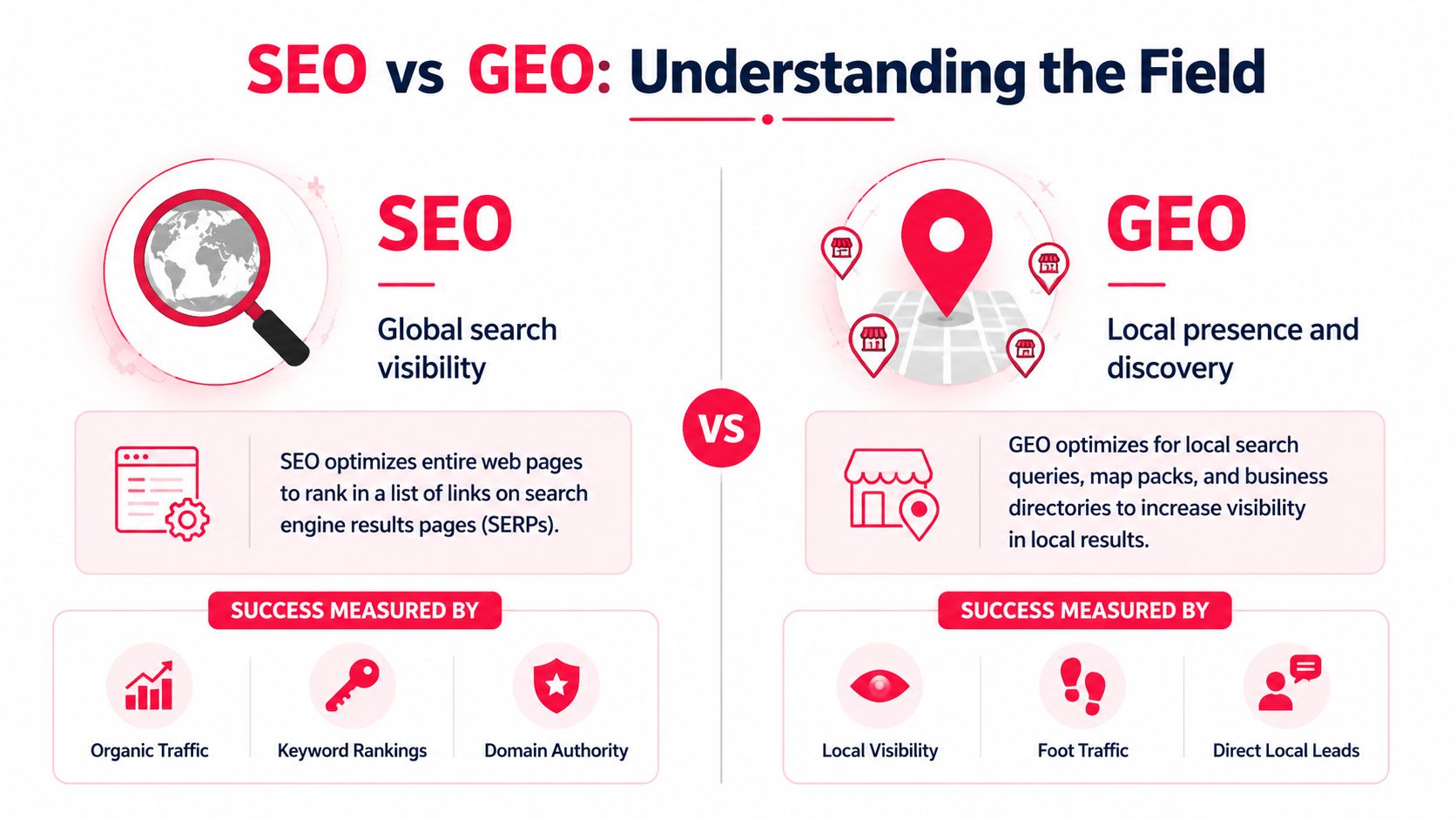
SEO and GEO compete in the same budget discussion, but they solve different distribution problems. SEO is built to win placement in search results. GEO is built to earn retrieval, trust, and citation inside AI-generated answers. If a leadership team treats those as the same motion, content production stays busy while buyer visibility drops.
A quick operating model
The operational difference is straightforward.
| Dimension | SEO | GEO |
|---|---|---|
| Primary unit | Full page | Section or passage |
| Main goal | Rank in link results | Get cited in AI answers |
| Main measurement | Position, traffic, CTR | Citation rate |
| Authority signal | Crawlability, relevance, backlinks | Citability, clarity, trust anchors |
| User action | Click to site | Consume answer in interface, then decide |
That shift changes what content has to do. A page can still rank with broad copy, thin support, and generic points. AI systems are less forgiving. They favor passages with explicit claims, attributable expertise, and evidence close to the statement being made. If those elements are missing, your content may still collect impressions while losing influence at the exact moment a buyer asks for a recommendation.
The practical test is simple. Can a model lift a paragraph from your page, preserve its meaning, and present it as a credible answer without needing the rest of the article for context? If not, the asset is weak for GEO even if SEO performance looks acceptable.
What changes inside the content itself
GEO rewards content blocks that are easy to extract, verify, and cite. In practice, that usually means:
- Declarative section openings. Put the answer in the first sentence.
- One-question, one-answer structure. Reduce ambiguity inside each block.
- Named experts. Attribute commentary to operators, product leaders, or technical staff.
- Evidence near the claim. Put proof in the paragraph, not several sections later.
- Clean entity references. Use consistent names for products, categories, competitors, and use cases.
This is less about creating a new content category and more about raising editorial discipline. Teams do not need an "AI article format." They need better passage design, clearer sourcing, and tighter claim structure. That is the core of an AI search optimization program, where editorial standards, technical accessibility, and brand authority have to work together.
One more implementation reality matters. SEO can tolerate content ownership sitting mostly with the search team. GEO usually cannot. Product marketing, subject-matter experts, content, and technical SEO all affect whether a passage gets cited. Without that coordination, companies publish pages that are indexable but not quotable.
A ranked page gets you considered. A citable passage gets you mentioned. In a citation economy, that difference shows up in branded demand, sales conversations, and conversion efficiency.
A Head to Head Strategic Comparison
GEO and SEO do not compete for the same outcome. SEO still buys visibility in a click-driven system. GEO improves the odds that AI systems cite your brand, frame your category correctly, and send buyers into the funnel with more context already formed.
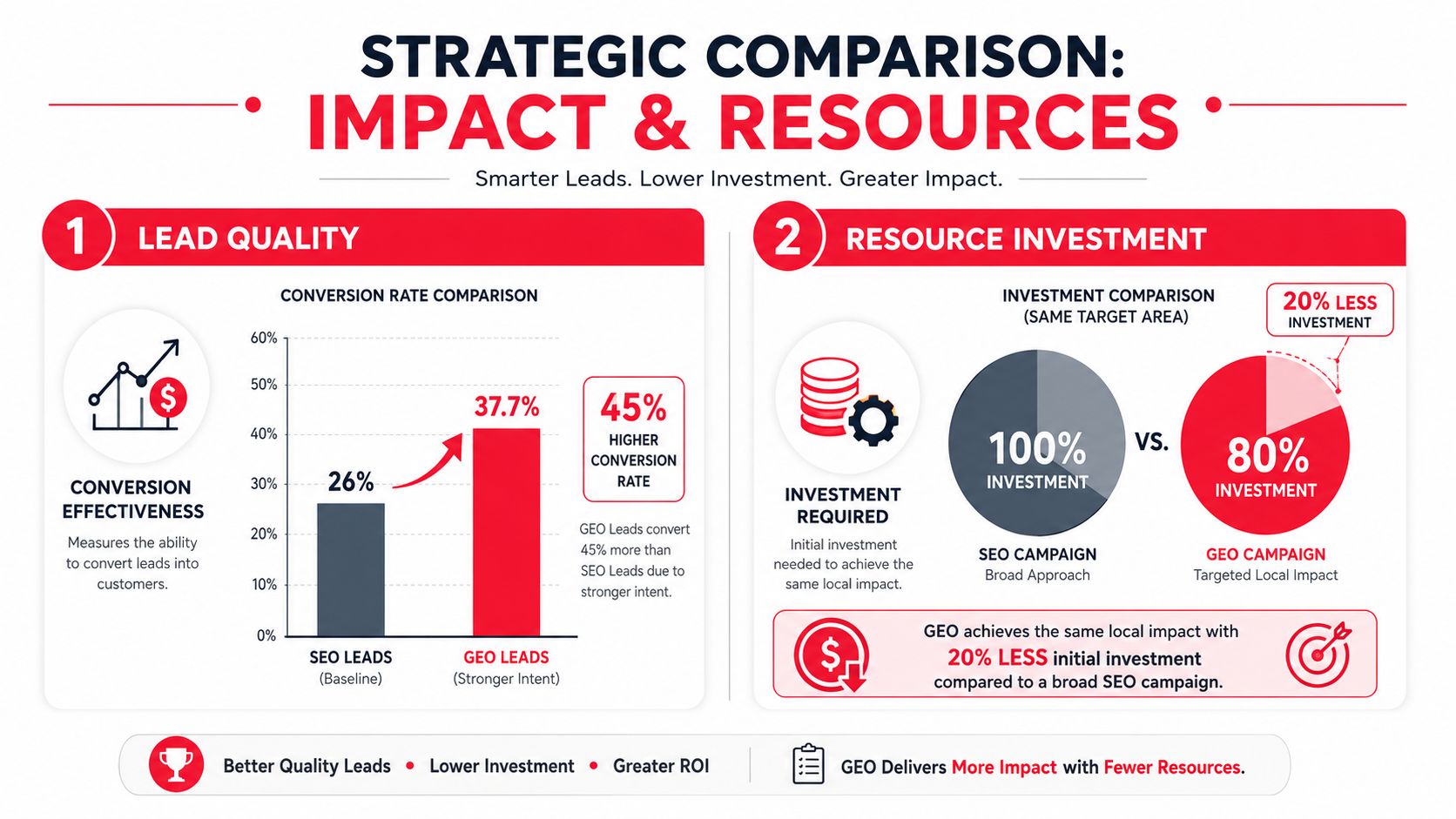
For a CEO, the practical question is simple. Which motion creates more pipeline per dollar, and what does the org need to operate it well?
The comparison table operators actually need
| Decision area | SEO | GEO |
|---|---|---|
| Lead quality | Strong for broad demand capture | 17% more qualified leads in controlled comparisons (Onely on GEO vs SEO) |
| Payback timeline | Typically 6 to 12 months | 3 to 5 months in controlled comparisons |
| Technical scope | Crawlability, indexing, site architecture | Retrieval readiness, section structure, AI crawler access |
| Core asset | Rankable page | Citable passage |
| Team bias | Keywords and backlinks | Brand mention share and semantic authority |
The lead quality row matters more than the traffic row. A visit from a loosely matched search term can inflate reporting and still produce weak pipeline. A citation inside an AI answer often reaches a buyer later in the journey, after the model has already filtered vendors, summarized trade-offs, and shaped the shortlist.
That changes conversion math. If traffic drops but qualification rate rises, sales accepts more of what marketing sends. Win rates can improve even before volume recovers. Boards care about that version of efficiency.
Where the payback actually comes from
SEO usually concentrates effort in keyword mapping, internal links, titles, technical fixes, and backlinks. GEO adds a content retrieval layer and an operating layer. Go Fish Digital argues that teams need a Layer 0 infrastructure check to confirm AI crawlers such as GPTBot and PerplexityBot are not blocked, plus an ai.txt file and a section-level structural audit so models can extract precise answers from a page (Go Fish Digital on SEO vs GEO).
A ranked page can still be absent from AI answers.
In audits, the same failure patterns show up repeatedly:
- Blocked AI crawlers. The page is live, but retrieval systems cannot access it reliably.
- Weak passage design. The article reads well end to end, but no section stands alone as a quotable answer.
- Claims without proof. The point is plausible, yet there is no source, no operator attribution, and no evidence close to the claim.
- Late answers. The conclusion appears too far down the page, which reduces extraction and citation odds.
Operator note: I treat section-level failure as a revenue issue, not an editorial issue. If the model cannot lift a clean answer, your brand loses the mention before the buyer ever reaches the site.
The payback difference also comes from workflow. SEO can run inside a search team for long stretches. GEO usually cannot. Product marketing, technical SEO, content, SMEs, and demand gen all affect whether a page gets cited, whether the citation is favorable, and whether the resulting session converts. Once that traffic lands, teams still need disciplined landing page split testing to turn higher-intent visits into meetings and pipeline.
Why SEO teams often stall
The common failure is organizational, not technical.
Many SEO teams are built to chase rankings. GEO requires a system for shaping how the market describes your company across your site, third-party platforms, expert commentary, and customer proof. The underpriced signal is brand mention quality, not just page position.
That is why teams stall after the first round of prompt-friendly edits. They update headings, add schema, clean up a few pages, and expect citations to follow. Then nothing changes because nobody owns the harder work: tightening category language, aligning product claims with evidence, increasing expert visibility, and making off-site references consistent enough for models to trust.
A YouTube discussion on the branding versus ranking gap makes the point directly. Teams that treat GEO as a thin technical layer miss the role of business listings, multimedia presence, and consistent brand data across rented platforms in how AI systems resolve and cite entities (YouTube discussion on the branding vs ranking gap).
GTM engineering becomes the deciding factor at that stage. Someone has to coordinate site content, product messaging, founder voice, customer proof, and off-site mention strategy into one system. Without that owner, SEO keeps producing pages and GEO keeps producing theory.
Integrating SEO and GEO for Market Dominance
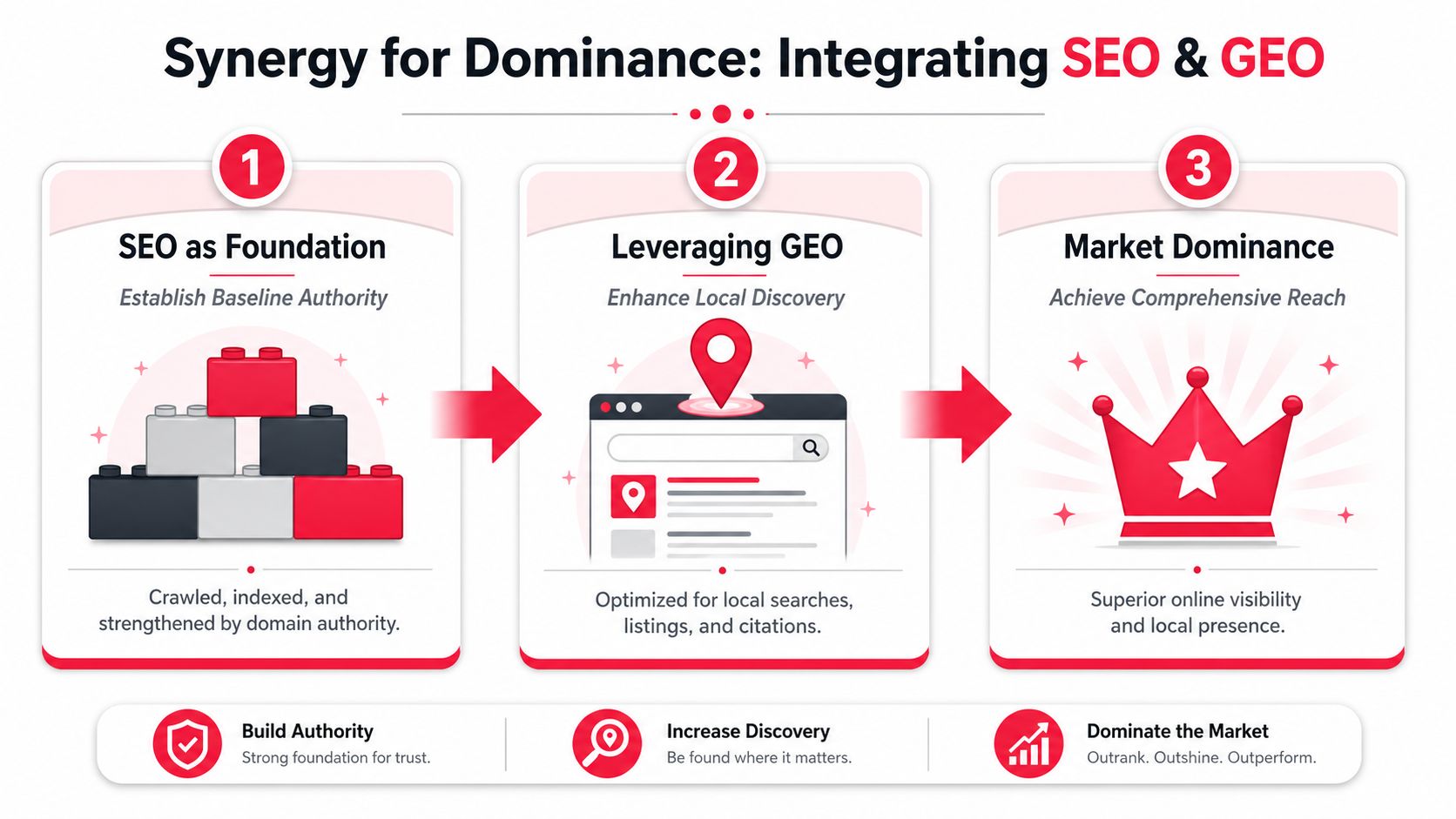
The strongest operating model uses both. SEO provides the base layer. GEO decides whether that base layer gets used by AI systems.
Use SEO as infrastructure
SEO still handles the hard basics. Your pages need to be crawlable, indexable, internally connected, and technically sound. If your foundation is weak, GEO has less to work with.
There's a reason analysts expect a high operational overlap between the two disciplines. One analysis speculates 90–95% overlap between SEO and GEO execution, while measurement diverges into citation frequency, share of model, and sentiment rather than rank and traffic (Presence on GEO vs SEO in 2026). That matches what operators see in practice. The workflows overlap. The scorecard changes.
Build authority off site too
Many teams miss the market. Recent 2025–2026 data indicates LLMs prioritize opinion-rich content and intermediary optimization on platforms like Reddit, LinkedIn, and industry forums over direct site content for informational queries. The same analysis says a site optimized for SEO only is “invisible in AI search on informational queries” and that teams without intermediary diversification fail Layer 0 infrastructure checks (Searchless on intermediary optimization).
That has direct GTM consequences. Your market education can't live only on your blog anymore. You need citable claims in external channels where models pull opinion, experience, and consensus.
A practical integrated motion usually includes:
- On-site answer assets: Rewrite high-intent pages into clean question-and-answer sections.
- Off-site expert distribution: Publish operator viewpoints on LinkedIn, Reddit, niche communities, and industry media.
- Multiformat presence: Turn core ideas into video, audio, and transcript-friendly assets.
- Testing discipline: Feed winning messages back into landing pages and forms. The landing page split testing playbook matters here because AI traffic often exposes weak message-market fit fast.
This is also where AEO work starts blending into CRO with AI. If AI interfaces send a visitor who already believes you're the answer, your page has to close that gap quickly. The acquisition layer and the conversion layer can't operate as separate teams anymore.
Measuring What Matters ROI and KPIs for GEO
Rankings, sessions, and non-brand clicks no longer capture the full economics of discovery. GEO changes the measurement model because influence can happen inside the answer, long before a visit shows up in analytics.
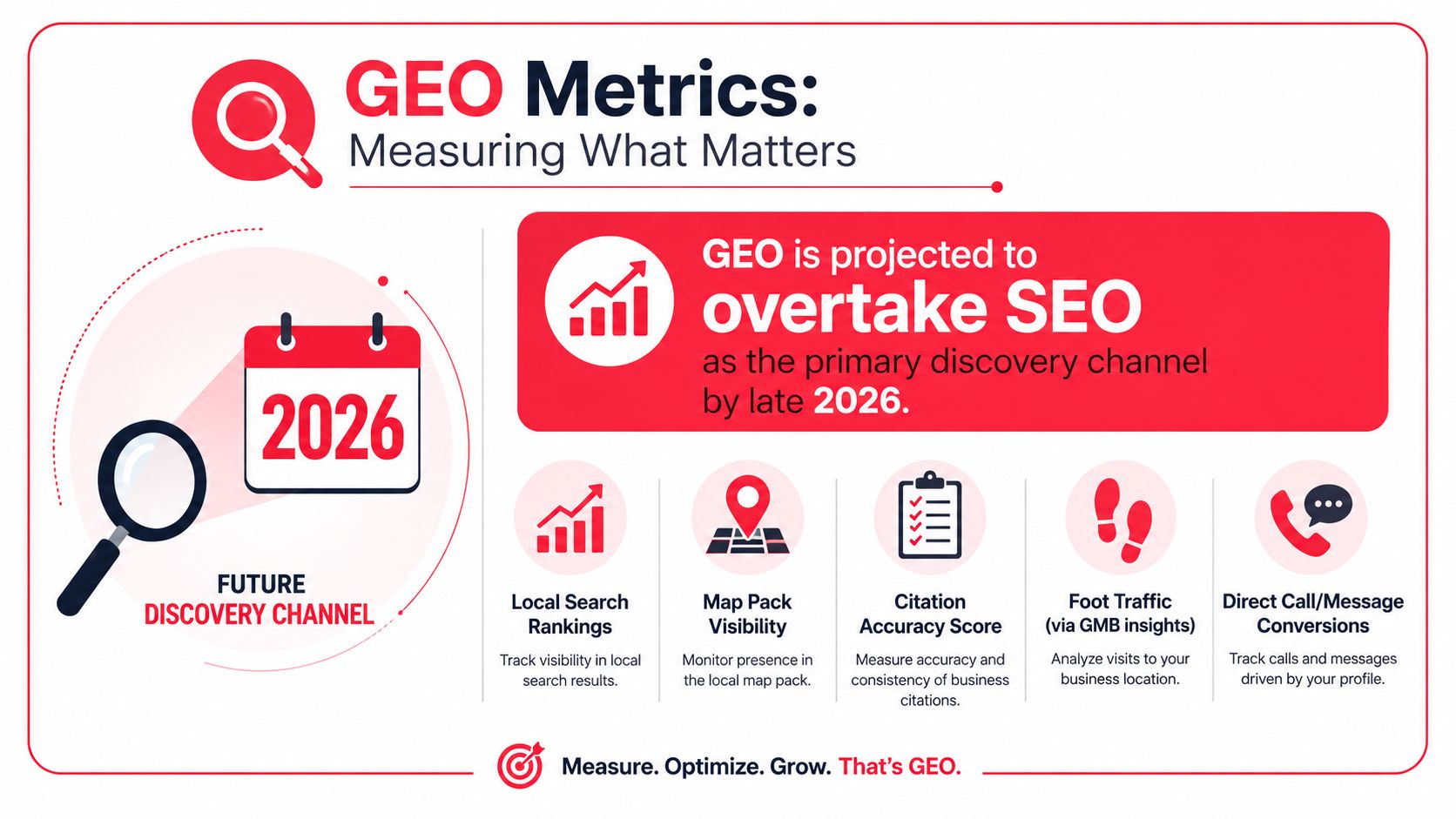
Some projections suggest GEO could surpass traditional SEO as a primary discovery channel over the next few years, especially as AI search behavior grows in B2B buying journeys (Wellows on GEO KPIs). Treat that as a scenario to prepare for, not a date to anchor the board plan around. The operating decision is simpler. If buyers are discovering vendors through AI answers today, the dashboard needs to measure citation and revenue impact today.
The dashboard that belongs in the board pack
The metrics worth showing leadership are the ones that explain whether your brand is present, trusted, and commercially useful in AI outputs.
- Citation frequency: How often your domain appears in AI answers for target prompts.
- Share of model: Your visibility share across the answer set for a topic cluster.
- Sentiment score: Whether the brand is cited positively, neutrally, or unfavorably.
- EQMR: The Early-Question Match Rate, or the percentage of high-intent questions covered by live structured content.
- APMR: The AI Presentation Match Rate, or the share of target clusters that show up in AI answers, not just in your crawl footprint.
Those metrics do a better job of exposing risk. A team can post healthy traffic numbers and still lose the category narrative if models cite competitors more often, cite review sites instead of the brand, or pull weak framing into the answer.
Here's the embedded explainer many teams use to orient execs and operators:
How to tie GEO to revenue
Revenue attribution gets messy fast. A prospect may first encounter your company in ChatGPT, validate you through third-party sources, then convert later through direct traffic, branded search, or sales follow-up. Last-click reporting misses that path.
The practical answer is blended attribution. Use GA4 to isolate visits from AI referrers such as chatgpt.com and perplexity.ai. Add a self-reported form field asking how the buyer first heard about you. Then compare stage progression, win rate, and ACV for those cohorts. This guide to measuring marketing effectiveness across assisted channels is the right reference point because GEO rarely behaves like a clean click-through channel.
I also want one more signal in the model. Off-site proof often shapes whether AI systems trust and cite your brand, especially in local or reputation-sensitive categories. If reviews influence your deal flow, build that into your measurement and ops plan. A simple starting point is to grow your business with reviews and track whether stronger third-party proof correlates with more favorable citations and higher close rates.
A workable GEO revenue model looks like this:
- Track direct AI referrals in GA4.
- Capture self-reported discovery on forms and in sales intake.
- Monitor citation frequency and prompt coverage for commercial topics.
- Compare pipeline quality, not just lead volume, across discovery cohorts.
That changes the board conversation. GEO is not a visibility side project. It is a discovery and influence layer, and it earns budget only if it improves qualified pipeline, sales efficiency, or win rate.
Your First 90 Days in the Citation Economy
The first quarter should be operational, not theoretical.
Month one audits
Start with access and structure. Check whether GPTBot and PerplexityBot can reach your content. Add an ai.txt file. Then audit your top content pages for section clarity, Q&A formatting, and citable claims.
You're looking for pages that already have authority and buyer intent but poor citability.
Month two retrofits
Pick three high-potential pages and rewrite them for retrieval. Add sourced statistics where appropriate. Add internal expert quotations. Break long narrative blocks into short declarative sections.
Also review your third-party footprint. If your category depends on trust and local proof, one practical asset is a review acquisition process. This guide on how to grow your business with reviews is useful because off-site proof often feeds broader entity trust, not just local conversion.
Month three measurement
Track citation frequency on your test pages. Monitor AI referral traffic. Add a self-reported attribution field to forms and compare sales quality from those leads against your standard organic cohorts.
By the end of the quarter, you should know three things:
- Which pages get cited
- Which prompts mention your brand
- Which assisted conversions drive pipeline
If you want to move faster, bring in a fractional CAIO who can connect AI search optimization, CRO with AI, GTM engineering, and agent commerce readiness into one operating plan. That's the work Stimulead does with growth-stage teams: audit the current funnel, find where AI changes discovery and conversion, then turn it into an execution roadmap your team can run.