
Google AI Mode accounted for 54.3% of publishing citations in 2026, versus 19.4% for ChatGPT and 13.1% for Perplexity. That concentration matters because ai answer engines are now a citation problem before they're a traffic problem.
For growth-stage B2B teams, the decision is whether to treat these systems as part of growth operations or as an optional SEO side project. The teams that win are the ones that can prove where they're cited, why they're cited, and whether those citations change pipeline behavior.
Table of Contents
- Why AI Answer Engines Are Changing Brand Visibility
- How AI Answer Engines Retrieve, Rank, and Ground Answers
- What AI Answer Engines Are Not
- Why Retrieval Quality Limits Answer Reliability
- Becoming Citable When Buyers Ask AI First
- When Not to Optimize for AI Answer Engines
- Next Steps for Marketing and Product Teams
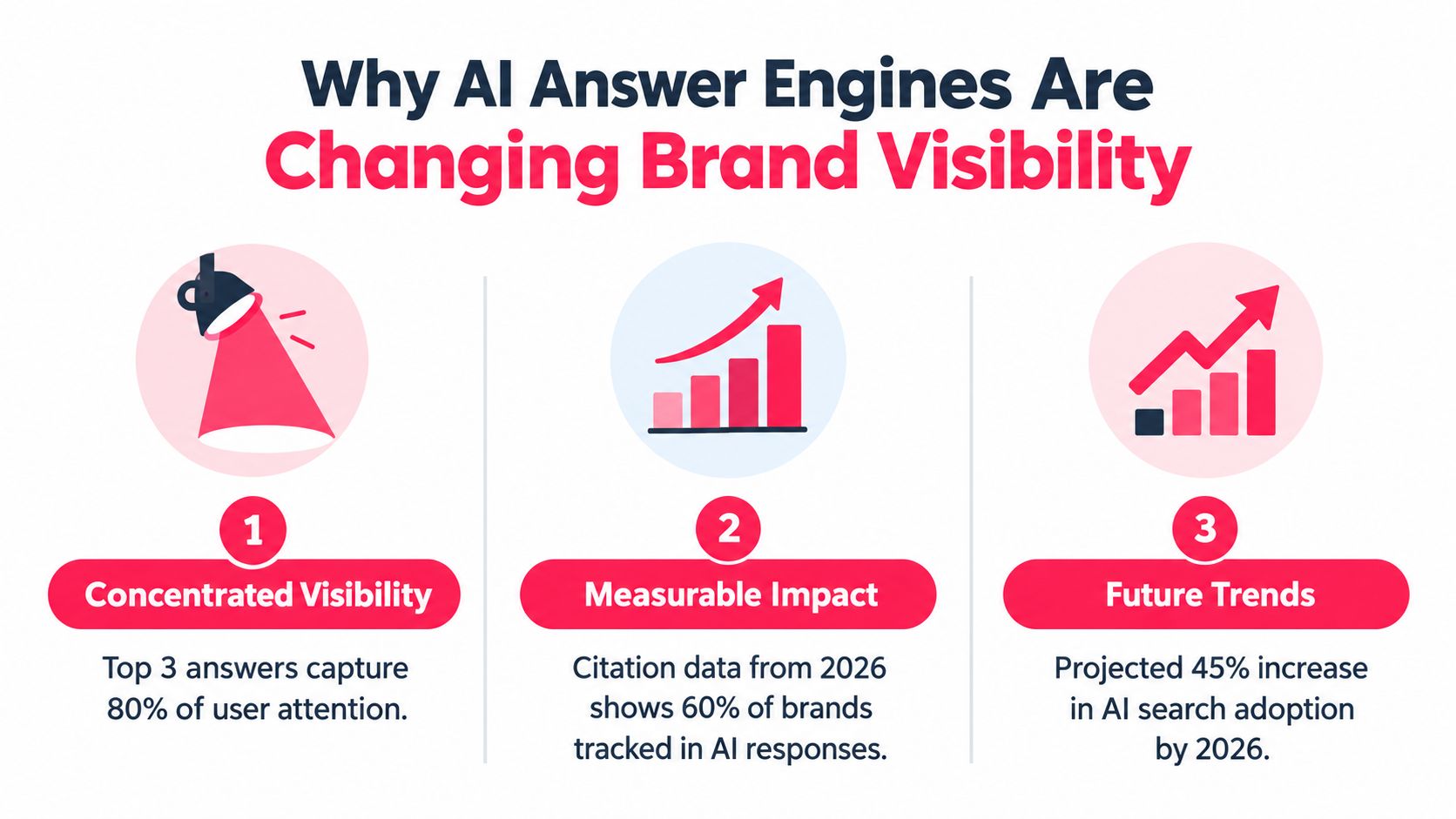
Why AI Answer Engines Are Changing Brand Visibility
The useful question is no longer whether your site ranks. It's whether an answer engine can describe your category correctly, cite your brand when a buyer compares options, and carry your product facts into the buying journey.
That shift is measurable. Conductor's 2026 benchmark found that Google AI Mode accounted for 54.3% of publishing citations, ahead of ChatGPT at 19.4% and Perplexity at 13.1%. That concentration means visibility is being allocated inside a few systems and a few source patterns, not spread evenly across the web Conductor benchmark summary.
Teams still get stuck because they optimize for clicks on blue links instead of optimizing for whether an answer engine credits them at all. A buyer can absorb your positioning, product facts, and competitor context without visiting your site, which means traditional rank tracking misses part of the journey.
Practical rule: if your brand is absent from the citation layer, your funnel starts later than your competitors' funnel.
The right response is to treat AI-mediated discovery as a growth operation with a measurement layer, not a content experiment. That means deciding which queries matter, what evidence should surface, and where your attribution model can observe exposure. A useful starting point is an AI visibility audit guide from Agentable, which is relevant because the audit question comes before the content question.
The internal question is where to begin once a brand sees this shift. Our Stimulead guide on getting recommended by ChatGPT, Claude, or Gemini is useful context because recommendation and citation are now tied to the same evidence problem.
How AI Answer Engines Retrieve, Rank, and Ground Answers
AI answer engines work in a sequence that looks simple from the outside and messy inside. They retrieve candidate pages, break them into smaller chunks, score those passages for relevance and trust, then synthesize an answer and cite only some of the material.
That chunk-level competition changes what wins. A homepage with polished copy can still lose if the engine can't isolate a usable passage, while a tightly written comparison page or fact sheet can win because the answer is easy to extract. A vendor fact sheet often serves factual grounding, a comparison page usually serves evaluative language, and a case study can support proof, but each needs a different structure.
What content actually gets selected
Search engines can reward broad page authority. Answer engines need extraction paths.
That means the best content is usually:
- Direct-answer sections, where the first sentence answers the implied question.
- Machine-readable product facts, where specs, dates, and naming are consistent.
- Chunked comparison pages, where one section covers one decision criterion.
- Evidence-backed case studies, where the result is stated plainly enough to cite.
A strong page does two jobs at once. It reads naturally for a human and still survives being split into fragments by a retrieval layer.
A practical way to think about this is to stop writing for a single page view. Answer engines often decompose a query into sub-queries, which means a brand competes at the passage level. That's why dense narrative copy, hidden details, and generic claims tend to underperform.
The same logic applies to technical layout. The answer engine readiness guide for Shopify is relevant here because it treats structure as an extraction problem, not a branding exercise. Our own internal work at Stimulead also points the same way, which is why our guidance on llms.txt belongs in the implementation stack for teams that want machine-readable source paths.
What AI Answer Engines Are Not
AI answer engines are not traditional search with a fresh coat of paint. Traditional search ranks pages. Raw chat synthesizes without strong sourcing. Answer engines try to ground the response, then attach citations, which creates a different accountability problem.
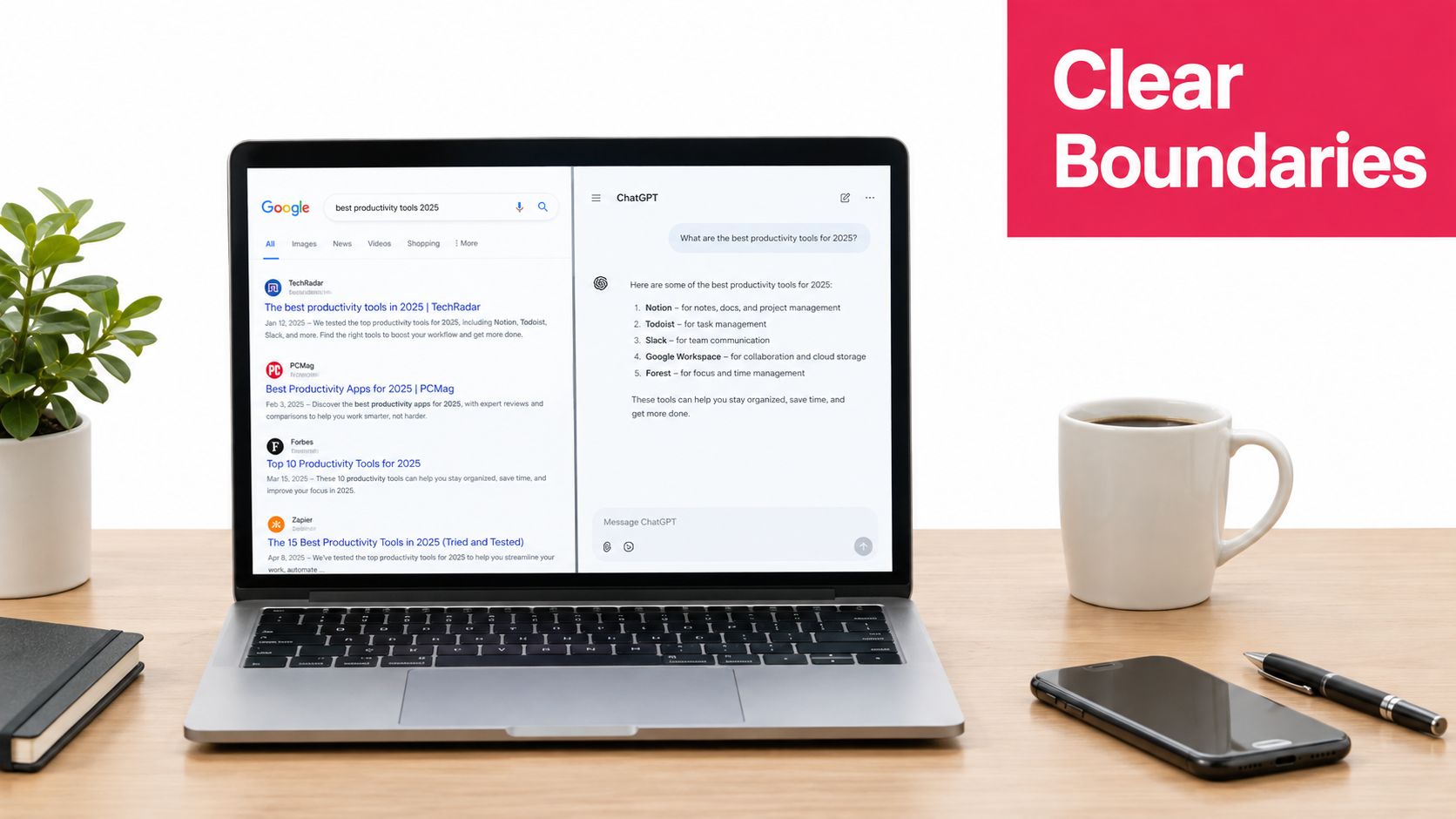
That distinction matters because the click path changes. In classic search, the buyer often lands on your page before they've formed a view. In answer engines, the buyer may already have a shortlist before the first click, which means brand exposure happens earlier and may be more compressed.
The operating difference
| Channel | Source behavior | Brand control | Buyer path |
|---|---|---|---|
| Traditional search | Ranks pages | Moderate | Click-first |
| Raw LLM chat | Synthesizes from training and context | Low and opaque | Answer-first |
| AI answer engines | Retrieves, grounds, cites | Higher than chat, lower than search | Answer-first with citation |
That table is the practical boundary. Search still rewards page authority and click behavior. Raw chat can be useful for ideation, but it doesn't give a clean citation path. AI answer engines sit in the middle, and that middle creates a new risk, because a brand can be visible without being credited correctly.
The marketing implication is straightforward. If your buyer learns about category alternatives from AI summaries, then answer engine visibility can compress the funnel or route buyers toward you before they reach your site. That makes AI Overviews and similar systems a distribution layer, not a novelty project.
Why Retrieval Quality Limits Answer Reliability
Reliable answer-engine performance depends on retrieval quality more than model quality. That matters because the retrieval layer decides what evidence the system even has access to, and weak retrieval leaves the generator with the wrong material.
The RAG benchmark guidance in the verified data is clear. Retrieval metrics such as Precision@K, Recall@K, MRR, and nDCG measure whether the right passages were surfaced, while answer metrics such as faithfulness, answer relevance, semantic similarity, and correctness measure whether the final response was grounded and useful RAG evaluation guidance. Teams need both, because a good generator can't rescue bad retrieval.
Why the benchmark numbers matter
On the CRAG benchmark, most advanced LLMs reached 34% or less accuracy, straightforward RAG improved that only to 44%, and state-of-the-art industry RAG solutions answered only 63% of questions without hallucination CRAG benchmark paper.
That should reset expectations. It means production systems still need stronger source selection, rejection of unsupported answers, and tighter context verification. It also means content volume alone won't solve the problem, because the answer engine can only surface what it can trust and retrieve cleanly.
The operational lesson is simple, if retrieval is weak, the system can look intelligent and still answer badly.
For marketers, the implication is direct. Good content is necessary, but it isn't sufficient. Brand teams need evidence that is specific, citable, and easy to separate from surrounding prose, or the retrieval layer will skip it.
Becoming Citable When Buyers Ask AI First
The practical question is not how to rank. It's what evidence, structure, and source distribution make a brand the preferred citation when a buyer asks an answer engine for options.
That's where the measurement gap becomes a strategy gap. One 2026 industry report framed answer-engine visibility as a monitoring gap, an attribution gap, and a competitive-intelligence gap, which is exactly how it feels in practice when the old rank report no longer tells the whole story. The same body of reporting also noted that 80% of brands were cited at least once, but only 15% secured the top citation position with their own domain, while 20% were not cited at all analysis of brand citations in answer engines.
What the evidence layer needs
The brands that become citable usually do a few things consistently:
- They publish named facts, not just positioning statements. Product names, use cases, limitations, and comparison criteria are written in plain language.
- They make pages extractable, with headings that match the question a buyer would ask.
- They distribute proof off-site, because answer engines don't rely only on one domain.
- They keep source naming consistent, so the same product doesn't appear under different labels across pages.
The local-service benchmark reinforces the point. Gemini 2.5 Flash named an average of 12.53 businesses per query while citing 569 distinct source domains, and the most-cited domains were third-party sources like bestlawfirms.com, reddit.com, forbes.com, superlawyers.com, and justia.com local-service AI search benchmark. Third-party sources still dominate the recommendation layer, which is why brand-owned pages need to be built for citation rather than assumed to earn it.
Practical rule: if your best evidence lives only on one page and one domain, the citation layer is working against you.
For teams that need a concrete process, start with source distribution before content volume. Build pages that can answer a specific buyer question, support them with proof pages, and then make sure the supporting claims appear in places answer engines already trust. The Stimulead article on ranking in Google AI Overviews is relevant because it addresses the same citation mechanics from the search side.
When Not to Optimize for AI Answer Engines
Not every brand should pour resources into AI answer engine optimization immediately. Some teams are too early, some have the wrong query mix, and some can't measure attribution well enough to know whether the work matters.
That caution isn't academic. Measurement and attribution are still poorly solved, and a lot of teams are optimizing blind without cross-platform visibility into citation patterns or zero-click discovery. The problem is more serious now because AI-mediated discovery is mainstream enough that hidden attribution is no longer a niche issue, but the tooling is still uneven.
The cases where waiting is rational
A delay can be the right call when:
- Your category queries are low-intent, so citations won't change commercial outcomes.
- Your brand doesn't have sourceable proof yet, which means optimization would outpace evidence.
- Your analytics stack can't observe exposure, so you'd be funding activity without a signal.
- Your source footprint is thin, which limits citation probability outside your own site.
That's especially relevant when concentration is high. If Google AI Mode is taking the majority of publishing citations and a few third-party sources dominate the rest, spreading effort across every engine can waste time. A growth-stage team should concentrate on the queries where the citation layer is both relevant and observable.
The failure mode to avoid is easy to spot. Teams publish content, see occasional mentions, and call it progress even though pipeline attribution never changes. That creates the illusion of motion without a reliable business signal.
Next Steps for Marketing and Product Teams
Pick one query cluster, such as “best [category] for [use case],” and test it before you expand. Run a 20-query citation audit across Google AI Mode and ChatGPT, then ship one extractable comparison page with machine-readable facts that answer the query without forcing the model to infer them.
That gives marketing and product teams a concrete read on whether citations are possible, where they come from, and what evidence is missing. If the page earns citations from third-party sources, the next decision is whether to extend the pattern to adjacent queries or stop where the proof is thin.
Keep the test narrow enough to measure. Track citation presence, source mix, and visible exposure for that cluster, and compare those signals with the pages buyers use. If the work does not connect to pipeline or qualified demand, the problem is usually measurement, not visibility.
Where teams get stuck is treating AI answer engines like another content refresh. The useful move is to make one page easier to quote than the alternatives, then learn from the citation trail before you scale.