
Weekly generative-AI use nearly doubled to 34%, and 54% of respondents had seen an AI-generated answer after a search. LLMO is the discipline of winning inclusion and accurate citation inside those answers, rather than competing only for search clicks.
For CEOs, CMOs, and CROs, the decision is whether to treat AI visibility as another content task or as a new evidence and measurement system. We recommend the second approach. A mention has limited value unless the answer represents the company correctly, reaches a real buying question, and contributes to branded demand, account engagement, or pipeline.
Table of Contents
- Why AI Answer Visibility Now Replaces Simple Ranking Targets
- What LLMO Actually Means for Revenue Teams
- How LLMO Differs from Traditional SEO Work
- When AI Answers Replace Clicks, Visibility Can Mask Loss
- When LLMO Is Worth Investing in Right Now
- How to Build an LLMO Measurement System
- Where LLMO Fails Without Governance and Owned Channels
- What Growth Leaders Should Test Next
Why AI Answer Visibility Now Replaces Simple Ranking Targets
The old visibility target was straightforward: rank for a query, earn the click, and convert the visitor on your site. That model still matters, but it no longer captures how buyers research vendors. AI systems increasingly frame the category, compare suppliers, and summarise evidence before a buyer reaches a traditional search result.
The Reuters Institute's 2025 global study found that standalone generative-AI use across six countries rose from 40% in 2024 to 61% in 2025. Weekly use rose from 18% to 34%, while use of generative AI for obtaining information increased from 11% to 24%. More than half of respondents, 54%, said they had seen an AI-generated answer after a search during the preceding week.
That changes the visibility question. Your company can influence consideration without receiving a website visit. An answer engine may describe your category, list your competitors, recommend a vendor, or cite your evidence before a prospect opens a browser tab.
Practical rule: Treat AI answers as a distribution surface and a representation risk, not as an SEO novelty.
Google's AI Overview timeline makes the shift concrete. Google began testing the feature in the United States on March 22, 2024, launched it to all U.S. users on May 15, expanded it to countries including the United Kingdom, India, Japan, Brazil, and Indonesia in August, and reached more than 100 countries and territories by October 28, 2024. The channel moved from experiment to global availability within roughly seven months.
Teams reviewing AI answer engines at Stimulead should therefore ask a harder question than “Where do we rank?” Ask whether the information ecosystem around the company gives models enough consistent, credible evidence to represent it accurately. Practical guidance on how to optimize content for AI overviews is useful here, provided it supports a broader measurement plan rather than becoming a formatting exercise.
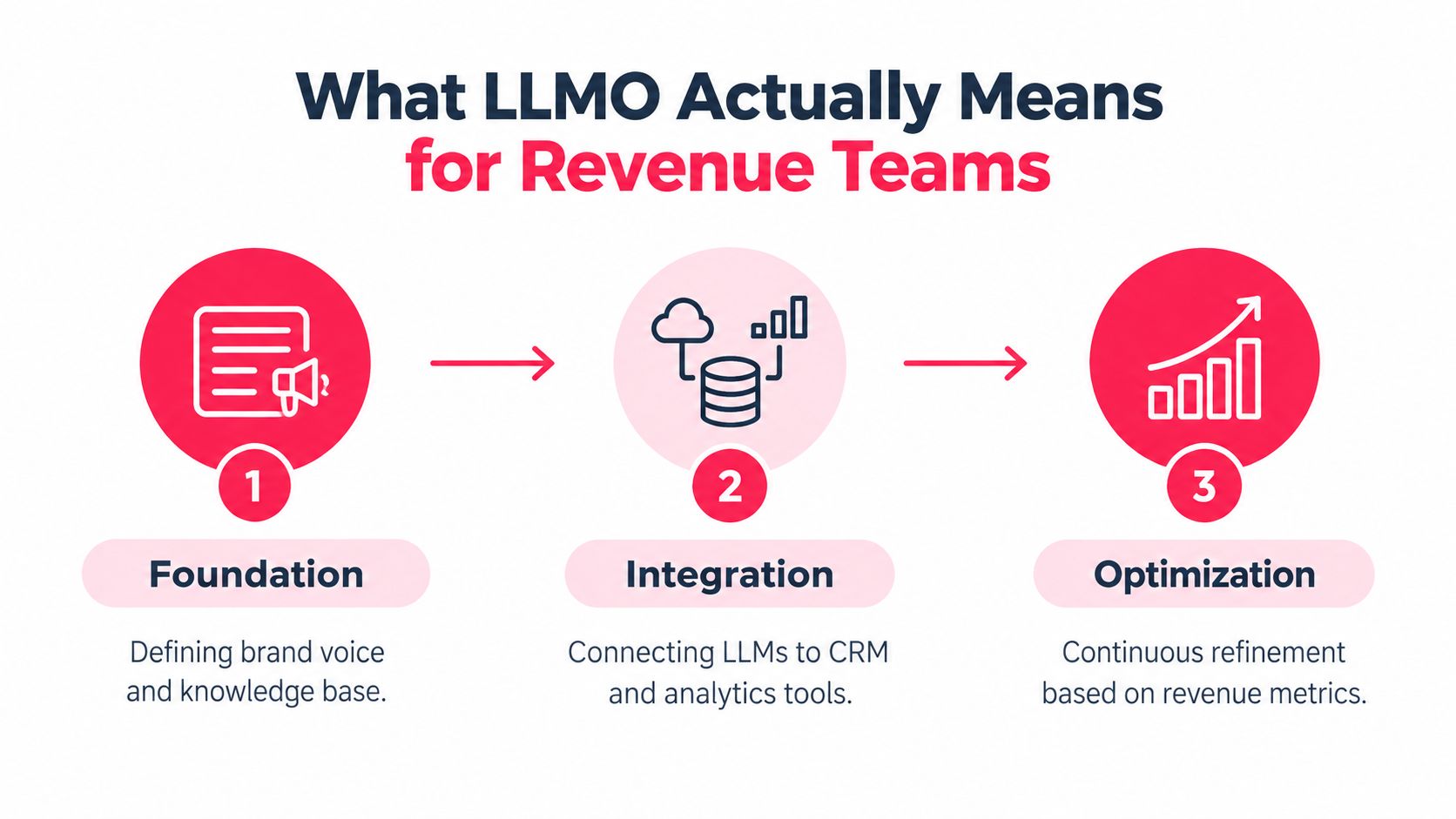
What LLMO Actually Means for Revenue Teams
LLMO, or large language model optimization, improves how a company, product, or source is understood, selected, and cited by generative-AI systems such as ChatGPT and AI-powered search. SEO primarily targets ranked links and clicks. LLMO targets inclusion in synthesized answers, recommendations, and cited source sets.
That difference matters to revenue teams because an answer engine must perform several operations before a buyer sees a recommendation. It interprets the prompt, retrieves documents, ranks the available evidence, assembles context, generates an answer, and attributes sources. Your page can be relevant yet fail to enter the retrieved set. It can be retrieved yet omitted from the answer. It can be cited yet described inaccurately.
Google's AI Overview rollout made this operationally important. Testing began in the United States on March 22, 2024, broad access followed on May 15, and availability reached more than 100 countries and territories by October 28, 2024. Those milestones don't make LLMO a replacement for SEO. AI answers still depend heavily on crawlable, trustworthy web content.
The revenue team's working definition
We use LLMO to describe three connected jobs:
| Job | Revenue question | Evidence required |
|---|---|---|
| Retrieval | Can the system find the company for a target prompt? | Crawlable pages, clear entities, relevant language |
| Representation | Does the answer describe the offer correctly? | Explicit claims, current product facts, consistent terminology |
| Influence | Does visibility affect demand or pipeline? | Branded searches, account activity, assisted conversions |
Teams looking for practical AI search visibility tips should keep this distinction intact. A citation is an observable event. It isn't proof of commercial impact. Our AEO strategy work treats answer visibility as one layer in a measurement system that connects source quality to buyer behaviour.
How LLMO Differs from Traditional SEO Work
LLMO and SEO share infrastructure, but they compete in different selection processes. SEO asks a search engine to rank a page among links. LLMO asks an answer system to select evidence, integrate it with competing evidence, and produce a claim that may or may not include your company.
The technical pipeline includes query interpretation, document retrieval, reranking, context assembly, answer generation, and source attribution. That sequence creates more failure points than a ranking report reveals. A page may rank well for a keyword while failing to answer the conversational prompt that a buyer submits.
Research on retrieval-augmented generation found that language models handle noisy retrieved evidence well, while still struggling with negative rejection, information integration, and counterfactual or false information. That is why evidence-grounded pages matter more than persuasive copy. A product page should state what the product does, who it serves, where it operates, and which limitations apply.
A separate controlled study spanning six LLMs and 252,000 paired retrieval trials found that topical relevance and ranking position were the strongest drivers of first citation. Price, recency, and position acted as gatekeeper factors, while completeness and trust signals provided secondary benefits. The retrieval and citation study also reported negligible impact from formatting compared with those factors.
What the team should measure
| SEO measure | LLMO measure |
|---|---|
| Ranking position | Retrieval inclusion |
| Organic sessions | Answer mention rate |
| Click-through rate | Citation position |
| Backlinks | Citation quality |
| Page conversion rate | Factual accuracy and assisted influence |
This is why AEO versus SEO shouldn't become a naming debate. Page structure helps humans and machines extract information, but headings and bullet lists won't compensate for weak topical match, stale pricing, unclear product facts, or poor third-party evidence.
When AI Answers Replace Clicks, Visibility Can Mask Loss
Answer visibility can rise while revenue signal falls. That is the core risk.
A Pew Research Center analysis of nearly 69,000 Google searches from about 900 U.S. adults found that users clicked a conventional result on 8% of visits when an AI Overview appeared, versus 15% when it did not. Only 1% clicked a link inside the AI summary itself. 26% ended the session without clicking any link after seeing an AI Overview, compared with 16% on pages with traditional results alone.
For revenue teams, this changes the problem. Winning a mention is not the same as winning consideration, pipeline, or attributed revenue. AI systems can absorb the informational part of the journey and leave your site with a smaller role. If your team measures success only by whether the brand appeared in the answer, you can miss the harder question: did that answer move a buyer closer to action, or did it satisfy the query without creating any measurable next step?
That creates two jobs for marketing. First, secure accurate inclusion when buyers ask AI systems to explain the category, compare options, or frame vendor shortlists. Second, design owned pages to do the work AI answers cannot do well: prove fit, handle objections, show constraints, and convert intent into a demo, trial, or sales conversation.
Compare the investment choices
| Situation | Primary priority | Why |
|---|---|---|
| Buyers still discover the category through conventional search | SEO and conversion fundamentals | Better pages and stronger internal linking may address the main constraint |
| Buyers ask AI systems to define, compare, or shortlist vendors | LLMO testing | Answer engines may shape the buying frame before a site visit |
| The brand has inconsistent product facts across the web | Governance first | More citations can spread incorrect claims |
| The company has strong visibility but weak landing pages | Owned-channel conversion work | More mentions do not fix poor follow-through |
One analysis of 3,119 informational queries across 42 organizations found that brands cited in Google AI Overviews received 35% more organic clicks and 91% more paid clicks than brands that were not cited. The researchers also said the data could not establish causation. Treat those figures as a signal to test citation exposure against commercial outcomes, not as proof that mention share translates into demand.
When LLMO Is Worth Investing in Right Now
LLMO deserves executive attention when your buyers use conversational research to define categories, compare vendors, or decide which evaluation criteria matter. This is especially relevant for growth-stage B2B companies whose sales process already depends on educational content, analyst-style comparisons, and high-consideration buying committees.
It shouldn't outrank basic conversion work when the company has weak product pages, unclear positioning, poor CRM hygiene, or little evidence outside its own site. An answer engine can't fix a product that the market struggles to describe. It can only select and assemble the evidence it can find.

Use a simple prioritisation test
Check buyer behaviour. Review sales calls, win-loss notes, and customer interviews for questions such as “Which vendors are best for this use case?” or “How does this category compare with an alternative?” Those questions should become prompt candidates.
Audit answer exposure. Test a narrow set of commercial, comparative, problem-solving, and category-definition prompts across ChatGPT, Gemini, Claude, Perplexity, and Google AI Overviews where available. Record whether the company appears, whether the source is cited, and whether the description is accurate.
Inspect evidence quality. Confirm that product names, customer segments, integrations, pricing conditions, geographic coverage, and limitations remain consistent across owned and reputable third-party sources.
Set the commercial baseline. Capture qualified organic sessions, branded-search demand, account engagement, demo requests, opportunities, and pipeline before changing content or prompts.
Assign ownership. Marketing can manage content updates, but a revenue leader or fractional Chief AI Officer should own the cross-functional measurement system.
A short implementation review should leave you with a decision, not a large backlog. If answer visibility is low but fundamentals are strong, test LLMO. If answer visibility is acceptable but pipeline is weak, repair the conversion path first.
How to Build an LLMO Measurement System
Treat LLMO as a repeated experiment across prompts, platforms, and source combinations. Model outputs vary, so a single impressive answer proves very little. A fixed prompt panel gives the team a stable way to compare retrieval, citation, accuracy, and competitor displacement over time.
A B2B software company might organise its panel by buying committee role. A CMO prompt could ask which platforms support a specific acquisition problem. A CRO prompt could ask how vendors compare on implementation risk. A sales leader prompt could ask which solution fits a given team size or integration environment.
Build the panel around decisions
| Prompt group | Example buyer question | Score |
|---|---|---|
| Category | What does this solution category do? | Correct category placement |
| Commercial | Which vendors fit this use case? | Inclusion and recommendation position |
| Comparison | How does vendor A compare with vendor B? | Competitor displacement |
| Risk | What limitations should a buyer consider? | Accuracy and balanced representation |
| Action | What should a team evaluate before buying? | Proof-point inclusion and next-step relevance |
Track mention rate, citation position, factual accuracy, citation quality, and competitor displacement. Then connect changes to branded search, demo requests, target-account engagement, assisted conversions, opportunities, and pipeline.
A third-party analysis reported that brands in the top quartile for web mentions received more than 10 times as many AI citations as brands in the next quartile. The same analysis reported a 0.334 correlation between brand search volume and AI citation frequency across more than 7,000 analysed citations. The BusinessWire report treats these as signals, not causal proof. We use them to form testing hypotheses.
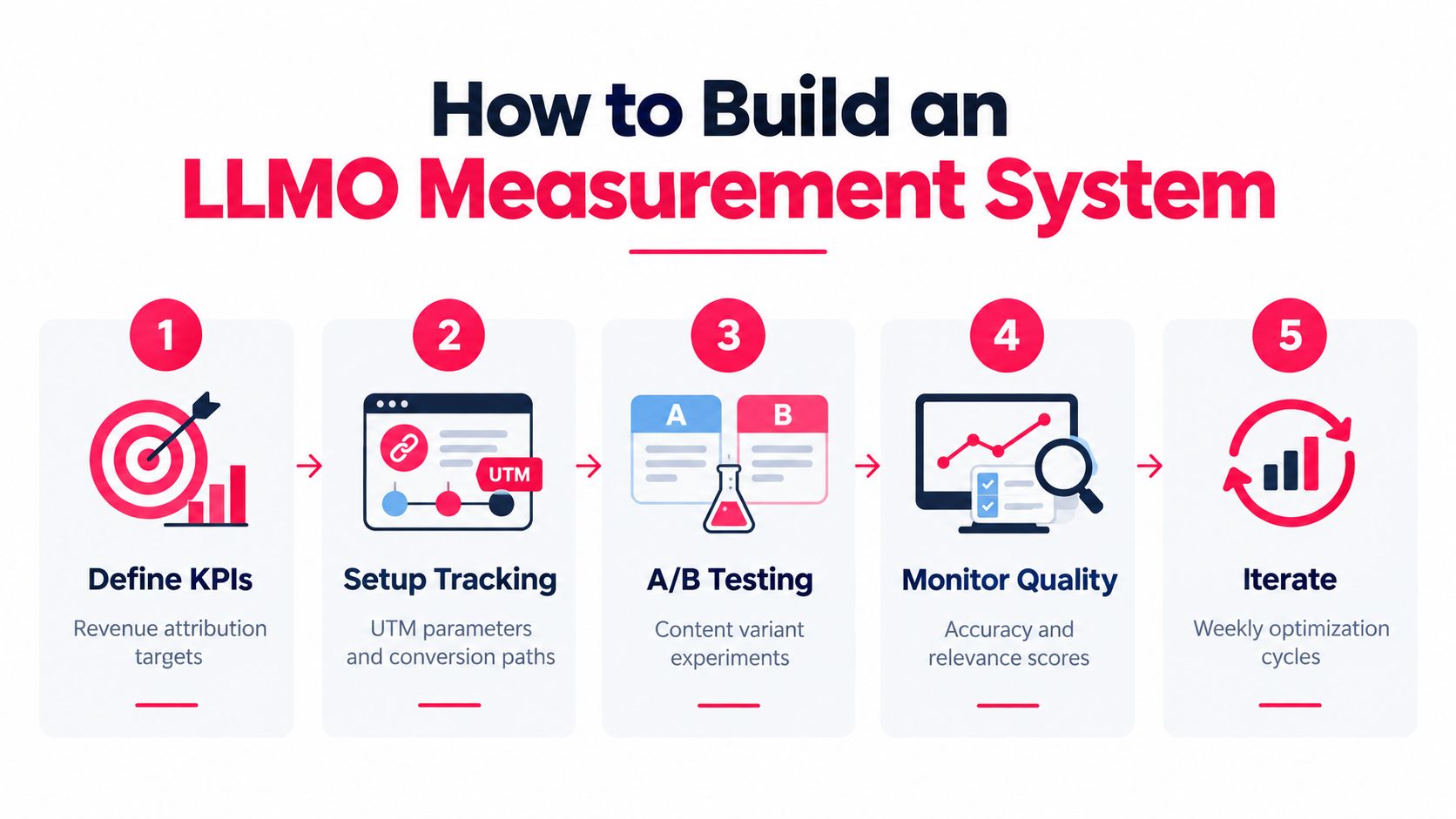
For implementation, teams can use a spreadsheet for a small panel, Looker Studio for reporting, and a CRM such as HubSpot or Salesforce for account and pipeline connections. Larger teams may add prompt-monitoring software, but the tool should serve the test design. Stimulead offers AI search optimisation work covering query mapping, content coverage, source clarity, entity clarity, and tracking of brand mentions and citations in AI-generated answers.
Where LLMO Fails Without Governance and Owned Channels
LLMO fails when the company treats citation volume as the objective. A brand may appear more often while models repeat an outdated product description, confuse two similarly named entities, or recommend a feature the company no longer sells. More visibility can amplify bad information.
The operating problem usually sits across teams. Product owns the facts, marketing owns the message, sales hears the objections, customer success knows where expectations break, and legal may control claims. Without one owner for the source of truth, each team publishes a slightly different version of the company.
Common failure conditions
- Unstructured product facts: Models can't reliably distinguish plans, integrations, exclusions, or customer segments.
- Conflicting external evidence: Directory pages, partner profiles, reviews, and articles describe the company differently.
- Weak proof points: The answer mentions the brand, but buyers have no memorable evidence to justify a next step.
- Poor conversion paths: A prospect reaches the website and encounters a generic page, unclear qualification, or no relevant call to action.
- No assisted measurement: The team counts sessions and direct leads while missing influence on branded searches and account activity.
A practical governance process should assign a product-fact owner, review material changes, document approved claims, and identify which pages support each claim. A lightweight guide to building with llms.txt can help teams think about machine-readable site guidance, but a file won't compensate for contradictory public information.
The answer layer and owned channel must work together. The answer creates recognition and consideration. The site needs structured product facts, memorable proof, direct-response landing pages, and tracking for assisted outcomes. If those pieces aren't ready, invest there before chasing more citations.
If you are building this capability, what is AI search optimization covers the content and site architecture work, and what is AI visibility explains how to audit and report on it.
What Growth Leaders Should Test Next
Start with the baseline, not the content calendar. Record qualified organic sessions, branded-search demand, demo requests, target-account engagement, opportunities, and pipeline for the period before you change pages or launch prompt monitoring.
Then choose a narrow prompt set tied to real buyer questions. Include category definitions, vendor comparisons, implementation concerns, and use-case recommendations. Run the same prompts across the answer engines that your buyers use, and score:
- Whether the company appears.
- Whether the answer cites a company source or an independent source.
- Whether the company is represented accurately.
- Whether competitors displace it.
- Whether visibility is followed by branded search, account activity, or a qualified conversion.
Don't optimise for raw mention counts. A mention that misstates the product can damage sales conversations, while a citation that reaches a high-intent buying prompt may matter even without an immediate referral session.
The ownership question is the final decision. LLMO crosses content, product marketing, SEO, sales operations, analytics, and governance, so it rarely succeeds as an isolated marketing task. Assign an executive sponsor, fund a focused test, and make the owner responsible for both answer accuracy and commercial influence.
If your company already has strong content and a measurable sales funnel, Stimulead can assess your target prompts, source coverage, citation performance, and owned-channel conversion path, then turn the findings into an executive roadmap. Book an AI search visibility review at stimulead.com and decide whether LLMO deserves investment now, or whether another constraint should come first.
Image filename: what-is-llmo-revenue-strategy.jpg
Image filename: what-is-llmo-business-professional.jpg
Image filename: what-is-llmo-measurement-system.jpg
