
AI search optimization is the engineering of content and site architecture so retrieval systems can discover, rank, and cite your brand in generated answers. By July 2025, Google said AI Overviews had reached 2 billion monthly users across more than 200 countries and territories, so this is already a distribution channel, not an experiment.
The board-level decision is simple. Do you keep optimizing only for blue links, or do you build for citation share, answer visibility, and the buying prompts your team cares about?
Table of Contents
- The Shift From Ranked Links to Cited Answers
- Engineering Content for Retrieval Systems
- Platform-Specific Citation Behavior
- Redefining Pipeline Metrics and KPIs
- Building a Controlled Diagnostic Workflow
- Where Optimization Programs Fail
The Shift From Ranked Links to Cited Answers
Google's AI Overviews have changed search economics because they compress the path from question to answer. Pew Research Center found that when an AI summary appeared, users clicked a traditional result in 8% of visits, compared with 15% when no summary appeared, and clicks on a link inside the summary happened in only 1% of visits (Pew Research Center). The click is still possible, but the old assumption that a top ranking reliably produces traffic no longer holds in the same way.
For B2B leaders, the true shift is distribution. A brand can shape the shortlist, influence evaluation, and appear inside an answer without winning the session. That changes pipeline math, because a visit is now only one possible outcome of visibility.
A useful outside example is the Cosmy AI shopping visibility guide, which treats AI-mediated discovery as a visibility problem rather than a traffic-only problem. B2B follows the same logic. A cited source can affect vendor selection long before a form fill.
Our guidance on AI answer engines follows the same operating view. If the machine is the first reader, the page has to be selected before it can earn the click.
What this means for B2B acquisition
The buyer journey gets shorter, but the evaluation surface gets wider. Commercial and transactional prompts are showing up inside AI Overviews more often than many teams expected, so product pages, comparison pages, and implementation pages matter alongside educational content.
Practical rule: if your content only works when a human reads the full page, it is probably underprepared for answer systems.
AI search optimization is not a copywriting tweak. It is a layer of demand capture where the goal is being selected as evidence, not merely listed as a result.
Engineering Content for Retrieval Systems
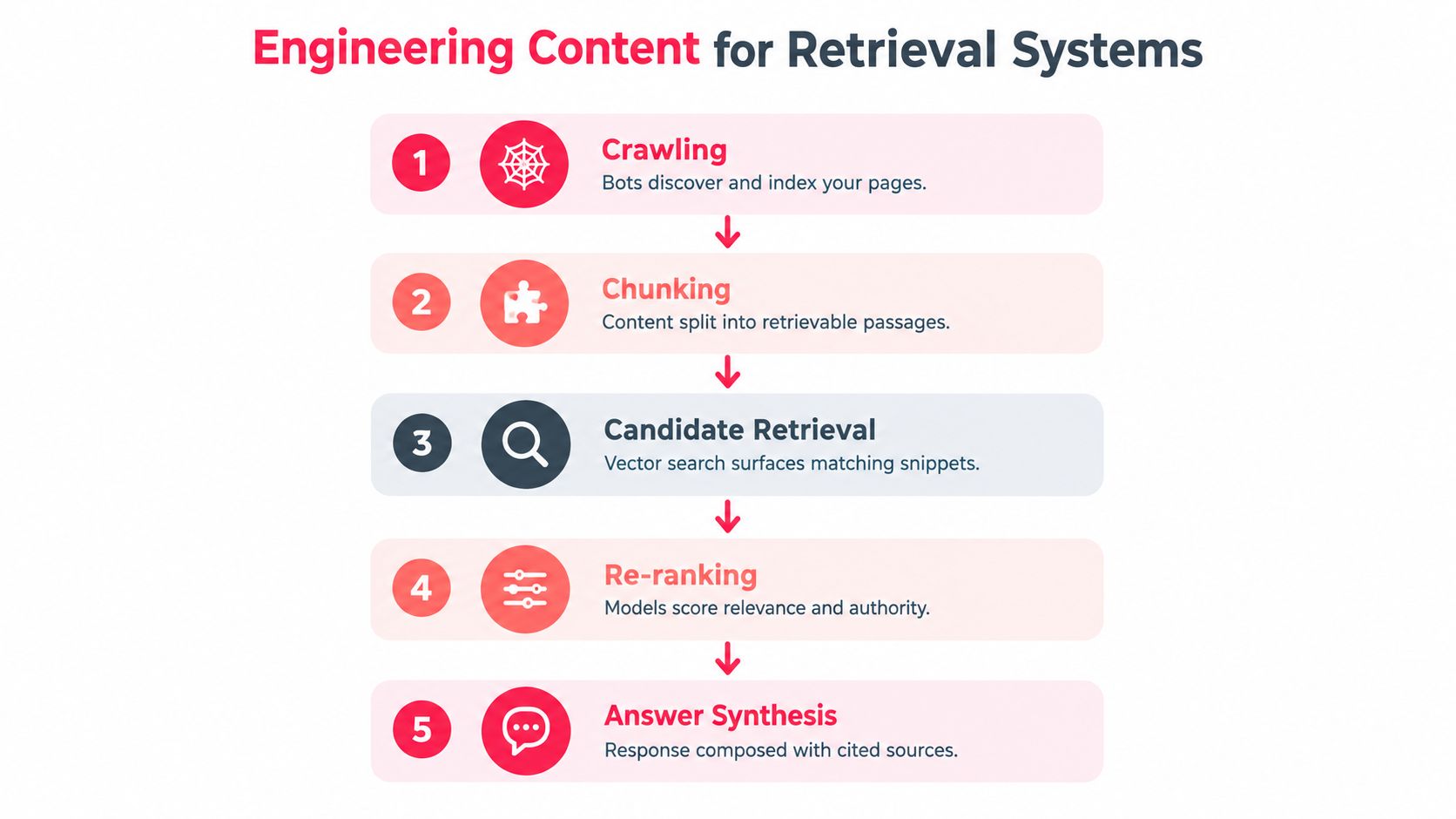
The technical work starts before the answer is written. Retrieval systems move through crawling, chunking, candidate retrieval, reranking, and answer synthesis, and each stage can block your page from being cited even if the prose reads well to a human.
Google says its AI search features use the same foundational SEO requirements as ordinary search and do not require special AI files or dedicated schema markup (Google Search documentation). That means crawlability, indexability, and clear page structure still come first. Our internal guide on optimizing content for LLMs uses the same operating assumption.
What to make machine readable
A page has a better chance of entering the evidence set when it uses explicit entities, unambiguous claims, descriptive headings, and internally consistent terminology. We see teams lose citations when a page hides the answer inside abstract marketing language or spreads one idea across too many loosely connected sections.
A recent generative-search benchmark found that adding structural information improved retrieval hit rate by 22% and improved average retrieval rank by 2.72 positions compared with optimizing body text alone (benchmark study). That is a strong signal that structure matters before wording does.
A page should read like evidence, not like brand poetry.
What to change first
- Name entities plainly. Use product names, category names, and role names consistently across the page.
- Put the answer near the heading. A retrieval system needs a clean passage it can lift.
- Use headings that carry meaning. “How pricing works” gives a model more to work with than “Why choose us.”
- Remove ambiguity. If one page says “platform,” another says “tool,” and a third says “system,” you are making retrieval harder.
- Keep claims stable. A model is less likely to trust pages that contradict themselves.
For a practical read on how a model parses structure, the article on understanding AI content parsing is useful because it focuses on extraction, not just writing quality. That distinction matters when the system is choosing passages, not reading the page linearly.
Platform-Specific Citation Behavior
A common mistake is assuming one ranking pattern applies everywhere. It doesn't. A large study analyzing 55,936 queries found that LLM search responses cited an average of 4.3 URLs from 3.4 domains, versus 10.3 URLs from 7.3 domains in traditional search, with only 38% of domains overlapping between the two systems (study on LLM search citation behavior).
That tells us two things. First, being strong in Google is helpful but insufficient. Second, citation behavior is platform-specific, so the useful diagnostic is not “Do we rank?” but “Where do we get cited, and in what form?”
Our work with B2B teams often shows that one engine prefers concise, highly structured pages while another cites broader supporting pages. The source selection pattern changes by surface, by query type, and by the degree of evidence available.
What to audit across platforms
Use the same commercial prompt set across the engines your buyers touch. Then record which domains are cited, which claims are surfaced, and whether your brand appears as a named source, a recommendation, or not at all.
| Diagnostic question | What to record |
|---|---|
| Is the brand cited? | Citation presence or absence |
| Is the claim accurate? | Whether the answer reflects your page correctly |
| Is the source prominent? | First mention, secondary mention, or buried reference |
| Is the evidence first-party? | Product page, help doc, blog, review, or third-party mention |
That table is more useful than a generic rank tracker because it maps directly to evidence selection. It also shows where your first-party proof is missing.
Our note on how to get recommended by ChatGPT, Claude, or Gemini sits in that same category. The point is not to chase a universal ranking factor. The point is to diagnose where each system finds enough proof to recommend you.
Redefining Pipeline Metrics and KPIs
Given the click compression described above, dashboards that still treat organic sessions as the main signal miss cited-but-not-clicked influence. AI search optimization changes the reporting problem. The question is no longer only whether traffic arrived, but whether the brand was present in the answer that shaped the decision.
Pipeline reporting needs three outcomes, not one.
The three metrics that matter
- Answer visibility. Did the brand appear in the generated answer or recommendation?
- Citation share. Among named competitors, how often did our brand appear?
- Assisted pipeline. Did later visits, branded searches, demo requests, or closed opportunities rise after exposure?
Citation and click are no longer the same event. A cited brand can shape a shortlist without producing a visit, and standard web analytics will not separate that influence cleanly.
What to measure in practice
For B2B reporting, a monthly review should answer a few direct questions:
- Which prompts surfaced us?
- Which prompts surfaced competitors but not us?
- Which pages were cited most often?
- Did branded search volume or direct traffic move after citation gains?
- Did sales hear the brand mentioned in qualification calls?
That view is more useful than chasing sessions alone. It also helps the CRO team separate top-of-funnel visibility from downstream conversion behavior.
If a citation shapes a buying decision, the absence of a click does not mean the absence of value.
The trade-off is real. Optimizing for more clicks can conflict with optimizing for more influence in high-consideration purchases. For many B2B categories, the better target is being named inside the answer that frames vendor choice.
Building a Controlled Diagnostic Workflow
The cheapest way to start is a controlled prompt library tied to pipeline stages. The Stanford AI Index reported that the cost of querying a model at roughly GPT-3.5 level fell from $20 per million tokens in November 2022 to $0.07 per million tokens by October 2024 (Stanford AI Index). Lower cost makes repeated testing practical, but cheaper testing still needs discipline.
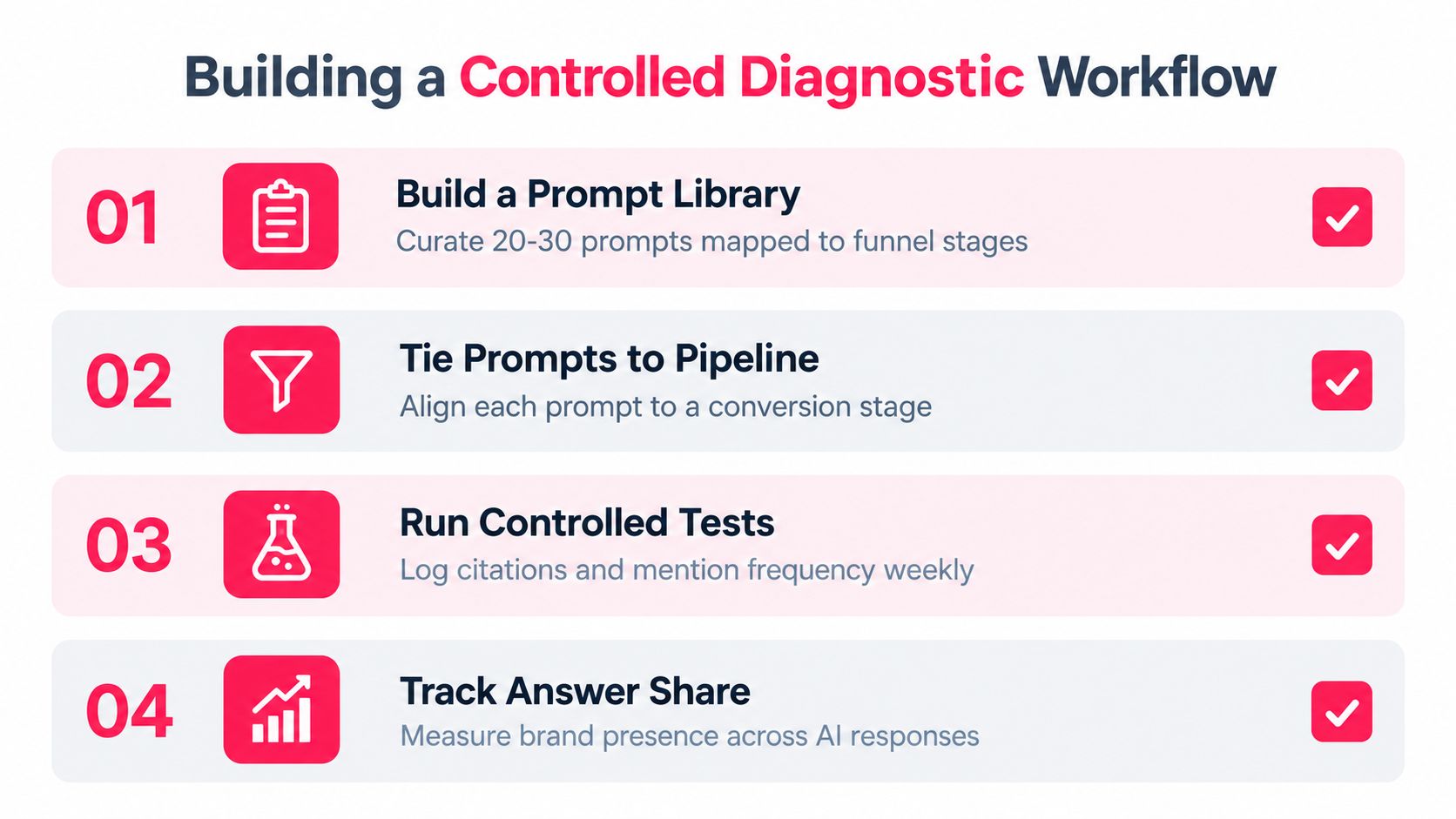
A simple workflow we use
- Build a prompt library. Include buyer questions, comparison prompts, implementation prompts, and competitor prompts.
- Tie prompts to pipeline. Mark each one as awareness, evaluation, selection, or post-purchase.
- Run controlled tests. Keep the prompt wording stable and log citations, mentions, and accuracy.
- Track answer share. Watch whether your brand appears more often across the same prompt set over time.
The value comes from repetition. One run tells you almost nothing. Repeated runs let you see whether a page change, a new proof point, or a structure update changed retrieval behavior.
What to store every time
- Exact prompt text
- Date and surface
- Citations and mention frequency
- Competitors named
- Whether the answer was accurate
- Whether the cited page could convert an executive visitor
That last point matters. A citation that lands on a weak page can waste the opportunity. We've seen teams win visibility and still lose the lead because the destination page had no clear proof, no next step, or no sales relevance.
Two related guides go deeper on measurement. What is AEO explains why answer engines break traditional forecasting, and what is LLMO shows how to test AI visibility against pipeline outcomes.
Where Optimization Programs Fail
Google states that its AI search features use the same foundational SEO requirements as ordinary search and do not require special AI files or dedicated schema markup, so conventional technical eligibility is still the baseline (Google Search documentation). That simple fact exposes a common failure mode. Teams spend time chasing a new tactic while the page is still hard to crawl, hard to parse, or too vague to cite.
The second failure is treating every signal as equal. A mention in an answer, a citation from a priority competitor query, and a passing impression in a low-intent prompt do not deserve the same reporting weight. If you lump them together, you can't tell whether the program is helping pipeline or only inflating visibility.
The third failure is mistaking cheap automation for market evidence. Automated prompt checks are useful, but a low-cost test run is not the same thing as a stable pattern. Buyers, queries, and answer surfaces change, so one clean result should trigger more testing, not a strategy rewrite.
What does not work
- Body-text-only optimization. Strong prose with weak structure often leaves retrieval performance flat.
- Single-engine testing. Visibility in one answer surface does not carry to another.
- Traffic-only reporting. A cited answer can create influence without a click.
- Thin content production. Pages that read like generic AI copy rarely earn durable citations.
- Ignoring off-page proof. If the wider web doesn't corroborate you, the system has less reason to trust you.
The next decision is operational, not philosophical. Choose the ten prompts that matter most to your pipeline, map the pages that should answer them, and audit whether those pages can be retrieved, cited, and trusted before you write another article.
