
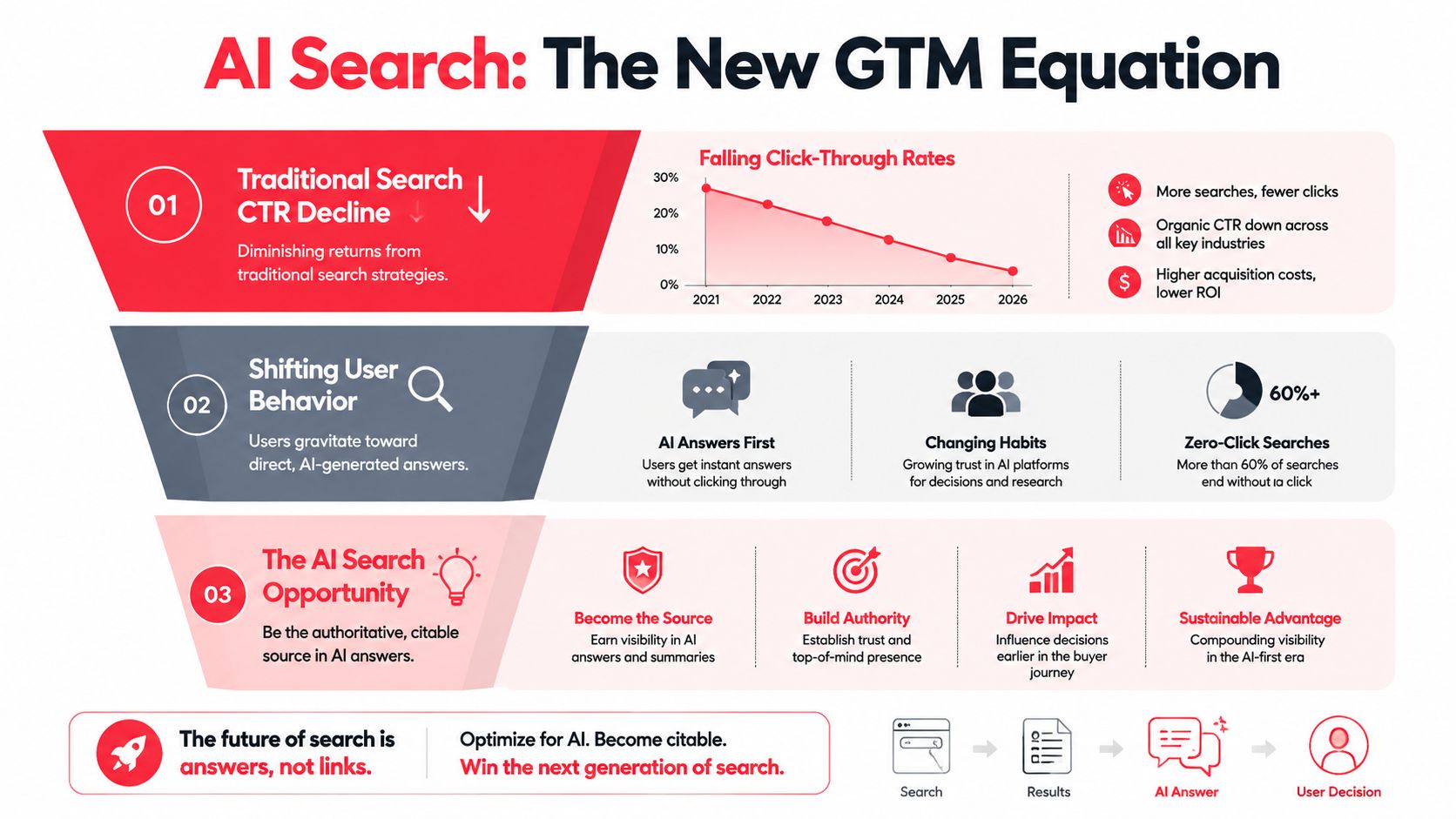
The fastest way to lose visibility in AI search is to keep writing for clicks. When a Google result includes an AI summary, traditional clicks drop to 8% of visits, compared with 15% when no AI answer is present, and AI Overviews also cut position-one organic CTR by 58% as of December 2025, according to the cited industry data in the source brief. That changes the job. Your content has to be easy for machines to quote, trust, and reuse inside the answer, because the click may never happen.
That means how to optimize for AI search is now a revenue problem, not a content tweak. The teams that win will treat AI search visibility as a pipeline input, then build around citation rate, recommendation quality, and prompt-level presence across the markets that matter. If your brand isn't one of the names the model can safely cite, you're invisible at the moment a buyer asks for options.
Table of Contents
- Why AI Search Changes the GTM Equation
- Designing Your Signals for AI Ingestion
- Creating Answer-Centric Content and Prompts
- Technical Frameworks for AI Search
- How to Measure and Test for AEO
- Governance and Your AEO Roadmap
Why AI Search Changes the GTM Equation
The search result page used to be the battlefield. Now the answer box is. Pew Research found that when a Google search included an AI summary, users clicked a traditional result in only 8% of visits, versus 15% when no AI-generated answer was present. The same source brief also notes that AI Overviews appeared for about 21% of keywords and pulled at least one cited source from pages in the top 20 organic results in 97% of cases. That's a very different game from classic rank chasing, and it changes where revenue teams should spend attention. Pew Research via the SEOProfy industry summary
What matters now is being cited inside the answer, because that's where buyers are forming their shortlist. A top blue link still matters, but it's no longer the only place visibility lives. If an AI system can summarize the category without mentioning your company, the market may still know the problem, but it won't know your position in it.
Practical rule: treat AI search as a distribution layer. If the model can't clearly extract your claim, your proof, and your category fit, your page is easy to skip.
The GTM impact is broader than marketing
This is why AEO sits with GTM engineering, not just content marketing. The work touches your site structure, your claims, your product naming, your author signals, and the way sales and marketing describe the offer. A CEO or CRO should care because AI systems are now influencing the first shortlist before a rep ever gets a chance to talk.
That's also where achieve answer engine readiness becomes a useful benchmark. The phrasing matters because readiness is bigger than publishing more content. It's about making your company legible to answer engines, then proving you can be cited consistently.
A practical starting point is to tie every important informational page to a buyer question. Then ask whether the page would still make sense if an AI system pulled only the opening section. If the answer is no, the page is still written for scanning humans, not for citation engines.
The internal work matters too. A site built to support AI agents and structured discovery gives the model cleaner entity signals, cleaner product language, and cleaner pathways to the pages that matter. That's the difference between being referenced as a source and being ignored as noise.
Designing Your Signals for AI Ingestion
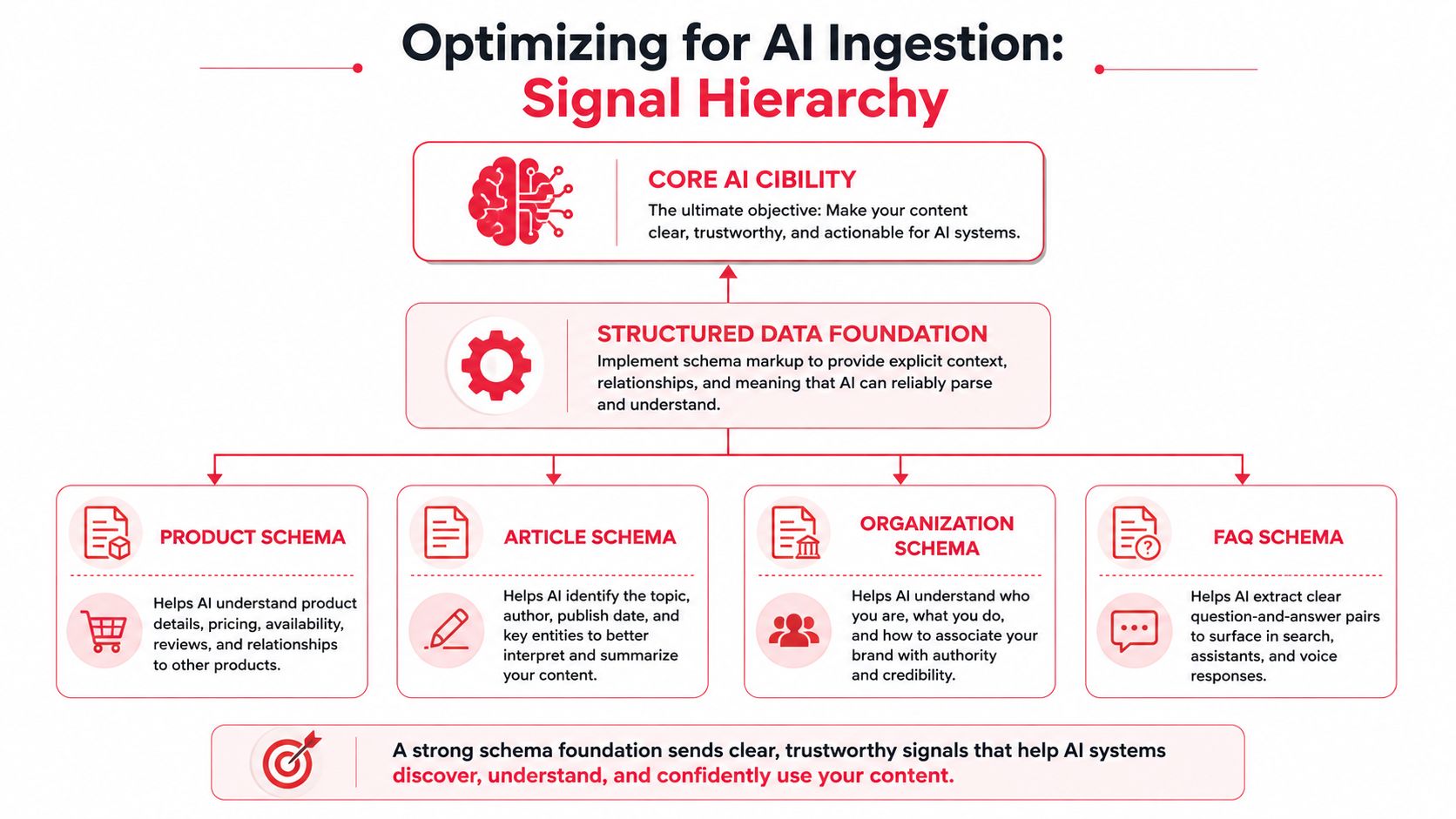
AI systems need to know who you are, what you sell, and why your content deserves trust. That starts with structured data, clear entity language, and content that resolves ambiguity fast. If a model has to guess whether your company is the brand, the product, or just another mention, you've already made citation harder than it needs to be.
Start with the entities that disambiguate your business
The first job is to make your company machine-readable. Organization, Product, Person, and Article schema help AI systems separate your brand from the rest of the market. Use Organization schema for the company, Product schema for the offer, Person schema for named authors or executives, and Article schema for publishable editorial assets.
That sounds technical, but the business goal is simple. You want the system to know who wrote the page, what the page describes, and which entity should get credit. When that's clear, the page is easier to cite and harder to confuse with a competitor's version of the same idea.
A clean implementation also supports future agent commerce readiness. If an AI assistant has to recommend, compare, or even place an order, it needs dependable entity data first. Messy metadata makes downstream automation brittle.
Make the content legible before you add more of it
A lot of teams keep adding more pages when the underlying problem is that the existing pages are poorly labeled. I'd fix naming, headings, and schema before I publish another thin article. The goal is a content system where every important page can stand on its own and still fit into a broader topic cluster.
Practical rule: don't treat schema as decoration. Treat it as a contract between your site and the systems that need to interpret it.
For teams building a stronger information layer, the internal llms.txt guidance can help shape what AI systems should find first on your site. Use it as part of the same discipline you'd apply to site architecture, author pages, and product naming. The point is consistency. If the page says one thing, the schema says another, and the homepage says a third, the model gets a muddy signal.
This is also where embeddings matter in business terms. Think of embeddings as the way AI maps meaning, so content about the same topic gets clustered together even when the words differ. That means you're designing for semantic clarity, not keyword repetition. If your page talks around the point, the model has to work harder to infer what you mean.
Creating Answer-Centric Content and Prompts
The most reliable AI content pattern is still the simplest one. Put the answer first, keep the section self-contained, and make the proof easy to extract. A page that buries its point in the third paragraph is asking an answer engine to do extra work, and most systems will just move on.
Write in answer blocks, then add context
One practical rule is to open each section with a direct 40 to 60 word answer, then add support below it. That format gives AI systems a clean passage to quote, and it gives buyers the quick resolution they want when they land on the page. The cited guide in the brief makes the same point clearly, because extractable content is easier to reuse in AI answers. AEO Eye guidance on answer-first sections
Here's the discipline I'd use with a growth team:
- Start with the direct answer. State the claim or definition in one tight block.
- Add proof right after it. Use a source, a product detail, or a concrete example.
- Keep one idea per section. If the section needs three ideas, split it.
- Use question-shaped headings. Write the way a buyer asks in ChatGPT or Gemini.
That structure works because AI search favors clarity and specificity. It also fits the way operators decide. CEOs don't need a long preamble on what a category means. They need to know whether the answer is credible, relevant, and safe to act on.
Test the questions your buyers actually ask
Prompt testing is the part often overlooked. Pick the questions your ideal customer would ask an AI system, then check whether your site is the source that gets named. If the answer comes from a competitor, you've found a real gap, and it isn't always a content volume problem. Sometimes the issue is that your claims are too vague, your proof is too hidden, or your terminology doesn't match the market's language.
I'd focus first on informational prompts, because that's where the opportunity sits. The source brief notes that 99.9% of keywords triggering AI Overviews are informational, while commercial, transactional, and navigational queries are much smaller shares. That makes educational content, definitions, comparison pieces, and decision support the first priority for AEO. Google AI optimization guidance in the source brief
The quality bar is also different. AI systems prefer pages with specific claims and sourced evidence, so a thin thought leadership post won't carry the same weight as a page that answers a buyer question directly. Build pages that can be quoted out of context without losing meaning. That's the standard.

When the content is ready, connect it to a visible recommendation path. A page optimized for how to get recommended by ChatGPT, Claude, or Gemini should still feel human, but it has to be built for extraction first. That means short sections, visible answers, and proof that can survive being quoted on its own.
Technical Frameworks for AI Search
The strongest AEO programs don't start with public content. They start with internal systems that teach the team how AI reads and retrieves information. If you can't make your own knowledge base easy for an AI to use, you're going to struggle when external answer engines try to do the same thing.
Use RAG as your internal proving ground
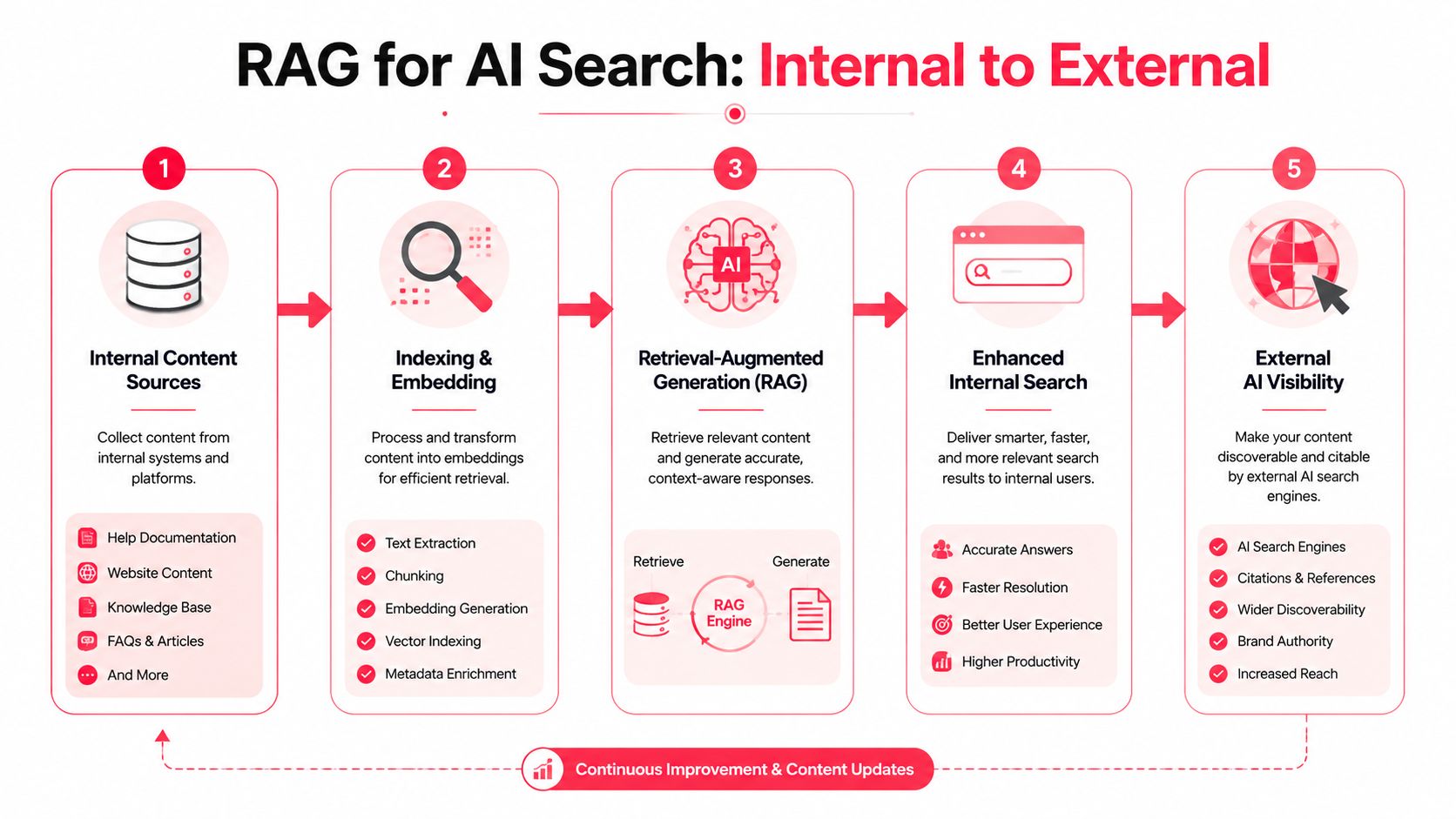
Retrieval-Augmented Generation, or RAG, is the model of letting an AI look up approved material before it answers. In plain English, it means the system checks your own content first, then uses that content to shape the response. That gives you better control, better accuracy, and a cleaner path to later citations.
Your internal search stack becomes a rehearsal space for external visibility. When help docs, product pages, and support content are organized for retrieval, you're also building the repository that outside answer engines want to trust. The same structure that helps a rep find a feature explanation can help a model cite it.
A good way to pressure-test that setup is with site search. If your internal AI search already struggles to find the right answer, external systems will struggle too. Tools like future-proof site search can help teams think about internal retrieval as a product capability, not an afterthought.
Build for fetchability, then for elegance
The engineering standard is straightforward. Put important content in crawlable HTML, keep the most useful answer near the top, and avoid hiding your best material in formats that are harder to parse. Many teams, however, lose ground here. They invest in polished design, but the content is buried behind layers the model doesn't process cleanly.
AI search works best when the page already behaves like a well-structured knowledge base.
That applies to help centers, product documentation, comparison pages, and case study libraries. The cleaner the internal taxonomy, the easier it is for retrieval systems to map topics to the right pages. Over time, that structure improves the odds that an external AI sees your site as a dependable source rather than a loose pile of pages.
There's also a governance angle here. If product, marketing, and support all describe the offer differently, RAG can surface those contradictions. That's useful. It exposes where the company's public language still needs alignment before any external AI can recommend it with confidence.
How to Measure and Test for AEO
If you can't measure it, you can't defend the budget. For AI search, the right measures start with prompt-level visibility, then move to citation quality, recommendation accuracy, and traffic you can trace in analytics. Traditional rank tracking alone misses too much of the picture.
Build a baseline from the prompts that matter
A practical starting point is to select 30 to 50 commercially relevant prompts, then run them across the 2 to 3 AI search platforms that matter most. Record whether your brand appears, is recommended, linked, cited, and described accurately. That baseline gives you a real comparison point, and it's the kind of repeatable workflow the cited checklist recommends. Aleyda Solis AI search optimization checklist
From there, map each miss to one of three buckets:
- Owned content gap. The answer on your site is weak, buried, or missing.
- Third-party source gap. The model trusts other sources more than yours.
- Entity clarity gap. The system understands the topic, but not your brand's role in it.
That bucketed view matters because it turns a vague “we're not showing up” complaint into a fix list. A content rewrite, a better source ecosystem, and a clearer company description are three very different jobs. Treat them separately.
Tie visibility to revenue signals
The measurement stack should also include AI-referred sessions in GA4, plus a review of which landing pages receive those visits. A newer playbook in the brief recommends setting up GA4 custom channel groups, running a GEO audit, and using a commercially relevant prompt set as the baseline. That's the right instinct. You want visibility, but you also want evidence that the visibility is moving users toward buying behavior. Optimize GEO AI playbook
A good operating cadence is weekly prompt checks and a monthly review of pattern changes. Don't obsess over a single result. AI outputs change by session, by platform, and by query phrasing. What matters is whether your brand is gaining consistency across the topics tied to pipeline.
I'd also keep a note on accuracy. If the AI cites you but describes your offer badly, that's still a problem. Bad descriptions create bad clicks, bad handoffs, and confused sales conversations. Citation without accuracy isn't useful enough to count as win.
Governance and Your AEO Roadmap
AEO works best when one person owns the system. Marketing can't do it alone, and product can't treat it like a side task. The company needs one owner who can bridge content, engineering, analytics, and executive priorities, then a cadence that keeps the work moving.
Put the operating model in writing
The simplest governance structure has three parts. First, assign a single owner for AEO who can coordinate across marketing and product. Second, hold a quarterly review of prompt visibility, citation quality, and AI-referred traffic patterns. Third, reserve a small budget for tooling, testing, and content updates so the work doesn't depend on spare cycles.
That's the model I'd put in front of a CEO or CRO because it keeps the program tied to business outcomes. It also makes the trade-offs visible. If the company wants more AI citations, it has to invest in better source quality, clearer product language, and stronger operational discipline.
Use one Monday action to build the case
This week, have your team audit your top 10 informational pages against the answer-first standard, then run your brand name through three different AI search engines and capture the results in one shared doc. If the pages aren't being cited, or the description is wrong, that evidence gives you a clear business case for a focused AEO sprint.
If you want a deeper read on where the gaps usually sit, Stimulead can help with a practical audit and roadmap across CRO with AI, GTM engineering, AI search optimization, and agent commerce readiness. Start there, then decide whether the bottleneck is content, structure, or governance.