
Google users click a traditional result on only 8% of visits when an AI summary appears, compared with 15% without one, according to Pew Research Center's analysis of Google AI summaries. CEOs, CMOs and CROs therefore face a funding decision: keep treating search as a traffic channel, or build an AEO strategy around being cited when the click disappears.
We recommend the second option, with one condition. AEO should earn a place in the roadmap only when the team can connect citation visibility to buyer questions, trust signals and downstream pipeline influence. For growth-stage B2B companies with $1M to $50M in revenue and 10 to 200 staff, that means sequencing work around commercial queries instead of publishing another volume of generic articles.
Table of Contents
- Introduction Why AEO Is Now a Pipeline Decision
- How AEO Differs From SEO and When Each Matters
- Content and Schema Tactics That Earn Citations
- Technical Signals That Determine Whether You Get Parsed
- Measuring AEO Without Fooling Yourself
- What Does Not Work and Where AEO Fails
- AEO Roadmap in Practice for SaaS Ecommerce and B2B
Introduction Why AEO Is Now a Pipeline Decision
AEO changes the unit of value in search. A traditional result asks the buyer to click, read and form an opinion. An answer engine can compress that sequence into a response that names several sources, explains the trade-off and recommends a shortlist before the buyer ever visits your website.
Pew found that users click a cited source inside a Google AI summary only 1% of the time, while 88% of AI summaries cite three or more sources. The commercial question is therefore larger than traffic recovery. Your company needs to be present as a trusted source, then make that citation useful later when the buying group checks vendors, compares approaches or asks sales for proof.
We've implemented AEO roadmaps for B2B teams where the first constraint wasn't writing capacity. It was deciding which questions deserved executive attention, which pages could support a defensible answer and which technical fixes would remove the company from consideration before content quality mattered.
Operating view: AEO is visibility without a guaranteed visit. Pipeline influence comes from being named in the answer, being credible when the buyer validates the claim and giving revenue teams a reason to continue the conversation.
AEO emerged as a distinct discipline in the mid-2010s, after search platforms added answer-first features. The sequence included Google Knowledge Graph in 2012, Hummingbird in 2013, featured snippets in 2014, RankBrain in 2015, BERT in 2019 and MUM in 2021. ChatGPT expanded the category in late 2022, followed by AI chat in Bing, Google conversational search in 2023, and broad Google AI Overviews in 2024, as documented in the history of AEO from featured snippets to AI Overviews.
A useful starting point is Crescade's guide to finding an AEO strategy for growth, particularly for teams mapping answer-engine work against existing SEO activity. Our focus is narrower and more operational: when to fund AEO, what to change first, how to measure citation presence, and when to pause because another constraint is more important.
By the end, leadership should be able to make three decisions. First, whether answer-engine visibility matters for your buying motion. Second, which query clusters and source types deserve investment. Third, whether your team can test and govern the work without confusing a noisy visibility signal with commercial progress.
How AEO Differs From SEO and When Each Matters
AEO isn't SEO with a new label. The two disciplines share technical and editorial foundations, but they optimize for different moments in the buying journey.
SEO tries to win a position that earns a visit. AEO tries to make a source selectable inside a synthesized answer, where the buyer may never see the page in the traditional result set. Rankings still matter because they support discoverability and authority, but a ranking alone no longer predicts whether the answer engine will carry your claim into the conversation.
| Dimension | Classic SEO | AEO for Answer Engines |
|---|---|---|
| Primary job | Earn qualified website visits | Earn selection, citation and trusted mention |
| Optimization unit | Page, topic and keyword | Claim, answer block, entity and query cluster |
| Typical surface | Search results page | AI summary, conversational answer or recommendation |
| Main metrics | Rankings, organic sessions and conversions | Citation share, citation quality, brand presence and influenced pipeline |
| Content signal | Relevance, links, usability and depth | Direct answers, evidence, named expertise and machine-readable structure |
| Commercial risk | Losing traffic to a ranking competitor | Being absent from the buyer's synthesized shortlist |
The distinction changes budget allocation. A team may already have an SEO program producing traffic to high-intent pages, yet lack clear answers for questions such as implementation risk, integration limits, buying criteria or category comparisons. Those pages need more than keyword placement. They need claims that an engine can extract, verify and attribute.
AEO also introduces model-specific behavior. In a 6.8 million-citation study summarized by Yext, citation patterns differed across models and intent types, with Google AI Overviews, Perplexity and Gemini frequently leading with YouTube. Yext's analysis of AI citation behavior across models supports a practical conclusion: the same page may be discoverable in one system and ignored in another.
That's why we don't recommend replacing SEO with AEO. Keep SEO where organic demand, product research and conversion pages depend on clicks. Add AEO where answer compression affects category consideration, vendor selection or executive trust.
A deeper comparison of the operating differences appears in Stimulead's AEO versus SEO analysis. For ecommerce teams, Cosmy's ecommerce AI SEO tips provide a useful adjacent perspective on product discovery and search structure.
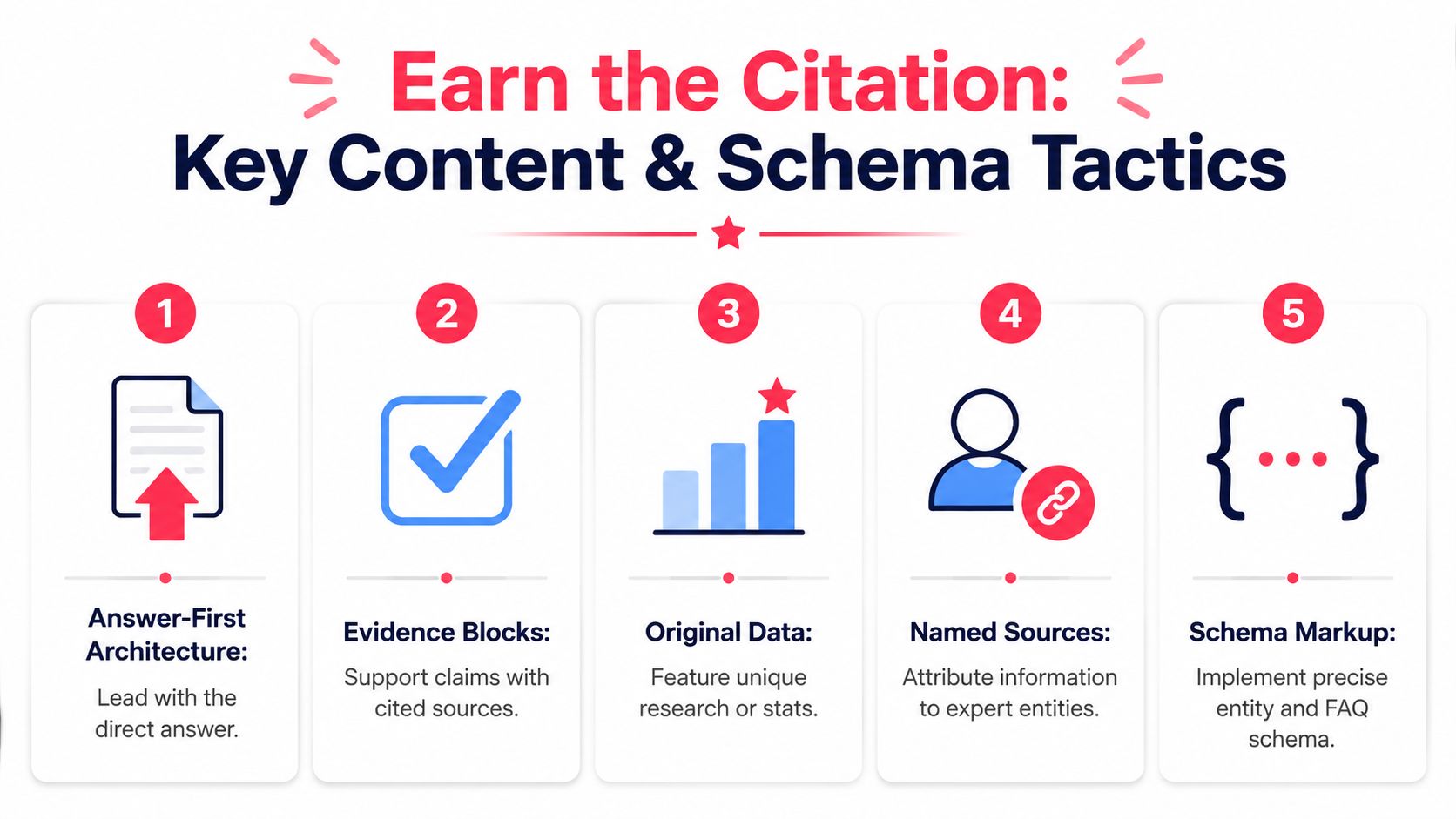
Content and Schema Tactics That Earn Citations
Citable content gives an answer engine a clean unit to retrieve and attribute. The page should state the answer early, separate evidence from opinion and make the responsible entity clear.
Start with the claim a buyer needs
Lead each priority section with a direct answer to the question implied by its heading. Follow it with qualification, evidence and the commercial implication. Don't make a buyer or model search through a long introduction to find the actual position.
Evidence blocks work well for B2B pages. Use an explicit claim, a source link, a date or scope qualifier and a short explanation of why the evidence applies. Original research, implementation observations and named subject-matter experts give the page information that generic language can't supply.
Named sources matter because trust is contextual. A technical page should identify the product leader, solutions architect, customer-facing specialist or external source responsible for the claim. Consistent entity naming also helps answer engines understand whether two references point to the same company, product or category.
Retrofit pages before commissioning a content factory
For a 10 to 200-person team, the fastest route usually starts with existing commercial pages rather than a large publishing program.
- Select priority pages. Choose comparison, integration, pricing, implementation and category pages tied to active sales conversations.
- Extract buyer questions. Review CRM notes, Gong or Chorus transcripts, support tickets and sales enablement documents. Group questions by intent, not by isolated keyword.
- Rewrite the opening blocks. Put the answer, qualification and proof near the top of each page.
- Add evidence and ownership. Attribute claims to named people or credible external sources. Remove unsupported superlatives.
- Add structured data. Use relevant Article, Organization, Product, BreadcrumbList or FAQ schema where the page contains that information.
- Test the cluster. Query multiple engines with the same buyer intent, record citations and wait for a meaningful sample before changing the page again.
Teams commonly underestimate review time. A product marketer can own the brief, a subject-matter expert can validate claims, an engineer can implement schema and a revenue leader can confirm that the answer matches the sales process. That division is usually more productive than asking one content manager to own every layer.
NanoPIM's guide to optimizing for AI Overviews is a useful reference for teams working through page structure and answer extraction. Stimulead also covers the practical steps in preparing a website for Google AI Overviews.
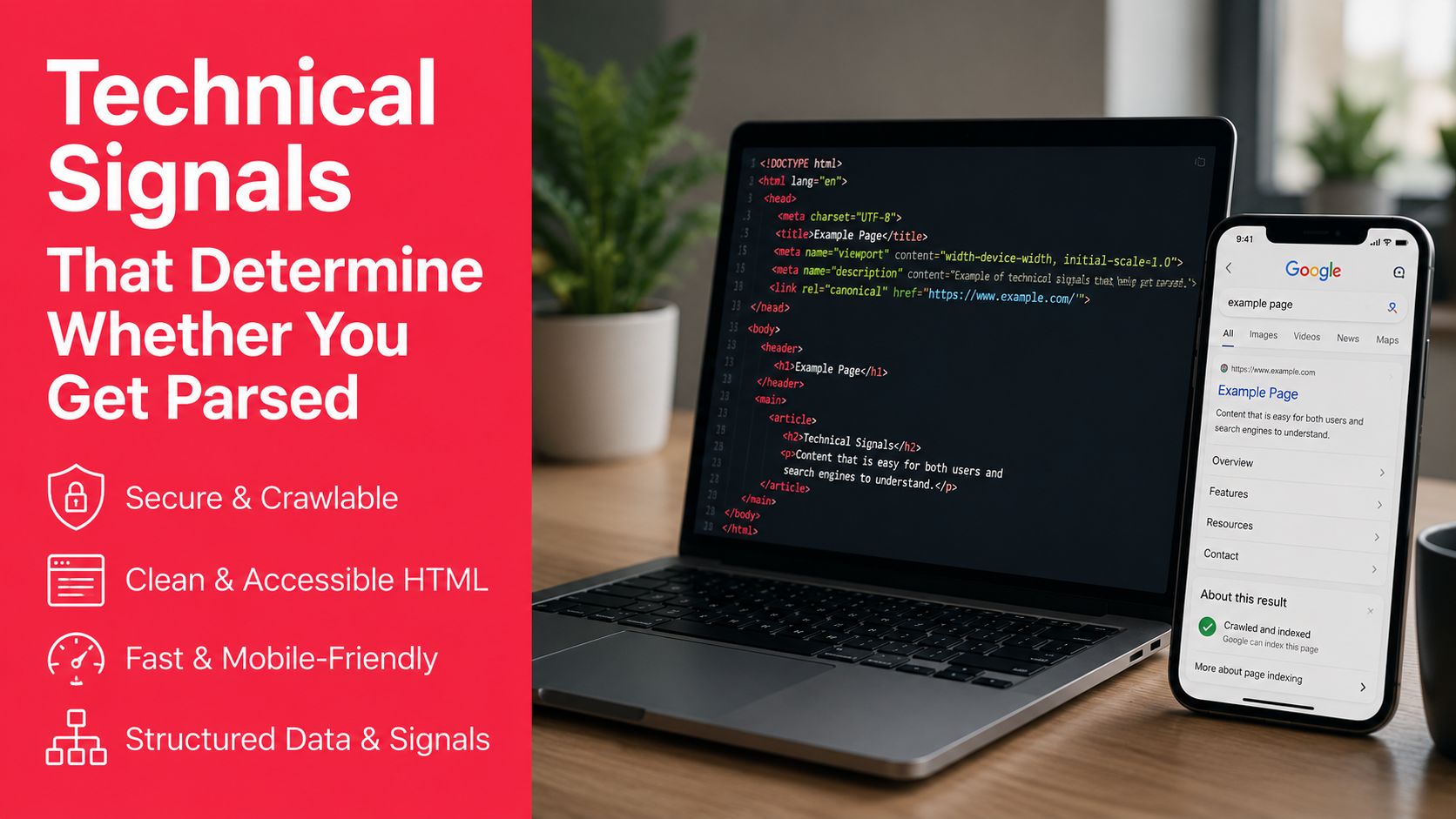
Technical Signals That Determine Whether You Get Parsed
Strong editorial content can't earn a citation if the system can't reliably retrieve or interpret it. In client implementations, the technical layer often decides whether a well-written page enters the candidate set at all.
Fix access before adding complexity
Start with crawlability, indexation, canonical consistency and rendered content. Then check whether key claims exist as readable HTML rather than only inside an interactive component, image or client-side experience. JavaScript isn't automatically a problem, but relying on it without an accessible HTML representation creates unnecessary uncertainty.
One 2026 benchmark set reports that static HTML with schema was parsed 94% of the time, compared with 23% for JavaScript-rendered content without schema, a 71-point implementation gap. The figures come from Mentionova's AEO marketing statistics benchmark. Treat the result as a directional implementation warning, not a promise of citation performance.
Use a fix order that protects testing velocity
Engineering and marketing operations should work through technical issues in this order:
- Access: Confirm that important pages can be crawled, rendered and indexed.
- Structure: Use clear headings, HTML tables, descriptive links and stable page sections.
- Schema: Add accurate structured data and validate it with Google's Rich Results Test.
- Freshness: Give pages visible update dates and maintain claims that can age.
- Entity consistency: Keep product, company, author and category names consistent across the site and trusted external pages.
- Monitoring: Recheck templates after releases, migrations and major CMS changes.
Schema doesn't turn weak content into a trusted source. It gives machines clearer context about content that already exists. The same principle applies to author pages, product data and organization details. If the markup says one thing while the visible page says another, the signal becomes less useful.
Engineering rule: Fix the rendering path before debating whether a paragraph should be shorter. A page that isn't parsed can't benefit from editorial refinement.
Model and intent differences also affect prioritization. A technical documentation page may need precise entities and integration details, while a category comparison may need third-party validation and a clear evaluation framework. Stimulead's website preparation guidance for AI agents addresses the broader machine-readability problem beyond search snippets.
Measuring AEO Without Fooling Yourself
AEO measurement starts with a visibility problem: citations can increase while clicks decline. If leadership reviews the program through sessions alone, the team may cut work that already influenced a buyer inside an AI-generated answer.
Use citation share across a query cluster as the primary unit, rather than treating one prompt as proof. Group queries by commercial intent, including vendor comparisons, implementation questions, integration concerns and category evaluation. For each test, record the engine, prompt, cited domains, citation position, claim covered, and whether the company appears as a source, recommendation or passing mention.
Sample enough to make a decision
Citation share varies by engine and prompt. The methodology in Link Research's AI search measurement guidance indicates that dependable estimates may require about 40 to 50 queries on Gemini, around 100 on Perplexity and 150 or more on SearchGPT. Typical 95% confidence intervals range from 3 to 6 percentage points, so a modest week-over-week change may reflect sampling noise rather than a real shift.
Set a review threshold before testing begins. Compare cluster-level movement over a defined period, keep the query set stable, and separate measured changes from exploratory prompts that test new buyer language. This prevents a single volatile response from triggering a new content brief.
Track three layers of value
| Measurement layer | What to record | Why it matters |
|---|---|---|
| Visibility | Appearance rate, citation share and engine coverage | Shows whether the company enters relevant answers |
| Citation quality | Source position, claim context and competitor presence | Distinguishes a meaningful citation from a weak mention |
| Commercial influence | Branded search, assisted sessions, sales references and opportunity notes | Connects answer visibility to the buying journey |
A holdout design adds discipline. Select comparable query clusters, update one group and leave another unchanged during the testing period. Keep prompts consistent enough for comparison, while maintaining a separate exploratory set for emerging buyer terminology.
GA4 can record referrals from AI platforms when a buyer clicks. CRM fields can capture “heard about us through an AI answer” when sales asks the question consistently. Neither captures every exposure, especially when summaries suppress the visit, so combine platform observations, analytics and structured feedback from the revenue team.
Measure the pipeline consequence at cluster level. Compare citation movement with branded demand, assisted sessions, sales references and opportunity progression for the same intent group. Model-specific source mixes also matter, because a page cited by one engine may be absent from another. The benchmark source can help frame implementation expectations, but internal tests should determine which citations influence qualified pipeline.
What Does Not Work and Where AEO Fails
AEO fails when leadership treats it as a formatting checklist. Adding an FAQ block, shortening paragraphs and inserting schema can improve parsing, but those changes won't compensate for generic claims, weak evidence or a page that doesn't answer a question buyers care about.
Single-query wins create a second trap. One favorable response can feel like progress, yet answer engines vary outputs by wording, model, location and timing. If the team reports a citation victory from one prompt, the result may disappear before a sales opportunity references it.
Common failure modes
- Formatting without substance: A clean answer block that repeats widely available information gives the engine little reason to select your page.
- JavaScript-first delivery: A polished application that leaves key content unavailable in initial HTML can lose consideration, especially when schema is absent.
- One-model optimization: Content tuned for ChatGPT may not earn the same treatment in Perplexity, Gemini or Google AI Overviews.
- Traffic-only reporting: A citation that influences an offline buying conversation won't appear in standard referral reporting.
- Uncontrolled claims: Product, pricing and capability pages become risky when marketing updates language without product, legal or sales review.
- Refreshing dates without evidence: Changing a publication date while leaving stale examples and unsupported claims does not create meaningful freshness.
The Yext research points to another overlooked issue. Citation behavior changes by model and intent, and YouTube frequently appears among leading sources for Google AI Overviews, Perplexity and Gemini. A website-only program can therefore miss the source formats an engine prefers for a given question.
Governance deserves equal attention. Assign an owner for factual review, a technical owner for schema and rendering, and a revenue owner for query priority. Pause AEO work if the company has serious conversion friction, unreliable product data or unclear positioning. More visibility can send more buyers into a confusing experience, which makes the investment harder to defend.
Evidence is still developing, so we avoid promising a universal lift. The responsible claim is narrower: teams can improve their odds of being selected by making high-value answers clear, supported, accessible and consistent across the sources buyers and engines consult.
AEO Roadmap in Practice for SaaS Ecommerce and B2B
The same AEO strategy produces different work by business model because the answer source and buyer risk change.
SaaS
A SaaS company should prioritize comparison, migration, integration and implementation questions. A useful page explains where the product fits, where it doesn't, which systems it connects to and what evidence supports the recommendation. Product marketing owns the answer, solutions engineering validates technical claims and sales supplies recurring objections from discovery calls.
The citation target isn't a generic category definition. It's a buyer asking which platform fits a specific operating environment and needing evidence before inviting vendors into the process.
Ecommerce
Ecommerce teams need clean product entities, accurate attributes, availability data and accessible buying information. Product pages should make specifications, compatibility, returns and delivery conditions easy to parse, while supporting content answers genuine comparison and use-case questions.
A beautiful catalog with incomplete structured data creates a source problem. Merchandising, engineering and customer service need a shared process for correcting product facts, because answer engines can repeat stale or incomplete information at scale.
B2B services
Professional services companies win with expertise-led answers, named practitioners and proof of how decisions work in real engagements. A page about transformation, compliance or implementation should state the approach, constraints and conditions under which it may fail. Generic thought leadership rarely carries enough distinction to earn a durable citation.
For all three models, start with an audit of query clusters rather than a sitewide content inventory. Stimulead's AI search and AEO advisory can include gap analysis across ChatGPT, Claude, Gemini and Perplexity, content restructuring, citation checks and machine-readability work, alongside internal ownership.
The next decision is simple. Select one commercial query cluster, record the current citation baseline across the engines that matter to your buyers, and inspect the pages and source formats currently being cited. Then fund the smallest remediation sprint that can test content, technical access and downstream sales capture together.