
The popular advice is to hand a complete marketing or sales process to an autonomous agent and wait for pipeline. We disagree. The useful decision is which workflow deserves agent-native redesign, and which should remain a monitored layer over a deterministic process. That distinction determines whether your team gets faster testing and cleaner handoffs, or an expensive system nobody trusts.
For CEOs, CMOs, and CROs at companies with $1M to $50M in revenue and 10 to 200 staff, the constraint usually isn't access to a model. It's integration quality, approval capacity, identity data, cost control, and the ability to measure a qualified action. We build around those constraints at Stimulead, because an agent that can't be evaluated against pipeline movement is a demo with API access.
Table of Contents
- The Real Decision Behind Agentic AI Workflows
- What an Agentic Workflow Actually Contains
- Three Orchestration Patterns and When Each Breaks
- Marketing and Sales Workflows Worth the Build
- A Sequencing Roadmap From Audit to Production
- Where Agentic Workflows Consistently Fail
- Governance, Cost, and KPIs Baked In From Day One
- Pick One Workflow and Redesign It Agent-Native
The Real Decision Behind Agentic AI Workflows
End-to-end autonomy is the wrong default for most growth-stage B2B companies. The practical question is whether to redesign a small number of bounded workflows around agent capabilities, or to add supervised AI steps to an existing process while the team learns where judgment still matters.
The market data supports a restrained approach. A 2025 McKinsey survey found that 23% of organizations were already scaling an agentic AI system in at least one business function, while 39% were still experimenting. McKinsey's findings place agents beyond novelty, but they don't support the assumption that autonomous systems are mainstream. The same report describes a wider enterprise AI transition in which companies are beginning to treat agents as operational systems rather than isolated pilots. McKinsey's 2025 State of AI report is a better basis for planning than a product demo.
Our operating rule: redesign only when the task is bounded, the data is structured, and a qualified human can validate the output quickly.
That rule eliminates many attractive but poor candidates. A lead enrichment and routing process may qualify because the agent can inspect firmographic data, resolve an account, assign a route, and request approval. Deal closing usually doesn't. The social context, commercial judgment, and downside of an incorrect commitment make full autonomy a weak first bet.
What earns a redesign
Score each candidate against three conditions:
- Bounded action: The workflow has a defined outcome and a limited tool set.
- Structured evidence: The agent can retrieve authoritative data from a CRM, warehouse, product catalog, or approved content store.
- Fast human validation: An operator can approve, reject, or correct the proposed action without reconstructing the entire case.
If any condition fails, start with monitored partial automation. Let the agent research, classify, draft, or recommend. Keep the write action behind an approval gate until the team has enough trace data to judge reliability.
This approach also controls token spend. Long autonomous loops consume more context, create more tool calls, and produce harder-to-debug failures. A supervised workflow can deliver useful cycle-time gains while keeping the model boundary narrow and the business owner in control.
What an Agentic Workflow Actually Contains
A production agentic workflow isn't a junior employee in software. It is a set of explicit components with separate failure modes, owners, and tests. If those components aren't designed independently, the model will appear to reason while the system loses records, repeats actions, or routes work to the wrong account.
The five components that need owners
Tool discovery determines which functions the agent can find and call. Use function catalogs, API schemas, and retrieval over a capability registry. The failure mode is predictable: APIs change, descriptions drift, and a stale registry causes the agent to choose an obsolete or irrelevant tool.
Planning breaks a goal into actions, chooses a route, and replans when a call fails. The planning layer should record the intended sequence and enforce a cost and latency budget. If replanning continues indefinitely, the workflow becomes expensive and opaque. Our default is to cap retries and escalate rather than let the agent keep searching for a route.
Memory separates temporary working state from durable facts. A scratchpad can hold the current task, episodic state can preserve the work already completed, and structured or vector storage can retain approved facts. Unpruned episodic state leaks tokens into later calls and increases the chance that old context overrides current CRM data.
Guardrails validate inputs, outputs, policies, permissions, and proposed actions. Validators that accept vague or incomplete outputs fail. Add schema checks, policy checks, a kill switch, and explicit rejection paths.
Human handoffs need staffed queues, ownership, and service levels. A nominal approval gate doesn't protect the company if nobody is assigned to review it. Define the escalation trigger, the override channel, and the maximum wait before the workflow stops.
Teams often confuse these systems with rules-based automation. The distinction is useful, and this agentic vs RPA difference explains why planning and tool selection introduce different testing requirements.
Three Orchestration Patterns and When Each Breaks
Choose orchestration based on workflow complexity, latency tolerance, and the debugging capacity of your team. More agents don't automatically produce more output. They produce more state, more traces, and more failure paths.
| Orchestration Pattern | Best-Fit Workflows | Breaks When |
|---|---|---|
| Single-agent linear loop | Enrichment, single-step summarization, triage | Tool calls multiply, context degrades, or error recovery needs several branches |
| Supervisor-agent topology | Multi-step research, AEO content production, CRO experimentation | Sub-agent contracts are vague or the supervisor becomes a concurrency bottleneck |
| Multi-agent graph | Deal-room synthesis, agent-commerce negotiation | Token costs and trace reconciliation exceed the team's ability to observe and debug |
Single-agent linear loop
Use one planner with sequential tool calls when the workflow is narrow. Account enrichment, call summarization, and lead triage benefit from a small state surface and simple approval logic.
This pattern breaks when the agent needs too many calls to complete one task. Context quality declines, error recovery becomes binary, and a single bad tool result can contaminate every subsequent decision. Keep the tool catalog tight and return a structured result to the human or deterministic system.
Supervisor-agent topology
A supervisor can dispatch research, classification, drafting, and validation to specialist workers. This fits CRO experimentation, where one controller can coordinate audience selection, variant generation, analytics retrieval, and experiment review.
The contract between each worker matters. Specify inputs, outputs, permitted tools, timeout behavior, and escalation conditions. Without those contracts, the supervisor spends its effort interpreting inconsistent responses and becomes the bottleneck.
Multi-agent graphs
A graph is appropriate when several peers need to exchange state or negotiate a complex result. A deal-room synthesis workflow might separate account research, product fit, commercial risk, and executive brief generation.
Use this pattern only when your team can trace every node and reconcile conflicting outputs. Graph-structured evaluation is becoming more appropriate because a system can fail by choosing the wrong sequence or omitting a required branch, even when its final prose looks plausible. WorfBench and WorfEval evaluate workflow structure through graph and subsequence matching rather than checking only the final answer.
Marketing and Sales Workflows Worth the Build
The strongest candidates have a clear trigger, a narrow action boundary, and a metric that an operator already reviews. We don't approve a build because a workflow sounds intelligent. We approve it when the expected improvement in testing velocity, response time, conversion, or transaction completion can justify the engineering and governance cost.
CRO experimentation
A supervisor agent can translate a test hypothesis into a variant matrix, retrieve performance data, identify weak variants, and prepare a decision for the growth lead. The agent shouldn't publish changes without approval unless the experiment operates inside a predefined risk boundary.
A sensible pilot runs within a 14-day window and uses CAC payback under 90 days as the commercial guardrail. Those figures are operating targets for the workflow design, not claims about market performance. The point is to connect agent activity to a decision about test velocity and acquisition economics.
Prospecting and follow-up
Research agents can enrich target accounts, identify relevant signals, draft a sequence, and place approved prospects into an SDR queue. The SDR approves in batch, corrects account associations, and owns the final send.
The planning target can be a 3x reply rate over static templates and a 25% to 40% reduction in time-to-first-touch, but those are hypotheses to validate in your own funnel, not guaranteed outcomes. Instrument reply quality, meeting acceptance, disqualification reasons, and the time between signal detection and human approval. Our AI outbound approach treats research, personalization, and approval as separate measurable stages.
AEO monitoring
Monitor agents can check whether important pages continue to appear in answers from ChatGPT, Perplexity, and Gemini, then open a content refresh task when citation or answer inclusion changes. The human gate belongs with the content or product marketing owner, who verifies the source material and approves the rewrite.
The commercial metric is inbound demo conversion from AI-referred traffic. Don't judge the workflow by the number of prompts it monitors or drafts it creates. Judge it by whether qualified visitors arrive, whether they convert, and whether the revised page remains accurate.
Agent-commerce readiness
For companies selling products through machine-mediated buying, the first build may be data infrastructure rather than a conversational agent. Expose product, pricing, availability, eligibility, and fulfillment data through clean tool schemas, then measure checkout completion.
The agent boundary should stop before irreversible commercial actions unless the buyer's rules, inventory conditions, and approval limits are explicit. A failed recommendation is inconvenient. A wrong order or database update creates a reconciliation problem that can erase the value of the pilot.
| Workflow | Agent Boundary | Human Gate | Justifying Metric |
|---|---|---|---|
| CRO experimentation | Hypotheses, variants, analysis, loser pruning | Growth lead approves launch and final readout | Test cycle time, CAC payback |
| Prospecting | Account research, enrichment, sequence drafting | SDR approves batch and exceptions | Reply quality, time-to-first-touch |
| AEO monitoring | Citation checks, drift detection, rewrite draft | Content owner verifies sources | AI-referred demo conversion |
| Agent-commerce readiness | Product discovery and transaction preparation | Commercial owner approves exceptions | Checkout completion |
Real-world tool complexity changes the calculation. MCP-Bench tests agents across 28 live MCP servers and 250 tools, measuring fuzzy tool retrieval, multi-hop planning, grounding in intermediate outputs, and cross-domain coordination. That is closer to the operational problem than a single prompt benchmark.
A Sequencing Roadmap From Audit to Production
Do not begin by selecting a model. Begin by selecting a workflow whose volume, variation, latency needs, and error tolerance can be measured.
Phase one, audit and score
During weeks 1 to 2, inventory candidate workflows and score each one on:
- Volume, how often the process runs.
- Variance, how many legitimate paths it contains.
- Latency, how quickly the action must happen.
- Error tolerance, what an incorrect action costs and whether it can be reversed.
Rank candidates on a frequency versus failure-cost matrix. High-frequency, reversible work is usually a better first candidate than low-frequency work with severe commercial consequences.
Phase two, supervised pilot
During weeks 3 to 6, build one pilot around one orchestration pattern. LangGraph or CrewAI can suit a build path. Lindy or n8n can suit a buy path when the workflow is commodity and the required integrations already exist. Hold the operating budget under $5,000 per month during the pilot, including model calls and platform costs.
The team shape should stay small:
- One fractional CAIO, accountable for sequencing, risk, and executive decisions.
- One orchestration engineer, responsible for tools, state, evals, and deployment.
- One domain operator per workflow, responsible for approval and exception handling.
- One GTM lead, responsible for the commercial metric.
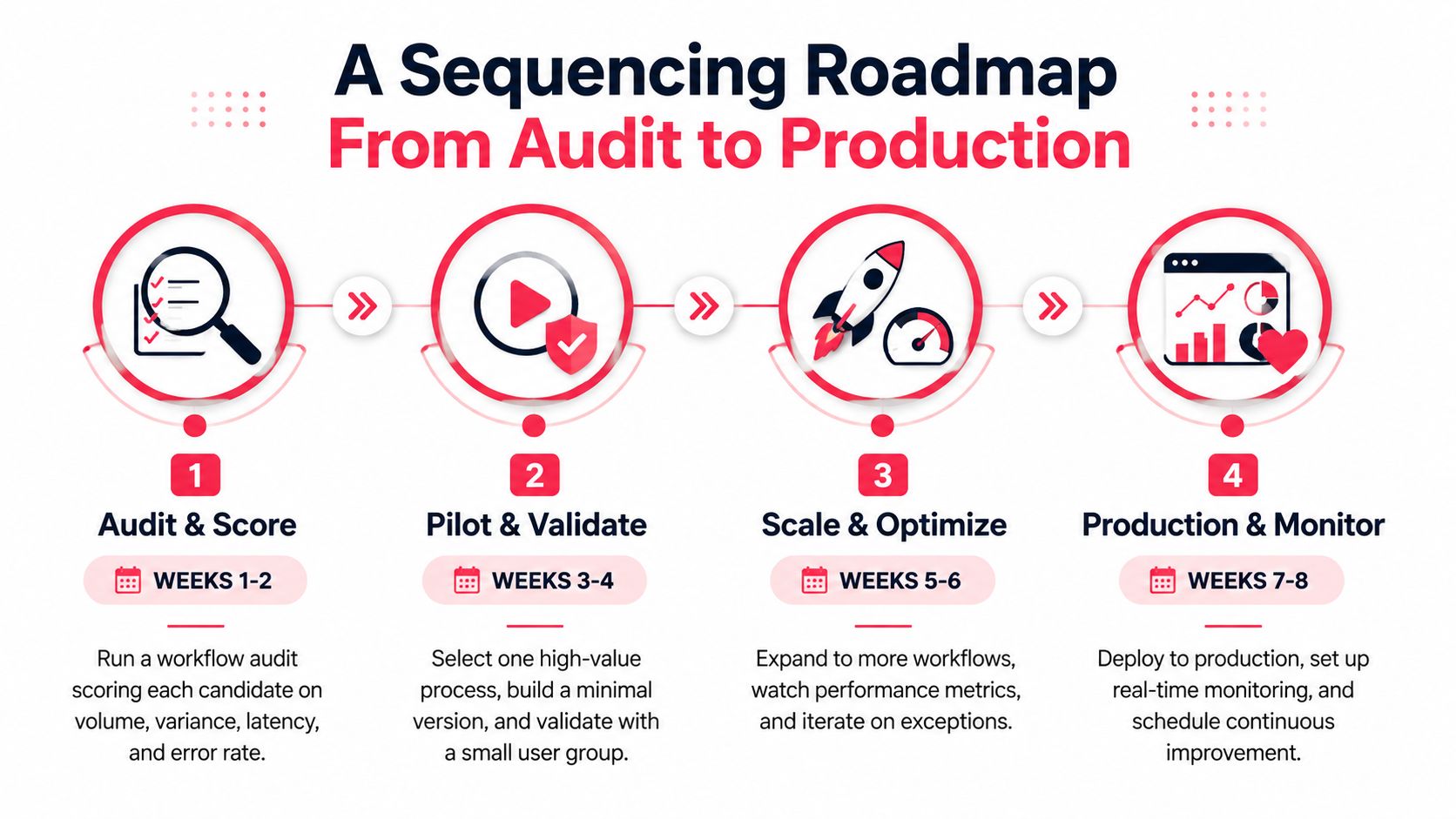
Phase three, production preparation
During weeks 7 to 12, graduate only after adding evals, latency budgets, rollback criteria, and trace review. A vector store such as Pinecone may support durable retrieval. Langfuse can provide an observability layer for prompts, tool calls, latency, and cost.
Buy when the workflow is standard and the business risk is low. Build when the workflow depends on proprietary data, unusual decision logic, or compliance controls that a generic platform can't expose clearly. Stimulead's AI testing framework is one option for prompt unit tests, integration tests, golden-set regression checks, adversarial probes, shadow evaluation, and runtime monitoring.
Phase four, operating controls
In the second quarter, add agent-level RBAC, PII redaction, and FinOps dashboards. Connect spend to workflow outcomes, not to a general AI budget. The AI implementation roadmap can help executives turn these phases into an accountable delivery sequence.
Where Agentic Workflows Consistently Fail
Most failed builds don't fail because the model lacks intelligence. They fail because the team automates the wrong process, hides a batch job behind agent language, or gives the system access to ambiguous records.
Human-centric processes pasted over are the first trap. SDR handoffs that depend on tribal knowledge, multi-tab reconciliation, or informal account context don't become agent-ready when someone converts the checklist into prompts. Redesign the process around explicit data, decision states, and reversible actions before adding orchestration.
Batch pipelines dressed as agents create false confidence. A nightly job that exports a CSV and posts it to Slack may be useful automation, but it doesn't contain a planning and tool-use loop. Calling it agentic makes the missing capabilities harder to see.
A missing identity layer produces duplicate work and unsafe actions. Before orchestration, establish a canonical graph connecting account, contact, opportunity, and product records. If the system can't resolve which account or entitlement it is acting on, the best prompt in the stack won't repair the ambiguity.
Token economics can fail at contact-center scale. A 40-turn supervisor-agent call priced at $0.03 per 1,000 tokens doesn't pencil against a $4 lifetime-value conversation. Those figures are a planning example, not a universal cost model, and the correct response is model routing, prompt compression, caching where appropriate, and hard turn budgets.
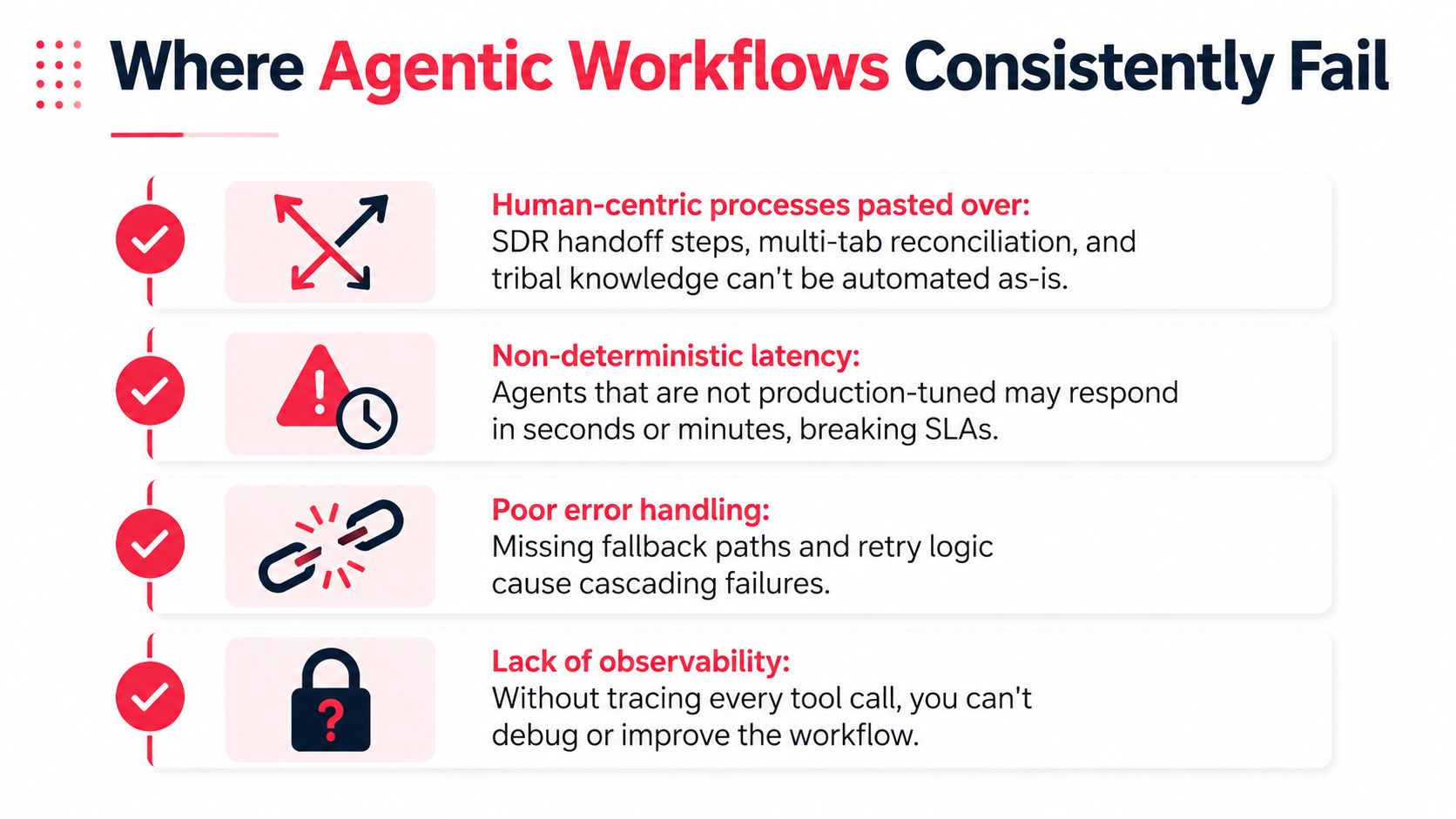
Production buyers are also confronting integration cost. Independent enterprise coverage identifies reliability, system integration, and cost as major blockers, including Salesforce and legacy database integration problems and token economics that can overwhelm contact-center models. The 2025 year-end enterprise review from Arion Research is useful because it focuses on production constraints rather than demo capability.
Governance, Cost, and KPIs Baked In From Day One
Governance belongs in the workflow scorecard, not in a separate compliance queue. The revenue owner needs one view of security, approval latency, model spend, exception volume, and pipeline impact. Without that connection, a workflow can keep consuming budget after its qualified actions stop improving.
Set four controls before production access:
- Agent-level RBAC: Define what the agent may read, write, and trigger, regardless of the human user's permissions.
- Immutable audit trails: Log every tool call, input, output, approval, and override in a tamper-evident record.
- Approval gates: Stop high-stakes actions, autonomous spend, external messages, and irreversible database changes until the assigned owner approves.
- Sandbox testing: Run representative cases against non-production systems before exposing live records.
Dataiku's enterprise guidance specifies RBAC at the agent level, immutable audit trails for every agent action, multi-level approval gates for high-stakes decisions, and sandbox testing before deployment. Dataiku's agent guidance offers a practical control baseline. Use these AI governance best practices to turn those controls into an implementation checklist.
IBM identifies six capabilities associated with autonomous workflow adoption: change management, AI governance, data governance, real-time data integration, interoperability, and financial integration. IBM's 2026 enterprise operations report gives QBR owners a useful review frame. Ask whether the sales team can absorb a new approval route, whether the data team can supply current records, and whether Finance can attribute model cost to an outcome.
The weekly operating scorecard
Every workflow should report:
- Pipeline influenced, with a defined attribution rule.
- Cost per qualified action, including model, platform, and review cost.
- Override rate, split between harmless corrections and material errors.
- Compliance exceptions, including access violations, missing approvals, and unredacted sensitive data.
Set a per-workflow spend ceiling and route low-stakes classification to a smaller model tier. Review variance weekly. If cost rises while qualified actions stay flat, reduce context, shorten plans, or pause the workflow. Governance works when the owner can make that call from the same dashboard used to review pipeline.
Pick One Workflow and Redesign It Agent-Native
Choose one workflow this week. Don't start with full-cycle outbound, deal closing, or any process where the deliverable depends on a human's social context. Those workflows carry too much ambiguity for a first autonomous redesign.
Score each candidate against four filters:
- Measurable pipeline outcome: You can define the qualified action, conversion event, or time-to-action metric.
- Callable data: The relevant records already live in systems the agent can access through controlled tools.
- Reversible failure: A human can undo the action without repairing customer trust or financial records.
- Owner authority: The current process owner can approve, reject, or override the agent.
Strong first choices include inbound lead enrichment and routing, SDR follow-up triggered by intent signals, and AEO refreshes on pages losing answer-engine inclusion. The first version should expose only the tools required for that workflow, return a structured recommendation, and pause before the consequential action.
Run a two-week pilot with a baseline, a golden set of known cases, approval logging, tool-call traces, and a written kill rule. Shelve the workflow if identity resolution remains unreliable, review queues aren't staffed, cost per qualified action exceeds the agreed ceiling, or the operator can't explain why the agent chose its route. Move it toward production only when the owner can validate outputs quickly and the commercial metric improves without creating unacceptable exceptions.
The next decision isn't which agent platform to buy. It is which workflow earns a controlled redesign. Score three candidates against the four filters, appoint the domain operator, and schedule the first supervised build review this week.