
Your CRO is choosing between two frontier models for an SDR assistant that drafts the first email after every inbound demo request. One model wins the public leaderboard. The other trails by three points, yet produces cleaner short-form copy for your brand and buyer personas.
The leaderboard can't answer the commercial question. Your decision depends on reply quality, routing accuracy, latency, cost, and the effect on meetings booked and pipeline coverage during rollout. AI model evaluation should operate as a commercial control system, beginning with the business decision and ending with evidence from repeated, production-like trials.
Table of Contents
- The Decision a Benchmark Score Cannot Make
- Define the Evaluation Before Choosing a Model
- Measure What Can Survive Production
- Build a Repeatable Evaluation Pipeline
- Tie Model Tests to Commercial KPIs
- Choose Tools, Data, and Ownership
- See the Decision in Operating Context
- Fix Common Evaluation Failures
The Decision a Benchmark Score Cannot Make
A public benchmark measures a defined task under a defined test setup. Your outbound assistant works inside a different system. It reads CRM fields, follows brand constraints, adapts to personas, handles incomplete inputs, and produces copy that may influence a live buying conversation.
That gap matters because AI evaluation has moved from simple, task-specific tests toward broader and harder measurements. MNIST reached roughly 99% accuracy for top convolutional models, while ImageNet systems were around 72% top-five accuracy in 2010, later surpassing human performance by 2015 before the challenge was retired in 2017, according to this history of AI benchmark development. Each cycle produced the same operating lesson. Once a benchmark becomes familiar, its score provides less headroom for deciding what works in a new environment.
A model leaderboard can tell you which candidate performed better on its selected tasks. It can't tell you which model should draft your first-touch email, classify buying intent, extract account data, or decide when to escalate to a human.
Commercial rule: A benchmark rank is evidence about capability. It isn't evidence that your workflow is safe to release.
The difference between benchmark accuracy and generalized accuracy is central here. NIST's evaluation guidance distinguishes performance on a fixed test set from performance across the wider population of similar tasks. NIST also recommends statistical models for estimating uncertainty in evaluation results. Anthropic's evaluation guidance, referenced in the same verified research, recommends reporting mean differences, standard errors, confidence intervals, and correlations when comparing models.
The procurement question should therefore be explicit:
- What business decision must improve?
- Which live workload will test it?
- What tolerance would make the weaker leaderboard model acceptable?
- What evidence would cause you to reverse the initial choice?
- Who can stop the rollout?
Without those answers, leadership is purchasing a credential. With them, the team can decide whether a model earns access to a revenue workflow.
Define the Evaluation Before Choosing a Model
Write an evaluation charter before your team shortlists vendors. This prevents a familiar failure mode, where the organization selects a model first and then designs tests that confirm the selection.
Start with four definitions.
- Objective: Name the commercial decision the system must improve. Examples include MQL-to-SQL progression, SDR reply rate, lead routing accuracy, qualified account coverage, or support escalation quality.
- Workload: List the prompts, CRM fields, documents, tools, routing conditions, and failure cases the model will encounter. Include edge prompts sampled from real records, with customer permissions and access controls in place.
- Decision threshold: Set the minimum acceptable quality level, maximum inference cost, and latency budget. These constraints protect the funnel from a model that produces elegant outputs too slowly or at an unacceptable operating cost.
- Consequence: Record what happens when the model passes, misses, or degrades. Name the release owner, rollback owner, and approver for any exception.
The charter should describe the decision in language that a CRO, product leader, and risk owner can interpret the same way. “Choose the strongest model” is not a threshold. “Promote the candidate only if it meets the required reply-classification quality, stays within the approved latency budget, and produces no unreviewed policy violations” is closer to a release rule.
| Definition | Question to Answer | Owner | Commercial Consequence |
|---|---|---|---|
| Objective | Which business decision should improve? | Revenue or product owner | Defines the KPI under review |
| Workload | What real inputs and edge cases will the system receive? | Product and data teams | Determines whether the test resembles production |
| Decision threshold | What quality, cost, and latency are acceptable? | Executive sponsor and technical owner | Creates the promotion gate |
| Consequence | What changes after pass or failure? | Release and risk owners | Establishes rollout, review, or rollback |
Keep the evaluation objective narrow enough to govern a decision. A company may eventually need a portfolio of tests, but a release gate should answer one operational question at a time. A model can pass a content-generation test while failing extraction, routing, or tool-use requirements.
This charter also protects the team from score shopping. If the preferred model changes during procurement, the workload and thresholds remain fixed. That makes the comparison meaningful and gives the board or executive team a defensible record of why the selected model entered production.
Measure What Can Survive Production
Production fitness requires separate report cards. Combining every result into one composite score hides the failure that matters most to the business.
Task quality covers correctness, format adherence, extraction accuracy, classification behavior, and completion of the requested action on the workload. Use automated graders for repeatable checks, then sample outputs for structured human review. Human reviewers should score against a rubric that defines acceptable tone, factual support, policy compliance, and actionability.
Calibration measures whether confidence tracks observed correctness. A model that knows when it may be wrong gives your router, retrieval layer, and human reviewers useful information. Artificial Analysis includes a non-hallucination rate in its model index, and HalluScan reported an expected calibration error of 0.083 after score correction, as documented in the verified hallucination and calibration research. Use calibrated uncertainty to route risky outputs instead of treating every answer as equally reliable.
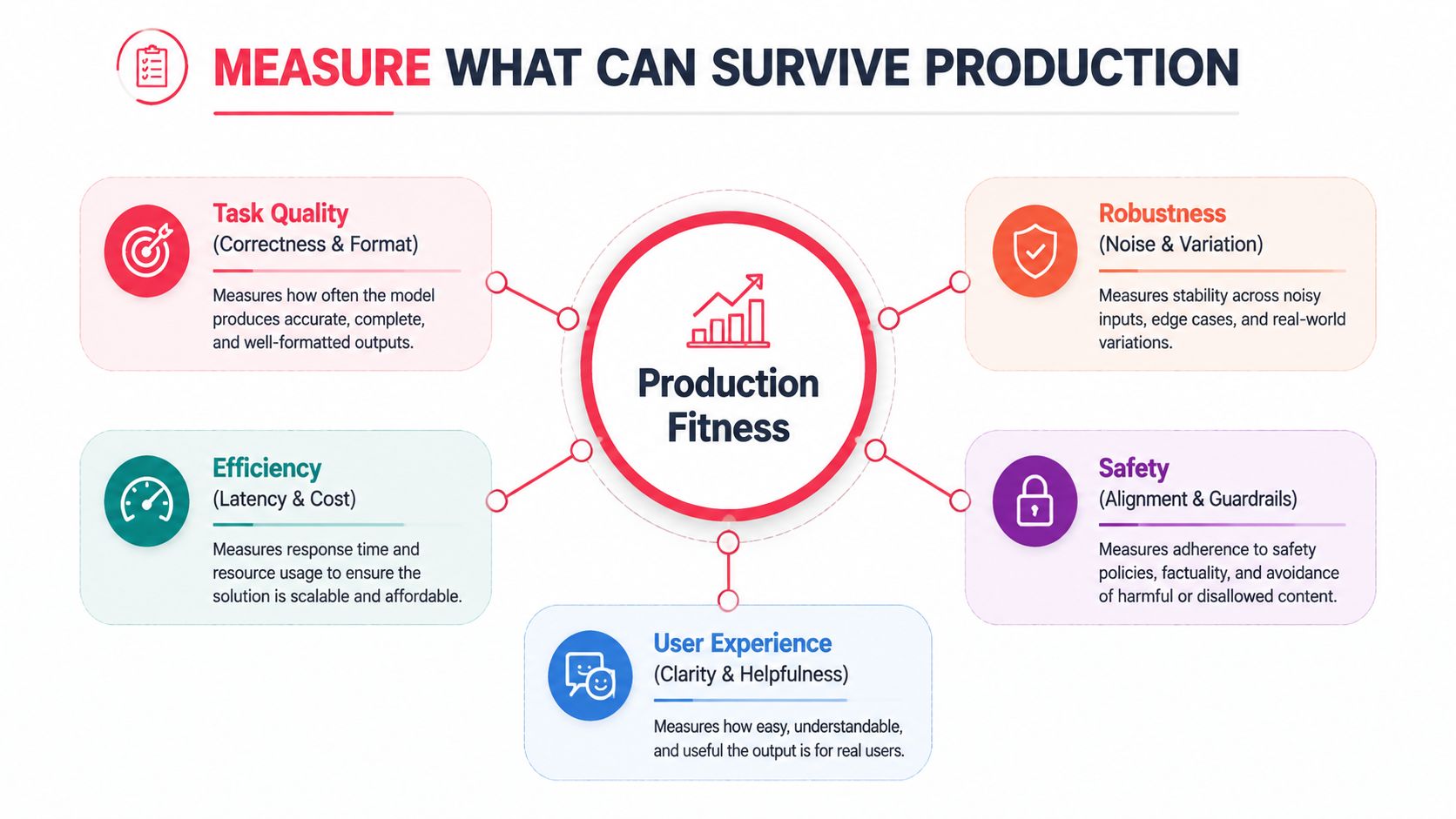
Five report cards belong in the release review
Robustness probes prompt variation, adversarial inputs, schema changes, missing fields, tool-call failures, and repeated execution. A clean result on the preferred prompt says little about how the system behaves when a prospect's industry field is blank or a connected API returns an unexpected response.
Fairness examines error rates across the customer segments, geographies, languages, and account types that your company serves. The relevant question is operational. Does the model route or describe some qualified prospects less accurately than others?
AEO and AIO measures matter when the system creates public-facing content or supports generative search visibility. Track answer-engine visibility, citation patterns, factual support, and downstream referral behavior where those signals affect acquisition. Don't let a strong answer-engine result compensate for weak internal workflow safety.
Hallucination needs more than one score. A 2025 ACL benchmark defines hallucination rate as incorrect answers among attempted answers and also tracks false refusal rate, preventing a model from appearing safe by refusing too often. A 2025 Frontiers survey separates prompt sensitivity from model variability, while a 2025 EMNLP paper uses AUROC and PR-AUC to assess hallucination detectors.
Use all five families as gates. A candidate that wins task quality but fails calibration, fairness, or resilience doesn't pass production review.
For teams building the surrounding content and retrieval layer, our LLMs.txt guidance provides a related implementation reference. Treat that work as part of the system under evaluation, not as a substitute for testing the model.
Build a Repeatable Evaluation Pipeline
A model test that runs once is a demo. A pipeline creates evidence that another team can inspect, repeat, and challenge.
Use these eight stages:
- Fix a representative workload. Pull prompts, documents, constraints, and production traces that reflect actual usage. Separate sensitive data from the working set and document the sampling rule.
- Label or sample ground truth. Have qualified reviewers annotate the expected classification, extraction, response, or action. Record disagreement instead of hiding it.
- Freeze the evaluation set. Put the set under version control with access restrictions. Keep a private held-out set so candidates can't be tuned against every visible example.
- Run candidates repeatedly. Vary seeds, parameters, and relevant prompt conditions. Record run-level results rather than keeping only an average.
- Score automatically and manually. Automated checks handle format and exact-match requirements. Structured human review covers tone, judgment, ambiguity, and edge cases.
- Test routing. Compare single-model and multi-model paths for cost, latency, escalation, and failure recovery. Router logic adds behavior that needs its own evaluation.
- Monitor after release. Track drift, refusal rates, policy violations, confidence, latency, cost, and workflow outcomes. A passing pre-release test doesn't freeze the operating environment.
- Define release gates. Set objective thresholds before promotion, document exceptions, and name the person who can approve or stop the change.
Every stage should produce an artifact. The product owner owns the workload definition, the data team owns dataset lineage, the ML or engineering team owns orchestration and logs, and the risk owner signs off on safety and rollback.
The SpecStory, Inc. playbook for product teams is useful context for documenting agent integration decisions, particularly where tool behavior and workflow state affect the outcome.
When a candidate fails, preserve the prompt, model version, configuration, output, grader result, reviewer notes, and business consequence. Your team should be able to replay the decision after a vendor update, an incident, or a change in conversion performance.
For a practical structure covering repeated trials, scoring, and review, see Stimulead's AI testing framework. The important design choice is repetition. A single result can't show whether the model is stable enough for the workflow.
Tie Model Tests to Commercial KPIs
The evaluation report should tell an executive what changes in the business. If the report ends with “Model A scored higher,” it hasn't completed the job.
Map each quality signal to the funnel metric it can plausibly affect. Classification and extraction quality may affect qualified-lead rate, outreach acceptance, or SQL conversion. Calibration and refusal behavior may affect escalation volume, customer satisfaction, and review capacity. Latency and inference cost may affect acquisition economics and coverage on high-intent sessions. Consistency may affect consistency of pipeline contribution across weeks and segments.
| Evaluation Metric | Primary KPI Affected | Review Cadence | Acceptable Threshold Direction |
|---|---|---|---|
| Task correctness | Qualified-lead rate, SQL conversion | Weekly during rollout | Higher quality, with no critical errors |
| Calibration and refusal behavior | Escalation rate, CSAT, review load | Weekly and after prompt changes | Better confidence alignment, controlled refusals |
| Latency and cost per request | Acquisition cost, session coverage | Daily operational review | Lower cost and latency within the approved budget |
| Prompt robustness | Workflow consistency, pipeline contribution | Weekly drift review | Stable performance across input variation |
| Fairness and policy compliance | Segment coverage, compliance exposure | Release review and recurring audit | No unacceptable disparity or policy breach |
A growth-stage company should also track the evaluation system itself. Testing that takes too long becomes a bottleneck, while testing that lacks ownership becomes a ritual.
Use this operating checklist:
- Workload coverage: Does the set contain normal, ambiguous, incomplete, and high-risk inputs?
- Gate thresholds: Are quality, calibration, latency, cost, and safety requirements written before the run?
- Monitoring coverage: Can the team see production drift, refusals, failures, and policy violations?
- Owner assignment: Does every gate have a named owner and approver?
- Rollback path: Can the team route traffic back without waiting for a new model evaluation?
- KPI linkage: Does each report metric connect to a conversion, pipeline, service, or risk outcome?
Review four executive KPIs weekly:
- Conversion lift or loss per AI-assisted workflow.
- Revenue at risk when a model changes.
- Time required to evaluate a candidate.
- Percentage of production traffic operating behind evaluation guardrails.
We don't advise treating every model change as a revenue experiment. Some changes should be blocked because they increase compliance exposure or weaken auditability, even if the immediate funnel signal looks positive. The commercial control system must protect both performance and permission to operate.
Choose Tools, Data, and Ownership
Choose the operating stack by function. A single platform rarely handles evaluation, observability, data lineage, governance, and human review equally well.
| Tool category | What it needs to handle | Typical owner |
|---|---|---|
| Evaluation harness | Prompt orchestration, scoring, replay, model comparison | ML or engineering |
| Monitoring and observability | Drift, refusal logs, latency, cost, production traces | Engineering and operations |
| Data management | Dataset versioning, access control, labeling, lineage | Data team |
| Governance and lineage | Approval workflows, audit trails, policy ownership | Risk and executive sponsor |
| Human review | Sampling, annotation, adjudication, qualitative checks | Product and operations |
Name tools only after you understand the integration boundary. An evaluation harness that can't replay CRM context is a poor fit for an SDR workflow. A monitoring product that records latency but not refusal reasons leaves the release owner without useful evidence. A governance system that demands manual approval for every low-risk prompt change can slow testing until teams bypass it.
Data requirements deserve the same discipline. Use licensed corpora for training, agreement-based customer data for fine-tuning, frozen evaluation sets under access control, and synthetic or red-team data for safety coverage. Keep evaluation data separate from tuning data where possible, and log who changed labels, prompts, and scoring rules.
Ownership should cross functional lines:
- Data team: permissions, lineage, sampling, and retention.
- ML or engineering: execution, instrumentation, routing, and rollback.
- Product: workload definition, acceptance criteria, and user impact.
- Risk or legal: policy constraints, sensitive use cases, and approval evidence.
- Revenue operations: funnel definitions and KPI interpretation.
Stimulead provides advisory and implementation support for AI testing, vendor evaluation, governance, and marketing and sales workflows. It belongs in the same category as other specialist support, alongside internal engineering and product ownership.
Read our AI governance best practices when you need to formalize approval and accountability. Before committing to a vendor, assess integration depth, model portability, lock-in risk, secure storage, labeling capacity, reviewer time, and the cost of collecting evidence for every evaluation cycle.
See the Decision in Operating Context
The same evaluation method produces different release decisions across workflows. These examples are representative illustrations, not published client case studies, and they don't report invented performance results.
Product and pricing assistant
A product team might compare two candidates through a paired, blinded review using real product questions, pricing constraints, escalation triggers, and out-of-scope prompts. The review would prioritize factual correctness, citation support, calibrated uncertainty, refusal behavior, latency, and cost.
The release threshold could require the assistant to answer approved questions accurately, cite the correct source material, and route uncertain pricing requests to a human. The commercial signal would be observed through a controlled production window using qualified-session conversion and assisted-session progression, rather than a public leaderboard position.
Sales outreach generation
For an SDR assistant, the workload should include CRM fields, account context, persona constraints, approved claims, short-form tone requirements, and incomplete records. A randomized or shadow comparison can evaluate reply classification, message acceptance by SDRs, policy compliance, latency, and cost before the model writes directly into the sending workflow.
The decision might be to use the lower-ranked model for first-touch drafts if it passes brand and factuality gates and produces more usable outputs for the target workflow. The commercial signal would be reply behavior and meeting progression over the agreed observation window, with a rollback path if quality or compliance deteriorates.
Pipeline prioritization
For prioritization, compare candidates on ranking consistency, extraction quality, segment error rates, confidence calibration, and the quality of the handoff to sales. Run the candidates in shadow mode against live records so representatives can compare recommendations without allowing either model to alter the official pipeline.
A threshold might require stable ranking under missing or changed fields, acceptable performance across customer segments, and a documented explanation path for human review. The commercial signal is stage-to-stage movement and sales acceptance, not the model's aggregate reasoning score.
Fix Common Evaluation Failures
Most evaluation failures are operational. Teams use a public score as a shortcut, test a single run, or let the same group that ships the model approve its release.
| Failure | Symptom | Remedy |
|---|---|---|
| Leaderboard fixation | The highest-ranked model wins without workflow testing | Compare candidates on a private, production-like workload |
| Test contamination | Known prompts produce suspiciously strong results | Freeze held-out data and review for leakage |
| Single-run snapshot | Results change after a rerun | Repeat trials and report run-level variation |
| Subjective prompt bias | One evaluator's preference determines the winner | Blind reviewers and use a written rubric |
| Calibration blind spot | Confident errors reach customers | Add confidence checks and escalation rules |
| Router neglect | The fallback path changes cost or behavior unexpectedly | Test routing and shadow deployments separately |
| Missing rollback | The team can't stop a degraded release quickly | Define rollback ownership before promotion |
| Conflicted ownership | The shipping team grades its own system | Add independent product or risk approval |
Static leaderboards also hide scale and tradeoffs. IBM's community database aggregates more than 22,000 model results across 2,200 benchmarks, while Artificial Analysis's Intelligence Index combines nine evaluations across mathematics, science, coding, reasoning, and agentic work, as documented in the benchmark coverage research. More coverage makes a single score less sufficient, not more decisive.
Evaluation setup can change rankings. Independent research reports position sensitivity, verbosity bias, and scorer inconsistency, including a 2026 summary citing about 15% score inflation for longer outputs, as described in the evaluation robustness review. Repeat runs, private or dynamic sets, blinded review, and domain-specific success metrics reduce the chance that your test harness selects the wrong model.
A broader audit of 112,303 AI-related records found the models studied were, on average, 10.85 ECI points behind frontier models of their time, with that gap widening by 5.53 ECI points per year, according to this analysis of the evaluation-to-utility gap. The practical warning is direct. Benchmark winners can still fail live work because memorization, leakage, and abstract scoring don't guarantee generalization.
Within seven days, appoint one executive owner and one independent reviewer, freeze a representative workload, write the release thresholds, and run both candidate models repeatedly in shadow mode. Don't change production traffic until the evidence can survive that review.
If your team is comparing models for an active marketing, sales, or customer workflow, book a Stimulead evaluation session. We'll help you freeze the workload, define the gates, run the comparison, and turn the evidence into a controlled production decision.
