
You ask ChatGPT a buying question that should point straight at your company. It recommends a competitor instead.
That's not a search problem. It's a go-to-market failure in a new channel.
For growth-stage teams, AI assistants are already acting like the first SDR, the first analyst, and sometimes the first shortlist builder. I call that agent commerce. Buyers ask a model who to trust, what tool to pick, or which vendor fits their use case. If your company doesn't show up, your pipeline has a visibility gap long before a rep gets involved.
I don't treat this as SEO with new packaging. I treat it as revenue engineering for AI agents. Your site has to be crawlable. Your content has to be citable. Your brand has to look trustworthy across the public web. Then you need a measurement loop tied to pipeline, not vanity traffic.
If you want a broader view on how to rank in ChatGPT, that resource is useful context. But the part most companies miss is the operating model. Getting recommended by ChatGPT, Claude, or Gemini usually breaks because marketing owns content, product owns site changes, RevOps owns reporting, and nobody owns the system.
That's the gap this playbook fixes.
Table of Contents
- Introduction Beyond Search Rankings
- The Essential Technical Foundation
- Becoming the Citable Authority
- Engineering Trust Signals for AI
- The 90-Day AEO Implementation Sprint
- Measuring and Proving AEO Impact
Introduction Beyond Search Rankings
If your team still thinks AI visibility sits inside the SEO bucket, you're already behind.
Traditional search let you compete for clicks. AI recommendations decide who gets named before the click exists. That changes the job. You're no longer trying to rank a page. You're trying to make your company the most defensible answer to a buyer's question.
That's why the phrase how to get recommended by ChatGPT or Claude or Gemini matters less as a content topic and more as a leadership problem. The winning companies treat it like a cross-functional system. GTM engineering fixes access and data consistency. Marketing builds citable assets. RevOps measures share of recommendation. Sales uses the language buyers prompt with.
Practical rule: If an AI assistant can't confidently explain who you are, who you serve, and why you're credible, it won't recommend you when revenue is on the line.
Here, AEO becomes useful. Not as theory. As execution.
For leadership teams, the commercial question is simple. Are AI systems increasing your chance of entering the deal before a buyer visits your site? If yes, you should see better fit on inbound conversations, tighter category positioning, and less time wasted on deals where your value prop is misunderstood. If no, your competitors are training the market in your place.
AEO sits next to the work many teams already need anyway: CRO with AI, GTM engineering, AI search optimization, and agent commerce readiness. It belongs with the systems that drive qualified pipeline, not inside a content calendar nobody reads after publishing.
The Essential Technical Foundation
A buyer asks ChatGPT for the best vendor in your category. Your competitor gets named. You do not. The problem often starts before messaging, positioning, or thought leadership. The model cannot reliably access, parse, or prioritize your source material.
That is a revenue systems failure.
If AI agents cannot crawl your commercial pages, your brand drops out of the recommendation set before pipeline even starts. Fewer recommendations means fewer qualified visits, fewer branded searches, fewer demo requests, and less influence on shortlist creation.
Start with crawl access
Set up crawler access first. Do not delegate this to chance or assume your site is already open. B2B companies regularly inherit old robots.txt rules that block AI user agents, hide key subdirectories, or restrict documents that explain products, pricing, implementation, and use cases.
Your first job is simple. Confirm the AI crawlers you care about can read the pages that drive revenue. That usually includes GPTBot, ClaudeBot, PerplexityBot, OAI-SearchBot, and Google-Extended. Anthropic documents its crawler behavior and access requirements in Anthropic's documentation for Claude web crawlers.
Then add an llms.txt file at the domain root. Use it to point models toward the pages you want cited, define your company in plain language, and identify the canonical resources that best explain your offer. If you leave that context scattered across duplicate pages, old PDFs, and vague navigation, the model has to guess. Guessing lowers recommendation accuracy.
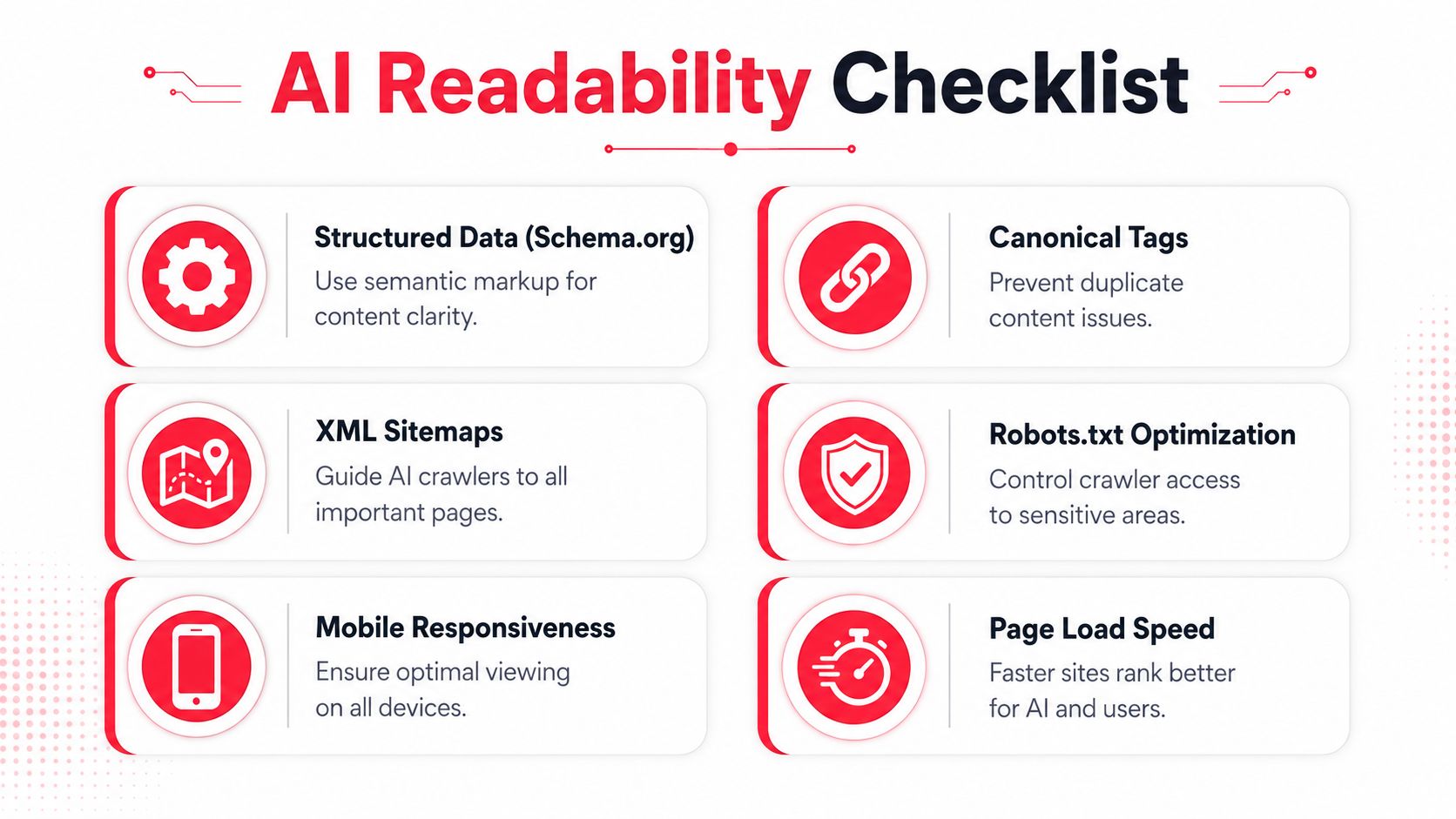
Use this checklist to assign tickets:
- Crawler access: Confirm approved AI user agents can read product, service, pricing, comparison, and resource pages.
llms.txtcoverage: Summarize your company, products, ideal buyers, and preferred source pages.- Canonical control: Consolidate duplicate URLs so authority does not split across variants.
- XML sitemaps: Surface priority pages fast.
- Mobile responsiveness: Weak mobile UX weakens usability signals and reduces engagement after the click.
- Page speed: Slow pages increase abandonment and reduce the odds that buyers reach a conversion event.
Make your content machine-readable
Crawlability gets you into the system. Legibility improves your odds of being cited accurately.
Use structured data. Article, FAQPage, Organization, Product, and BreadcrumbList schema give models cleaner signals about what a page contains, who published it, and how it fits into the rest of the site. Then tighten page architecture so the answer appears near the top. If the first screen is brand theater and the actual definition starts six scrolls down, you are forcing the model to do extraction work it can avoid by citing someone else.
A stronger page pattern looks like this:
| Page type | What should appear near the top |
|---|---|
| Service page | A direct definition of what you do, who it is for, and the business problem it solves |
| Comparison page | Clear differences, selection criteria, and fit guidance tied to buying context |
| FAQ page | Prompt-shaped questions with short, direct answers |
| Resource page | Named author, source-backed claims, publish date, and refresh date |
Do the same for supporting assets. If your sales team depends on PDFs, decks, one-pagers, and research briefs, clean formatting affects whether those documents can be parsed and reused by AI systems. The Markdown Converters guide to AI document preparation gives your team a practical standard for that work.
One rule matters more than the rest. Every page should answer a buyer question fast, in plain language, with enough structure that a machine can extract the answer without interpretation drift.
If you want a fast gap analysis before assigning engineering and RevOps tickets, run an AI readiness assessment for GTM and website infrastructure. Use it to find the technical blockers that are suppressing recommendation probability, branded demand capture, and influenced pipeline now.
Becoming the Citable Authority
A buyer asks ChatGPT, Claude, or Gemini for the best vendor in your category. The model scans the market, looks for a source it can quote cleanly, and skips your site because your pages read like positioning copy instead of operational guidance. That is a pipeline problem, not a content problem.
If you want AI systems to recommend you, give them citation-ready assets that map to buying intent and reduce answer risk. This is the revenue side of AI search optimization for B2B growth. The goal is not traffic. The goal is getting named in high-intent prompts that influence shortlist creation, demo requests, and sourced pipeline.
Write for buyer prompts with commercial intent
Broad category pages rarely get cited because they force the model to interpret vague language. Specific pages get cited because they answer a narrow question fast.
Set your content strategy around prompt classes tied to revenue stages:
- Problem identification: Define the problem in plain language and explain the cost of inaction.
- Solution evaluation: Explain how your approach works, where it fits, and where it does not.
- Vendor selection: Publish comparison pages, selection criteria, implementation requirements, and expected outcomes.
- Purchase validation: Answer security, integration, pricing, rollout, and change-management questions clearly.
This standard should change what your team ships.
Cut messaging like this:
- Weak: “We deliver advanced solutions for modern revenue teams.”
- Citable: “AI GTM engineering connects enrichment, account research, routing, personalization logic, and outbound execution so revenue teams can launch campaigns faster and improve qualified pipeline yield.”
The second version gives the model a usable definition. It also gives buyers a reason to keep reading.
Build assets that reduce interpretation risk
AI systems cite pages that are easy to extract, compare, and summarize. Your content hub should function like a decision system for the model, not a library of loosely related blog posts.
Create assets in these buckets:
Definitive guides
Cover one problem, the operational model, the tradeoffs, and the implementation path.Methodology pages
Publish your framework with named stages, inputs, outputs, and ownership.Case-backed pages
Show verified results, constraints, and what changed in the account, process, or system.FAQ clusters
Use the exact questions prospects ask in sales calls and procurement reviews.Comparison pages
Include fit, misfit, migration concerns, buying criteria, and who should choose an alternative.
Analysts at Ahrefs found that AI assistants often cite pages with clear, direct answers and strong brand presence across the web in their study of AI search traffic and citations. That matches what works in practice. Pages that define terms, explain tradeoffs, and answer objections earn more recommendation opportunities than polished thought leadership with no operational detail.
One sentence matters here. Put the answer in the first screenful.
Show your operating model, not just your point of view
Authority comes from explainability. If a model cannot identify how you work, who you help, what inputs you need, and what outcome you produce, it has little reason to cite you over a competitor.
Publish the mechanics:
- Your process
- Your data dependencies
- Your implementation sequence
- Your governance model
- Your expected time-to-value
- Your failure modes
That is what makes a page citable under pressure. A buyer asking how to get recommended by ChatGPT or Claude or Gemini does not need another article about the future of AI discovery. They need a page that explains the technical requirements, the GTM workflow changes, and the measurement model a revenue team can apply this quarter.
Tighten authorship and freshness
Authority decays when ownership is unclear and content goes stale.
Use a real author with a relevant role. Support claims with evidence when you have it. Refresh pages that no longer match your current product, market, or implementation approach. Google's documentation on creating helpful, people-first content is still a useful editorial standard here because it rewards originality, experience, and clear purpose over generic summaries.
Set a simple governance rule:
- Named expert: Every commercial page has an accountable author.
- Evidence: Claims are attributed or written qualitatively.
- Refresh cycle: Update pages when your offer, integrations, or market context changes.
- Prompt target: Each page exists to answer a defined buyer question tied to a pipeline stage.
That is the standard for citation. What's more, it is the standard for revenue influence.
Engineering Trust Signals for AI
A buyer asks ChatGPT for three vendors. Your company has the right product, the right price point, and a solid sales team. The model still names two competitors. The gap is rarely your homepage copy. The gap is trust infrastructure across the public web.
Content makes you eligible for consideration. Trust signals determine whether an AI system is willing to recommend you in a commercial context. That is a GTM engineering problem tied directly to pipeline quality, win rate, and the cost of getting shortlisted.

Reviews shape recommendation confidence
Reviews are part of the model input layer. If your review footprint is weak, stale, or negative, you reduce the chance that AI assistants surface your brand for buyer-facing prompts.
OpenAI has described ChatGPT search as a system that combines web results with live information from third-party providers, including reviews and local data sources, in its ChatGPT search documentation. That should change how leadership treats review operations. Review generation is not a side project for customer marketing. It affects how often your brand enters high-intent evaluation flows.
Manage these profiles like revenue assets:
- G2
- Trustpilot
- Google Business Profile
Set an operating target. Fresh reviews every month. Clear responses to negative feedback. No abandoned profiles. If a prospect sees weak sentiment, your sales team has a conversion problem. If an AI model sees weak sentiment, you may never get the meeting.
Data consistency is a revenue systems issue
Claude and other assistants pull from a mix of web content, publisher material, and business data sources. Anthropic states that Claude can search the web to gather current information and cite what it finds in its web search product documentation. If your company facts conflict across that ecosystem, you create avoidable doubt.
That doubt costs distribution.
Your company description, category, website URL, headquarters, pricing model, and product positioning should match across the sources buyers and models are likely to encounter. If G2 says one thing, your website says another, and a business directory uses an outdated description, you force the model to reconcile conflicting records. It often resolves that by naming a cleaner competitor.
Here's the operating standard leadership should review every quarter:
| Signal | What leadership should check |
|---|---|
| Business profiles | Same company description, same category framing, same URL |
| Review platforms | Current activity, positive sentiment, visible response cadence |
| Reference databases | Core facts match your website |
| Wikipedia presence | If applicable, accurate and maintained |
Assign one owner. In smaller companies, that is usually RevOps or marketing ops with support from PR and web. In larger companies, treat it like master data management for external GTM systems.
This is why AI visibility belongs inside broader GTM engineering. The work spans data hygiene, reputation operations, entity consistency, and measurement. For a broader view of that operating model, see AI search optimization services for GTM teams.
After you've tightened profiles and reviews, use this video as a practical walkthrough on the category:
Social sentiment affects who gets named
AI assistants do not separate social proof from discoverability the way internal teams often do.
Public sentiment influences whether your brand appears credible, current, and safe to recommend. Positive customer posts, partner mentions, founder visibility, and third-party discussion all strengthen that environment. Silence creates less evidence. Negative commentary creates friction. Both reduce recommendation confidence.
Treat reputation management as pipeline infrastructure. Track branded mentions, response times, review velocity, sentiment trends, and referral traffic from AI assistants. Then connect those signals to SQL volume and influenced revenue. If trust signals improve and AI-assisted pipeline does not, fix the citation path. If citation improves and conversion lags, fix the offer.
The 90-Day AEO Implementation Sprint
A leadership team usually notices this problem in pipeline review. Branded search is flat, paid spend is rising, and prospects arrive on sales calls saying ChatGPT mentioned a competitor first. That is not a content problem. It is a GTM systems problem, and you fix it with a sprint, not a vague brand program.
Run this as a 90-day build with one owner, weekly checkpoints, and a scoreboard tied to revenue. Track prompt inclusion, assisted sessions from AI assistants, influenced pipeline, and win rate on deals where buyers used AI during research. If those numbers do not move, the work did not matter.
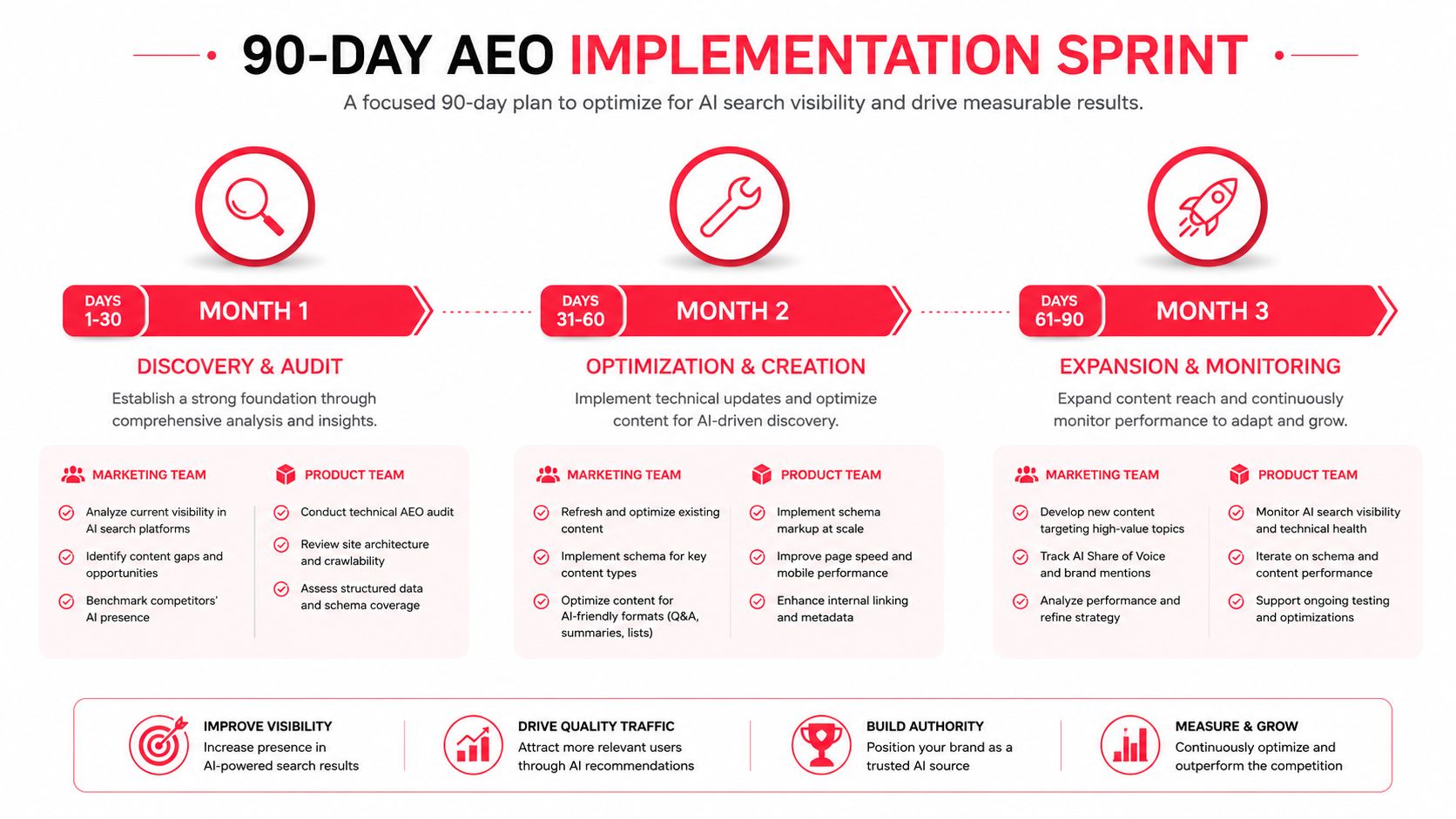
Days 1 through 30
Start with infrastructure and ownership.
Get product, web, demand gen, RevOps, and customer marketing into the same operating cadence. Audit crawlability, fix broken canonicals, tighten sitemap coverage, publish llms.txt, and confirm your highest-value pages render cleanly for bots and agents. Then clean every external profile, partner listing, and directory entry that shapes how AI systems identify your company.
Assign one accountable owner across the whole sprint. Functional owners should be explicit:
- Product or web lead: fix crawler access, schema gaps, and page rendering issues
- Marketing lead: rewrite company descriptions and category language across owned and third-party properties
- RevOps: build the baseline prompt set, traffic tagging, and reporting layer
- Customer marketing: run review and testimonial collection tied to target categories and use cases
This month removes failure points. If an agent cannot access, parse, or reconcile your company data, you will not earn recommendation share.
Days 31 through 60
Now work the pages that influence pipeline.
Start with the homepage, core service pages, comparison pages, pricing-adjacent pages, and sales enablement assets already used in active deals. These pages do the commercial heavy lifting. They should answer buyer questions in plain language, state who the offer fits, name alternatives, and make claims that can be cited.
Use a clear standard:
- Open with direct answers to buyer-intent questions
- Add FAQ, Article, Organization, and Person schema where relevant
- Use the exact language buyers use in prompts
- Show named authors, operators, or subject-matter owners
- Cut vague positioning copy and category fog
This is revenue engineering for AI agents. The goal is not generic visibility. The goal is to increase the odds that an AI system can retrieve your page, understand your offer, and recommend it in a buying context that leads to qualified pipeline.
Days 61 through 90
The final phase expands citation coverage and closes measurement gaps.
Push for third-party mentions that strengthen entity recognition and commercial relevance. Prioritize credible editorial coverage, customer proof, analyst mentions, partner ecosystem pages, and review velocity over random link building. A few relevant citations that confirm what you sell and who you serve do more for recommendation quality than a pile of low-context backlinks.
Use this phase to pressure-test the full buying journey. Ask whether ChatGPT, Claude, or Gemini can identify your category, explain your differentiation, compare you against alternatives, and send a prospect to the right page without sales correcting the story later. If the answer is no, your GTM narrative still has gaps in the plumbing.
For teams that need a structured execution plan, this AI implementation roadmap for leadership and GTM teams gives you the workstreams, owners, and review cadence to run AEO like a pipeline program instead of a side project.
Measuring and Proving AEO Impact
Your leadership team asks a simple question after 60 days of AEO work. Are we getting named in AI buying conversations, and is that creating pipeline?
Answer that with a measurement system tied to revenue, not vanity visibility.
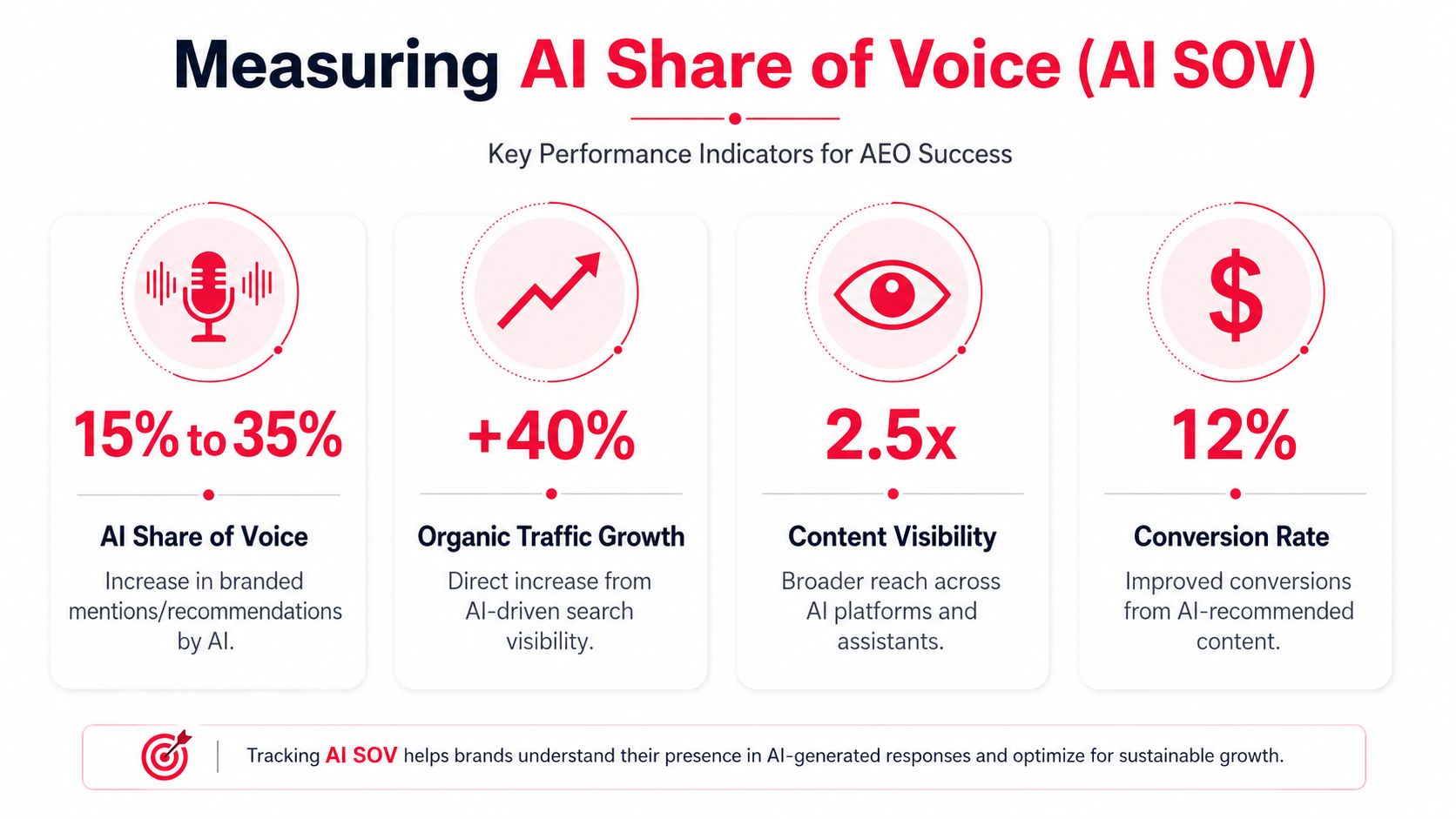
AI Share of Voice is the lead metric. It shows how often ChatGPT, Claude, Gemini, and other AI assistants cite your brand in commercial prompts that resemble real buyer research. Track it like you would paid search impression share or category share in analyst reports. If your brand is absent from high-intent prompts, you are losing consideration before a rep ever gets a meeting.
Use AI Share of Voice as the lead metric
Start with a controlled prompt set built from your actual funnel. Use category searches, competitor comparisons, pain-point prompts, and vendor evaluation prompts pulled from sales calls, Gong transcripts, search term reports, and win-loss interviews. Then run those prompts across the AI systems your buyers use and log four fields: whether your brand appears, where it appears, whether the description is accurate, and which source URLs the model seems to rely on.
This is the measurement discipline. AI visibility rises or falls based on retrieval, citation, and narrative control. Track those inputs so GTM, content, product marketing, and RevOps can fix the right problem fast.
A practical way to structure this work is to benchmark a fixed prompt library and review results on a recurring cadence, similar to the AI search measurement workflows covered by Profound's AI visibility resources.
Use a prompt set that includes:
- Category prompts: “Best [category] for [use case]”
- Comparison prompts: “Better choice than [competitor] for [buyer type]”
- Problem prompts: “How should a [persona] solve [pain point]”
- Evaluation prompts: “Which vendor should a [company type] choose for [job to be done]”
Track these each month:
| Metric | What it tells you |
|---|---|
| Brand cited or not | Presence in AI-driven buying research |
| Position in the answer | Whether you are leading consideration or showing up late |
| Narrative accuracy | Whether the model explains your offer, ICP, and differentiation correctly |
| Citation sources | Which pages, reviews, docs, and third-party mentions are shaping the answer |
Tie visibility to revenue signals
AI Share of Voice is an operational metric. Revenue impact shows up downstream.
Map monthly changes in AI Share of Voice against metrics your CRO already reviews: qualified inbound rate, demo-to-opportunity conversion, sales cycle length, competitive loss reasons, and the share of prospects who mention ChatGPT, Claude, Gemini, or Perplexity during discovery. If recommendation share goes up but pipeline quality does not, your citation footprint may be improving while your commercial narrative still fails. If recommendation share and conversion quality rise together, AEO is doing its job.
Run this like a revenue engineering program. Assign an owner. Set a baseline. Review the same prompt set every month. Tag self-reported attribution when prospects say they found you through AI research. Ask sales to log when buyers arrive with an AI-formed vendor shortlist. That is the signal leadership should care about.
The target is straightforward. Increase the rate at which AI systems retrieve your brand, describe it correctly, and send buyers into the funnel with higher intent.
If you want to know how to get recommended by ChatGPT or Claude or Gemini, start by measuring recommendation share against pipeline outcomes this week. Teams that wait for perfect attribution give faster competitors time to become the default answer.
If you want help turning this into a working revenue program, Stimulead can do that through a focused audit, implementation roadmap, or ongoing fractional CAIO support. Start with a practical conversation about your current AI visibility, GTM engineering gaps, and what needs to change first at Stimulead.