
The most popular advice on how to optimize content for LLMs is too small. It treats this shift like a formatting tweak. Add FAQ schema. Shorten paragraphs. Write a summary. Hope ChatGPT notices.
That advice misses the actual change.
Your content is no longer written only for people. It's also consumed by retrieval systems, AI assistants, and buying agents that extract, compare, and cite pieces of information. They don't move through a page like a human buyer. They parse for usable units. If your site reads well but stores facts badly, you'll lose visibility where future pipeline gets shaped.
I've seen leadership teams hand this problem to content marketing. That's the wrong owner. This is a GTM engineering problem with revenue consequences. The companies that win won't publish more articles. They'll publish cleaner facts, better structure, tighter attribution, and machine-readable proof.
Table of Contents
- Stop Writing Content Start Engineering Data
- The Tactical Authoring Playbook
- Engineer Your Content for AI Ingestion
- Win Agent Commerce with Data-First Modules
- Measure What Matters Citation and Attribution
- Your Governance Model for LLM Optimization
Stop Writing Content Start Engineering Data
“Content is king” worked when distribution depended on humans clicking links and reading pages top to bottom. That model is incomplete now. AI systems don't reward eloquence first. They reward extractable facts, clean structure, and source clarity.
If you want to optimize content for LLMs, stop treating your library like a publishing archive. Treat it like a product data layer for your go-to-market engine.
The old content model breaks under AI retrieval
Most company content is still built as persuasion-first narrative. Long intros. Soft claims. Repeated points. Buried proof. That format can still help a human reader. It performs badly when an LLM needs to pull one precise answer, compare vendors, or cite a source in context.
The shift is simple. Every high-value page should act like a machine-readable asset.
That means your team needs to ask different questions:
- What fact lives on this page
- Can an LLM extract it without surrounding context
- Can a procurement agent compare it against alternatives
- Who owns the accuracy of each claim
- How quickly can we refresh stale data
This is why I push leadership teams to borrow from Documentation as Code principles. Version control, explicit ownership, structured updates, and review discipline shouldn't sit only inside engineering docs. They belong in revenue content now.
Practical rule: If a claim matters to revenue, it needs an owner, a source, a last-updated process, and a format a machine can parse.
Structured data is the economy
The companies that win AI search and agent commerce won't be the ones with the most blog posts. They'll be the ones with the cleanest content objects. Think comparison tables, direct answers, verified product facts, implementation steps, pricing logic, security details, and named evidence.
That's why this belongs inside GTM engineering, alongside CRO with AI, AEO, sales enablement, and agent commerce readiness. Your content team still writes. Your product team still provides detail. Your growth team still sets priorities. But the operating model changes. You're assembling reusable modules, not drafting essays.
A useful mental model is this:
| Old model | New model |
|---|---|
| Article as campaign asset | Page as structured knowledge object |
| Human persuasion first | Machine extraction first, human trust second |
| Quarterly publishing calendar | Continuous data maintenance cycle |
| Vanity metrics | Citation, attribution, and influenced pipeline |
If your team keeps publishing prose without engineering the data underneath it, your brand may stay visible in search while disappearing from AI recommendations. That's a bad trade.
The Tactical Authoring Playbook
The authoring standard has changed. Writers need to stop producing flowing narrative and start producing citable units. That requires editorial discipline, not creativity theater.
Why authors need new rules
The first rule is simple. Open each section with a direct answer. A step-by-step methodology for LLM optimization requires frontloading answers in 50 to 70 word Answer Blocks, and every heading should be a specific question users ask AI, followed immediately by a 40 to 60 word direct answer, according to Averi's guidance on creating content that surfaces in LLM search.
The second rule is density. Content that includes quantitative claims, such as specific statistics and metrics, achieves 40% higher citation rates from LLMs, and 76.4% of the most-cited pages in ChatGPT responses have been updated within the last 30 days, based on Onely's research on LLM-friendly content. If your writers can't insert real numbers, named methods, and current facts, they're building low-citation assets.
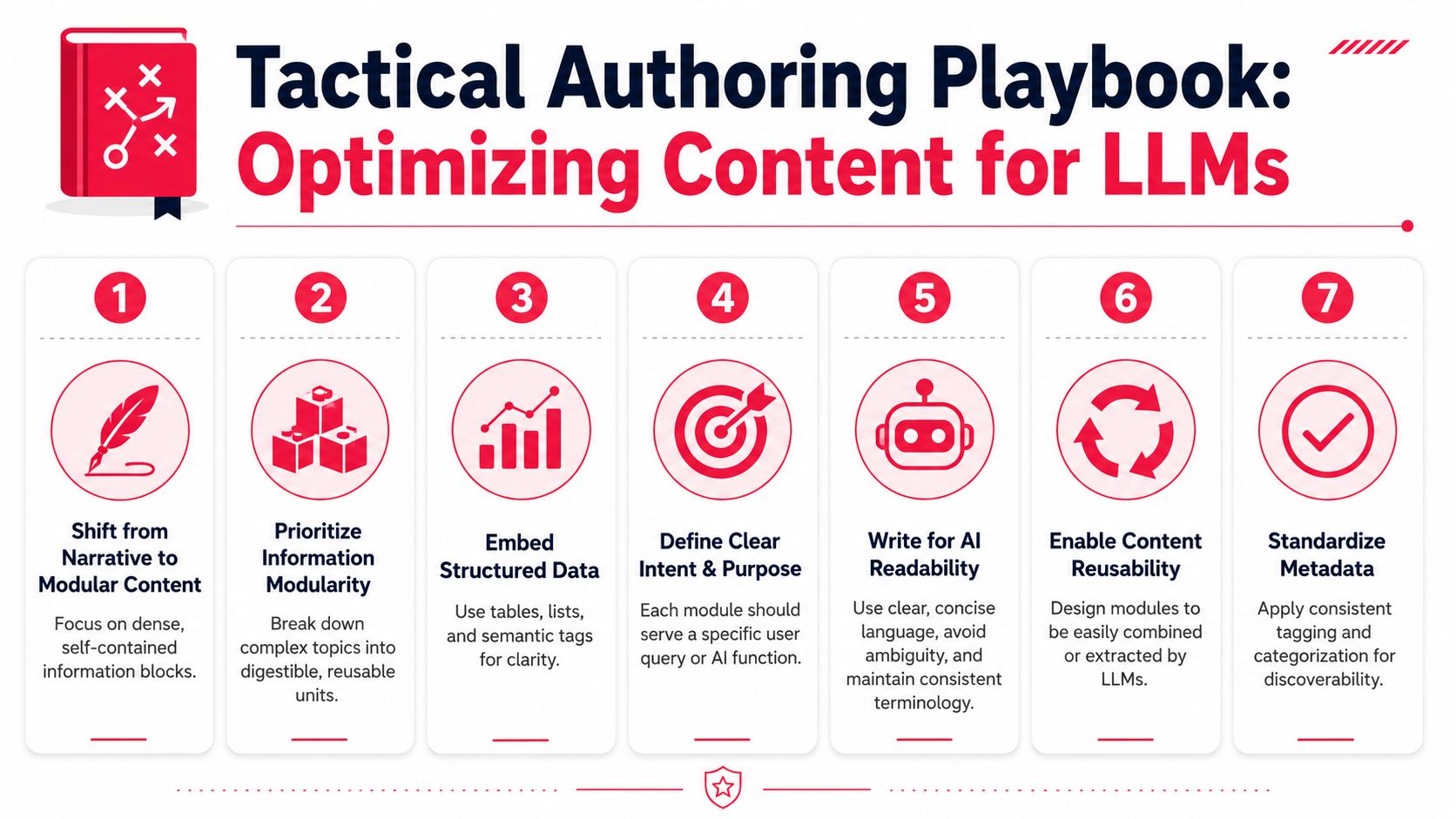
Here's the playbook I use with teams.
Write question-led headings
Turn vague headings into direct queries. “Platform Overview” becomes “How does the platform reduce implementation effort?” AI systems retrieve better from explicit intent.Frontload the answer
Don't warm up. Answer first. Then expand with proof, caveats, and examples.Keep paragraphs short
Two to four sentences is the right operating range. Dense blocks get skipped by humans and parsed poorly by machines.Use lists and tables for comparison logic
Product differences, rollout steps, eligibility criteria, and implementation paths belong in structured formats.Insert proprietary evidence wherever possible
Internal A/B test results, implementation observations, and deployment notes carry more value than recycled commentary when they're specific and attributable.Keep terminology fixed
Pick one term for each core concept. Don't rename the same thing across the page for style.Refresh pages on a schedule
If the page matters to pipeline, put it on an update calendar. Stale pages lose citation value.
Your writer's job is no longer to “cover a topic.” It's to publish the cleanest answer block on the internet for a buying question that matters.
A before and after example
Here's what weak copy looks like:
Our platform helps growing teams improve their sales and marketing performance through automation, analytics, and smarter workflows that support better decision-making across the funnel.
That paragraph says almost nothing. It sounds polished. It gives an LLM nothing firm to cite.
Now rewrite it as a machine-readable block:
- Question heading: How does the platform support revenue teams?
- Direct answer block: The platform gives revenue teams a single operating layer for campaign execution, reporting, and workflow automation. Teams use it to standardize handoffs, publish reusable sales and marketing assets, and reduce delays caused by disconnected systems.
- Proof layer: Add implementation steps, integration details, ownership, and any real internal metrics you can verify.
- Comparison layer: Add a table that clarifies where this fits versus CRM workflows, analytics tooling, and enablement systems.
That's how you optimize content for LLMs in practice. You write for extraction, then for persuasion.
Engineer Your Content for AI Ingestion
Great writing won't save a page that AI systems can't access or interpret. Many teams fail in this area. Marketing rewrites copy. Engineering leaves the delivery layer untouched. The result is a prettier page that still underperforms.
What engineering must ship
Your content stack needs a technical ingestion layer. I'd put these items on the same priority list as tracking, conversion instrumentation, and revenue reporting.

The baseline checklist:
Server-side rendered HTML
Most AI crawlers cannot execute JavaScript. Server-side rendering is the fix, and failing to do it can mean 40 to 60% of your content is missed by agentic traffic, according to Yotpo's LLM optimization guide.Schema markup for content intent
Use FAQPage, HowTo, Product, and other relevant schema types so machines can interpret the purpose of a block without guessing.Content chunking logic
Pages should break into coherent sections with stable headings, standalone answers, and comparison units. This helps retrieval systems pull the right fragment.Embeddings-ready structure
If your content enters RAG workflows, clean semantic segmentation matters. One section should answer one job.Accessible feeds and repositories
Headless CMS setups, XML sitemaps, RSS, and clean APIs make your knowledge layer easier to crawl and reuse.
A practical reference for teams that need the broader framing is the LLMrefs guide on content optimization. It's useful because it forces teams to think beyond copy edits and into system design.
What breaks AI crawlability
I see the same failure patterns repeatedly.
| Failure | Revenue consequence |
|---|---|
| Key details loaded only through JavaScript | AI crawler misses core proof points |
| Important answers hidden in tabs or accordions | Retrieval layer gets partial context |
| PDFs carrying the real detail | Product facts become harder to parse and compare |
| Weak schema coverage | Machines infer page purpose poorly |
| Inconsistent headings | Chunking quality drops |
This work overlaps with AEO and technical SEO, but the economic logic is different. You're not only trying to rank pages. You're trying to make your knowledge usable inside AI answers and downstream buying flows.
If your team wants a practical view of how recommendation visibility works across major models, read this guide on getting recommended by ChatGPT, Claude, or Gemini. It's the same operating problem: clear entities, accessible content, and evidence a model can pull with confidence.
Engineering owns delivery. Marketing owns clarity. Revenue leaders need both in the same room.
Win Agent Commerce with Data-First Modules
Content is often still published for a human evaluator who reads a page, books a call, and asks follow-up questions. That buyer still exists. A second evaluator is already entering the process: the AI agent that screens vendors before a person ever joins.
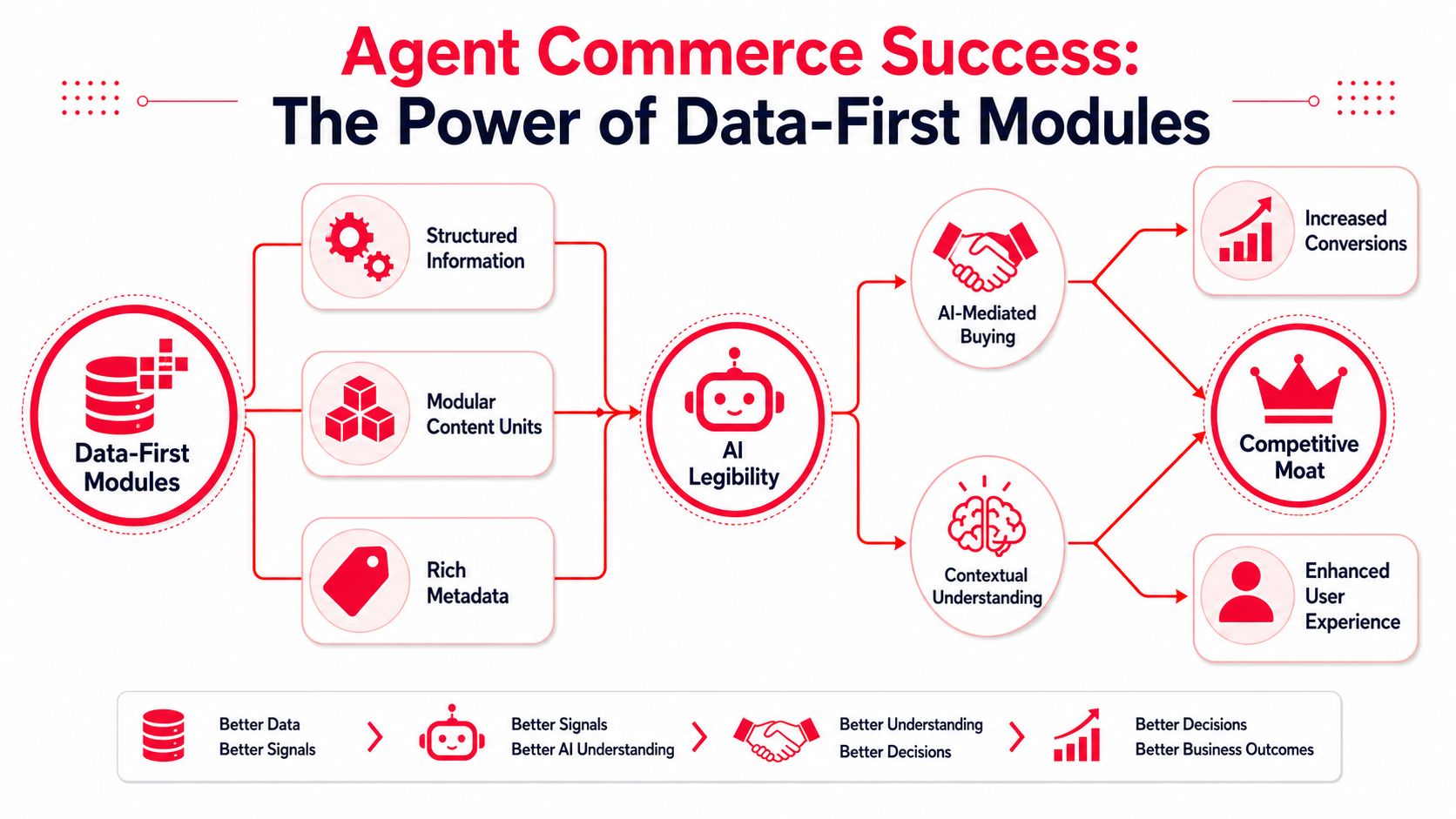
Only 8% of current LLM optimization content covers agent-commerce readiness, yet AI-mediated buying is projected to influence 22% of B2B transactions by 2027. Agents prioritize verifiable metrics and structured data over traditional narrative content, according to Adobe Experience League's best practices for LLM optimizer.
That gap is your opening.
What an agent-ready module looks like
An agent-ready module is closer to a spec sheet than a blog post. It should answer procurement-style questions without requiring a sales rep to interpret the page.
Core components:
Named claim blocks
Clear statements with direct attribution, ownership, and a visible update cadence.Comparison tables
Feature differences, implementation requirements, support boundaries, and commercial fit.Eligibility and exclusion criteria
State where your product fits and where it doesn't. Buying agents reward clarity.Permission signals
Publish anllms.txtfile and keep crawl permissions explicit for commercial ingestion.Consistent entity data
Product names, service categories, leadership entities, and use cases should match across site pages and external profiles.
Here's the strategic point. Storytelling still matters later in the process. It performs poorly at the evaluation layer where agents screen vendors on facts.
Why this changes vendor selection
A buying agent doesn't care that your homepage “feels premium.” It cares whether it can confirm implementation scope, product fit, and proof without ambiguity.
That creates a real moat for companies with strong GTM engineering. If you publish machine-readable modules on pricing logic, onboarding prerequisites, integrations, compliance posture, and outcome evidence, you become easier for software agents to shortlist.
This matters across Stimulead's core domains: CRO with AI, AI search optimization, GTM engineering, and agent commerce readiness all converge here. The same discipline that helps an LLM cite you also helps an agent evaluate you.
For a deeper view of how AI agents are reshaping commercial workflows, this primer on AI agents in go-to-market systems is a useful companion.
A quick visual helps frame the shift:
Publish fewer narratives. Publish more vendor-readable modules.
Measure What Matters Citation and Attribution
Most leadership dashboards are blind to AI visibility. They still track sessions, rankings, and assisted conversions while ignoring whether LLMs mention the brand accurately, cite the right page, or send qualified traffic from AI surfaces.
That's a measurement failure, not a reporting preference.
The dashboard your team actually needs
Only 12% of marketing teams currently measure AI referral traffic or citation fidelity, despite LLMs citing sources in 68% of generated responses for B2B queries, according to Onely's analysis of how to optimize content for LLMs. If your team isn't measuring this, you can't connect LLM visibility to revenue.
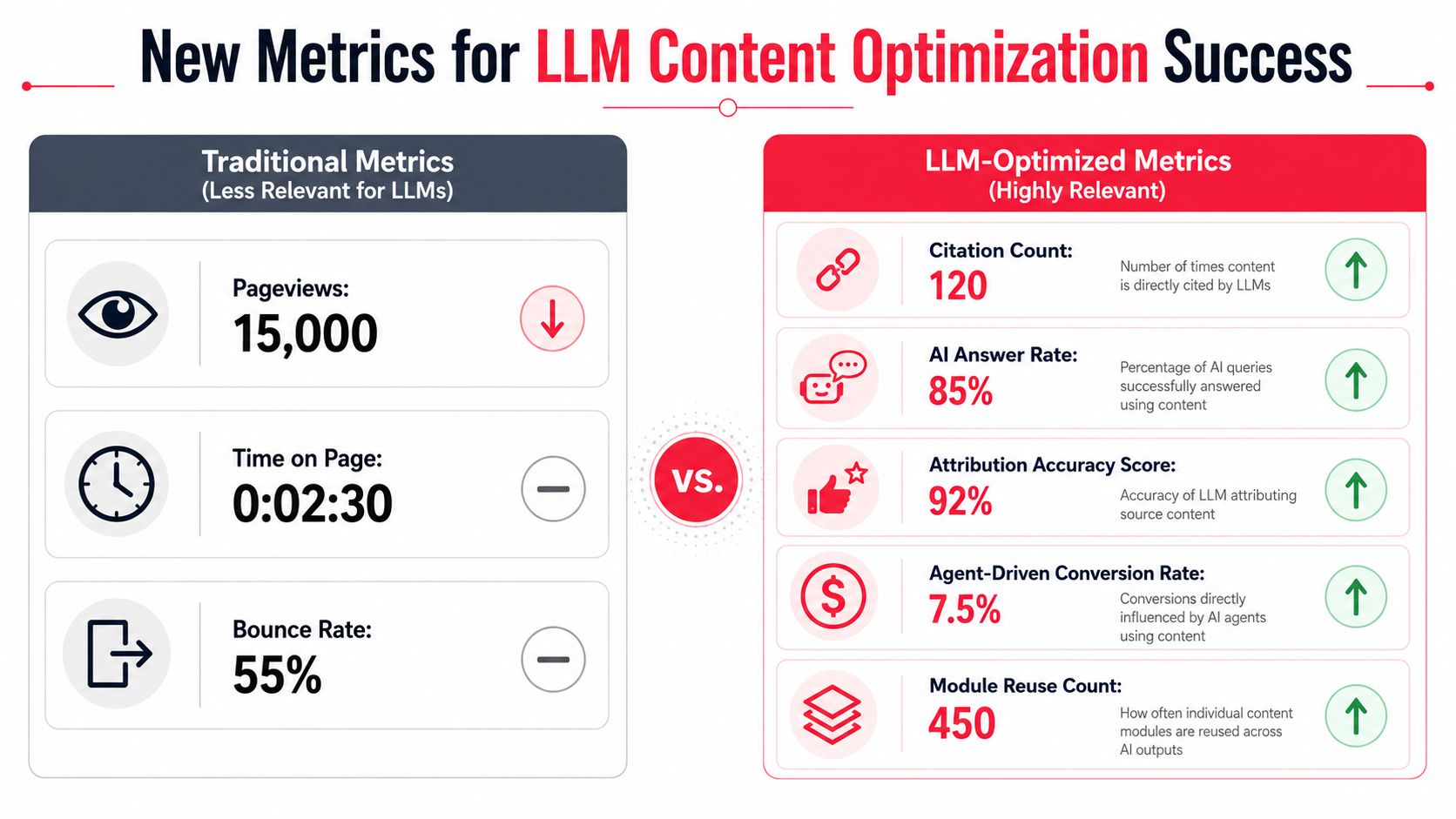
The dashboard I want CEOs to see each month includes:
Citation accuracy
When a model cites your brand, does it point to the right page and represent the claim correctly?Brand mention frequency
How often do ChatGPT, Gemini, and Perplexity mention you for the commercial prompts that matter?Model-specific visibility
Don't average across platforms. Each model behaves differently.AI referral quality
Look at session quality, assisted pipeline, and downstream conversion patterns from AI-origin traffic.Entity consistency
Check whether your product names, category labels, and core claims remain stable across pages and external references.
How to report this to leadership
Don't take vanity metrics into the boardroom. Frame an AI Attribution Framework that ties visibility to pipeline.
A simple operating view works:
| Metric type | Leadership question |
|---|---|
| Citation fidelity | Are models representing us correctly |
| Brand mention frequency | Are we appearing in high-intent buying prompts |
| AI referral quality | Does AI visibility create pipeline, not noise |
| Recency coverage | Are our highest-value pages fresh enough to stay citable |
| Entity consistency | Can models identify us cleanly across channels |
If you need a related lens on visibility in AI-mediated search interfaces, this guide on ranking in Google AI Overviews helps teams connect search presence with answer-surface performance.
If your content team reports pageviews while your buyers ask ChatGPT for vendor recommendations, your reporting model is behind your market.
Your Governance Model for LLM Optimization
This work fails when nobody owns it. Marketing thinks engineering will handle it. Engineering thinks content will clean it up. Product assumes sales will escalate what matters. Then stale claims sit on high-value pages and models learn the wrong story about your company.
Governance fixes that.
Who owns what
Start with named roles, even if the same person holds multiple responsibilities.
Revenue leader
Sets business priority. Which pages matter most for pipeline, category framing, and vendor selection?Content lead
Owns answer-block quality, module clarity, and publishing workflow.Product or solution owner
Signs off on factual correctness for features, implementation constraints, and use-case fit.Engineering lead
Owns SSR, schema deployment, crawlability, content delivery, and machine-readable accessibility.Analytics owner
Tracks citation, attribution, referral patterns, and model-level visibility.
Don't create a committee with vague responsibility. Create a publishing chain with explicit approval.
Here's the operating cadence I recommend:
Audit high-intent pages first
Start with product pages, solution pages, pricing-adjacent pages, comparisons, implementation guides, and category explainers.Convert pages into modules
Break each page into direct-answer blocks, proof units, comparison elements, and structured metadata.Assign claim ownership
Every quantitative statement, product assertion, and competitive comparison needs a human owner.Set a refresh schedule
Pages that influence sales conversations should move into a recurring review cycle. If you can't maintain a page, don't publish a dense claim set on it.Test in real models
Run prompt sets across the AI systems your buyers use. Record mention patterns, citation behavior, and gaps.
A rollout plan for the next quarter
The first quarter of execution should be narrow and practical.
Phase one is discovery. Pull a list of the pages that already drive qualified traffic, influence sales calls, or explain commercial fit. Ignore vanity blog posts unless they directly shape category understanding.
Phase two is re-architecture. Rewrite those assets into machine-readable modules. Add question-led headings, direct answers, clearer tables, and fixed terminology. Move hidden proof into visible HTML.
Phase three is technical deployment. Ship SSR where needed. Add schema. Clean internal links. Make sure each important page can be parsed without client-side rendering. Validate what an AI crawler can see.
Phase four is measurement. Build a recurring review around attribution, mentions, and AI-origin opportunity data. Many teams prematurely conclude their efforts at this point. Avoid this.
A practical review workflow looks like this:
| Step | Owner | Output |
|---|---|---|
| Page priority selection | Revenue leader | Ranked list of commercial pages |
| Content module rewrite | Content lead | Answer-first structured draft |
| Fact validation | Product owner | Approved claim set |
| Technical release | Engineering lead | Crawlable, structured page |
| Model testing | Analytics owner | Visibility and citation report |
Two governance rules matter more than the rest.
First, don't let freelancers or agencies publish unowned claims. If a fact can influence a buying decision, someone inside the company must approve it.
Second, don't separate this work from the rest of GTM operations. The same discipline that drives faster experimentation in CRO with AI and cleaner systems in GTM engineering should drive your LLM optimization program. This is part of revenue infrastructure now.
If you want to optimize content for LLMs and turn it into a repeatable motion, start with ten pages, not a hundred. Pick the ones that shape vendor selection. Rebuild them as machine-readable assets. Then measure whether models cite, mention, and route buyers through them.
If you want a working plan for this, Stimulead helps growth-stage teams turn LLM optimization, AEO, CRO with AI, and agent commerce readiness into an execution roadmap your marketing, product, and engineering teams can run. Start with the pages closest to revenue. That's where the returns show up first.