
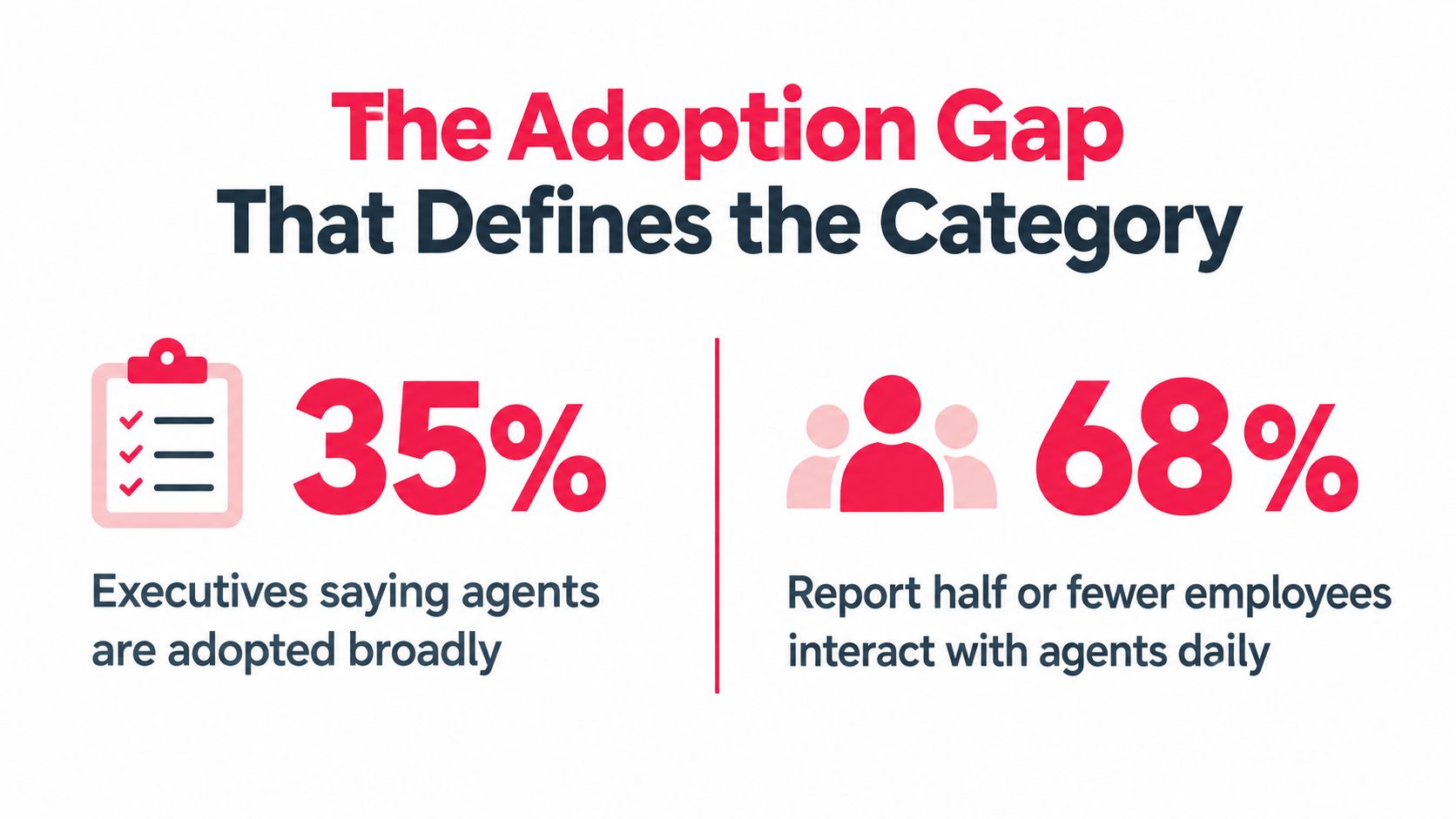
Only 35% of executives said agents were adopted broadly in a 2025 survey, while 68% reported that half or fewer employees interacted with agents daily. Agentic search is goal-directed retrieval that plans subquestions, evaluates evidence, and may take actions rather than returning ranked links, and your first decision is how much agency to permit.
For a CEO who already runs SEO and CRO, buying another search interface isn't the strategic issue. We recommend assigning each workflow an agency tier before choosing software, then measuring whether its additional autonomy earns its operating cost.
Table of Contents
- The Adoption Gap That Defines the Category
- How Agentic Search Actually Works
- A Four-Tier Model for Agency
- Why This Is a Revenue Story, Not an SEO One
- Choosing the Right Search Architecture
- Where Agentic Search Breaks
- A 30-60-90 Plan Growth Leaders Can Run
The Adoption Gap That Defines the Category
The adoption gap matters because a company can deploy an agent without giving it broad authority. PwC's survey of 300 senior executives reported the opening figures, alongside 79% reporting some adoption and just 17% reporting full adoption across almost all workflows and functions. Those figures describe agentic AI generally, not agentic search specifically.
Don't treat an agentic-search purchase as evidence that your company has autonomous research. A system may search approved documents while depending on a person to resolve ambiguity or authorize its next step.
Deployment isn't delegated authority
EY's July 2025 reporting found that approximately 34% of senior leaders said their companies had started implementing agentic-AI technology. Different surveys measure different populations and adoption thresholds. Neither supports treating agentic search as a settled category with uniform capabilities.
When leaders ask what is agentic search, we translate the question into an operating specification. What goal can the system interpret? Which sources can it access, and what can it do after finding an answer?
Browser access deserves separate scrutiny. Clearcote Labs' resource on MCP integration for browsers belongs in the integration review, where engineering should examine the connection between tool access and actual permissions.
Buy the authority your workflow needs. Don't accept the authority a vendor happens to bundle.
For your website, the corresponding question is whether a researching system can extract evidence that supports a recommendation. A page can rank well yet leave a buyer's eligibility question unanswered. Treat discoverability and recommendation eligibility as separate tests.
Choose the required tier before approving a pilot. A cited research answer and permission to modify a customer record require different controls.
How Agentic Search Actually Works
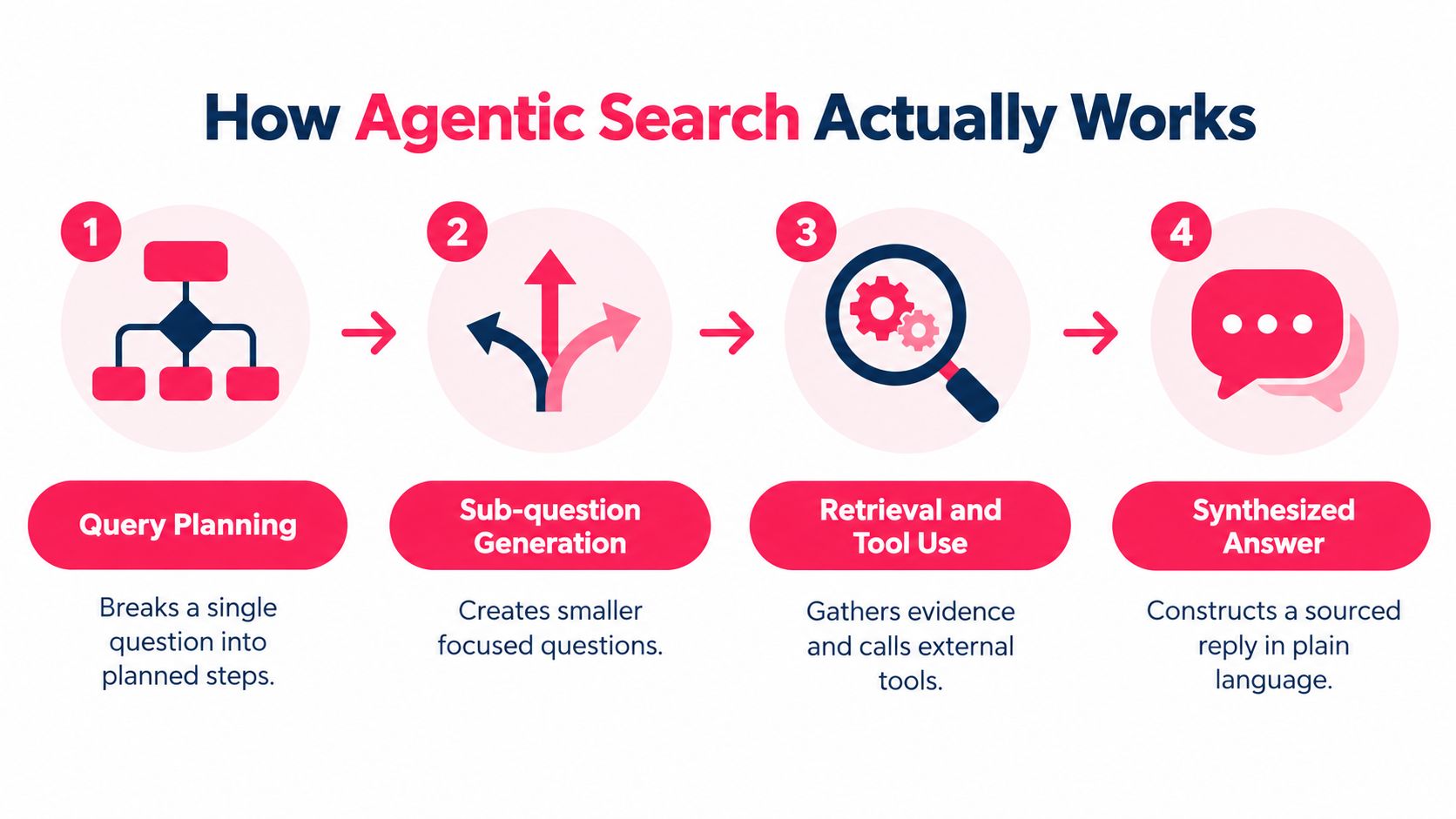
We specify agentic search as a controlled state machine, with explicit transitions and limits. A larger prompt doesn't substitute for a defined workflow, particularly when the system must reconcile evidence across documents.
A hypothetical sales-enablement question makes the distinction clear: can a prospect use your product under its security requirements? The system must connect product documentation with the prospect's constraints, then identify missing evidence before answering.
Build the loop explicitly
- Establish the information need and acceptance criteria. Translate the request into subquestions without expanding its scope.
- Select permitted tools and sources. Separate internal knowledge access from external browsing.
- Retrieve evidence and move within documents. Preserve the passage supporting each material claim.
- Check coverage and contradictions. Continue only when an unresolved question warrants another retrieval.
- Stop with a supported answer or an explicit evidence gap. Validate citations before returning the result.
Microsoft Research's AgenticRAG evaluation used search, find, open, and summarize tools, reporting 49.6% Recall@1 on BRIGHT, 0.96 factuality on WixQA, and 92% answer correctness on FinanceBench. Its ablation reported a 5.9× improvement when moving from single-shot retrieval to agentic tool use. These are benchmark results, not promised improvements for your production workload.
A taxonomy-guided academic-search evaluation reported Recall@100 rising from 0.214 to 0.314, a 46.7% relative gain, while identifying continuing efficiency and constraint-sensitive retrieval weaknesses. The operational lesson is to budget for additional retrieval rather than assume better answers arrive without extra cost.
Log each query, retrieved-document usefulness, evidence coverage, and stopping reason. Measure citation validity separately from whether the answer sounds plausible.
Our guide to AI answer engines addresses the distribution-side context. For a specialist audit reference, consider the CitationOS legal AI visibility audit, while keeping your own evaluation tied to the questions your buyers ask.
A Four-Tier Model for Agency
A RAG chatbot and an agent authorized to submit a purchase request shouldn't share a procurement checklist. Calling both agentic obscures the most consequential difference: their permitted actions.
We use retrieve, investigate, recommend, and execute as an agency model. These are design choices, not a maturity ladder that every company should climb.

| Tier | Permitted activity | Required audit evidence | Approval gate |
|---|---|---|---|
| Retrieve | Read approved sources and return passages | Query, source identifiers, access checks | Permission before restricted-source access |
| Investigate | Plan research and change queries as evidence develops | Query sequence, tool calls, unresolved gaps | Approval for new domains or sensitive sources |
| Recommend | Evaluate options against stated criteria | Criteria, supporting passages, uncertainty | Human acceptance for high-impact decisions |
| Execute | Send messages, update records, submit forms, initiate purchases | Approved action, target, result, rollback status | Explicit authorization before consequential actions |
Permissions should follow failure cost
The retrieve tier can mislead a user with an irrelevant passage. The execute tier can create an external commitment. Your security owner and CRO should assess those failure costs before engineering grants write access.
A recommendation workflow might compare vendors against documented requirements without contacting them. An execution workflow could send the resulting shortlist to procurement or submit a form. Keeping those permissions separate lets you improve research quality without exposing the company to every downstream action.
For commercial measurement, retrieve and investigate tiers can be evaluated on research effort and evidence coverage. Recommend-tier workflows can be evaluated on accepted recommendations and qualified opportunities. Execute-tier workflows also need action-error tracking and intervention costs.
The research on agentic-query boundaries distinguishes ordinary tool use from broader agency involving browser control or external applications. Merely calling a search tool doesn't establish that a system should have execution authority.
Our default is read-only access during evaluation. Add a permission only after the workflow demonstrates that the permission is necessary and the owner can explain how an incorrect action will be contained.
Why This Is a Revenue Story, Not an SEO One
For acquisition teams, the commercial question is whether a buyer receives enough accurate information to advance toward a purchase. A citation is a distribution event. It isn't pipeline until you can connect it to qualified buying activity.
Don't replace your existing funnel with an unsupported assumption about click loss or AI-generated purchases. The evidence available here doesn't establish either outcome. We recommend treating AI-mediated answers as an acquisition hypothesis that deserves measurement.
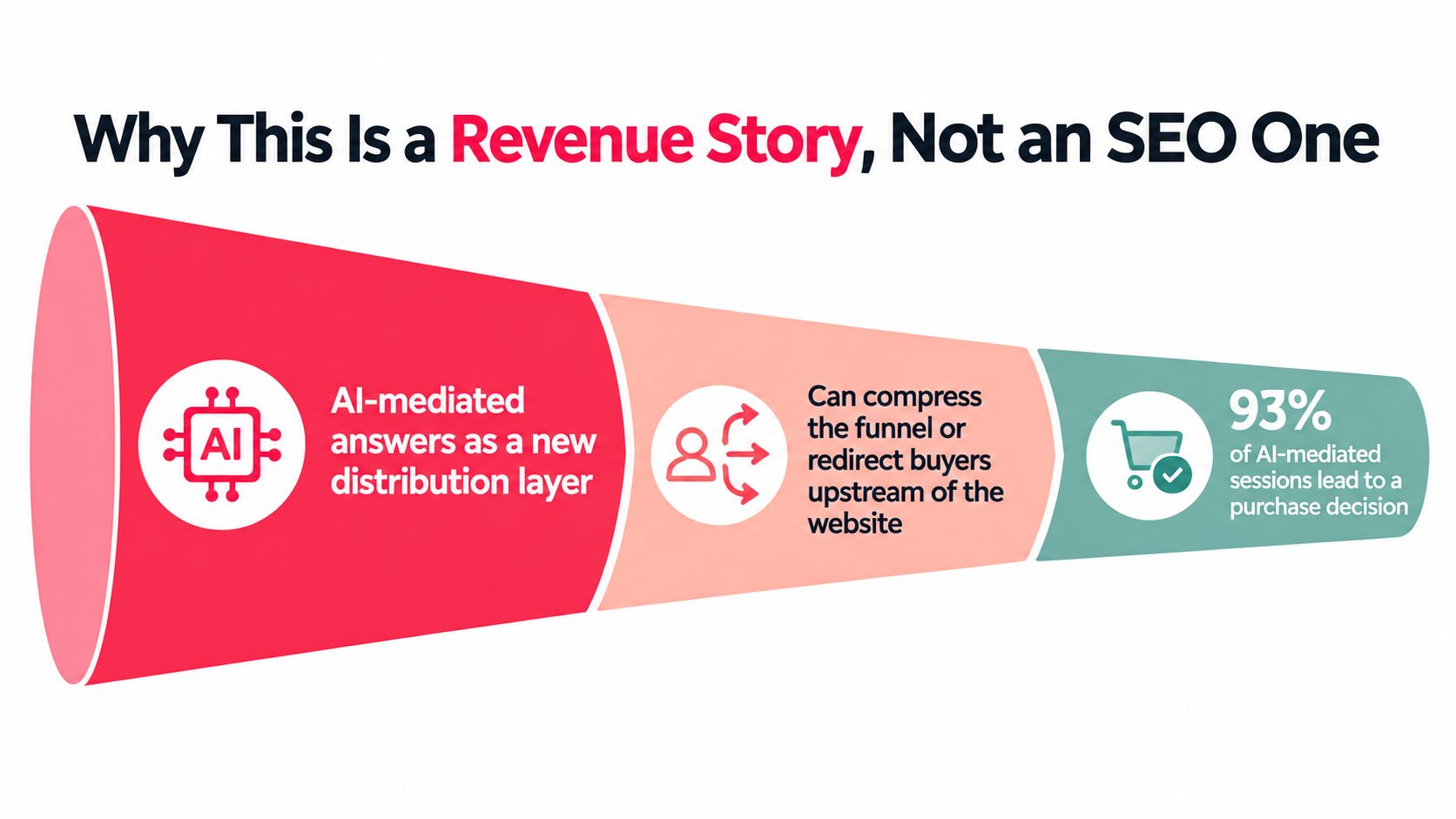
Treat this as a conceptual funnel. Any purchase-rate claim displayed in the graphic is unverified and shouldn't be used for forecasting.
Measure qualification rather than mentions
Your operating equation remains straightforward:
Qualified opportunities × win rate × average contract value = expected bookings.
Apply that equation to a clearly defined cohort. Track attributable AI referrals where available, and record buyer-reported discovery when attribution is incomplete. Don't assign the full value of an opportunity to a citation because both occurred.
| Observation | Commercial interpretation |
|---|---|
| Your company appears in an answer | Visibility, without proof of buying intent |
| The answer describes your eligibility accurately | Potentially better qualification |
| A referred buyer becomes a qualified opportunity | Observable pipeline contribution |
| Sales corrects an inaccurate recommendation | Rework cost and a content defect |
The content priority is buyer qualification. Document implementation prerequisites, exclusions, and product limitations so a recommendation can be checked against evidence. Removing ambiguity may prevent a poor-fit lead, which can be more valuable than generating another form submission.
WebscrapingHQ's resource, boost your audit with scraping, is a useful audit reference to consider alongside permitted collection methods. Use collected observations to identify gaps, not to manufacture attribution.
Our revenue growth consulting approach places these tests in the same operating review as conversion work. The CRO should own qualification outcomes; the SEO owner should own retrieval eligibility. Finance should challenge any forecast that converts answer mentions directly into bookings.
Choosing the Right Search Architecture
We recommend hybrid routing rather than running every request through an agentic loop. A request for a known policy document doesn't need the same architecture as a question requiring evidence across conflicting sources.
Choose the cheapest architecture that meets the task's evidence requirements. That decision is easier to defend than a blanket mandate to make search autonomous.
Search architecture trade-offs
The table below gives directional implementation expectations, not measured scores. The research discussed earlier supports the benefit of iterative retrieval on difficult tasks, but it doesn't establish universal production latency or prices.
| Approach | Recall on multi-hop | Latency | Cost per query | Citation quality |
|---|---|---|---|---|
| Traditional keyword search | Limited when evidence requires connected searches | Usually lowest overhead | Primarily retrieval infrastructure | Returns documents; passage support needs checking |
| Single-shot RAG | Depends heavily on initial retrieval coverage | Retrieval plus answer generation | Retrieval and generation costs | Can cite retrieved passages but miss needed sources |
| Agentic retrieval | Better opportunity to discover missing evidence | Variable across retrieval rounds | Additional model and tool usage | Can validate across sources; still requires testing |
Use conventional retrieval for navigational requests and straightforward factual lookups. Route ambiguous questions or high-value investigations to the agentic path when extra evidence could change the decision.
Microsoft's search, find, open, and summarize tool pattern offers a concrete implementation reference. Your engineering team should expose narrowly scoped tools rather than unrestricted access to every connected application.
Set a cost ceiling per completed task
Per-query pricing can hide retries and human review. Finance needs the cost of a usable result, including retrieval calls, generation, and correction effort.
We don't recommend generic price ranges without a defined workload. Require vendors to quote against your evaluation set, with clear assumptions about document volume and permitted tool calls. Compare accepted-answer cost and time-to-answer against the existing process.
The architecture and agency tier remain independent. Agentic retrieval can operate entirely read-only, while a simple lookup can precede a tightly controlled external action.
For the website-side requirements, use our guide to preparing a website for AI agents. Approve the routing policy when engineering can explain both escalation conditions and the point at which the system must stop.
Where Agentic Search Breaks
More searching doesn't guarantee more objective research. An agent can repeatedly retrieve visible material while missing the document that would change its recommendation.
Research on autonomous research under information constraints identifies concerns including paywall bias, concept drift, privacy exposure, and weak reproducibility. The earlier agentic-query research also identifies over-search and under-search. Neither failure disappears because the output contains citations.
Require an evidence contract
Before scaling, specify what a defensible answer must contain:
- Define the relevant date and geography so the system doesn't combine incompatible evidence.
- Prefer primary sources where available, and distinguish supporting evidence from repeated claims.
- Preserve query history and citation provenance. Reviewers must be able to trace material conclusions.
- Identify inaccessible evidence instead of treating it as nonexistent.
- Label uncertainty and unresolved contradictions before a person accepts the recommendation.
Over-search consumes resources without resolving a gap. Under-search produces an answer before the system has enough evidence. Query drift can turn a narrowly scoped question into a different investigation.
Privacy requires a separate access review. The cited research describes browser-assistant tests in which sensitive information could be transmitted to service providers. Don't allow customer context into external browsing because it helps formulate a better query.
A confident answer with an incomplete evidence trail is a failed result.
Require human review before execute-tier actions during the pilot. For high-impact recommendations, the reviewer must inspect the supporting passages, not merely approve the prose. If your team can't reproduce how a material conclusion was reached, the workflow isn't ready to scale.
Related reading: what is AI visibility covers how to measure whether AI systems mention and cite you, and what is AI search optimization covers how to make your content retrievable in the first place.
A 30-60-90 Plan Growth Leaders Can Run
Start with an owned workflow and a bounded decision. The schedule below is a proposed implementation sequence, not a promise about how quickly your company will achieve results.
Assign the CMO responsibility for acquisition testing and the CRO responsibility for qualification outcomes. Engineering owns enforcement; security and legal approve the access boundaries.
First 30 days audit eligibility and permissions
Google's AI-search guidance describes publicly accessible, crawlable content as an input to its generative search systems and states that indexing and serving aren't guaranteed. Check priority pages for accessibility, intended sitemap inclusion, and indexability. Publication alone isn't success.
Document search-crawler and training-crawler choices separately. The bot documentation distinguishes OAI-SearchBot, used for search visibility, from GPTBot, which governs crawling that may support training. Blocking the search crawler prevents appearance in search answers, with a possible navigational-link exception when a user directly requests the URL.
Create an eligibility register for commercially important pages. Track the share that meets access requirements, then record observed retrieval and citation separately.
By 60 days run a bounded pilot
- Select a query class where missing evidence has a meaningful operating cost.
- Assign its agency tier and establish an existing-process baseline.
- Log citation validity, evidence coverage, time-to-answer, and error rate.
- Record accepted recommendations and any linked qualified opportunities.
- Place approval gates before external actions and test rejection paths.
Keep the evaluation set stable enough to compare changes. Increase testing velocity through repeatable evaluations, not by expanding permissions and changing the workload simultaneously.
By 90 days decide whether to scale
Require a tier register, permission matrix, and documented audit-log retention policy. Define rollback triggers before expanding access, including unsupported high-impact recommendations or unauthorized actions.
Scale only when the workflow meets its evidence requirements at an acceptable completed-task cost. A failed pilot can still produce a useful decision: retain conventional retrieval and fix the underlying documentation.
Your options include internal implementation, vendor-led configuration, or fractional oversight. Stimulead provides executive advisory and implementation oversight for teams that need ownership across these decisions.
Bring your priority buyer queries, current crawler permissions, and a representative failed research task to an executive advisory discussion. We'll use them to define a bounded pilot, assign its agency tier, and establish the evidence and cost thresholds your leadership team can approve.
