
Most revenue growth consulting still measures a funnel AI has already broken. The actual decision is whether you want an advisor who can connect AI-era buying behavior to measurable pipeline outcomes, or a team that keeps polishing metrics buyers no longer create inside your owned channels.
A competent engagement starts with the buyer's new path to purchase. In B2B, research often begins in AI search, review sites, and peer content, then reaches your sales team only after the shortlist is already forming, so old attribution habits can make the work look better or worse than it really is. That is the case we make as Stimulead, and it changes what we measure, how we sequence the work, and when we tell a client not to act.
Table of Contents
- The Decision You Are Actually Making
- How We Frame CRO, GTM Engineering and Pipeline Acceleration
- The KPI Stack We Build With Clients
- Conversion Math and Testing Velocity Before You Sign
- Where Revenue Growth Consulting Fails
- Comparing the Three Engagement Models
- What an Engagement Looks Like in Practice
- How to Choose a Partner That Can Show the Math
The Decision You Are Actually Making
If you lead a growth-stage B2B company, you're not deciding whether to buy a consulting engagement. You're deciding whether an external advisor can connect AI-mediated buying behavior to revenue decisions you can defend in front of the board.
The common mistake is to ask for more leads, more tests, or more content before you've accepted that buyers now arrive with more of the journey already completed. G2's 2025 Buyer Behavior Report says 79% of software buyers report that AI search has changed how they research, and 29% now start with AI search more often than Google, while enterprise buyers at companies with 1,000 to 5,000 employees use AI search and review sites as leading research sources at 55% and 56% respectively. That means the standard funnel is often measuring capture, while a chunk of demand creation happens elsewhere. G2's 2025 Buyer Behavior Report
Practical rule: if a partner can't explain how they measure influence before the first form fill, they're still selling a pre-AI playbook.
A serious revenue growth consulting engagement should answer five questions. Where is demand created, where is it captured, what signals are worth trusting, what sequence changes first, and which metrics are being ignored on purpose. If those questions aren't on the table, you're buying activity, not a revenue system.
How We Frame CRO, GTM Engineering and Pipeline Acceleration
We treat CRO, GTM engineering, and pipeline acceleration as one coupled revenue engine. When they're separated into different workstreams, teams get local wins, then wonder why pipeline and bookings barely move.
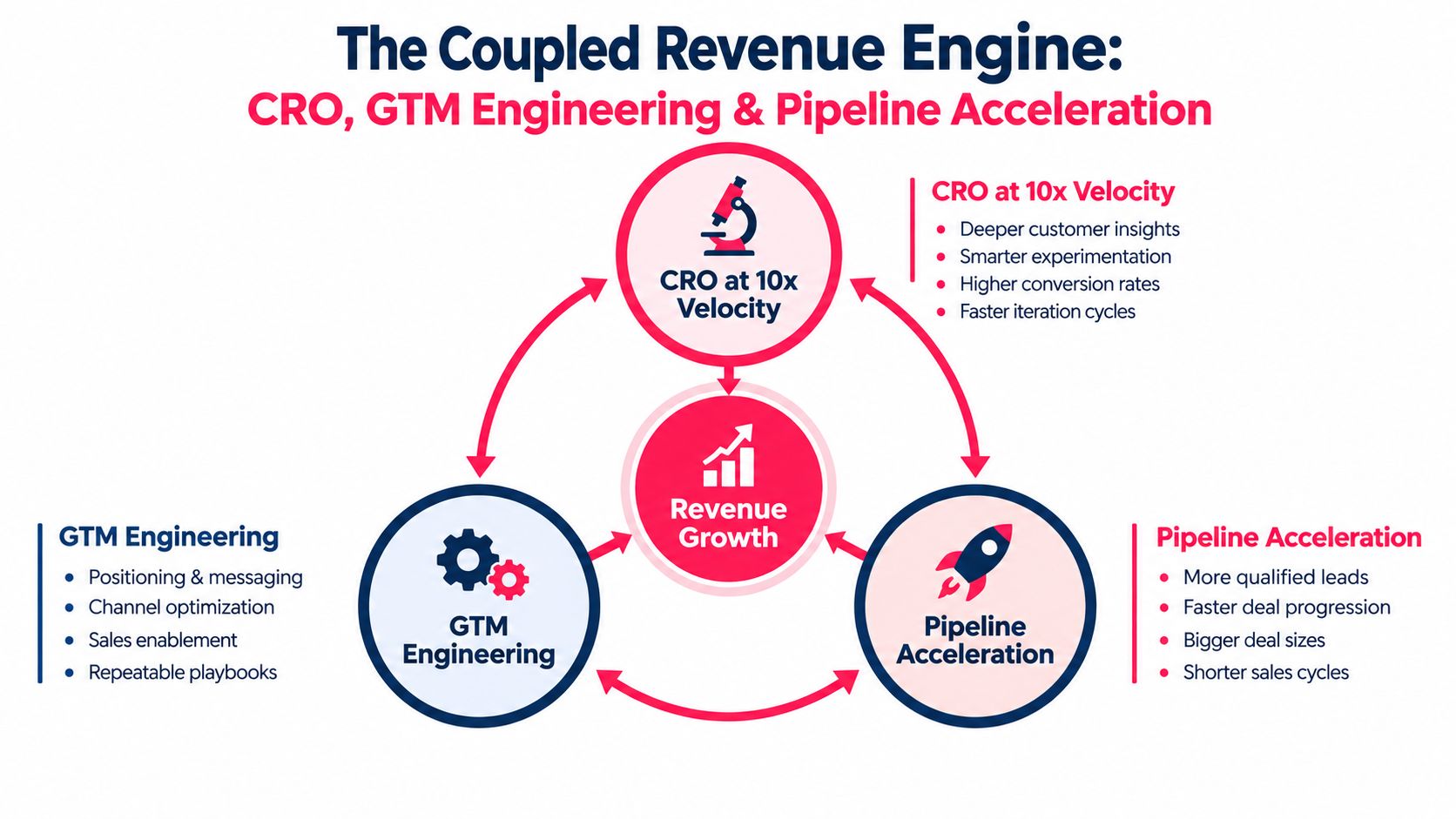
CRO at 10x velocity
CRO changes the quality of what a week of optimization produces. A standard program chases visible conversion points, while a stronger one uses AI-assisted research, faster hypothesis generation, and tighter backlog discipline to test the parts of the offer that matter most.
GTM engineering
GTM engineering is where we connect research, segmentation, enrichment, and outreach. If a team needs better account data for this layer, B2B data enrichment for GTM teams is the type of supporting input we often evaluate, because the quality of the account record shapes the quality of the message.
Pipeline acceleration
Pipeline acceleration is where the work becomes commercial. That means reducing the gap between signal and qualified opportunity, then measuring whether the account advances, not whether the campaign generated a nice-looking response rate.
We often point teams to our own internal framing of GTM engineering because the work lives between research, outreach, and qualification, not in a single channel. A scope built around one metric is a campaign. A scope built around the coupled engine is a revenue system.
The fastest way to waste good AI tooling is to let marketing optimize a landing page while sales still qualifies leads using assumptions from a different buying journey.
The KPI Stack We Build With Clients
We keep the measurement stack boring on purpose. If the metrics can't survive a CFO review, they don't belong in the operating plan.
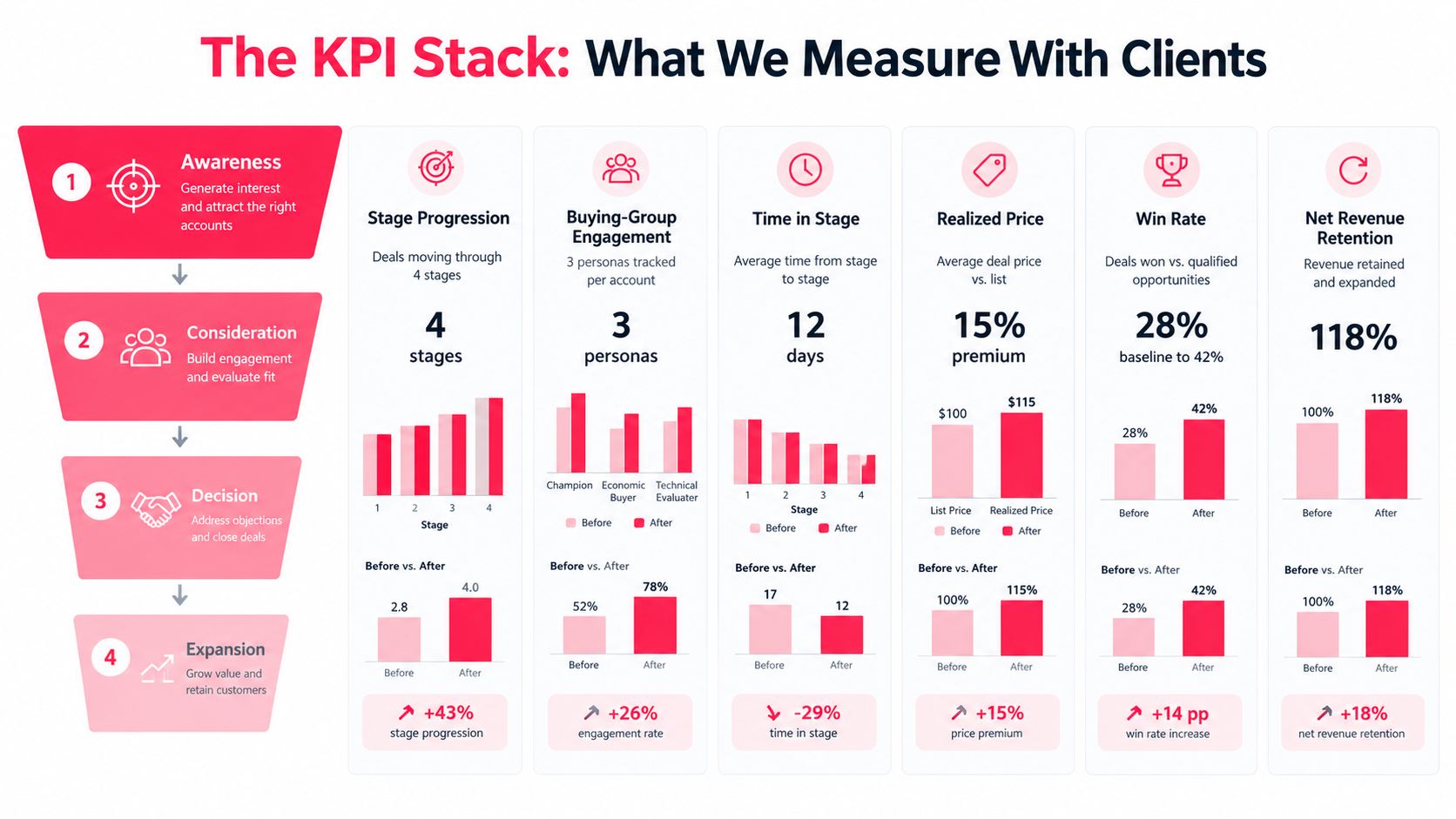
What stays in the stack
We keep stage progression, buying-group engagement, time in stage, realized price, win rate, and net revenue retention. Those metrics tell us whether the commercial system is moving, whether buying groups are advancing, and whether the company is protecting value after the sale.
We demote lead volume, MQL counts, and last-touch attribution. They can be useful operational notes, but they rarely tell us whether revenue improved. For attribution, we separate demand creation from demand capture, then track AI-assisted touches alongside source data instead of pretending every opportunity can be assigned to one channel.
The reason is simple. AI has changed how buyers research, so the journey often starts before your site or sales motion sees the first click. That's where we use controlled experiments, matched-market analysis, or cohort comparisons, not a fantasy spreadsheet that assigns every win to the last touch.
| Metric | What we keep | What it tells us |
|---|---|---|
| Stage progression | Yes | Whether opportunities actually move |
| Buying-group engagement | Yes | Whether enough stakeholders are covered |
| Time in stage | Yes | Where deals stall |
| Realized price | Yes | Whether value is protected |
| Win rate | Yes | Whether the offer wins in market |
| Net revenue retention | Yes | Whether post-sale value compounds |
For founders who want a broader framework for this kind of reporting, revenue attribution for founders is a useful lens to compare with the measurement stack we use inside client work. Our own internal guide on how to measure marketing effectiveness sits in the same operating logic, but the point is always the same, measure the business outcome you want.
Conversion Math and Testing Velocity Before You Sign
A good CRO partner will talk about sample size before they talk about promise. That's because testing velocity means very little if most tests never reach a decisive result.
A dataset of 2,408 A/B tests run between January 2023 and March 2026 found that 17.4% reached statistical significance with a winning variant, 8.4% reached significance with a losing variant, and 74.2% were inconclusive (WebTonic's A/B testing statistics). The practical lesson is blunt, more tests do not equal more learning. Better hypotheses, better traffic allocation, and cleaner stopping rules do.
What we scope differently
For growth-stage B2B traffic levels, we usually reduce the number of simultaneous tests and increase the quality of each hypothesis. A team with limited volume can't afford to split samples across a dozen weak ideas and call that optimization. We'd rather validate one meaningful offer change than ship six inconclusive page edits.
Useful checkpoint: ask any consultant how they define validated learning per cycle. If they can't answer, they probably count launches instead of learning.
Pricing belongs in the same conversation. McKinsey says pricing programs have produced a 2-to-7-percentage-point-or-more improvement in return on sales within one year (McKinsey pricing programs). That matters because a conversion lift that ignores price can look like progress while leaving enterprise value on the table.
The math is straightforward. At 40% gross margin, a 5% price increase can tolerate about an 11.1% volume decline before gross-profit dollars fall, assuming unit cost stays unchanged. That's why we model price-volume-mix sensitivity before recommending a price move, and why realized price matters more than list price. If a partner can't show that math, they're asking you to trust optimism instead of economics.
Where Revenue Growth Consulting Fails
The weakest engagements all fail in familiar ways. The first is activity theater, where teams count emails, tests, and leads while revenue stays flat.
The second is the one-time report. A consultant spends weeks producing strategy, then hands over a deck no one owns. That kind of work often looks polished because it avoids the hard part, changing workflows, incentives, and reporting.
The third failure mode is scaling AI outreach before governance exists. In a 2025 BSI survey of more than 8,900 working professionals across the UK, US, France, Germany, China, Japan, India, and Australia, only 24% of organizations reported having an AI governance program, 24% said employee use of AI tools was monitored, 30% had risk-assessment processes, and 33% had a standardized process for introducing new AI tools (BSI AI governance survey). If a team is generating AI content or AI-assisted outreach before those controls exist, the work is outpacing the company's ability to contain risk.
Forrester's revenue-engine analysis also matters here. It says market conditions are the largest contributor to growth-rate performance, while controllable drivers such as outsourced services, marketing-generated new logos, pipeline-to-quota ratio, and renewal revenue sit among the leading drivers (Forrester revenue engine analysis). That means a partner who takes credit for a market tailwind is selling a story, not an operating diagnosis.
Red flags we screen for:
- Lots of motion, little movement. They celebrate tests launched or content shipped, not stage progression.
- Governance after the fact. They want to scale AI use before tool inventories, approvals, and human review are in place.
- Attribution certainty where none exists. They assign precise credit to journeys buyers partially hid from owned channels.
- Deck-first delivery. They produce strategy faster than the team can implement it.
- No distinction between market and execution. They claim control over demand that was really lifted by macro conditions.
Comparing the Three Engagement Models
We offer three models because companies at different stages need different depths of support. The consulting market itself has moved in the same direction, toward recurring and implementation-linked work rather than one-off advice.
| Model | Cost shape | Who executes | Time to first results | Best fit |
|---|---|---|---|---|
| Executive advisory | Lower commitment, retainer-based | Your leadership team, with our guidance | Faster on decisions, slower on implementation | CEOs and boards that need an AI roadmap, vendor evaluation, and board-ready strategy |
| Hands-on team training | Fixed project or training block | Your marketing and sales teams | Moderate, once workflows are adopted | Teams that need CRO, prospecting, and AI-content workflow skill transfer |
| AI Growth Partnership | Audit plus ongoing fractional CAIO support | Shared execution with our oversight | Fast on diagnosis, sustained on rollout | Growth-stage companies that need prioritized KPIs, implementation, and ongoing direction |
The wrong model is usually the one that asks for more commitment than the team can absorb. A 12-person company with one overloaded marketer rarely needs a large advisory layer before it needs workflow repair. A more mature team with a usable operating cadence may need the ongoing partnership because the bottleneck is execution discipline, not ideas.
Our own what is AI consulting page maps these differences clearly, and it's the right question to ask before any sales call. If the model doesn't match the operating reality, the engagement will drift into drift.
What an Engagement Looks Like in Practice
In one SaaS engagement, pipeline had stalled even though lead volume looked healthy. The CRM treated opportunities like single-decision-maker deals, but buying-group analysis showed they needed coverage across many more stakeholders and much longer decision cycles than the team had been forecasting.
We rebuilt stage progression around stakeholder coverage and buying-group engagement, and forecasting accuracy improved before revenue did. What did not work was adding more outbound volume on top of a broken qualification model. That only made the pipeline noisier.
In another client engagement for an e-commerce brand, CRO testing velocity went up, but most tests were inconclusive. We cut concurrent tests, raised hypothesis quality, and rebuilt the backlog around pricing and offer architecture rather than surface-level layout changes.
The pattern is consistent, when the measurement layer is wrong, more effort only scales confusion.
What failed there was the instinct to keep testing every page element because “something has to move.” What worked was choosing fewer, higher-stakes hypotheses and giving each one enough traffic to learn something useful.
How to Choose a Partner That Can Show the Math
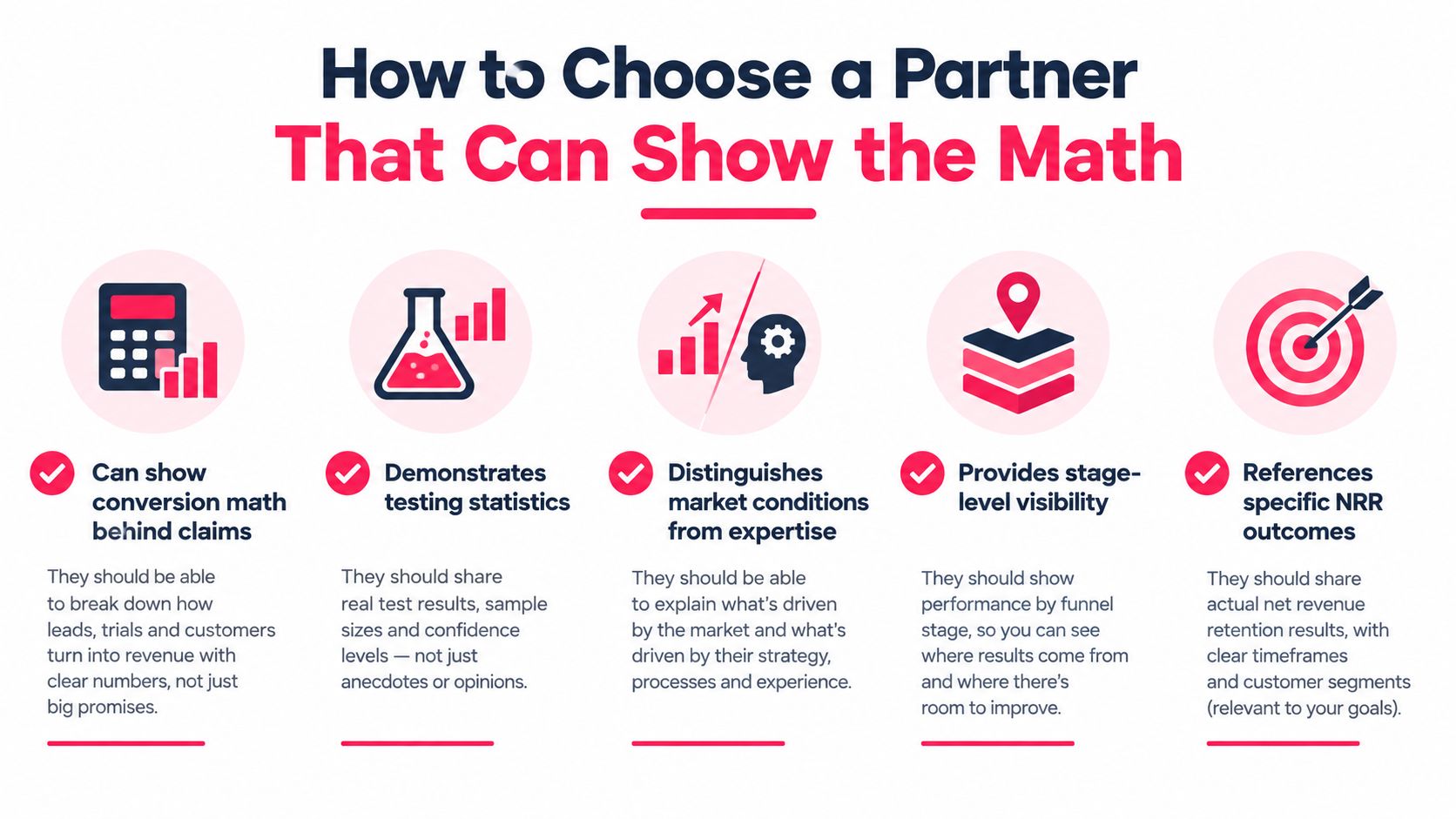
Choose a partner who can show how its claims connect to pipeline and revenue. Ask for the calculation behind conversion sensitivity, test significance, buying-group coverage, and realized price. If those inputs never appear together, the engagement is not ready for serious revenue work.
The partner should separate market movement from controllable drivers. AI changes attribution and buying assumptions by altering how prospects research, compare, and enter the funnel. A capable advisor will identify which signals support a claim, which remain uncertain, and how that uncertainty affects forecasting.
Before booking a consultation, write down the single revenue number you want moved in the next two quarters. The right partner will ask for that number first.
Use compare SEO tools for consultants to assess tooling separately from measurement. Tools can accelerate a weak operating model. Our guide to how AI consulting connects strategy with execution and our guide to how GTM engineering connects research, outreach and qualification show the execution layer a partner should support.
If you are evaluating revenue growth consulting, send Stimulead that target number. We can help determine whether advisory, training, or a fractional AI growth partnership fits before discovery begins.
