
Organic click-through on informational queries that show a Google AI Overview fell from 1.76% to 0.61% between mid-2024 and September 2025, a 61% decline across the 3,119 queries Seer Interactive tracked for 42 organizations (Search Engine Land). That drop is real, and it's the smaller half of the story. Your click report now captures a shrinking share of the moments where a buyer meets your brand, which makes LLM SEO a retrieval and attribution problem before it's a content problem.
The work is straightforward to describe. You want an engine to retrieve your page for a subquestion, represent your claims accurately, name you where a recommendation is being made, and send a buyer forward who was going to convert anyway. Each of those four things fails separately, and a rank tracker sees none of them.
What follows is the measurement system I'd build in the first month, the levers that move citations, and the cases where winning a citation costs more traffic than it earns.
Table of Contents
- Why Organic Click Reports Undercount AI Discovery
- How an AI Answer Decides Which Brands to Name
- Third-Party Sources Decide Most Recommendations
- When Winning Citations Costs Traffic
- Confirm the Crawler Policy and Baseline Before You Change a Page
- Six Measures and the First-Month Run
Why Organic Click Reports Undercount AI Discovery
The decision in front of most growth teams is whether to keep judging search by rankings and organic sessions. Pew Research Center's March 2025 analysis of browsing data from 900 U.S. adults settles it. When an AI summary appeared, users clicked a traditional search result in 8% of visits, against 15% when no summary appeared (Pew Research Center).
The exposure concentrates in exactly the queries your sales team cares about. In the wider Pew analysis of the same browsing data, searches of ten or more words produced an AI summary roughly 53% of the time (Pew Research Center). A question phrased the way a buyer in month three of evaluation phrases it is more likely to get an answer above the links than a two-word category term is.
The report a CEO asks for usually starts with a position chart.

A tracker can show a stable position while the answer block above it absorbs the click. A brand can be named inside a summary with no session ever appearing in analytics. Position tracking answers whether a URL sits in a list. It doesn't answer whether the engine named you, described your pricing correctly, or linked the page it read.
The scope runs wider than Google. Our comparison of AEO and SEO covers where the two disciplines diverge, and the AI search optimization guide sets out the full program across assistants. For the reporting mechanics on the analytics side, Revenue AI Lab's walkthrough on how to track SEO performance is a sensible inventory of the fields to export before you add AI-specific measures.
One limit on the Pew figure: it measures panel browsing behaviour, not any single company's funnel. The share of clicks you personally lose to summaries is an estimate to test on your own traffic. Start this week. Export last quarter's queries of eight words or more, non-brand impressions and branded search volume, and freeze them as the baseline before anyone touches a page.
How an AI Answer Decides Which Brands to Name
Picture a reference librarian handed one rambling question. She rewrites it as four sharper ones, pulls candidate books off the shelves, keeps the two worth reading, writes half a page and cites the volumes she used. A language model runs the same sequence, and your page can fall out at any of the five stages.
| Stage | What the engine does | Where you can act |
|---|---|---|
| Query rewriting | Splits one buyer question into subqueries | Answer the subquestions a buyer would ask next |
| Retrieval | Pulls candidate pages and passages from its index | Keep priority pages crawlable and state key terms explicitly |
| Reranking | Filters candidates for relevance with a language model | Align each section tightly with one question |
| Synthesis | Writes the answer from short excerpts | Make each section understandable without the rest of the page |
| Citation | Chooses which sources to link | Build third-party evidence behind the claims you make |
Where the sequence actually breaks
Semantic fit beats keyword repetition. In the LitSearch retrieval benchmark, state-of-the-art dense retrievers scored 24.8 percentage points higher recall@5 than BM25, and LLM-based reranking lifted the best dense result by a further 4.4 points (arXiv). A page carrying the right phrase but the wrong answer loses to a page that explains the concept accurately.
The engine's own rewrite outranks your on-page work. A study of what drives AI citations found the search engine's rewritten subqueries and retrieval choices explained 32% of citation variation, while on-page properties explained 2.8% (Scholar Inbox). That sets the order of work. Settle the subquestions first, then polish the page that answers them.
If you're arriving from a rank-tracking workflow and want to see how vendors package this, Google Ranker Pro's AI SEO approach is one example of the shape it takes. For the differences in what each engine retrieves, our guide to AI answer engines covers the split between Google's index, Bing-fed assistants and engines running their own crawler.
Because only a short excerpt travels to the model, a page earns retrieval when a single section answers a single subquestion in self-contained prose. Run this test this week. List ten subquestions a buyer asks immediately after reading your main pitch, then check whether one section answers each without help from the rest of the page. Where the answer is implied across three sections, no engine will reconstruct it.
Third-Party Sources Decide Most Recommendations
Publishing more of your own pages is the reflex, and it's the wrong first move. A cross-market analysis of 167,551 URL-grounded citations across 128 brands found that 85.7% pointed to non-owned websites against 14.3% to brand-owned domains, and that roughly 80% of citations came from about 18% of domains (arXiv).
The reason is structural. Answer engines use outside evidence to check what category you're in, who you're compared against and whether a recommendation holds up. Your product pages are one input among many, and the comparison queries that decide shortlists lean hardest on sources you don't control.
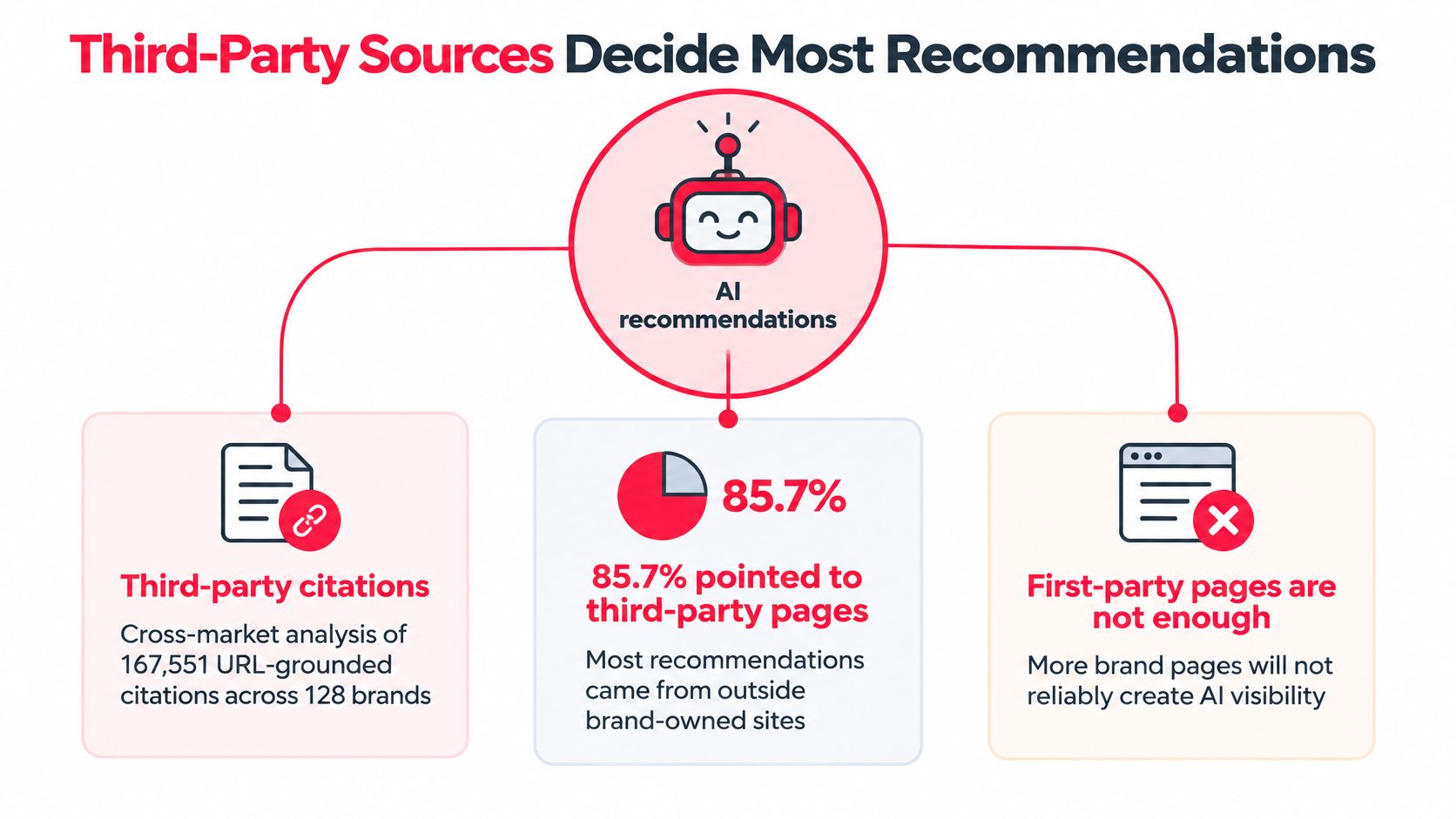
Build the evidence graph as three rings. Priority entities sit in the middle: your product, your category, the use cases you win and your pricing model. The owned layer surrounds them with documentation and factual pages. The outer ring carries independent references, and that ring is where most of the weight sits.
| Layer | Examples | What to track |
|---|---|---|
| Owned layer | Product documentation, factual pages, pricing pages | Factual consistency with the fact sheet |
| Review platforms | G2, Capterra | Whether the brand is named or only used as supporting evidence |
| Professional bodies and partner ecosystems | Industry associations, integration partners | Repeat citation for target queries |
| Trade publications | Credible industry press | Whether coverage of the brand matches the fact sheet |
The caveat deserves stating plainly. Those percentages come from one large study, and we haven't run a controlled test across our own client base, so which source type carries the most weight in your category is a hypothesis to check against your own citation log. Work from the domains that recur in answers for your prompts rather than counting mentions in volume. A dozen citations on low-authority pages moves nothing.
When Winning Citations Costs Traffic
Most LLM SEO advice assumes a citation is unambiguously good. A browser experiment reported the opposite pressure: removing Google AI Overviews and AI Mode raised publisher click-through, and AI Mode reduced referrals without a corresponding improvement in user trust or search experience (arXiv).
There's a second problem in the same paper. A study of 11,000 queries found the top-100 domains surfaced by Search GPT overlapped with traditional Google results by only 24 to 25%, and that AI summaries reduced hedging by as much as 60%. Your qualifications may not survive synthesis. A page that says results vary by deployment can come back as a flat claim carrying your name.
Citations aren't a tax either. In Seer Interactive's 2025 analysis, websites cited in AI Overviews recorded 35% higher organic click-through (Seer Interactive). So the question isn't whether to be cited. It's which queries the cited page wins, and whether the mention sends a qualified buyer forward or answers the question so completely that the visit disappears.
The decision rule we use: segment by buying stage. A top-of-funnel explainer can be worth citing even with no click, because it builds recognition. A pricing, eligibility or implementation page needs a mention plus a reason to click, or the engine is doing your competitor's qualification for you.
What doesn't work, in order of how often we see it.
Chasing every prompt spreads a small budget across clusters where you have no evidence and no page. Adding schema to pages no engine retrieves changes nothing, because markup helps interpretation after retrieval, not selection before it. Writing three-sentence summaries of complex topics gives the engine no reason to visit and no detail to quote accurately. Treating a mention as a lead inflates a dashboard nobody can trace to pipeline.
The trust evidence is thin. Nobody has run a clean test of whether AI-mediated discovery builds or erodes brand preference over twelve months, so treat the trade-off as a test design rather than a settled rule. Pick the clusters to hold back as untouched citation tests this month, and write down what would count as a win before you see the results.
Confirm the Crawler Policy and Baseline Before You Change a Page
Before anyone rewrites a heading, settle a governance question. OpenAI's crawler documentation identifies OAI-SearchBot as the crawler used to surface sites in ChatGPT search, and states that sites opted out of it won't appear in ChatGPT search answers, though they may still appear as navigational links (OpenAI). Blocking it removes answer eligibility even while the pages stay public and indexable everywhere else.

- Get a decision on the record. Legal, security and content owners decide together whether ChatGPT search discovery is permitted for the business.
- Write the robots.txt rule and record who approved it and when, so the next person to touch the file knows it was a choice.
- Verify in server logs that OAI-SearchBot is requesting priority pages after deployment. An allow rule isn't proof of access if a CDN or WAF drops the user agent.
- Test three to five priority pages with the buyer prompt set you'll run weekly, not with a spot check in one engine.
- Freeze the baseline before any page changes: non-brand impressions, branded search volume, direct and referral sessions, assisted pipeline. Hold it four weeks, so later movement can be credited to the change rather than to seasonality.
Our AI Search and AEO engagement includes a gap analysis across ChatGPT, Claude, Gemini and Perplexity, content restructuring for LLM discoverability, citation and mention building, and the schema and machine-readability work that follows access. If you're weighing the file that often gets proposed alongside this, our article on llms.txt covers what it does and doesn't settle. Teams running large product catalogues face the same access and structure decisions at a different scale, and CIQRA's AI search advice for retail catalogues works through that case.
Six Measures and the First-Month Run
A citation count is not a metric. Six measures, tracked separately, tell you where the program is stuck, and each one has a warning sign that changes the next move.
| Metric | Question it answers | How to collect it | Warning sign |
|---|---|---|---|
| Brand mention rate | Is the brand named for tracked prompts | Weekly run of the buyer prompt set across four engines | Mentions rise while pipeline stays flat |
| Linked citation rate | Does the answer link to one of our pages | Log cited URLs for each prompt | Cited, but the summary repeats errors |
| Source retrieval | Did the engine read the page without citing it | Compare cited pages with pages visited where a tool exposes them | Pages retrieved often but cited rarely, so the answer section is weak |
| Factual accuracy | Does the answer describe category, pricing and fit correctly | Manual review against a fact sheet | Confident statements that are wrong |
| Branded search | Are buyers returning by name | Trend in search console and analytics | Flat while mentions grow |
| Assisted pipeline | Does AI-influenced traffic become opportunities | CRM source fields and self-reported attribution | No lift after four to six weeks |
Sampling that survives a second run
Answers vary between runs, so fix the sample before you draw conclusions from it. Forty to 60 buyer prompts, run weekly across ChatGPT, Claude, Gemini and Perplexity, logged in one sheet with the date and session, gives you a series you can compare instead of a screenshot you can't. Weight the set toward the phrasing a buyer uses in month three of evaluation rather than month one. Specificity and stage meet there.
Referral volume from assistants is still small but moving. Statista recorded 155.52% growth in ChatGPT-generated referral traffic between October 2024 and February 2025, with Perplexity at 54.78% and Gemini at 43.64% (Statista). Growth off a small base stays small, so use referral counts as a leading indicator and let CRM attribution carry the pipeline question.
The first month in sequence
- Write 40 to 60 buyer questions, weighted toward long, specific phrasing.
- Group them by stage: problem, category, comparison and purchase.
- Run each prompt in the four engines and log the mention, any linked citation, the cited URLs and any factual errors.
- Score each group and mark the prompts where no owned page answers the subquestion the answer relies on.
- Rewrite one cluster with self-contained sections and a fact sheet the team agrees on, and leave the other clusters untouched as a control.
- Re-run the identical prompts after four weeks.
Stimulead's founder has developed or optimized 110+ customer acquisition funnels and written 841+ landing pages. Purchase-stage phrasing is where the difference between a mention and a referral shows up, which is why the prompt set weights it heaviest.
Where the method is weak
Manual sampling is slow. A 60-prompt set across four engines takes most of a day each week if one person does it alone. Assign one marketing operations owner to the sheet and one content lead to the rewrite, and skip the enterprise visibility platform until you know which cluster you'd fix first.
Four weeks is also too short to prove pipeline impact. It's long enough to see whether retrieval and citation changed, which is the question the rewrite was meant to answer.
The output is one table per cluster, before and after, with the error log attached. Where mentions rise and accuracy falls, you have a reputation problem wearing a visibility costume, and that's the finding worth escalating.
The next decision is which cluster to rewrite first. I'd take the one with the heaviest purchase-stage weight and the weakest owned coverage, because that's where a single new section can move both retrieval and conversion. If you want that diagnosis done with you rather than by you, our AI opportunity audit covers search visibility, conversion, sales process and data readiness, and it's built to show where AI produces measurable gain in your business and where it currently doesn't. An audit is advisory. It won't guarantee citations, and any provider who promises specific placements is selling something nobody controls. You can start that conversation here.
