
When Google displayed an AI summary, users clicked a traditional result in 8% of visits, versus 15% without a summary, according to Pew Research Center's analysis of 900 U.S. adults in March 2025. Before buying LLM optimization services, decide whether you're purchasing a citation retainer or a system that can test whether assistant recommendations changed demand.
Table of Contents
- The Buying Decision Hiding in the Click Data
- Scope an LLM Optimization Service by Workstream
- Prove Incrementality Before You Trust a Score
- Earn the Sources Assistants Already Cite
- Run the Work as a Weekly Operating Loop
- Where LLM Optimization Services Waste the Quarter
- Choose the Engagement That Matches the Constraint
The Buying Decision Hiding in the Click Data
The same Pew analysis found that links inside AI summaries received clicks in 1% of visits, while users ended their browsing session after 26% of searches with a summary, compared with 16% without one. Those findings describe Google browsing behavior, not B2B pipeline, but they expose the weakness in a reporting model built around clicks alone.
For a company with $1M to $50M in revenue and an existing marketing function, ranking is an incomplete success metric. An assistant can influence a shortlist without sending a measurable visit, and a citation can produce no commercial effect at all.
We treat this as an operating problem shared by the CMO and CRO. Legal and web operations own the crawler-policy decisions. An SEO vendor shouldn't inherit those decisions by default.
The buying team needs answers to four questions: what's in scope, how influence will be proved, which independent sources matter, and when the work should stop. For useful terminology when comparing proposals, SemDash's generative search optimization breakdown provides a supporting reference.
Use the review meeting to connect answer evidence with commercial records.

A mention proves that an assistant included your company. It doesn't prove that a buyer changed their decision.
Scope an LLM Optimization Service by Workstream
What belongs in an LLM optimization engagement
| Workstream | Buyer question | In scope | Refuse if sold alone |
|---|---|---|---|
| Answer coverage | Are we named, cited, and accurate on buyer prompts? | Fixed prompt log across ChatGPT, Claude, Gemini, and Perplexity | A schema package sold as the way into AI answers |
| Off-site evidence | Which independent sources can make an assistant recommend us? | Source map, claim checklist, and a plan for earned coverage | More articles on the brand domain only |
| Crawler policy | Are we discoverable in search without granting training permission? | Separate robots.txt decision for OAI-SearchBot and GPTBot, with legal and security sign-off | A blanket allow-all-AI-bots change |
| Incrementality | Did this create demand or only relabel existing demand? | Branded-search lift, assisted conversions, CRM opportunities, and a holdout | A mention score with no pipeline read |
| Claim control | Can we stand behind the facts an answer repeats? | Named owner, source check, and a correction path for pricing and security pages | A citation-volume target on high-stakes URLs |
Read this table as an acceptance test, rather than a package checklist. Each workstream needs an accountable owner and a deliverable someone outside the agency can inspect.
For answer coverage, require the actual prompts and answer captures. Record the assistant, run date, search mode, cited URLs, and factual errors. A blended score without those records prevents your team from distinguishing a useful recommendation from an inaccurate mention.
Off-site evidence requires a different deliverable. The useful output is a map connecting buyer claims to independent pages, followed by assignments for earning or correcting that evidence.
Separate permissions before changing access
Crawler policy needs an explicit decision. The crawler documentation distinguishes OAI-SearchBot, used for ChatGPT search, from GPTBot, associated with training-related collection; a company can allow one while disallowing the other.
Blocking GPTBot therefore doesn't, by itself, block ChatGPT search visibility. Legal should approve the permission policy, security should review the access implications, and web operations should implement and verify the change.
Our llms.txt assessment belongs in that technical evaluation. A discoverability file shouldn't become a substitute for checking whether important pages are accessible and understandable.
Give commercial claims a separate standard
Incrementality is the workstream permitted to make pipeline claims. Claim control answers a different question: whether a buyer can rely on the facts repeated in an assistant's answer.
Our AI Search & AEO work includes gap analysis across the four assistants, content restructuring for LLM discoverability, and citation and mention-building strategy. Schema, structured data, and machine-readability work support that implementation; they aren't an independent promise of inclusion.
Mark any proposal that delivers only the easiest part of answer coverage, a recurring screenshot report, while leaving evidence ownership and measurement unspecified.
Prove Incrementality Before You Trust a Score
Your report must separate exposure, influence, incremental demand, and closed pipeline. Combining them produces an attractive dashboard that can't answer the executive question.
A Lil Big Things analysis of AI visibility measurement reports that about 2.5% of visits following an assistant's brand mention carried a trackable AI-referral parameter, while other research it discusses put 55.9% of AI-influenced visits in branded search; it also cites LLM referrals at only 0.15%–1.5% of referral traffic. These are separate findings, not a unified B2B attribution benchmark.
A high conversion rate on a small referral slice can reflect selection bias. Buyers already close to purchase may use an assistant to validate a choice, then arrive ready to convert.
What the report must separate
| Layer | What to record | Where it comes from | Do not treat as the result |
|---|---|---|---|
| Exposure | Brand named, cited, and factually correct | Fixed prompt logs across the four assistants | A blended weekly visibility score |
| Influence | The path after an assistant mention | Referral records, branded search, buyer responses | Mentions, citations, and sessions combined |
| Incremental demand | Lift against an unchanged comparison group | Search Console, GA4, and a holdout | Referral conversion rate alone |
| Closed pipeline | Opportunity source, stage, and assistant use | HubSpot or Salesforce, plus post-sale responses | Impressions or mention volume |
Build the measurement chain in order
Start with controlled prompt tests on stable commercial questions. Then inspect branded-query movement in Google Search Console; Month17's guidance on setting a baseline from archived GSC data is useful when establishing the comparison period.
Next, record assisted conversions in GA4 as assisted, rather than relabeling them as last-click acquisition. Connect those records to opportunity source and stage in HubSpot or Salesforce, then add a short post-sale question asking whether the buyer used an assistant.
Finally, keep a comparable segment, page group, or region unchanged. Agree on the test window and the minimum commercially meaningful change before implementation, and record concurrent campaigns that could explain any lift.
The distinction is easier to enforce when everyone uses the same measurement model.
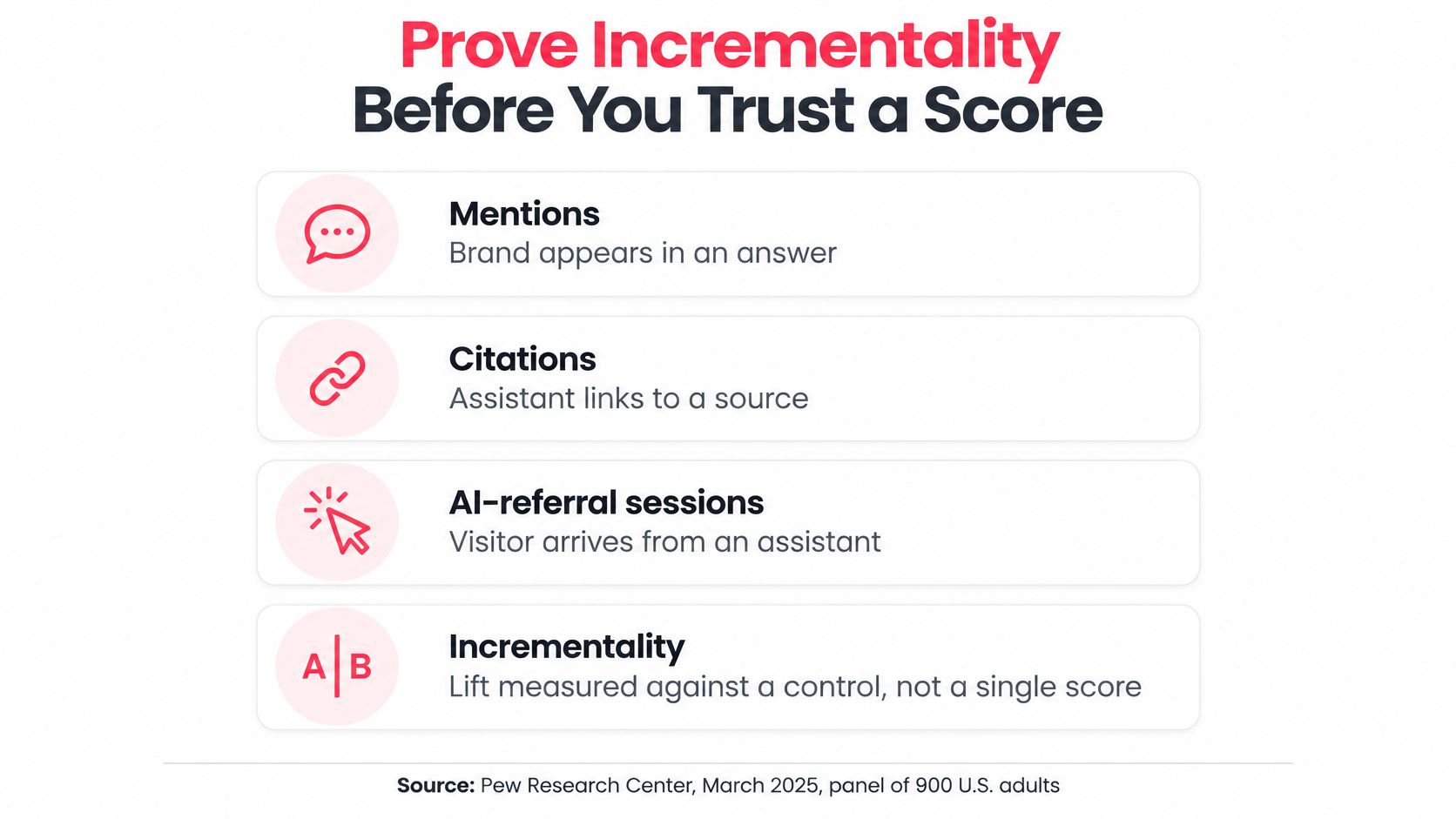
Our AI visibility audit provides a diagnostic starting point. Public evidence on B2B incrementality remains thin, so your own CRM evidence should carry more weight than a vendor benchmark.
A weekly visibility score is an input. Incrementality requires a credible comparison with what would have happened without the work.
Earn the Sources Assistants Already Cite
Publishing more owned pages is a weak intervention when assistants support recommendations with independent evidence. Start by inspecting the sources used for your category, rather than commissioning another content cluster.
Paradigm Media Networks' citation analysis describes nearly 370,000 citations, with recommendation answers frequently citing pages containing “best” or “top” and Reddit plus YouTube accounting for 43% of cited sources; a separate commerce analysis it discusses attributed 34% to editorial/review sites, 22% to forums, 18% to marketplaces, 14% to brand-owned sites, and 7% to video.
Those findings don't establish the source mix for your B2B category. Use them as a reason to investigate independent evidence, not as instructions to redirect your budget into consumer platforms.
Build a claim-to-source map
For B2B, inspect analysts and comparison pages alongside communities, technical documentation, customer discussions, and partner pages. Test video where your prompt logs show it matters; don't assume the consumer citation mix transfers.
- List the claims buyers ask assistants to check. Include implementation time, security posture, and who the product is suitable for.
- Record which domains each assistant cites when answering those questions. Preserve the specific page, rather than only the domain.
- Mark where your company is absent or misstated. Distinguish a missing recommendation from an incorrect fact.
- Assign the evidence gap to PR, customer advocacy, documentation, or partnerships. The owner needs a route to the source.
- Earn the correction through a real customer account, documented integration, or independent review. Record the published evidence before measuring answer changes.
Use this source map to decide where the team should spend effort.
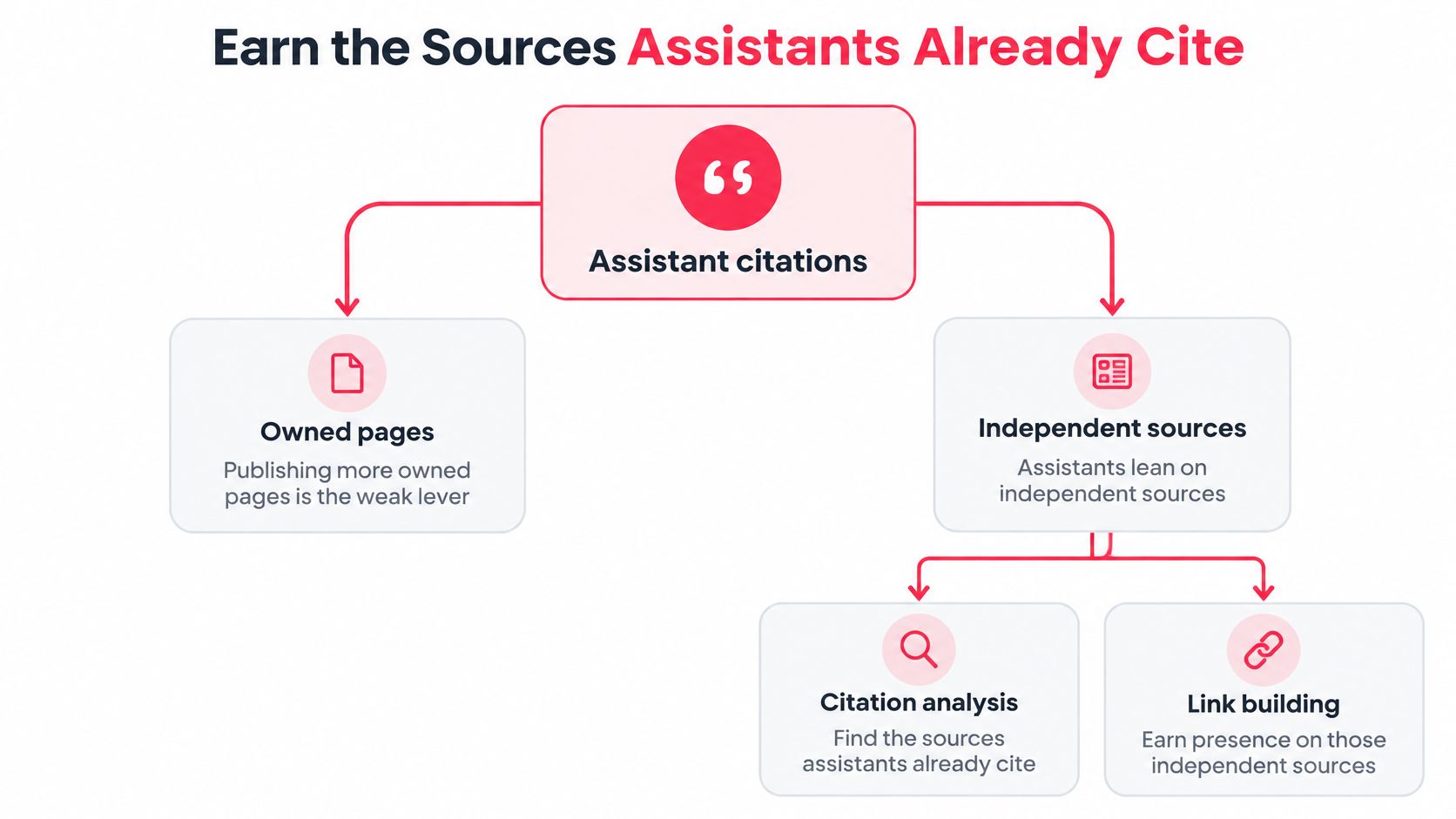
Owned pages still supply authoritative product facts. Our guidance on optimizing content for LLMs supports that work, while our AI search optimization article covers the monitoring routine. The decision here is which evidence deserves monitoring.
Invented reviews and compensated placements disguised as community participation create compliance risk and contaminate the evidence buyers use. If a small group of competitors dominates the cited set, another generic explainer offers no credible mechanism for changing inclusion.
Run the Work as a Weekly Operating Loop
Use the existing marketing lead and agency. The operating requirement is a controlled queue of changes, not a new content department.
The visual gives the team a shared workflow; the execution sequence below adds source matching and implementation acceptance.

- Have the marketing lead freeze a proposed set of 25 to 40 commercial questions, tagged by stage and product line. Keep it unchanged for a month of runs.
- Assign the agency to run identical prompts across the four assistants. Log names, citations, and factual errors separately.
- Have the analyst match each error to its cited source. Unexplained errors stay unresolved.
- Write implementation specs identifying the page, claim, third-party asset, and reviewer. The client-side owner accepts the assignment.
- Ship a small batch and preserve the prompt set. Count published, reviewed changes as shipped, never drafts.
- Review answer accuracy, branded-query movement, and CRM opportunities touched. The CMO and CRO discuss exceptions rather than narrating the dashboard.
Keep infrastructure outside this scope
Model routing, quantization, and GPU serving belong to a separate project when the company operates its own models. The benchmarks explain why that boundary matters.
The 2025 Stanford AI Index measured GPT-3.5-level performance, 64.8% on MMLU, at about $20 per million tokens in November 2022 and about $0.07 with Gemini-1.5-Flash-8B by October 2024, more than 280 times lower. The PagedAttention paper reports approximately 2–4× higher vLLM throughput against FasterTransformer and Orca at comparable latency.
A quantization benchmark across Llama-3, DeepSeek, and Qwen models with 1.5B–34B parameters found INT4 throughput improvements up to 3.9×, alongside average task-score declines of roughly 3–5 percentage points. Those acceptance tests don't belong on an answer-visibility invoice.
Our AI opportunity audit examines conversion, search visibility, sales process, and data readiness. It can conclude that AI search shouldn't come first; the AI Growth Partnership then turns the prioritized roadmap into ongoing fractional CAIO direction.
Use the accompanying video as a discussion resource for the implementation team.
Where LLM Optimization Services Waste the Quarter
Weak proposals make invoicing easy while leaving the buying decision untouched. Use the scope table's refusal column to reject isolated deliverables, then require a stop rule for the remaining work.
Google's guidance on AI features says there's no special Schema.org markup required for generative AI features, and structured data isn't a prerequisite for appearing in those experiences. Schema can support ordinary rich-result eligibility, but a completed checklist isn't proof that an assistant will cite your company.
The same discipline applies to access and publishing. A blanket crawler change bypasses a permission decision; an explainer without a corresponding buyer question consumes production capacity without a testable hypothesis.
Define failure before approving production
Give every intervention a disconfirming metric. A content correction should fail acceptance if the assistant still repeats the same error under comparable tests. An evidence campaign should lose priority if the relevant source pages never enter the observed citation set.
For commercial work, don't extend the engagement merely because the mention index rises. Have the analyst compare the agreed demand measures with the holdout, account for concurrent campaigns, and report uncertainty rather than inventing an attribution story.
Stop work that has neither a named reviewer nor an observable condition under which you would reject it.
Review sensitive claims before accelerating publication
Pricing and security pages need accountable reviewers before public rewrites. Medical or financial claims warrant the same restraint: faster publication can spread an incorrect statement before the responsible expert has approved it.
The NIST Generative AI Profile, published in July 2024, provides a governance basis for documented ownership and monitoring. Apply that basis through source checks, confidentiality rules, and a correction path when an assistant misstates the company.
Start sensitive-page work with the prompt log and an approved source of truth. The reviewer should verify the proposed wording and know who can publish a correction.
Cut any workstream whose owner can't explain what would cause it to stop. Testing velocity matters only when the team can reject a bad intervention.
Choose the Engagement That Matches the Constraint
Choose Executive Advisory when leadership needs a roadmap, vendor selection, and board-ready direction before committing to a weekly operating loop. It's our fractional Chief AI Officer partnership for CEOs, CMOs, and CROs who need AI inside the growth strategy without hiring a full-time AI leader, suited to Series A–C or established companies.
Choose the AI Growth Partnership when existing teams and agencies need a prioritized audit and direction across parallel workstreams. It includes the opportunity audit, a roadmap with KPIs, implementation-level specifications, and agent-commerce readiness where assistant-mediated buying merits preparation.
We set direction, assess production readiness, and write the specifications. Your existing team and agencies keep building.
We're paid for strategy and outcomes, rather than replacing the agency. If nobody can review claims, record assistant influence in the CRM, or authorize crawler changes with legal sign-off, postpone public optimization and fix those constraints first.
Make the next decision a scoped audit with Stimulead. Bring your commercial prompt coverage, cited-source records, and CRM attribution setup so we can identify the constraint and write an actionable brief before you approve a content order.
