
Most advice on LLMs.txt is upside down. It starts with formatting, templates, and generators. It should start with one harder question: will this file change revenue outcomes for your team right now?
For most growth-stage companies, the answer is, "only if you treat it as a low-cost experiment inside a broader AI search and conversion program." LLMs.txt can help organize high-value content for AI systems. It can also waste time if your team treats it like a ranking shortcut. I've seen both paths. The teams that get value from it keep scope tight, wire it into existing content operations, and test whether any model reads it. The teams that miss usually ship a file, declare victory, and never connect it to pipeline, citations, or sales workflows.
That's the practical lens CEOs, CMOs, and CROs need. LLMs.txt sits at the edge of AEO, GTM engineering, and agent commerce readiness. It may become useful infrastructure. It is not a substitute for structured data, clean documentation, strong landing pages, mobile-first UX, or measurement discipline.
Table of Contents
- Introduction to LLMs.txt Inventory
- Business Impact of LLMs.txt Inventory
- Recommended LLMs.txt Schema for Marketing and Sales
- Validated Examples of LLMs.txt Files
- Automation and Integration Patterns for LLMs.txt
- Criteria for Evaluating LLM Selection
- Governance and Security Considerations for LLMs.txt
- Quick Reference Checklist for LLMs.txt Maintenance
- Playbook Templates for Vendor Evaluation and GTM Workflows
- Glossary of Key LLMs.txt Terms
- Cross Reference Index of Stimulead Resources
- Practical Next Steps for LLMs.txt Implementation
Introduction to LLMs.txt Inventory
An LLMs.txt inventory is a curated map of the pages you want AI systems to find first. In practice, that usually means product pages, pricing, documentation, policies, implementation guides, and other pages that support buying decisions or correct product usage.
What is often overlooked is that the spec separates two jobs. /llms.txt is a slim index with navigation links and one-line descriptions for agents that fetch more pages after the first request. /llms-full.txt is a single concatenated Markdown file for agents that want one request with everything inside it, as described in the LLMs.txt specification summary.
That distinction matters most for SaaS, API products, and documentation-heavy sites. If your buyer journey depends on feature comprehension, implementation clarity, or policy accuracy, a bad file design creates friction for both humans and machines.
Most teams should treat LLMs.txt like technical hygiene with upside, not like a distribution channel.
There's also an adoption gap that should change how you prioritize this. A major blind spot in most guides is the lack of proof that platforms use the file. No major AI platform has officially committed to parsing it, and Google's John Mueller explicitly said "No AI system currently uses llms.txt" in the reporting covered by Publii's LLMs.txt guide. If you were hoping for preferential treatment in AI search, that claim doesn't hold.
So yes, create one if the cost is low and your content is already structured. But put it in the right bucket. It's an experiment. It belongs behind higher-confidence work such as schema, citation tracking, answer-ready content, and conversion fixes.
Business Impact of LLMs.txt Inventory
The business case for LLMs.txt is indirect. The direct revenue case belongs to AEO. If your brand wants upstream influence in AI-mediated buying, you need structured data markup and citation tracking across AI environments. That approach directly correlates with increased mention frequency, sentiment, and pre-conversion revenue attribution in partner funnels, based on the Partnerize framework for measuring AI-driven conversions.
That's where most budget should go first.
LLMs.txt can support that motion by making your best commercial and support content easier to package. But it doesn't replace the systems that help leadership inspect revenue movement. If your team has limited bandwidth, I'd rank work in this order:
- Fix citation readiness with structured data, clean canonical pages, and answer-oriented copy.
- Track AI mentions and downstream influence in assisted conversion paths.
- Tighten mobile conversion paths because more than 50% of total web traffic in most industries now comes from mobile devices, and a weak mobile journey will drag conversion no matter how polished your AI-facing assets are.
- Publish LLMs.txt once your source pages are clean.
Where LLMs.txt helps
A good file can reduce confusion around what your company wants cited or fetched first. That's useful when you have sprawling docs, old support content, multiple pricing versions, or scattered product pages.
Where LLMs.txt doesn't help
It won't rescue weak source material. It won't repair broken pricing logic. It won't fix missing FAQs, poor schema, or generic feature pages. And it won't create pipeline by itself.
For CEOs and CROs, the trade-off is simple. If publishing LLMs.txt takes a small amount of engineering and content time, do it. If it starts competing with proven AEO work, conversion testing, or GTM instrumentation, cut scope fast.
Recommended LLMs.txt Schema for Marketing and Sales
Generic llms.txt templates are usually too thin to help pipeline. Revenue teams need a schema that points AI systems to pages that answer buyer questions, reduce sales friction, and survive legal and pricing review.
The formatting rules are tight enough that sloppiness creates parsing risk. The current draft spec in the llms.txt repository on GitHub sets the practical baseline: one H1 using the brand or product name, a short blockquote summary directly under it, H2 sections for grouped links, and link entries written as Title: Description. That structure is simple to produce, but the main work is choosing which pages deserve inclusion and then validating how AI platforms ingest them.
Use two files with different jobs
I recommend treating the files as separate operational assets.
- Use
/llms.txtas the curated index for pages tied to evaluation, purchase, implementation, and support. - Use
/llms-full.txtonly if your team can generate clean Markdown from maintained source content and keep it current across releases.
This is a revenue decision, not just a documentation decision. A short, curated file is easier to review with product marketing, sales engineering, legal, and support. A full-file export can help discovery, but it also increases the chance that an outdated pricing page, deprecated integration, or superseded policy gets picked up and repeated in AI answers.
For growth-stage SaaS teams, I usually start with the smaller file, then add /llms-full.txt after the company proves three things: page ownership is clear, update workflows are reliable, and the team has a validation routine for ChatGPT, Claude, Perplexity, and any buyer-facing agent workflow they care about.
A category model built for commercial use
A practical schema for marketing and sales usually includes these categories:
- Product
- Pricing
- Documentation
- Security and Compliance
- Use Cases
- Customer Stories
- Support and Policies
Those categories map well to the actual buying journey. Product and use case pages shape initial fit. Pricing and security pages reduce late-stage friction. Documentation supports technical validation. Customer stories help with proof. Support and policy pages lower post-sale confusion and reduce avoidable objections during procurement.
A handoff-ready pattern looks like this:
# Acme Platform

> Acme Platform provides workflow automation software for revenue teams, including integrations, pricing, implementation guidance, and support resources.

## Product
Platform Overview: Summary of core product capabilities and buyer fit.
Integrations: Supported integrations and setup details.
Use Cases: Role-specific applications for sales, marketing, and operations.

## Pricing
Pricing: Current plans, packaging, and commercial considerations.
Enterprise: Enterprise buying path and procurement details.

## Documentation
Developer Docs: Technical setup, authentication, and implementation guidance.
API Reference: Endpoint-level reference for developers.

## Security and Compliance
Security Overview: Controls, architecture, and trust information.
Compliance: Current compliance posture and policy references.

## Customer Stories
Case Studies: Customer examples by segment and use case.

## Support and Policies
Help Center: Product support and troubleshooting.
Terms: Service terms.
Privacy: Privacy policy and data handling.
A few implementation notes matter more than teams expect:
- Use absolute URLs. Relative links are one of the fastest ways to create silent failures.
- Keep descriptions literal. Don't write clever marketing copy. Write what the page contains.
- Map categories to buyer intent. Pricing and use cases belong near the top for commercial sites.
- Remove dead pages fast. An outdated pricing page inside LLMs.txt does more damage than no file at all.
Practical rule: If a sales rep wouldn't send the page to a live prospect, it probably doesn't belong in LLMs.txt.
Validated Examples of LLMs.txt Files
Templates are easy. Useful examples are harder because most published files aren't tied to a real commercial workflow. The best way to judge quality is to ask whether the categories mirror how buyers evaluate the company.

Example one for a SaaS API company
A documentation-heavy SaaS company should bias the file toward onboarding and implementation clarity. That usually means Product, Documentation, Security, Pricing, and Support.
A workable structure looks like this:
# Northstar API

> Northstar API provides transaction infrastructure for software teams, with implementation docs, commercial details, and trust resources.

## Product
Overview: Core platform capabilities and target use cases.
Integrations: Native integrations and setup notes.

## Documentation
Quickstart: Fast setup path for developers.
API Reference: Full reference for endpoints and parameters.

## Security
Security: Security architecture and operational controls.

## Pricing
Pricing: Plan structure and commercial packaging.

## Support
Help Center: Troubleshooting and support articles.
What works here is prioritization. A technical buyer or coding agent can reach setup content immediately. A procurement contact can find pricing and security without digging through the docs tree.
Example two for an e-commerce brand
An e-commerce brand has a different job. The file should steer agents toward product taxonomy, shipping and returns, sizing, and support. Those pages reduce purchase friction and cut citation errors.
A clean version looks like this:
# Meridian Outdoor

> Meridian Outdoor sells performance apparel and gear, with product details, sizing guidance, shipping policies, and customer support resources.

## Products
Catalog: Main product catalog and category navigation.
Best Sellers: Frequently purchased items and featured collections.

## Buying Guides
Sizing Guide: Fit and sizing guidance across product lines.
Care Guide: Washing and product care instructions.

## Shipping and Returns
Shipping: Delivery options and fulfillment expectations.
Returns: Return policy and process.

## Support
Help Center: Order support and FAQs.
The common failure modes are predictable:
- Missing descriptions make the file less parseable.
- Relative URLs create ambiguity.
- Promotional category names hide buying intent.
- Low-value blog posts crowd out commercial pages.
If you want this file to help real buying workflows, treat it like a curated sales asset. Keep it small. Keep it current. Keep it biased toward decision-critical pages.
Automation and Integration Patterns for LLMs.txt
Manual maintenance works for about a week. After that, teams forget the file exists, pages move, and nobody knows whether the published version still matches the site.
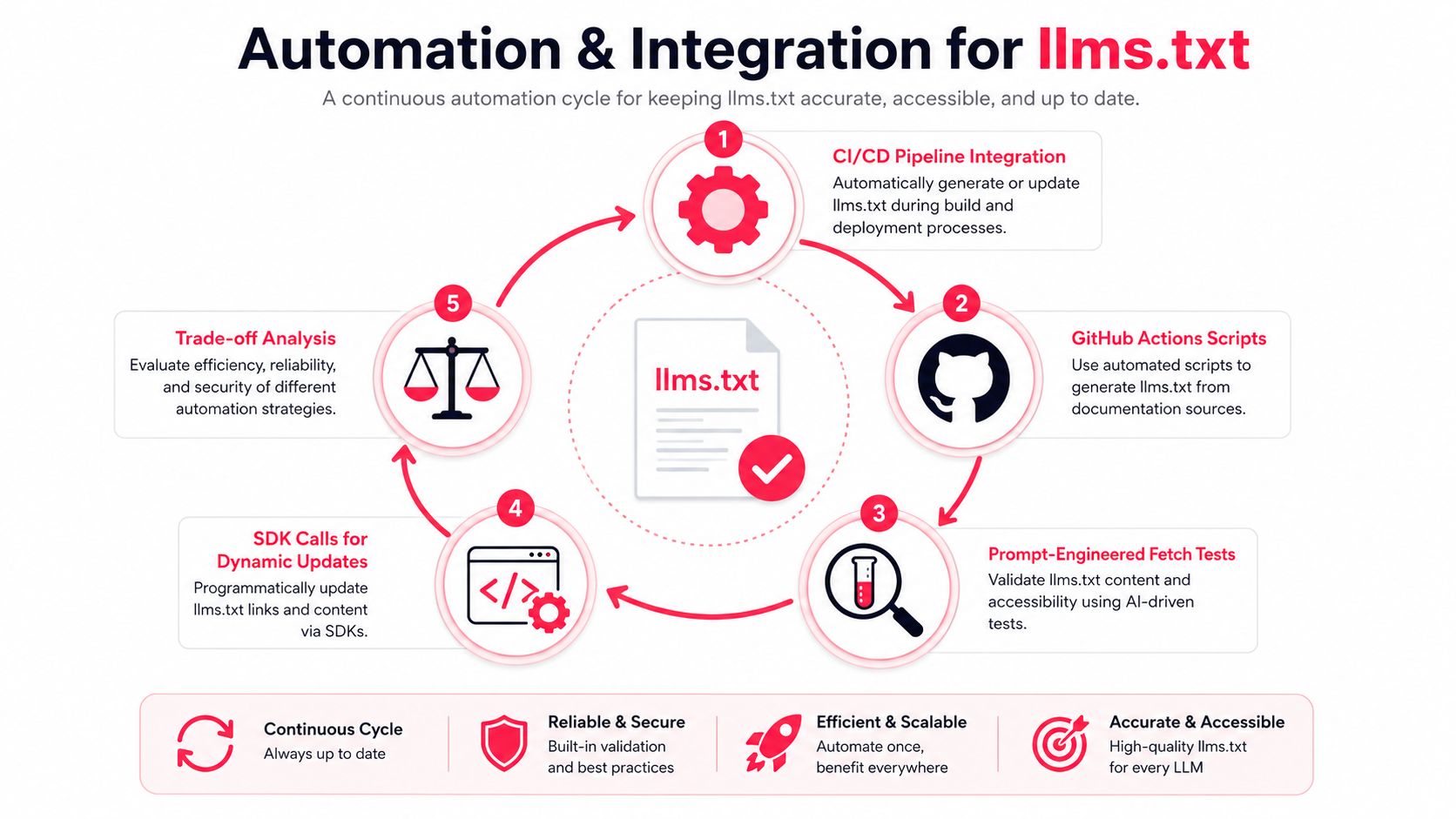
The better pattern is to generate LLMs.txt from source systems you already trust. For most companies, that means docs repos, CMS collections, or a page inventory maintained by growth and product marketing. If your team is already building AI-enabled workflows for content and operations, this should sit inside the same automation layer you use for AI automation in marketing and sales.
The maintenance pattern that holds up
I prefer a simple pipeline:
- Store approved source URLs in one place. That might be a YAML file, CMS collection, or content ops spreadsheet.
- Run a build script that outputs valid Markdown in the required structure.
- Fail the build if required fields are missing, categories exceed the approved range, or links return errors.
- Publish both files only after review if your site uses both index and full versions.
- Log changes in version control so marketing and engineering can inspect what changed.
A minimal pseudo-workflow looks like this:
content source -> validation script -> llms.txt output -> link check -> deploy
At this point, trade-offs emerge.
| Approach | Best for | Risk |
|---|---|---|
| Manual editing | Small sites with stable pages | Drift and stale links |
| Build-time generation | SaaS and docs-heavy teams | Needs schema discipline |
| CMS-driven generation | Marketing-led sites | Requires governance on page approval |
| Dynamic API generation | Fast-moving catalogs | Higher complexity and review needs |
Here's the operational rule. If your release velocity is high, manual editing won't keep up. If your site is small and static, full automation is overkill.
A short video can help your team visualize how the file works in practice:
How to verify parsing instead of assuming it
Most articles stop at "make sure the file loads." That isn't enough.
A neglected issue in this space is verification. Practical guidance on testing is rare, and one of the few clear signals we have is that Claude is one of the few engines actively reading LLMs.txt, according to Smart Money Media's guide to LLMs.txt verification. That makes Claude the right place to run live checks.
Use a basic protocol:
- Ask a brand-specific question in Claude with web search enabled.
- Use a query tied to pages listed in your file, such as pricing, implementation, or return policy.
- Check cited URLs in the answer.
- Compare output before and after file changes so you know whether updates affect retrieval behavior.
- Inspect for silent failures like broken absolute links or vague descriptions.
If you can't prove retrieval on a live platform, treat the file as unpublished from a business standpoint.
That testing habit matters more than the file itself. It forces your team to stop guessing.
Criteria for Evaluating LLM Selection
Choosing an LLM for search visibility work, internal copilots, or agent commerce isn't about model benchmarks in the abstract. It's about operational fit. If you care about LLMs.txt, the first criterion is obvious: does the platform show any sign of respecting it in real usage?
What belongs in the rubric
I use five criteria.
- Parsing support. Can the model or surrounding product retrieve URLs that align with the file?
- Web retrieval reliability. Does it consistently cite source pages instead of hallucinating structure?
- Commercial fit. Can your team connect model usage to pipeline, support deflection, or conversion work?
- Governance options. Can legal and security teams control exposure and review source pages?
- Workflow compatibility. Does it fit your stack, from CMS to analytics to CRM?
If you're comparing customer-facing AI layers too, look at vendor ecosystems. For teams reviewing embedded chatbot and assistant tools, guides covering platforms like Chatbase can be useful because they show how different vendors package retrieval, deployment, and control.
LLM evaluation criteria comparison
The table below is qualitative on purpose. Public commitments on LLMs.txt parsing are limited, so pretending to rank vendors with false precision would be a mistake.
| Criterion | Importance | LLM A | LLM B | LLM C |
|---|---|---|---|---|
| Parsing support | High | Some live testing signals | No clear public commitment | No clear public commitment |
| Web retrieval reliability | High | Strong in some workflows | Varies by product context | Varies by product context |
| API stability | Medium | Assess in pilot | Assess in pilot | Assess in pilot |
| Governance controls | High | Review contract and admin options | Review contract and admin options | Review contract and admin options |
| Revenue impact potential | High | Use on live commercial use cases | Use on live commercial use cases | Use on live commercial use cases |
A CEO doesn't need a prettier table. They need a decision rule.
Pick the model your team can test against revenue this week, not the one with the loudest launch cycle.
For most companies, that means piloting on a narrow workflow. Product recommendation. Pricing explanation. Support deflection. Sales research. Then inspect what the system cites, how often it retrieves approved pages, and whether it moves a KPI your revenue team values.
Governance and Security Considerations for LLMs.txt
LLMs.txt looks harmless because it's only a text file. That's exactly why it gets sloppy treatment. Teams publish links without checking whether the destinations expose stale claims, internal playbooks, deprecated docs, or compliance-sensitive material.
What to control before publishing
Start with page eligibility. Every linked destination should pass the same review standard you'd apply to a public sales enablement asset.
Use a short control list:
- Ownership. One person in marketing or product marketing owns content inclusion.
- Approval. Engineering or web ops approves deployment changes.
- Security review. Security or legal reviews categories that touch trust, compliance, or policies.
- Audit trail. Every change lands in version control with reviewer names and rationale.
If your company sells into regulated regions, page-level review should include residency and privacy implications. A practical primer like this GDPR and data residency guide helps teams align public documentation with where data is stored and how claims are worded.
A simple approval workflow
I recommend folding LLMs.txt into the same controls you use for AI-facing content governance. If your team doesn't have that system yet, start with an operating checklist and tie it to broader AI governance best practices.
A simple flow works:
- Marketing proposes additions based on live buying journeys.
- Web or engineering validates structure and link integrity.
- Legal or security reviews sensitive destinations.
- Ops publishes through normal deployment controls.
- Analytics or growth logs test results from live AI environments.
Two mistakes show up often. First, teams include pages because they're politically important, not because they're useful. Second, nobody removes outdated pages after launches, pricing changes, or product packaging updates.
The fix is boring and effective. Treat LLMs.txt as a governed artifact. Small file. Clear owner. Review trail. Regular pruning.
Quick Reference Checklist for LLMs.txt Maintenance
You don't need a quarterly committee for this. You need a fast sprint check.
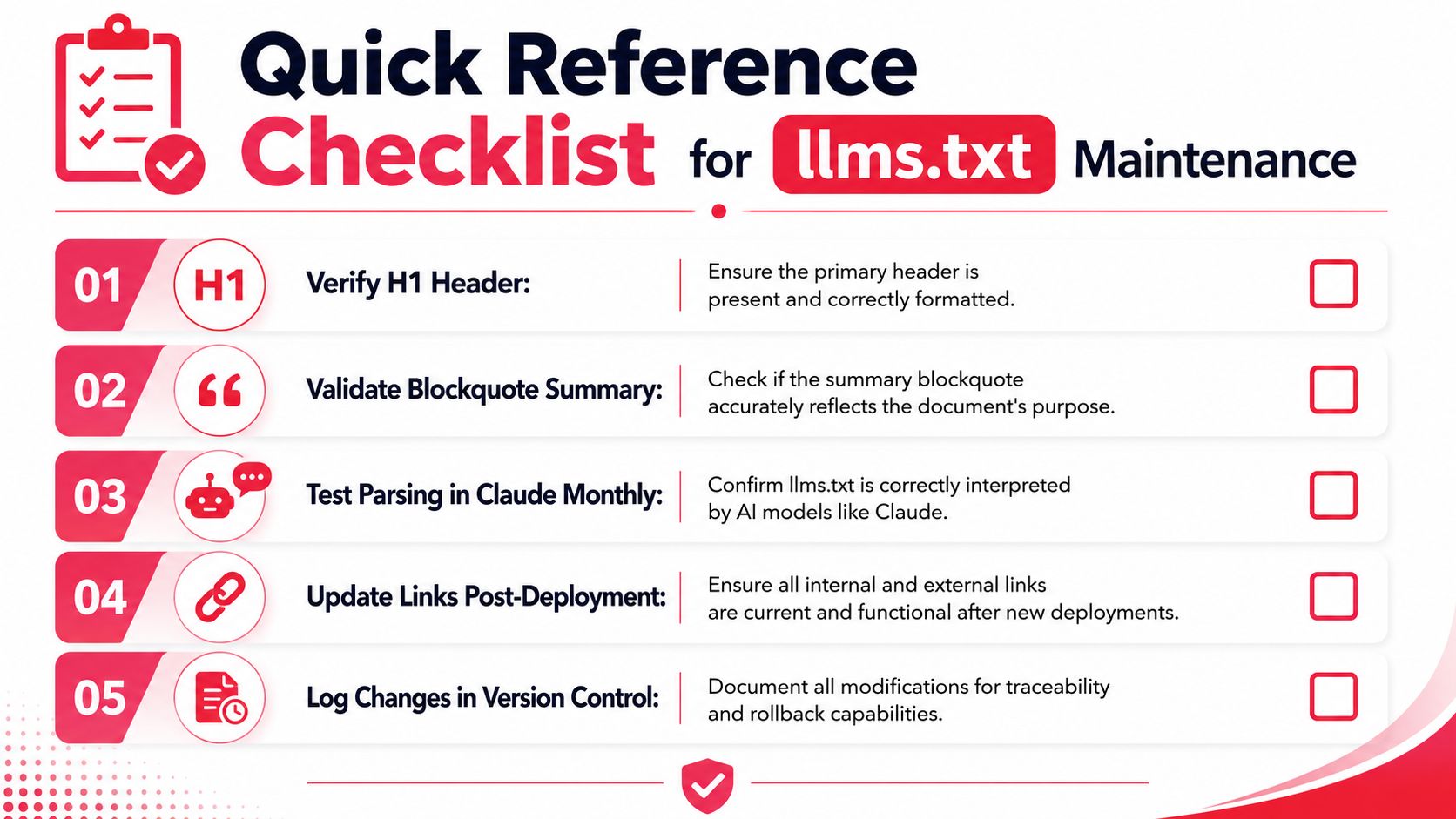
Use this pass or fail list:
- H1 is present. The file has exactly one H1 and it uses the literal brand or product name.
- Blockquote follows immediately. The summary sits right under the H1 and describes the site plainly.
- Categories stay disciplined. H2 sections stay within the approved logical groups and don't sprawl.
- Links use the correct format. Every entry follows
[Title](URL): Description. - Claude check is logged. Someone ran a live parsing test and saved the result.
- Changed pages are reflected. Pricing, docs, policy, and support links still point to current destinations.
- Version control is current. The latest update has an owner, date, and reason.
A team can review that in a few minutes during a sprint close. If two or more items fail, stop treating the file as reliable input for AI systems.
Playbook Templates for Vendor Evaluation and GTM Workflows
Most AI pilots drift because nobody ties them to a weekly number. The rule I use is simple, and it matches what Stimulead has published on AI pilots: the only valid success metric is a revenue-tied KPI your team can inspect weekly, such as win rate improvement, landing page conversion lift, or outbound sequence reply rate. If speed, quality, and business movement don't all shift within two weeks, revise or kill the pilot, as explained in this guidance on AI workflow pilots.
Vendor evaluation template
Use this when you're assessing an LLM vendor, retrieval layer, or AI search workflow.
| Field | What to enter |
|---|---|
| Use case | Example: pricing explanation, product recommendation, sales research |
| Decision owner | CEO, CMO, CRO, or functional lead |
| Technical owner | Engineering, RevOps, or web lead |
| Parsing test method | Live query checks against approved pages |
| Governance review | Security, legal, and brand review status |
| Revenue KPI | One weekly inspectable KPI |
| Review cadence | Weekly |
| Kill criteria | No movement in speed, quality, and business outcome within the pilot window |
Keep scoring qualitative. The point isn't to create a fantasy precision model. The point is to force decision-makers to confront fit, proof, and accountability.
GTM workflow template
Use this when LLMs.txt is part of a broader commercial workflow.
Goal
Connect approved source pages to AI-mediated buying journeys.Functions involved
Marketing, sales, product marketing, web, RevOps, support.Primary workflow
Publish approved source pages, maintain LLMs.txt, test live retrieval, review citations, and inspect downstream KPI movement.KPI choice
Pick one. Landing page conversion lift. Win rate improvement. Outbound reply rate.Operating cadence
Weekly KPI review. Sprint-level page and file review. Immediate revision if retrieval points to weak or outdated pages.Exit rule
If the workflow creates busywork without better citations, cleaner sales conversations, or movement in the chosen KPI, stop.
This is also where AI-powered CRO matters. Growth teams can test at 10x the speed of traditional human-led testing by automating micro-optimizations like copy, button placement, and form changes, according to CXL's analysis of AI and conversion rate optimization. That matters because the pages you expose to AI still need to convert humans after the click.
Glossary of Key LLMs.txt Terms
A shared vocabulary keeps teams from talking past each other. Use these definitions internally.
Core terms
LLMs.txt
A Markdown file at the root of a site that points AI systems to high-value content.LLMs-full.txt
A larger concatenated Markdown file that contains the full documentation set in one place.H1 header
The top-level heading. In this format, it should contain the literal brand or product name.Blockquote summary
The short summary immediately under the H1 that explains the purpose of the site or product.Parsing engine
The model or retrieval system that reads the file and decides what to fetch next.
Workflow terms
AEO
Answer Engine Optimization. The work required to earn citations and recommendations in AI environments.CI/CD
Build and deployment workflows that can generate, validate, and publish LLMs.txt automatically.Citation tracking
Monitoring where and how AI systems mention your brand or pages.Agent commerce
Buying flows where AI systems influence or assist product selection, comparison, and recommendation.
Keep these definitions in your ops docs. It saves time in legal review, web planning, and vendor calls.
Cross Reference Index of Stimulead Resources
If you're treating LLMs.txt as part of a revenue system, a few adjacent topics deserve more attention than the file itself.
AI search visibility and recommendation strategy
The most relevant next read is how to get recommended by ChatGPT or Claude or Gemini. It connects source-page quality, citations, and answer readiness to actual recommendation outcomes.CRO with AI
Use this topic to tighten the landing pages, forms, and post-click experience that LLM-referred visitors will hit.GTM engineering
This matters when you need cleaner page inventories, stronger content operations, and better routing between web, CRM, and reporting.Agent commerce readiness
This matters if your buyers increasingly rely on AI systems to compare tools, summarize pricing, or shortlist vendors before speaking to sales.
The broader point is simple. LLMs.txt should sit inside a system that already measures influence, conversion, and pipeline. On its own, it doesn't carry enough weight.
Practical Next Steps for LLMs.txt Implementation
This week, do three things.
First, run a live parsing test in Claude. Use a question tied to a page you'd want cited in a sales or buying scenario. Log the prompt, returned URLs, and whether the output matches your approved source pages. If the test fails, don't guess why. Check link format, descriptions, and destination quality.
Second, draft your LLMs.txt schema and review it with engineering. Keep the first version narrow. Product. Pricing. Docs. Security. Support. That's enough for most companies. If you can't agree on which pages belong, your issue isn't the file. It's source-page governance.
Third, launch a small pilot with one revenue KPI. That could be landing page conversion lift, win rate improvement, or outbound reply rate. Review it weekly. If your team sees no movement in workflow speed, output quality, or business progress inside the pilot window, cut scope or stop.
That's the right posture for LLMs.txt. Useful if controlled. Cheap if scoped. Dangerous only when it distracts from work that already drives revenue.
If you want help turning LLMs.txt, AEO, CRO with AI, GTM engineering, or agent commerce readiness into a measured operating plan, Stimulead can help your team assess the opportunity, structure the pilot, and tie the work to revenue.