
AI search optimization moved out of the experimentation bucket. It now sits in the revenue line.
The reason is simple. In one 2026 analysis, about 93% of AI search sessions ended without a website click, and AI Overviews cut clicks to the top-ranking page by 58% (Superlines research on AI search statistics). If your acquisition model still assumes search traffic flows from rankings to visits to forms, that model is already under pressure.
This changes the job. You're no longer optimizing only for blue links. You're optimizing for whether an answer engine describes your category correctly, cites your brand when buyers compare options, and carries your product facts into the buying journey. That's why executives who are already investing in CRO, GTM engineering, and AI-assisted sales should treat AI search optimization as part of growth operations, not as an isolated SEO project. If you need executive ownership for that shift, this is the kind of remit that usually lands with a fractional Chief AI Officer.
If your team is still treating this as “prepare for rankings plus maybe some schema,” that's too narrow. A useful framing is to prepare for AI Overviews as a distribution layer that can either compress your funnel or route buyers toward you before they ever reach your site.
Table of Contents
- Why AI Search Is a Board-Level Concern
- The AEO Audit Your Starting Playbook
- The New Technical Stack for AI Readiness
- Content and Corroboration Tactics That Work
- A Measurement Framework Beyond Clicks
- Building Your Team and Choosing Partners
- Your First 90-Day Execution Roadmap
Why AI Search Is a Board-Level Concern
Most marketing shifts can stay inside the demand gen team for a while. This one can't.
When AI systems answer the question directly, they decide which vendors get framed as credible, which product claims get repeated, and which sources get named. That affects branded search, direct traffic quality, category education, and sales-call context before your team ever gets a chance to pitch. AI search optimization is a revenue control issue because the answer layer is now influencing buyer perception upstream of the click.
There's also a market signal executives shouldn't ignore. The generative engine optimization market was estimated at $848 million in 2025 and projected to reach $33.7 billion by 2034 at 50.5% CAGR (Superlines research on AI search statistics). That doesn't mean every vendor deserves budget. It does mean operators across categories are moving spend and attention into this channel.
The board-level trade-off
A leadership team usually faces three choices:
- Treat AI search optimization as an SEO extension. Cheap in the short term. Weak in execution because nobody owns product facts, entity consistency, analytics, and sales alignment together.
- Treat it as a content project. Faster to start. Limited impact because content without entity trust, technical access, and measurement rarely changes commercial outcomes.
- Treat it as a growth system. Harder to organize. More likely to produce signal you can tie to pipeline.
Practical rule: If AI search work isn't connected to pipeline review, CRM attribution, and category messaging, it won't stay funded.
What works is central ownership with cross-functional execution. Marketing shapes the narrative. Product marketing supplies the facts. RevOps defines attribution. Engineering fixes access and structure. Sales reports which AI-framed objections or comparisons are showing up in calls. That's the operating model.
The AEO Audit Your Starting Playbook
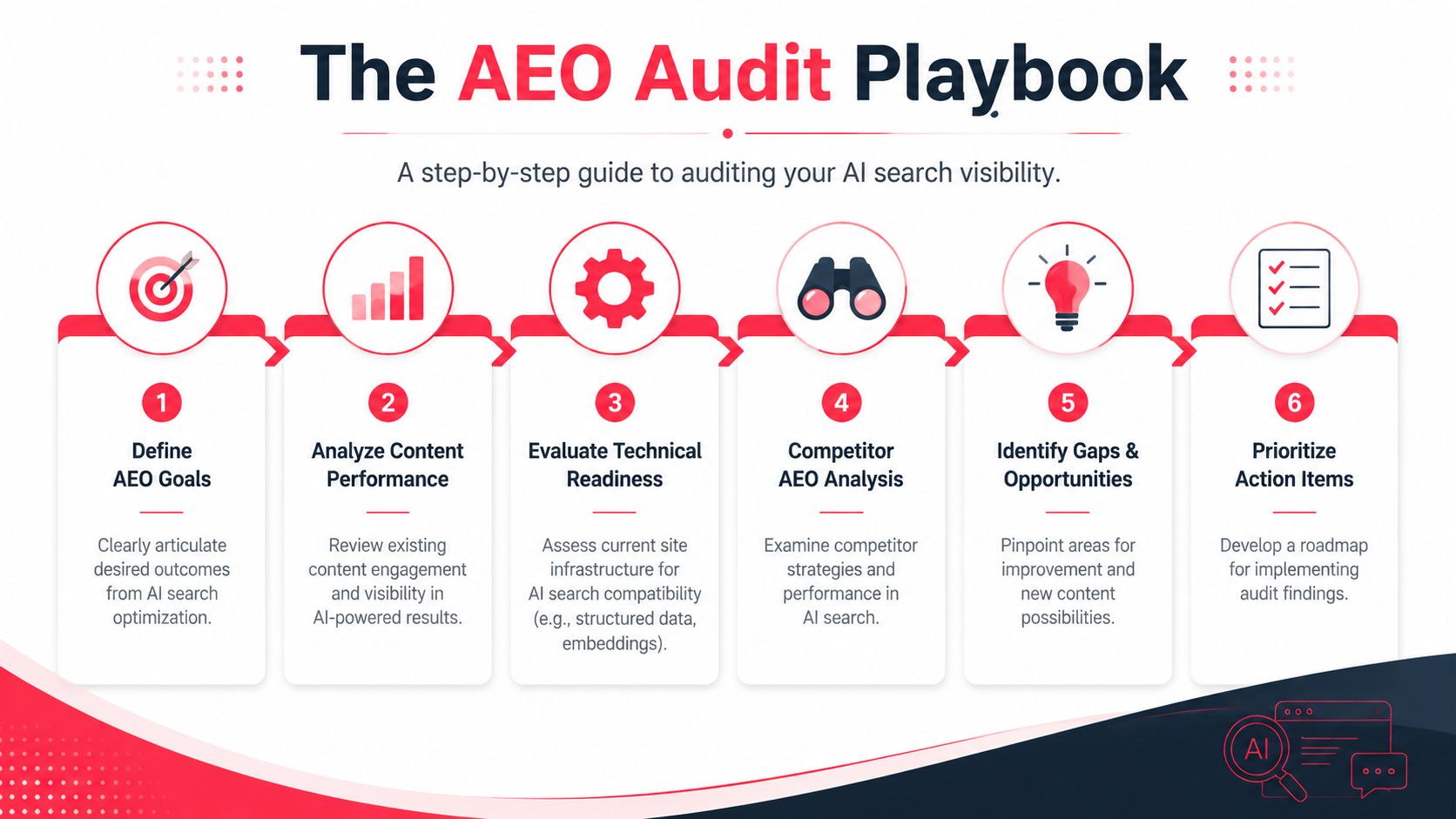
Before you change content, tools, or team structure, get a baseline. AEO programs fail early because teams publish “optimized” pages without knowing whether they're visible for the queries that matter.
A practical workflow starts with 20 to 30 buyer-intent queries across ChatGPT, Perplexity, and Claude, then tracks citation rate, share-of-voice rank, and platform coverage weekly. The same workflow recommends measuring downstream impact by attributing AI-referral traffic in GA4 and mapping it to MQLs and revenue in CRM (Discovered Labs guide to AI visibility audits). That's the right starting point because it gives executives a scorecard instead of opinions.
Start with commercial queries
Don't start with vanity prompts. Start with the phrases that sit close to revenue.
Use a balanced set such as:
- Problem-aware queries like buyers use before they know your category well
- Category queries where the engine recommends types of solutions
- Comparison queries where vendors get named
- Implementation queries that shape trust after shortlist creation
- Local or vertical modifiers if geography or industry changes the answer
A good external reference for prompt shaping and SERP pattern review is Surnex's AI Overviews strategy. It's useful because it forces teams to think in query classes instead of random tests.
Build the scorecard
Keep the scorecard simple enough that it gets updated every week.
| Field | What to record |
|---|---|
| Query | Exact buyer-intent phrase |
| Platform | ChatGPT, Perplexity, Claude, Google AI Mode if tested manually |
| Answer presence | Whether your category position or product angle appears |
| Citation presence | Whether your brand is named or linked |
| Share of voice | Which brands appear most often |
| Message accuracy | Whether the answer describes your offer correctly |
| Commercial intent | High, medium, or low |
| Next action | Page update, schema fix, corroboration, new asset |
Tie visibility to revenue systems
Organizations often stop too early. They track mentions and call it success.
That misses the commercial question. Did AI-originated discovery create qualified demand, improve conversion quality, or reduce friction in sales? Connect AI-referred sessions in GA4 to your CRM and inspect what those visitors do differently from other traffic sources. Look at demo requests, sales-qualified leads, influenced opportunities, and closed-won notes. The point isn't perfect attribution. The point is directional evidence you can use to prioritize.
The first scorecard shouldn't try to prove ROI. It should expose where your company is absent, misrepresented, or easy to replace in AI answers.
If you want this work to hold budget, present the audit like a pipeline risk review. Show where the buyer asks for help, which competitors the models mention, and where your own product facts fail to appear.
For teams doing AI-assisted content execution, this is a natural bridge into a broader AI content marketing operating model.
The New Technical Stack for AI Readiness
Executives don't need to become experts in vector databases. They do need to know what the stack enables.
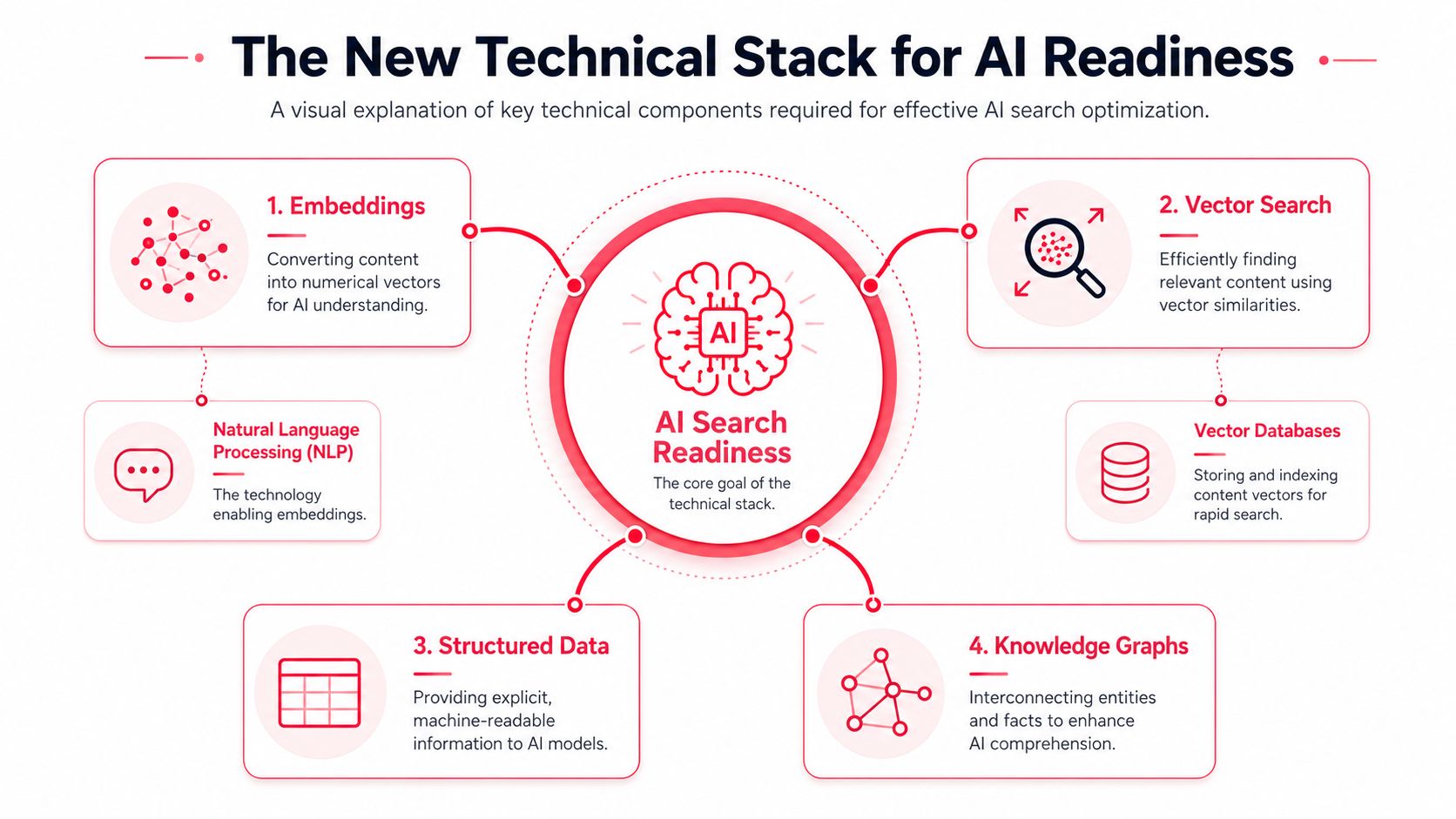
Traditional search systems match pages to keywords and authority signals. AI systems try to retrieve meaning, compare entities, and assemble answers from available evidence. That changes how your content, docs, product data, and structured information need to be stored and exposed.
What the stack actually does
Think of the stack as four layers.
First, structured content. This is your site, help center, product pages, pricing details, policies, and category content organized in a way machines can parse. Clean headings, explicit claims, FAQ blocks, and visible on-page support matter here.
Second, embeddings. These turn text into a map of meaning. Your engineering team doesn't need to explain the math to leadership. What matters is the outcome: systems can find conceptually related material even when the wording changes.
Third, vector search. This is the retrieval layer that pulls the most relevant content based on semantic similarity. If a buyer asks a nuanced question, vector retrieval helps the system find the right paragraph or document instead of only a page with matching terms.
Fourth, RAG, or retrieval-augmented generation. This takes retrieved source material and uses it to produce a grounded answer. From a business standpoint, RAG reduces the odds that your on-site AI assistant, sales agent, or internal knowledge bot answers from vague memory instead of current source content.
If your content repo is messy, duplicated, or detached from product truth, AI systems will surface that mess faster than human visitors ever could.
What leadership should ask for
A strong technical brief for AI search readiness should answer these questions:
- Content access: Can crawlers and systems reach the pages that contain your product facts, category explanations, and proof?
- Source structure: Are key claims visible on-page and supported by markup where appropriate?
- Knowledge source quality: Are pricing, plans, support docs, and feature details maintained in a single source of truth?
- Entity clarity: Do your brand, products, people, locations, and relationships appear consistently across systems?
- Retrieval design: If you deploy on-site AI, can it retrieve precise source passages instead of broad documents?
- Governance: Who approves updates when product messaging changes?
Google's own guidance is still the baseline for external visibility. Pages need crawlability, a valid HTTP 200 response, indexable content, and markup that matches visible content. Restrictive controls such as nosnippet, data-nosnippet, max-snippet, or noindex can limit appearance in AI experiences, and Google also points to unique content and good page experience as prerequisites (Google guidance on succeeding in AI search).
For marketing leaders, that means AI readiness isn't a plugin. It's content architecture, technical access, and retrieval discipline applied to revenue-critical information. If your team needs a broader frame for how this connects to the rest of your stack, this piece on AI marketing and online growth systems is a useful companion.
Content and Corroboration Tactics That Work
Work often begins with article rewrites. That's only part of the job.
AI systems need two things from your brand. They need content they can parse with confidence, and they need outside signals that confirm your company is real, current, and credible. Many programs underperform because they only fix the first part.

On-page content that AI can trust
Write pages so a retrieval system can extract one clean answer from them.
That means fewer vague slogans and more explicit statements. If your product serves a specific buyer, state who it's for. If you replace a workflow, name the workflow. If pricing depends on usage or seats, explain the model in plain language. If implementation has dependencies, say so.
A practical page review looks for:
- Clear factual claims with direct wording instead of soft positioning language
- Visible support for markup so structured data reflects what users can see
- Tight sectioning with headings that map to buyer questions
- Original material such as internal data, frameworks, or operational points of view
- Freshness discipline so outdated product facts don't linger in old URLs
The content that performs best in AI environments usually has sharp edges. It says something specific. It includes distinctions a generic model summary can't reproduce cleanly.
Off-page corroboration is where many teams lose
A persistent gap in AI search optimization is off-page corroboration. Generative systems appear to rely on external mentions, authoritative directories, reviews, and other third-party signals to verify a brand's entity and legitimacy. Consistent business facts, geospatial accuracy, location pages, and directory presence are all cited as important inputs for AI understanding (Uberall on AI search and off-page corroboration).
For executives, this matters because the fix often sits outside the content team. SaaS companies need aligned listings, product profiles, executive bios, review platforms, and partner pages. Multi-location brands need location pages, business profile hygiene, and consistent operating details. B2B firms need conference profiles, association pages, author bios, and clear entity references that tie back to the company.
A simple corroboration checklist:
- Core business facts: Company name, product names, category, locations, contact details
- Third-party presence: Review sites, directories, partner listings, marketplace pages
- Expert identity: Founder bios, author pages, speaking profiles, podcast appearances
- Commercial proof: Reviews, testimonials, public case material, customer quotes where approved
- Local accuracy: Business Profile details, service areas, location landing pages
Here's a practical walkthrough worth watching before your team starts reworking page templates and entity pages:
What usually fails
Three patterns show up again and again.
First, publishing lots of generic educational content. It may rank somewhere. It rarely earns recommendation value in AI answers if it doesn't carry a distinct viewpoint or proprietary detail.
Second, relying on schema alone. Schema helps. It doesn't rescue weak, unclear, or unsupported claims.
Third, splitting ownership across too many teams. Content updates happen in one queue, review sites in another, local listings somewhere else, and nobody checks whether the same company facts appear consistently across all surfaces.
Strong AI visibility usually comes from tight product facts, explicit authorship, and corroboration that survives cross-checking.
A Measurement Framework Beyond Clicks
Clicks still matter. They just aren't enough to judge AI search optimization.
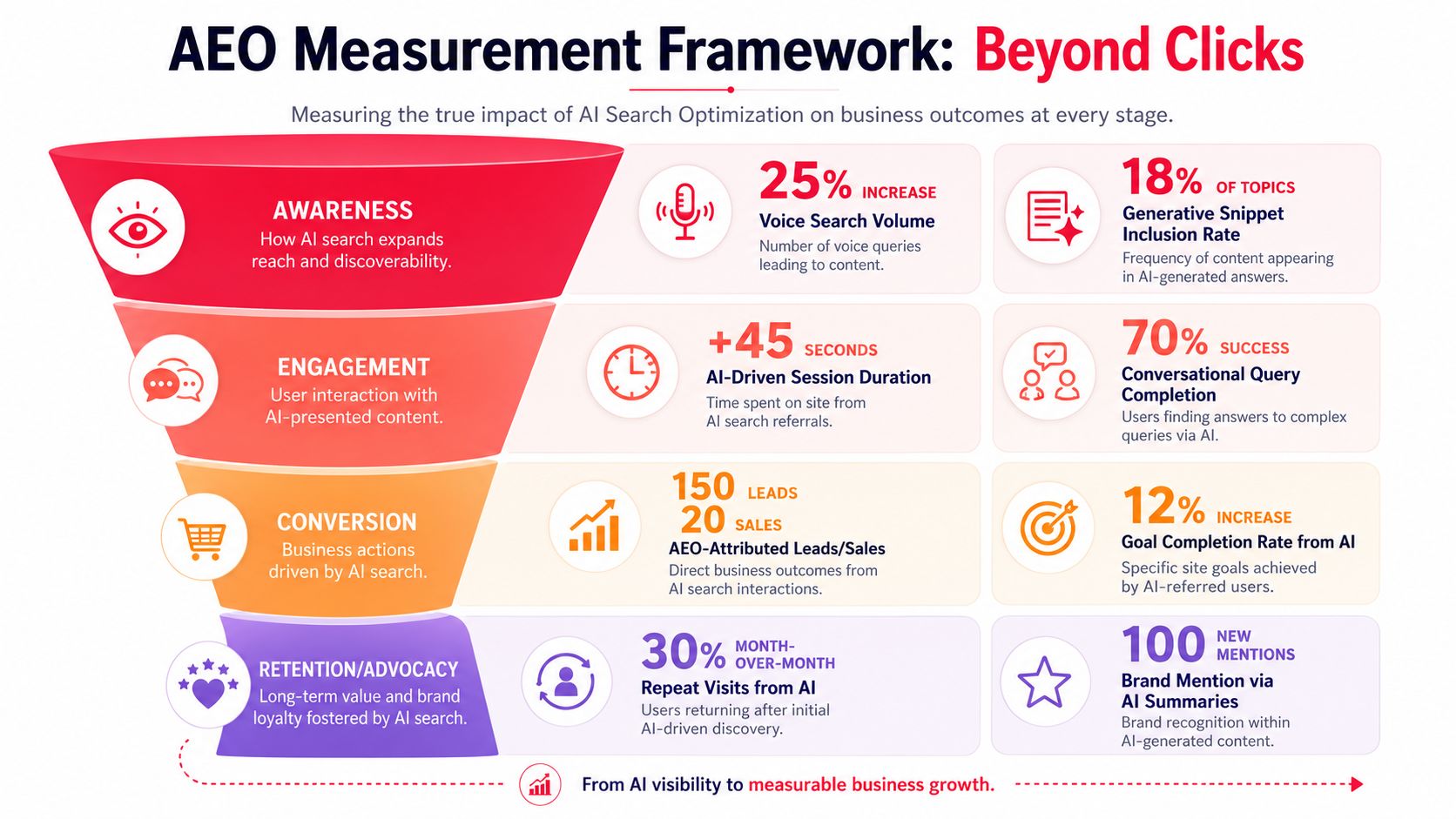
The better way to measure this channel is to split it into two jobs. Answer optimization means shaping how an AI system explains a topic, category, or workflow. Citation optimization means becoming the source or named brand inside the answer. Those aren't the same objective, and they don't produce the same business effect.
Separate answer optimization from citation optimization
This distinction matters because many informational queries drive discovery even when the brand isn't named, while category or comparison queries are where mention rate becomes more commercially important. Teams should segment query types, measure visibility separately for answer optimization versus citation optimization, and prioritize original data or unique viewpoints that are hard for LLMs to summarize without attribution (Insight Partners on generative search go-to-market changes).
That changes the KPI model.
For informational queries, you may care more about whether the answer reflects your category framing, methodology, or buying criteria. For comparison queries, you care whether your brand is named, how it's positioned, and which competitors appear beside it.
Use a funnel your CRO will accept
A practical executive dashboard should move from visibility to revenue, even if attribution stays imperfect.
Track a funnel like this:
| Stage | What to measure |
|---|---|
| AI answer presence | Whether target queries produce a relevant answer pattern |
| Citation rate | How often your brand or pages are named |
| Share of voice | Which competitors dominate mentions |
| AI referral traffic | Sessions arriving from AI surfaces where trackable |
| Commercial actions | Demo requests, trials, qualified forms, calls |
| Revenue influence | Opportunities and closed-won records connected in CRM |
This keeps the conversation grounded. If answer presence rises but citations stay flat, your content may be informing the category without owning the recommendation. If citations rise but commercial actions don't move, your traffic quality or landing experience may be weak. If referral traffic is modest but sales calls show stronger buyer education, AI may be helping earlier in the funnel than analytics can easily capture.
Measure where AI changes buyer belief, not only where it creates a click.
Run tests with commercial intent
Teams often test the wrong pages first. They start with broad blog posts because those are easy to edit.
Start where the buying decision gets shaped. Product comparison pages. Solution pages. Integration pages. Industry pages. FAQ sections sales already uses in calls. Help center content tied to objection handling. Then run structured tests on query clusters and review the answers weekly.
Good tests usually focus on one variable at a time:
- Source clarity: Rewriting sections so product claims are explicit and extractable
- Entity clarity: Tightening brand, product, and category references across key pages
- Attribution bait: Publishing original frameworks, internal data, or non-obvious implementation guidance
- Commercial framing: Improving comparison and use-case pages where mention rate matters most
The key is to review results in the same room as RevOps and sales leadership. That's how AI search optimization earns a place in the revenue meeting instead of staying buried in marketing reporting.
Building Your Team and Choosing Partners
This work spans search, content, analytics, and systems. That's why resourcing is usually the bottleneck.
A fully in-house team needs someone who understands technical SEO, structured content, analytics instrumentation, entity management, prompt-based testing, and sales alignment. Most growth-stage companies have some of those skills. Few have all of them under one owner with enough time to move fast.
Build, buy, or partner
Here's the practical comparison.
Build in-house works when you already have a strong SEO lead, technical support from engineering, disciplined RevOps, and a product marketing team that can produce source material quickly. The upside is control. The downside is speed.
Buy software works when your main gap is monitoring or workflow support. The upside is visibility. The downside is that software won't resolve unclear product messaging, weak source content, or fragmented ownership.
Partner with specialists works when you need a working system faster than you can hire for it. The upside is execution speed and pattern recognition. The downside is that you still need an internal owner who can approve priorities and keep teams aligned.
If you go that route, how to vet an AI search optimization agency lists what to check before you sign.
AI Search Vendor Evaluation Checklist
| Criteria | What to Ask | Red Flag |
|---|---|---|
| Query methodology | How do you select and segment commercial queries across funnel stages? | They focus on vanity prompts or branded terms only |
| Platform coverage | Which AI platforms do you monitor and how often? | They report one platform and call it comprehensive |
| Technical audit depth | Do you inspect crawlability, indexability, snippet controls, markup visibility, and content access? | They jump to content rewrites without technical review |
| Content strategy | How do you decide which pages to rewrite, create, merge, or retire? | They sell volume without source prioritization |
| Entity corroboration | How do you evaluate reviews, directories, profiles, and off-page consistency? | They treat AI search as on-page SEO only |
| Measurement | How do you connect AI visibility to GA4, CRM stages, and revenue influence? | They report impressions and mentions with no business tie-in |
| Testing process | What changes do you test first, and how do you review outcomes? | They can't explain a repeatable testing loop |
| Team integration | How do you work with product marketing, RevOps, sales, and engineering? | They operate as an isolated content vendor |
| Governance | Who owns updates when product facts change? | No answer beyond “your team can update that later” |
Use that checklist before budget approval. It will save you from buying dashboard theater.
Your First 90-Day Execution Roadmap
This only works if someone owns the sequence. Don't open six workstreams at once. Start with audit, source truth, and a narrow commercial query set.
Google AI Mode reportedly reached 75 million daily active users and over 100 million monthly active users by early 2026, up 4x since its May 2025 launch (Digital Applied collection of AI search SEO statistics). Adoption moved quickly enough that waiting for a perfect plan is a bad trade.
Days 1 through 30
Set the baseline and clean the foundation.
- Finish the audit: Lock your commercial query set and record current answer presence, citations, and competitor mentions.
- Name one owner: Put a single leader in charge of weekly review and cross-team follow-through.
- Check technical access: Review crawlability, indexability, snippet settings, structured data fit, and page experience.
- Create a source inventory: List the pages and repositories that hold product truth, pricing logic, feature descriptions, and proof points.
- Map measurement: Ensure AI-referred traffic, form events, and CRM stages can be reviewed together.
Days 31 through 60
Focus on the pages closest to money.
Pick the top commercial cluster. Usually that means solution pages, comparison pages, integration pages, and FAQs tied to sales friction. Rewrite for clarity, make claims explicit, remove soft language, and tighten internal consistency across brand and product names.
At the same time, clean off-page corroboration. Update review profiles, business facts, executive bios, product listings, and any high-trust third-party pages that carry outdated information.
Days 61 through 90
Start disciplined testing and report in business terms.
Use weekly reviews to compare pre-change and post-change answer patterns across your target queries. Watch where brand mention improves, where message accuracy improves, and where AI-referred visitors convert differently. Package the results for leadership using pipeline language, not SEO language.
A simple board-ready readout should answer three things:
- Where we were absent
- What changed after source and entity fixes
- What moved in qualified traffic, sales conversations, or pipeline influence
That's enough to justify the next tranche of work.
If you want help turning this into an operating plan, Stimulead can step in as a fractional CAIO partner for the audit, vendor evaluation, execution oversight, and revenue measurement. The cleanest next step is a scoped assessment across AI search optimization, CRO with AI, GTM engineering, and agent commerce readiness.