
A fractional Chief AI Officer usually costs $5,000 to $30,000 per month in the US mid-market, versus $400,000 to $750,000 annually for a full-time hire. If you're a growth-stage CEO, CMO, or CRO, that gap is the difference between testing an AI revenue plan this quarter and carrying an expensive executive bet you may not need yet.
You're likely in the same spot I see every week. AI clearly belongs in revenue operations now. Your marketing team wants help with AI search optimization. Your sales team wants better research, prospecting, and outbound workflows. Your CRO wants more testing velocity. Your board wants a plan. But writing a full-time CAIO compensation package into the budget feels reckless when the scope is still moving.
That's why the smarter conversation isn't “can we afford AI leadership?” It's “how should we buy it so cost tracks revenue impact?” Monthly retainers matter. Structure matters more. The right deal gives you strategy, governance, and execution pressure without committing to a permanent executive before the role has earned its keep.
Table of Contents
- The Executive's AI Dilemma
- Three Fractional CAIO Models and Their Costs
- What Drives Your Fractional CAIO Cost Up or Down
- Beyond Retainers: Structuring a Performance Deal
- Calculating the ROI of Your AI Investment
- Your Next Step: An AI Readiness Audit
The Executive's AI Dilemma
Most growth companies don't need a full-time Chief AI Officer. They need senior AI judgment attached to revenue targets, fast.
That distinction matters because a full-time CAIO is expensive and slow to hire. In the US mid-market, fractional CAIO engagements range from $5,000 to $30,000 per month, representing 20 to 40% of the all-in annualized cost of a full-time CAIO at $400,000 to $750,000, while achieving measurable outcomes within the first 90 days, according to HatchWorks' 2026 fractional CAIO pricing analysis.

That speed matters more than most operators admit. A full-time search burns calendar. A fractional operator can step in while your team is still deciding where AI belongs across paid acquisition, outbound sales, AEO, and post-click conversion. If your funnel is already leaking, waiting for a perfect executive hire is its own cost.
Cost is only half the decision. When a fractional AI officer pays off covers the budget, vendor and governance authority the seat needs to be worth paying for.
Where leaders get this wrong
I see two bad decisions over and over.
- Overhire too early: A company with limited AI use in production commits to a permanent executive before there's a clear operating model.
- Underbuy the role: A company hires an advisor for vague “AI strategy” and gets a slide deck instead of pipeline movement, testing systems, and team adoption.
Practical rule: Buy enough AI leadership to own the revenue agenda, but don't buy permanent headcount until the role has a defined job and economic proof.
For growth-stage teams, the target is simple. You want someone who can set priorities, police vendor noise, create governance, and tie AI work to sales and marketing outcomes. That usually starts with a fractional model.
What you should budget first
Start with the business problem, not the title.
If the goal is higher conversion on existing traffic, the budget should point toward CRO with AI. If the goal is pipeline, the budget should point toward GTM engineering and outbound systems. If the goal is discoverability in AI answers, the budget should point toward AEO and AI search work. If your buyers will increasingly transact through assistants and agents, the budget should include agent commerce readiness.
The fractional chief AI officer cost only makes sense once you tie it to one of those jobs.
Three Fractional CAIO Models and Their Costs
There isn't one market price because there isn't one job. A fractional CAIO can be a strategist, an operator, or a builder of internal capability. If you don't separate those models, you'll compare the wrong proposals and buy the wrong thing.
Senior independent fractional CAIOs charge $700 to $1,500 per hour or $20,000 to $80,000 per month on retainer, with project floors between $50,000 and $250,000, according to UVIK's fractional chief AI officer pricing guide. That upper band is real, but it only makes sense when the executive owns hard decisions and execution risk.
Executive advisory
This is the lightest model. You bring in a CAIO to shape the roadmap, evaluate vendors, set governance, and keep the leadership team from making expensive AI mistakes.
Best fit:
- Founder-led companies: You have urgency, but no internal AI lead.
- Commercial teams with tool sprawl: Marketing bought one thing, RevOps bought another, and no one owns the stack.
- Boards asking for a plan: You need a credible roadmap and a decision framework.
Typical structure:
- Monthly retainer: Usually at the lower end of the market range.
- Defined leadership access: Leadership meetings, roadmap reviews, vendor diligence.
- Short initial term: Long enough to produce operating priorities.
Team enablement
This model sits closer to the floor. The executive still drives direction, but the main output is workflow adoption across sales and marketing.
The work often includes prompt systems, research workflows, outbound personalization, AEO briefs, testing frameworks, and team operating rhythms. Many companies often see immediate traction through these efforts because the gap usually isn't ambition. It's execution discipline.
A useful parallel is how operators evaluate OKR consulting cost UK before hiring strategic planning help. The same principle applies here. You're not buying theory. You're buying operating cadence, accountability, and translation from strategy into weekly work.
AI growth partnership
This is the heavy model. It starts with a deep audit, moves into KPI-backed roadmap work, and continues with ongoing executive ownership across revenue functions. This is the model I prefer when AI touches multiple parts of the funnel and somebody needs to call the shots.
If you want a reference point for what this can include, a Fractional Chief AI Officer engagement can cover roadmap design, implementation oversight, vendor evaluation, CRO with AI, GTM engineering, AI search optimization, and agent commerce readiness under one executive layer.
| Engagement Model | Best For | Typical Monthly Cost | Common Structure |
|---|---|---|---|
| Executive Advisory | Leadership teams that need roadmap, governance, and vendor evaluation | $5,000 to $15,000 | Retainer |
| Team Enablement | Sales and marketing teams that need workflows, training, and operating cadence | $10,000 to $30,000 | Retainer or defined-scope project |
| AI Growth Partnership | Companies treating AI as a revenue program across multiple functions | $20,000 to $80,000 | Retainer, often with project floor or performance component |
You're paying for executive ownership, not headcount.
How I'd choose between them
If your team can execute once given direction, buy advisory.
If your team has appetite but weak AI habits, buy enablement.
If AI work cuts across acquisition, pipeline, conversion, content systems, and commercial ops, buy the partnership. That's where the higher fractional chief AI officer cost starts to make sense because the role owns prioritization and results, not isolated advice.
What Drives Your Fractional CAIO Cost Up or Down
A $6,000 monthly engagement can turn into a $25,000 one for a simple reason. One company wants advice. The other wants an executive who can change how revenue teams work, decide what gets built, and carry the number.
That gap is what you are paying for.
Scope changes the price fast
If the brief is narrow, cost stays controlled. If the brief touches acquisition, conversion, sales productivity, content operations, and governance, fees rise because the role shifts from advisor to operator.
Use this filter before you discuss price:
- Single workstream: One target outcome, such as AI-assisted outbound research or CRO testing.
- Cross-functional program: Sales, marketing, RevOps, and leadership all need coordination.
- Outcome ownership: The CAIO is expected to set priorities, make vendor decisions, sequence rollout, and report against commercial KPIs.
Each step up the ladder increases value, but only if the business expects measurable results. If you want help defining the line between strategy, implementation, and operating ownership, this breakdown of what AI consulting includes is a useful framing tool before you sign anything.
Company shape drives effort more than team size
Headcount is a weak pricing signal. Operational mess is the stronger one.
A 40-person company with clean CRM data, one decision-maker, and a competent RevOps lead is cheaper to support than a 300-person company with five disconnected tools, no KPI discipline, and three executives arguing over priorities. The second company does not need more AI theory. It needs more time spent on alignment, sequencing, and change management.
That is why two companies with similar revenue can get very different quotes.
Analysts at AI Assembly Lines argue that for companies below the level where a full-time CAIO makes financial sense, a fractional model is often the better fit while the business is still proving a limited set of use cases. I agree with that logic. If AI is not yet tied to a clear revenue motion, do not buy a full executive salary. Buy a scoped operator and make the role prove impact first.
If the company cannot name the metric, the vendor, and the workflow that need executive ownership, keep the engagement small.
Geography matters, but economics matter more
US-based fractional CAIOs usually price higher than UK or broader European talent. That part is obvious.
What matters more is whether regional price differences survive contact with your operating model. A lower-cost advisor in another market is not a bargain if your leadership team needs live collaboration, fast decisions, and deep context inside your GTM system. On the other hand, if the work is roadmap design, governance, and vendor evaluation, a distributed bench can reduce cost without hurting outcomes.
Buy for operating fit first. Then optimize geography.
The hidden cost driver is strategic ambiguity
Vague mandates inflate cost faster than any rate card.
If leadership says, “help us with AI,” the CAIO ends up auditing tools, joining extra meetings, fixing random workflow issues, and absorbing work no one scoped. Hours expand. Priorities blur. Results get harder to attribute. That is how a cheap retainer becomes expensive.
Set the commercial target before you negotiate the fee. Tie the role to a small number of outcomes such as pipeline creation, conversion rate lift, faster proposal turnaround, lower content production cost, or higher sales capacity per rep. Then price the engagement around that level of ownership.
My recommendation is simple. If the mandate is fuzzy, keep the monthly fee low and the term short. If the mandate is tied to revenue and the CAIO has authority to change systems and process, pay more upfront and attach part of the compensation to results. That structure protects margin and gives you a cleaner path to ROI.
Beyond Retainers: Structuring a Performance Deal
Flat monthly retainers are easy to buy. They're also easy to misuse.
If your company hires a fractional CAIO purely on time allocation, you create the wrong incentive. The executive gets paid for presence. You need them paid for progress.
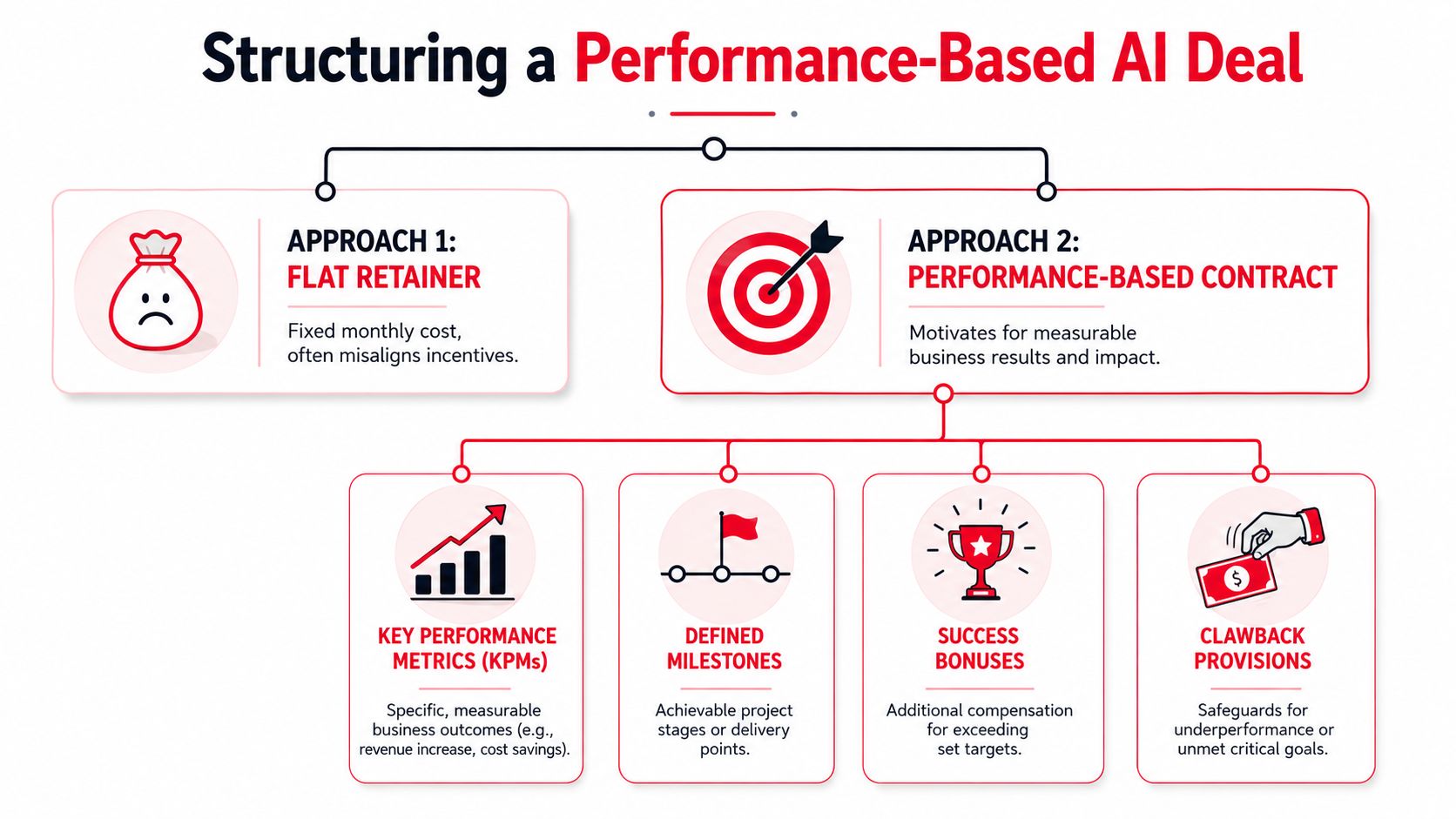
Flat retainers create lazy incentives
The market talks too much about monthly fees and too little about the cost of strategic drift. Data shows 68% of AI initiatives fail due to poor governance and undefined ROI, and a better approach is pricing by outcome tiers, such as $10K per month for roadmap plus a bonus per 10% conversion lift achieved, according to Iternal's analysis of fractional chief AI officer pricing.
That point matters because most failed AI programs don't die from software cost. They die from weak ownership, weak KPI design, and too many side quests.
If you want a clean explanation of where advisory and execution meet, this breakdown of what AI consulting includes is useful context before you negotiate the contract.
How to build a performance contract
I'd structure the deal in layers.
Base retainer
- Pays for leadership access, roadmap ownership, governance, and weekly operating cadence.
- Keeps the CAIO available for decisions that can't wait for a project memo.
Milestone payments
- Tie these to concrete delivery points.
- Examples include approved roadmap, vendor shortlist, launch of prioritized workflows, or implementation of reporting.
Variable upside
- Attach this to revenue or efficiency outcomes the executive can influence.
- Good metrics include conversion rate movement, qualified pipeline from AI-assisted outreach, or reduction in waste from bad tooling.
Protection clauses
- Add scope boundaries.
- Add review gates.
- Add clawback logic for missed critical deliverables if the agreement is heavily milestone-based.
A common market structure includes a retainer of $15,000 to $30,000 per month for 1 to 3 days weekly, a 5 to 10% variable bonus tied to cost-per-token reduction, latency improvement, or revenue uplift, optional equity of 0.05 to 0.2% vesting over 24 to 36 months, and a monthly cap of 32 to 48 hours, according to the Umbrex fractional chief AI officer playbook.
Here's the visual version of that logic:
A practical structure I'd actually sign
I'd keep it simple.
- Base fee: Enough to secure access, leadership meetings, and weekly execution review.
- Outcome metric one: A commercial KPI tied to the first priority, such as conversion improvement from AI-assisted CRO work.
- Outcome metric two: A pipeline KPI tied to outbound or qualification workflows.
- Reset clause: Reprice after the first phase once the company has real usage data and a clear operating model.
A good performance deal makes both sides uncomfortable in the right way. The company has to define success. The executive has to own delivery against it.
If the CAIO refuses any outcome component, I'd ask why. If the company wants pure performance with no retainer, I'd also push back. Executive work includes governance and decision-making that won't show up as a neat line item every week. The answer is a hybrid structure.
Calculating the ROI of Your AI Investment
The board doesn't care that you hired a smart AI operator. It cares whether revenue moved, waste dropped, and execution sped up.
That's why I build the business case backward from one or two commercial outcomes. You don't need heroic assumptions. You need simple math the leadership team will trust.
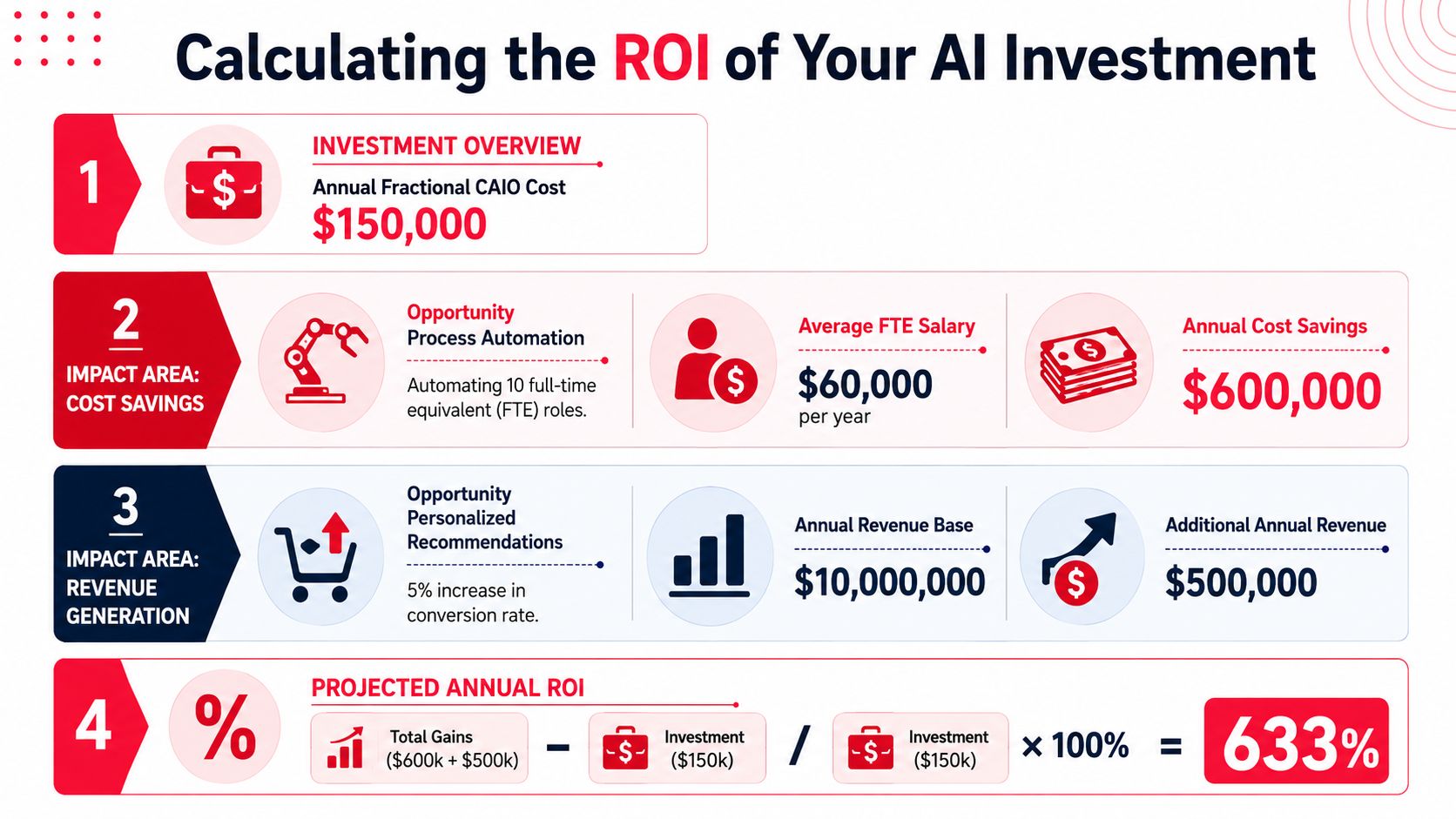
ROI example for CRO with AI
Use your existing traffic and conversion stack.
Say the fractional CAIO comes in and focuses your team on tighter experimentation, faster test design, cleaner analysis, and AI-assisted page iteration. In practice, that might mean rewriting offer pages, testing proof blocks, improving qualification paths, and feeding user research into faster copy and UX changes.
The ROI model is straightforward:
- Start with current revenue from the funnel
- Estimate a realistic conversion lift range internally
- Apply that lift to the revenue base
- Compare the gain to the CAIO fee and any tooling or implementation spend
If you want a quick way to sanity-check the upside before you take it to finance, this BuddyPro ROI calculator is a decent starting point for framing the return.
ROI example for GTM engineering
Now switch to pipeline.
A CAIO working with sales and RevOps can build AI-supported account research, qualification summaries, call prep, and personalized outbound systems. The gain often shows up as faster SDR output, better first-touch relevance, and cleaner handoffs to AEs. That doesn't require replacing the team. It requires removing low-value manual work and tightening the workflow.
The model I use is:
- Define the bottleneck: research time, message quality, follow-up consistency, or rep capacity
- Map the workflow change: what AI now handles and what the rep still owns
- Track the commercial output: more booked meetings, better qualification, or faster cycle movement
How I pressure-test the business case
I keep it tight. If the ROI story depends on six assumptions, it's weak.
Use this checklist:
- Pick one revenue path first: Conversion, pipeline, or sales productivity.
- Name the owner: CRO, CMO, RevOps lead, or sales leader.
- Set the review cadence: Weekly operational review, monthly executive review.
- Require proof in the funnel: Better win rates, cleaner conversion, shorter manual cycles, stronger buyer intent capture.
For companies focused on CRO with AI, GTM engineering, AI search optimization, or agent commerce readiness, the upside is usually visible early if the work is scoped well. The mistake is trying to force a giant enterprise ROI model before you've validated the first revenue use case.
Your Next Step: An AI Readiness Audit
You are about to sign a fractional CAIO contract. If you are weighing marketing leadership on the same basis, our guide to the fractional CMO agency model covers that comparison. The proposal says $8,000 a month, the scope sounds smart, and nobody has named the first revenue metric. That is how companies burn a quarter and call it “AI strategy.”
Start with an audit that leads to a decision, a scope, and a pricing model tied to business results.
A good audit does three jobs fast. It finds the revenue use case worth funding first. It exposes the operational constraints that will slow delivery. It tells you whether you need a strategic advisor, a hands-on operator, or a short sprint with a defined outcome.
What the audit needs to answer
Keep it tight and commercial.
- Where AI can affect revenue first: Pick the first use case tied to pipeline creation, conversion rate, retention, or sales capacity.
- What blocks execution today: Identify workflow bottlenecks, approval delays, weak process ownership, and manual work that drags output down.
- What data and systems are usable now: Separate clean, accessible inputs from systems that need cleanup, integration, or replacement.
- Who will adopt the workflow: Name the team leader, day-to-day users, and likely points of resistance.
- What governance is required: Set approval rules for tools, prompts, customer data, reporting, and model outputs.
The audit should also shape the commercial deal. If the first use case has a clear path to revenue, do not default to a plain monthly retainer. Structure part of the engagement around delivery milestones or business outcomes. For example, keep a fixed fee for the audit and implementation plan, then attach variable compensation to a metric the executive team already reviews, such as qualified pipeline created, sales cycle time reduced, or expansion opportunities surfaced. That is how you align CAIO cost with actual commercial impact instead of paying for activity.
What to do after the audit
You should leave with three decisions.
First, choose the problem you are hiring for. Strategy, adoption, or execution. Each requires a different operator and a different price.
Second, choose the pricing structure. If the revenue path is fuzzy, use a fixed-fee audit and a narrow follow-on scope. If the revenue path is clear, add performance-based compensation so the CAIO gets paid more when the business gets paid more.
Third, set the first scorecard. One owner. One revenue metric. One review cadence. If you cannot do that, you are not ready for an ongoing fractional engagement.
If you want a practical place to start, use an AI readiness assessment before you commit to a larger contract.
Set the budget after the audit, not before. Then write the agreement around a defined revenue outcome, a delivery timeline, and a payment structure that rewards results. That is how fractional chief AI officer cost turns into an investment with a real return.