
You're probably in one of three situations right now.
Revenue has flattened, even though the product is good. Your team is busy, your agency is shipping deliverables, and your pipeline still feels thinner than it should. Or you're asking a head of marketing to do executive work they were never hired to own. Or you know AI matters across CRO, GTM engineering, AI search, and agent commerce, but nobody on the leadership team can turn that into a system that moves revenue.
That's where a fractional CMO agency can make sense. But only if you buy the right thing.
Most companies don't need more marketing activity. They need executive ownership over growth, paired with practical AI implementation that your existing team can run.
Table of Contents
- What an AI-Powered Fractional CMO Agency Actually Does
- Fractional CMO vs In-House vs Traditional Agency
- Key AI Functions That Drive Revenue Impact
- How to Vet Your Fractional CMO Agency
- Sample Engagement Scopes and Pricing
- Real-World Examples by Business Type
- Your Next Step Finding the Right Growth Partner
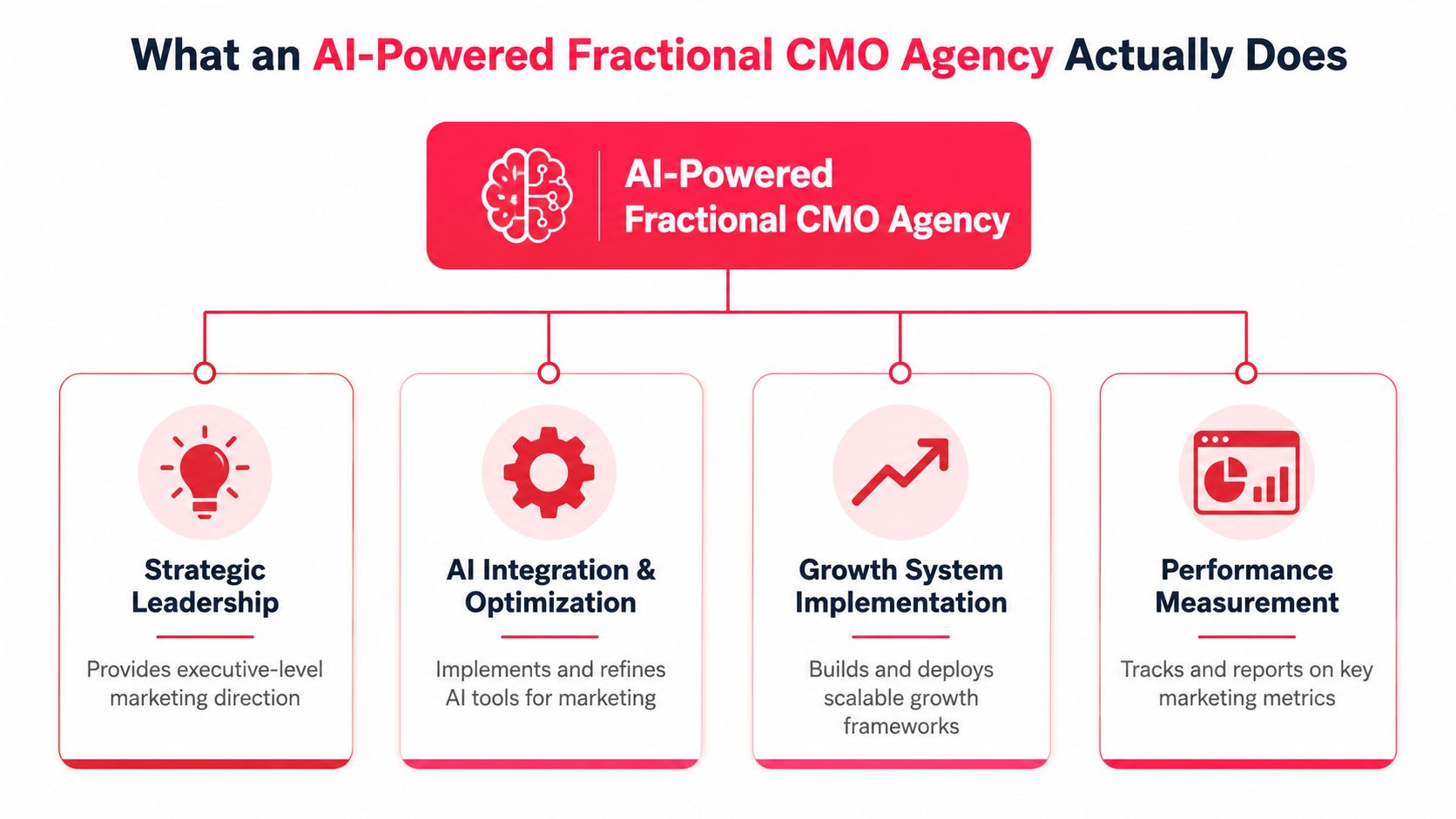
What an AI-Powered Fractional CMO Agency Actually Does
You feel the problem before you see it in the dashboard. Pipeline looks busy, paid spend is climbing, sales says lead quality is mixed, and nobody can point to the one constraint suppressing revenue. That is usually when a CEO starts looking at fractional leadership.
A strong Fractional CMO agency steps into that gap with operating ownership. The job is to turn marketing from a set of channel activities into a managed revenue system with clear targets, clear accountability, and a faster path from insight to execution.
Revenue ownership comes first
The reason you keep hearing about this model is simple. Companies want senior marketing leadership without adding a full executive salary before the growth engine is ready for it. Analysts at Breakthrough3x, in its review of fractional CMO growth and outcomes, point to a fast-growing market and stronger average revenue growth among companies using fractional CMOs. From a CEO's seat, that matters because it reflects a real buying shift, not a passing trend.
What a good agency owns is more specific than “marketing strategy.” It defines the revenue model, pressure-tests your funnel math, and decides where intervention will produce the fastest return. In practice, that means aligning on pipeline targets, CAC limits, sales cycle assumptions, conversion rates by stage, and the reporting source your team will trust when numbers get uncomfortable.
The first month should produce decisions, not a slide deck. A serious engagement usually starts with funnel diagnosis, ICP and offer refinement, channel mix review, and a list of bottlenecks ranked by expected revenue impact. If the scope never gets down to stage conversion, payback period, or win rate by segment, the agency is staying too high-level.
Practical rule: If the agency cannot name the metric it owns, you are buying advice, not leadership.
AI changes the operating model
AI matters here because it changes throughput. It lets one senior operator cover more ground across research, testing, reporting, and execution without adding a large team too early.
The best firms use AI in four places that affect revenue directly:
- Research systems: call transcript analysis, CRM pattern review, lost-deal analysis, category messaging gaps, and faster segmentation work.
- Execution systems: content production workflows, lead scoring support, outbound personalization, creative testing, and campaign iteration.
- Decision systems: reporting that ties spend to pipeline, segment performance, sales feedback, and conversion movement in one place.
- Discovery systems: visibility across AI search, answer engines, and the new buying paths shaped by agents and assistant-led research.
This is also where role design starts to matter. Some companies need marketing leadership only. Others need tighter coordination between growth, systems, data governance, and AI adoption. In those cases, a fractional Chief AI Officer engagement can complement the CMO function and keep the stack, workflows, and risk controls from drifting apart.
A modern fractional CMO agency should also know where brand work ends and GTM engineering begins. CRO, routing logic, attribution hygiene, offer testing, landing page velocity, and sales handoff design often produce more revenue than another round of top-of-funnel content. If your team depends on paid social or creator-led acquisition, I would also review current UGC video ad strategies 2026 approaches, because creative output and testing cadence now influence paid efficiency more than many teams admit.
The agency earns its keep by coordinating your internal team, contractors, media partners, and AI tools against one revenue plan. That is the work. Not more meetings. Not better vocabulary. Revenue movement.
Fractional CMO vs In-House vs Traditional Agency
Most CEOs compare the wrong things. They compare invoices instead of operating models.
A full-time CMO, a traditional agency, and an AI-focused fractional CMO solve different problems. One gives you embedded executive leadership. One gives you channel execution. One gives you executive ownership without the fixed headcount.
The model comparison that matters
Here's the side-by-side that usually makes the decision clearer.
| Attribute | In-House CMO | Traditional Agency | AI-Focused Fractional CMO |
|---|---|---|---|
| Cost structure | Highest fixed commitment | Variable retainer or project fees | Lower than full-time executive hire |
| Strategic ownership | Strong if hire is good | Usually limited | Strong when scope is tied to revenue |
| Execution control | Through internal team | Through agency team | Through internal team, vendors, and systems |
| Speed to impact | Slower hiring cycle | Fast for channel tasks | Faster than full-time hire for executive direction |
| AI capability | Depends on individual hire | Often tool-level | Best when built around workflows, testing, and governance |
The financial trade-off is one reason companies choose fractional. Fractional CMOs cost 40% to 60% less than full-time hires, with cited ranges of $96k to $180k versus $300k to $650k, according to Geisheker's analysis of the model.
If you're evaluating whether this role should sit beside a broader AI leadership function, it's worth looking at the responsibilities of a Fractional Chief AI Officer as a parallel frame. In some companies, that's the missing layer above marketing.
Where companies get burned
The failure mode isn't usually the first six months. It's what happens after.
A lot of firms treat the fractional CMO agency like a temporary fix. Strategy gets centralized in one external brain. The team depends on that person for prioritization. Then the engagement ends, nobody has absorbed the operating model, and momentum drops. Geisheker reports that 68% of firms discontinue fractional CMOs within 12 months without a transition plan, causing a 35% drop in marketing velocity in those cases.
You can rent strategy for a while. You can't rent it forever and expect the company to stay stable after the handoff.
Traditional agencies create a different risk. They execute assets, campaigns, and media plans, but they rarely own the commercial system. They won't usually redesign funnel measurement, reset GTM priorities, or decide that your paid acquisition is masking a messaging problem.
An in-house CMO can solve that, but it's still the highest-cost bet. For growth-stage companies, the cleaner move is often a fractional CMO agency that installs the system, trains the team, and plans the handoff from day one.
Key AI Functions That Drive Revenue Impact
A CEO usually sees the symptom first. Pipeline volume looks fine, but win rates stall. Traffic grows, but demo requests do not. Sales says lead quality is soft. Marketing says campaigns are working. An AI-powered fractional CMO agency earns its keep by fixing those conversion and go-to-market bottlenecks, not by producing more assets.
The functions that move revenue are AI-driven CRO, GTM engineering, and AEO with agent commerce readiness. If a firm cannot show how AI improves one of those three areas, it is selling tools, not a growth system.

AI-driven CRO
Start at the revenue gate. Demo request, trial signup, add-to-cart, or booked consultation. Pick the step that has the biggest downstream effect on pipeline and sales efficiency.
Then instrument it properly. A capable agency pulls from session recordings in Hotjar or Microsoft Clarity, CRM stage movement in HubSpot or Salesforce, sales call notes, page-level drop-off data, and objection patterns from tools like Gong. Those inputs become a prioritized testing queue tied to revenue, not a random list of page edits.
That usually leads to changes in offer framing, page structure, form length, proof placement, qualification logic, routing rules, and copy variation by segment. The trade-off is speed versus control. More experiments create more learning, but only if someone enforces test discipline and reads results in the context of close rate and sales capacity.
For teams building internal automation and experimentation workflows, understanding AI agents in go-to-market systems is part of the job.
GTM engineering
GTM engineering is where strategy meets systems. It turns raw market insight into repeatable execution across targeting, outreach, handoff, and reporting.
The inputs are not mysterious. Closed-won and closed-lost notes, CRM history, product usage, enrichment data, segment economics, and sales transcripts usually contain enough signal to sharpen ICP rules and rewrite messaging by buyer type. A good fractional CMO agency turns that signal into segmentation logic, outbound paths, landing pages, campaign triggers, and reporting that sales can trust.
One useful outside read on this is leveraging AI for pipeline insights, especially if your sales team has activity volume but weak visibility into where deals slow down.
This is also where weak operators get exposed. They can talk positioning in a strategy deck, but they cannot connect CRM fields, intent data, sequencing logic, and attribution in a way that produces better opportunities. In practice, GTM engineering means fewer handoff failures, clearer pipeline diagnostics, and faster iteration on segments that convert.
AEO and agent commerce readiness
Buyers now ask AI tools for recommendations before they ever fill out a form. That shifts part of discovery away from traditional search and into answer engines, assistants, and shopping agents. If your brand, product, or service information is hard for those systems to interpret, you lose demand before analytics tools even register the visit.
A strong agency treats AEO as a distribution and retrieval problem. It improves entity clarity, answer structure, comparison content, trust signals, schema, FAQ architecture, and product or service pages so AI systems can pull accurate information with less ambiguity. On the commerce side, it makes pricing, product attributes, policies, and offer details easier for software agents to parse and recommend.
That standard is rising quickly. The benchmark is no longer basic prompt use. Buyers should expect an operating model that uses multi-agent workflows for research, enrichment, content operations, campaign optimization, and reporting, with clear rules around data access, model context, and human review. O-CMO outlines that shift in its 2026 perspective on fractional CMOs.
How to Vet Your Fractional CMO Agency
A CEO usually knows within 20 minutes whether the call is useful. The agency either ties marketing work to pipeline and revenue mechanics, or it stays vague and sells polish. For an AI-powered fractional CMO agency, the standard is higher. They should be able to explain how they improve conversion rates, fix GTM bottlenecks, and make your brand easier for AI systems to retrieve and recommend.
Vetting gets easier when you stop evaluating style and start testing operating depth. Ask for specifics on decisions, systems, and ownership. If they cannot explain how work gets done inside your current stack, they are probably selling strategy without execution.
Questions that expose real capability
Start with the work that changes revenue in the next 90 days, not broad vision.
- On revenue ownership: “Which funnel metric would you take responsibility for first, and what is the expected business impact if it improves?”
- On CRO execution: “Show me how you identify the highest-friction conversion step, what data you use, and how quickly you can launch the first test.”
- On GTM engineering: “How would you connect CRM, ad platforms, enrichment, and reporting so sales and marketing are working from the same account signals?”
- On AEO capability: “What would you change on our site so AI assistants and answer engines can retrieve accurate information about our product, pricing, and category fit?”
- On data governance: “What data enters your AI workflows, what stays temporary, and who approves access?”
- On operating cadence: “What should be live by day 30, day 60, and day 90?”
- On reporting: “Show me the dashboard you use to tie channel activity to qualified pipeline, win rate, and CAC payback.”
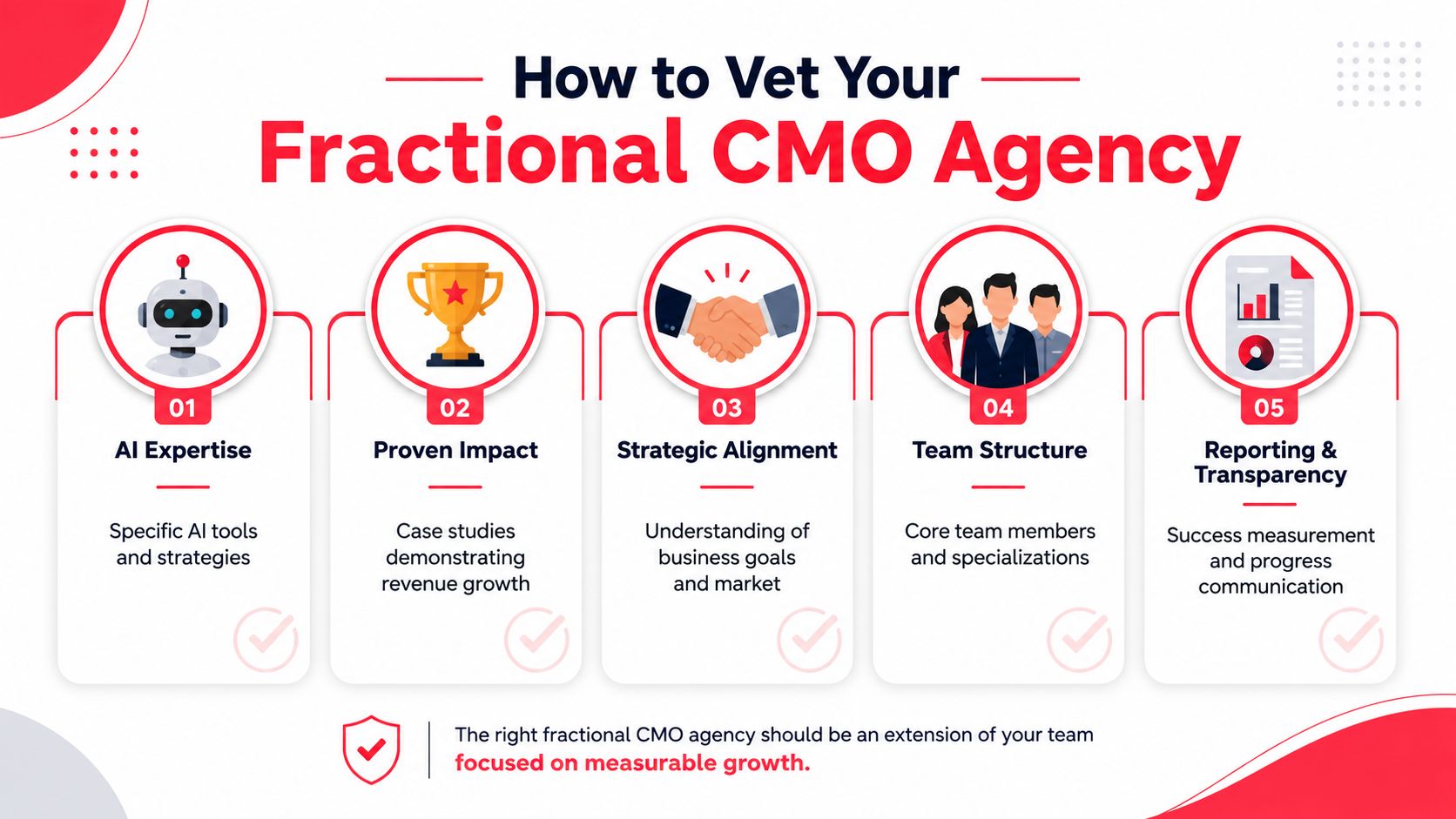
A strong answer includes trade-offs. Good operators will tell you what they would not do yet, which systems create drag, and where AI should stay out of the loop. That matters more than polished language.
Ask them to walk one workflow from signal to revenue. For example: traffic drop, diagnosis, test design, launch, reporting, and handoff. If they stay at the planning layer, expect slow execution later.
Red flags in the sales process
Watch how they scope the engagement. If the proposal is built around audits, slide decks, and status calls, you are buying advice. That can work if your internal team already executes well. It fails when you need someone to own funnel performance and system design.
The next red flag is weak implementation detail. A credible fractional CMO agency should be able to explain how it works with HubSpot, Salesforce, GA4, Gong, Clarity, your CMS, and your warehouse if you have one. They do not need to love your stack. They do need a clear plan for using it without turning every engagement into a migration project.
Also look for pricing discipline. If they cannot explain what is included, what changes scope, and how they price strategic oversight versus hands-on buildout, expect margin games later. Oviond's first chapter on agency pricing is a useful reference point because it shows how serious agencies separate recurring work, deliverables, and reporting expectations.
One more warning sign. They describe AI as content speed. That is too shallow for an executive growth role. You are hiring for better decisions, faster experimentation, cleaner attribution, and stronger conversion paths, not just more assets.
The best agencies make the handoff clear before the contract is signed. They can name who owns what after month six, what gets documented, how approvals work, and how your team keeps the system running if the engagement scales down. That is what mature revenue operations looks like.
Sample Engagement Scopes and Pricing
A CEO usually asks the wrong first question here. The question is not "What does a fractional CMO agency cost?" It is "What revenue problem am I hiring them to fix, and what level of authority do they need to fix it?"
Scoping errors get expensive fast. If you hire for light advisory when conversion rate, attribution, and GTM handoffs are broken, you get polished recommendations and no change in pipeline. If you buy a heavy engagement before proving the need, you pay for buildout your team may not be ready to support.
The cleanest way to scope a fractional CMO agency is by operating role. Advisor. Interim leader. Full AI growth partner.
Three engagement models
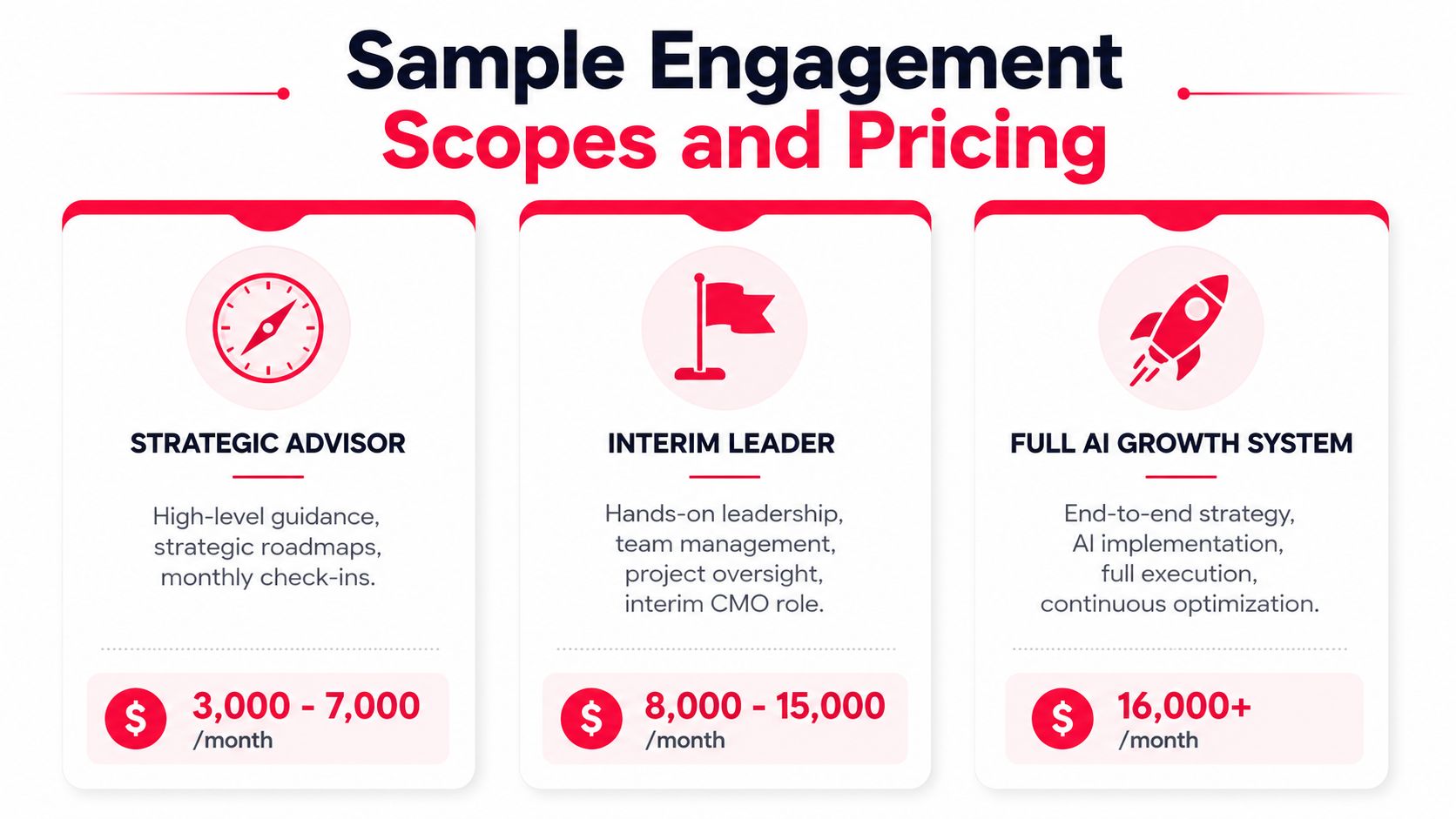
Strategic Advisor fits teams that already have competent execution. The agency sets priorities, pressure-tests channel allocation, defines KPIs, and helps the CEO or revenue leader make fewer bad bets. This model works best when the bottleneck is decision quality, not production capacity.
Interim Leader fits a transition period. A CMO left, the founder is still acting as head of marketing, or sales and marketing need one operator to run planning, agency management, reporting, and weekly revenue cadence until a full-time hire makes sense. This scope needs clearer authority than advisory work because someone has to make trade-offs, not just recommend them.
Full AI Growth Partner is the highest-involvement model. It combines executive oversight with hands-on work across CRO, GTM engineering, AEO, lifecycle flows, reporting, and experimentation. This is the right model when revenue is being constrained by system design, not just message quality. If your funnel leaks between ad click, form fill, routing, follow-up, and sales acceptance, this is usually the level that can fix it.
Pricing should reflect which of those jobs you are buying. If the proposal prices all three as some version of "fractional CMO support," expect scope confusion later.
What good scoping looks like
A solid proposal answers four operational questions before the contract is signed:
- Decision ownership: What they can change directly, what needs executive approval, and how fast approvals happen
- Team interface: Which internal team members they manage, which outside agencies they coordinate, and who owns execution by channel
- System scope: Whether the engagement includes funnel analysis, CRO experiments, CRM workflow changes, AEO content structure, paid media oversight, lifecycle automation, or sales enablement
- Exit plan: What gets documented, what stays with your team, and how responsibilities transition if the engagement scales down
That last point matters more than many CEOs expect.
A strong agency should be able to show how scope turns into operating output. For example, if they claim CRO ownership, the proposal should mention research cadence, testing workflow, design and dev dependencies, and how winning experiments get rolled out across the funnel. If they claim GTM engineering capability, they should specify what they will touch in the CRM, routing logic, lifecycle automation, and reporting layer. If they claim AEO expertise, they should explain how they restructure content for answer-first discovery and AI search visibility, not just publish more blog posts. You can see what that looks like in these growth marketing case studies, where scope is tied to actual execution and business outcomes.
If you want a useful outside frame for thinking about retainers and value packaging, Oviond's first chapter on agency pricing is worth a read. It helps separate scope-based pricing from vague monthly retainers.
One caution on pricing examples you will see online. Fee ranges vary because the true variable is not title. It is depth. A firm that joins the weekly forecast call and reviews dashboards is selling one thing. A firm that rebuilds funnel instrumentation, fixes lead routing, improves conversion paths, and gives your sales team cleaner demand capture is selling something very different.
Real-World Examples by Business Type
The best way to judge fit is by business type. The same title can mean very different work depending on your revenue model, sales motion, and team maturity.
B2B SaaS
A typical SaaS case starts with a common problem. Paid acquisition is active, outbound exists in fragments, and the website gets traffic, but demo quality is uneven and sales says leads are weak.
A strong fractional CMO agency resets the system from the middle, not the top. It tightens ICP definition, rewrites the message by segment, rebuilds the demo path around qualification, and creates a weekly operating cadence between marketing and sales. Then it sets experimentation priorities across landing pages, lifecycle flows, paid messaging, and sales enablement.
The fastest wins usually come from cleaner segmentation and better conversion flow, not from adding channels.
E-commerce
In e-commerce, the work often starts lower in the funnel. Merchandising, paid creative, offer structure, PDP clarity, cart flow, and post-click continuity usually matter more than a grand brand strategy.
The agency should pair AI-assisted CRO with creative testing discipline. That means analyzing session behavior, identifying friction points, rewriting product pages for answer clarity, and preparing content for AI-assisted shopping experiences. If the site is already getting qualified traffic, this work can move revenue quickly.
In e-commerce, the agency earns its keep when it changes purchase behavior, not when it produces prettier assets.
Professional services
Professional services firms usually have a different issue. Expertise is strong, but packaging and market communication are weak.
The right engagement creates category clarity. It sharpens the offer, builds authority content around actual buyer questions, aligns partner bios and service pages with commercial intent, and gives the team a way to follow up consistently after inbound interest. In these companies, the fractional CMO agency often acts as the first real bridge between reputation and pipeline.
If you want to see how this kind of work can translate across different models, growth marketing case studies can be a useful reference point.
AI startup
For AI companies, speed matters more than polish in the early phase. According to Mark Gabrielli's reported engagement metrics, measurable outputs such as go-to-market strategy, ICP definition, messaging architecture, and demand generation planning often appear within 30 days. Pipeline movement is typical in 60 to 90 days as campaigns launch, and compounding results build over 6 to 12 months.
That timeline is realistic when the product is real, the founder can make decisions quickly, and the agency has access to users, sales calls, and product context.
What doesn't work is hiring a fractional CMO agency and then starving it of inputs. No customer calls. No CRM access. No founder involvement. That stalls the entire process.
Your Next Step Finding the Right Growth Partner
You don't need another theory deck. You need a yes or no decision.
Use this quick diagnostic:
- Growth has stalled: You have a solid product, some marketing activity, and revenue still feels slower than it should.
- AI capability is thin: Your team knows AI matters, but nobody can turn it into production workflows across CRO, GTM engineering, AEO, and reporting.
- Executive ownership is missing: You need senior strategic control, but a full-time executive hire doesn't make financial sense right now.
If you answered yes to two or more, start shortlisting specialized firms. Take two or three intro calls. Use the vetting questions from this guide. Push for specifics on workflow design, data governance, KPI ownership, and handoff planning.
If you want a more hands-on model that combines executive AI strategy with implementation oversight, training, and ongoing operating support, review Stimulead's AI Growth Partnership.
The next step isn't “learn more.” It's to test whether a fractional CMO agency can own your growth problem with enough technical depth to fix it.