
You're probably in the same spot as a lot of growth-stage leaders right now.
Your team has tested ChatGPT. Sales wants AI for outreach. Marketing wants faster content, better personalization, and a way to show up in AI search results. Your board wants a point of view. Vendors are pitching “AI-powered” everything. What's still fuzzy is the only part that matters. How does this turn into revenue?
That's where AI consulting earns its keep. Done well, it helps you decide where AI belongs in your funnel, which workflows deserve automation, what needs a human in the loop, and how to connect all of that to pipeline, conversion, and retention. Done badly, it produces a strategy deck, a disconnected pilot, and one more tool your team ignores.
For operators, the useful question isn't abstract. It's very practical: what is AI consulting when you care about marketing efficiency, sales capacity, and measurable growth? The answer has less to do with model demos and more to do with system design, implementation discipline, and KPI ownership.
Table of Contents
- AI Is Here Now How Do You Make It Make Money
- AI Consulting Is More Than Technical Advice
- Four Ways to Engage an AI Consultant
- How AI Consulting Drives Marketing and Sales KPIs
- The Anatomy of a Successful Engagement
- How to Measure ROI and Avoid Wasted Spend
- The 7 Questions to Ask Any AI Consultant
AI Is Here Now How Do You Make It Make Money
Many teams don't have an AI problem. They have a prioritization problem.
There are too many possible use cases and too little clarity on which ones move the P&L. One team is testing AI-generated landing pages. Another is buying conversation intelligence. Someone else wants an SDR agent. Without a revenue frame, those decisions stay fragmented.
That's why AI consulting has become a real operating category, not a niche experiment. The global AI consulting market is valued at USD 8.4 billion in 2024 and projected to reach USD 59.4 billion by 2034, with North America at about USD 3.0 billion in 2024, according to Market.us research on the AI consulting market. That matters because it tells you your peers aren't treating this as prompt tinkering. They're buying help with strategy, implementation, governance, and execution.
What executives actually need from this category
A CEO or CMO usually doesn't need another brainstorm session on AI possibilities. They need someone who can answer four things fast:
- Where revenue moves first: Which AI use cases can affect lead quality, sales cycle speed, conversion rate, or retention soonest.
- What your stack can support: Whether your CRM, analytics, ad platforms, site architecture, and data flows can support the use case.
- Who owns the workflow: Which parts stay with marketing, sales, RevOps, product marketing, or external partners.
- How success gets measured: What baseline you're using and which KPI decides if the project expands or dies.
Practical rule: If an AI initiative can't be tied to a revenue metric before work starts, it's usually a workshop, not an operating investment.
If you want a useful outside perspective on where AI fits in a modern marketing function, this AI marketing playbook for CMOs is a solid companion read. It's useful because it connects AI use to real marketing workflows instead of generic trend talk.
A good first step is an AI readiness assessment. The point isn't to score your company for novelty. It's to find the gap between what your team wants AI to do and what your data, systems, and operators can support right now.
AI Consulting Is More Than Technical Advice
If you strip away the hype, AI consulting is a business discipline built around turning AI into operational results.
That means use-case selection, roadmap design, vendor choices, integration with your existing systems, workflow changes, team enablement, and governance. Model selection is part of the picture, but it's rarely the whole job.
The category expanded quickly because companies started using AI faster than most internal teams could absorb it. The share of firms using AI in at least one business area rose from about 20% in 2017 to 50% by the end of 2022, according to this industry summary citing McKinsey-reported figures. Once that shift happened, companies needed outside operators who could connect AI capability to daily business processes and reduce implementation risk.
What AI consulting looks like in practice
For growth-stage companies, the work usually starts with a commercial objective.
Maybe marketing wants better funnel conversion. Maybe sales wants cleaner account research and faster personalization. Maybe the company wants to show up in AI-generated answers when buyers ask category questions. The consultant's job is to translate that goal into a system your team can run.
That usually includes:
- Use-case framing: Define the business problem in plain terms. More qualified demo requests. Faster lead follow-up. Better expansion signal detection.
- Data and systems review: Check where the inputs live. CRM fields, call transcripts, analytics events, CMS content, product usage, ad platform data.
- Workflow design: Decide what gets automated, what gets augmented, and where human review stays mandatory.
- Implementation planning: Map tools, integrations, owners, approvals, and measurement.
- Adoption support: Train the people who will use the workflow, not just the executive sponsor.
Why technical skill alone isn't enough
A lot of AI projects fail for ordinary reasons. Bad source data. No owner. Weak process design. A disconnected pilot that never reaches production. Or the classic mistake: buying software before defining the job.
This CIO overview of what AI consultants do gets at the core issue. Good consultants build an AI roadmap tied to company goals, choose tools, support integration into existing IT structures, and address ethics and data protection requirements. For a CEO or CRO, that means you shouldn't judge an AI consultant by how impressive the demo looks. Judge them by whether they can specify data requirements, integration points, stakeholder roles, and adoption metrics before recommending a system.
The consultant who starts with your funnel, your CRM, and your team constraints is usually more useful than the one who starts with a favorite model.
When someone asks, what is AI consulting, that's the practical answer. It's the work of making AI usable inside a live business, with enough process discipline that the output survives after the engagement ends.
Four Ways to Engage an AI Consultant
The right engagement model depends on what's broken.
Some companies need strategic direction. Some have already chosen the use case and need help getting to production. Others need an embedded operator because nobody internally owns the AI roadmap. If you choose the wrong model, you either overpay for advisory when you need execution or force implementation work onto a consultant hired for strategy.
Here's the side-by-side view.
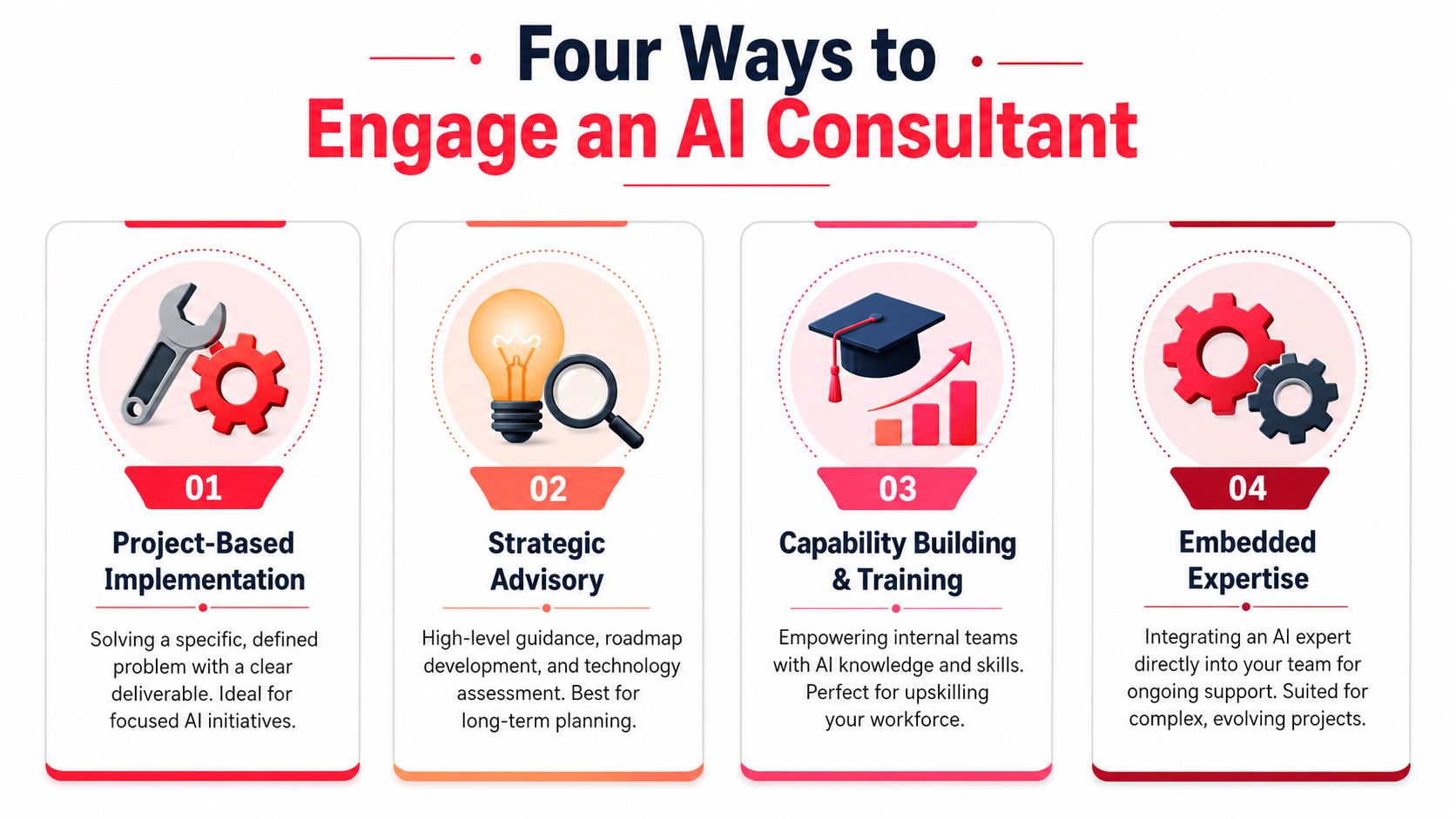
A quick comparison
| Engagement model | Best fit | What you should expect | Common risk |
|---|---|---|---|
| Executive advisory | Leadership needs clarity | Roadmap, vendor guidance, prioritization, board-ready decisions | Strategy with no owner |
| Implementation oversight | Team has a plan but needs control | Architecture review, workflow design, launch management, KPI tracking | Consultant lacks operator depth |
| Capability building and training | Team needs new habits | Practical workflows, role-based training, playbooks, governance rules | Team learns tools but not process |
| Fractional CAIO or embedded expert | AI spans multiple departments | Ongoing leadership, prioritization, execution oversight, internal alignment | Scope drifts without clear KPIs |
Executive advisory
This works when the executive team needs to decide where AI belongs before spending heavily.
You're sorting through tool categories, trying to make sense of AI search, internal copilots, SDR automation, content workflows, analytics layers, and governance. The consultant helps narrow the field and sequence decisions. For a CEO, this often means getting from “we need an AI plan” to a shortlist of initiatives with business cases and owners.
Useful deliverables here include a use-case map, build-versus-buy guidance, risk review, and budget priorities. Less useful is a broad transformation deck that doesn't touch revenue operations.
Implementation oversight
This model fits when your team already knows the target use case.
You might be deploying AI-assisted lead routing, automating call analysis, improving outbound research, or wiring an LLM-based assistant into a sales workflow. In those cases, the consultant acts more like a systems operator than a strategist. They pressure-test architecture, keep vendors honest, manage handoffs, and make sure the workflow survives contact with real users.
The best implementation advisers spend more time on systems and adoption than on ideation.
Capability building and training
A lot of growth teams don't need a big strategy project. They need better day-to-day execution.
Role-specific training matters. Marketing may need AI-assisted testing workflows for landing pages, creative variations, and content briefs. Sales may need cleaner account research, call prep, objection handling, and follow-up support. RevOps may need stricter process design so the workflow outputs feed the CRM correctly.
The signal of a good training engagement is behavior change. If everyone leaves with prompts but no operating rules, it won't stick.
Embedded expertise
This is the strongest fit when AI touches multiple revenue teams and nobody has the bandwidth to drive it.
An embedded adviser or fractional CAIO can own prioritization across marketing, sales, RevOps, and leadership. That changes the work from one-off consulting to ongoing AI operating management. In practice, this often looks like weekly review of use cases, vendor decisions, pilot design, KPI tracking, governance, and team adoption.
Stimulead is one example of this model through a fractional CAIO approach focused on marketing and sales execution, alongside advisory and training options.
Why delivery models are shifting
The best firms don't rely only on custom work. Modern AI consulting increasingly uses an asset-based model, where reusable software, fine-tuned models, and proven methods accelerate delivery, as described in IBM's explanation of asset-based consulting. For buyers, the takeaway is simple. Ask whether the consultant brings repeatable assets, tested workflows, and clear operating metrics, or whether you're paying from scratch for every engagement.
How AI Consulting Drives Marketing and Sales KPIs
At this stage, the category either earns trust or loses it.
If AI consulting doesn't change a KPI your revenue team already cares about, it's overhead. The strongest work shows up in places your dashboard already tracks: lead quality, speed to contact, conversion rate, pipeline progression, rep productivity, win rate support, and retention signals.
The practical use cases usually cluster into four areas.
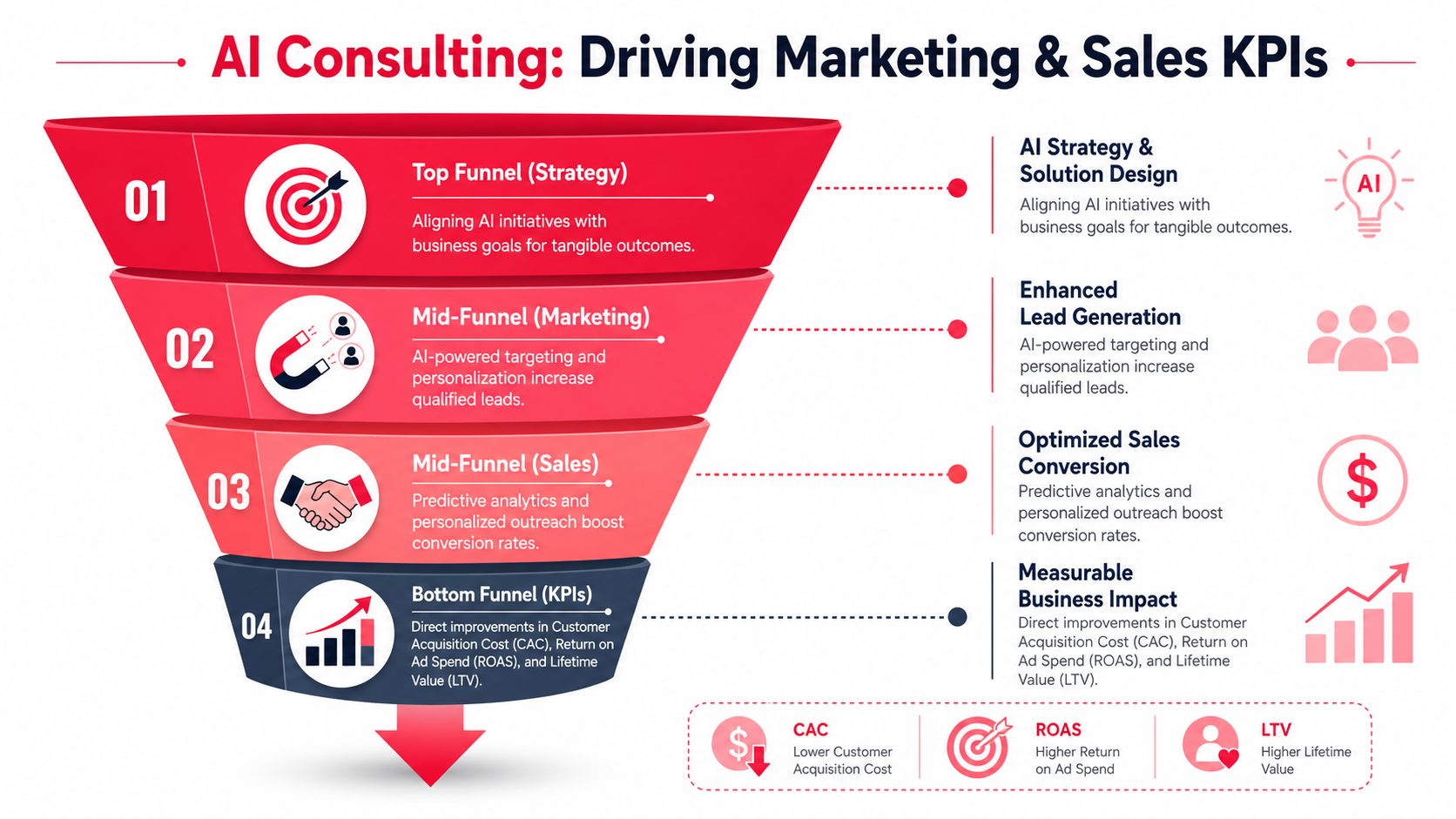
CRO with AI
For marketing leaders, AI is often most useful when it increases testing velocity.
That can mean faster generation of landing page variants, tighter message-to-audience matching, more structured analysis of session recordings and chat logs, or quicker identification of drop-off patterns in form flows. The point isn't more copy. The point is more informed experiments and faster learning loops.
A consultant earns value here by putting discipline around the process:
- Hypothesis quality: Tie each test to a behavioral signal, not a generic “improve conversion” goal.
- Variant production: Use AI to draft and structure options faster, with human review on positioning and brand risk.
- Measurement setup: Make sure analytics can isolate the change and its business effect.
- Decision rules: Define when a test rolls out, gets revised, or gets killed.
GTM engineering
AI begins to affect sales capacity.
Think account research workflows, persona-level outbound preparation, transcript analysis, qualification support, CRM enrichment, and follow-up generation that reps can effectively use. The gain isn't “more automation” by itself. It's better use of human sales time.
A good consultant treats GTM engineering like process design. Inputs need to be reliable. Prompts need structure. Outputs need a clear place in the sales workflow. If reps have to clean every result manually, the system is underdesigned.
The fastest way to waste AI spend is to automate a messy workflow. You'll just create messy output at higher speed.
AI search and AEO
AEO matters because buyers increasingly ask LLMs for recommendations before they ever hit your site.
That changes content strategy. You need category pages, use-case pages, FAQs, comparison content, proof assets, and entity clarity that AI systems can parse and cite. This is less about chasing volume and more about becoming the brand that shows up in machine-mediated discovery.
An AI consultant working on AEO should look at your content architecture, structured claims, internal linking, topical coverage, and how well your site answers the kinds of questions buyers ask tools like ChatGPT and Perplexity.
Agent commerce readiness
The next shift is machine-assisted buying.
That won't affect every company at the same pace, but the pattern is already visible. More discovery, evaluation, and recommendation steps will be handled by software agents acting on behalf of users. If your pricing, product data, policies, and category positioning aren't easy for agents to interpret, you'll lose visibility in those flows.
For a closer look at where this is heading, this overview of AI agents is useful. The executive takeaway is straightforward: your digital funnel increasingly needs to serve both humans and machines.
The Anatomy of a Successful Engagement
Strong AI consulting work has a clear sequence. Weak work drifts in discovery, jumps to tools too early, or launches a pilot with no path to ownership.
In a healthy engagement, each phase has a deliverable, an owner, and a decision gate. That's how you keep the work tied to business outcomes instead of curiosity.
Here's the typical shape.
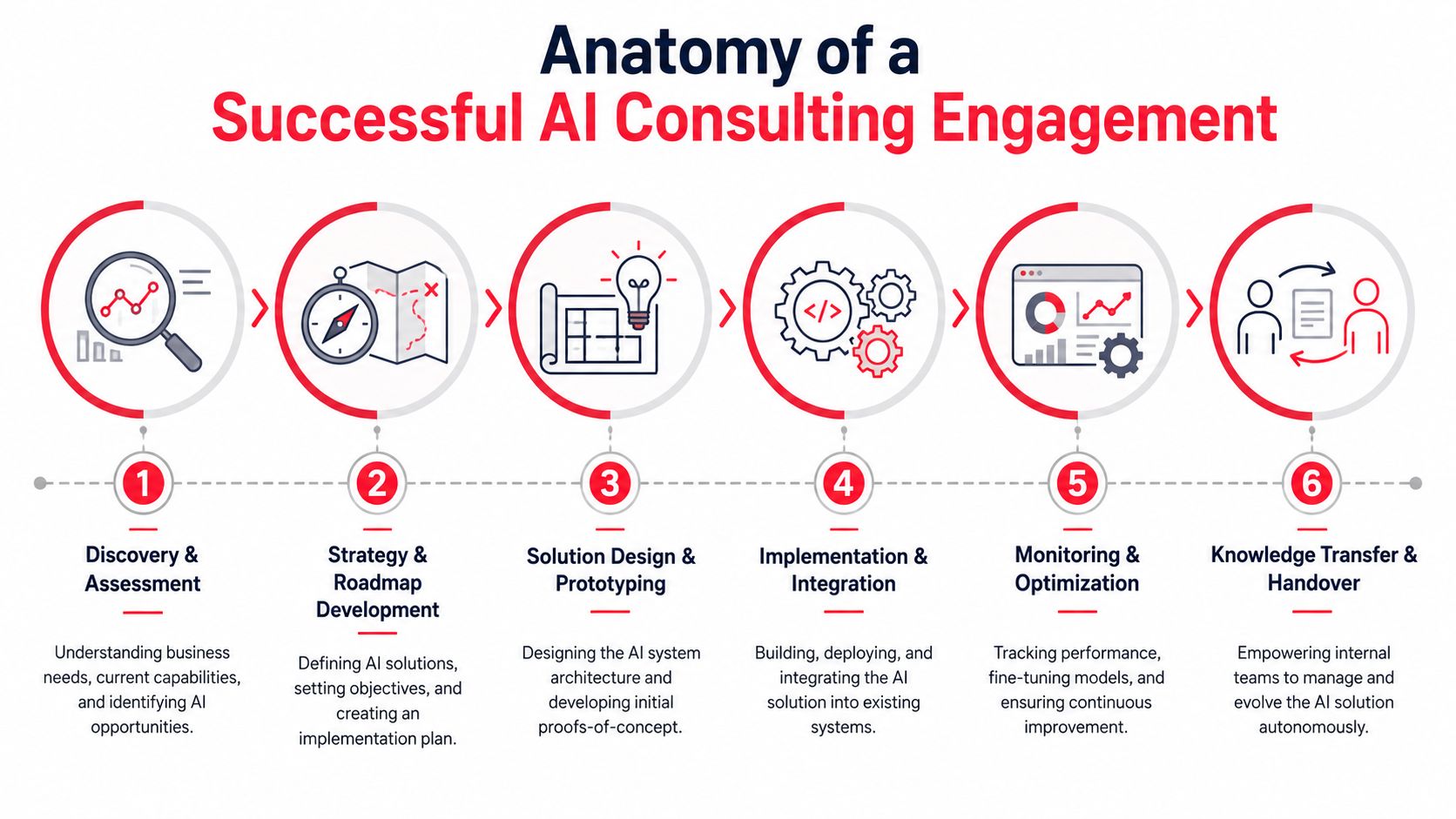
Deep dive audit
This phase looks at your current operating reality.
The consultant reviews funnel goals, team structure, tooling, data quality, content assets, CRM hygiene, workflow friction, and governance constraints. For a marketing and sales engagement, that often means auditing ad workflows, landing pages, lifecycle sequences, outbound process, call review habits, and reporting integrity.
The output should be specific. Which use cases are feasible now. Which ones depend on cleaner data or process changes. Which ones should wait.
Prioritized roadmap
A roadmap is useful only if it forces trade-offs.
Most companies have more AI opportunities than execution capacity. The consultant should narrow the list to a small set of use cases with clear commercial relevance, realistic implementation effort, and named owners. That means sequencing, not collecting ideas.
A practical roadmap usually identifies:
- Immediate wins: Workflows that can ship with current tools and teams.
- Mid-range builds: Use cases that need integration work or process redesign.
- Hold items: Ideas that sound attractive but don't have the data or ownership to succeed yet.
Pilot and proof
The pilot should answer one question. Does this workflow create measurable value under live conditions?
That means a narrow scope, a defined audience, and one or two business metrics that decide whether the experiment expands. Good pilots are boring in the best way. They're constrained, observable, and easy to evaluate.
“Run the smallest pilot that can still affect a real business metric.”
Scale and handoff
At this juncture, many projects break.
A consultant can build a useful workflow, but if nobody inside the company owns it, performance falls fast. Scaling requires documentation, team training, governance rules, review cadence, and a named operator who can manage prompts, logic, exceptions, and updates.
For companies that need ongoing leadership across multiple initiatives, a fractional Chief AI Officer model can bridge the gap between pilot success and steady execution.
How to Measure ROI and Avoid Wasted Spend
This is the part buyers should get tougher on.
A lot of AI consulting still gets sold as insight work. The problem is that AI now automates much of the research and analysis that used to justify large consulting teams. Buyers are right to ask what they're paying for and how value will be proven. The Hackett Group's glossary note on AI consulting makes this point clearly: leaders need consultants to specify which KPIs will improve, by how much, and over what timeline.
That standard changes the buying process. You're not purchasing thoughtfulness. You're purchasing a defined business outcome path.
What to measure
For growth-stage companies, the starting metrics should usually be commercial, not technical.
A consultant may track prompt accuracy, response quality, or model behavior internally. That's fine. Your executive dashboard should still center on business results. In marketing and sales, that often means:
- Conversion rate movement: Landing pages, demo requests, trial starts, booked meetings, opportunity progression.
- Efficiency gains: Faster campaign production, faster lead follow-up, lower manual research burden, better use of rep time.
- Pipeline quality: Better qualification, stronger routing, clearer intent signals, higher acceptance by sales.
- Cycle compression: Less lag between inquiry and response, faster proposal support, quicker movement through defined stages.
Red flags that waste budget
Most failed engagements follow familiar patterns.
| Red flag | What it usually means |
|---|---|
| Tool recommendation before process review | The consultant is selling software, not solving a workflow problem |
| No baseline metric | You won't be able to judge impact honestly |
| No internal owner | The pilot may work briefly, then decay |
| Generic training for every role | Marketing, sales, and RevOps won't use the system the same way |
| No handoff plan | You'll stay dependent on the consultant for basic operation |
One practical test helps a lot. Ask the consultant to explain the same project in three layers: executive KPI, workflow change, and system requirement. If they can't do all three, they probably haven't implemented this in a live go-to-market team.
If you're evaluating sales-side AI specifically, LeadBlaze's AI sales assistant insights are worth reviewing because they connect conversational AI to sales workflow realities rather than abstract automation claims.
The 7 Questions to Ask Any AI Consultant
Before you sign anything, force the conversation into operating detail.
A polished strategy pitch can hide a weak implementation record. A highly technical vendor can miss the business problem. The right questions expose both.
Use this checklist in the first serious call.
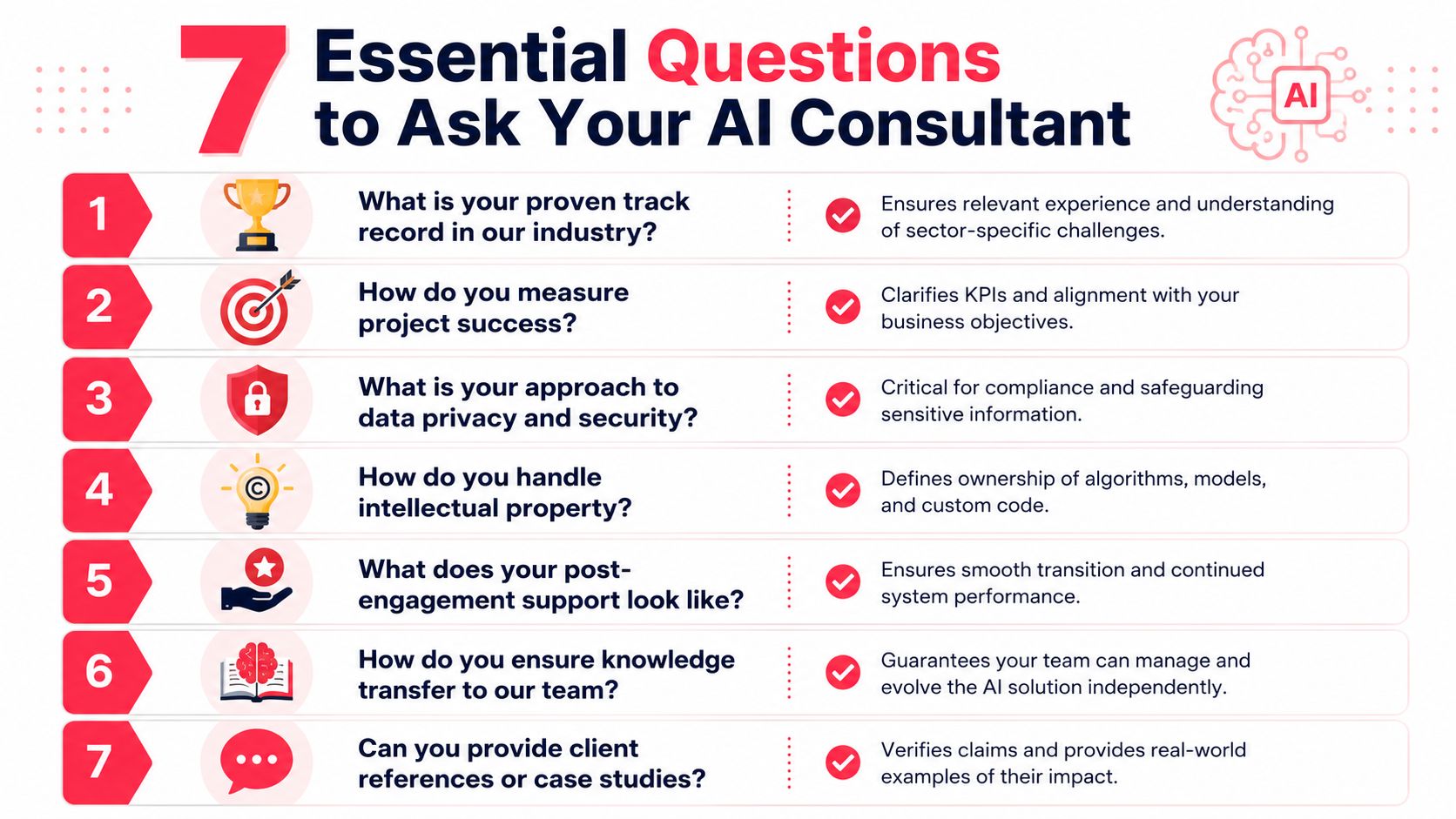
The checklist
Which revenue KPI are you taking aim at first?
If the answer stays broad, the engagement will too.What workflow changes inside marketing, sales, or RevOps?
AI value comes from changed process, not tool access.What data inputs do you need from us?
This tells you whether they understand implementation constraints.What gets automated, and what stays human-reviewed?
Serious operators think in control points, not blanket automation.Who on our team needs to own this after launch?
If ownership is vague, adoption will be weak.What does the pilot look like, and what decides success?
You want a testable path, not an open-ended engagement.What reusable assets, playbooks, or systems do you bring?
This separates repeatable operators from consultants who rebuild every project from zero.
This short video is also useful before a vendor conversation:
Hire the consultant who can tie AI to one commercial bottleneck, show how the workflow will run, and name who owns it after they leave.
If you're still defining what AI consulting should look like inside your business, start with one revenue problem. Pick the bottleneck. Define the KPI. Then bring in a partner who can turn that into a working system instead of a slide deck.
A practical next step is to review your current funnel and list the places where your team loses time, context, or conversion. That's where AI consulting usually creates value first.