
You’re probably in a familiar spot right now. Your team is testing AI tools across marketing, sales, support, and ops. The demos look good. The vendors sound confident. Your board wants an AI plan. But inside the business, nobody owns the hard part: turning AI activity into pipeline, conversion rate, and revenue.
That gap is where the Chief AI Officer starts to matter.
For a growth-stage company, this role shouldn’t be framed as a prestige hire or a research lead. It’s a revenue operating role. Someone has to decide which AI initiatives deserve budget, which should die fast, how results get measured, and who is accountable when a pilot never makes it into the sales process or customer journey. If nobody owns that, AI becomes another line item with no clean path to return.
Table of Contents
- Why We Need to Talk About the Chief AI Officer Now
- What a Revenue-Focused CAIO Actually Does
- Key Responsibilities and Revenue-Focused KPIs
- When Your Company Reaches the AI Tipping Point
- Full-Time Executive vs Fractional Partner
- A Sample 90-Day CAIO Roadmap
- Your Next Step to Generate Revenue from AI
Why We Need to Talk About the Chief AI Officer Now
The market has already moved past “should we try AI?” The question is who owns it when it starts touching pricing, personalization, lead scoring, content velocity, outbound workflows, and customer experience.
This role is no longer confined to enterprise experimentation. Hays Technology reports that 48% of FTSE 100 companies now employ a CAIO, and an Amazon survey in Canada found that more than half of respondents worked with one. That matters less as a trend headline and more as an operating signal. Large companies are formalizing AI accountability because scattered pilots don’t scale by themselves.
Growth-stage companies feel the same pressure earlier than they expect. You may not need a giant AI org. You do need someone who can decide whether AI should be used to improve funnel conversion, raise outbound quality, tighten attribution, support AI search visibility, or prepare your catalog and content for agent commerce. Those choices affect revenue. They also create friction across teams fast.
The real problem is ownership
In most companies, AI gets split across too many people:
- Marketing owns content tools but can’t validate revenue impact.
- Sales owns outreach tools but doesn’t control data quality or governance.
- Ops owns systems but often lacks GTM context.
- Founders own the pressure because everyone expects a result.
That structure creates busy teams and weak outcomes. You get experimentation without prioritization.
Practical rule: If three different leaders are each running AI initiatives and nobody can tie them to one revenue scoreboard, you already have a leadership gap.
Why CEOs should care
The Chief AI Officer is becoming relevant because AI now changes execution, not just planning. It affects how fast your team can test offers, how well your site answers buyer intent, how qualified your pipeline is, and whether reps spend time on real conversations or low-value admin.
For CEOs, CMOs, and CROs, the useful frame is simple. A Chief AI Officer is the person who connects AI spend to commercial output. If that connection stays fuzzy, your company won’t get paid for its enthusiasm.
What a Revenue-Focused CAIO Actually Does
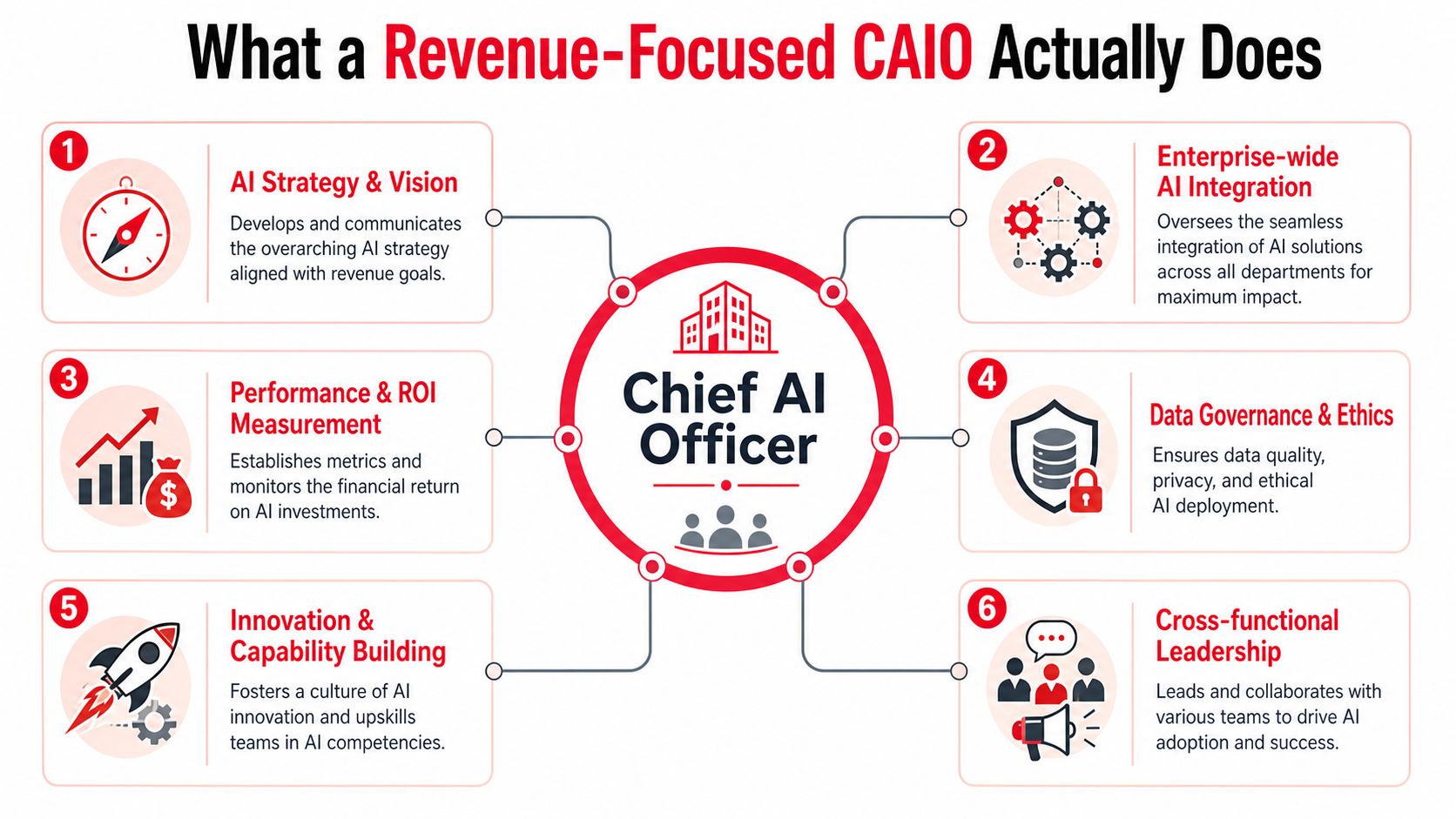
A revenue-focused Chief AI Officer runs an operating model. They don’t sit on top of a pile of disconnected tools. They decide where AI belongs in the funnel, what data it needs, how success gets measured, and which teams have to change their workflow to make the result real.
PwC’s view of the role is the right starting point. The CAIO owns AI strategy, works across the C-suite, and sets frameworks so use cases are chosen based on business impact, feasibility, cost, and risk. That’s exactly the job in a growth company too. The difference is that the focus should sit much closer to pipeline and conversion.
Four jobs that matter in practice
First, the CAIO picks where AI can move revenue fastest. In some companies that’s CRO. In others it’s sales research, personalization, win-rate support, or AI search optimization. The mistake is trying to “deploy AI everywhere” before you’ve proven a commercial win.
Second, they force alignment across teams. Marketing may want faster content production. Sales may want better prospecting. Product may want AI features. Legal may want tighter controls. A good CAIO makes those requests compete against business outcomes, not internal politics.
Third, they build the selection filter. Every use case should pass a basic test:
| Decision area | What the CAIO checks |
|---|---|
| Business impact | Will this affect pipeline, conversion, retention, or sales capacity? |
| Feasibility | Do we have the data, systems, and team to ship it? |
| Cost | What will this require in tools, internal time, and change management? |
| Risk | Are privacy, governance, or brand issues manageable? |
Fourth, they move pilots into operating workflows. That’s where most companies fail. The test worked. The team liked it. Nobody changed process. The pilot dies.
What this looks like inside GTM
In practical terms, a Chief AI Officer should be able to translate a revenue problem into a build plan.
Examples:
- Low website conversion: Use AI to speed experiment design, segment traffic, improve on-page relevance, and tighten form or demo flows.
- Weak outbound quality: Use GTM engineering to give reps cleaner account research, better personalization inputs, and faster sequence preparation.
- Poor visibility in AI-driven discovery: Build content and entity structure for AI growth marketing workflows that support AI search optimization and answer-engine visibility.
- Rising churn risk: Connect product and customer signals to predictive workflows. For teams working on this problem, SigOS’s guide on AI churn prediction is a useful reference on how AI can support earlier intervention.
The Chief AI Officer should own one sentence the board can understand: “Here are the AI initiatives tied directly to revenue, here’s what they need, and here’s how we’ll judge them.”
Key Responsibilities and Revenue-Focused KPIs
A Chief AI Officer without scoreboards becomes a strategist with expensive slide decks. The job has to cash out into measurable business movement.
A lot of companies make the same hiring mistake here. They look for vision, vendor familiarity, and executive presence. Those matter. But the role also needs technical fluency. Chief AI Officer job templates often call for deep knowledge of machine learning, NLP, computer vision, Python, R, TensorFlow, PyTorch, cloud platforms, and at least 10 years in AI plus 5 years in senior leadership. The reason is practical: the person has to evaluate model quality, deployment readiness, and business ROI at the same time.
Responsibilities that affect revenue
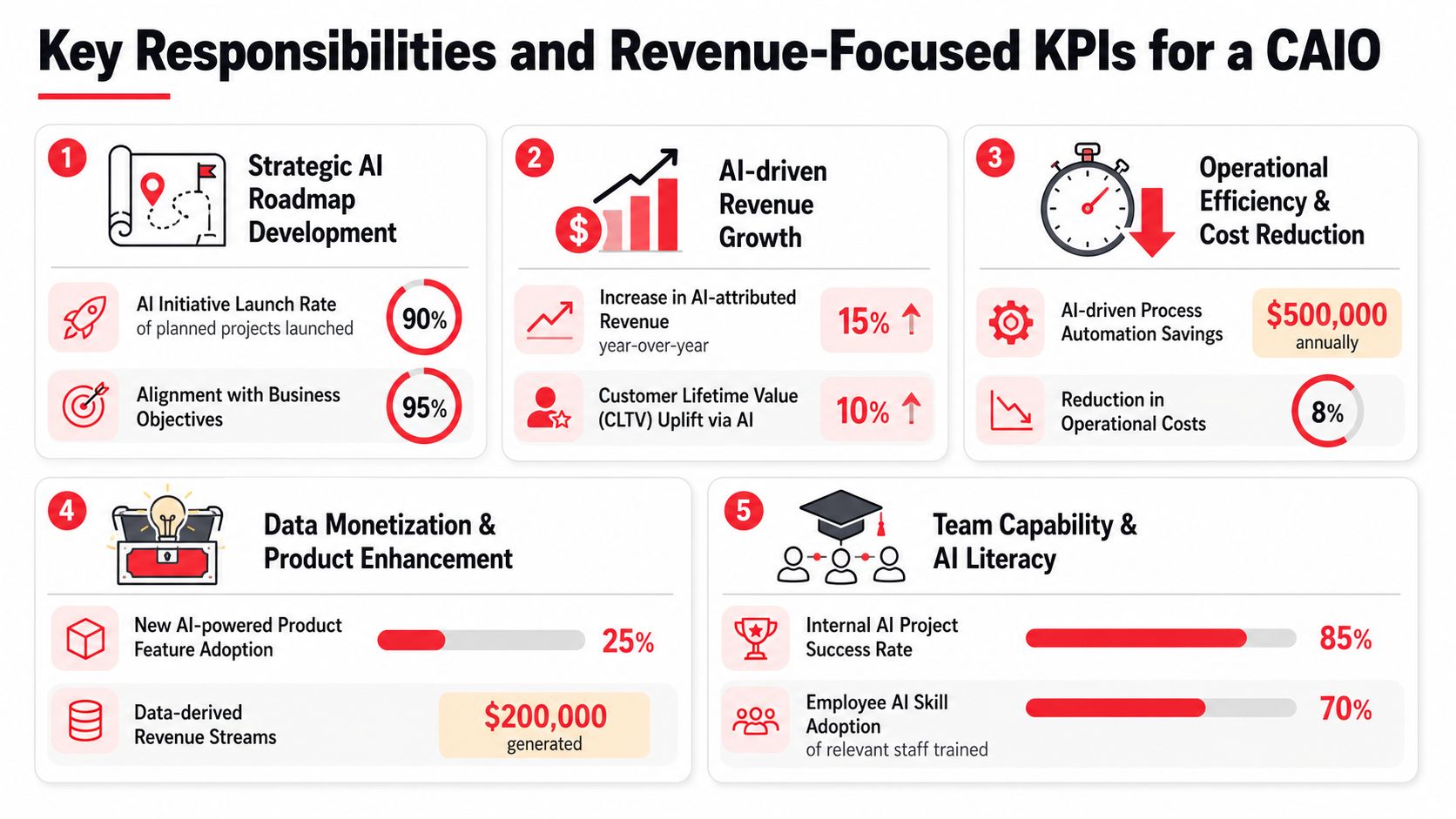
A strong CAIO usually owns a mix of these responsibilities:
- Roadmap ownership that ranks use cases by likely commercial impact.
- Vendor evaluation so the company doesn’t buy overlapping tools with no path to adoption.
- Workflow design across marketing, sales, and revenue ops.
- Measurement design so AI gets judged on output, not excitement.
- Governance coordination with security, legal, and data owners.
- Team enablement so systems get used.
If your CAIO can’t work across those areas, they’ll get trapped in one lane. That’s how companies end up with a smart AI program and no revenue movement.
The KPIs that matter
I’d judge the role on business metrics first, operating metrics second, and technical metrics third.
Business metrics
- Pipeline quality: Are AI-supported programs generating better-fit opportunities?
- Lead-to-meeting conversion: Are qualification and routing workflows improving handoff quality?
- Lead-to-customer conversion: Are AI-assisted nurture and CRO programs producing more closed revenue?
- Sales cycle support: Are reps getting faster research and better account context?
- Expansion or retention signal quality: Are customer-risk and upsell signals getting surfaced early enough to act on?
Operating metrics
- Testing velocity: How quickly can the team launch and learn from GTM experiments?
- Adoption by team: Are reps, marketers, and managers using the workflow in production?
- Time to insight: How fast can the company go from question to action?
- Pilot graduation rate: Which pilots become standard process?
Technical and governance metrics
- Model performance over time
- Data quality and freshness
- Policy adherence and auditability
- Reliability in production
For teams building governance muscle, this guide on mastering AI governance for your systems is a useful companion because it keeps the discussion tied to policy, compliance, and operating discipline.
What doesn’t count as success
A dashboard full of prompts isn’t a win. Neither is a stack of licenses nobody uses.
Revenue teams should ask one hard question every month: which AI workflow changed buyer behavior, seller behavior, or conversion behavior?
If the answer is vague, the program needs a reset. The Chief AI Officer’s job is to make the answer obvious.
When Your Company Reaches the AI Tipping Point
You don’t hire a Chief AI Officer because AI is popular. You hire one when the cost of fragmented execution becomes higher than the cost of focused leadership. Larger organizations often fold this into a combined data and AI function, which we cover in our guide to the chief digital and artificial intelligence office.
The clearest hard threshold in the market comes from Kellogg Insight, which says a dedicated CAIO makes sense when a company has at least 1 million customers, is moving into personalization, and has the resources to implement AI effectively. The same source notes a median salary north of $350,000 and says top firms have offered seven-figure signing bonuses. That tells you what the market thinks this role is worth. It’s a senior executive decision.
Most growth-stage companies won’t match that profile exactly. But they can still hit an AI tipping point much earlier.
Signs you have a strategy problem, not a tooling problem
Watch for these conditions:
- Multiple AI pilots are running at once and nobody can compare them against one revenue plan.
- Personalization is becoming central to acquisition, nurture, pricing, or customer expansion.
- Your data sits in separate systems and each team is interpreting it differently.
- Marketing and sales are buying tools independently with no common architecture.
- You need board-level clarity on where AI spend should go next.
That last one matters more than people think. Once AI reaches budgeting, hiring, and customer-facing workflows, the company needs executive ownership.
The wrong reasons to hire
Don’t make this hire because competitors announced an AI role. Don’t make it because your team wants “someone to own prompts.” And don’t make it because a vendor convinced you the software requires a new title.
A Chief AI Officer is justified when AI has become cross-functional, commercially material, and politically messy.
Here’s the simple test. If your next phase requires decisions across GTM, ops, data, legal, and leadership, you’re beyond software procurement. You’re into operating model design.
A lot of CEOs use headcount as the only trigger. That’s too blunt. Company stage matters less than organizational complexity and revenue dependence on smarter execution. If your business now depends on personalization, faster testing, cleaner GTM systems, or stronger coordination across teams, you may need leadership before you need more tools. This is similar to the broader growth-team decision covered in this Stimulead article on when you should build a growth team.
Full-Time Executive vs Fractional Partner
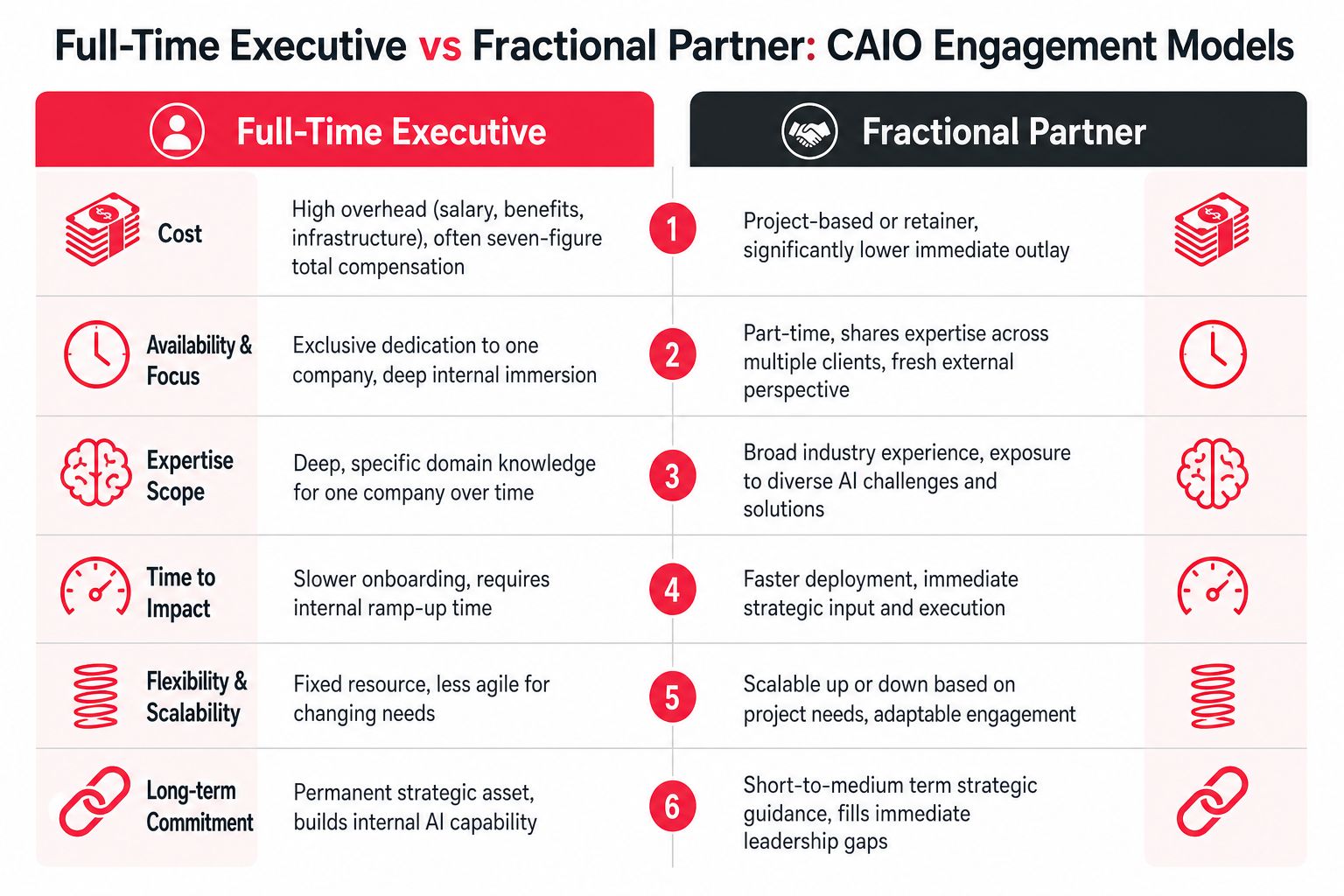
Most growth-stage companies shouldn’t jump straight to a full-time Chief AI Officer. They need the outcomes of the role before they need the org chart.
That’s where the delivery model matters. SiliconANGLE notes that the fractional CAIO model is gaining attention because many organizations are still stuck trying to turn pilots into scaled value. That tracks with what I see. The issue usually isn’t lack of ideas. It’s lack of prioritization, authority, and execution rhythm.
When full-time makes sense
A full-time Chief AI Officer fits when AI is core to the product, closely tied to proprietary data, or dependent on large internal teams. It also makes sense when the company needs day-to-day executive presence across several departments and expects AI to remain a standing board topic.
Use a full-time model if you need someone to:
- Build internal AI capability across engineering, data, and GTM.
- Own major budget decisions tied to long-range AI infrastructure.
- Manage a growing AI function with direct reports and internal hiring.
- Set durable governance standards for many active systems.
When fractional is the better move
A fractional model fits earlier. It works when you need executive judgment, a roadmap, vendor filtering, pilot oversight, and team direction, but you don’t yet need a permanent C-suite salary commitment.
That’s often the right move when your priorities are:
| Need | Better fit |
|---|---|
| Fast GTM use-case selection | Fractional |
| Cross-functional alignment without adding full-time overhead | Fractional |
| Ongoing AI org leadership with internal teams | Full-time |
| Deep product or platform AI ownership | Full-time |
| Executive guidance during an adoption phase | Fractional |
For many companies, a fractional CAIO can drive CRO with AI, GTM engineering, AI search optimization, and agent-commerce readiness without forcing an early executive hire. Firms like Stimulead’s fractional Chief AI Officer advisory are built around that model: roadmap, oversight, team enablement, and execution support tied to revenue functions.
A fractional model works well when the company needs judgment and momentum more than hierarchy.
The trade-off CEOs should care about
Full-time gives depth and internal availability. Fractional gives speed and lower immediate commitment.
The wrong choice is hiring full-time before the company has enough clarity to use the role well. If your business still needs to identify the best AI revenue use cases, prove one or two wins, and build internal operating discipline, fractional usually gets you there faster.
A Sample 90-Day CAIO Roadmap
You should expect visible output in the first quarter. Not perfection. Not a grand AI manifesto. Output.
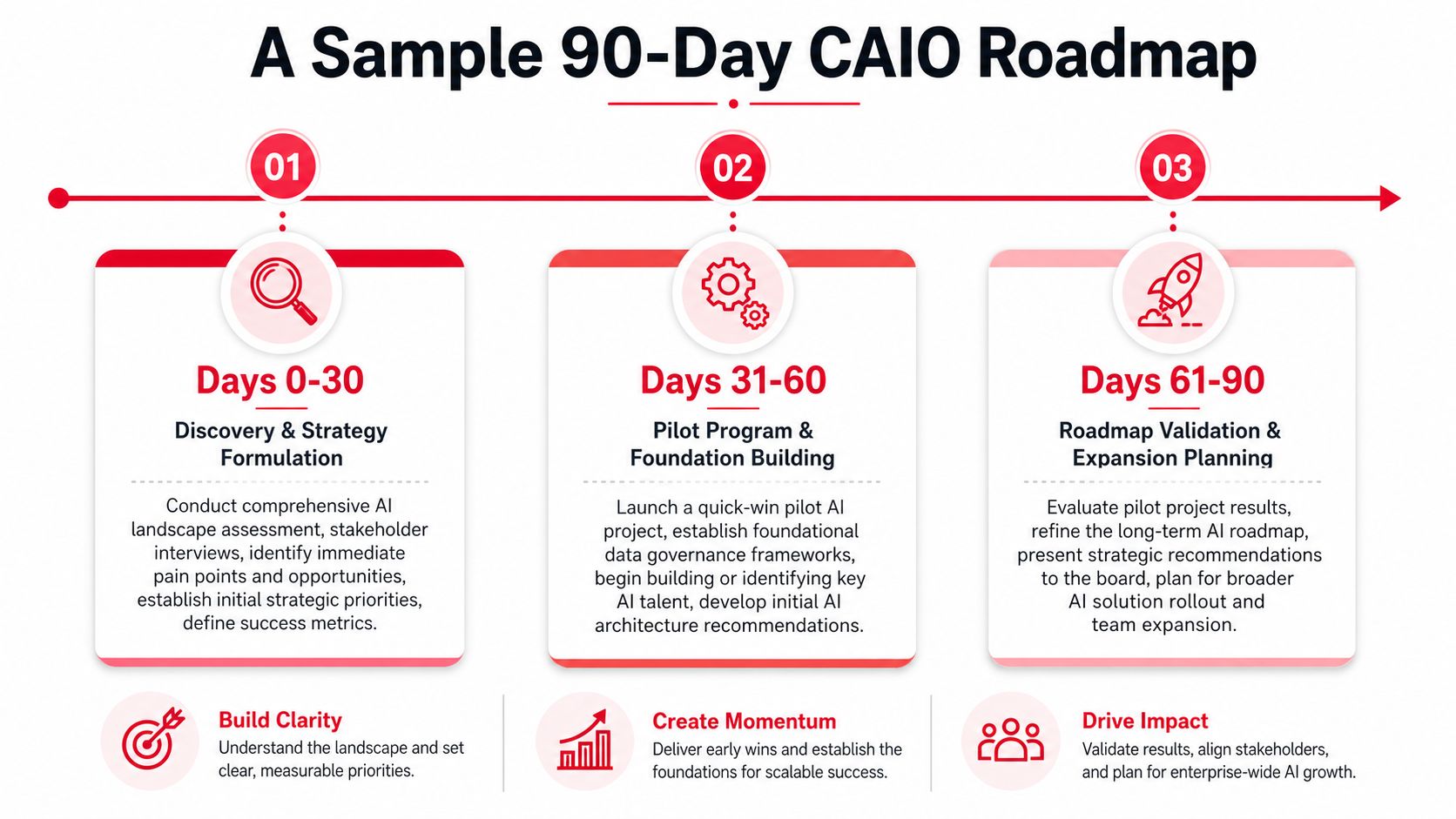
A good Chief AI Officer spends the first ninety days creating focus, proving one revenue use case, and building enough structure that the next decision is obvious.
Days 0 to 30
Start with an audit. That means customer data sources, CRM hygiene, traffic and funnel reporting, content systems, sales workflows, current AI tools, and open experiments.
Then interview the people who own revenue friction. Usually that includes the CEO, CMO, CRO, RevOps, sales managers, and whoever touches the tooling day to day.
The output from this phase should include:
- A ranked list of commercial use cases
- A map of data and workflow blockers
- A short list of tools to keep, replace, or avoid
- A measurement plan tied to pipeline or conversion
- A clear owner for the first pilot
Field note: If the first month ends without a forced prioritization decision, the CAIO is collecting information instead of leading.
Days 31 to 60
Launch one focused pilot. One. Two at most if they share the same data and buyer motion.
Good first pilots usually live close to revenue. Examples include AI-assisted landing-page testing, AI-supported outbound research, lead qualification support, or AI search content restructuring for category pages and high-intent commercial pages.
Use this phase to define:
- What changes in the workflow
- Who uses it
- What metric should move
- How the team records wins and failures
This is also the point where governance gets practical. Access, approval rules, QA, and reporting standards need to be documented early.
A lot of leaders also benefit from hearing how another operator frames this transition from experimentation to execution:
Days 61 to 90
By now, the CAIO should be able to present a board-ready view of what happened.
That report should answer three questions in plain language:
- What did we test?
- What changed in a business metric or workflow?
- What should we scale, stop, or fix next?
The final output of the quarter should be a working playbook. Not theory. A repeatable process, with owners, metrics, governance, and budget assumptions.
If you don’t get that by day ninety, the role is drifting.
Your Next Step to Generate Revenue from AI
Don’t start with the title. Start with the diagnosis.
Get your leadership team in one room and answer these five questions truthfully:
- Where is revenue currently leaking? Look at conversion, qualification, sales capacity, retention risk, and visibility in AI-driven discovery.
- Which AI projects are already in motion? List them. If nobody can explain owner, metric, and business purpose, you have a leadership issue.
- Does your team have the skills to operationalize AI? Tool access isn’t the same as workflow design, QA, and measurement.
- Are your data and systems good enough for AI to work in production? If the underlying records are messy, adding models won’t fix the business.
- Do you need an operator, an advisor, or a department head? That answer points you toward a fractional CAIO, a full-time executive, or foundational cleanup first.
Use those answers to make one decision this quarter. Choose the highest-value AI use case tied to revenue. Assign an executive owner. Define the metric before the pilot starts.
If your team needs a practical place to start on revenue mechanics, this guide on increasing B2B SaaS revenue today is a useful discussion prompt for the leadership meeting.
The companies that get paid from AI don’t treat it like a side experiment. They give it ownership, constraints, and a scoreboard.
If you’re deciding on your first strategic AI hire, map your current AI activity against one revenue metric first. Pipeline quality, conversion rate, sales efficiency, or retention signal quality all work. Once that metric is clear, the right Chief AI Officer model usually becomes obvious.