
A fractional AI officer earns a place on your org chart when AI spending has become fragmented across vendors, teams, and risk owners. The counterintuitive point is that the decision isn't about whether you need AI strategy. It's about whether one person has enough authority to approve spend, select vendors, and answer for incidents.
For CEOs, CMOs, and CROs at growth-stage B2B companies, that distinction determines whether a part-time executive creates control or merely adds another layer of advice. We'll assess the seat through four lenses: ownership boundaries, cost against a full-time CAIO, governance limits, and a roadmap tied to pipeline and operating metrics.
Table of Contents
- The Decision You Are Actually Making
- What a Fractional AI Officer Owns
- Three Engagement Models and What Each Costs
- The Math Against a Full-Time CAIO Hire
- When a Fractional AI Officer Is the Wrong Call
- A 90-Day Roadmap Tied to Revenue KPIs
- Your First Move This Week
The Decision You Are Actually Making
The typical choice is uncomfortable. Keep AI advisory work on the side and let the CTO, COO, marketing team, sales operations, or vendors absorb execution, or assign budget and vendor authority to one part-time executive who reports directly to the CEO or COO.
We recommend the second option only when the company has enough fragmented AI activity to require a single accountable owner. A fractional AI officer should be able to stop a risky implementation, reject a redundant tool, require evidence before production release, and redirect spending toward a business priority. Without that authority, the company has hired a strategist while leaving the actual decision rights untouched.
That distinction matters because AI decisions now sit across product, marketing, sales, customer support, security, and finance. A CTO may own infrastructure but lack authority over marketing automation. A CMO may own customer acquisition but lack the remit to approve data handling. A vendor may deliver a workflow while leaving your team responsible for model behavior, privacy, and business outcomes.
The practical test: if nobody can answer “who approved this AI vendor?” and “who stops it when it fails?”, your company has an ownership problem.
We've seen operators approach this decision as a choice between hiring developers and buying tools. That misses the executive question. Vision's comparison of hiring a developer and using AI tools is useful because it frames the trade-off around capability and control. The same logic applies at the leadership level. Tools and developers can execute tasks, but someone still needs authority over the system those tasks create.
A board meeting, fundraise, or product launch makes the gap visible. Before that deadline, decide whether AI is still a collection of local experiments or an operating capability that deserves a named owner.
What a Fractional AI Officer Owns
IBM's 2026 CEO study surveyed 2,000 CEOs across 33 geographies and found that 76% of organizations reported having a Chief AI Officer, compared with 26% the year before. The same source cites a separate CAIO study reporting that 61% of CAIOs control their organization's AI budget. IBM's CAIO statistics analysis provides the relevant scale context: the role is becoming a budget-bearing executive seat.
A fractional version should preserve the authority that makes the seat useful. The arrangement can be part-time, but the mandate can't be vague. We recommend documenting four decision rights in the engagement letter and operating charter:
- Budget approval: Set a clear spending ceiling for AI tools, services, experiments, and implementation work. Purchases above that limit should go to the CEO, CFO, or an agreed investment committee.
- Vendor and model selection: Give the officer sign-off authority for model providers, data vendors, automation platforms, and agencies that process company information.
- Risk register ownership: Require a live record of use cases, data access, model risks, mitigations, owners, and review dates.
- Incident reporting: Create one reporting line into the CEO or COO for material AI incidents, including inaccurate outputs, unauthorized data exposure, service failures, and unexpected automated decisions.
The role also owns sequencing. A CAIO should decide which use cases move from experiment to production, what evidence a team must collect, and which projects should stop. For revenue teams, that might include AI-assisted prospect research, proposal generation, lead qualification, recommendation visibility, or support workflows. The point is to connect the workflow to a measurable business process and an accountable operator.
The boundary with adjacent leaders
A consultant typically delivers a strategy, assessment, or implementation package. The consultant may recommend a vendor, but the company retains the decision and absorbs the consequences after the engagement ends.
An internal VP of Data or CTO usually owns technical delivery, architecture, and engineering priorities. That leader may become the de facto AI owner, but the role can be constrained by product deadlines, infrastructure priorities, or a lack of authority over go-to-market budgets.
| Dimension | Fractional CAIO | AI Consultant | Internal VP of Data or CTO |
|---|---|---|---|
| Budget authority | Explicit authority within an agreed ceiling | Usually advisory | Depends on existing remit |
| Vendor selection | Owns recommendation and sign-off process | Evaluates or recommends | Often limited to technical vendors |
| Risk register | Maintains cross-functional ownership | May create the initial framework | Often focused on technical risk |
| Incident reporting | Direct route to CEO or COO | Escalates through sponsor | Follows existing engineering chain |
| Production oversight | Decides sequencing and release conditions | Delivers defined scope | Balances AI against other priorities |
| Best use | Executive control without a full-time seat | Defined assessment or build | Long-term internal ownership |
The fractional CAIO fails when these rights exist only in a slide deck. Put them in writing, name the approvers, and specify what happens when marketing, sales, product, and security disagree.
Three Engagement Models and What Each Costs
Choose the engagement by the decisions the officer must own, not by the title's prestige. If the CAIO only provides occasional executive judgment, an embedded operator is unnecessary. If the company has active vendor spend, production workflows, and board scrutiny, a short report leaves budget authority and risk ownership unresolved.
Current industry estimates place fractional CAIO work at roughly one to four days per week or 8 to 20 hours weekly. Monthly retainers range from $5,000 to $25,000 in one estimate and $10,000 to $30,000 in another, according to this fractional executive AI leadership analysis. Treat those figures as market guidance, then set the fee against decision rights, operating cadence, and the AI budget the officer can control.
| Engagement Model | Price Range | Typical Scope | Best Fit Stage |
|---|---|---|---|
| Monthly executive retainer | $5,000 to $30,000 per month, depending on scope and market | Budget governance, vendor decisions, roadmap control, risk reviews, implementation oversight, leadership meetings | Companies that need recurring judgment and coordination |
| Defined project engagement | Typically $15,000 to $60,000, depending on deliverable count and audit depth | AI assessment, vendor review, governance framework, or implementation plan | Teams that need a bounded deliverable before deciding on ongoing ownership |
| Equity and cash hybrid | Cash retainer plus a negotiated equity grant, priced against the unpaid portion of the role | Reduced cash commitment in exchange for a broader strategic relationship | Funded companies with a clear need for senior involvement and constrained cash |
A project fee should buy a defined outcome, not access to an undefined advisor. A governance framework usually spans 4 to 6 weeks, while an assessment or vendor review should specify the systems examined, decisions delivered, and executive sign-off required. The contract must state who owns the recommendations after handoff.
Equity requires tighter controls. Set the time commitment, decision rights, confidentiality, termination terms, vesting, and conflicts before work starts. Establish the cash fee first, then value any equity against the work the company expects without cash payment. Do not exchange budget savings for unclear authority.
A retainer fits when the CAIO must attend operating meetings, review vendors, maintain the risk register, and report to the CEO. A project fits when the company can name the deliverable and accept that decision ownership returns to internal leaders afterward. Use the hybrid only when both sides want a continuing relationship and can define the officer's authority in writing.
For rate comparisons, scope questions, and contract considerations, see Stimulead's guide to fractional Chief AI Officer cost. Stimulead provides executive advisory, team training, and ongoing implementation oversight connected to marketing and sales operations.
The Math Against a Full-Time CAIO Hire
A full-time CAIO is a major fixed commitment before the company has proved that AI work requires a permanent executive seat. Salary is only the starting point. Benefits, equity, recruiting, onboarding, and the cost of keeping the role fully occupied can push the annual burden well beyond compensation.
That cost may be justified when AI has become a permanent operating function. It is harder to justify when the company is still applying AI to a limited set of workflows and needs disciplined decisions about vendors, risk, and internal ownership. A fractional officer can provide executive oversight without turning every experiment into a permanent headcount decision.
For a side-by-side view of the two models, see fractional CAIO vs full-time Chief AI Officer.
| Cost Line | Full-Time CAIO | Fractional CAIO |
|---|---|---|
| Executive compensation | Full salary and executive package | Fee based on defined scope |
| Benefits and employment costs | Paid by the company | Usually covered within the provider fee |
| Recruiting and onboarding | Company-funded and time-consuming | Provider enters as an external executive resource |
| Weekly availability | Full-time access | Agreed hours, days, and priorities |
| Authority | Can become a permanent internal owner | Must be written into the engagement |
| Capacity for execution | Greater internal availability | Limited by the contracted capacity |
| Best economic case | A large, continuously staffed AI function | Several important initiatives without a full-time workload |
The comparison changes once budget authority enters the discussion. A fractional CAIO should not be accountable for AI risk while a product leader controls vendor selection, a finance leader controls spending, and nobody owns the final approval. Define the spending limit, vendor approval rights, escalation path, and executive sponsor before comparing fees.
The fractional model works when the officer can set the operating model, assess vendors, inspect implementation, and hold internal owners to agreed decisions. It does not replace product engineering, security, legal review, or data platform capacity. Those functions still need named operators inside the business.
The full-time option becomes stronger when AI requires daily management of a large engineering team, continuous incident response, or attendance in every product and security forum. In that situation, limited availability can create an authority gap between responsibility and action.
Use one test this quarter. List each AI decision requiring executive approval, then record who makes it, who can stop it, who controls the budget, and who reports the consequence. If that workload fills a permanent operating role, begin a full-time search. If the decisions are significant but intermittent, a fractional CAIO can match the need without adding permanent executive cost.
For a broader description of the permanent role's responsibilities, review Stimulead's overview of the Chief AI Officer position.
When a Fractional AI Officer Is the Wrong Call
A part-time executive isn't a substitute for missing internal accountability. Grant Thornton's 2026 AI Impact Survey found that 78% of business executives lacked strong confidence that they could pass an independent AI governance audit within 90 days, based on a survey of 950 leaders across 10 industries. Grant Thornton's 2026 AI Impact Survey points to a governance problem that requires evidence, controls, and named owners.
A fractional CAIO can design those controls, but the company still needs people who operate them between meetings. Don't hire a part-time officer to mask the absence of a security owner, legal reviewer, data steward, or engineering manager.
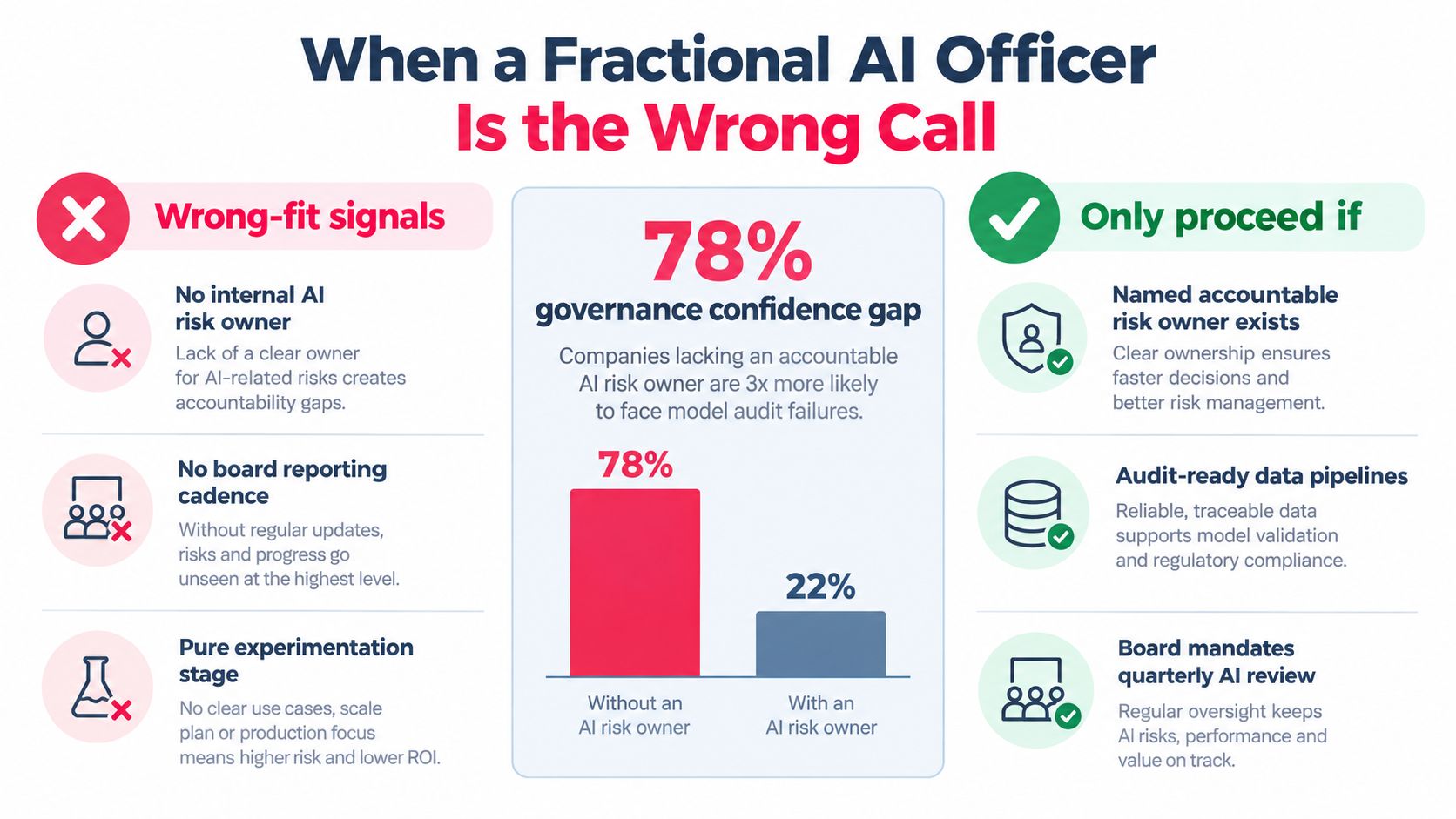
Three conditions that should stop the hire
AI affects regulated decisions. If your systems influence credit, health, or hiring decisions, a fractional officer may lack the daily presence needed for review, documentation, escalation, and conformity work. Keep a permanent accountable owner close to the process, with legal, security, and compliance involved from the start.
The company is approaching a public-market scrutiny event. A pre-IPO company with material AI exposure needs consistent evidence, board reporting, controls testing, and executive availability. A part-time authority ceiling can leave gaps precisely when investors and directors ask for a complete account of model risk.
The CEO expects one person to run a large engineering organization as well. AI strategy and engineering management are related, but they aren't interchangeable jobs. If the CAIO is also expected to manage a 50-person engineering organization, the company should fund the permanent leadership structure that workload requires.
EY reports that 98% of senior AI executives have formal AI governance policies, while 69% worry about lacking internal expertise to evolve those controls and 63% worry about implementing or designing them. EY's 2026 survey on autonomous AI implementation and oversight makes the operating constraint clear. Written policy doesn't equal working control.
There's a real cost to part-time authority. If the board expects one person to answer for every AI risk, that person needs enough access, staff support, and decision power to do the job. Pretending otherwise is how companies end up explaining preventable incidents in public.
A 90-Day Roadmap Tied to Revenue KPIs
The first quarter should produce operating evidence, not a larger AI strategy document. We recommend a sequence that gives the CFO a view of spend and gives the CRO or CMO a view of pipeline, conversion, cost, or service capacity.
The exact KPI depends on the workflow. Don't claim pipeline contribution before attribution exists. Baseline the current process first, then set a target that the process owner accepts.
Days 1 to 30
Instrument the AI spend stack. Pull invoices, contracts, user counts, renewal dates, model usage, and ownership for tools such as Salesforce Einstein, HubSpot AI, OpenAI or Anthropic API usage, Gong, Clay, and internal automation services.
The deliverable is a one-page vendor consolidation brief. It should identify duplicate capabilities, unused seats, renewal decisions, data access, and the accountable business owner for every active tool.
Track:
- Spend visibility: total AI-related spend with a named owner for each contract.
- Workflow baseline: current hours, conversion stage, response time, cost per ticket, or review effort.
- Risk status: use cases with missing documentation, unclear data access, or no human checkpoint.
Stimulead's AI implementation roadmap can help structure the work, but the roadmap should be adapted to your systems and board commitments.
Days 31 to 60
Ship one revenue-adjacent workflow into production. Choose lead scoring, proposal generation, prospect research, support deflection, or another process where the owner can define success before launch.
A production gate should include data permissions, human review, failure handling, logging, and a named operator. The CAIO should also record the baseline and the target, such as hours saved per qualified opportunity, proposal cycle time, qualified pipeline influenced, or support cost per ticket.
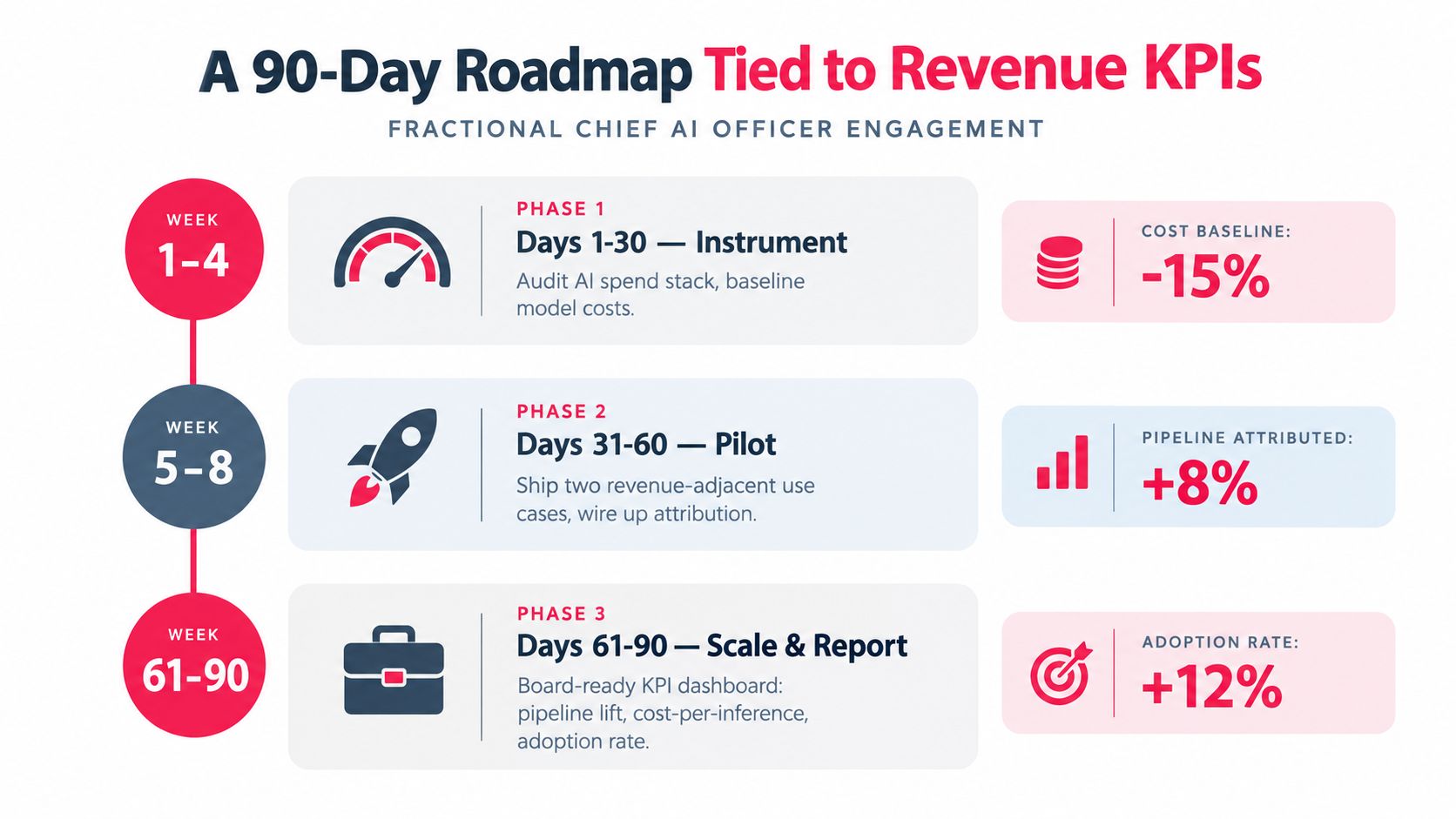
Days 61 to 90
Instrument attribution and report against the agreed target. If the workflow affects buying decisions, include bottom-of-funnel behavior in the measurement plan. Research from Siege Media on AI buying advice identifies pricing, comparison, alternative, and “best for” prompts as especially relevant to vendor choice, so recommendation visibility can become a pipeline input where it matches the company's market.
A board-ready report should show:
- What changed: workflow, owner, release date, and users.
- What moved: hours, qualified pipeline, conversion stage, cycle time, inference cost, or support cost.
- What remains uncertain: attribution gaps, sample limitations, data quality, and risks.
- What gets funded next: a small number of initiatives tied to an owner and a measurable outcome.
Independent guidance for fractional CAIOs recommends operating metrics such as experiment-to-production velocity, inference cost per user, and compliance readiness, alongside controls such as risk-tier matrices and automated checks for high-risk builds. Umbrex's fractional CAIO playbook offers a useful reference for turning governance into measurable operating work.
Your First Move This Week
Pull the last six months of AI-related invoices and vendor contracts. Include API usage, software subscriptions, agencies, implementation partners, data providers, and internal project costs where they can be isolated.
Then map that spend against one revenue line. Choose qualified pipeline, proposal throughput, conversion, sales cycle time, customer retention, or support cost per ticket. The purpose isn't to force an ROI claim. It's to determine whether the spend is large and fragmented enough to justify an executive owner.
Within 10 business days, the CEO or a direct report should produce a one-page memo containing:
- The named AI budget and its current owner.
- Every vendor, contract owner, renewal date, and business purpose.
- The active AI use cases and their accountable operators.
- A flagged risk register covering data access, model behavior, vendor dependency, and incident response.
- The one revenue or operating line that will receive measurement attention.
A board-ready decision then becomes clear. Hire a fractional AI officer if the company has meaningful spend and cross-functional decisions but doesn't need a permanent executive. Hire full-time if the workload and risk require daily authority. Decline both options if the spend is too small and the company still needs to define the business problem.
Write the memo before the next board-prep cycle. It will force a yes, no, or part-time decision tied to actual dollars and ownership, rather than enthusiasm about AI.
Pull the invoices, assign the budget owner, and complete the memo within 10 business days. Then decide whether your company needs a fractional AI officer with real authority, a permanent CAIO, or no new executive seat yet.
