
You're probably in one of two situations right now.
Either your team is pushing for AI across marketing and sales, and you need a way to decide what deserves budget. Or you've already tested a few tools, got some mixed results, and now you want a cleaner path from experimentation to revenue.
That's where an AI readiness assessment earns its keep. Done well, it isn't a maturity quiz. It's a decision tool. It tells you where AI can move pipeline, conversion, win rate, or sales efficiency now, and where your team will burn money if you push too early.
For growth-stage companies, the mistake is usually scope. Leaders try to assess “the whole business” and end up with a broad scorecard that nobody uses. A better move is tighter. Focus the assessment on GTM first. Marketing, sales, revenue ops, analytics, content, and the workflows that influence acquisition and pipeline.
Table of Contents
- Why Most AI Plans Fail Before They Start
- Phase 1 Scoping and Stakeholder Alignment
- Phase 2 The Data and Technology Audit
- Phase 3 Evaluating Skills and Processes
- Phase 4 Building Your Scoring Model and Roadmap
- Your First 90 Days After the Assessment
Why Most AI Plans Fail Before They Start
Most failed AI efforts don't fail because the model was weak. They fail because the company started with bad assumptions.
The CEO assumes the data is usable. The CMO assumes the team can absorb another workflow. The CRO assumes the CRM reflects reality. None of those assumptions hold for long once implementation begins.
That's why an AI readiness assessment matters before vendor selection, pilot design, or budget approval. Companies that perform one are 47% more likely to achieve successful implementation, while 37% of executives underestimate how important readiness is before launch, according to OvalEdge's write-up on measuring AI readiness. That gap explains a lot of what shows up in the market: rushed pilots, unclear ownership, and no path from demo to deployment.
Practical rule: If your team can't explain which GTM workflow should change first, you're not ready to buy more AI tools.
Leaders often frame readiness as a technical review. It's broader than that. You're checking whether the company can absorb change in a way that produces sales and marketing results. That means looking at people, process, data quality, governance, and measurement before anyone starts promising pipeline gains.
A lot of teams would benefit from assigning one accountable operator to drive this work. If that capability doesn't exist in-house, a fractional Chief AI Officer model gives you a way to own the roadmap without hiring a full executive team too early.
The real cost of skipping readiness
Skipping the assessment creates three expensive patterns:
- Tool-first buying: The team buys a prospecting agent, content assistant, or CRO copilot before defining the workflow it should improve.
- Pilot purgatory: A few people get value, but nothing spreads because process owners, approval rules, and KPIs were never set.
- Data surprises: Midway through implementation, everyone learns the CRM is incomplete, attribution is inconsistent, or product data is buried across systems.
The point of the assessment isn't caution for its own sake. It's speed with fewer dead ends. If you want AI to influence revenue, the fastest path is usually a narrower one with cleaner prerequisites.
Phase 1 Scoping and Stakeholder Alignment
If you scope this too broadly, the assessment turns into a corporate workshop. That's wasted motion.
For a growth-stage company, start inside revenue. Marketing, sales, revenue operations, content, and analytics. A structured assessment usually spans pillars such as business strategy, governance, data foundations, infrastructure, culture, and model management, which is how Microsoft's assessment framework frames readiness. That matters because revenue teams break when one of those pillars is weak, even if the others look fine.
Set the boundary around revenue
Use a simple scope statement:
We are assessing AI readiness for the workflows that drive demand generation, conversion, pipeline creation, sales execution, and customer acquisition efficiency.
That excludes finance automation, HR policy, and broad enterprise experimentation for now. You can assess those later. Right now, the work is to find the shortest route from readiness to measurable GTM output.
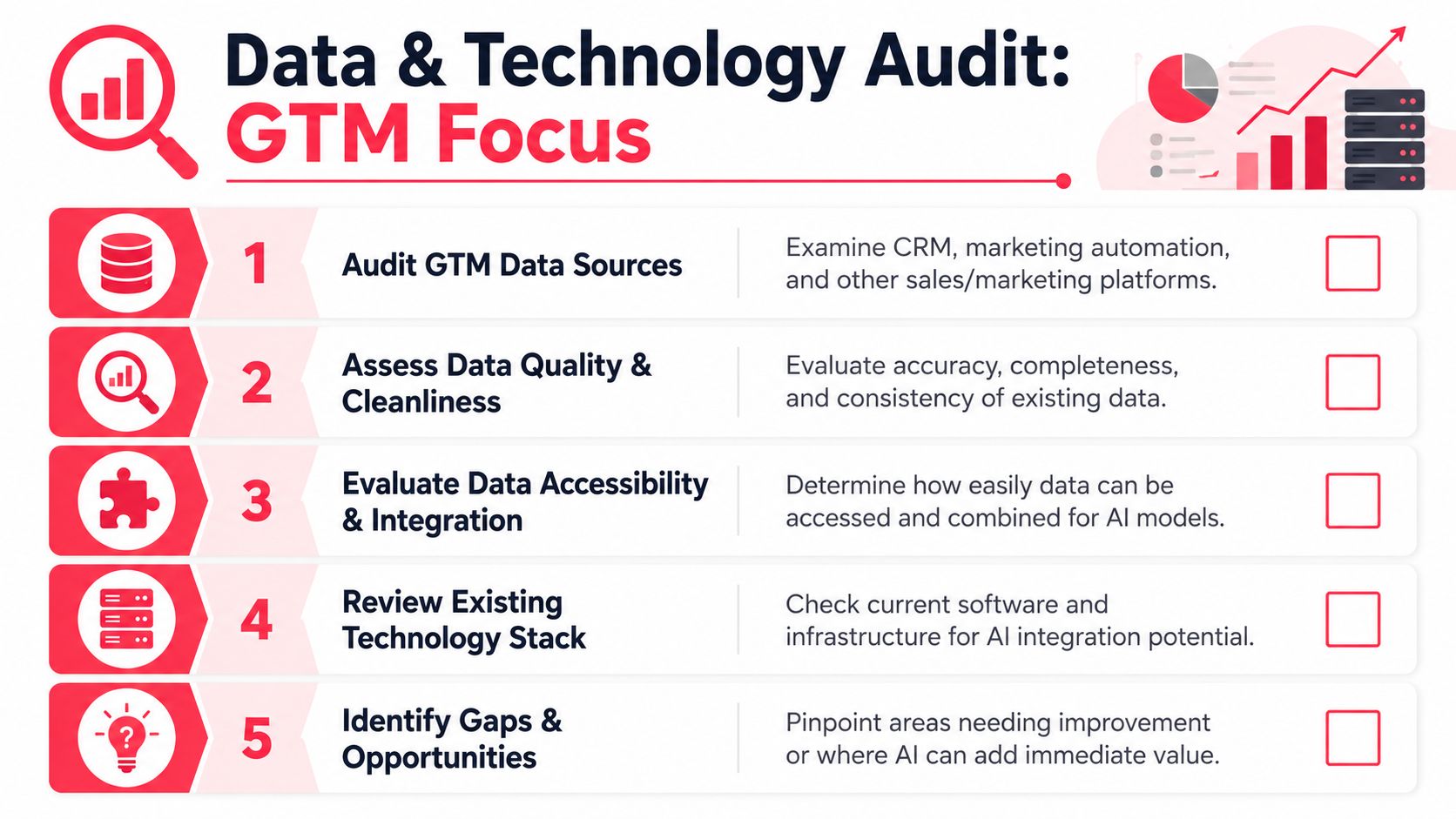
Start with these stakeholder groups:
Executive owners
CEO, CMO, CRO, and whoever owns RevOps. You're looking for strategic constraints, budget posture, risk tolerance, and current priorities.Workflow operators
Demand gen manager, lifecycle lead, SDR manager, content lead, sales ops, and an AE who consistently outperforms peers. They'll show you where the process breaks.Technical enablers
Data lead, CRM admin, marketing ops, and whoever manages integrations. They'll tell you whether the workflow can be instrumented, automated, or measured.
Give each conversation a hard boundary. Thirty to forty-five minutes. Same core prompts. No abstract “AI vision” discussion unless it ties to a revenue workflow.
Interview the people closest to friction
Ask questions that expose lost time, low conversion, and inconsistent execution.
For the CEO
- Where do you expect AI to change growth first?
- Which revenue metric would make you keep funding this work?
- Where have prior tech rollouts slowed down?
For the CMO
- Which campaigns are hard to scale because production is bottlenecked?
- Where does the team lose time in research, briefs, content refresh, testing, or reporting?
- Which channel matters most for the next two quarters, paid, organic, outbound support, partner, or AI search?
For the CRO
- Where do reps spend time that doesn't help them sell?
- Which parts of prospecting, follow-up, or account research are too manual?
- Where does pipeline quality break down between handoff and close?
For RevOps and systems owners
- Which fields in the CRM are required but ignored?
- Can you connect first touch, opportunity creation, and closed-won cleanly enough to evaluate impact?
- Where do integrations fail or create duplicate records?
For frontline operators
- Which task do you repeat every day and hate every time?
- Where do top performers use judgment that the rest of the team can't copy?
- What's the one workflow you'd fix first if you had a dedicated builder for a month?
What works here is pattern recognition. If three different people describe the same bottleneck in different language, that's usually where your first AI roadmap item lives.
A strong scope also includes adjacent areas many teams ignore early. If AI search optimization and agent commerce matter to your market, inspect public content structure, schema, product feeds, answer formatting, and whether your site content is machine-readable enough for recommendation engines and buying agents. Those aren't side topics anymore. They sit inside GTM readiness.
Phase 2 The Data and Technology Audit
Optimism now meets reality.
Numerous groups report having ‘a lot of data.’ That's not the same as having usable data for AI. In early programs, 67% of organizations cite data quality issues as their top AI readiness challenge, according to the figure cited in the earlier OvalEdge source. That matches what shows up in GTM teams every week: broken lifecycle stages, duplicate contacts, weak taxonomy, disconnected analytics, and content trapped in systems nobody can query cleanly.
Audit the systems your revenue team actually uses
Start with the systems that influence revenue decisions every day.
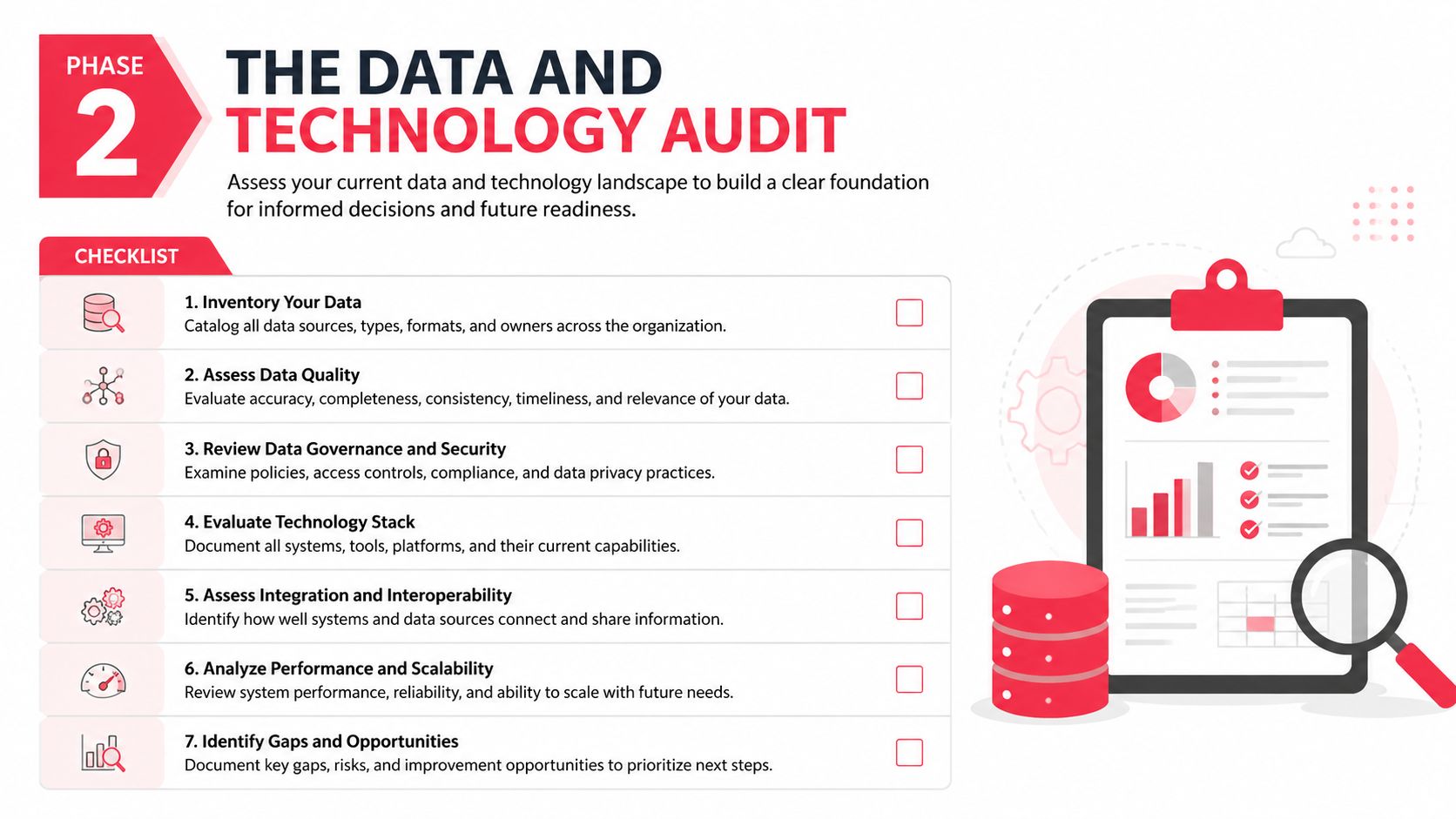
Don't ask whether the data warehouse is elegant. Ask whether the GTM team can act on trusted information fast enough.
CRM audit
Check required fields, stage discipline, contact-account relationships, lead source consistency, and owner hygiene. If reps can skip the fields that matter, any AI workflow built on top will drift fast.Marketing automation audit
Review lifecycle definitions, enrichment logic, scoring rules, routing, campaign naming, and audience segmentation. Many “AI personalization” plans fail because the underlying segments are too messy to personalize against.Analytics audit
Confirm whether you can trace a path from acquisition source to pipeline and closed-won at a level your leadership team trusts. If that chain is weak, AI may still help execution, but proving ROI will be harder.Content and knowledge audit
Inspect where messaging, product positioning, case material, objections, pricing context, and competitor notes live. If this is spread across docs, Slack, decks, and rep memory, AI assistants will return inconsistent outputs.Public content audit
Review site structure, FAQs, product data, comparison pages, documentation, and supporting schema. For AEO and agent commerce readiness, this is table stakes.
If your team needs a better frame for what buyer understanding should look like before adding automation, this guide on how B2B marketers use data to understand buyers is a useful companion.
Bad GTM data doesn't stay in the dashboard. It shows up in targeting, lead routing, outreach quality, forecasting, and the prompts your AI stack sees every day.
Define good enough for the first wave
A common mistake is demanding perfect data before launching anything. That creates a long cleanup project with no business pressure behind it.
For early GTM AI use cases, “good enough” usually means:
| Area | Good enough looks like |
|---|---|
| CRM records | Core fields are consistently populated for the segment you want to target |
| Funnel definitions | Marketing and sales use the same stage language |
| Content inputs | Messaging and proof points are stored in a place the team can govern |
| Reporting | You can compare pre-pilot and post-pilot performance on a few agreed metrics |
| Integrations | The systems involved in the pilot can pass data reliably |
Don't try to fix every data issue at once. Fix the subset tied to the first roadmap item. If the first project is outbound personalization, clean account, persona, industry, case-study mapping, and enrichment flow first. If the first project is CRO with AI, focus on event tracking, session behavior, landing page inventory, and test archive quality first.
That sequence keeps the audit tied to revenue. Otherwise you get a broad data cleanup effort that drifts for months.
Phase 3 Evaluating Skills and Processes
A company can have solid tools and still be unready.
The gap usually sits in execution habits. Teams say they want AI, but their work is still trapped in undocumented steps, personal workarounds, and “ask Sarah, she knows how that works” dependencies.

Check for operator behavior, not AI enthusiasm
You don't need a formal HR assessment to evaluate readiness. Look for evidence in the work.
Here's the simple test I use. Can the team do these things already, without AI?
Document a repeatable workflow
If nobody can describe the current process step by step, automation will magnify confusion.Review outputs against a standard
Teams that can't define what “good” looks like struggle to use AI well because every output turns into a taste debate.Run small experiments
AI works best with teams that can test, review, and iterate fast.Adopt shared templates
If every rep or marketer insists on a personal system, scale gets harder.
A content team is a good example. If briefs are inconsistent, approvals are slow, and subject-matter review is informal, adding AI to content production often creates more volume but less trust. In those cases, it helps to study workflow examples like Sight AI's guide to content strategy, because it shows the role design and process discipline that content operations need before AI can add speed safely.
Governance starts in GTM workflows
Governance sounds like an enterprise concern until an AI-generated email makes a false claim, or an automated sales assistant pulls the wrong pricing logic into a customer response.
Recent institutional frameworks put more weight on ethical AI, legal controls, and cross-functional accountability, especially for customer-facing use cases in marketing and sales, as described in Project Evident's AI readiness diagnostic. That's the right lens for growth companies too.
Ask these questions during the assessment:
- Who approves customer-facing AI outputs before they go live?
- Who owns prompt libraries, message rules, and brand constraints?
- Who decides which use cases require human review every time?
- Who investigates when an AI workflow produces a bad output?
- Who can shut down a workflow if risk rises?
If nobody owns the risk, nobody owns the system.
CEOs often need to force clarity. The CMO might own AI content operations. The CRO might own sales-assistant deployment. RevOps might own workflow instrumentation. Legal or an external advisor may need to review high-risk use cases. What matters is decision rights. Without them, adoption slows the moment something goes wrong.
Phase 4 Building Your Scoring Model and Roadmap
Most assessments die in a slide deck.
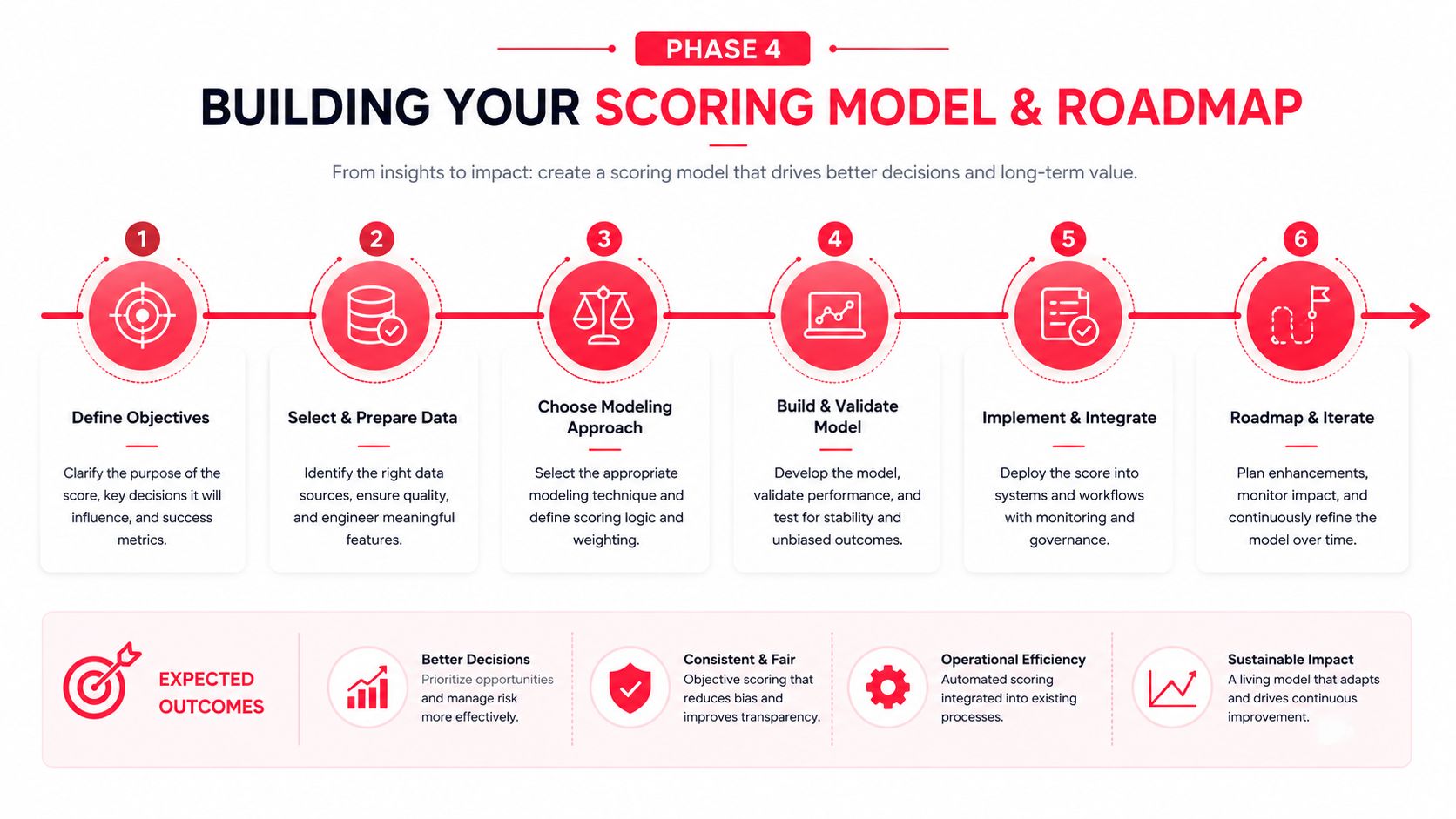
The team reviews the findings, nods at the heat map, and moves on. That happens because the output is descriptive, not operational. A revenue-focused assessment needs to end with choices, sequencing, owners, and success measures.
The better frameworks answer a practical question: what do we do next, and in what order? That's the point made in Agility at Scale's view of AI readiness assessment. The score matters less than the roadmap it produces.
Use a scoring model your leadership team will actually use
Keep the model simple. Score each pillar from 1 to 5. You don't need false precision. You need a shared view of where execution will stall.
Use these pillars:
- Strategy
- Data
- Technology
- Skills
- Process
- Governance
- Measurement
A 1 means the area is blocking progress. A 3 means usable with constraints. A 5 means ready to support scaled deployment.
If you're shaping the people side of that score, DataTeams' AI team analysis is a useful reference for organizing a practical skills-gap review without turning it into a bloated HR exercise.
Prioritize with impact versus readiness
Once each pillar has a score, list possible AI projects and place them on a simple matrix.
High impact, high readiness
Start here. These are quick wins. Examples include AI-assisted outbound research for one sales pod, CRO test ideation support, or support-content refresh for high-intent pages.
High impact, low readiness
These are big bets. Keep them, but attach prerequisite work first. Examples include full lifecycle orchestration, account-level predictive workflows, or customer-facing AI agents tied to product and pricing logic.
Low impact, high readiness
These can help team adoption, but they usually shouldn't lead the roadmap unless they remove a clear bottleneck.
Low impact, low readiness
Ignore these for now. They create noise.
One practical way to pressure-test the roadmap is to run each proposed project through your growth model. If the initiative can't connect to a traffic, conversion, pipeline, or sales-capacity assumption, it probably belongs lower in the queue. This framework for a SaaS growth model is useful for keeping that conversation grounded in operating math rather than AI enthusiasm.
Operator view: A readiness roadmap should tell your team what to start, what to defer, and what foundation work must happen before budget expands.
Sample AI Readiness Scoring Model
| Assessment Pillar | Key Questions | Score (1-5) |
|---|---|---|
| Strategy | Do leaders agree on the GTM use cases that matter and the metrics that justify investment? | |
| Data | Is the CRM, funnel, and content data usable for the first pilot? | |
| Technology | Can current systems support the workflow, integrations, and reporting needed? | |
| Skills | Do the people involved know how to operate, review, and improve AI-assisted work? | |
| Process | Are the target workflows documented and repeatable enough to automate safely? | |
| Governance | Are approval rules, risk owners, and escalation paths clear for customer-facing use cases? | |
| Measurement | Can the team track pre-pilot and post-pilot performance credibly? |
After scoring, create a roadmap with four fields per initiative:
- Owner
- Prerequisites
- Pilot KPI
- Decision date
That last field matters more than many teams realize. Every pilot should have a date when leadership decides to scale, revise, or stop.
Your First 90 Days After the Assessment
The assessment should create urgency, not paperwork.
Large methodologies such as UNESCO's RAM are designed to be completed in less than a year and produce a report with recommendations to address gaps, according to UNESCO's explanation of its AI Readiness Assessment Methodology. If a complex public-sector process can stay time-bound and action-oriented, a growth-stage GTM assessment has no excuse for drifting.
Pick one quick win and ship it
Take one project from the high-impact, high-readiness quadrant and launch it inside a quarter.
Good candidates usually have these traits:
Clear workflow boundary
One team, one use case, one approval chain.Observable business metric
Something tied to output or conversion, not vague “adoption.”Contained risk
Human review stays in place while the workflow proves itself.
Examples:
- AI-assisted research and personalization for a specific SDR pod
- CRO ideation and test prioritization for a set of landing pages
- Content refresh for bottom-funnel pages built to improve AI search visibility and answer coverage
- Sales enablement assistant trained on approved messaging, objections, and case material for one segment
Run the quarter with a tight operating cadence
Use a simple rhythm.
Days 1 to 14
Set scope, owner, baseline metric, workflow rules, and review standards. Make sure everyone knows what success and failure look like.
Days 15 to 30
Launch with a small team. Keep the workflow narrow. Capture exceptions, bad outputs, bottlenecks, and review time.
Days 31 to 60
Tune prompts, templates, routing, and QA rules. If the issue is data, fix only the fields and logic that affect this use case.
Days 61 to 90
Compare results to baseline. Decide whether to scale, revise, or stop.
A quarter is long enough to learn whether the workflow deserves expansion. It's short enough to keep the company honest.
If you need outside help after the assessment, this is the point where a partner should step in with execution ownership, vendor judgment, and operating discipline. That's where Stimulead's AI Growth Partnership fits. Start with the audit, turn it into a prioritized roadmap with KPIs, then run the first pilots until the team has proof, process, and a repeatable cadence.