
Only 13.9% of 15,098 real buyer-question checks cited a brand across ChatGPT, Gemini, Perplexity, and Claude, while 53% of brands were invisible across all four platforms for their own buyer questions, according to independent 2026 AI visibility research. For a growth-stage B2B company, the decision is clear: either treat AI answers as an unmeasured black box, or audit them as a distinct funnel stage and assign people to fix what fails.
An AI visibility audit earns its place when it produces a defensible fix list. A score without query context, source evidence, engine segmentation, owners, and pipeline logic is reporting theatre. We use the audit to answer three operational questions: Can an AI engine retrieve the brand? Does it cite a credible source? Does it recommend the brand when buyers ask for options?
Table of Contents
- The Decision an AI Visibility Audit Actually Forces
- Designing the Prompt Set That Holds Up
- System Discovery and the Data You Must Inventory First
- Scoring Criteria That Map Failures to Owners
- Where AI Visibility Audits Quietly Mislead
- Turning Findings into a Prioritized 90-Day Roadmap
- What to Do Before Your Next Audit Cycle
The Decision an AI Visibility Audit Actually Forces
The first decision isn't whether your company needs more content. It's whether AI assistants now deserve the same instrumentation discipline you apply to organic search, paid acquisition, and sales conversion. CEOs, CMOs, and CROs at B2B companies with established teams already have enough dashboards. Adding another vanity score won't help anyone forecast pipeline.
A useful audit isolates three outcomes:
- Retrieval: Does the engine find and use your domain or relevant brand entity?
- Citation: Does the answer return a specific first-party or authoritative third-party source?
- Recommendation: Does your brand appear in a shortlist, comparison, or buying answer?
These outcomes expose different failures. A crawler may reach your product page while the model fails to retrieve it for a relevant question. The model may mention your company while citing a weak directory, an outdated review, or a competitor's comparison page. It may cite your content without placing you in the recommendation set.
Stimulead's AI search optimization work treats those outcomes as separate measurements because each one points to a different operating decision. A technical team can repair crawl access, a content team can clarify category and use-case language, and marketing or communications can improve the external sources that shape answers. A practical overview of ways to improve your AI visibility can add context, but it shouldn't replace prompt-level testing.
Practical rule: An audit is a diagnostic input to a 90-day remediation plan. It isn't the plan, and it isn't the outcome.
Owned content still matters. The 2026 visibility dataset found that 51.7% of AI citations pointed to brands' own pages (source data), so a company shouldn't abandon its website while pursuing third-party mentions. The right decision is to fund measurement only when leadership is prepared to assign owners and ship fixes.
Designing the Prompt Set That Holds Up
A prompt set fails when it resembles a keyword list. B2B buyers ask AI systems to define a category, compare approaches, shortlist vendors, explain implementation constraints, and assess price or fit. Your test set must reproduce those decisions with wording that remains stable across engines.
Build four buckets. Use 25 to 40 prompts per bucket as the operating range specified in the audit methodology, giving a cycle enough breadth to reveal patterns without creating a spreadsheet nobody reviews. The same wording should run across ChatGPT, Perplexity, Claude, and Gemini, with model versions and testing conditions recorded.
| Prompt Bucket | Count | Example Query | Failure Mode Exposed |
|---|---|---|---|
| Category definitions | 25 to 40 | Which platforms help B2B SaaS teams improve lead qualification? | Discovery and category association |
| Comparison queries | 25 to 40 | Compare leading lead-routing platforms for a mid-market SaaS company. | Competitive substitution |
| Vendor shortlist requests | 25 to 40 | Which vendors should a B2B revenue team shortlist for lead routing? | Recommendation absence |
| Implementation or pricing questions | 25 to 40 | What should a company assess before implementing lead-routing software? | Retrieval, evidence, and commercial clarity |
Capture one row for each prompt and engine. A lightweight CSV can use:
run_id, engine, model_version, prompt_id, bucket, brand_present, cited_first_party_url, response_position, competitor_substituted, source_urls, sentiment, notes
The three fields that matter most at the start are presence, citation, and competitor substitution. Presence tells you whether the brand appears. Citation tells you whether the engine can connect the claim to a source. Competitor substitution tells you who occupies the answer when your company doesn't.
Avoid relying on branded prompts. A question that includes your company name tests recognition and retrieval, while a non-brand category question tests discovery. The distinction matters because prompt-level research across 110,523 responses found keyword-brand alignment was the strongest marginal predictor of brand mention, explaining 32.5% of variance, compared with 11.2% for brand identity and 5.2% for intent type. Those effects overlap, so they shouldn't be added together.
Keep each cycle readable. 120 to 150 prompts can produce a useful operating set, while a 600-prompt library can become a data-entry exercise. Add new prompts from sales calls, win-loss interviews, search data, and competitive questions, then retire low-value prompts rather than allowing the library to expand without control.
System Discovery and the Data You Must Inventory First
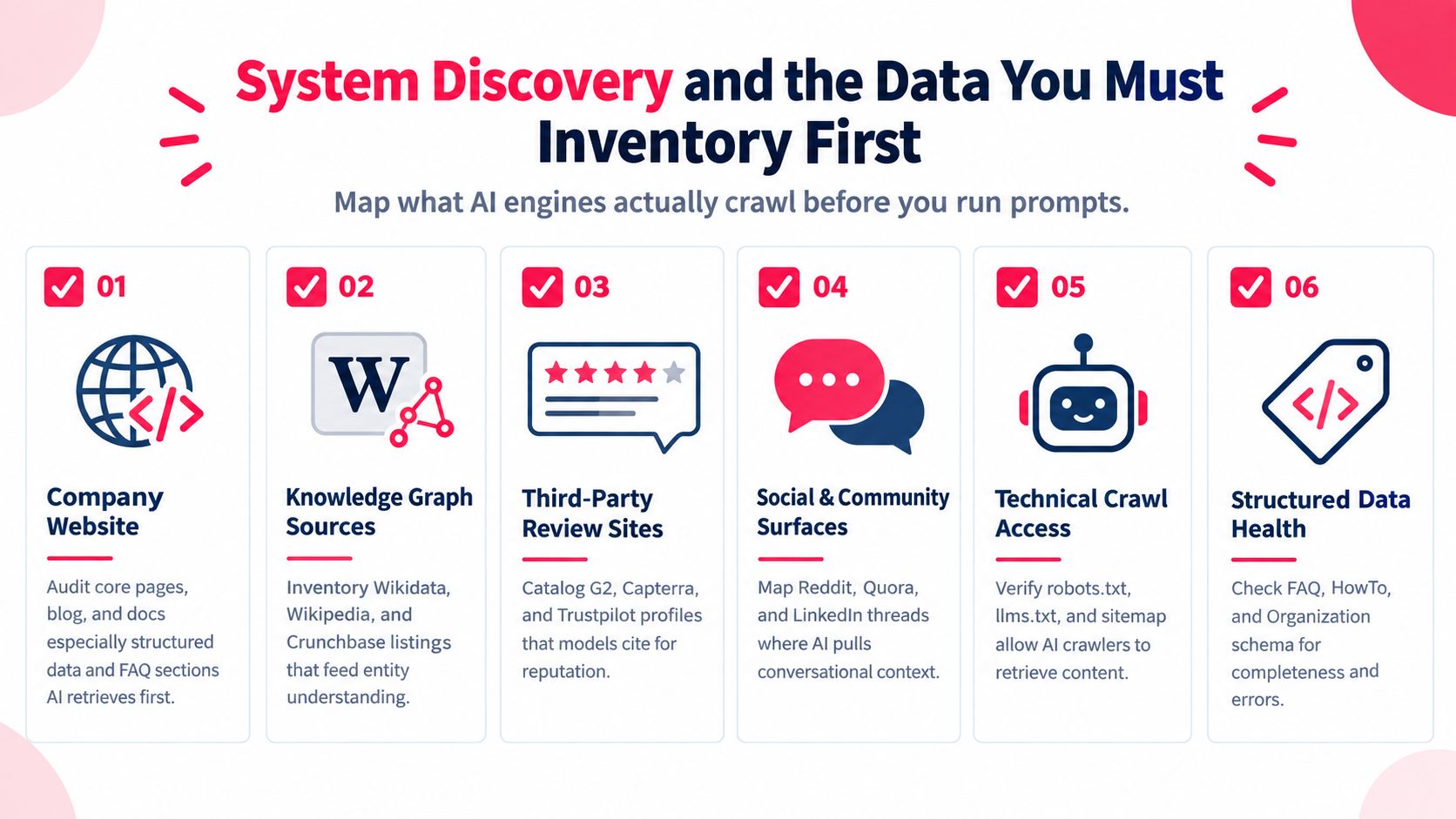
Prompt testing can't explain a retrieval failure if you haven't mapped the assets an engine could use. Before the first run, create an inventory of the company's own pages, technical access rules, structured data, and external references. The website is one source in a wider evidence system.
Inventory the evidence layer
Review product, solution, pricing, comparison, alternatives, customer, documentation, and developer pages. Use Screaming Frog or Sitebulb to identify orphaned pages, blocked resources, redirect chains, canonicals, and internal-link gaps. Check whether important claims appear in crawlable HTML rather than only inside client-rendered interfaces.
Then audit the external sources that models may use to understand the company:
- Review profiles: G2, Capterra, Trustpilot, and Gartner Peer Insights.
- Entity sources: Wikipedia, Wikidata, Crunchbase, and consistent company profiles.
- Editorial sources: Press archives, trade publications, analyst coverage, and partner pages.
- Community sources: Reddit, Quora, LinkedIn discussions, and specialist forums.
- Technical controls:
robots.txt, XML sitemaps, server-side rendering, and anyllms.txtimplementation.
Validate structured data with Schema.org's validator and inspect Organization, Product, FAQ, HowTo, and software-related markup for accuracy. Review the current llms.txt guidance as one reference point, but don't assume the file solves retrieval on its own. A permission file can't compensate for thin product information, contradictory company descriptions, or inaccessible documentation.
Make ownership visible
The inventory should fit on one page. Each row needs the asset, URL, business purpose, owner, last-updated date, crawl status, source type, and retrieval risk. The owner might be the technical SEO lead, product marketing manager, documentation lead, communications director, or sales operations manager.
The risk field should be practical. Mark an asset as high risk when it is blocked, outdated, contradictory, unsupported by evidence, or controlled by a third party with no internal relationship. Many discover that no person owns the complete external source profile. That gap belongs in the audit backlog before anyone commissions more articles.
Scoring Criteria That Map Failures to Owners
A single visibility score hides the work. We score separate axes because a brand can be present without being cited, cited without being recommended, or recommended with an inaccurate description.
| Scoring Axis | Failure Mode | Primary Fix Owner | Weighting Guidance |
|---|---|---|---|
| Retrieval presence | Relevant content or domain isn't surfaced | Technical SEO lead | Weight by high-value query coverage |
| Mention rate | Brand isn't named in a relevant answer | Content or product marketing | Weight by non-brand demand and sales relevance |
| Citation rate | Brand appears without a credible linked source | Digital PR and structured data owner | Weight by commercial and trust-sensitive prompts |
| Share of answer | Competitors occupy the recommendation set | Competitive intelligence lead | Weight by shortlist and comparison prompts |
| Sentiment-class accuracy | Description is inaccurate, negative, or incomplete | Communications lead | Weight by claims that affect deal progression |
The methodology defines citation rate as queries where the brand appears divided by total queries tested, multiplied by 100, as documented in the AI visibility audit methodology. We record response position, sentiment, cited sources, and natural-language variants alongside that rate. Mention rate and citation rate remain separate fields because a model can name a company without trusting a page enough to cite it.
Share of answer needs a clear denominator. Count the named vendors or linked competitors in each response, then record how much of that recommendation space your company occupies. This is more useful than a broad share-of-voice figure when the commercial question is, “Who should we shortlist?”
A failure is actionable only when one team can own the next change.
Weighting should follow pipeline value. A low-volume implementation question from an active sales segment may deserve more attention than a high-volume category definition that never affects a buying committee. The audit owner should hand each team its failures, evidence, proposed fix, KPI, and retest date.
Where AI Visibility Audits Quietly Mislead
Many audits measure model noise and present it as a stable business signal. The first distortion is keyword-brand alignment. If prompts repeatedly contain the category language associated with your company, the test may reward that alignment even when the company has weak independent recognition. The 110,523-response analysis cited earlier quantified that effect, which is why branded and non-branded prompts must be separated rather than blended.
The second distortion is the tier ladder. The 2026 brand-visibility study found global household names appeared in 73% of relevant AI answers on their first run, established mid-market and regional brands in 44%, and niche or small brands in 11% (study). A growth-stage B2B company can look absent when the prompt implicitly asks for category leaders and the engine defaults to famous enterprise names.
Separate the causes before acting
The third problem is engine-default substitution. ChatGPT, Gemini, Perplexity, and Claude may select different competitors because their retrieval systems, source preferences, model versions, and recent context differ. A competitor appearing in one run doesn't prove it owns the category, and your absence in one run doesn't prove a technical failure.
Use stratified reporting:
- By engine: Keep each platform's result set separate.
- By query type: Split definitions, comparisons, shortlist requests, and implementation questions.
- By company tier: Compare your brand with realistic mid-market and niche cohorts, not only household names.
- By source ecosystem: Record whether the answer relies on owned pages, reviews, analyst material, communities, or competitor content.
The practical test is whether the proposed fix matches the failure. Technical remediation won't correct a missing third-party review profile. A new comparison page won't repair a blocked documentation portal. A communications response won't solve an inconsistent Organization entity.
Turning Findings into a Prioritized 90-Day Roadmap
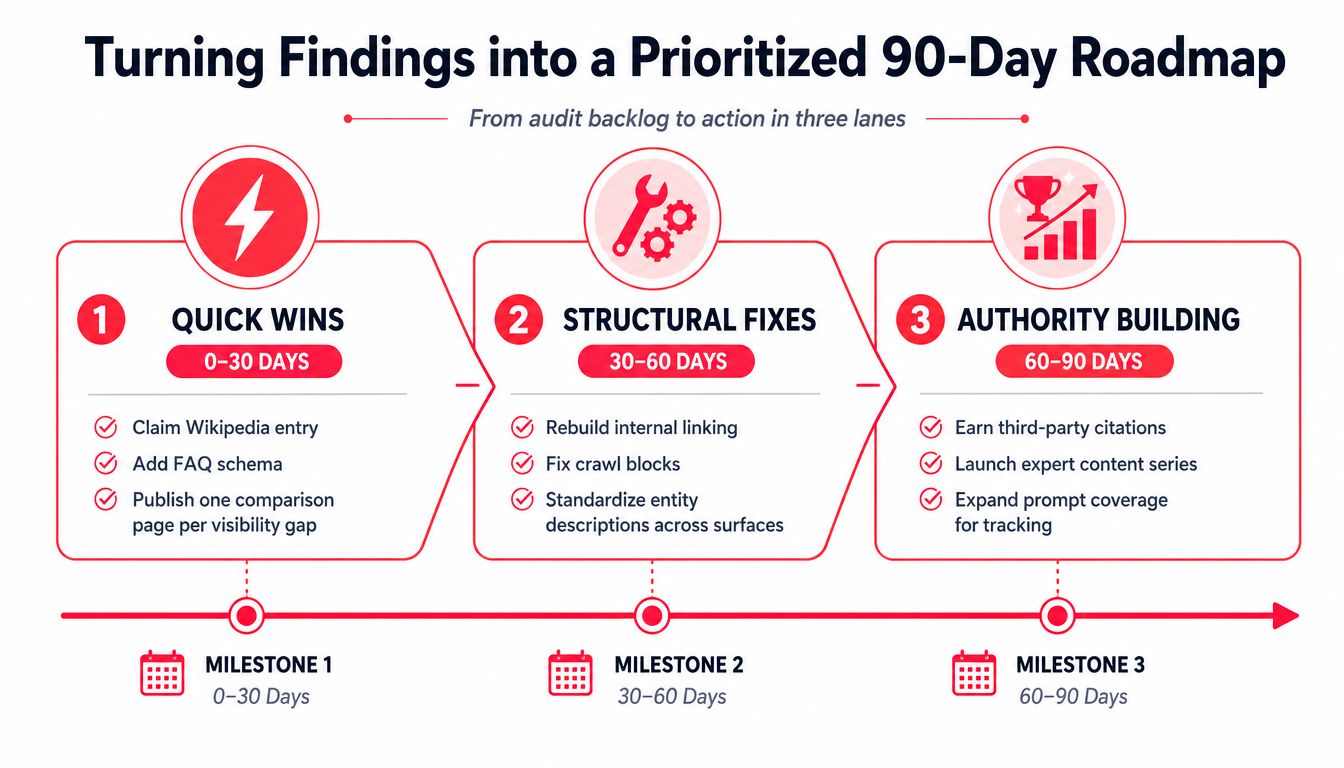
The audit report should become a backlog with dates, owners, and evidence. We use three lanes because fixes mature at different speeds and leadership needs to see what can ship now versus what depends on external authority.
Lane one, quick wins
Within the first 30 days, fix accessible assets:
- Correct inaccurate Organization and Product schema.
- Remove crawl blocks from priority pages.
- Improve internal links between category, solution, comparison, and documentation pages.
- Publish comparison pages where repeated prompts expose a clear information gap.
- Correct company descriptions across controlled profiles.
Each item needs one owner and one measurable output, such as a shipped page, corrected schema validation, or a resolved crawl issue.
Lane two, structural fixes
Between 30 and 60 days, address issues that need coordination. Build evidence-rich pages around buyer problems, standardize product and category language, repair documentation retrieval, and establish an outreach list for publications and review sites that appear in answer citations. The source list from the audit should decide where communications spends time.
Lane three, authority work
The 60-to-90-day lane covers third-party citations, analyst relations, expert content, partner references, and recurring communications. Expand the prompt library only after the baseline and fix list are stable. Stimulead's AI implementation roadmap provides a related way to connect owners, sequencing, and operating controls.
Use a simple pipeline proxy where it is defensible:
citation rate × relevant category search volume × conversion rate × average contract value
That equation is a planning model, not proof of causation. If a team can't explain the source and confidence level for each input, it should report the KPI without attaching a revenue estimate. A roadmap that claims commercial impact without defensible inputs is theatre.
Run a weekly dashboard with lane status, shipped artifacts, citation rate, competitor substitution, and blocked dependencies. Don't change the prompt set or scoring weights mid-cycle, or the baseline becomes impossible to interpret.
What to Do Before Your Next Audit Cycle
Close the current cycle before scheduling the next one. Store the prompt set, engine names, model versions, run dates, scoring weights, source classifications, and baseline outputs in a versioned document. Without that change log, the next audit may show a different result because the test changed rather than because visibility changed.
Assign one person to refresh the prompt universe quarterly. That owner should pull questions from sales call recordings, win-loss interviews, customer success escalations, and Search Console exports. Every finding in the backlog needs a shipped artifact, KPI, owner, and retest date.
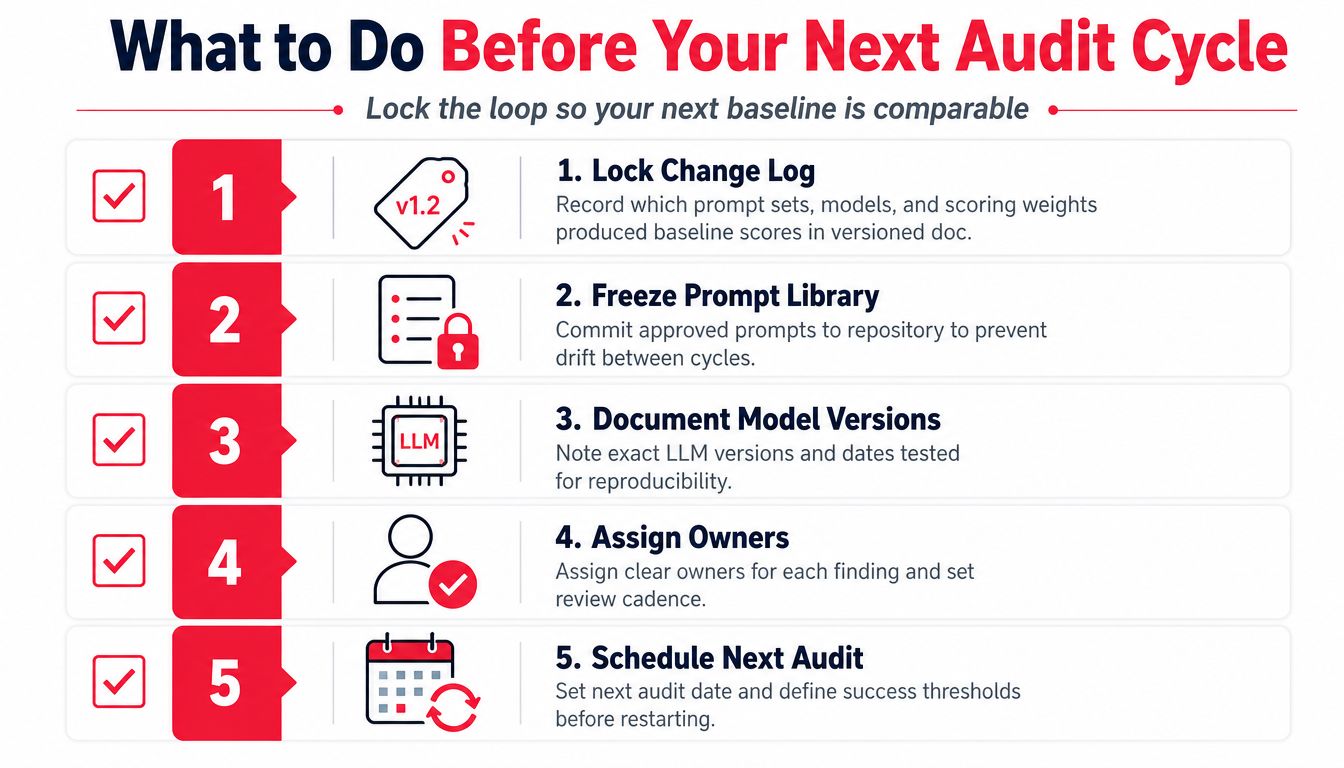
Pre-register the success threshold for each initiative before reviewing the results. Faster retesting suits schema, internal linking, and content changes. Authority work, partnerships, and public relations need a longer interval. A practical 2026 content audit guide can support the wider content inventory, but the AI audit still needs its own engine and prompt controls.
Choose the next cycle based on remediation velocity, not calendar habit. This week, appoint the audit owner, freeze the baseline prompt library, and select the first three findings that a named team can ship. Then attach each finding to a commercial query and schedule the retest before work begins.