
AI personalization uses machine learning to adapt what each person sees or is offered, based on behavioral and contextual data. That definition describes the method, not its value. The practice earns its place only when a randomized holdout shows incremental lift in a decision that happens often enough to test. If a team cannot design that comparison, it may be doing segmentation, generating copy, or retargeting under a new label. More data and licences alone do not establish personalization's impact.
Table of Contents
- What AI Personalization Decides for Each Visitor
- Five Technical Approaches and What Each Costs to Run
- Where Personalization Pays in Marketing, Sales and CRO
- Measuring Lift Against a Holdout Instead of Clicks
- Data and Privacy Limits for Each Personalization Use Case
- Where Personalization Backfires and When to Hold Off
- A Staged Roadmap From Quick Win to Scaled Program
- Confirm the Holdout Design Before Committing Budget
What AI Personalization Decides for Each Visitor
A demo can show customized greetings, recommended content, or changing offers. The test is what changes the visitor's next decision, and whether a randomized holdout shows incremental lift. Without that comparison, a changing page is a product feature, not evidence of effective personalization.
A 2026 systematic review of 135 Scopus-indexed studies published between 2007 and 2026 describes AI personalization as adapting what an individual sees, receives, or is offered based on behavioral and contextual data. Inputs can include viewing or purchase history, searches, ratings, clicks, session behavior, and similarities between users. In the reviewed marketplace research, collaborative filtering, deep learning, machine learning, and hybrid recommendation architectures were prominent approaches. The review also reports 14.35% annual growth in publications.
A bookseller who uses past purchases to change which books they recommend is personalizing. A window display shown to every passerby is broadcasting, even when it includes a visitor's name.

Three Layers Teams Merge
- Segmentation assigns a group, such as enterprise manufacturing accounts, and serves the group a shared experience.
- Personalization ranks content, an offer, or a next action for an individual, then updates that ranking as behavior changes.
- Name insertion changes the copy's appearance while leaving the underlying choice untouched.
A usable system needs meaningful first-party signals, a model that estimates intent, and delivery fast enough to change the decision in front of the visitor. Those inputs do not guarantee lift: sparse signals, slow delivery, or a decision that rarely occurs can make testing inconclusive or the program uneconomical to run.
Before a demo proceeds, ask which decision changes, which audience sees the change, and which data triggers it. Then ask how the team will compare outcomes with a holdout.
If nobody can name the decision or define its holdout, the purchase under discussion is content production capacity, not proven personalization.
Five Technical Approaches and What Each Costs to Run
The five approaches below move from lower data and engineering demand to higher demand. Run cost is a Stimulead planning estimate from scoping work, not a vendor benchmark. Ask every vendor for a quote separated into licence, integration, and monthly model maintenance before comparing totals.
| Approach | What it decides | Data it needs | Run cost (planning estimate) | Best first use |
|---|---|---|---|---|
| Rules-based segmentation | Which block, offer or email a known segment sees | CRM fields, lifecycle stage, page events | Low; runs in existing marketing automation | Lifecycle emails and industry landing pages |
| Machine-learning propensity and ranking | Which next action or offer scores highest per account | Several months of labelled outcomes such as opportunity stage and closed-won | Medium; needs a data engineer and model monitoring | Next-best-offer on known contacts |
| Recommender systems (collaborative filtering, hybrid) | Which products, articles or resources each user is likely to want | Interaction logs, catalogue metadata, similarity signals | Medium to high; vendor platform or custom build | Content or product recommendations on high-traffic sites |
| LLM-driven hyper-personalization | Message, page copy or research summary written for one account | Account research, enrichment data, approved claims library, prompt guardrails | Variable; model usage plus reviewer time on every output | Account-specific outreach drafts reviewed before sending |
| Real-time contextual decisioning | Which experience to show inside the session, from live signals | Event streaming, session data, latency budget | High; engineering-heavy | On-site experiences for high-intent visitors |
What Each Row Demands
Rules-based segmentation usually runs inside HubSpot or Braze, often within an existing licence. It earns its place when lifecycle stage and industry are reliable, but it cannot learn that two accounts in the same segment now want different next steps.
Propensity and ranking models need labelled outcomes, monitoring, and an owner who notices drift when product, pricing, or sales process changes. Medium cost here means people as much as software. A model rebuilt only when performance visibly drops will rank yesterday's buyer accurately and today's buyer badly.
Recommender systems fit high-traffic product and content catalogues. They fail early when interaction logs are sparse or catalogue metadata is thin, because similarity has little reliable material to work from.
LLM-driven personalization looks cheap in a demo because reviewers aren't priced into the screen. Budget for an approved claims library, prompt guardrails, and human review before sending. Variable model usage is manageable. Unreviewed account claims create the expensive problem.
Real-time contextual decisioning needs event streaming and a latency budget, which makes it the most engineering-heavy option. Adobe Target, Optimizely and Dynamic Yield are the typical platforms in the medium-to-high band, quoted as annual licences plus integration fees.
Planning warning These tool price bands are unverified scoping estimates until confirmed against current vendor quotes. Don't approve a business case from a category range.
Most growth-stage companies should start where existing systems already hold the data. Move right across the table only when recurring volume and labelled outcomes justify added maintenance.
Where Personalization Pays in Marketing, Sales and CRO
Personalization earns its place when it improves a repeated decision over a standard experience, measured against a holdout. Netflix illustrates the scale available when behavior repeats: its recommender is reported to influence approximately 80% of hours streamed, and economic research estimated replacing it with a popularity-based algorithm would reduce engagement by 12%, as described in New America's Netflix case study. That is evidence about a high-volume consumer service, not a B2B target.
For a company with a few thousand monthly visitors, the practical question is which marketing, sales, or CRO decision happens often enough to test, and whether outcomes are recorded cleanly enough to measure incremental lift. The table specifies the inputs to check before committing: baseline rate, minimum detectable lift, holdout share, test window, and a sample-size calculation. Set the values from your own data, then verify the required sample with a sample-size calculator. Any values used in planning should be assumptions to test, not benchmarks.
| Use case | Primary metric | Volume check before launch | Fits when |
|---|---|---|---|
| CRO landing-page variants by industry and intent | Conversion rate against control | Enter baseline conversion, minimum detectable lift, holdout share, and test window into a sample-size calculator. Proceed only if expected eligible visits meet the calculated sample. | Recurring traffic comes from known intent sources |
| Lifecycle email by role, usage and stage | Incremental conversion against holdout | Use the stage's baseline conversion and minimum detectable lift, set the holdout share and test window, then check whether eligible contacts meet the calculated sample. | Product usage or CRM stage is recorded |
| Sales account prioritisation and outreach drafts | Qualified pipeline per 1,000 contacts | Estimate baseline qualification, define a detectable lift, reserve a holdout share, set the test window, and check the available routed accounts against the required sample. | Routing rules come from a governed signal model |
| Pricing-page routing for returning visitors | Conversion and revenue per visitor after margin | Use the returning-visitor baseline, minimum detectable lift, holdout share, and decision window to calculate the needed sample; confirm enough eligible visits are likely. | Visitors have already compared plans |
Where We Would Place the First Bets
Landing-page variants are worth testing when industry and intent change the argument, proof, or call to action. Swapping a headline while leaving the offer and page order unchanged tests little. Our AI conversion rate optimization work focuses on whether variants represent different decisions, not merely whether the team can ship them quickly.
Lifecycle email is often a practical early candidate because role, usage, and stage may already be tied to known contacts, with downstream conversion trackable. Keep a holdout on the standard journey. Without one, seasonality and campaign effects can look like model lift.
Sales prioritisation can help when routing rules use governed signals, as described in our signal-based selling guide. Pricing-page routing is relevant for returning visitors who have compared plans and may still need specific information, such as implementation risk or procurement proof.
We work with clients, but cannot cite a completed personalization result approved for publication with a holdout, named industry, and disclosed outcome. That limits what we can claim, and it matters when evaluating evidence. One-off enterprise proposals are also a poor fit: bespoke judgment dominates, and too few decisions repeat for a model to learn reliably.
Measuring Lift Against a Holdout Instead of Clicks
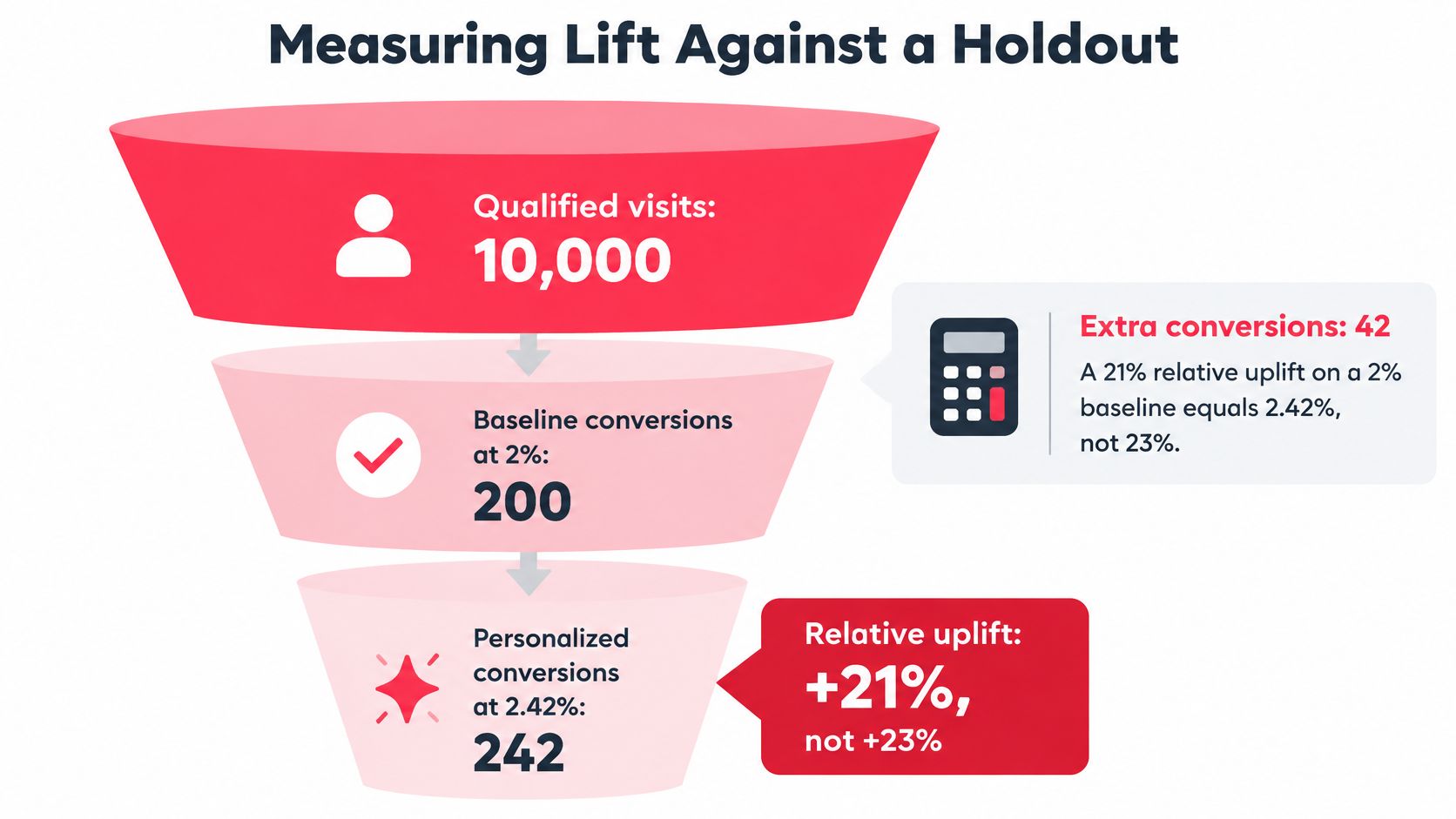
Start with arithmetic that sales decks often blur. A published study on AI-enabled personalization reported a 21% conversion uplift for personalized email, the highest uplift among the methods examined. On a 2% baseline, a 21% relative uplift produces 2.42%, not 23%. At 10,000 qualified visits, that difference is roughly 42 additional conversions, before qualification and pipeline effects.
Treat 21% as a hypothesis. The study covered personalized recommendations, dynamic pricing, targeted advertising, and email campaigns together, so it doesn't establish a B2B benchmark.
| Metric | What it proves | How it misleads | Test design it needs |
|---|---|---|---|
| Click-through rate on personalized modules | Surface relevance of the ranking | Rises on curiosity clicks, says nothing about conversion | Compare against a holdout that sees the default experience |
| Incremental conversion rate | Whether the personalized path converts more people than control | Needs enough volume to separate signal from noise | Randomised holdout drawn from the same audience |
| Revenue per visitor after margin | Economic value after discounts and cannibalisation | Discounting inflates it without margin adjustment | Same holdout, margin-adjusted |
| 90-day retention or repeat purchase | Whether personalization creates demand or only pulls a purchase forward | Slow, and confounded by other changes in the same quarter | Cohort comparison with a window fixed before launch |
| Opt-out, unsubscribe and complaint rate | Whether the experience is costing trust | Often ignored until deliverability falls | Tracked by cohort against control |
| Offline ranking metrics (precision@k, NDCG, calibration) | Whether the model ranks well before it goes live | Strong offline scores can still lose in a live test | A gate before launch, never a reported result |
The Calculation and the Constraint
Use this formula. Incremental conversions multiplied by margin, minus tooling, integration, and labour. Include reviewer time, data engineering, model monitoring, and the opportunity cost of delayed tests.
Offline metrics such as precision@k, recall@k, NDCG, and calibration tell engineers whether ranking deserves a live test. They don't prove business value. A model can rank historically clicked content beautifully and still produce no extra qualified opportunities.
Detecting movement from 2% to 2.42% needs large volumes. Run a sample-size calculation before launch, following the discipline in these A/B testing best practices. Where volume falls short, extend the window or measure opportunity-stage progression, and state the weaker inference plainly. Clicks can be a diagnostic. They can't carry a budget case alone.
Data and Privacy Limits for Each Personalization Use Case
Personalization should be defined by what it can justify, not by how many signals a vendor can ingest. Before launch, specify the decision, the minimum data it requires, and how a holdout will test for incremental lift. If the team cannot explain the signal's purpose or measure a benefit against a control, do not collect or use it for that decision.
Research on personalized differential privacy examines privacy protections for personalized systems. It does not, by itself, establish a complete data-governance design. In practice, teams should document why each signal is needed, limit identifiable data to what the decision requires, and set access and retention rules before launch. A first-party data strategy can clarify which customer-provided and observed signals are available and how they are collected.
Differential privacy limits how much a model's output changes when one person's data is added or removed. Epsilon is the privacy budget that expresses the trade-off between privacy protection and utility. For a marketing team, the operational question is which data can support a decision without retaining unnecessary identifiers.
| Use case | Data it may use | Consent and legal check | Human review |
|---|---|---|---|
| Routine content or product recommendations | Browsing and purchase behaviour, coarse aggregates | Disclose in the privacy notice and provide an opt-out where required | Quality sampling |
| Lifecycle email to known contacts | CRM fields, opt-in status, engagement events | Check the lawful basis and consent requirements for each region | Review a monthly sample of live messages |
| Intent-based account routing in B2B | Third-party intent, website identification, firmographics | Review vendor contracts and identification rules | Sales operations reviews routing rules quarterly |
| Pricing, eligibility or access decisions | Account history, contract and payment data | Check whether GDPR Article 22 applies to the specific decision | Provide a route to human review and contest where required |
| GDPR Article 9 special-category data | Health, biometric, genetic, racial or ethnic origin, political opinions, religious or philosophical beliefs, trade union membership, sex life or sexual orientation | Assess Article 9 requirements and obtain legal sign-off before use | Legal and compliance review before any test |
| Financial or employment data | Payment history, financial details, job or employment information | These are not automatically Article 9 special categories; assess other applicable privacy and discrimination rules | Review the proposed use and its potential effects |
The Legal and Governance Boundary
Under GDPR Article 22, people have rights concerning decisions based solely on automated processing, including profiling, when those decisions produce legal or similarly significant effects. Exceptions and safeguards depend on the circumstances. Page-content tailoring may have different consequences from automated eligibility, pricing, employment, credit or access decisions, but the distinction is fact-specific. Have counsel assess the actual decision, its effects and the role of human review.
Use NIST's AI Risk Management Framework functions, GOVERN, MAP, MEASURE, and MANAGE, to structure documentation. Record approved signals, intended audiences, accountable owners, test results and override paths. If a use case cannot meet its legal requirements or demonstrate incremental value against a holdout, pause it.
Where Personalization Backfires and When to Hold Off
Personalization should prove incremental lift against a holdout. More customized messages or extra clicks do not establish value if the experience fails to improve outcomes for customers. The gap between executive confidence and customer experience is a warning: Verizon's 2025 customer-experience research found 44% of executives said AI was delivering personalization benefits, while only 26% of consumers said their experience had improved. Another 30% of consumers said it had worsened, and 44% noticed no improvement.

Four Illustrative Failure Modes
- Name insertion dressed as personalization changes a familiarity cue while every account receives the same offer, sequence, and argument. Measure whether the tailored experience changes a meaningful outcome, not whether a name appears.
- Company-metric optimization can push a cross-sell module to every checkout visitor because attach rate is the internal target, even when the visitor is trying to pay. The metric may rise while the customer experience worsens.
- Over-targeting high-activity users can improve average relevance while poorer outcomes for quieter cohorts stay hidden in aggregate reporting. Break out results by cohort before scaling.
- Signal overload occurs when teams add intent sources without deciding which signals take priority. More inputs can add noise rather than improve targeting; test whether each signal contributes incremental lift.
Privacy perception also affects results. A 2025 quantitative study of 473 respondents found AI personalization improved trust and satisfaction overall, but privacy concerns moderated those effects and could weaken subsequent purchase behavior. Transparency alone may not resolve that concern if customers lack practical control.
Hold off if the audience cannot support the pre-launch sample-size calculation described in the measurement section, or if CRM records cannot be matched to outcomes. Frequent product or pricing changes can also destabilize labels before a test produces a useful result. For consequential decisions, do not proceed without the human review required by the applicable governance process. If a team cannot define a holdout, outcome, and decision rule, it cannot show that personalization works.
A Staged Roadmap From Quick Win to Scaled Program
Durations below are planning assumptions from our scoping work, not benchmarks. A company with clean CRM data and an experienced CRO lead can compress the sequence. A company rebuilding event tracking should expect the early stages to take longer.
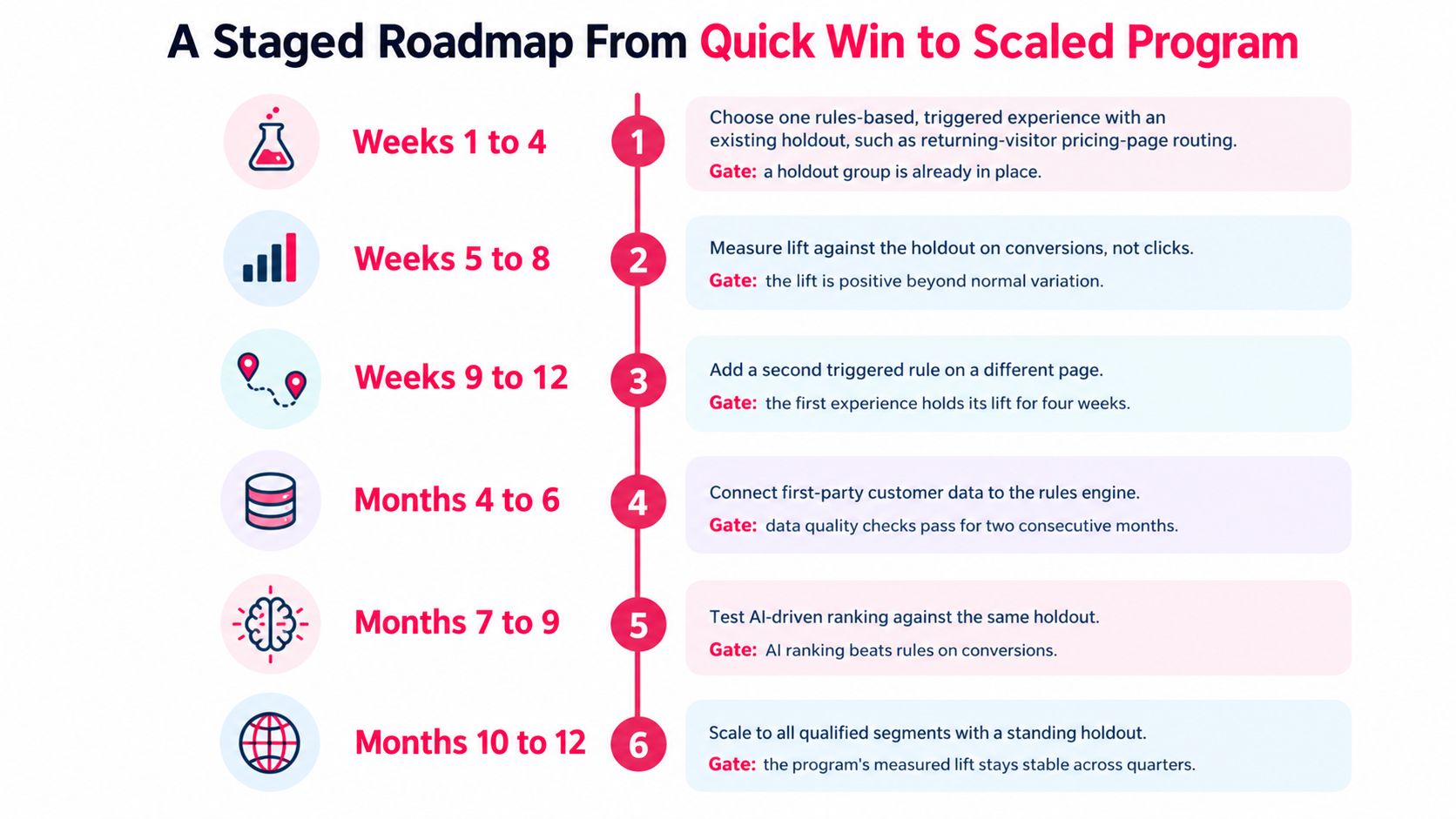
- Weeks 1 to 4 Choose one rules-based, triggered experience with an existing holdout, such as returning-visitor pricing-page routing or one lifecycle email. Name the owner and primary metric before build work starts. Gate, the baseline and holdout definition are documented.
- Weeks 5 to 16 Pilot machine learning or a recommender only where labelled outcomes already exist. Pre-register the test window, minimum detectable lift, and stop rule. Gate, the sample-size calculation supports a decision inside the window.
- Scale gate Expand only when incremental conversion and qualified pipeline both move, opt-out rates hold, and cohort results pass the fairness check. A conversion gain purchased with complaints or poor qualification stays a pilot.
- Months 4 to 9 Add two more use cases and build the data layer separating known from anonymous visitors. Reuse feature definitions and measurement code where possible. Gate, each new use case has its own holdout rather than borrowing credit from the first.
- Ongoing from week 5 Keep an inventory of live experiences, classify each as routine or consequential, and assign a named owner. Review data inputs, overrides, and model drift on a fixed cadence.
- Retirement Remove any experience that fails its holdout and record why it failed. Keeping weak experiences because build cost was high turns a test program into permanent clutter.
The sequence protects learning. Scaling before the gate multiplies maintenance faster than evidence.
A quick win should prove measurement discipline as much as lift. If the first project cannot produce a clean decision, a larger platform will produce a larger ambiguous report.
If you are deciding who should own this work, our CRO definition separates conversion rate optimization from the Chief Revenue Officer role and explains when each applies.
Confirm the Holdout Design Before Committing Budget
Fund one pilot this quarter only if its holdout can be designed now. Six items must be true before budget is released.
- One use case has enough recurring volume.
- A randomized holdout is drawn from the same audience.
- One primary metric is agreed by the CRO lead and the CFO.
- An offline ranking gate has passed, where a model is involved.
- Data classification is complete, including consent and human review needs.
- A named owner can stop, change, or retire the experience.
Draft the pre-registered test brief with a direct prompt. Give the model the use case, audience, baseline conversion rate, minimum detectable lift, holdout size, test window, and kill criteria, then ask for a one-page brief with metric definitions and a stop rule. Check its sample-size arithmetic against a standard calculator before anyone signs it.
Teams without a data engineer or experienced CRO lead can treat a fractional CAIO engagement from Stimulead as one option, starting with an audit and prioritised roadmap with KPIs. Run that audit, or complete the checklist internally, this week before the next planning cycle commits budget to a licence.
