
Many teams think signal-based selling fails because they picked the wrong data provider. That's usually backwards. The core failure is operational. A company can buy intent data, job-change feeds, technographic data, and website identification, then still miss revenue because nobody governs which signals matter, who owns the response, or how fast the team has to act before the window closes.
Broad outbound has already shown its limits. HubSpot's State of Sales reporting says 80% of sales require five or more follow-up calls after the first contact, while 44% of salespeople give up after one follow-up. That gap is exactly why timing beats volume, and why a signal-driven motion has to be built like a revenue system, not a campaign tactic. The best programs I've seen treat every signal as a testable input, then route only the ones that have real lift in their own funnel.
Table of Contents
- Why Most Signal-Based Selling Programs Fail
- The Four Signal Categories That Drive Revenue
- Building a Signal Normalization and Ranking System
- Auditing Signal Quality and Eliminating False Positives
- Designing Signal Response Workflows and Measuring Execution Speed
- Signal-Based Selling Implementations by Industry
- Your 90-Day Signal-Based Selling Roadmap
Why Most Signal-Based Selling Programs Fail
The most common mistake is treating every signal as if it deserves the same urgency. A pricing-page visit, a funding announcement, and a random content download do not deserve the same motion, yet many teams dump them into one SDR queue and call it orchestration. That creates noise, slows response, and trains reps to ignore alerts that never convert.
More signals can lower conversion
I've watched teams add more intent sources and watch reply quality fall. The reason is simple. More sources produce more alerts, and more alerts create a larger false-positive pool unless you've already built governance, ranking, and routing rules. Signal-based selling only works when the team can prove that a given event correlates with closed-won revenue in that ICP.
The clearest way to think about it is this. Signal-based selling is a speed and governance problem first, and a data problem second. If the source is noisy, the signal decays fast, or the rep has no context, the play will underperform even if the raw event looked promising.
The programs that stick do less at first
The best starting point is narrow. Use one or two high-value triggers, route them cleanly, and measure whether they produce pipeline with less waste than your baseline motion. The point is to earn confidence in the system before you expand the signal stack.
If you want a concise companion to this view, Salesmotion's pipeline boost with Signal Based Selling is useful because it frames the method as a revenue motion, not a list of tactics. For teams that are still deciding whether their revops stack can support this, the first sanity check is an AI readiness assessment. It forces the conversation away from “what data can we buy?” and toward “what can we operationalize?”
Practical rule: If a signal can't be owned, timed, and measured, it doesn't belong in the active queue.
Why this matters in production
In production, the weak point is rarely the model. It's the handoff. A signal lands, enrichment starts, routing waits, the rep gets distracted, and the account is cold by the time outreach happens. That's why the best systems are built around narrow response paths, clear owners, and simple rules that survive daily usage.
The Four Signal Categories That Drive Revenue
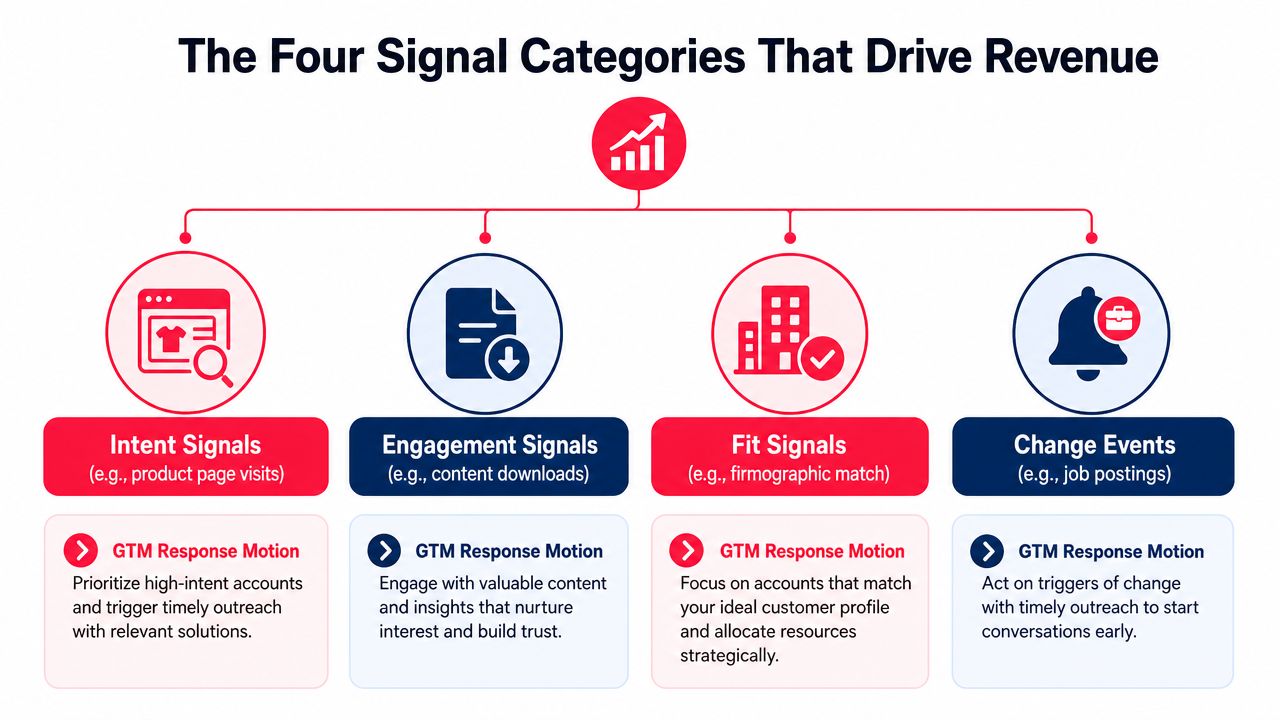
Signal programs usually fail when teams mix categories that need different responses. The account that fits your ICP is not the same as the account that is actively researching. The contact who downloaded a guide is not the same as the one who just changed jobs. Each category implies a different level of urgency, owner, and message.
Intent signals need immediate action
Intent signals include research activity and competitor content consumption. Apollo's description of signal-based selling names research activity, technology changes, funding events, and engagement with your content as examples of the signals that show real buying behavior Apollo. These are the moments when outreach should feel timely and specific, because the buyer is already in motion.
The right owner is usually an SDR or AE, depending on deal size and account tier. If the signal is contact-level, the response should be fast. If it's account-level, it needs enrichment first so the rep knows who to contact and why.
Engagement signals need context before outreach
Website visits and content downloads matter, but they're rarely enough on their own. They show interest, not always readiness. A blog reader may be educating themselves, while a pricing-page visitor is much closer to a buying window. The response motion should reflect that difference.
Engagement signals feed nurture or light outbound, then escalate when the pattern repeats or combines with another trigger. Marketing usually owns the first layer. SDRs or AEs should own the moment the activity becomes a sales-ready pattern.
Fit signals decide whether the account deserves attention
Fit signals include company size, technographic match, and other firmographic traits that tell you whether the account belongs in the ICP at all. These signals should shape prioritization, but they shouldn't be mistaken for buying intent. A perfect-fit account with no event data is still a low-urgency target.
Change events create the clearest windows
Change events are the most obvious buying-window indicators. Funding announcements, executive hires, and job changes signal shifts in budget, authority, or stack architecture. The historical value of signal-based selling is that it turned these scattered cues into an organized go-to-market method, replacing static lead lists with event-driven prioritization. Salesmotion's framework also treats website activity, content downloads, executive hires, job changes, funding announcements, technology installation or changes, and engagement with competitor content as real-time events rather than arbitrary cadence triggers Salesmotion.
A change event is only useful if the team can act while the window is still open.
Building a Signal Normalization and Ranking System
Raw signal feeds are messy. Company names don't match cleanly, subsidiaries get split across records, and the same account can fire five alerts that belong to one entity. If you don't normalize that data first, your routing logic will look active while your pipeline gets distorted.
Normalize before you rank
Start by deduplicating company identities so every event rolls up to the correct account. That sounds basic, but it's one of the biggest reasons signal programs break. Once identities are clean, you can compare signal volume against baseline conversion to pipeline and stop rewarding alert frequency just because it feels busy.
Pipecorn's waterfall enrichment guide is useful here because it pushes the same operational discipline. Enrichment only helps when the account record stays coherent across sources.
Rank by evidence, not instinct
A practical scoring matrix should include four factors.
| Signal Type | ICP Frequency | Baseline Conversion | Pipeline Impact | Execution Difficulty | Priority Score |
|---|---|---|---|---|---|
| Intent signal | High or medium, depending on segment | Compare against your actual close rates | Estimate influence on active opportunities | Usually moderate | Score highest only if timing is fresh |
| Engagement signal | Often frequent | Compare repeated visits against single visits | Usually lower unless repeated or page-specific | Low to moderate | Medium priority unless paired with another trigger |
| Fit signal | Common in list-building | Compare against conversion from similar-fit accounts | Useful for targeting, weaker alone | Low | Lower priority without a live event |
| Change event | Less frequent, often sharper | Compare conversion before and after the event | Often strongest when it changes budget or authority | Moderate | High priority when recency is strong |
CommonRoom's approach, reflected in the available implementation guidance, is to map each signal by frequency among ICP accounts, baseline conversion to pipeline, estimated pipeline impact, and execution difficulty. That gives you a prioritization model you can defend in front of sales and revops instead of a rep's gut feel.
Start with fewer signals than you think
Most vendor-agnostic playbooks are right about one thing. Start with 2–3 high-impact signals. Each account can generate thousands of behavioral data points over time, and that's exactly why smaller signal stacks usually outperform bloated ones. The goal is to find the few triggers that create reusable lift, then build from there.
Signal-based selling implementation guidance from Stimulead's AI sales tools review is relevant if your team still needs to decide which systems can support routing, enrichment, and personalization without creating another ops bottleneck.
Auditing Signal Quality and Eliminating False Positives
Teams often ask whether a signal is visible. More advanced teams ask whether it's predictive. That difference matters because a signal can look exciting in the dashboard and still fail to move revenue in your funnel.
Compare closed-won to closed-lost
The cleanest audit starts with historical deals. Pull closed-won and closed-lost accounts, then compare which signals showed up before each outcome. If a trigger appears in both groups at the same rate, it's noise. If it shows up disproportionately in wins, it deserves a place in the active stack.
The strongest neutral advice in the available guidance is to audit accuracy, transparency, and relevance across every source, then compare closed-won versus closed-lost deals to see which signals correlated with outcomes. That's the right standard for governance. A source that's impressive in demos but opaque in production becomes a liability fast.
Build a decay model for weak signals
Signal quality doesn't stay fixed. A trigger can be useful at first, then decay as competitors adopt the same source or buyers change behavior. That's why false-positive tracking has to be part of the operating model. If the signal keeps producing unqualified alerts, the team should downgrade or discard it.
Operational truth: A signal that feels busy can still be useless.
A simple governance rule works well. If a signal keeps creating outreach that doesn't advance to meeting or pipeline, it needs review. Don't keep it because it's new. Don't keep it because it's easy to buy. Keep it only if it has reusable lift over baseline.
Strong signals are explainable
The best signals are also the ones reps can understand. If the source is too black-boxed, it becomes hard to write messaging that feels natural. That's why explainability matters as much as accuracy. Reps should know what happened, why it matters, and what story to tell in the first touch.
The available guidance points to a contrarian truth. More signals do not automatically mean better timing. The core question is whether the trigger has meaningful lift in your own funnel and whether the source is trustworthy enough to operationalize at scale.
Designing Signal Response Workflows and Measuring Execution Speed
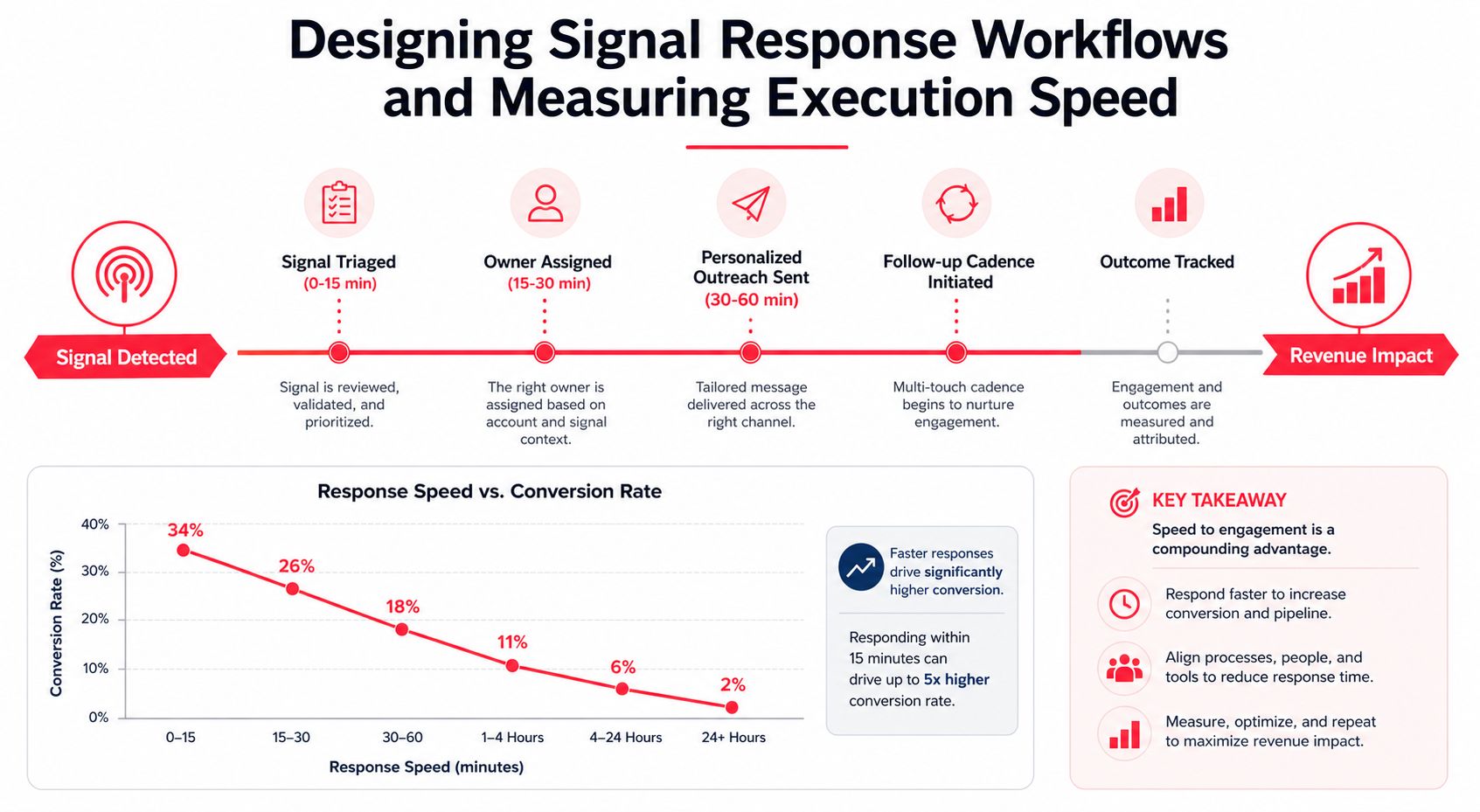
Speed is where most signal programs lose their edge. A team can detect the right event and still miss the window because ownership is unclear or the rep gets the alert too late. If you want the signal to matter, the response path has to be decided before the signal arrives.
Decide who owns which signal
Different triggers should route to different owners. SDRs handle fast-response top-of-funnel motions. AEs should own high-value account changes and expansion paths. CS can own product-usage or renewal-related changes. Marketing should handle light engagement and nurture until the account is ready for human outreach.
The useful rule is simple. The higher the buying intensity, the closer the response should move to the revenue owner who can advance the deal. Too much automation creates handoff friction, and too much manual work creates latency.
Measure execution velocity, not just conversion
The common advice says “respond quickly.” That's too vague. Measure response latency by signal type, then track whether faster execution changes meeting rate or pipeline progression. If one signal converts well only when acted on within a narrow window, that's useful operating knowledge.
A strong workflow includes four prebuilt pieces.
- Trigger ownership. Each high-value signal should have a named owner.
- Message library. Each signal needs a specific outreach frame.
- Routing rule. The account should go to the right rep or queue automatically.
- Measurement layer. Track latency, handoff quality, and conversion by signal type.
The linked how to use AI in sales guide from Stimulead matters here because AI only helps if it shortens the gap between trigger and action. If your team is still writing custom research manually after the alert fires, the system is already leaking speed.
Build for clean handoffs
The handoff is where conversion usually breaks. An SDR may triage the alert, but if the AE doesn't understand the context, the message resets to generic. That's why the playbook has to define who speaks first, who follows up, and when the next step happens.
Build the playbook before the signal fires. Teams that improvise after the alert rarely move fast enough to preserve the opportunity.
Signal-Based Selling Implementations by Industry
The same method works differently depending on the buying cycle. SaaS, e-commerce, and professional services each need their own trigger mix, owner map, and measurement logic. The point isn't to copy one template everywhere, it's to fit the signal motion to the commercial model.
B2B SaaS
For SaaS, the strongest combinations usually pair product usage with external change events. A usage spike can signal expansion potential, while funding or executive hires can open a new buying window for adjacent products. I've found that competitive displacement also works well here when the trigger is tied to a concrete change, like a new leader entering the account or a stack shift.
The workflow should usually start with product-led or account-level triggers, then route to the AE for expansion, cross-sell, or displacement motion. Track the accounts that move from alert to meeting, then from meeting to opportunity, so you can tell whether the motion is generating real pipeline or just activity.
E-commerce and DTC
In e-commerce, the signal set is usually more immediate. Browsing behavior, cart abandonment, and seasonal purchase patterns often produce the most actionable windows. Email and SMS sequences do the heavy lifting here, especially when the recommendation logic is tied to the actual session or product interest.
The best teams keep the response simple. If someone views a product several times, the message should reflect that behavior. If cart abandonment repeats, the follow-up should look different from a generic promo blast. The KPI set should stay close to revenue, with conversion and repeat purchase behavior taking priority over opens.
Professional services
Professional services firms usually need slower, higher-context signals. Content engagement, webinar attendance, and technology changes are often the first signs that a company is entering evaluation. That means the outreach needs more context and a more consultative tone.
Here, I've seen better results when marketing warms the account first, then the business developer or partner steps in after the signal stack deepens. This model works because the buyer is often comparing expertise, process, and trust, not just features. The team should track booked consults, opportunity creation, and eventual contract movement, since those are the metrics that matter in a longer sales cycle.
Your 90-Day Signal-Based Selling Roadmap
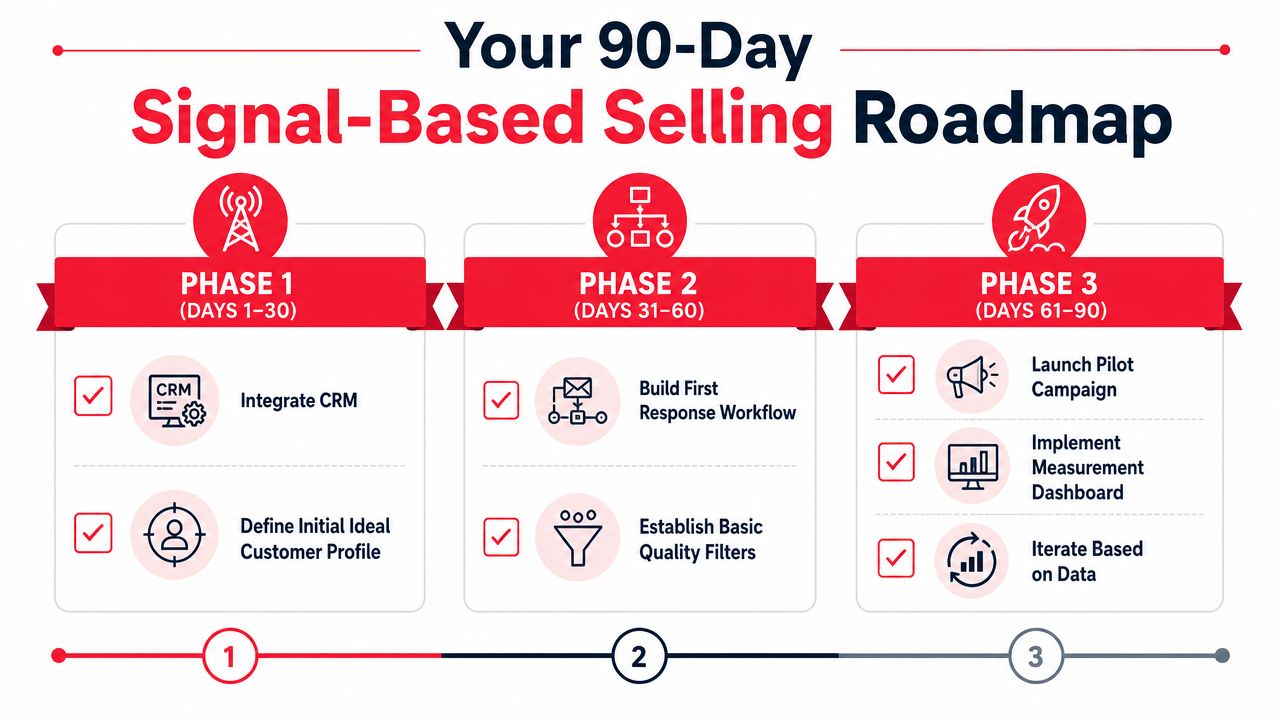
Phase one is about proving the motion with one signal. Phase two is about cleaning up the data and making the response repeatable. Phase three is where you audit quality and decide whether the system deserves more automation.
Days 1 to 30
Connect one high-value signal source and integrate it into the CRM. Define the initial ICP, then build routing rules that send the alert to a named owner. Track baseline conversion from that signal before touching anything else.
Days 31 to 60
Build the first response workflow, then add quality filters so weak signals don't flood the queue. This is the point where signal normalization matters, because duplicated accounts and poor enrichment will distort your results if they aren't cleaned up.
Days 61 to 90
Launch a pilot campaign, implement a measurement dashboard, and iterate from actual outcomes. The core KPIs are signal-sourced pipeline percentage, response time by signal type, conversion lift over baseline, and false-positive decay rate. If those aren't moving in the right direction, slow down before you add more signals.
The strongest teams use this period to decide what gets expanded and what gets cut. That discipline matters more than tool count.
If you're leading GTM and want to make signal-based selling a real revenue system, book a working session with Stimulead. We'll audit your signal stack, map routing and response ownership, and build a practical plan across CRO with AI, GTM engineering, AI search optimization, and agent commerce readiness so your team can move from alerts to pipeline without adding operational drag.