
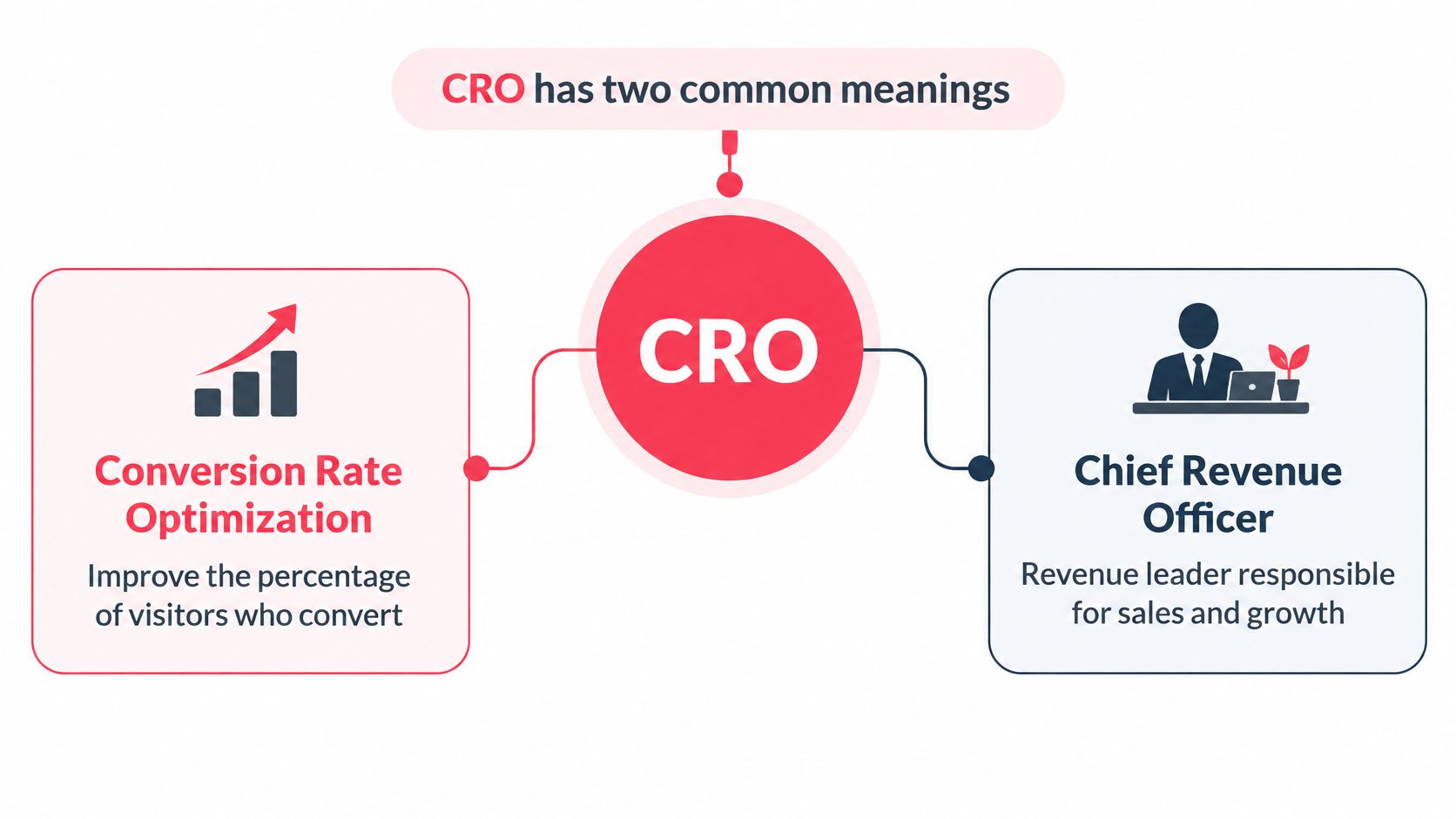
CRO most often means Conversion Rate Optimization, the systematic practice of increasing the percentage of visitors who complete a defined action, calculated as conversions divided by the relevant traffic population times 100; in executive hiring, it also means Chief Revenue Officer, the role coordinating the full revenue system across sales, marketing, and customer success. Choosing the wrong meaning can send a company toward an executive hire when it needs better measurement, or toward page experiments when it needs executive accountability.
Before approving either investment, can your leadership team name which problem it's solving? We treat that question as an operating decision: establish whether the constraint concerns conversion performance or authority across the commercial system before committing budget.
Table of Contents
- What CRO Actually Means in 2026
- The Conversion Rate Equation and Why the Denominator Decides Everything
- When CRO Means Chief Revenue Officer
- Where Conversion Friction Actually Lives
- When Faster Testing Makes CRO Worse
- The Attribution Problem AI Discovery Created for CRO
- A CRO Checklist for the Next Quarter
What CRO Actually Means in 2026
Choose the CRO meaning by identifying what you expect to change. A conversion optimization mandate changes a measurable customer journey; a Chief Revenue Officer mandate changes ownership and decision rights across departments.
That distinction matters when a CEO asks marketing to improve conversion while sales disputes lead quality. The company might need a better qualification experience, or it might need someone with authority to resolve conflicting departmental targets. Those require different scopes, even when both appear under the same acronym.
Define the outcome before assigning the work
For conversion optimization, specify the desired action. Purchasing, submitting a lead form, subscribing, and requesting a demo represent different commitments, so their conversion rates shouldn't be compared as equivalent outcomes.
A benchmark compilation reports a 6.6% median landing-page conversion rate and a 2.71% average online-store purchase conversion rate, but those figures describe different actions and populations, as documented in BlazeHive's conversion rate benchmark compilation. Neither figure establishes a target for a B2B company's qualified-demo funnel.
A useful CRO definition should tell the team what it can change and what outcome it must measure.
For teams evaluating the optimization meaning, Next Point Digital's guide to get more value from existing traffic provides relevant context. Treat that as a journey-improvement mandate, rather than a substitute for resolving ownership disputes between marketing and sales.
Separate the mandates in writing
Before approving a project or job description, complete this comparison with your leadership team.
| Decision | Conversion Rate Optimization | Chief Revenue Officer |
|---|---|---|
| What changes? | A defined customer experience | Commercial ownership and operating decisions |
| Who executes? | Experimentation specialists and implementation teams | An executive working through department leaders |
| What must be explicit? | Eligible traffic and completed action | Authority and cross-functional accountability |
| What won't the mandate resolve alone? | Conflicting departmental incentives | Unreliable event tracking |
We recommend writing the full term in budget requests and hiring documents. An acronym is too ambiguous to serve as an implementation scope.
The Conversion Rate Equation and Why the Denominator Decides Everything
The denominator determines what the percentage describes. Google Ads defines conversion rate around trackable ad interactions during the same period, whereas Google Analytics' ecommerce definition uses transactions relative to sessions.
For B2B teams, that difference becomes material when several people from a buying committee return repeatedly before requesting a demo. A session-based measure describes visits; an account-based measure describes buying companies. Neither is better, but they answer different questions.
How the Same Conversion Looks Under Different Denominators
These published examples illustrate the measurement conventions. They aren't observations of the same audience and shouldn't be used to rank channel performance.
| Source | Formula | Example | Resulting Rate |
|---|---|---|---|
| Google Ads conversion rate definition | Conversions ÷ trackable interactions × 100 | 50 conversions ÷ 1,000 interactions | 5% |
| Google Analytics ecommerce conversion definition | Transactions ÷ sessions × 100 | One transaction ÷ 10 sessions | 10% |
We require a measurement specification before implementation. It records the eligible population, conversion event, measurement window, and rules for excluding duplicate or invalid activity.
Where apparently precise reporting fails
Suppose marketing reports every submitted demo form while sales counts only accepted leads. The disagreement can persist even when both dashboards calculate their percentages correctly, because the teams are measuring different outcomes.
Repeated submissions create another problem. If a prospect retries a form after an error, counting each submission as a separate conversion can reward a broken experience.
Measurement rule: Approve the event definition before approving the experiment.
A practical implementation should preserve the path between the website event and its CRM record. We want the team to be able to inspect whether a submitted request became an accepted lead and then an opportunity, rather than treating the analytics event as the end of the investigation.
Keep the reporting window consistent, too. A change in which prospects have had time to qualify can distort a comparison even when the landing page hasn't changed.
When CRO Means Chief Revenue Officer
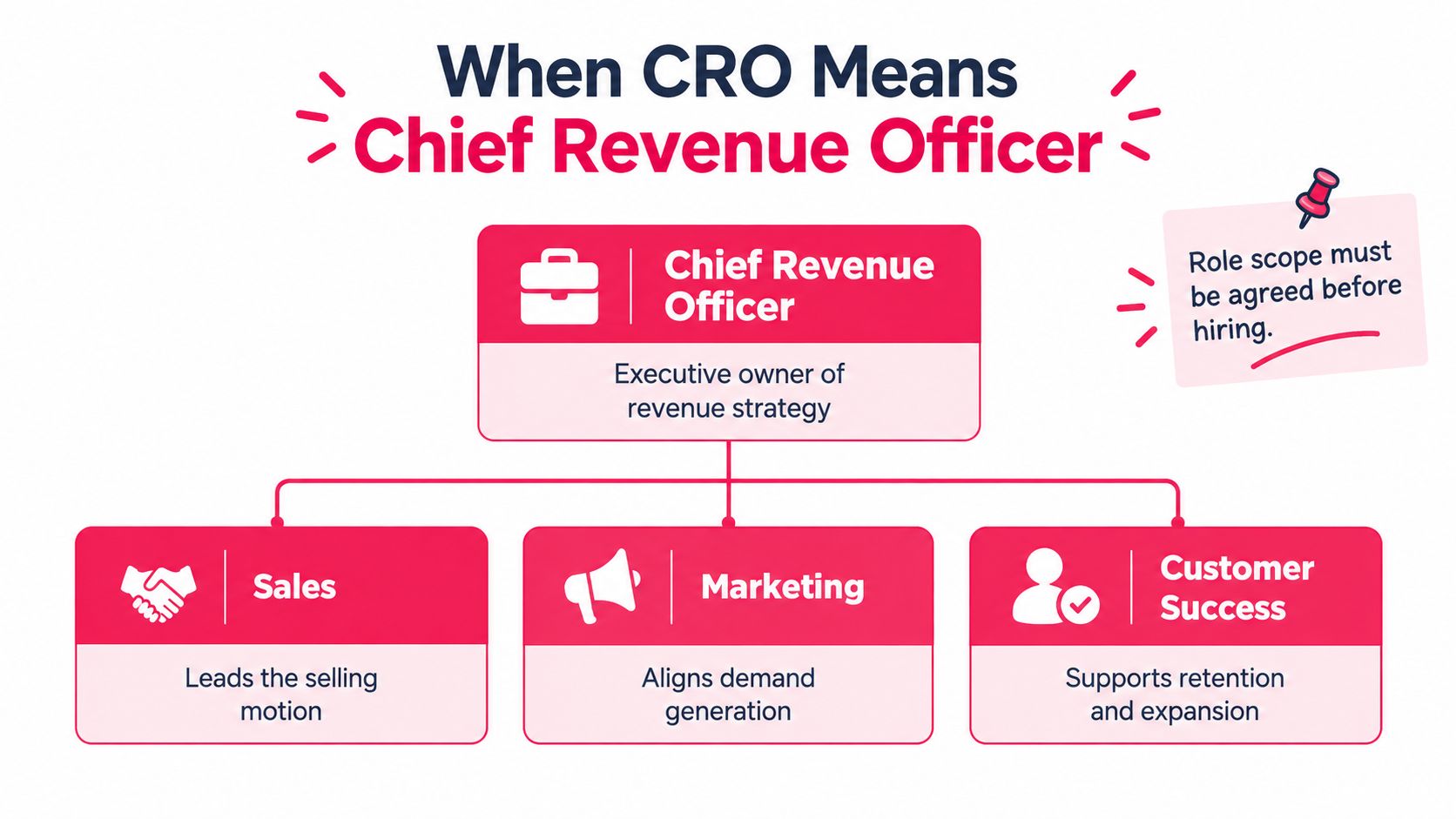
Hire a Chief Revenue Officer when the unresolved constraint requires executive authority across commercial functions. Hire conversion expertise when the constraint is a measurable journey problem with an accountable sponsor already in place.
The executive remit extends beyond a sales quota. Resultist's Chief Revenue Officer role specification assigns responsibility for standardized outreach across sales, client management, marketing, and communications, alongside pipeline monitoring and forecasting. It also covers the acquisition-to-customer-success cycle, channel development, and continual experimentation in a lean-startup environment.
What the hiring evidence supports
An ISG analysis of 102 Chief Revenue Officer job postings found sales responsibilities in 88%, partnerships and channels in 85%, RevOps, forecasting, or pipeline discipline in 75%, and marketing in 74%. Sales remains foundational, but the advertised responsibilities commonly cross departmental boundaries.
Those postings describe expected scope, not proof that every company needs the role. A CEO should still establish which decisions the executive will own and which department leaders will retain.
| Current constraint | More appropriate intervention |
|---|---|
| Department leaders disagree about qualification and commercial priorities | Clarify executive authority and shared accountability |
| Leaders agree on priorities, but handoffs and reporting are inconsistent | Establish revenue operations ownership |
| A tracked journey has a specific completion problem | Assign conversion research and implementation expertise |
Agree on authority before recruiting
We would settle stage definitions, pipeline inspection rules, and forecast ownership before finalizing the job description. Our revenue operations consulting article addresses the related operating layer between executive intent and daily execution.
A company that gives its CRO a bookings target while leaving qualification policy outside the role creates an accountability problem. A different title won't resolve that restriction.
Ask candidates how they would handle a marketing experiment that increases submissions while reducing sales acceptance. The useful answer should explain decision rights and evaluation criteria, rather than defaulting to either department's dashboard.
Where Conversion Friction Actually Lives
Diagnose friction at the point where buyers abandon a task, then investigate why. A redesign proposal without that evidence is difficult to prioritize against other implementation work.
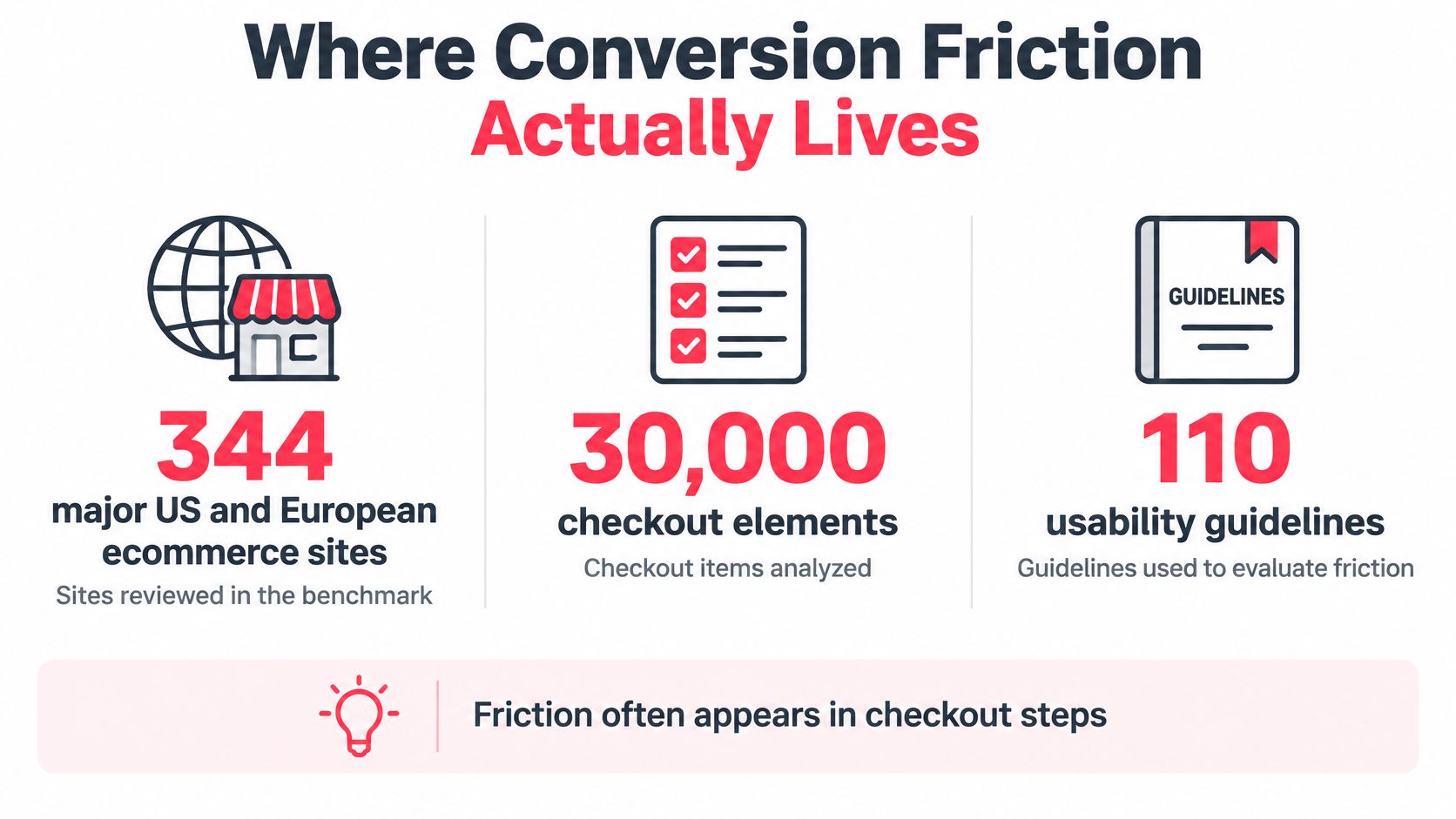
Baymard's checkout usability benchmark reviewed 344 major US and European ecommerce sites, examining more than 30,000 checkout elements against over 110 usability guidelines. It rated 65% of sites mediocre or worse and only 2% good.
Use benchmarks to form hypotheses
The same Baymard benchmark estimates approximately 32 actionable checkout improvements for the average large ecommerce site and a potential 35% conversion-rate increase through checkout UX improvements. That's an estimated opportunity, not a promised result or a B2B demo-form benchmark.
Baymard's checkout usability report reports an average of 11.3 form fields, with 22% of users having abandoned because of checkout complexity, and describes an ideal checkout of roughly 12 total form elements. Fields and total elements are different units: the latter also includes controls such as checkboxes and dropdowns.
Borrow the diagnostic method from checkout research. Don't borrow the expected uplift for a different buying journey.
For B2B companies, our implementation recommendation is to inspect the transition between buyer intent and the information request. A demo form may ask for details that sales needs eventually but doesn't need before the initial conversation.
Prioritize a fix the team can evaluate
- Locate the largest observable abandonment point and verify that tracking works there.
- Inspect the experience for unclear requirements, errors, or unnecessary effort.
- Write a hypothesis connecting the proposed change to completion.
- Compare the changed experience against a defined baseline.
Removing qualification questions carries a trade-off. Marketing may receive more requests while sales has less information for routing, so completion alone shouldn't determine whether the change remains in production.
Actual results depend on traffic quality and offer strength, as well as product-market fit. Implementation quality and statistical validity also constrain what the team can conclude.
When Faster Testing Makes CRO Worse
Pause experimentation when the company can't collect enough relevant outcomes to answer the proposed question. A busy testing calendar doesn't compensate for sparse conversions or an unstable measurement setup.
The practical review starts with the evidence behind the reported result.

Test validity depends on baseline conversion, traffic allocation, minimum detectable effect, and adequate outcome volume. Business cycles matter because prospects exposed at different times may progress under different conditions.
Match the method to the available evidence
Repeated experiments with few completed outcomes can produce false positives or inconclusive results. Teams can also optimize a local action, such as clicking a demo button, without improving qualified pipeline.
We use a broader decision framework when conventional split testing is underpowered:
- Review buyer interviews and sales conversations for recurring objections.
- Diagnose funnel transitions before proposing page variants.
- Consider a larger offer or journey experiment when small changes can't produce a decision-useful result.
- Use instrumented holdouts or properly designed sequential testing when the available data supports them.
Sequential methods still require statistical planning. They don't give teams permission to stop whenever a dashboard looks favorable.
The embedded video is provided as supplementary viewing.
Automation doesn't create additional evidence
AI-assisted workflows can produce more variants while leaving the original sample-size problem unresolved. Splitting limited traffic across more treatments can make the decision harder rather than faster.
Our guidance on split testing landing pages belongs within that evidence constraint. Testing velocity should mean faster movement toward a defensible decision, rather than more experiments launched.
When the likely constraint is the offer or sales follow-up, pause cosmetic variants. Judge the replacement work by qualified pipeline, activation, retained revenue, or contribution margin, depending on the business model.
The Attribution Problem AI Discovery Created for CRO
Observed referral conversion doesn't establish how much demand a discovery channel created. A buyer can encounter a recommendation, research the company elsewhere, and convert through a different recorded source.
Practical Ecommerce's comparison of AI referral analyses describes a 12-month analysis of 973 ecommerce websites, representing approximately $20 billion in revenue, in which ChatGPT-referred traffic converted worse than organic search, affiliate, and email-related channels. The researchers also noted that last-click attribution can undercount earlier AI influence.
The same comparison describes an analysis of 94 ecommerce brands where ChatGPT referrals converted at 1.81%, versus 1.39% for non-branded organic search, a 31% advantage. Different samples and measurement choices support different conclusions, so neither result establishes a universal channel ranking.
Report separate questions separately
For B2B buying journeys, we recommend separating observed performance from causal claims. A dashboard should make clear what the team measured and what remains uncertain.
| Measure | Question it addresses |
|---|---|
| Observed conversion rate | What share of tracked visits completed the action? |
| Incremental lift | What additional outcomes resulted from the intervention? |
| Assisted influence | What earlier touchpoints were observed or reported? |
| Revenue per visit | What commercial value accompanied tracked traffic? |
| Post-purchase quality | Did acquired customers retain value after conversion? |
A post-purchase discovery question can supplement tracked attribution, but self-reported answers aren't controlled evidence. Keep that limitation visible rather than converting every reported recommendation into a causal claim.
Separate content production from attribution
A team considering Landra to automate listicle creation for e-commerce should evaluate the content workflow separately from any claim about AI-assisted purchases. Publishing more comparison content doesn't establish that recommendations caused subsequent orders.
Our AI search optimization article addresses the discovery side of that work. The executive CRO should own how the company allocates commercial credit, while conversion specialists preserve clear experiment boundaries.
For high-consideration purchases, report uncertainty explicitly. Otherwise, leadership may cut discovery work because another channel received the final click, or credit discovery for purchases that would have happened anyway.
For one of the most common CRO tactics, what is AI personalization explains how to prove incremental lift with a holdout test before scaling.
A CRO Checklist for the Next Quarter
Choose the next intervention by locating the constraint, rather than selecting a CRO service or job title first. We recommend a short decision record that the CEO and commercial leaders approve before implementation begins.
Establish the conditions for action
- Fix the measurement specification. Record the unit of analysis and conversion event, then agree on the attribution window and minimum data quality requirements.
- Instrument the relevant funnel transitions. Segment by device, new versus returning users, geography, and acquisition channel where the data supports meaningful interpretation.
- Prioritize the largest observed abandonment points. Require evidence of friction before moving a generic best-practice recommendation into the implementation queue.
- Set guardrails appropriate to the journey. These may include revenue per visitor, refund rate, lead quality, and page performance.
- Classify the remaining constraint. Decide whether the company needs better measurement, an offer change, a sales-process fix, or executive authority before adding variants.
Select the appropriate owner
A Chief Revenue Officer hire fits a cross-functional authority gap. A specialist implementation project fits a bounded journey problem, while fractional advisory can support a team that needs prioritization and implementation oversight.
Stimulead offers fractional Chief AI Officer advisory and implementation oversight as an option alongside an internal program owner or specialist agency. The appropriate choice depends on who can maintain the measurement standard and make decisions when results are inconclusive.
Bring your current funnel report and proposed CRO scope to the next leadership meeting. Decide whether to authorize an executive hire, commission a measurement audit, or repair a documented journey failure, and assign an accountable owner before committing to another tool.
