
Only about 30% of companies created a single customer view across channels, while just 1% to 2% used data for a full cross-channel experience, according to Boston Consulting Group's first-party data research. That gap changes the decision facing most B2B leaders: the first-party data strategy shouldn't start with a tag audit or a CDP purchase. It should start with the delay between a customer signal and the action your team takes.
We've implemented these systems inside growth-stage companies, and the recurring failure is predictable. Marketing collects more events, sales receives stale account alerts, and leadership funds another platform before anyone fixes consent state, identity resolution, or activation latency. The practical argument is simple: first-party data creates value only when trusted records reach the right decision system quickly enough to affect pipeline.
Table of Contents
- The 30% Problem With Most First Party Data Programs
- What First Party Data Actually Means in a B2B Stack
- The Four-Layer Operating Model That Replaces CDP-First Thinking
- Consent-Led Collection Design That Survives a Privacy Review
- When Clean Rooms Earn the Overhead and When They Do Not
- Activation Use Cases That Move Pipeline
- The Six KPIs That Separate a Live Program From a Data Lake
- A 90-Day Sequencing Plan for the Next Decision
The 30% Problem With Most First Party Data Programs
BCG's benchmark doesn't say that roughly 30% of first-party data goes unused. It says that, as of 2021, only about 30% of companies were creating a single customer view across channels, and only 1% to 2% were using data to deliver a full cross-channel experience. That distinction matters. The problem is organizational capability, not an average unused-data ratio.
A company can collect every website event in Google Tag Manager, store sales activity in Salesforce, and capture product usage in Snowflake while still failing to act. If those systems don't resolve one visitor to one person, one account, and one lifecycle stage, the data remains disconnected evidence.
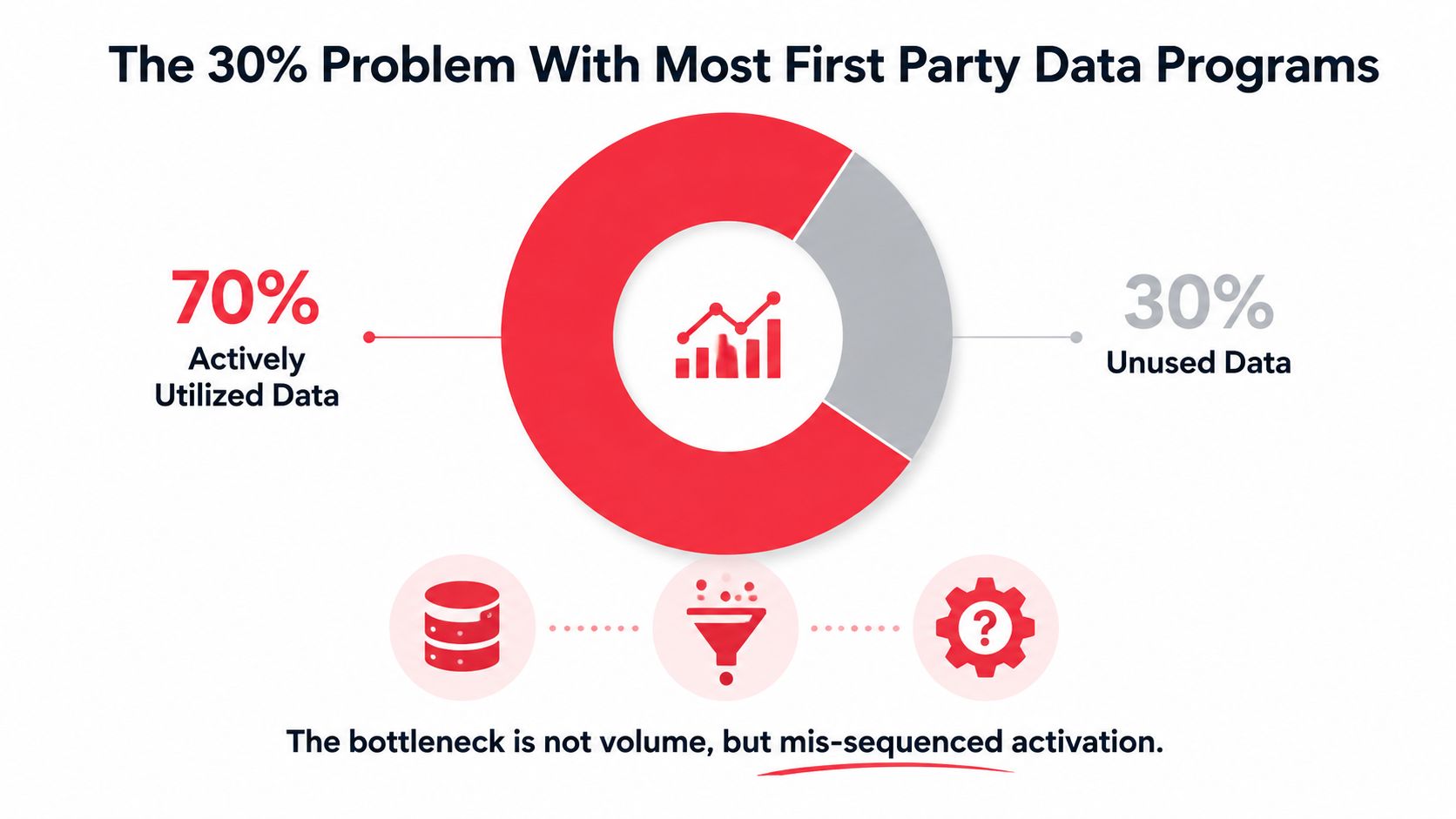
Collection creates inventory, activation creates value
Tag-count dashboards reward activity without proving usefulness. A growth-stage B2B company should instead ask:
- How quickly does a qualified signal reach a sales or marketing workflow?
- Can the system connect anonymous behavior to an account without breaking consent rules?
- Can a marketer explain why a person entered a segment and why another person was suppressed?
- Can finance tie the intervention to qualified pipeline or conversion movement?
Slow activation produces familiar symptoms. A high-intent visitor sees a generic page because the account match arrives later. A lead-routing rule fires after a rep has already contacted the account manually. A nurture message ignores a pricing interaction because the preference or lifecycle update hasn't propagated.
The teams that treat first-party data as an activation pipeline design event schemas around decisions. The teams that treat it as a collection exercise optimize for more records. We recommend fixing the first group of bottlenecks before evaluating a larger CDP, expanded identity graph, or additional paid media integration. For broader channel planning, the AY Rank guide to best B2B SaaS SEO agencies can help leaders assess which external partners understand technical data and demand-generation constraints.
Operating rule: If a signal can't change a customer, sales, or measurement decision within the relevant buying window, collecting more of that signal is probably waste.
What First Party Data Actually Means in a B2B Stack
For a B2B company, first-party data means information collected directly through owned properties and company-controlled interactions. That includes website behavior, product telemetry, CRM records, sales conversations, support tickets, authenticated sessions, email responses, and account activity captured with an appropriate permission or legal basis.
The useful definition is operational. A CRM contact record becomes valuable when it can be connected to an account, consent state, buying stage, and action. A product event matters when it changes routing, onboarding, expansion messaging, or account prioritization. A content download matters when it contributes to a decision model rather than sitting as an isolated activity in a marketing automation platform.
The categories below prevent teams from mixing data ownership with data intent.
| Data Source Taxonomy for B2B First-Party Strategy | |||
|---|---|---|---|
| Data Class | Source | Freshness | Primary Activation Use |
| Identity data | CRM, authenticated product account, email relationship | Changes as records or relationships change | Account matching, routing, suppression |
| Behavioral data | Website sessions, product telemetry, content paths | Immediate to periodic | CRO decisions, intent scoring |
| Commercial data | Opportunities, orders, renewals, pricing activity | Event-driven | Stage progression, attribution |
| Service data | Support tickets, call notes, success records | Event-driven | Risk detection, message selection |
| Consent data | Preference center, cookie choices, processing records | Must update with each decision | Eligibility, suppression, audit |
| Zero-party data | Surveys, declared preferences, profile settings | Changes when the customer tells you | Personalization and qualification |
| Second-party data | Partner-shared audience or account records | Depends on partner refresh | Collaboration and controlled reach |
Twilio Segment's 2022 report found that 37% of brands were exclusively using first-party data for personalization, up from 31% in 2021. The same report recorded hybrid usage across the market, including brands using an even mix of first-party and third-party data, which shows that adoption was becoming central while execution remained incomplete.
B2B teams often collect events before resolving account context. That sequence creates impressive activity reports and weak sales actions. Build the identity graph and consent model around the use case first, then decide which events deserve permanent storage.
The Four-Layer Operating Model That Replaces CDP-First Thinking
A CDP-first roadmap usually starts with procurement. The team selects a platform, connects sources, imports inconsistent profiles, and discovers that the platform can't make ambiguous consent or account ownership disappear. We've seen this create a polished interface over unresolved operating problems.
Our preferred model has four layers. The order matters because each layer supplies a condition the next layer needs.
Layer one sets the permission boundary
Consent and governance defines what the company may collect, retain, enrich, model, and activate. The UK ICO consent guidance requires consent to be freely given, specific, informed, and unambiguous, with processes for obtaining, recording, and managing it.
The failure mode is silent invalidity. Teams discover it during a privacy review, after a vendor integration, or when a customer challenges an unexpected use. Define purpose, lawful basis, retention, regional rules, and withdrawal behavior before data enters downstream systems.
Layer two makes records reachable
Identity resolution connects anonymous visitors, known contacts, authenticated users, and account hierarchies. It needs explicit matching rules, confidence states, merge controls, and a process for correcting false matches.
The failure usually appears in the first serious routing or personalization cycle. Sales sees duplicate accounts, marketing suppresses the wrong contact, and analytics assigns behavior to the wrong buying group.
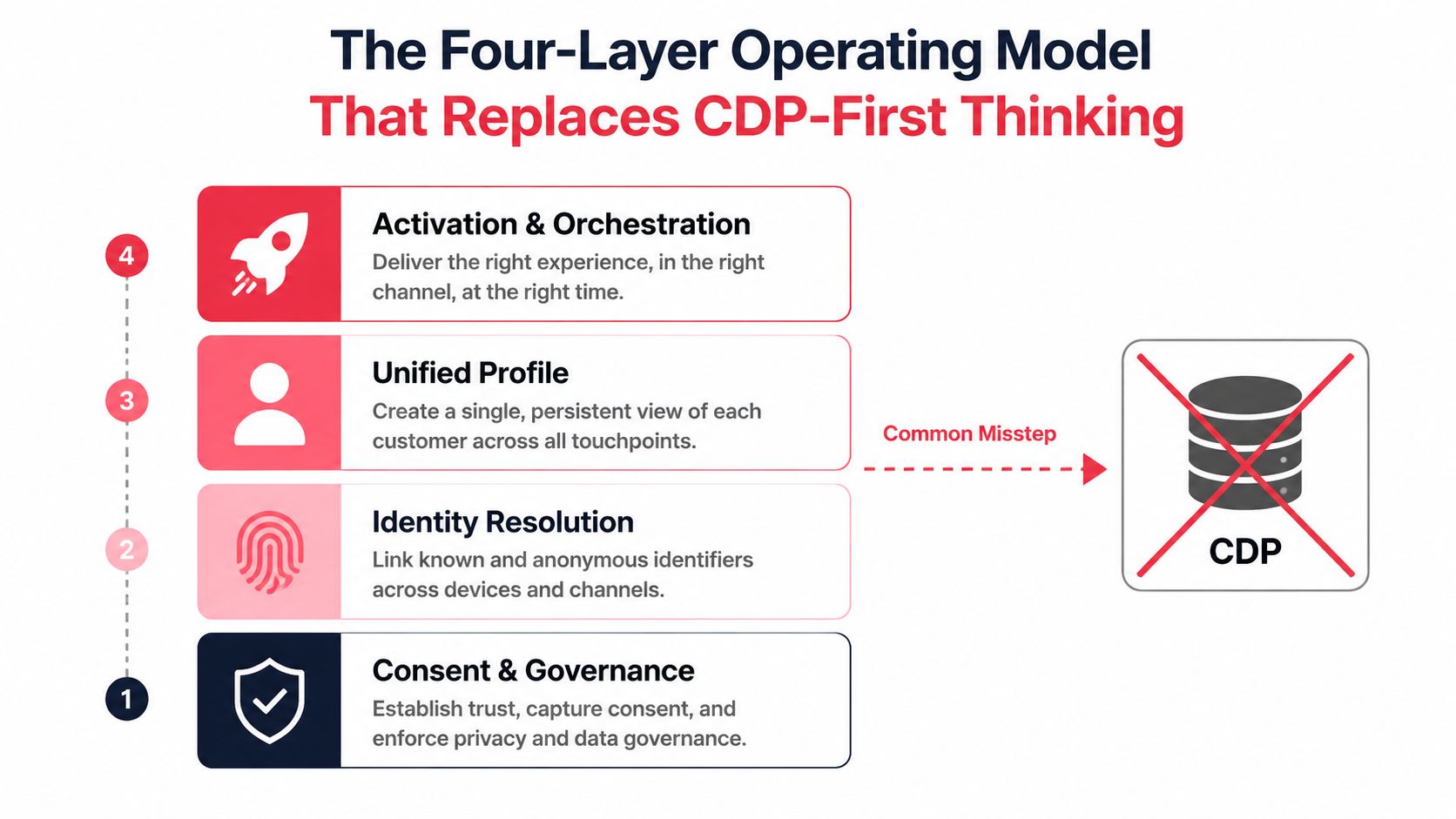
Layer three turns the graph into action
The activation surface includes Salesforce routing, HubSpot workflows, advertising audiences, website personalization, customer success alerts, and experimentation tools. Use APIs or event streams where timing affects the decision. Use batch exports where latency doesn't change the outcome.
The common failure emerges during the second quarter of implementation. The profile exists, yet no owner trusts the audience enough to use it in production.
Layer four proves the system earns its place
Measurement closes the loop between data, intervention, and outcome. Define the conversion event, holdout method, attribution rule, and cost model before launch. The first-party data measurement framework recommends tracking volume, sources, processing speed, profile depth, and the share of collected data activated for analytics and cross-channel marketing.
A CDP may support all four layers, but it doesn't replace them. Buy the platform only when it reduces a measured constraint.
Consent-Led Collection Design That Survives a Privacy Review
A privacy-safe first-party data strategy begins with the collection experience and continues into every destination that receives the record. The ICO's standard requires clear, specific, informed, and unambiguous consent. For B2B companies, that affects demo forms, event registration, product onboarding, enrichment, advertising audiences, and model training.
A defensible form separates operational processing from optional marketing permission. It explains the purpose, names relevant vendors or categories of sharing, describes withdrawal, and preserves an auditable record. A weak form preselects marketing, bundles service access with personalization, or requests account-level contact data without explaining how the company will use it.
| Consent UX Review: Pass Versus Fail | ||
|---|---|---|
| Requirement | Pass Example | Fail Example |
| Purpose | “We'll use this email to respond to your demo request.” | “We may use your details to improve experiences.” |
| Choice | Separate service communication from optional marketing | One bundled checkbox for every purpose |
| Withdrawal | Preference-center link and equivalent opt-out path | Hidden process that requires a support request |
| Record | Timestamp, purpose, version, source, and status | A single “consented” field with no history |
| Vendor disclosure | Named CRM, analytics, or advertising destination where relevant | Unexplained sharing with “partners” |
| Data minimization | Fields tied to routing or qualification | Extra demographic fields collected without a use |
Governance needs enforcement, not a policy PDF
Create event allowlists and assign owners for each source. Enforce retention windows, regional restrictions, suppression rules, and field-level access in the warehouse and activation tools. Separate anonymous browsing records from identified business records until the identity and permission conditions are satisfied.
Review enrichment, international transfers, advertising exports, and AI training paths. If a contact withdraws marketing permission in HubSpot but remains eligible in an ad platform, that mismatch is a product defect. Teams that want a visual reference for privacy controls can also review this data privacy consulting security icon.
Track rejected consent, unclear opt-outs, stale preferences, and cross-system mismatches in the same operating review as broken forms and failed routing. Permission quality determines whether activation remains reliable.
When Clean Rooms Earn the Overhead and When They Do Not
A clean room is a controlled collaboration environment. It isn't a default replacement for a warehouse, CRM, or activation platform.
The strongest use case involves a partner whose data changes a decision you can't safely answer alone. A media platform may hold exposure data while your company holds customer or transaction data. A controlled match can help evaluate overlap or campaign effect without giving either party unrestricted access to the other's records.
Peer-reviewed research on consented first-party audience data found that self-collected demographic and content-interest data improved efficacy and efficiency compared with specifically designed third-party segments for identifying IT decision makers. That study in the Journal of Marketing Analytics supports a narrow decision: use directly observed data where it answers the question, and add collaboration only when partner data contributes material information.
| Clean Room or In-House Activation? | ||
|---|---|---|
| Criterion | In-House Activation | Partner Clean Room |
| Primary use | CRM, product, web, sales, and customer signals | Restricted joins with partner-held exposure or audience data |
| Speed | Faster for governed internal questions | Depends on matching and query approval |
| Auditability | Usually simpler | Requires output controls and partner governance |
| Cost profile | Warehouse, engineering, and analyst time | Licensing plus legal, matching, review, and operations |
| Best decision | Keep the question internal when existing data answers it | Use when partner data materially changes the decision |
Compare the full operating cost. Include legal review, identity coverage, query limits, output thresholds, analyst time, approved-audience latency, and the work required to turn an output into media or sales action.
If a governed warehouse can answer the question in days, keep it in-house. IDC's 2025 market assessment of clean rooms treats them as an important advertising and marketing category, but importance doesn't make them suitable for every mid-market company.
Activation Use Cases That Move Pipeline
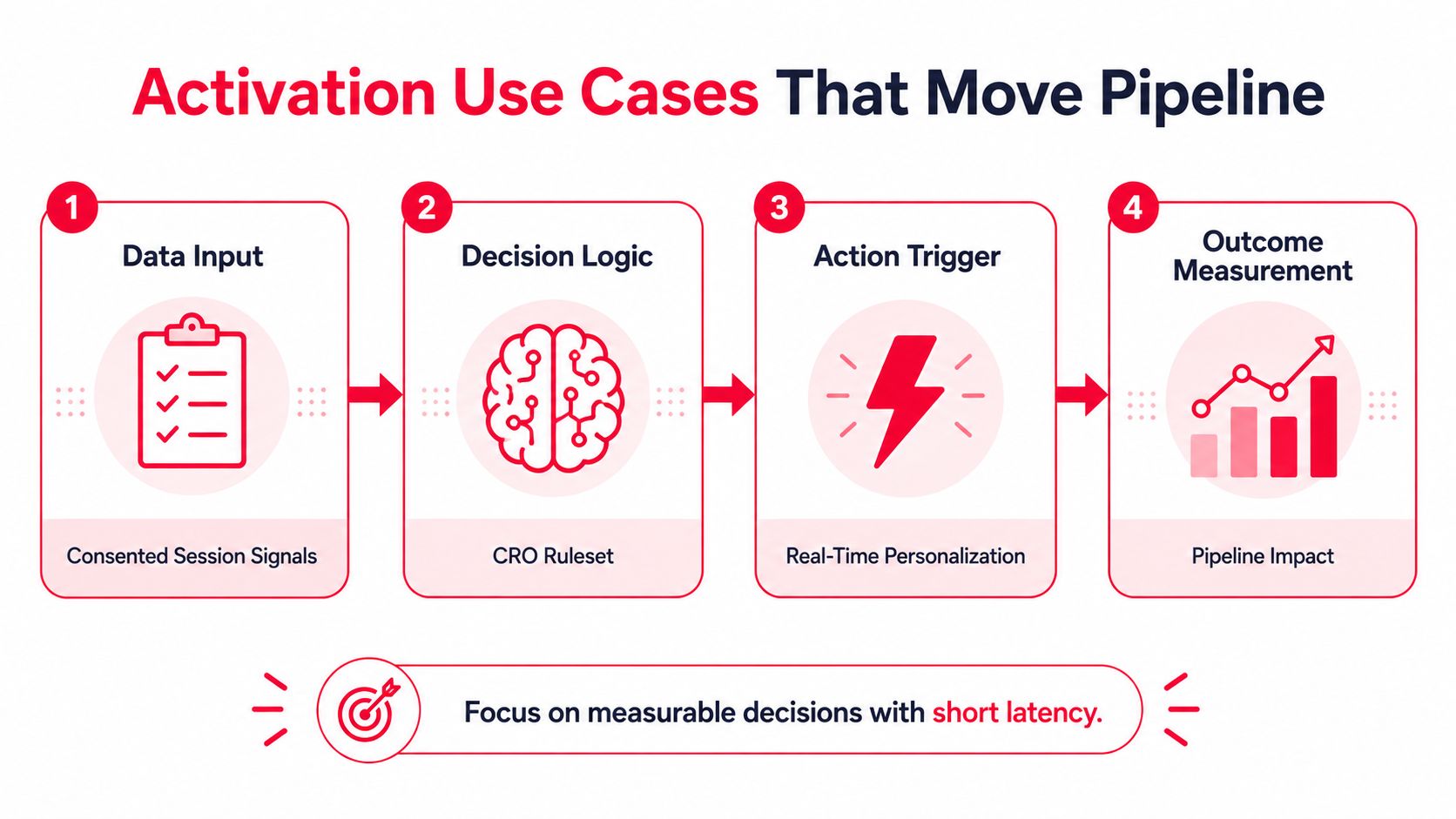
Production activation begins with a decision. The team should know what changes, who receives the output, how quickly the action occurs, and which outcome determines continuation.
CRO needs a decision rule
Suppose an enterprise visitor returns repeatedly, reads implementation content, and reaches pricing but doesn't request a conversation. The system can use consented session behavior, account context, and experiment history to select an approved comparison guide or relevant proof point.
The test needs a holdout and a defined conversion event. A lift in clicks alone doesn't justify the data and review cost. Measure qualified conversion, account progression, or another outcome that the revenue team accepts.
AEO needs account-level measurement
For answer-engine optimization, group first-party questions, content paths, downloads, and conversions by organization where identity and permission allow it. Prioritize pages whose audiences contribute assisted pipeline, then measure qualified visits, assisted conversions, and sales velocity.
Citations or answer visibility can be useful diagnostic signals. They're insufficient as the commercial endpoint.
Sales needs signal economics
Product usage spikes, support themes, pricing activity, and buying-group engagement can become scored actions for sales. Set an alert threshold only when signal strength and account fit make expected opportunity value greater than rep labor.
Track accepted meetings, stage progression, and sourced pipeline. We've found that sales teams ignore signal systems that produce volume without clear action ownership. Our related guidance on signal-based selling covers the operating discipline required to keep alerts useful.
Personalization needs boundaries
Let AI select a message, asset, or channel from approved variants. Keep eligibility, suppression, frequency, and consent deterministic. That division gives the model room to choose content without allowing it to invent a permission state or contact a suppressed person.
Google's sitewide tagging guidance describes how first-party cookies support conversion measurement, and its enhanced-conversions materials report that conversions attributed to first-party cookies reached 89%, while Search-campaign conversions increased 114% year over year in the cited materials. Those figures come from Google's sitewide tagging and privacy materials, and they should be treated as platform-specific evidence, not a universal forecast.
The economic test remains direct:
Incremental pipeline or revenue divided by data, model, media, engineering, and review cost.
Start with one CRO decision, one AEO prioritization workflow, one sales signal, and one personalized nurture. Scale only after each beats its baseline or holdout.
The Six KPIs That Separate a Live Program From a Data Lake
A dashboard becomes useful when every metric has a threshold, owner, and response. We don't recommend reporting data volume as a success metric unless the volume supports a live decision.
The framework below uses operating thresholds as management rules, not industry benchmarks. Each company should calibrate them against its own baseline and buying cycle.
| Six KPIs for First-Party Data Activation Programs | |||
|---|---|---|---|
| KPI | Threshold | Failure Mode Caught | Owner |
| Identity match rate | Below the agreed use-case baseline | Anonymous activity fails to reach the right account | RevOps, weekly |
| Consent coverage of active accounts | Any material gap in eligible records | Campaigns use incomplete or stale permission state | Privacy lead, weekly |
| Time to activation | Longer than the decision window | Personalization or routing arrives too late | Data engineering, daily |
| Model drift | Score behavior departs from validated baseline | Lead or intent ranking loses reliability | Data science, monthly |
| Activation-attributed pipeline lift | No measured improvement against baseline or holdout | Activity gets mistaken for commercial impact | Marketing ops, per test |
| Data subject request response time | Outside the company's documented service target | Deletion, access, or correction work becomes manual and risky | Privacy counsel, per request |
The marketing effectiveness measurement guide provides a useful companion for connecting activation metrics to business outcomes. Put these measures into the revenue operations meeting, privacy review, and experiment calendar. A forgotten dashboard can't protect pipeline.
A 90-Day Sequencing Plan for the Next Decision
A 90-day build should produce evidence, not a larger backlog. Staff for the work you need, defer purchases that don't address the current constraint, and define the kill criteria before implementation begins.
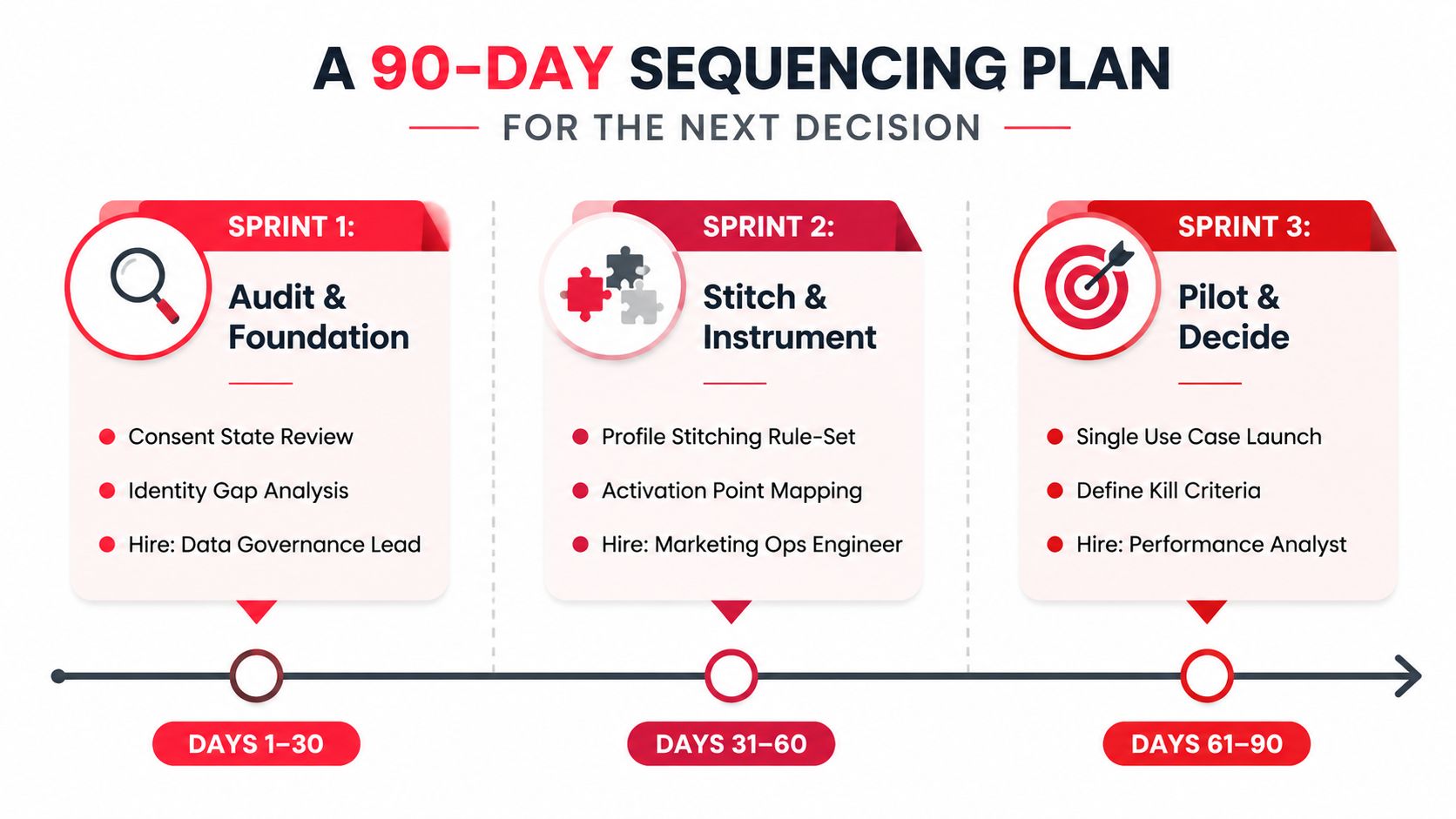
Days 1 to 30 establish control
Run a consent and identity audit across the website, CRM, marketing automation, product analytics, warehouse, and advertising destinations. Close the instrumentation gaps that affect one priority decision, then create a governed source of truth for identity, account hierarchy, lifecycle stage, and consent state.
Staff a revenue operations lead, data engineer, and privacy counsel. Don't hire a broad transformation team before you know which workflow deserves production support.
Days 31 to 60 ship useful actions
Choose two production use cases, one for sales and one for CRO. Map every input, transformation, destination, owner, suppression rule, and measurement event. Put one AI-assisted personalization workflow on a high-intent surface, with approved content variants and a holdout.
Defer paid CDP features, broad identity-graph expansion, and organizational redesign. A new platform can wait while the team tests whether the operating model reduces activation latency.
Days 61 to 90 decide what deserves investment
Evaluate a partner clean room only if an external data source changes the decision materially. Monitor model behavior, consent mismatches, identity exceptions, and test outcomes. Make a hard go or no-go decision on a CDP based on measured activation improvement, governance coverage, and team capacity.
Kill the initiative if the first sprint can't produce a trusted identity path, documented permission state, and an owned production decision. Don't keep funding collection because the implementation team has already invested time.
The timeline below captures the sequencing we use with leadership teams.
For additional reading before the audit, you can browse data strategy resources from Wonderment Apps. If the work includes AI decisioning, map the data dependencies inside an AI implementation roadmap before selecting vendors.
Start with the audit this week. Name the executive owner, select one revenue decision, and ask your team to report the current consent coverage, identity match quality, and capture-to-activation delay. If those three answers aren't available, don't buy a CDP yet. Fix the operating path first, then fund the tool that removes a measured constraint.