
Most companies start AI conversion rate optimization from the wrong premise. They think the upside comes from smarter copy, sharper prompts, or one more personalization layer. The underlying issue is simpler. The average website conversion rate across industries is 2.35%, and companies using on-site testing report an overall lift of about 14%, while A/B testing can increase conversion by roughly 49% on average, according to ElectroIQ's CRO statistics roundup. That gap is where revenue sits.
The way the program is run decides the outcome more than the tooling does. Programs guided by experienced operators report 28% to 34% conversion lifts, while fully automated programs average only 4% to 7%, according to this AI CRO benchmark guide. Same technology, very different results.
For a leadership team, that should reframe the discussion. AI doesn't replace CRO discipline. It compresses the time between finding friction and shipping a valid test. If you also want to improve your organic conversion, that same discipline matters even more because search traffic compounds the cost of weak pages. If your team still treats optimization as a side project, start with a tighter operating model. A practical baseline is this quick start guide to conversion rate optimization, then layer AI on top where speed and pattern detection are key.
Table of Contents
- Your AI CRO Starting Point
- Conduct Your AI Readiness Audit
- Build Your Prioritization Framework
- Install a High-Velocity Testing Engine
- Optimize for AI Search and Agent Commerce
- Govern, Measure, and Scale Your Program
Your AI CRO Starting Point
AI conversion rate optimization becomes useful when leadership stops treating it like software procurement and starts treating it like revenue operations. The benchmark matters because it exposes how much room most sites still have to improve. When conversion starts low, even small gains matter, especially on pricing pages, signup flows, demos, and checkout steps.
The mistake I see most often is speed without structure. Teams buy an AI testing product, generate a pile of ideas, then learn they can't trust their funnel data or isolate impact. That creates activity, not revenue.
Where the business case actually comes from
The business case isn't abstract. It comes from two realities.
- Baseline performance is usually weak. A lot of growth-stage sites convert in the low single digits.
- Testing still works. Structured experimentation has meaningful upside when teams run it consistently.
- AI changes the cycle time. It helps teams process behavioral inputs faster, generate hypotheses faster, and ship iterations faster.
Practical rule: If your current CRO process takes weeks to move from insight to live test, AI has room to pay for itself. If your data is fragmented, it won't.
That's why I don't advise leadership teams to ask, “Which AI CRO tool should we buy?” I ask, “Where are we slow, blind, or inconsistent in the conversion process?” The answer usually sits in one of three places: analysis bottlenecks, test design bottlenecks, or deployment bottlenecks.
What AI CRO should mean inside a growth-stage company
At this stage, AI CRO should function as an operating system with clear ownership.
You need:
- A revenue target. Tie optimization to qualified pipeline, purchases, booked meetings, or activated accounts.
- A testing scope. Pick one funnel stage where friction is visible and stakes are high.
- A decision loop. Define who reviews insights, who approves tests, and who pushes changes live.
If those pieces aren't in place, AI will accelerate confusion. If they are, it will increase testing velocity and shorten the path from user behavior to revenue impact.
Conduct Your AI Readiness Audit
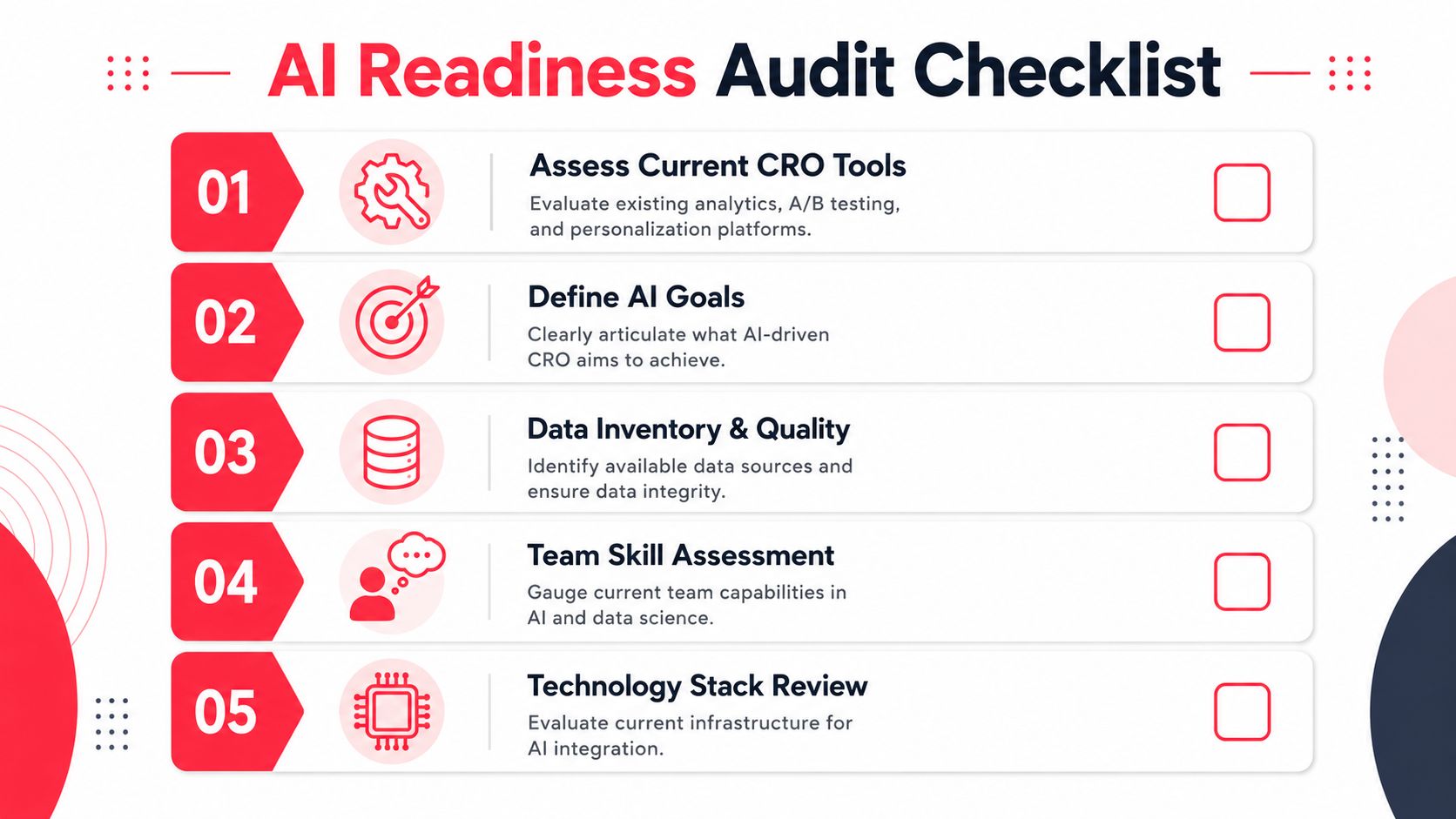
Before you deploy any AI workflow, audit the system that AI will sit on top of. Most failures in AI conversion rate optimization are basic operational failures disguised as model issues. The stack isn't connected. Event tracking is inconsistent. Sales data never feeds back into marketing. The team can launch a test, but can't explain whether it improved business outcomes.
A practical workflow starts with maturity assessment, then data unification, then pilot testing, and AI delivers value fastest when the data stack is unified and the use case is narrow enough to measure cleanly, as described in Monday's guide to AI conversion rate optimization.
Audit the data before the tools
Start with the handoffs between systems. I want to know whether the company can trace a path from traffic source to pipeline outcome without patchwork spreadsheets.
Check these first:
- Analytics coverage: Are key events tracked on landing pages, forms, product pages, signup flows, and checkout steps?
- CRM connection: Can you connect on-site behavior to lead quality, deal creation, or closed revenue?
- CDP or customer profile layer: Do your systems recognize returning users, segments, and account context in a way marketing and sales can both use?
- Feedback inputs: Are session replays, on-page feedback, chat logs, and call notes available in one review workflow?
If the answer is no on most of those, fix that before you ask AI to recommend anything.
Audit the current operating cadence
Some teams have decent tools and weak execution. Others have mediocre tools and strong operators. The second group usually wins.
Review the current motion:
| Audit area | What to check | What failure looks like |
|---|---|---|
| Testing cadence | How often the team ships valid experiments | Tests stall in approval or design |
| Insight quality | Whether hypotheses come from behavior and funnel data | Opinion-driven test backlog |
| Ownership | Who decides, builds, reviews, and reports | Shared responsibility means no responsibility |
| Deployment | How quickly variants can go live | Engineering queue blocks basic tests |
A useful audit output fits on one page. If your readiness document becomes a strategy deck, the team is avoiding the bottleneck.
Audit the team, not just the stack
AI CRO changes workflows. That means you need to know who can interpret behavior, who can write a valid hypothesis, who can QA variants, and who can read results without overreacting to noise.
I usually score the team on four practical capabilities:
- Analysis: Can they turn user behavior into testable friction points?
- Experiment design: Can they write a clean control, variation, segment, and success metric?
- Implementation: Can they ship page changes without long engineering delays?
- Decision discipline: Can they stop weak tests and scale strong ones without politics?
Weakness in one of those areas becomes your first constraint. That's your starting point. Not perfection. Not “AI maturity.” Just the first thing that needs fixing.
Build Your Prioritization Framework
Once the audit is done, most leadership teams face the same problem. They have too many plausible AI projects. Homepage personalization. AI-written ad-to-landing copy sync. Pricing page variants. Smarter forms. Dynamic checkout logic. Chat-based qualification. All sound reasonable. Only a few deserve immediate budget and attention.
I use a simple scoring model that kills vague debate. Every initiative gets scored on Revenue Impact, Confidence, and Implementation Speed. Keep the scale at 1 to 5. Don't make it more complicated than the decisions require.
Use one scorecard for every candidate initiative
Here's the matrix.
| Initiative | Revenue Impact (1-5) | Confidence (1-5) | Implementation Speed (1-5) | Total Score |
|---|---|---|---|---|
| AI-assisted landing page headline testing | 4 | 4 | 5 | 13 |
| AI-generated form field and CTA variants | 4 | 4 | 4 | 12 |
| Pricing page message personalization by segment | 5 | 3 | 3 | 11 |
| Dynamic checkout flow personalization | 5 | 2 | 2 | 9 |
| Full-funnel redesign driven by AI recommendations | 5 | 2 | 1 | 8 |
This isn't scientific precision. It's an executive filter.
Score impact with revenue logic, not enthusiasm
Revenue Impact should reflect where the initiative sits in the funnel and how directly it affects a meaningful business outcome. A pricing page test usually deserves a higher score than a blog CTA test. A demo request form for high-intent traffic matters more than a cosmetic homepage change.
Confidence depends on evidence. If session replays, CRM outcomes, and user feedback all point to one friction point, confidence is high. Our guide to customer research with AI covers how to gather that evidence faster. If the hypothesis comes from a brainstorm and a few anecdotes, confidence is low.
Implementation Speed forces honesty. If engineering must refactor templates, legal must review claims, and analytics must rebuild tracking, the initiative is slow even if the idea sounds smart.
Teams waste months on “high impact” ideas that are really low-confidence, slow-moving projects with a political sponsor.
What usually gets funded first
In growth-stage companies, the best early bets tend to share three traits:
- They sit on high-intent pages.
- They can ship without major engineering work.
- They produce clean learning even if the first variant loses.
That usually pushes teams toward landing pages, lead forms, demo request flows, core product pages, and pricing page messaging before more complex personalization logic. If your company needs a planning structure for that broader revenue model, this SaaS growth model framework is a useful companion because it forces teams to map optimization work to the parts of the funnel that produce revenue.
Two examples of good and bad prioritization
A good first AI CRO initiative is AI-assisted headline and offer testing on a paid landing page with stable traffic and one clear conversion event.
A bad first initiative is personalized checkout orchestration across channels when product, engineering, analytics, and lifecycle marketing all define users differently. That's a program, not a pilot.
Choose the project that teaches the company how to operate. That matters more than choosing the flashiest use case.
Install a High-Velocity Testing Engine
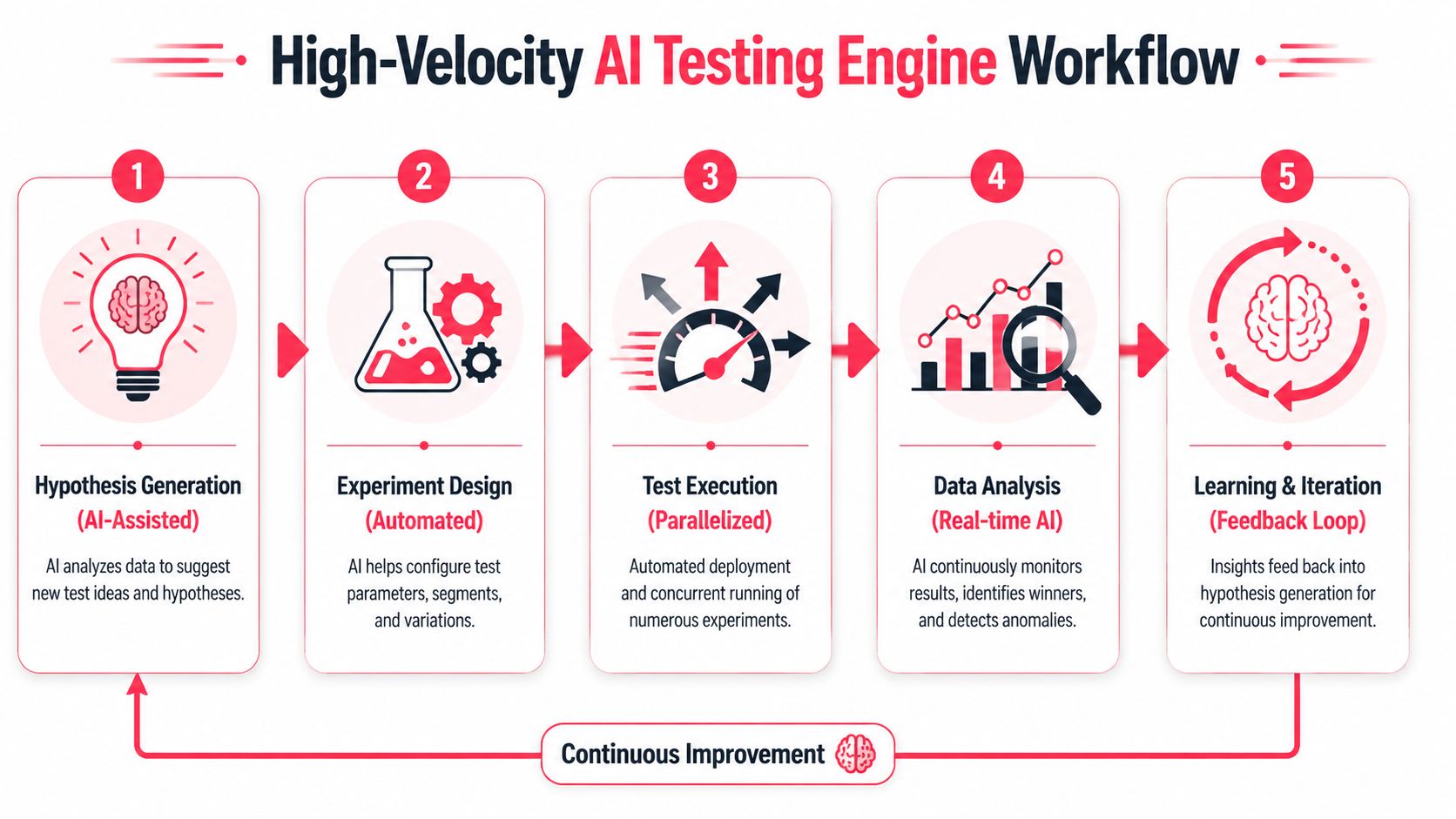
AI conversion rate optimization starts paying off when you install a testing engine that can move continuously without creating reporting chaos. The shift is operational. Manual CRO runs in batches. Someone reviews heatmaps, someone writes a hypothesis, someone waits on design, someone waits on engineering, someone waits on significance. AI can compress several of those steps, but only if your workflow is built for speed.
Industry examples collected by UXCam's AI CRO overview report that businesses using AI have increased conversion rates by as much as 20%, Amazon's recommendation engine has been credited with driving about 35% of annual sales through personalization, and vendor guidance claims AI-powered testing can reduce optimization time by up to 60%.
Build the loop around three motions
A high-velocity engine needs three connected motions.
First, AI-assisted hypothesis generation. Feed the system useful inputs: session recordings, rage taps, exits, path analysis, support transcripts, form abandonment, and sales objections. The AI's job is to cluster friction and suggest a test backlog. Your team's job is to reject weak ideas fast.
Second, automated experiment deployment. This stage often presents a bottleneck. If every test still needs custom design and engineering, your throughput won't change much. The practical fix is a page architecture that supports modular swaps in headlines, proof blocks, CTA language, form layouts, and offer framing.
Third, real-time analysis and iteration. You need fast reads without impulsive decisions. AI can surface directional winners, segment anomalies, and likely false positives faster than a person reviewing dashboards once a week.
Where operators get real gains
The strongest gains usually come from boring pages with obvious friction. Not clever homepages. Not novelty AI widgets. Pages where intent is high and confusion is expensive.
Common examples:
- Forms: Field order, labels, reassurance copy, and error handling often produce immediate learning. If your team is working on this area, Orbit AI has a practical piece on optimizing forms with AI.
- Pricing pages: Packaging, plan comparison clarity, FAQ placement, and objection handling matter more than visual flair.
- PLPs and PDPs: Recommendation blocks, sorting logic, product detail structure, and proof placement can move buying behavior.
- Demo flows: Shorter paths, better qualification logic, and cleaner handoff into sales reduce leakage.
The fastest teams don't automate every decision. They automate the repetitive parts and keep human review on offer, pricing, compliance, and brand risk.
What does not work
Three patterns usually fail.
- Prompt-first testing: Asking a model for “high-converting copy” without grounding it in user behavior.
- Too many variables at once: If the team changes messaging, layout, offer, and audience at the same time, learning quality collapses.
- No archive of learnings: Tests that end without structured capture force the company to relearn the same lessons every quarter.
One option for companies that need outside operating support is Stimulead, which works across CRO with AI, GTM engineering, AI search optimization, and agent-commerce readiness. The relevant point isn't the firm itself. It's the model. Someone has to own the operating system, not just the software license.
Optimize for AI Search and Agent Commerce
A lot of CRO advice still assumes the buyer is a human who lands on a page, reads a value prop, and clicks a CTA. That assumption is getting weaker. More buying journeys now start with an AI assistant, a search summary, or an agent-driven shortlist. If your site is hard for machines to interpret, you can lose before a human visitor ever arrives.

The emerging shift is from optimizing only page conversion to optimizing machine-readable persuasion, and if AI assistants summarize your offer, overly dynamic or opaque pricing and messaging may reduce retrievability and trust, according to CXL's analysis of AI and conversion strategy.
Clarity beats cleverness for machine-mediated buying
Certain personalization strategies can hinder your efforts. If every visitor sees different packaging names, vague price ranges, inconsistent feature descriptions, or rotating proof points, AI systems have a harder time retrieving and summarizing your offer accurately.
For SaaS, B2B, and e-commerce teams, that changes the conversion brief.
Make these pages easy for machines to parse:
- Product pages: Use consistent names, feature descriptions, use cases, and category language.
- Pricing pages: State plans, inclusions, and qualification rules clearly. Hide less.
- FAQ pages: Answer commercial questions directly, especially implementation, fit, limits, and support.
- Comparison pages: Use explicit language about alternatives, category fit, and differences.
- Schema and structured data: Mark up entities, products, offers, reviews, FAQs, and organization details where appropriate.
What to change on the page
I advise teams to audit pages for summarizability. If an LLM or shopping assistant had to explain your offer in a few lines, could it do that without guessing?
Look for these problems:
| Problem | Why it hurts | Better move |
|---|---|---|
| Opaque pricing language | Machines can't reliably summarize cost structure | Use plain plan descriptions and visible inclusions |
| Dynamic messaging by too many segments | Retrieval gets inconsistent | Keep core offer language stable |
| Weak information hierarchy | Important details get buried | Use clear headings and grouped content |
| Missing commercial FAQs | AI summaries skip buyer objections | Add direct answers in crawlable page sections |
If an assistant can't tell who your product is for, what it costs, and why it's different, your on-page CRO work won't save the lost demand upstream.
Prepare for agent commerce workflows
Agent commerce readiness is partly a content problem and partly a systems problem. Product, pricing, availability, and trust signals need to be exposed in a way software can evaluate.
This is the part many teams ignore:
If you want AI systems to recommend you, keep your commercial facts stable across pages, feeds, docs, and support content. AEO work and on-site conversion work now overlap. The page has to persuade humans and remain legible to machines.
Govern, Measure, and Scale Your Program
An AI CRO program without governance turns into unmanaged experimentation. An AI CRO program without measurement turns into software spend with a nice demo. Leadership needs both. Otherwise the company gets more tests, more dashboards, and no clean answer on revenue impact.
The first fix is governance by decision type. Don't build policy around tools. Build it around what the team is allowed to change without human review.
Separate what can be automated from what needs review
Use a simple control model.
Low-risk changes can usually run inside a defined testing lane with minimal approval:
- CTA wording
- Form layout changes
- Section order
- Proof placement
- Content modularity on landing pages
Medium-risk changes should involve a human approver before launch:
- Pricing presentation
- Qualification logic
- Segment-specific offer framing
- Recommendation logic that changes product visibility
High-risk changes should stay human-led:
- Core positioning
- Legal or compliance claims
- Contractual terms
- Brand-sensitive messaging
- Sales routing changes with downstream operational effects
That sounds basic, but it keeps teams from making the same mistake over and over. They automate what's easy to automate, then accidentally move business-critical levers without enough review.
Governance should speed execution. If your approval process adds more delay than your old manual CRO workflow, you built the wrong system.
Build an impact dashboard the board can understand
Most AI CRO reporting is still too tactical. Clicks. Variants. Heatmaps. Micro-wins. Leadership needs a line from testing activity to business outcome.
Your AI CRO impact dashboard should answer five questions:
How fast are we testing now?
Track testing velocity, active experiments, and average cycle time from insight to live test.Where are we learning?
Show which pages, funnels, and segments generate repeatable wins or repeated failures.What moved in the funnel?
Connect experiment results to form completions, booked meetings, activated users, purchases, or qualified opportunities.What is compounding?
Separate one-off wins from patterns that can be reused across campaigns, pages, or regions.Where is the risk?
Flag areas where automation produced inconsistent messages, tracking gaps, or conflict with sales and brand teams.
A good dashboard is sparse. It should let a CEO or CRO scan one view and know whether the program is producing speed, insight, and business impact.
Scale in phases
Most companies should roll this out in three phases.
Phase one education and rules
Train the people closest to the work. Marketing, growth, product marketing, lifecycle, sales ops, and web owners all need a shared language for experiments, AI-generated ideas, review standards, and reporting. Many companies benefit from outside guidance from a fractional Chief AI Officer who can set the operating rules without turning the program into a committee.
Phase two pilot with one business-critical funnel
Pick one funnel stage with clear intent and visible friction. Keep scope tight. One page cluster or one conversion path is enough. The pilot should prove that the company can gather signals, generate hypotheses, launch tests, read outcomes, and make the next decision quickly.
Don't scale a pilot that only proves the tool can generate content.
Phase three expand winning workflows
Scale workflows, not isolated wins. If AI-assisted analysis improves test quality on one landing page set, expand that workflow to other acquisition pages. If the team builds a reusable approval process for pricing page tests, apply it across adjacent commercial pages. If AI search readability work improves discoverability and page clarity, apply those standards to the rest of the site.
What leadership should insist on
CEOs, CMOs, and CROs should ask for three things every month:
- A short list of tests shipped and what was learned
- A clear statement of what changed in revenue-relevant outcomes
- A list of bottlenecks slowing the next round of tests
If the team can't produce that, the program is still too loose.
If you're building an AI CRO program this quarter, start with one page cluster, one owner, one source of truth for results, and one governance model the whole team can follow. That's enough to prove the system. Once that works, scale the operating method across GTM, AI search, and agent-commerce readiness.