
Stop Guessing. Your AI Sales Stack Starts Here.
You do not need another trend report on AI. You need to know which tools impact revenue and how to build them into your sales motion. The fastest-moving teams aren't buying one magic platform. They're building a stack around the exact constraint in front of them.
The evidence is already strong. A 2024 McKinsey study found AI sales tools can increase leads by more than 50%, reduce operational costs by up to 60%, and cut call times by as much as 70% (McKinsey figures summarized by Creatio). That matters because most growth teams still have reps doing research, admin, and follow-up work by hand when those hours should go into live pipeline.
I've seen the same pattern across implementations. Tool choice matters less than workflow fit. A bad stack with good workflow design will beat a bloated stack with weak ownership every time. If you're sorting through the best AI sales assistant software, start with the job each tool should own inside your motion.
This guide gets straight to that. No long feature dump. No recycled vendor copy. Just where each platform fits, what it does well, where it breaks, and how I'd use it in a growth-stage sales team focused on revenue, conversion rate optimization, GTM engineering, AI search optimization, and agent commerce readiness.
Table of Contents
- 1. Gong
- 2. Clari (incl. Groove by Clari)
- 3. Salesloft
- 4. Apollo.io
- 5. ZoomInfo SalesOS (plus Copilot/Engage/Intent)
- 6. Cognism
- 7. Regie.ai (RegieOne)
- 8. Qualified
- 9. Lavender
- 10. Clay
- Top 10 AI Sales Tools: Side-by-Side Comparison
- Your Next Step Run a GTM Stack Audit
1. Gong
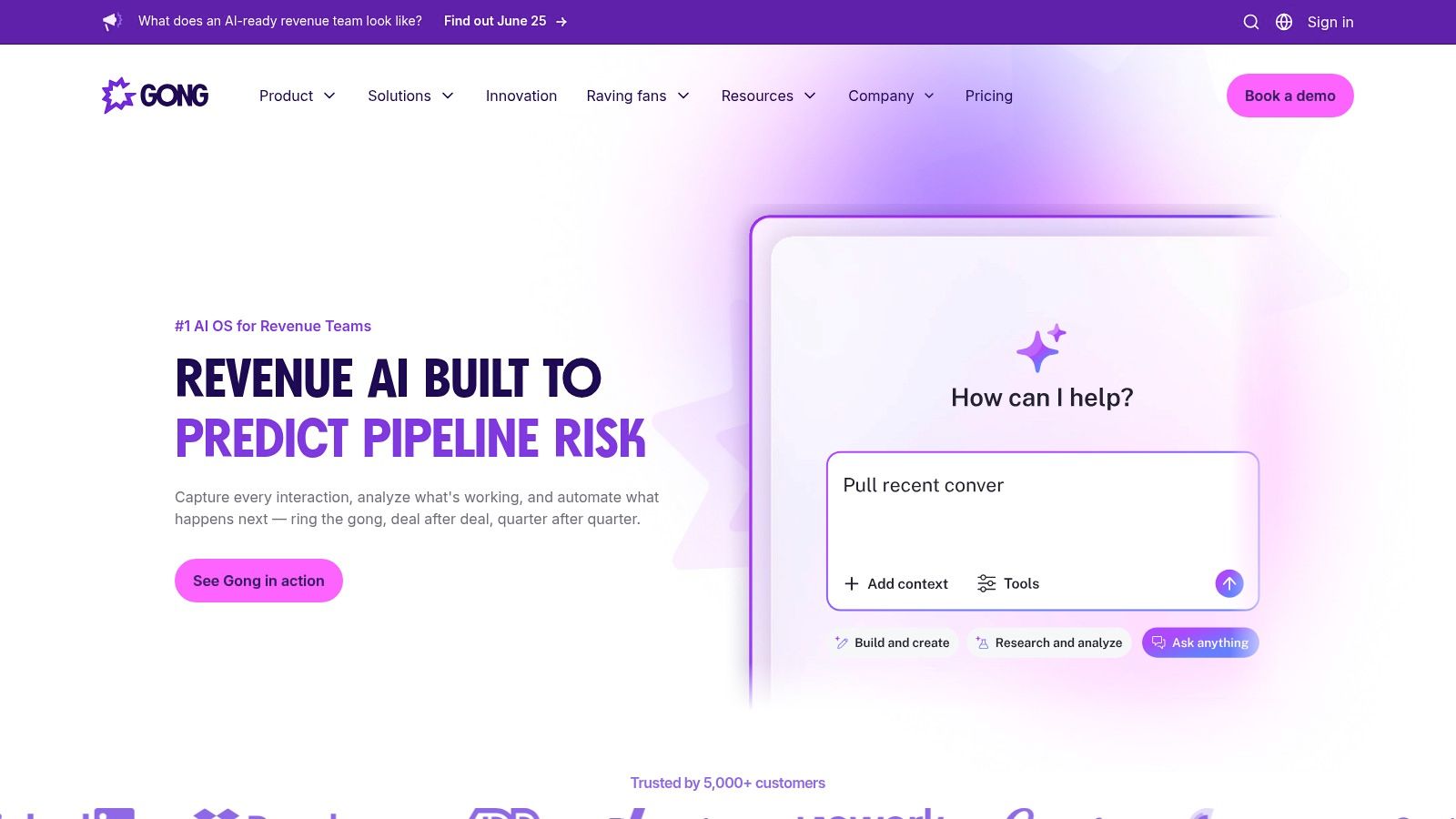
Gong belongs in the stack when leadership needs to inspect actual selling behavior instead of relying on CRM notes and manager opinion. If you run a team with enough call volume, Gong gives you a clean way to spot risk, coach reps, and standardize what “good” sounds like.
Teams get value fast. They stop arguing about anecdotal deal reviews and start listening to patterns across discovery, pricing, objection handling, and next-step control. That changes forecast conversations because managers are finally working from buyer language, not rep summaries.
Where Gong earns its seat
Gong is strongest when coaching is the bottleneck. If your reps are capable but inconsistent, call libraries and scorecards help managers coach with precision. That's especially useful if you're formalizing onboarding or tightening your sales enablement best practices.
Practical rule: Don't buy Gong if your team barely records calls. The platform needs recording volume and decent call hygiene to produce useful patterns.
The trade-off is simple. Gong is enterprise-oriented. Smaller teams can still use it, but the value drops if your motion is mostly email-led, founder-led, or low-call. If your pipeline quality problem starts before the first meeting, start elsewhere.
2. Clari (incl. Groove by Clari)
Forecast misses usually start as process problems, not rep effort problems. Clari earns its place when leadership needs a tighter grip on commit, upside, pipeline coverage, and inspection cadence across the whole revenue org.
That makes Clari a management tool before it becomes an AI tool.

Best fit for forecast discipline
Clari works best in teams that already run a real operating rhythm. RevOps owns definitions. Frontline managers review deals every week. Reps update close dates, next steps, and amount changes with some consistency. In that environment, Clari helps leadership spot slippage earlier and challenge forecast calls with more than rep confidence.
I like it most for growth-stage companies that have outgrown spreadsheet forecasting but are not ready to tolerate enterprise-level fog around the number. The ROI is usually management-side. Fewer surprise misses. Faster forecast calls. Better visibility into which deals are moving and which ones are just aging in place.
Groove by Clari can also make sense if you want engagement and revenue inspection under one vendor, especially if you're already thinking about how AI agents fit into a modern GTM workflow. The trade-off is straightforward. Buying both does not remove the need for process discipline.
Clari will not create rigor for a loose sales org. If stage exit criteria are vague, MEDDPICC fields are optional, and managers do deal reviews from memory, the platform mostly gives you a cleaner view of messy inputs.
Clari pays off when leadership is serious about inspection. It disappoints teams that expect software to fix weak pipeline hygiene on its own.
3. Salesloft
Salesloft still earns a place for outbound teams that need structure, governance, and manager visibility without turning the sales floor into chaos. I'd put it in the “serious sales engagement” bucket. It's good when your SDR or AE team already has a repeatable motion and needs scale.
The advantage is operational consistency. Cadences, multichannel execution, analytics, and CRM sync are mature. That matters more than flashy AI claims because sequence discipline usually breaks long before copy quality does.
Where Salesloft works best
Salesloft is a strong fit when your biggest issue is execution drift across reps and territories. The system gives leaders a way to standardize outreach while still leaving room for top performers to work their own accounts. For larger orgs, the admin controls are a real strength.
Here's the catch. AI doesn't rescue poor ICP definition. It just helps you run the wrong motion faster.
- Use Salesloft when: Your process is stable, reps need cadence discipline, and managers want better inspection.
- Skip it when: You're still figuring out who to target, how to message, or whether outbound should even be a core channel.
- Watch for: Tool overlap with your CRM, dialer, and call intelligence stack.
If you're earlier-stage and need data plus engagement in one place, Apollo often gets you moving faster.
4. Apollo.io
Apollo.io is the tool I'd pick first if a growth-stage team needs to get outbound running this quarter, not after a six-month stack project. It combines prospect data, sequencing, enrichment, a dialer, and basic AI workflows in one place, which cuts setup time and reduces the number of handoffs between RevOps and sales.
That matters most for teams with a clear ICP and a small ops bench. Apollo lets SDR leaders test segments, build lists, launch sequences, and inspect reply data without stitching together multiple vendors on day one.
Best use case for Apollo
Apollo fits best when speed and coverage matter more than perfect data control. I've seen it work well for companies that are still building outbound muscle and need one system for prospecting, outreach, and simple automation. It is also a practical option for teams evaluating a top platform to replace Zoominfo because the all-in-one model is easier to justify than a heavier enterprise contract.
The trade-off is real. Apollo can get noisy if your team treats volume as strategy. Credits disappear quickly across enrichment, exports, and AI actions, and data quality is uneven enough that enterprise reps should validate key accounts before they push contacts into sequences. That extra QA step adds work, but it is still usually faster than buying separate tools too early.
I would use Apollo when the priority is speed to pipeline, fast iteration, and decent enough data in one interface. I would not use it as the source of truth for a complex multi-region motion with strict governance requirements.
Apollo is strong for getting an outbound engine live fast. It is less convincing when your motion depends on tightly controlled data quality, territory rules, and cross-team governance.
5. ZoomInfo SalesOS (plus Copilot/Engage/Intent)
ZoomInfo is the tool I use when the problem is coordination, not just prospecting. Once sales, marketing, SDRs, and RevOps are all touching the same accounts, disconnected point tools start creating expensive mistakes. ZoomInfo earns its keep when you need one system to handle account selection, contact coverage, enrichment, intent signals, and execution rules across teams.
That does not make it the default choice.
ZoomInfo works best for growth-stage and enterprise teams that already have process discipline. If territories are messy, routing rules keep changing, and nobody owns data hygiene, buying SalesOS will not fix the operating model. It will give you more data, more workflows, and a bigger bill. The teams that get real ROI usually have a defined ICP, a functioning RevOps owner, and enough outbound volume to justify paying for coverage and orchestration in the same stack.
Where ZoomInfo makes sense
The strongest use case is a multi-team GTM motion where account priority needs to flow into execution. Intent data informs who to target. Copilot helps surface next actions. Engage gives reps a way to run outreach inside the same environment. In practice, that matters less because the AI is flashy and more because it cuts handoff delays between planning and execution. Teams exploring AI agent use cases for sales workflows usually end up here once they realize the hard part is not generating tasks. It is triggering the right action off shared account data.
The trade-off is overhead. ZoomInfo is expensive, add-ons stack up fast, and admins need to stay on top of governance or reps will burn credits and create list sprawl. I have also seen teams overestimate the value of intent unless they are clear on what should happen after a signal appears. If nobody is acting on those triggers within a defined playbook, intent becomes another dashboard people stop trusting.
If you're looking for a top platform to replace Zoominfo, the usual reason is straightforward. Your team either does not need this much infrastructure yet, or the contract cost is outrunning the pipeline impact.
I would use ZoomInfo for North America heavy teams running coordinated outbound and inbound motions across multiple roles. I would not start here if the company is still proving its ICP, running a lean SDR team, or trying to keep RevOps complexity low.
6. Cognism
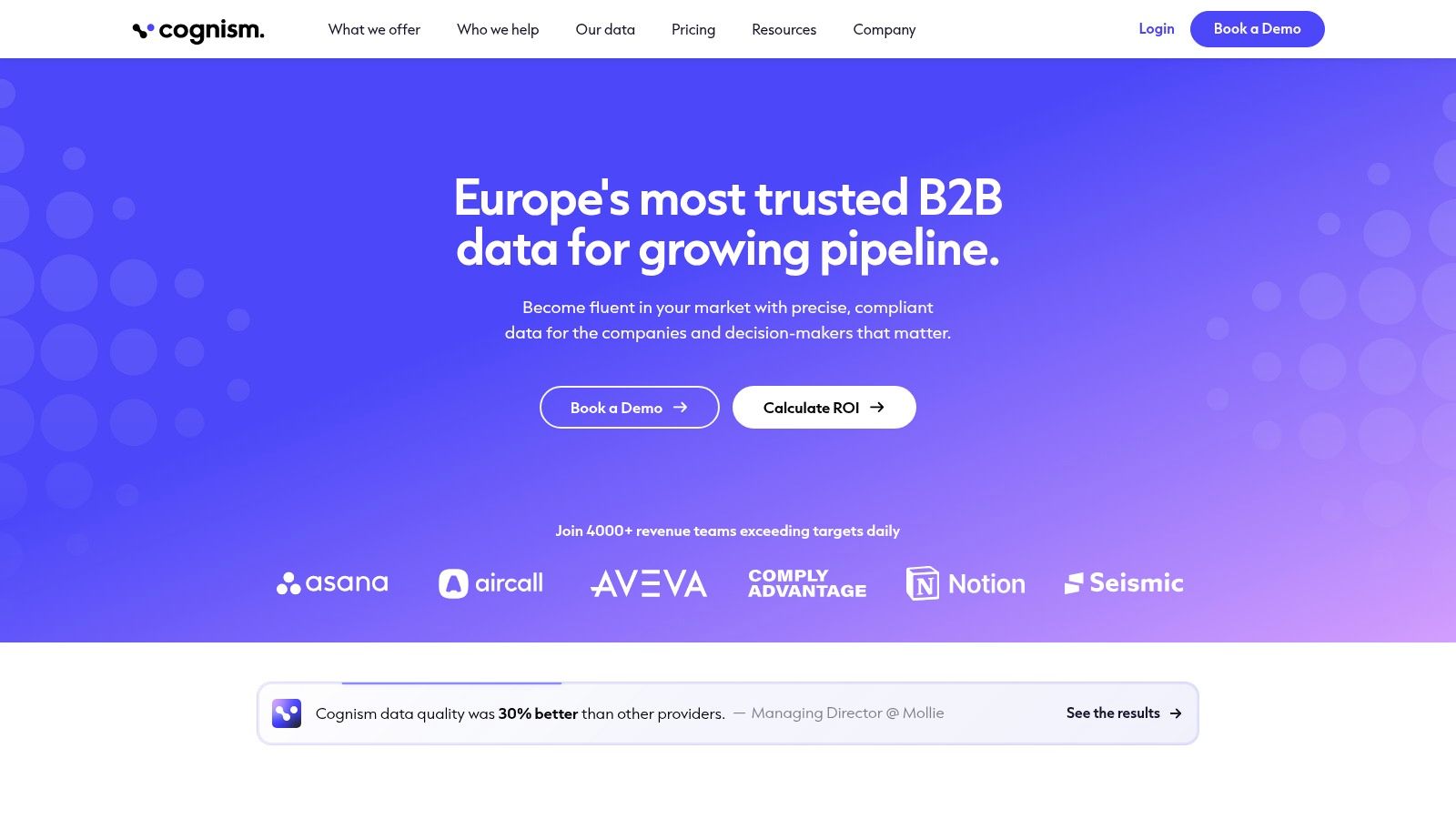
Cognism is the tool I'd put on the shortlist when the outbound motion is EMEA-heavy or privacy requirements carry real weight. U.S.-centric teams often underestimate how much friction shows up when they try to run one data strategy globally. Cognism usually handles that better than platforms built first for North America.
Its appeal isn't flashy. It's practical. Verified mobile data, enrichment, compliance posture, and usable search workflows matter if your reps need to hit people in regulated markets without creating a mess for legal and ops later.
Why Cognism wins specific markets
Cognism works best when the target market demands regional precision. If your SDR team spends too much time cross-checking records, fixing bad mobile numbers, or filtering out unusable data, the value is obvious. The platform also fits centralized data teams that want API or bulk delivery options.
The limitation is scale versus some U.S.-focused datasets. If your whole business is domestic and you mostly care about broad U.S. contact volume, other vendors may feel deeper. But if you're expanding in Europe, Cognism deserves serious consideration.
- Strong fit: EMEA prospecting, privacy-first orgs, and teams that care about data governance.
- Weak fit: Broad-brush U.S. outbound where volume matters more than regional nuance.
7. Regie.ai (RegieOne)

Regie.ai gets interesting when you want AI to do more than write drafts. RegieOne combines sequencing, intent/signals, research, enrichment, and dialing into a system that can expand rep coverage fast. That's different from a standard sales engagement platform.
I like it most for teams trying to push toward AI-led orchestration. If your SDRs still spend too much time stitching together data providers, writing first touches, and manually routing who gets worked next, Regie can shrink that operational drag.
Where RegieOne can move faster
The importance of agentic systems becomes clear. The workflow value isn't just “write me an email.” It's deciding which accounts to work, what signal matters, how the sequence adapts, and how the rep steps in at the right moment. That's why Regie often comes up in conversations about practical AI agent use cases for revenue teams.
Regie is strongest when speed and coverage are the problem. It's weaker if your domains, inboxes, and deliverability setup are sloppy.
That last point matters. Teams often blame the tool when email infrastructure is the issue. Regie performs best when domain strategy, mailbox health, and sequence governance are already under control.
8. Qualified

Qualified is one of the clearer answers for inbound acceleration inside a Salesforce-heavy company. If you already drive meaningful site traffic and your handoff between website, SDRs, and AEs is messy, Qualified can tighten that path.
I don't see it as a universal AI SDR. I see it as an inbound conversion tool with strong Salesforce gravity. That's an important distinction because the value depends heavily on your existing CRM, reporting setup, and website pipeline motion.
Best use case for Qualified
Qualified is a good fit for product-led and demo-led companies that need immediate response on high-intent visits. The AI SDR model helps route, book, and nurture without forcing a human SDR to monitor every conversation live. For growth teams working on CRO with AI, that direct handoff from buying signal to booked conversation is where the platform earns its keep.
What doesn't work is buying it before the basics are in place. If your traffic quality is weak, your routing rules are unclear, or your Salesforce setup is inconsistent, the tool won't rescue the funnel. It needs a clean inbound process and clear ownership.
I'd also think about agent commerce readiness here. As buyer journeys get more AI-mediated, your inbound layer needs to answer and route intent faster, with cleaner context than a standard chat widget.
9. Lavender

Lavender is one of the few tools in this category that I'd call easy to justify for a smaller team. It focuses on one thing: helping reps write better outbound emails faster. That narrow scope is a benefit, not a weakness.
The broader adoption trend helps explain why tools like this spread quickly. Generative AI use in marketing and sales grew from 33% in 2023 to 71% in 2024, according to the GetAlai benchmark summary. Once teams start using AI for drafting, coaching inside the inbox becomes the next logical step.
When Lavender pays back fast
Lavender works best when the team is email-heavy and managers need a lightweight way to improve message quality without redesigning the whole stack. Reps get real-time scoring, readability guidance, and personalization nudges inside Gmail or Outlook. That creates fast behavior change.
The limitation is obvious. It won't fix bad targeting, weak offers, or broken deliverability. It also doesn't replace a real outbound system. It's a writing and coaching layer.
- Best for: Small to mid-size teams with heavy email volume.
- Less useful for: Call-led teams or companies where outbound volume is already tightly managed inside a larger engagement platform.
- Worth watching: Whether reps follow the coaching or just use it to produce polished filler.
10. Clay
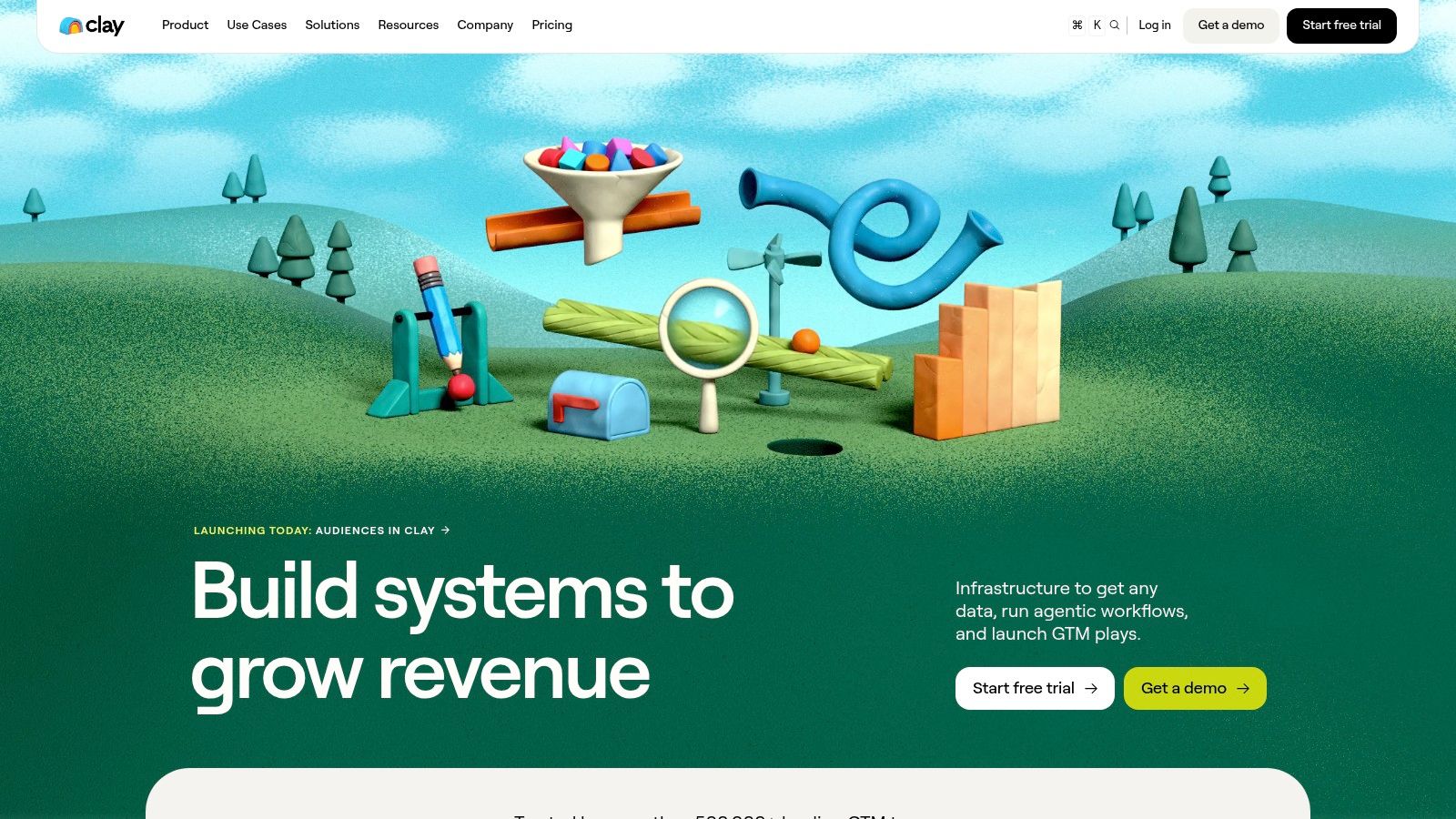
Clay is my favorite tool in this list for GTM engineering. It's not the easiest. It's often the most useful. If your team wants custom enrichment waterfalls, AI research, signal-based segmentation, and outbound workflows designed for your exact motion, Clay gives you that control.
Many "best AI sales tools" lists miss the point here. The tool itself isn't the edge. The workflow is. Clay is valuable because it lets operators design that workflow instead of accepting a vendor's default logic.
Why Clay is a builder's tool
Clay rewards teams that think in systems. If you want to pull from multiple data sources, create custom fields from web research, sync into CRM, and feed outreach or ad audiences from one logic layer, it's excellent. That makes it especially useful for Stimulead-style work in GTM engineering and AI search optimization, where enrichment logic often needs to reflect how modern buyers and AI agents evaluate vendors.
The trade-off is complexity. Clay can eat time if no one owns the build. This is not a set-it-and-forget-it tool.
The best Clay setups look like internal products. Someone owns the logic, the data sources, the QA, and the handoff into outreach.
That's why it shines in advanced teams and frustrates casual users.
Top 10 AI Sales Tools: Side-by-Side Comparison
No tool on this list is "best" in the abstract. The best one is the one that removes the biggest bottleneck in your sales motion without creating two new admin problems.
I use this kind of comparison to make stack decisions by function first, not by logo. If forecasting is weak, buy for forecast discipline. If reps are wasting hours building lists, buy for data and prospecting. If inbound speed is the issue, buy for conversion and routing. That framing matters because several of these platforms overlap, and overlap is where SaaS waste starts.
| Tool | Core focus | Best for | Where it fits best | Pricing / Considerations |
|---|---|---|---|---|
| Gong | Conversation intelligence, call review, coaching, deal inspection | Larger sales teams that need better manager inspection and rep coaching | Best when call volume is high enough to support repeatable coaching and forecast review | Enterprise pricing. Sales call required. ROI depends on adoption by managers, not just reps |
| Clari (incl. Groove) | Forecasting, pipeline inspection, revenue operations, sales engagement | RevOps-led orgs that want one system for forecast control and rep execution | Strong fit for teams standardizing forecast process across leadership and frontline managers | Quote-based pricing. Implementation can be heavy. Process discipline is required |
| Salesloft | Sequencing, rep workflows, conversation insights, CRM coordination | Outbound teams that need a proven engagement layer with admin control | Strong fit when governance, workflow consistency, and manager visibility matter | Contact sales for pricing. Works better with clean data and a defined ICP |
| Apollo.io | Prospecting database, enrichment, sequencing, dialer, AI assistance | Growth-stage teams that need broad outbound coverage at a lower starting cost | Good first platform for teams consolidating point solutions into one outbound system | Credit-based pricing. Watch overages. Data quality can vary by segment |
| ZoomInfo SalesOS | Data, intent, engagement, Copilot support | Mature teams that want scale, coverage, and one major data vendor | Best for teams that can operationalize intent and support a larger annual spend | Often expensive. Annual contracts are common. No public pricing |
| Cognism | B2B data, verified mobiles, compliance-oriented enrichment | EMEA-focused teams and buyers with stricter privacy requirements | Good fit when mobile accuracy and regional coverage matter more than sheer database size | Quote-based pricing plus credits. U.S. coverage is often narrower than top domestic vendors |
| Regie.ai (RegieOne) | AI-led prospecting, sequencing, enrichment, dialing | Teams pushing toward agent-assisted outbound execution | Best for teams that want automation across research, messaging, and execution in one workflow | Annual contracts and seat minimums are common. Dialer costs extra |
| Qualified | AI SDR for website conversion, chat, voice, routing, follow-up | Inbound-heavy and product-led teams with Salesforce at the center | Best when site traffic is strong and speed-to-meeting directly impacts pipeline | Custom pricing. Value is highest in Salesforce-centric teams |
| Lavender | Email coaching, inbox-side writing support, analytics | Teams trying to improve email quality fast without a major systems project | Good tactical add-on when reply rates suffer because messaging quality is inconsistent | Published per-seat pricing and free tier. Narrow scope compared with platform buys |
| Clay | Workflow building, enrichment waterfalls, AI research, list logic | GTM operators and advanced outbound teams building custom systems | Best when your edge comes from workflow design, not vendor defaults | Clear tiers. Usage depends on action and data credits. Requires an owner |
A few buying patterns show up fast in practice. Gong and Clari usually win budget when leadership wants tighter forecast calls and better deal inspection. Apollo, ZoomInfo, and Cognism compete around data quality, coverage, and cost structure. Salesloft and Regie sit closer to execution. Qualified owns a different lane entirely if inbound conversion is the primary revenue constraint.
The mistake is buying two tools for the same job and calling it optionality. For a growth-stage team, the better move is usually one system per core function, then a deliberate add-on only where the ROI is easy to measure.
Your Next Step Run a GTM Stack Audit
The right tool depends on your team's maturity, primary motion, and biggest bottleneck. Tool selection should start with workflow diagnosis, not vendor demos. I'd map the full path from lead capture to closed-won and inspect where reps still spend manual time, where handoffs fail, and where managers are making decisions from incomplete data.
That usually exposes the first purchase fast. Some teams need conversation intelligence because coaching and forecast judgment are weak. Others need a data and prospecting layer because reps still build lists by hand. Others need an inbound agent because high-intent traffic sits on the site too long before anyone responds.
The market is moving fast, but that doesn't mean your stack should grow fast. In 2025, 83% of sales teams using AI sales platforms reported revenue growth in the previous year, compared with 66% of teams that did not adopt them, according to the industry data provided above. Early adopters also saw win rate improvements of 30% or more, while lead follow-up times were reduced by up to 60%. Those gains come from implementation and adoption, not from collecting logos in the tech stack.
I'd pilot one tool in one high-friction part of the motion. Set the KPI before rollout. Track time recovered, meeting volume, pipeline creation quality, conversion rate movement, and forecast confidence. If you can't describe the operating change in one sentence, the pilot is too vague.
There's another reason to treat this as a stack audit instead of a buying exercise. Too many teams still ignore AI search optimization and agent commerce readiness. That's a mistake. Industry data in the planning set says 70% of B2B buyers now use AI agents to research vendors before engaging humans, and most mainstream sales stacks still assume a human-first buying journey. If your site, content, and outbound signals aren't prepared for AI-mediated discovery, your sales team will feel pipeline loss before marketing can explain it.
I'd also pressure test implementation risk early. The planning set notes 65% of AI initiatives fail to scale due to poor workflow integration rather than tool capability. That matches what I see in the field. The failure point usually isn't the model. It's ownership, process, CRM hygiene, or unclear KPIs.
If you want a practical starting point, review your current workflow and compare it against a broader guide to lead automation. Then pick one gap to fix. If you need a partner to run that audit, evaluate vendors, and build a board-ready AI roadmap around CRO with AI, GTM engineering, AEO, and agent commerce readiness, that's exactly what we do at Stimulead.
Samuel J. Woods leads Stimulead, a fractional Chief AI Officer advisory that helps growth-stage teams apply AI where it directly affects revenue. That includes CRO with AI, GTM engineering, AI search optimization, and agent commerce readiness.