
Most advice on GTM says the same thing. Hire a few more SDRs, tighten messaging, buy another data tool, and push harder on outbound.
That advice breaks the moment you need scale without a matching jump in payroll and management overhead. More reps usually means more list building, more CRM cleanup, more sequence maintenance, and more variance between top performers and everyone else. You get activity. You don't always get a system.
GTM engineering changes the operating model. It treats pipeline creation as an engineered system with inputs, logic, outputs, and diagnostics. That means buying signals flow into enrichment, routing, personalization, and outbound execution through automation instead of manual handoffs. The question isn't only what is GTM engineering. The better question is whether your next dollar should fund another rep or build infrastructure that keeps producing pipeline after the campaign ends.
For growth-stage teams, that is a P&L decision. It also sets up everything else leaders now care about in AI, from faster testing in CRO to structured data for AI search optimization and eventual agent commerce.
Table of Contents
- Stop Hiring SDRs Build a Revenue Engine Instead
- GTM Engineering vs Traditional GTM Strategy
- The Four Core Components of a GTM Engine
- The Role of GTM Engineering in AI Driven Growth
- Measuring Success with GTM Engineering KPIs
- A Phased Roadmap to Implementation
- Your GTM Engineering Readiness Checklist
Stop Hiring SDRs Build a Revenue Engine Instead
Most revenue teams still scale pipeline the old way. Add SDRs. Add managers. Add tools around them. Then accept that output rises and falls with rep quality, training, and daily discipline.
That model is linear. If you want more meetings, you usually need more people.
GTM engineering gives you a different cost structure. It designs systems that turn buying signals into revenue motion by combining RevOps, marketing ops, data engineering, and prompt engineering into one operating layer, as described in ZoomInfo's explanation of GTM engineering as an engineering problem. In practice, that means intent detection, enrichment, routing, CRM updates, and outbound execution run as one connected system.
The economic case is why this matters. OneAway states that GTM engineering replaces manual SDR prospecting with automated, signal-driven systems that detect intent, enrich prospects, and trigger personalized outbound, delivering 40 to 60 meetings per month at 60% lower CAC than traditional SDR teams in its write-up on signal-driven GTM engineering. That's the kind of comparison leadership teams need.
The hidden cost of the SDR-first model
Manual prospecting creates operational drag in places executives don't always see:
- List quality decays fast: Reps build lists once, then work stale records.
- Routing breaks undetected: Leads hit the CRM, but ownership rules and field mappings fail downstream.
- Personalization gets faked: Teams call it customized outreach when it's really light token replacement.
- Managers become workflow operators: Sales leaders spend time fixing process gaps instead of coaching deals.
One of the first places this breaks is CRM sync. If email activity doesn't write back cleanly, attribution gets messy and follow-up logic degrades. A practical resource on this specific problem is OutboundXYZ's guide on connecting email to CRM, because the outbound engine fails fast when communication data sits outside the system of record.
Practical rule: If pipeline depends on reps manually moving data between tools, you don't have a revenue engine. You have labor covering for system debt.
This is also why AI underperforms in weak GTM systems. Teams buy AI writing tools before they fix the data and orchestration layer underneath. If you're already working on AI for B2B marketing, GTM engineering is the piece that turns AI from content assistance into pipeline production.
GTM Engineering vs Traditional GTM Strategy
Leaders often lump GTM engineering into RevOps, sales ops, or standard growth strategy. That's where confusion starts. Traditional GTM strategy defines target markets, messaging, channels, and team motions. GTM engineering builds the systems that execute those motions repeatedly with less manual effort and better diagnostics.
RevOps usually governs process. GTM engineering builds the machine.
The operating difference
A traditional SDR model centers on human activity. Reps research accounts, pull contacts, write copy, enroll leads, update CRM fields, and chase handoffs. GTM engineering centers on system behavior. Data sources, APIs, enrichment rules, AI prompts, and sequencing logic carry most of the repetitive load.
DealHub describes GTM engineering as the application of software engineering principles such as modularity, scalability, and reliability to revenue execution in its definition of engineered revenue systems. That framing matters because it changes how leadership should evaluate the function. You stop asking, "How many calls did the team make?" and start asking, "Where did the workflow fail?"
GTM Engineering vs. Traditional SDR Model
| Attribute | Traditional SDR Model | GTM Engineering Model |
|---|---|---|
| Scaling model | Add headcount to add output | Add workflows, data coverage, and orchestration |
| Core work | Manual list building, outreach, follow-up | Signal detection, enrichment, routing, automation |
| Primary dependency | Rep skill and manager oversight | Data quality, workflow logic, system reliability |
| Personalization | Written by reps, varies widely | Generated from structured signals and rules |
| CRM role | Record of activity after the fact | Active control layer for routing and lifecycle state |
| Failure mode | Low activity, rep inconsistency, missed follow-up | Broken data flows, weak logic, poor signal quality |
| Management focus | Hiring, coaching, compliance | Architecture, testing, diagnostics, optimization |
| Main KPI orientation | Activities and rep output | System efficiency and pipeline contribution |
Why RevOps alone won't close the gap
Revenue Operations Alliance describes GTM engineering as a hybrid discipline with responsibilities across data orchestration, workflow automation, system integration, experimentation governance, and performance measurement in its overview of the GTM engineer role. That's broader than classic process administration.
A team can have excellent RevOps and still move too slowly because nobody owns workflow shipping velocity. That's the difference I see most often. RevOps can document lifecycle stages and clean fields. GTM engineering turns those rules into active automations that route, enrich, personalize, and trigger next actions without waiting on manual intervention.
RevOps keeps the system orderly. GTM engineering makes the system produce.
When executives ask what is GTM engineering, the cleanest answer is this: it is the build function for revenue infrastructure.
The Four Core Components of a GTM Engine
A GTM engine works when four layers connect cleanly. Remove one, and the rest starts to slip. You don't need the flashiest stack. You need architecture that can take a signal, verify it, act on it, and report what happened.
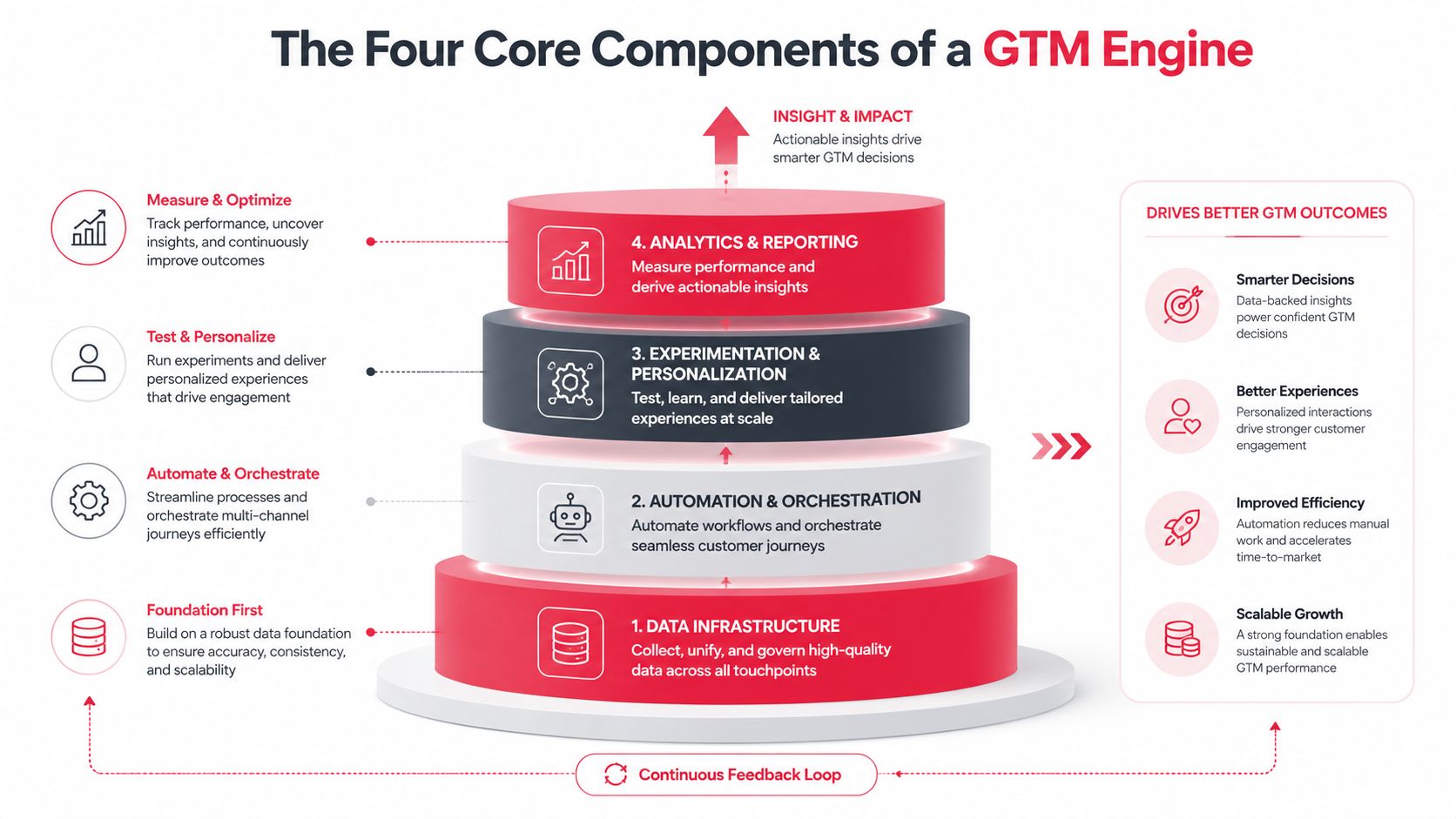
Data and signal intelligence
This is the fuel. If account, contact, and intent data are fragmented or unreliable, every downstream workflow suffers.
The first job is to define what counts as a usable signal. That could be website intent, enrichment coverage, inbound form data, product usage, job changes, or account-fit criteria. The point isn't collecting everything. The point is deciding which inputs should trigger action.
Norwest lays out five technical domains a GTM engineer executes in its article on what a GTM engineer does: pipeline automation, CRM architecture, outbound infrastructure, GTM analytics, and AI-native GTM. In the field, those start with disciplined data inputs.
The tooling stack
Tools matter less than the contract between them. CRM, enrichment, orchestration, and sequencing each need a clear role.
A practical stack usually includes:
- CRM as system of record: Salesforce or HubSpot holds lifecycle state, ownership, and account history.
- Enrichment layer: Clay, Apollo, ZoomInfo, or other providers fill missing company and contact data.
- Orchestration layer: Make, Zapier, n8n, or custom scripts move data and trigger actions.
- Sales engagement layer: Outreach, Salesloft, Apollo, or Smartlead handle sequencing and response workflow.
If two tools can enroll the same contact, expect duplicate outreach. If the CRM isn't the source of truth for lifecycle state, expect routing conflicts.
A quick visual helps when you're mapping these dependencies:
Workflow logic and automation
This is the brain. Good workflow logic answers five questions in sequence:
- Did a real signal occur
- Is the account in scope
- Do we have enough verified data to act
- What should happen next
- How do we prevent duplicate or conflicting actions
Waterfall enrichment, lead scoring, routing logic, deliverability controls, and AI-assisted research are integral components. The workflow should run unattended most of the time. Humans step in for exceptions, approvals, and live conversations.
Measurement and feedback loops
Many teams track campaign results. Fewer teams track system health. They should.
Watch for breakpoints such as enrichment failure, routing mismatch, sequence enrollment collisions, missing CRM write-back, and low signal-to-action speed. Those are engineering issues, not sales motivation issues.
A GTM engine fails in predictable places. If you can't name those places, you can't fix them fast.
The Role of GTM Engineering in AI Driven Growth
AI gets too much credit for outputs and too little scrutiny for inputs. If your CRM data is incomplete, your signal layer is weak, and your routing logic is inconsistent, AI will produce faster nonsense.
GTM engineering is what makes AI usable in revenue teams. It gives models structured data, workflow context, and execution paths. Without that, AI stays trapped in drafts, summaries, and disconnected assistants.
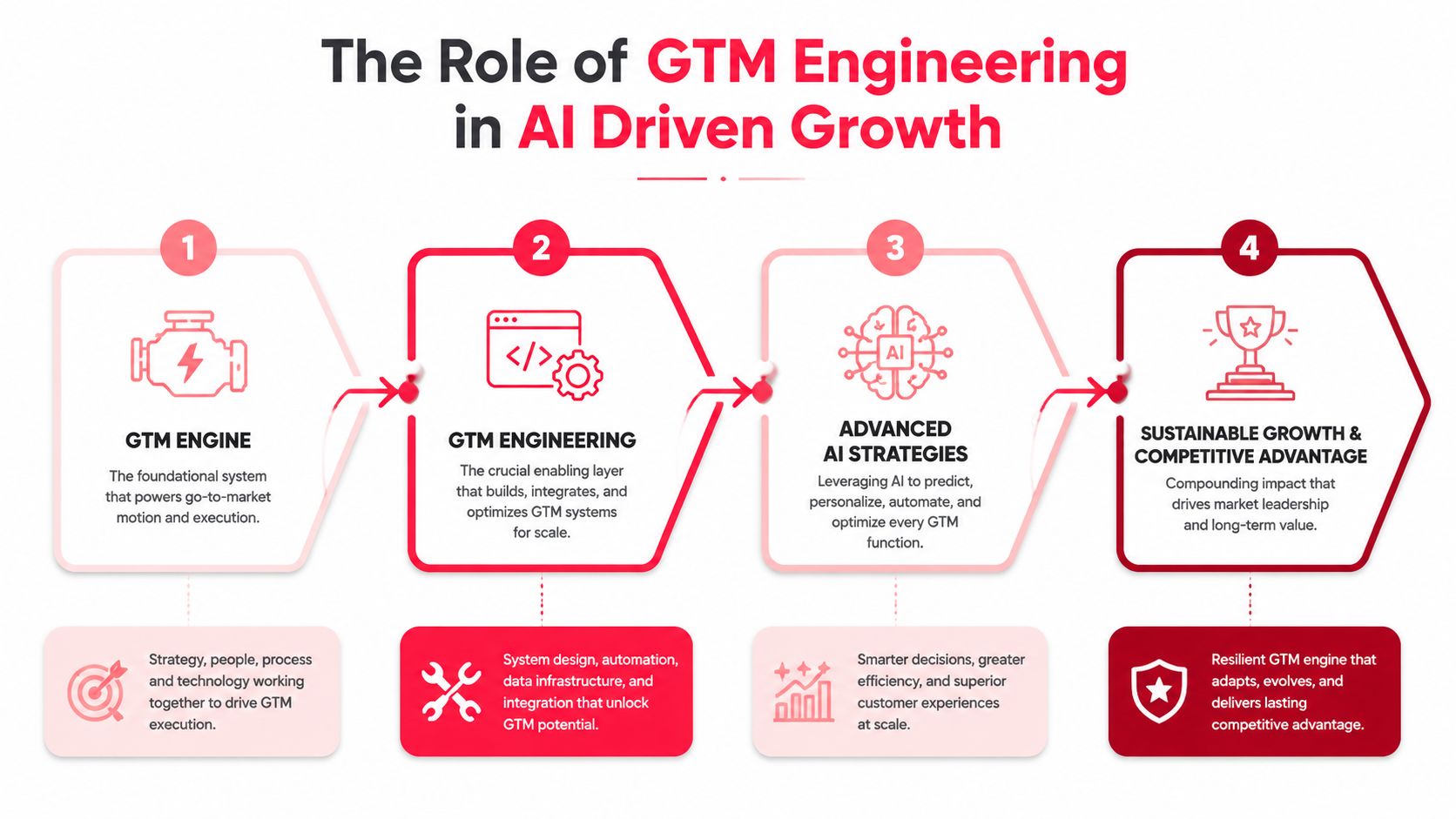
AI needs clean structure
The fastest way to waste an AI budget is to deploy models into a broken process. I see this in outreach teams all the time. They ask AI to write better emails when the underlying problem is poor account selection, bad contact coverage, and no clear next-action logic.
AI-driven CRO has the same dependency. Faster experimentation only works when event tracking, conversion definitions, and audience data are reliable. The same applies to sales enablement. If you're refining handoffs and rep workflows, Stimulead's guide to sales enablement best practices is relevant because enablement improves when systems carry context automatically instead of forcing reps to gather it manually.
A related use case is lifecycle messaging. Teams automating onboarding, expansion, or reactivation should study operational patterns like Mara's article on automating SaaS lifecycle emails, because these flows depend on event triggers and structured data in the same way outbound and routing do.
From AI workflows to agent commerce
The next shift is bigger than AI-generated copy. GTM engineering is moving toward agent orchestration. According to GTM AI, 42% of revenue leaders expect AI agent orchestration to dominate by 2027, where autonomous agents execute the buyer journey, as noted in its article on the shift toward AI agent orchestration. That's a projection, but it's a useful one.
For leadership, this changes the build priority. Systems need APIs, consistent object models, clear business rules, and machine-readable product and pricing data. Those requirements also matter for AI search optimization and AEO. If you want AI systems to understand your company, route demand correctly, and eventually transact on a buyer's behalf, your GTM stack has to expose clean signals and actions.
The same foundation supports agent commerce readiness. An agent can't book, buy, renew, or route a request through your revenue process if your workflow depends on spreadsheet exports and human memory.
The companies that win with AI won't be the ones with the most prompts. They'll be the ones with the cleanest systems behind those prompts.
Measuring Success with GTM Engineering KPIs
Activity metrics don't tell you if the engine is healthy. Dials, emails sent, and sequence enrollments can all rise while economics get worse. GTM engineering needs a different scorecard.
Drli reports that organizations implementing effective GTM engineering achieve 10x lower meeting generation costs, reduce sales cycles by 20%, and improve win rates by 50% in its analysis of GTM engineering and sales transformation. Those are business outcomes. Your dashboard should explain where they come from.
Track efficiency, not rep activity
Use KPIs that reveal system performance:
- Cost per qualified meeting: Total GTM program cost ÷ qualified meetings created. This tells you whether automation is producing cheaper pipeline than labor-heavy prospecting.
- Pipeline velocity: Value of qualified pipeline created over a defined period, tracked alongside stage progression time. This shows whether workflows move deals faster.
- Engineering-sourced revenue contribution: Closed-won revenue tied to workflows that originated from automated signals, routing, or outbound sequences.
- Automation rate: Share of GTM actions completed without manual handling. Examples include enrichment, routing, sequence enrollment, and lifecycle updates.
- Signal-to-action time: Time between a qualifying signal and the first correct system response.
These are easier to defend in board conversations because they tie operating mechanics to revenue output.
Build a dashboard a CFO will trust
A strong GTM dashboard combines commercial metrics with operational diagnostics. I usually want one layer for leadership and one for operators.
Leadership view
- Meeting economics: Cost per qualified meeting and trend direction.
- Pipeline movement: Velocity through core stages.
- Outcome quality: Win rate by source or workflow family.
Operator view
- Enrichment coverage: Where records are failing to complete.
- Routing accuracy: Whether ownership and territory logic are firing correctly.
- Execution health: Failed automations, duplicate enrollments, and missing CRM write-backs.
For teams tightening the measurement model, Grou has a useful reference on lead generation KPIs. The value isn't copying a list. It's making sure your dashboard separates business impact from busywork.
A Phased Roadmap to Implementation
Most companies shouldn't start with a full-stack rebuild. Start where pipeline is leaking, then build outward. GTM engineering works best as a staged implementation with visible operational gains in each phase.
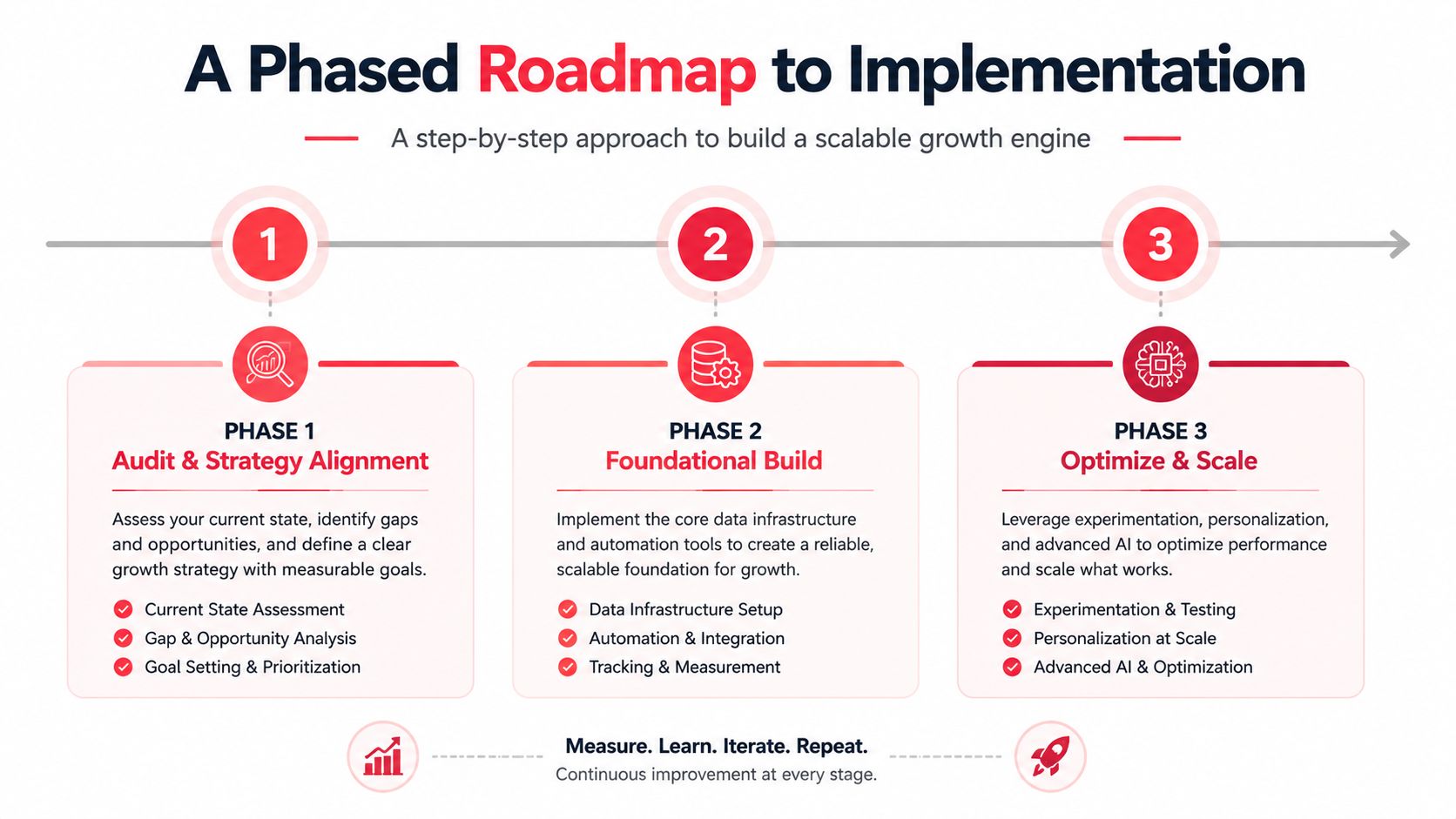
ZoomInfo defines GTM engineering as the discipline of designing systems that turn buying signals into revenue motion by blending RevOps, marketing ops, data engineering, and prompt engineering in its article on turning buying signals into revenue motion. That mix is why phased rollout matters. You're changing process, data, and execution at the same time.
Phase 1 audit and strategy alignment
Start with the current system, not the desired stack.
Map how leads enter, where accounts are enriched, how ownership is assigned, where lifecycle stages change, and which triggers should create action. Then inspect the obvious failure points. Duplicate records. Missing firmographics. Inconsistent stage definitions. Disconnected outbound tools. Slow or manual routing.
This phase should answer a few hard questions:
- Is ICP logic queryable: Can the team define the target account in fields and rules, or only in slide-deck language?
- Is the CRM trusted: Will sales, marketing, and finance accept it as the operating record?
- Is one workflow worth fixing first: Usually inbound routing, signal-based outbound, or lifecycle automation.
Phase 2 foundational build
Pick one workflow with clear commercial value and enough repetition to justify automation.
Good first builds include lead enrichment before routing, account scoring tied to sequence enrollment, or trigger-based outbound from intent signals. Wire the tools, define the data contract, set exception handling, and make sure write-back to the CRM is clean.
This is where ownership matters. Someone needs authority across RevOps, sales, and marketing systems. In some organizations that person is in-house. In others, an external partner handles the build. For example, Stimulead offers a focused audit on one GTM workflow as part of its AI advisory work, which is useful when a team needs architecture and implementation oversight without adding a full-time role.
Build one workflow that saves time and creates pipeline. Then prove it in the dashboard.
Phase 3 optimize and scale
After the first workflow is stable, expand carefully.
Add richer signal inputs. Improve prompt logic for personalization. Extend automation to expansion, reactivation, handoff management, and attribution. Then introduce AI where structured data already exists and where the model has a clear job.
At this point, the GTM engine starts compounding. New workflows launch faster because the core data and orchestration layers are already in place.
Your GTM Engineering Readiness Checklist
A company is ready for GTM engineering when leadership is willing to treat pipeline generation like a system build. That means trade-offs, owners, diagnostics, and operating discipline.
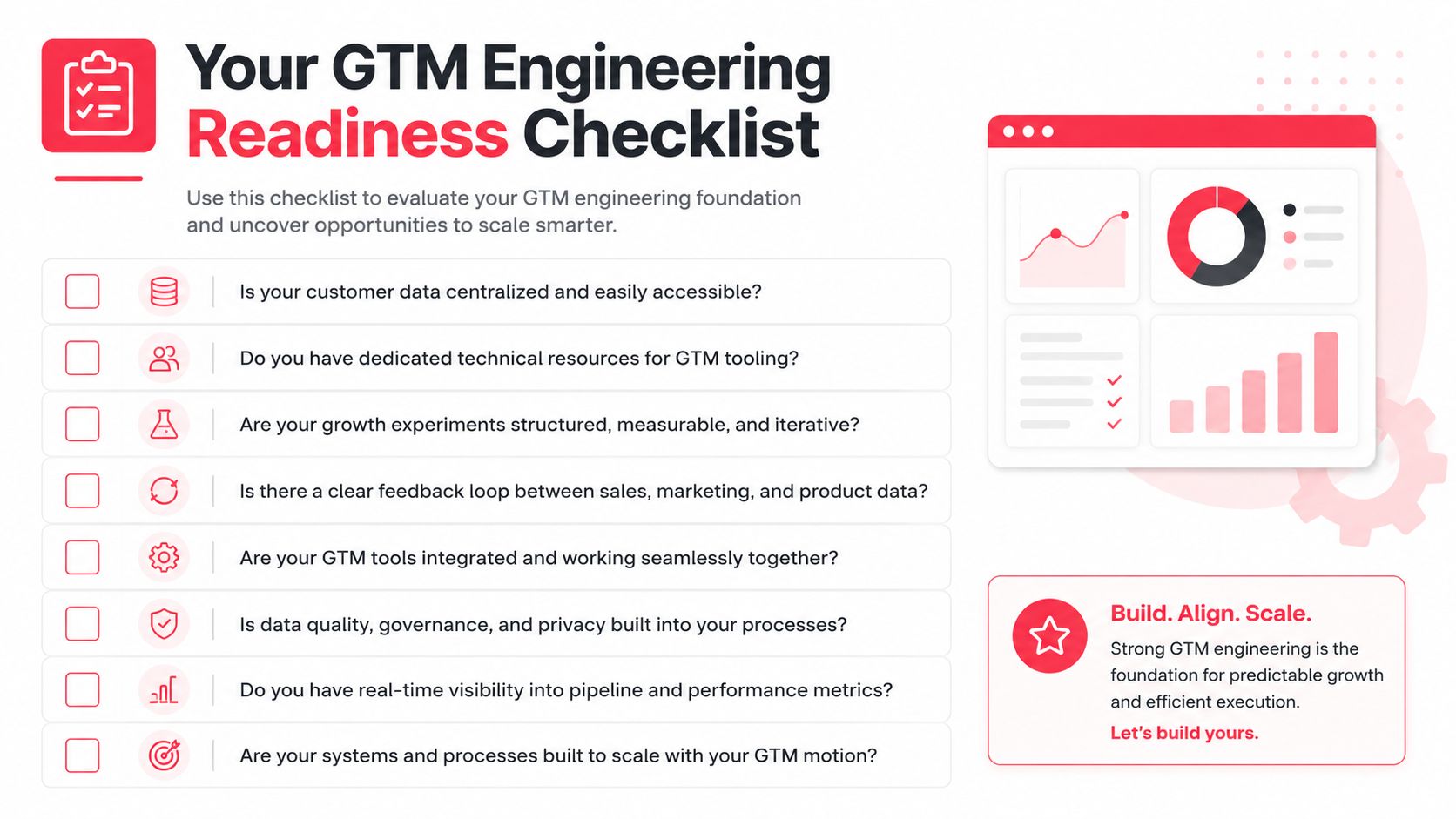
Run through these questions with your CEO, CRO, CMO, and RevOps lead:
- Is your ICP defined in data fields and rules: If the answer lives in narrative docs, automation will drift.
- Can you track a lead from first touch to closed-won cleanly: If attribution breaks, ROI arguments will stay weak.
- Does your CRM control lifecycle state: If other tools override stages or ownership, system logic will conflict.
- Can your team name the top workflow failures right now: If nobody knows where records, routing, or handoffs break, fixing them will be slow.
- Do you have technical ownership for GTM systems: Someone needs to own enrichment logic, integrations, prompts, and QA.
- Are your outbound and lifecycle tools writing back to the CRM reliably: If not, your data layer will decay.
- Can you test one workflow without reorganizing the whole team: Fast wins matter more than broad plans.
If several answers are no, don't buy more AI tools yet. Start with readiness. A formal AI readiness assessment helps surface the gaps before you commit budget to software, services, or new hires.
If you want a practical next step, audit one revenue workflow this week. Pick the one that touches pipeline earliest and breaks most often. Document the inputs, tools, owners, outputs, and failure points. Then decide whether the next investment should be another SDR seat or the system that makes every seat more productive.