
A few months ago, your team probably saw the pattern before you did. A non-branded query that used to bring in qualified demos stopped behaving like a normal search term. Google inserted an AI Overview at the top. Your page might still rank well, but the click path changed. Buyers now get their shortlist from the summary first.
That's the shift. Your new competitor for discovery isn't the company you track in Gong calls or deal reviews. It's the source Google decides to cite inside the answer itself. Sometimes that source is a smaller blog with better structure, clearer claims, and tighter topical coverage.
If you want to know how to rank in Google AI Overviews, treat this as a revenue system, not an SEO side quest. AEO sits inside GTM engineering now. It shapes who gets mentioned, who gets trusted, and who gets the first shot at buyer attention before a prospect ever lands on your site.
Table of Contents
- Your New Top Competitor Is Google Itself
- Shift from Keywords to Criterion Ownership
- Architect Content for AI Ingestion
- Build Verifiable E-E-A-T Signals
- The AEO Testing and Measurement Framework
- Your AEO Implementation Checklist
Your New Top Competitor Is Google Itself
The board doesn't care that your organic rank held. They care that pipeline from discovery terms got weaker. Once Google answers the question in the SERP, your content has to earn a citation before it can earn a click.
That changes how you allocate budget. You're no longer optimizing pages only for rank. You're optimizing for inclusion inside the answer layer that sits above the ranking layer.
This is a revenue problem first
When AI Overviews appear on high-intent informational terms, they reshape category education. That matters because informational queries often sit early in buying cycles where vendor preference starts forming. If your company isn't present in the summary, another company is setting the frame for what “best” means in your market.
For CEOs and CMOs, the operational consequence is simple:
- Content teams can't publish broad thought pieces and hope authority carries them.
- Demand gen teams can't judge performance on sessions alone.
- RevOps and GTM leaders need to map AI Overview visibility to assisted pipeline, branded search lift, and sales call context.
Google now mediates the first draft of the buyer's understanding. If your company isn't cited there, you're reacting to someone else's narrative.
This is why I treat AEO as part of the same system as CRO with AI, GTM engineering, and agent commerce readiness. The output isn't “more content.” The output is a machine-readable body of evidence that helps Google choose your page as a source.
Smaller players can beat larger brands
Large brands still have distribution, but AI Overviews often reward the page that answers the exact question with the least friction. The teams adapting fastest are the ones that tighten the structure, define a clear category claim, and publish usable evidence in formats machines can parse.
If you're reworking your editorial system anyway, these RepurposeYourContent insights are useful because they push toward modular content operations instead of one-off blog production. That's the right model for AEO. You need reusable claim blocks, evidence blocks, FAQs, and derivative formats that reinforce the same criterion across channels.
Shift from Keywords to Criterion Ownership
The companies that win AI Overviews don't obsess over keyword density. They own the criterion the model keeps reaching for when it summarizes the category.
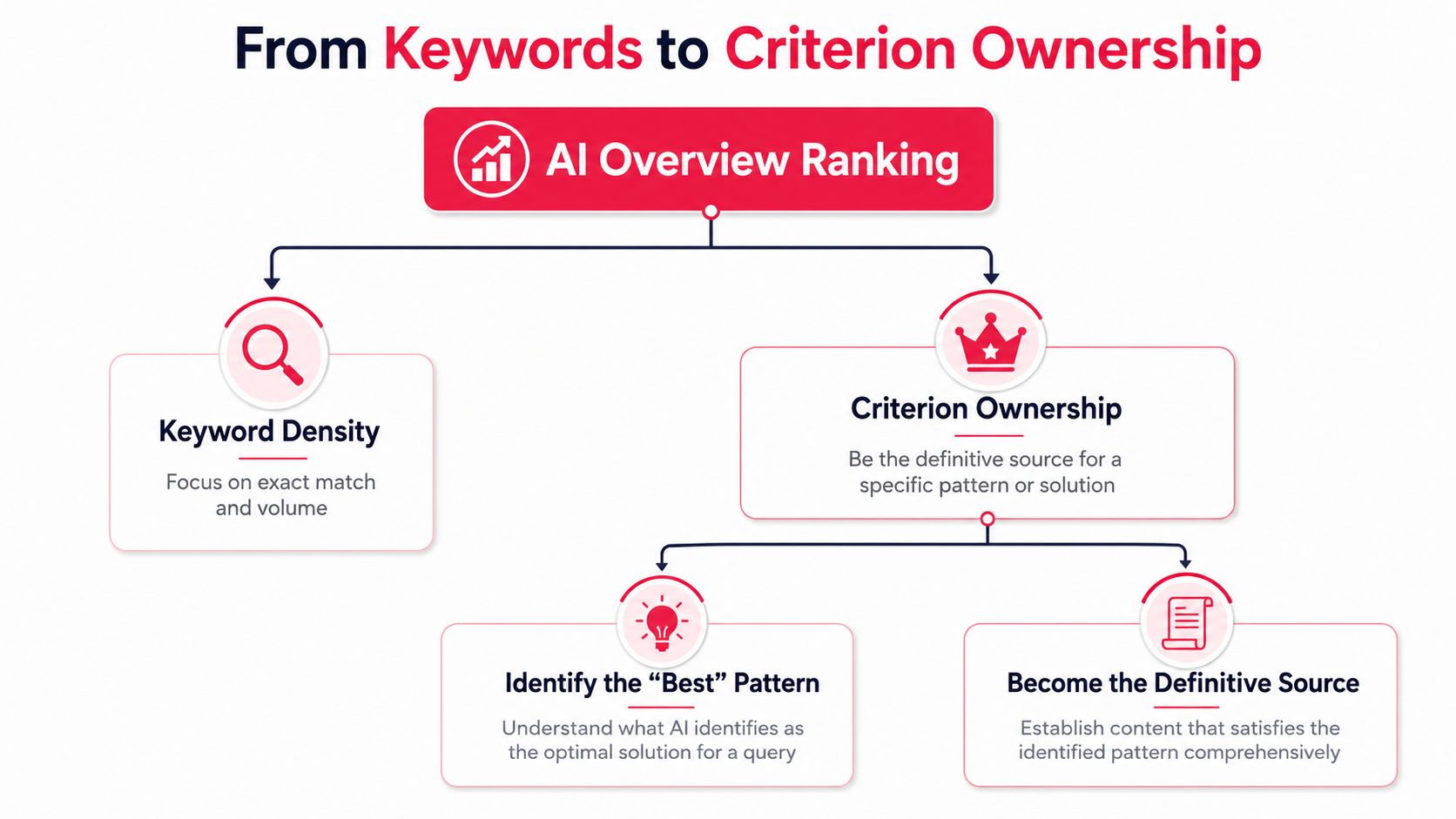
Backlinko puts it clearly in its AI Overviews methodology: to rank in Google AI Overviews, use a GEO approach built around criterion ownership, which means identifying and dominating the defining metric or pattern AI summaries repeatedly cite for your category. That process includes auditing four pillars, publications, review sites, communities, and creator channels, then building presence across them. The same source notes that inclusion depends on the page's ability to rank in the top 10 organically, that FAQ, HowTo, and Article schema provide explicit parse signals, that AI Overviews refresh quickly, and that orphan or non-crawlable pages get zero visibility.
Why keyword targeting breaks in AI summaries
AI summaries don't think in terms of “who used the keyword most often.” They compress patterns. They look for the source that most credibly answers the hidden category question.
In B2B software, that hidden question is often one of these:
| Query type | Hidden criterion Google is resolving |
|---|---|
| Best tool | Which vendor best fits a specific use case |
| How to improve a process | Which method gives the clearest path to execution |
| Comparison query | Which distinction matters most in the buying decision |
| Strategy query | Which framework gets repeated across trusted sources |
If you sell CRO services, “best CRO agency” is too broad to win in AI. “Best CRO at higher testing velocity” is a criterion. “Best for full-funnel experimentation with AI-assisted analysis” is a criterion. AI needs a lens. You need to supply it.
How to run a criterion audit
I use a four-part review. It's fast, ugly, and effective.
Publications
Search your target queries and read the pages AI is most likely to trust. Look for repeated phrases, repeated comparison frames, and repeated decision logic.Review sites
Check how category pages and review summaries describe the “best” vendors. These pages often compress buyer logic into a few sortable criteria.Communities
Scan Reddit, Slack groups, niche forums, and comment threads. Within these groups, buyers say what they genuinely care about, in plain language.Creator channels
Watch YouTube explainers, LinkedIn breakdowns, and analyst-style threads. Creators often name the criterion before brands do.
Practical rule: pick one category-defining claim you can actually prove, then repeat it with evidence across every surface that matters.
Once you identify the criterion, build a content moat around it:
- Core page: one definitive page that states the claim early and supports it.
- Support pages: FAQs, comparisons, process pages, and glossaries tied to the same claim.
- External validation: mentions in articles, podcasts, communities, and review ecosystems.
- Structured data: schema that helps Google parse the page as an answer source.
The final step is commonly missed. Teams publish the rewrite and wait. Don't. After re-optimizing for the specific AI answer pattern, request indexing in Google Search Console. AEO rewards teams that operate with speed.
Architect Content for AI Ingestion
If your page reads well to humans but parses poorly for machines, you won't get cited. Google's AI layer needs clean extraction paths.
Google AI Overviews prefer pages with an H2 or H3 roughly every 200 words, where each section starts with a concise summary paragraph that answers the question before expanding, according to AIOSEO's guidance on AI Overviews. That should change how your team writes every revenue-driving page.
Use answer-first blocks
Start with the answer. Then add the proof. Then add the nuance.
This is the structure I recommend for articles, solution pages, and comparison pages:
Bad structure
- Long intro
- Brand framing
- General trends
- Main answer buried mid-page
- FAQ added at the end as an afterthought
Better structure
- H2 phrased as the buyer question
- Two or three sentence answer immediately under the heading
- Supporting explanation
- Examples, visuals, or cited proof
- Internal links to adjacent pages that deepen the topic
Here's a simple template your team can use:
How do you rank in Google AI Overviews
Start by answering the query directly in the first paragraph under the heading. State the method, the condition, and the expected role of the page in the buying journey. Then expand with examples, comparisons, and implementation details.
What content format works best for AI Overviews
Use short sections, explicit subheads, self-contained paragraphs, FAQ blocks, and supporting visuals. Keep each content block understandable on its own because Google may extract a single section rather than your full article.
That structure is boring to writers who want flair. Ignore them. This format performs because it reduces parsing friction.
Clear structure beats clever writing in AI-mediated discovery.
Deploy the schema and knowledge flow
Most content teams stop at formatting. That's half the job.
Your technical stack should support extraction and context:
- FAQ schema for clear question-answer blocks
- HowTo schema when the page teaches a process
- Article schema for core editorial pages
- Internal links to related pages so Google sees a topic cluster instead of isolated assets
In this context, content operations starts to look a lot like knowledge operations. If your information is fragmented across docs, CMS entries, and product pages, your site becomes inconsistent. These effective AI knowledge management strategies are useful because the same discipline applies here. Controlled source-of-truth systems create more consistent external content.
For a practical content workflow, pair editorial rewrites with your broader AI content marketing system. The point isn't volume. It's publishing pages that answer buyer questions in a format both Google and your sales team can reuse.
A short operating checklist helps:
- Rewrite openings: Put the direct answer in the first paragraph of each major block.
- Fix headings: Use H2s and H3s that mirror actual search questions.
- Break paragraphs: Keep sections scannable and independently useful.
- Add visuals: Charts, infographics, and process graphics give the page more context.
- Connect the cluster: Link related pages so no important asset sits orphaned.
Build Verifiable E-E-A-T Signals
Trust decides whether Google cites you. If your claims aren't easy to verify, your page becomes background noise.

Search Engine Land reports in its guide to optimizing for AI Overviews that 85% of AI Overview citations come from pages already in the top 10 organic results. The same guide says strong inclusion requires primary answers within the first 100 words of logical blocks, H2/H3 subheaders that mirror exact user questions, and first-hand expertise through case studies. It also notes AI Overviews skew toward low-volume, non-branded informational queries, that stale pages and pages without visual context often get excluded, and that semantic clusters plus crawl audits matter because isolated pages rarely build enough topical authority.
What machine-readable trust looks like
E-E-A-T for AI isn't a vague branding exercise. It's a set of visible signals that a parser can map.
A strong page usually includes:
| Signal | What Google can verify |
|---|---|
| Named author | A real expert identity tied to the topic |
| First-hand examples | Evidence that the company has done the work |
| Clear sourcing | Claims supported by traceable references |
| Freshness | Recently updated facts and examples |
| Topical cluster | Related pages reinforcing the same subject |
If your author bio is thin, your examples are generic, and your page says the same thing as five competitors, Google has no reason to cite you.
Where most teams lose inclusion
They publish “expert content” written by generalists and then strip out the specifics during legal review or brand review. What remains is safe, polished, and useless.
You need visible proof. That can include screenshots, implementation details, process breakdowns, named methodologies, and original framing grounded in real work. For growth-stage companies, this is often where the internal skill gap shows up. Marketing owns production, but the actual expertise lives in product, sales engineering, customer success, or the founder's head. Fix that operationally. This is the same issue behind many teams' broader AI skills gap.
A practical way to tighten E-E-A-T:
- Assign a real operator as source owner: The strategist, CRO lead, or product marketer closest to the work should shape the claims.
- Use first-hand evidence blocks: Add process screenshots, original diagrams, or examples from actual implementations.
- Refresh pages on a schedule: AI Overviews favor current facts. Old examples weaken trust fast.
- Add visual context: Infographics and charts help both users and parsers.
- Audit crawl depth and orphan pages: If Google can't reliably discover the page in context, authority doesn't accumulate.
The bar for “expert” content has moved. You need material that reads like it came from someone who shipped the work, because it should have.
The AEO Testing and Measurement Framework
AEO needs a tighter operating loop than classic SEO. Waiting a quarter to review outcomes is too slow.

A YouTube walkthrough on AI Overviews notes that they refresh quickly, often within days, and that requesting indexing in Google Search Console by entering the URL and clicking request indexing accelerated visibility in multiple client tests after replacing statistics older than 12 months in updated pages, as covered in this AI Overview indexing workflow.
Track influence before traffic
Executives make a mistake here. They look for clicks first. AEO often shows up as influence before it shows up as direct sessions.
I track three layers:
Citation share
For a fixed set of target queries, how often does your brand or page appear in the AI Overview source set?Overview-assisted CTR
When a target page gets cited, does click behavior change relative to pages that aren't cited?Downstream conversion quality
Do sessions landing on AEO-shaped pages move differently through demo, trial, or sales-qualified stages?
Build this into your normal performance review. Don't isolate it as an SEO experiment. It belongs in the same reporting thread as content influence, branded search movement, and assisted pipeline. If you need a stronger measurement model, use the framing from this guide on how to measure marketing effectiveness.
Build a faster operating cadence
The workflow should feel closer to experimentation than publishing.
| Step | What the team does |
|---|---|
| Hypothesize | Define what answer pattern or trust signal should improve inclusion |
| Implement | Rewrite the page, tighten headings, update facts, add visuals |
| Request indexing | Push the update through Search Console immediately |
| Monitor | Check target queries and source inclusion |
| Iterate | Keep what improves inclusion and rewrite what doesn't |
Don't run this process on every page. Start with pages that already matter to pipeline. That usually means non-branded informational pages adjacent to core pain points, evaluation criteria, comparisons, implementation questions, and process education.
Operator move: create a standing weekly AEO review with content, SEO, RevOps, and demand gen in the same room. Treat page updates like GTM experiments, because that's what they are.
Your AEO Implementation Checklist
Use this as a live operating list for your next GTM meeting, not a note-taking exercise.
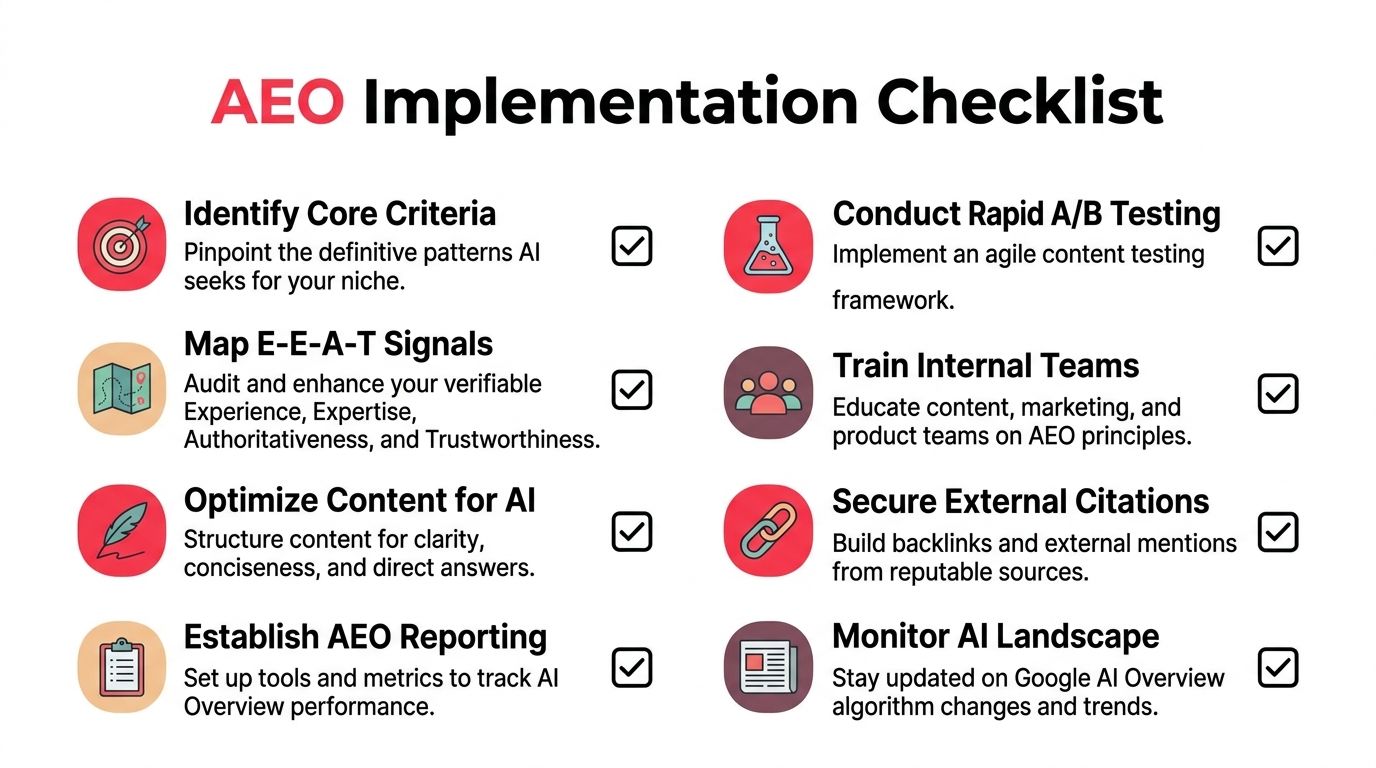
Start with team alignment. Marketing should own page rewrites and topic clusters. Engineering or web ops should own schema deployment, crawlability, and indexing hygiene. RevOps should own reporting definitions so AEO doesn't vanish into vanity metrics.
A short briefing video can help the team align on the new search reality:
Immediate actions for marketing
- Pick the target pages: Start with non-branded informational pages that influence pipeline.
- Define the criterion: Decide what “best” means in your category and make it explicit.
- Rewrite structure: Use question-based H2s and answer-first openings.
- Add proof blocks: Insert first-hand examples, visuals, and current facts.
- Track citation share: Monitor whether Google starts using your page in AI summaries.
Immediate actions for product and engineering
- Deploy schema: Add FAQ, HowTo, and Article schema where relevant.
- Fix crawl issues: Remove orphan pages and confirm key pages are indexable.
- Strengthen internal links: Build clusters around core commercial and informational themes.
- Support content freshness: Make updates easy to publish and easy for Google to recrawl.
Leadership decision
Assign one owner. If AEO sits halfway between SEO, content, and demand gen, it won't get done well. One leader needs authority to set targets, run tests, and force updates across functions.
If you want help turning this into an operating system, that's the work we do at Stimulead. We help growth teams connect AI search optimization, CRO with AI, GTM engineering, and agent commerce readiness to measurable pipeline outcomes. The next step is simple. Pick five revenue-relevant pages, run the criterion audit, rewrite them for AI ingestion, request indexing, and review results inside one week.